

Twins Video
During our Q&A session with him at the Winter Meltdown in January, Twins Director of Baseball Research Jack Goin opined that his organization ranked around the middle of the pack when it comes to optimizing analytics, though he candidly acknowledged they don't really hold a competitive advantage in that area at this time.
Now, the Twins are positioned to move briskly toward gaining one.
From Old School to New School
While his department has certainly made significant strides in recent years, I doubt that Goin would deny that Minnesota was playing catch up for a while. As forward-thinking front offices across the league began to adopt cutting-edge tracking methods and advanced statistics, a Twins franchise run by Ryan and his largely stagnant braintrust remained decidedly traditional in its philosophies.
The "if it ain't broke, don't fix it" approach lost any semblance of credibility in 2016 when a lengthy stretch of disappointment culminated with the worst season in Twins history. It was clear that things were broken. So, ownership made a move to fix them.
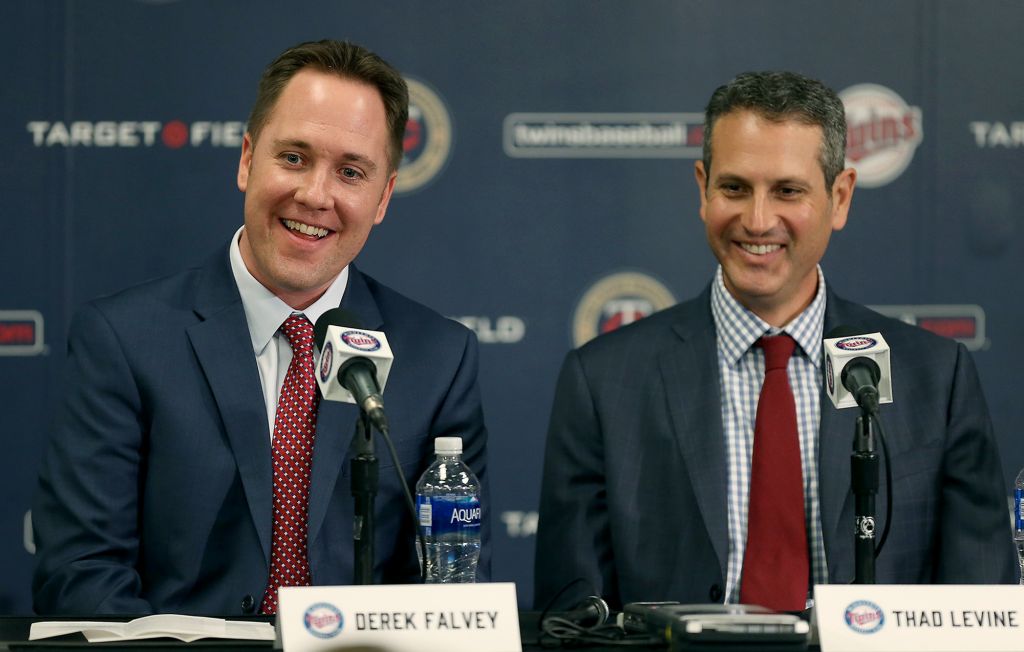
A track record of insularity and deference to reputation was thrown on its side with the decision to hire Falvey. Young, energetic and little-known on the national scene, he was a blinding contrast to Ryan, the heralded scout whose very presence commanded respect, and whose affable gruffness was a defining characteristic.
At a time where many fans understandably expected a minor change in course, and maybe even a simple switch to the next in command, Twins owner Jim Pohlad and president Dave St. Peter enacted a 180-degree turn. I give them a lot of credit for that. And everything I've seen thus far leads me to believe their choice was a savvy one.
Riding the Wave
Across the nation, analytics and technology are increasingly gaining influence – not just in baseball, but in the sports world at large. On Tuesday night, I had the privilege of co-hosting an event at The Pitch, an entrepreneurial hub in Northeast Minneapolis with a specific focus on innovative businesses operating in the field of sport.
We were celebrating the launch of The Ultimate Guide to SportsTech in Minnesota, which I helped compile with TECHdotMN. The digital doc serves as a window to some of the state's brightest up-and-comers in this rapidly growing space.
Back in January, I covered the MinneAnalytics SportCon event downtown, a first-of-its kind sports analytics conference bringing together experts and execs from various corners of the industry to discuss and dissect advancements within this evolving frontier.
One of the featured panelists of the day? None other than Falvey, who had attained his title as Chief Baseball Officer only a few months earlier.
A top Minnesota Twins executive speaking as an authority at a conference on analytics? Not so long ago, it would have seemed unthinkable, but it's a sign of the times at Target Field. And Falvey was very much at home on that stage.
The Puzzle Solver
Earlier this week, the New York Times published a profile on the new Twins CBO penned by Tyler Kepner. The piece discusses Falvey's career as a pitcher at Trinity College, wherein the right-hander relied upon his studious and strategic nature rather than superior talent to stay afloat.
That's been the ongoing story for Falvey, who never played professional baseball and joined Cleveland's front office shortly after graduating Trinity with an economics degree. "He likes working puzzles and solving problems," as Kepner put it, and he very quickly ascended ranks with the Indians while capturing the attention and admiration of baseball lifers like Terry Francona.
Despite his background, some might skeptically question what evidence exists of Falvey being a revolutionary figure in the scope of this franchise's story. He doesn't necessarily go around openly flaunting new-age stats and advanced metrics, after all. But there's no doubt he is well versed in such matters and, to be fair, constantly evangelizing those kinds of things right off the bat can be alienating in an organization with many lingering Ryan loyalists.
And that's also not really the point. The definition of analytics is "information resulting from the systematic analysis of data or statistics." And if you pay any attention to what Falvey says, you're bound to hear him talk about the value of data-driven decisions based on versatile sets of available info.
You could argue that we haven't necessarily seen those elements in action yet, as the realigned front office has taken a relatively hands-off approach with roster management in the early going. But if you look for them, signs of shifting philosophy are not difficult to find.
The New Way
Indications that Minnesota is taking a more modern approach to building a team and organization are, perhaps, somewhat sparse up to this point, but they are certainly noticeable.
The aggressive pursuit and signing of Jason Castro, a renowned pitching framing specialist, was an early signal. And while some of the other acquisitions may bear marks of the old regime, the reasoning and outcomes have been different.
While I was in Fort Myers, there was a belief among many covering camp that Ryan Vogelsong had an inside track for a rotation spot, especially after Trevor May went down. Such perceptions were, in my view, based on conditioning carried over from the previous era. Bringing the slow-tossing 39-year-old north based on little more than veteran influence would have been a trademark Ryan move, to be sure, but there's a different flavor now.
Sure enough, the Vogelsong drama ended early when he was released last week, winnowing the fifth starter competition down to pitchers whose presence in the rotation can actually yield tangible long-term benefits.
The signing and elevation of Craig Breslow might also look like a standard TR type maneuver, given his depth of MLB experience and previous ties to the Twins. At least, until you look deeper.
Recognizing that he was probably reaching the end of his career unless he figured out a way to gain an edge, Breslow reinvented himself, purchasing an expensive tracking device and using it to alter his delivery in order to maximize the spin on his pitches. He and his agent sold his revival by selling the data, and that struck a chord with Falvey.
"One of the things I think, as an industry, we can be a little bit better about is using evidence to help development," the CBO explained to Twins Daily earlier this month. "I think Craig was one who just went and did that on his own, which I commend him for."
The favorable impression went both ways. After the southpaw threw in front of scouts from numerous teams during the winter, he received nearly a dozen offers, some of which included more money than Minnesota's $1.25 million plus incentives. But by all accounts, it was Falvey's acute understanding and appreciation of what Breslow was trying to do that tilted the scales.
There are plenty of other subtle steps toward a more analytical approach in terms of the way Falvey, along with GM Thad Levine, have begun to piece things together. There has been an evident increase in hiring within Goin's research department, with job postings popping up a few times in the past few months. Jeff Pickler, added to the big-league coaching staff in December, has a background of implementing new data and software solutions. Paul Molitor named "the deciphering of information" as a distinct area Pickler can influence.
So What?
Now, of course, this is all fairly meaningless for the time being. Until we see real progress on the field, any supposed differences between the new leadership and the old are based only on rhetoric and platitudes. But as someone who has longed for the Twins to distance themselves from the outdated thinking and strictly observational analysis that embodied their outward mindset as an organization, I'm beyond refreshed by the things I have seen and heard from the individuals now running the show.
I'll leave you with this quote from Falvey. It is his response to the final question I asked him in a one-on-one session outside the Twins clubhouse when I was in camp two weeks ago.
"On the subject of analytics," I submitted, "is there anything that you see rising to the forefront that is maybe not being looked at too much right now?" It's a question that Terry Ryan – bless his heart – would have rolled his eyes at, and vaguely answered in some unsatisfying manner.
Here's Falvey's full answer, verbatim, with no foresight that it was coming.
"The evolution of StatCast is something that, of all 30 teams, I think there’s a few teams that have wrapped their hands around it a bit. I think there’s more teams that need to spend more time understanding it. But we have so much more information about how a player moves on the field, and where he’s positioned at the moment each pitch is thrown, how well he goes from first to third, efficiencies, things like that. And I think we’re going to have a better understanding of how to use that information to develop players’ individual skills. For instance an outfielder, routes to the ball and otherwise, we’re now going to have evidence and data that help us better understand how he moves around in the outfield, which will allow Jeff Pickler and our other minor league coaches along the way to better train at 2 o’clock in the afternoon to help put him in a better position at 7 o’clock. So that’s exciting. I’m excited about that particular tool impacting the game and each team is gonna be in a race to try to figure out who can do it best, that’s part of the deal. That’s the competition."
Indeed, that is the competition. And the Twins, in my humble opinion, are now far better equipped for it.





Recommended Comments
Create an account or sign in to comment
You need to be a member in order to leave a comment
Create an account
Sign up for a new account in our community. It's easy!
Register a new accountSign in
Already have an account? Sign in here.
Sign In Now