Jump to content
Twins Daily
  • Create Account
  • Twins News & Analysis

    Sizing Up Cody Allen


    Nick Nelson

    After reaching agreement with all of their arbitration eligible players last week, the Twins have solidified their projected 2019 payroll at around $96 million. That's about $30M below where they were last year (which was just below the MLB average), so needless to say they've got spending flexibility.

    The back end of the bullpen is the clearest need, and in that market, one name stands out as a fairly obvious fit.

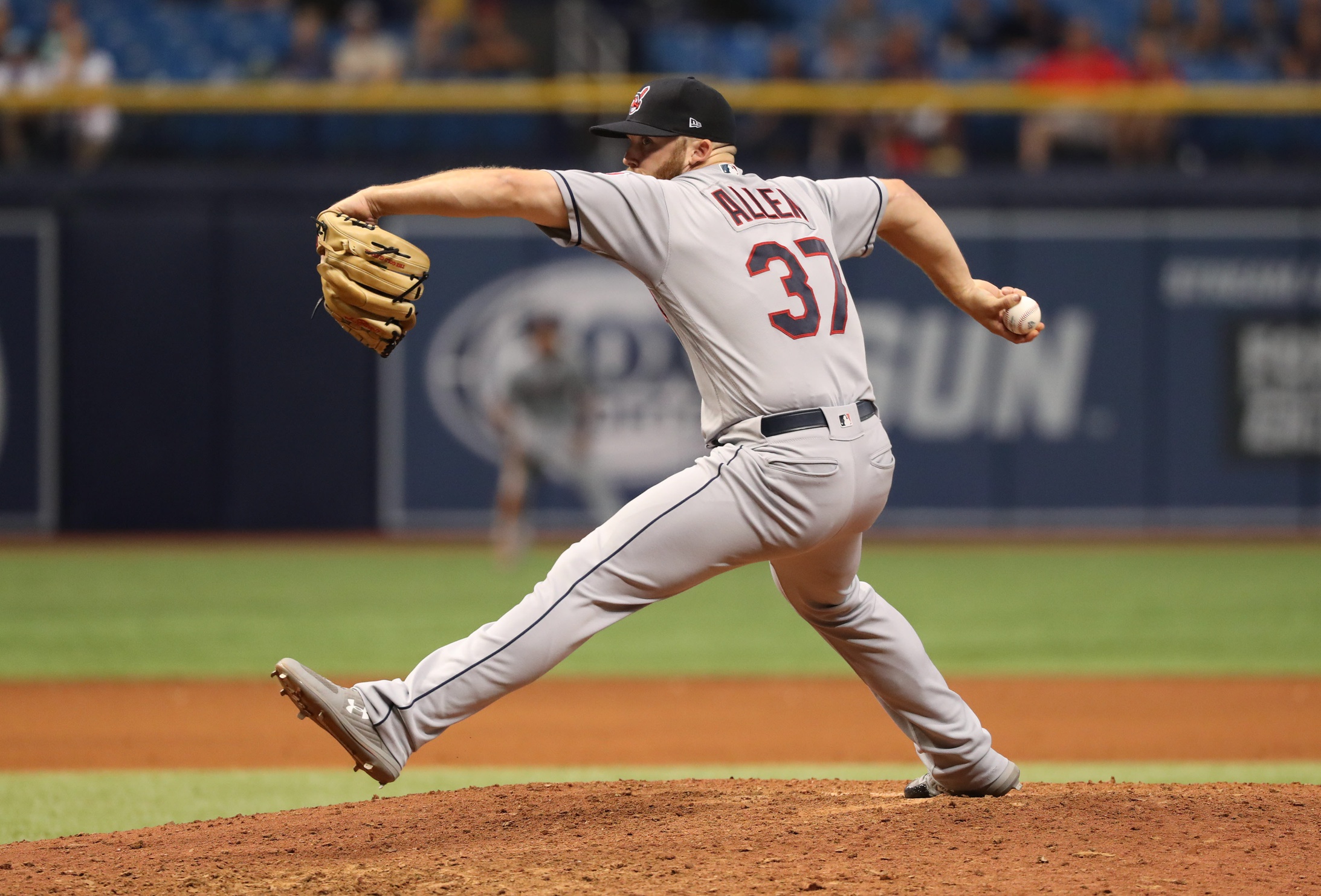
    Image courtesy of Kim Klement, USA Today

    Twins Video

    From 2014 through 2017, Cody Allen was consistently one of the better relievers in baseball. Serving as closer in Cleveland, he averaged 30 saves per season while posting a 2.62 ERA, 2.82 FIP, 1.10 WHIP, and 12.1 K/9 rate.

    In 2018, at age 29, he took a sizable step back, posting a 4.70 ERA with career highs in WHIP (1.36), BB/9 rate (4.4) and blown saves (5). His strikeouts were down along with his velocity. It was a troubling season for Allen and it couldn't have come at a worse time for him.

    But these circumstances make him an ideal fit for the Twins, who evidently aren't interested in any long-term commitments this winter. With another typical campaign in 2018, Allen might've been in line for a three- or four-year contract. But his major lapse creates too much risk for any team to make that leap now.

    Allen's most realistic hope now is for a high-dollar short-term deal, which is exactly what Minnesota's positioned to hand out. That's just one reason this match makes sense. There's also the team's need for a dominant late-inning reliever, and Allen's familiarity with Twins CBO Derek Falvey, who was Cleveland's co-director of baseball operations when the Indians drafted him in 2011.

    La Velle E. Neal III of the Star Tribune reported a month ago that the Twins were interested in Allen, but obviously nothing has come to fruition as of yet. It's been a slow-moving relief market. Perhaps the right-hander is waiting on Craig Kimbrel and Adam Ottavino – the two names clearly ahead of him in the pecking order – to sign and set precedent.

    I'm wondering if something like a one-year, $14 million offer might get it done with Allen, who would reel in more than half of his career earnings up to this point (he's totaled about $24 mil) with an opportunity to rebuild value in a prominent role and hit the market again next offseason.

    The upside here for the Twins is plain to see. But there is downside. It'd mean having $20M-plus tied up in two relievers who were both not very good in 2018. The money isn't really an issue, but the hefty guaranteed contracts mean Allen and Addison Reed will get every chance to earn them, possibly at the expense of worthy younger arms.

    Adding Allen to a bullpen that includes Reed, Taylor Rogers, Trevor May, and Blake Parker would leave few vacancies. Someone like Trevor Hildenberger, Gabriel Moya or Andrew Vasquez could more easily become blocked even if he proves deserving. The opportunity to try converting a younger starter, like Fernando Romero or Adalberto Mejia, becomes more limited.

    These aren't necessarily huge stumbling blocks, but they're worth keeping in mind for a team focused on rebuilding via the internal pipeline. Players need opportunities to develop.

    It's basically a moot point if Allen returns to his pre-2018 form or anything close. He'd significantly upgrade and legitimize Minnesota's bullpen unit. In light of that upside, and given the fact that – even in his down year – Allen's K and whiff rates would've ranked among the best in the Twins bullpen, I think the reward far outweighs the risk here. So I'm only left asking one question:

    What are we waiting for?

    Follow Twins Daily For Minnesota Twins News & Analysis

    Recent Twins Articles

    Recent Twins Videos


    User Feedback

    Recommended Comments


    Featured Comments


    According to Forbes, for luxury tax purpose the benefit expense was $14,044,700 per team.  For what I can see, revenue is around $260 million, which would put payroll around $135 million if they spent 52%, which is right around what they spent in 2018


    Given the teams struggles and ticket sales, I would expect they are budgeting less revenue in 2019.


    https://www.forbes.com/sites/maurybrown/2018/12/17/final-mlb-payrolls-for-all-30-teams-show-second-largest-decline-since-2004/#381115fe474a

    Actually, $135 million is what the Twins would have spent if they had not unloaded some players and their contracts mid-season. I think they actually spent less than $120 million, and still managed to have very little committed to 2019.

    Why the heck to we want a 30 year-old guy who's coming off a career-worst season posting a 4.70 ERA with career highs in blown saves? What am I missing here? The guy's washed up, he wasn't ever lights-out in the first place.


    Heck, give Blake Parker the closer job and Let Allen sign with the Padres or something for a middle relief role, no reason to sign him here in Minnesota.


    According to Forbes, for luxury tax purpose the benefit expense was $14,044,700 per team.  For what I can see, revenue is around $260 million, which would put payroll around $135 million if they spent 52%, which is right around what they spent in 2018


    Given the teams struggles and ticket sales, I would expect they are budgeting less revenue in 2019.


    https://www.forbes.com/sites/maurybrown/2018/12/17/final-mlb-payrolls-for-all-30-teams-show-second-largest-decline-since-2004/#381115fe474a


    Thanks for providing that link. I could not find any accounting for benefits. The league average for salaries (not payroll attributed to players) is about 45% of revenue and 14.4M is roughly 5.3% of total average salary. Of course, the combined cost equates to roughly 50% of revenue. I would expect teams with less than average revenue to spend a slightly lower percentage because the other operating costs should be a lower percentage of gross revenue for higher income teams.

    Actually, $135 million is what the Twins would have spent if they had not unloaded some players and their contracts mid-season. I think they actually spent less than $120 million, and still managed to have very little committed to 2019.


    According to the article with benefits, they spent $143 million

    I posted the average payrolls to show there is no validity to your claim that last year's increase was driven solely by the BAMtech infusion. If that was the case it would've been reflected elsewhere around the league. If you think that was some unique situation I suggest you research further; there have been several instances in recent years where MLB teams/owners received large sums of money as part of enormous MLBAM/TV contracts, and in those cases payroll was not affected.


    What happened last year wasn't a "coincidence." The front office saw short-term opportunities late in the offseason and ownership signed off. There's no reason to think that couldn't/shouldn't happen in this case.


    I honestly don't know why you and MLR have decided to grind this axe once again. The article suggests the Twins have money to spend and theorizes a $14M deal which would put them around $112M in payroll. I'm not the one confusing the issue at hand.

    It wouldn't necessarily be reflected league wide, as most teams accounted that money as capital and not revenue. I believe the Pohlad's told the FO that they would throw them a bone, and let them spend 50% of that money, even though it was technically capital and not revenue. I applaud them for doing that, however it doesn't disprove my argument.

    We have 10 years of payroll data since the kids took over for Carl. You point to one season of higher spending to make your argument. What about the other 9 years? Last year was the first time the FO ever considered that there might be benefits of spending more money?

    You don't know that is the reason payroll increased by $25 million. You are theorizing, just like I am.


    Actually, $135 million is what the Twins would have spent if they had not unloaded some players and their contracts mid-season. I think they actually spent less than $120 million, and still managed to have very little committed to 2019.

    According to the article with benefits, they spent $143 million

    I see what you are saying. I was thinking in terms of pure payroll.  The article states:


    The calculations for final payrolls are for the 40-man roster, that also “include the average annual values of contracts and $14,044,700 per club for benefits and extended benefits, which include items such as health and pension benefits; club medical costs; insurance; workman's compensation, payroll, unemployment and Social Security taxes; spring training allowances; meal and tip money; All-Star game expenses; travel and moving expenses; postseason pay; and college scholarships,” according to the Associated Press. The totals include “incentive bonuses, non-cash compensation, buyouts of unexercised options and cash transactions. In some cases, parts of salaries that are deferred are discounted to reflect present-day values.”


    So that seems to be all expenses related to the 40-man roster plus payroll?


    I would have assumed that Pohlad representation of spending 52% of payroll meant 52% of "only" payroll, but that could certainly be twisted around a bit.

    Edited by Don Walcott


    I see what you are saying. I was thinking in terms of pure payroll.  The article states:


    The calculations for final payrolls are for the 40-man roster, that also “include the average annual values of contracts and $14,044,700 per club for benefits and extended benefits, which include items such as health and pension benefits; club medical costs; insurance; workman's compensation, payroll, unemployment and Social Security taxes; spring training allowances; meal and tip money; All-Star game expenses; travel and moving expenses; postseason pay; and college scholarships,” according to the Associated Press. The totals include “incentive bonuses, non-cash compensation, buyouts of unexercised options and cash transactions. In some cases, parts of salaries that are deferred are discounted to reflect present-day values.”


    So that seems to be all expenses related to the 40-man roster plus payroll?


    I would have assumed that Pohlad representation of spending 52% of payroll meant 52% of "only" payroll, but that could certainly be twisted around a bit.


    It would be a very rare exception when an executive referencing personnel costs or payroll does not mean salary + taxes and benefits. I am actually being generous when a say a rare exception. I have never had a client at the executive level that disregarded taxes and benefits when referencing personnel costs. Many organizations refer to this as fully loaded costs. Businesses don't ignore costs.

    Edited by Major League Ready

    Large organizations assign dollar values to cross functional resources. You want access to a business analyst? That'll be $135 an hour. The BA is by no means being paid even half that even when including benefits, but the company expects to get more value out of the resource than just what they are being paid, plus there are opportunity costs, thus the high rate.


    I would be surprised if the Twins do anything like this, so we should be careful when we compare the Twins to corporations. In baseball, free agents get paid their full value to the organization and the other players get paid a fraction of their value. Other than professional basketball I am not aware of anything comparable to how baseball pays players.

    I was actually leaning against the Cody Allen idea until I went down the rabbit hole (again) of salary and revenue.


    One article cited how a team like Cleveland spent money after opening a new stadium and had a nice run of success (if not an actual championship), while other teams like Pittsburgh and Milwaukee just kept new stadium revenues in ownership’s pocket, and failed to see meaningful improvement on the field. I think Pohlad would want to be in that first group.


    As someone up thread said, if the Twins have a 2/20+ offer to Allen, I think that’s pretty reasonable, even if Allen signs for a little more. A 2/20 contract to Allen would destroy my narrative that Pohlad is refusing to go higher than $99 million in payroll this year, but it will make the team better for sure :) #tradeoffs

    Edited by Hosken Bombo Disco

    The interesting thing about Allen is that he shot through the Cleveland system in a hurry, despite being drafted after the 20th round, and was lights-out pretty much from his MLB debut.


    I think that’s been an underreported story since Falvey came over from Cleveland — how was a late selection like Allen able to have such success like that. Like, who were the 10th-20th round picks ahead of him? I’d prefer the Twins find and develop their own Cody Allen, though the real Allen would work, too. Falvey must have a gut feeling about the guy. At some point he will need to set aside the sophisticated models and go with his gut on something. I don’t know if that’s Cody Allen or not.

    It would be a very rare exception when an executive referencing personnel costs or payroll does not mean salary + taxes and benefits. I am actually being generous when a say a rare exception. I have never had a client at the executive level that disregarded taxes and benefits when referencing personnel costs. Many organizations refer to this as fully loaded costs. Businesses don't ignore costs.

    Are you saying that when an executive says “payroll,” that they actually mean “payroll, plus benefits, plus payroll taxes”?


    After reading the exact quote, I guess the better question is whether that is what is meant by “players salaries?”

    Edited by Don Walcott


    Are you saying that when an executive says “payroll,” that they actually mean “payroll, plus benefits, plus payroll taxes”?

    After reading the exact quote, I guess the better question is whether that is what is meant by “players salaries?”


    Yes, you have identified where this conversation goes wrong. There is little ambiguity in Payroll Expense or personnel expense. It's reasonable that someone might interpret salaries as meaning salary only without taxes and benefits.


    If an executive used the term "salaries" in a summary context and I could not clarify, I would assume he/she meant salary + benefits because these discussions are virtually always in that context. It's a meaningless discussion if part of the information is omitted. "Salaries" is not a term generally used by executives or financial analysts. They use "payroll" or "personnel costs" or even "salary + benefits". It would be interesting to see the exact quote but even if someone used the term salaries, I would assume any Twins executive meant salary + benefits because it makes no sense to exclude a portion of the expense. 


    Yes, you have identified where this conversation goes wrong. There is little ambiguity in Payroll Expense or personnel expense. It's reasonable that someone might interpret salaries as meaning salary only without taxes and benefits.


    If an executive used the term "salaries" in a summary context and I could not clarify, I would assume he/she meant salary + benefits because these discussions are virtually always in that context. It's a meaningless discussion if part of the information is omitted. "Salaries" is not a term generally used by executives or financial analysts. They use "payroll" or "personnel costs" or even "salary + benefits". It would be interesting to see the exact quote but even if someone used the term salaries, I would assume any Twins executive meant salary + benefits because it makes no sense to exclude a portion of the expense. 

    Here's what was written in the article at issue:


    "The team’s guideline is to spend 52 percent of revenue on player salaries, though the Santana trade will push the 2008 payroll well below that mark—likely somewhere around $55 million after a 2007 opening-day figure of more than $71 million.

    Twins president Dave St. Peter said the original budget called for an increase, not a reduction. Jim Pohlad said a 2009 payroll that surpasses the 52-percent standard would be acceptable, but not simply to appease fans for their role in funding for the new stadium."


    "Player salaries" is not particularly ambiguous. The business, legal and lay meaning of "salary" is the amount paid by an employer to an employee. In this case, the term is limited to the amounts paid to players.  This does not include payroll tax or benefits in any scenario.


    I have no idea what your background is nor who the executives you refer to are who you work with. My background is as a lawyer who has advised businesses and litigated business disputes for more than 23 years, and I've been a part owner of my own businesses for more than 18 years. I have worked with accountants, profit and loss statements and general ledgers extensively.


    I'll give you some free legal advice: don't use the term "payroll" to mean "payroll plus payroll taxes and benefits." Payroll taxes and benefits are not "payroll". In fact, you can't even have payroll taxes without knowing what your payroll is. Payroll taxes are based on payroll. If you added payroll taxes into payroll, you'd get taxed on more than your payroll -- and nobody wants to pay more taxes than required, right? Payroll is a specific defined term for compensation paid to employees. The only time benefits can be counted as part of payroll is when they are deducted from pay due to employees. Similarly, the only taxes included in payroll are taxes withheld from pay due to employees. Using the term "payroll" as you suggest is false and misleading, and I would suggest that the shareholders of companies would not be pleased if their executives were going around making promises about "payroll" when they actually mean "payroll plus payroll taxes and benefits." You can look up the definition of "payroll" on Quickbooks or from an accountant's perspective. You can look up the definition of "payroll" from the IRS perspective. Or you can simply look up the general definition of "payroll." "Payroll" does not include payroll taxes and benefits.


    From a business accounting perspective, payroll taxes and benefits are considered "labor load" or often they are simply lumped in as "overhead." Similar to worker's compensation, human resources, sometimes legal expenses related to human resources, 401K contributions, and even things like parking and holiday party expenses. These expenses are not considered part of "payroll" nor are they part of employee "salaries."


    You can insist that you and your executives commonly use the term "payroll" to mean something other than the actual technical definition of "payroll." (Frankly, I've never heard of anyone doing this before now.} But the problem that you'll face is that nobody will know what you are talking about because you are attempting to shift the definition of the word. Then, you can't have conversations like this that get anywhere because you're not speaking the same language.


    Now, to give the Twins ownership an out, they did say that paying 52% of revenues for player salaries was a "guideline." And if you've seen Pirates of the Caribbean, you know that a "guideline" is not the same as a "code."

    And now there is one!  Ottavino signs with Yanks for 3 years at $27MM!!  Robertson signed for $23MM/2years and Herrera $18MM/2years.  Any one of these are clearly superior to anyone now slated for the Twins' pen and were all eminently affordable for the Twins.


    Look out below if Allen slips from their grasp next!  There is no one else available in the same class who comes close to any of these four.  Shame on you Falvine!!

    After seeing the Ottavino deal, there’s no doubt in my mind that Allen would accept a 3yr/$24M offer, but is the FO willing to change things up and make that kind of commitment after all the one year deals we made?? I’m not so sure, and I hate that because filling the 9th with an established closer is really all that’s left for us to do in order to solidify ourselves as legit contenders for the division.

    WTF!!  Angels signed Cody for $8.5MM + $2.5MM in incentives for games finished. One year deal.  Of course there's a risk for someone with a bad year the year before, but certainly one the Twins could have afforded!  Obvious this FO loves to play the waiting game but it sure is excrutiating  for a team with such obvious needs.  Oh well, just have to wait and see, but my faith in the Wonder Boys is draining quickly!

    Totally fine with another team signing an aging reliever coming off a career-worst year with a 4.50ERA.

    In a vacuum yes I agree. I'm not totally fine with the Twins not signing any of the other 13-14 quality relievers available this winter.

    Such a contrast between the Angels approach to their bullpen and the Twins.


    They added Allen and Curtiss this week while not tendering Parker earlier. It is hard for me to see how the Twins come out ahead with these moves.


    I also realize looking at reliever stats has very little projection value. The Twins have much more data as well as scouts. It is critical they have made the right moves this winter.


    This is Falvey’s team. This is his coaching staff. My bar for his return next year is the Twins need to be buyers at the deadline. Short of that he and the other front office management must be replaced.

    Player A 2018

    4.70 ERA, 1.36 WHIP, 4.56 FIP, .307 xwOBA ,89.3 avg. exit velo


    Player B 2018

    4.71 ERA, 1.32 WHIP, 4.76 FP, .285 xwOBA, 88.4 avg. exit velo


    A is Cody Allen, B is Gabriel Moya. Just sayin'

    How does that sample compare to the other options that were available this winter and the Twins declined offering them a contract?


    As I said, Allen wasn't my favorite choice to sign this winter. He was simply one on a list of 12 relievers that I was more than happy to sign. The only reason Allen became a focal point is because he is one of the last free agents remaining that would appear to be an upgrade for the Twins.

    Player A 2018

    4.70 ERA, 1.36 WHIP, 4.56 FIP, .307 xwOBA ,89.3 avg. exit velo


    Player B 2018

    4.71 ERA, 1.32 WHIP, 4.76 FP, .285 xwOBA, 88.4 avg. exit velo


    A is Cody Allen, B is Gabriel Moya. Just sayin'

    Yes, if 2018 Cody Allen is who he is going to be, going forward, nobody wants him. Pretty much any form of analysis will tell you to go with someone younger and with perhaps more upside.


    His full body of work suggests better, if he can bounce back.


    Player A 2018

    4.70 ERA, 1.36 WHIP, 4.56 FIP, .307 xwOBA ,89.3 avg. exit velo


    Player B 2018

    4.71 ERA, 1.32 WHIP, 4.76 FP, .285 xwOBA, 88.4 avg. exit velo


    A is Cody Allen, B is Gabriel Moya. Just sayin'

    Player A struck out Justin Smoak on 7-23-18


    Player B gave up a HR to Justin Smoak on 4-1-18


    A is Matt Belisle.


    B is Dave Robertson. 


    Just sayin'.


    Create an account or sign in to comment

    You need to be a member in order to leave a comment

    Create an account

    Sign up for a new account in our community. It's easy!

    Register a new account

    Sign in

    Already have an account? Sign in here.

    Sign In Now

×
×
  • Create New...