



jorgenswest
-
Posts
8,284 -
Joined
-
Last visited
-
Days Won
9
Content Type
Profiles
News
Minnesota Twins Videos
2026 Minnesota Twins Top Prospects Ranking
2022 Minnesota Twins Draft Picks
Minnesota Twins Free Agent & Trade Rumors, Notes, & Tidbits
Guides & Resources
2023 Minnesota Twins Draft Picks
The Minnesota Twins Players Project
2024 Minnesota Twins Draft Picks
2025 Minnesota Twins Draft Pick Tracker
2026 Minnesota Twins Draft Tracker: Picks & Bonuses
Forums
Blogs
Events
Store
Downloads
Gallery
Everything posted by jorgenswest
-
Honestly don’t get the Android device reference or the clip. Too old for that stuff. Never been on TikTok and have no idea what “describes your life” has to do with this. If you really care I watched the clip of my computer monitor but my eyes are old. I can defer to the younger eyes that don’t see a jaw moving up and down as Buxton comes in. In that case it is Buxton’s fault.
-
Last year Wallner was sent down and had a very rough stretch there. He was sent out on April 15. By the end of May his AAA triple slash was 190/285/394 after 165 plate appearances. The comments about him at that point are similar to those about Julien and Miranda now. Be patient. Change is hard and hitting is hard. Changes often result in going backwards before moving forward and it takes time. I would give Julien and Miranda that time and leave them in AAA but not give up optimism of their upside if they struggle the for a long stretch. Gasper on the other hand really hasn’t had a long enough stretch in the majors to make any judgment based on his batting line. I would call him up and believe he is capable of giving the Twins competitive at bats.
- 81 replies
-
- 4
-

-
- dashawn keirsey jr
- byron buxton
- (and 1 more)
-
You can see Buxton calling for the ball on the replay but it was loud with kids packing the stadium. Centerfield has priority. Correa didn’t hear him early enough with the noise. I don’t find anyone at fault. It was two guys determined to make sure that ball was caught. I hope they return soon.
-
Going into the Guardian series on Monday they probably want the starter that gives them the best chance of limiting the use of the pen. Which of Matthew or Festa is likelier to go deeper into the game?
-
As long as a player has options and hits in the minors they will get opportunities. I wouldn’t give them a AAAA tag until options are exhausted. I don’t think the Twins see it that way either. Is the AAAA tag something a team manager or exec has used in describing a player? Is it just a creation that columnists, podcast hosts and bloggers started using?
-
I would think so. It is the first time in his career he has consecutive starts with game scores in the 70s. He did have three game scores in the 80s in 2019 but they were not back to back. Is it possible he finally is back from his long stretch of injuries? There were so many players this series that stepped up. How many played multiple positions? A few played at least three positions. That positional flexibility the Twins seem to value was needed in this series.
- 81 replies
-
- 5
-
-
- dashawn keirsey jr
- byron buxton
- (and 1 more)
-
Agree. I also believe the rain out forced the issue. They had the rotation set for Guardians/Royals week before the rain with SWR pitching Sunday. By calling up Funderburk instead of a starter I think they had decided to make this move before he took the mound yesterday.
- 24 replies
-
- 3
-
-
- simeon woods richardson
- david festa
- (and 3 more)
-
Is there a source and number that goes with tons? I found this by Fangraphs contributer Kiri Oler.
-
Woods Richardson optioned to St Paul
jorgenswest replied to Brock Beauchamp's topic in Minnesota Twins Talk
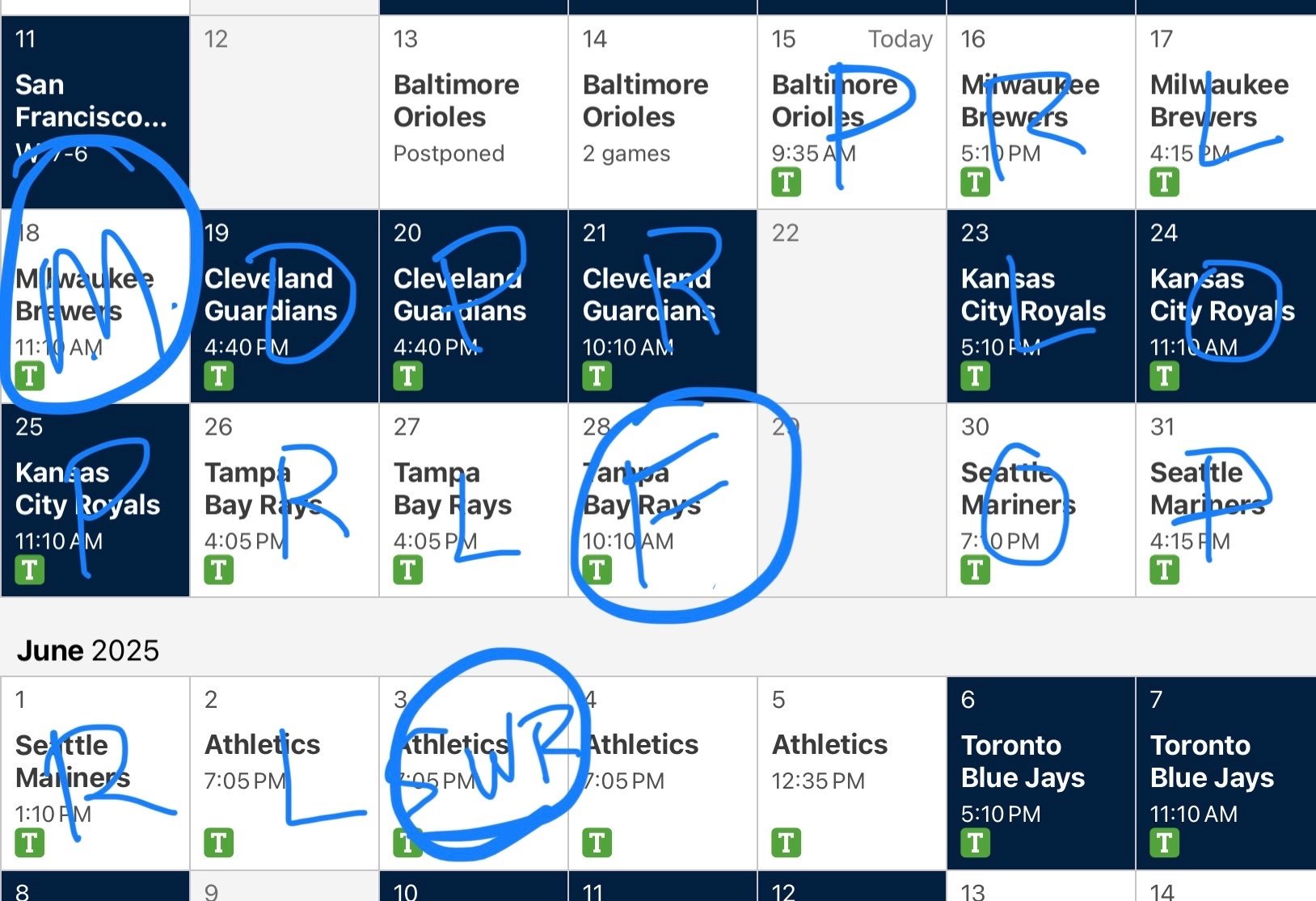
I think the move can help them set up the series for the Guardian/Royal week. They would need a starter on the 18th and 28th before he would be able to return. I also think the decision was made to do this before yesterday’s game. They chose not to bring up a starter for game 2 as the 27th man. Failing to bring up a starter meant that they would need one by Sunday. -
I appreciated listening to the podcast. Thank you. I would add that McCusker did not play first base in summer league or college or independent ball or the minors with the Twins. It doesn’t seem possible that no one at all those stops thought to look at him at first base. The only conclusion that makes sense to me is that he has been given practice time at first base and does not have the hands and feet necessary to play the position. The same is true for Larnach. Both are right handed throwers without any time in the infield in spite of being limited to corner outfield. It can’t be that no one in college or the minors thought of trying them there.
-
@Matthew Trueblood How many swings before a swing speed change becomes reliable? It seems like it wouldn’t need a very large sample.
-
I wouldn’t move him down based on the second Oriole game. Kremer and Ober also struggled facing the same team in two consecutive starts. I still don’t think it would be a bad move to option out Wood Richardson to have a starter for Sunday. It might give them the best chance to set up the rotation and bullpen for the Guardians and Royals week. It doesn’t seem like a bullpen day would be a good idea but I suppose starting Matthews or Festa could turn into a bullpen day. They could be very aggressive with moves looking towards next week. They could start Zebby on Sunday and then return him for an extra lefty in Funderburk. Funderburk can stay for that week until the 28th when the would need to use Festa. SWR could be back after that.
-
Be careful what you wish for with owners
jorgenswest commented on William Malone's blog entry in William Malone IV blogs about Twins
I did not remember having the impression that the Orioles deal for Burnes was better. According to MLBTR and a quote by Burnes the Orioles offer was not better. There offer was two years short of the DBacks offer and a little deceptive because of the differed money. The DBacks offered the 6 years and the Orioles would not go past 4. It kind of reminds me when we would hear reports of the Twins being involved in negotiation for free agent pitchers like Wheeler only to not go far enough to get them. I thought at the time the Twins weren’t really serious and part of them making those offers was PR while knowing all along it wasn’t going to be quite enough. It kind of feels like that with the Orioles offer. They knew 4 years wasn’t going to do it and the deferred money makes the offer seem better than it was. I think Burnes and Boras took the better offer with the DBacks. All the same, I would be pretty disappointed Orioles fan when I see that the only multiyear commitment was a moderate contract to O’Neill with the rest to aging veterans in Morton, Sugano, Sanchez and Kittredge. They also added Gibson and Carlson. Thus far those Orioles off season have combined for -1.9 fWAR. I still don’t think I need to be too careful for what I wish for related to the Twins ownership. I appreciate what the Pohlad’s have contributed to the community but it is time for new owners. I get that the new owners will likely come in setting the same payroll constraints as the Pohlad family. -
I was wondering about that too. The rain out in the Saints game didn’t help. It could have been Festa’s game. He hasn’t pitched since the 6th. If he doesn’t pitch today I would assume he had a simulated game yesterday to be ready for Sunday. Matthews last pitched on the 10th so the 18th would be an extended space between starts. Either is available. I wondered why not pitch Festa today. If he is healthy maybe they had the rotation set for the Guardians and Royals next week and didn’t want to interrupt that. Maybe they want to take the opportunity to set up the rotation differently and it will be Festa or Matthews in a different day. As for the 26 they may DFA Alcala or I guess the could option Woods Richardson.
-
So fun to watch the defense and the speed on the bases. In those streaks when his bat is going strong it is glimpses of Willie Mays from when I was a kid. I am not saying he is Mays because Mays did it every day for a few decades but when Buxton has stretches like he did a week ago I see Mays.
-
Falvey's Drafting & Development Results
jorgenswest replied to bean5302's topic in Minnesota Twins Talk
Lot’s of good work and thoughts in this thread. Thanks everyone. -
Falvey's Drafting & Development Results
jorgenswest replied to bean5302's topic in Minnesota Twins Talk
@bean5302As always really good work on the analysis. Teams need a solid foundation of players that have contracts prior to becoming free agents. Identifying, acquiring and developing that foundation is critical. It doesn’t matter how they were acquired whether it be the draft, international signing, waiver claim, trade, independent leagues, Japan, Korea or any other avenue. Three fifth of the rotation is pitchers they acquired while still under team control. Two they will have the entirety of team control. They will have one of the league’s best closers for all of his team control. I would think that identifying inexpensive free agents is also critical. This year the Twins added Bader, France and Coulombe for 8.75 million dollars. They have contributed. They have contributed 2.3 fWAR (2.8 bWAR) at the quarter pole. Identifying those inexpensive pieces was critical. The Orioles appear to have failed in identifying those pieces and it is significantly impacted their record thus far. I don’t know how this compares to other teams but I would think that Falvey has been at least above the median in identifying, acquiring and developing a foundation of players. -
Good point. Not a single reliever has been placed on the IL since the start of the season. I should have added that. How many teams can make that claim? I am certain that as soon as someone is injured there will be debate about whether it falls on the Twins use of the bullpen.
-
If the Twins believe that McCusker is ready there is definitely a place for him. Castro can play 2B and Clemens or Bride can be moved to clear a spot for him. Those two combined for 4 starts since the return of Lewis and Castro. Those starts could have been given to McCusker. I don’t know if McCusker’s strikeout and walk rates are going to work at the major league level. I am curious to find out though. You can be successful in the majors combining a low average with a high ISO. Most of those players also combine a high strike out rate with a high walk rate. McCusker doesn’t have that high walk rate. Can he match Seiya Suzuki or would he match Jhonkensy Noel?
- 7 replies
-
- 3
-
-
- mickey gasper
- carson mccusker
- (and 5 more)
-
At the quarter pole the Minnesota Twins bullpen has 2.3 WAR which is first in the major leagues. That isn’t the same as saying they have had the best bullpen. I don’t think WAR is a great measure for a bullpen but is way better to be first in WAR than last. The Twins bullpen ranks 13th in innings pitched and in a tie for 4th through 8th in games pitched. The teams ahead of the them in games pitched include the first place Dodgers and the Cubs. The Guardians and Mariners also have pitched 140 games with a few more innings from their bullpen. The Dodgers use of the bullpen both last year and this year is very extreme. The Dodgers bullpen has thrown 28.2 innings more than the Twins excluding opener starts. Including those it would be 34.2 more innings for the Dodgers. Individually Louis Varland leads the majors in appearances with 22. Jax and Duran have 20 appearances. The Dodgers also have three pitchers with 20 or more games. The Dodgers top 6 have 116 appearances. The Twins top 6 have 110 appearances. This includes opener starts. The Twins don’t have anyone near the leaders for innings pitched individually. Duran and Varland at have 19.1. They appear to always have an 8th man in the bullpen that they don’t use at times for days. They eventually get used for length to save the rest of the arms and then are DFA’d or optioned. We have seen Dobnak, McCaughan, Blewett and Funderburk have been in that role. Alcala moved into that role when Stewart returned. Jax and Sands have both been in that 8th man spot in previous seasons and performed their way out of it.
-
Loved the game. Brooks Lee came up big. Two hits for Lewis. Clemens with a scorching double. Larnach and Bader with multiple hits. Four innings and one earned run by the bullpen and that run came on a double play grounder that deflected off Jax. Keirsey with the big hit. So much to discuss about the players that actually played in the game.
- 43 replies
-
- 6
-
-
- pablo lopez
- brooks lee
- (and 3 more)
-
It isn’t a report. It isn’t from someone reporting news. It is someone’s own idea of what trade should be made.
-
That Vazquez play was outstanding. The ninth inning double play was so big too. We have learned this year that a pitcher’s throw to a base isn’t a certainty. That throw was spot on for the double play.
- 39 replies
-
- 3
-
-

-
- rocco baldelli
- trevor larnach
- (and 1 more)
-
Arguably yes. Yesterday his game score was 74. His best game score as a Twin is 75 in a game last year against the White Sox with 7 shut out innings. Given the quality of competition I would have to give the nod to last night’s game. He has another 74 in an 8 inning start against Cleveland last year. It might take precedence given the importance of the game but Duran blew the save in the 9th. He also has a 73 against Boston as a Twin. Probably not his best start ever though. He had three starts with game scores in the 80s in his rookie season.
- 51 replies
-
- 3
-
-
- chris paddack
- byron buxton
- (and 4 more)
-
I disagree that it is a rumor. A rumor needs to be based on some information about talks between the teams. It appears simply to be an idea of someone on the outside and not someone reporting on baseball.

