


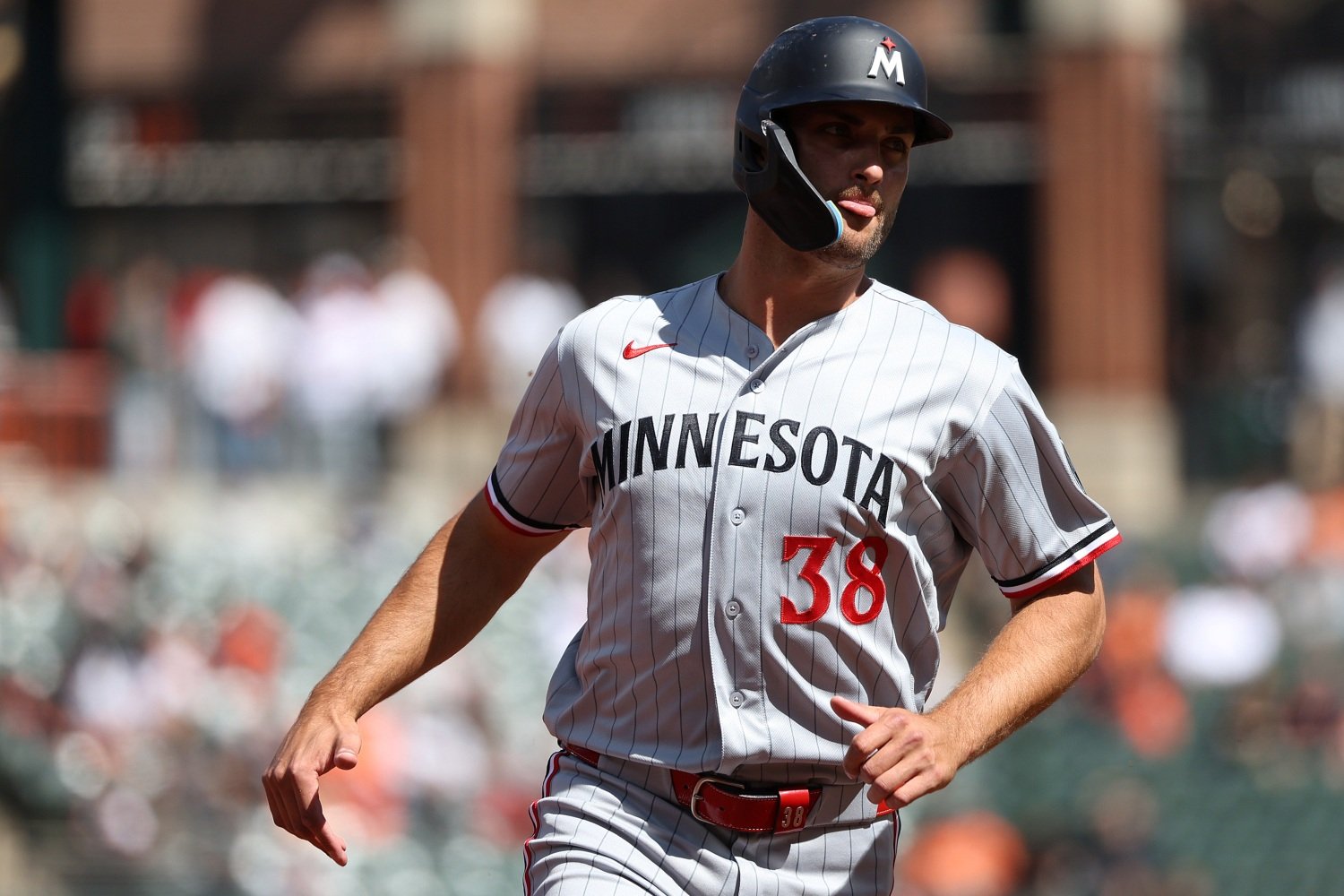
Twins Video
In the Twins' fourth game of the 2026 season, Matt Wallner connected for his first home run. It was just his second hit of the year, as he's striking out around 30% of the time and hitting into some tough luck. He's struggled with some adjustments to the ABS challenge system, though he's also walked at a high rate in the extremely limited early sample.
Results mean little in snatches of a few games here and there, though, so let's talk about process. Wallner has altered two key things that became problematic for him in a poor 2025 season, and now, he's a bit better insulated against some of his glaring weaknesses than he was in the past.
Firstly, as was covered pretty well this spring, Wallner's stance and stride have changed. He's noticeably less open in the batter's box, and his feet also start farther apart. That makes his stride a bit shorter to get to (more or less) the same position at contact, which produces a slightly less linear, lunging address of the ball.
.png.77cbf4e959422085fbda7759c8247eaf.png)
A shorter stride means greater balance and the ability to see the ball a bit better a bit longer, which should result in better swing decisions and a higher contact rate. Wallner swung at 26% of pitches outside the zone during spring training, which is only very slightly lower than the chase rates he posted in 2024 and 2025 (around 29%), but he's swung at barely over 14% of out-of-zone pitches in the first few games of the regular season. His strikeout rate remains high, but that's inevitable for Wallner; he swings for the fences and works deep counts.
More importantly, but less certainly, Wallner seems to be letting the ball travel more this spring. His contact point is deeper (around 33 inches in front of his frame, down from 36-37 inches in the past). A deeper contact point typically leads to better contact rates but less pull power. We don't have enough data to call this signal instead of noise yet, but to whatever extent he's seeing the ball a bit deeper, that, too, makes Wallner more dangerous.
Let's compare two key moments in the swing for the two pitches this year on which Wallner has put his improved process on display, with the same moments in swings against simiiar offerings last year. First, here's a comparison of his first hit of the year (a line-drive single off Orioles starter Shane Baz and his 98-MPH fastball) with a fastball from Yankees righty Luis Gil last season, on which he hit a routine flyout. The top two images show the moment when the pitcher released the ball. The bottom two show the moment when Wallner's front foot engaged with the ground, allowing him to fully execute his swing.
.png.26ae5a24828bcb843aa50d9577004231.png)
As the animations above suggested, Wallner's tweaked stance and stride put him in better hitting positions. Last year, the former hard-throwing pitcher looked too much like he still was one, bringing his front leg all the way up past his front elbow. This year, that leg kick is slightly but vitally modulated, engaging his core and giving him a timing mechanism but not throwing off his balance. As he lands, you can see his weight is more evenly distributed this year, whereas the longer stride in 2025 left him lurching.
Here's the same set of images for a sweeper on which he popped up lazily last summer in Toronto, and the one on which he tagged Kris Bubic for his first homer on Monday.
.png.bee0005566d4a471f90cb16f1b7a9a4e.png)
The themes are the same, but you can spot one more variable. Against lefties, Wallner is better able to stay back this year, which lets him start his hands a bit earlier without overcommitting. Last season, he was starting in plenty of time against a pitch that wasn't even especially fast, but still had to rush the barrel, and he was late and flat through the hitting zone on a fat pitch. This year, he was dangerous throughout the swing and unloaded on a Bubic mistake.
These changes to his lower-half mechanics relate to an important one in his actual bat path. Last summer, I noted that Wallner had flattened his swing, to the detriment of his contact quality and his overall game. A fkat swing requires that contact point way out in front of you, which can also lead to more whiffs. It was a strange and ill-fitting adjustment for a tall, patient pwoer hitter. This season, in limited looks, he appears to have reverted to a better plan.
Here are his key swing characteristics for pitches in the medium bracket in terms of vertical location, according to Statcast. (I've focused on these to eliminate the distortionary influences of swing distribution by location early in the season, and because Wallner only has a meaningful number of swings in that middle tier.)
| Season | Bat Speed | Swing Tilt |
Contact Point (in.)
|
| 2024 | 77.6 | 31° | 33.4 |
| 2025 | 76.8 | 27° | 35 |
| 2026 | 76.4 | 30° | 31 |
Without losing any meaningful amount of bat speed, Wallner has recovered his tilt and is letting the ball travel more when it's in the best segment of the zone for hitting. That's a strong indicator. He still has some key vulnerabilities that will be hard to cover: he doesn't handle velocity or the ball up in the zone well. However, his changes in setup, stride and bat path this spring give him a chance for the kind of rebound the Twins desperately need from him. A version of Wallner who bats, say, .240/.350/.520 is much closer at hand than it was last year, which is also an encouraging signal about the team's new hitting coaches. It's still unlikely that Wallner gets to that level, but after he batted .202/.311/.464 last season, the ability to even dream on such a major improvement is a testament to Wallner's openness to vital changes and the coaching staff's deftness.








Recommended Comments
Create an account or sign in to comment
You need to be a member in order to leave a comment
Create an account
Sign up for a new account in our community. It's easy!
Register a new accountSign in
Already have an account? Sign in here.
Sign In Now