


Twins Video
There is a temptation to look at a catcher’s defensive development through one statistic. For Khadim Diaw, that statistic does not tell the entire story.
The Minnesota Twins catching prospect has allowed 123 stolen bases this season while throwing out just 10 runners. That eight-percent caught-stealing rate is difficult to overlook, particularly for a player whose long-term future could be tied to his ability to remain behind the plate.
But within the Twins organization, there is a much different evaluation of Diaw's defensive progress. On a recent episode of Inside Twins, Twins Director of Player Development Drew MacPhail offered significant praise for the work Diaw has done behind the plate this season.
“He’s made even more strides defensively,” MacPhail said. “He came in pretty raw and he’s grading now as one of our best receivers in the system.”
That is a noteworthy development for a player who entered professional baseball with plenty of offensive intrigue but needed considerable refinement defensively. Diaw is showing that refinement.
The Defensive Transformation
Diaw was never viewed as a finished product when the Twins selected him in the third round of the 2024 MLB Draft. His athleticism was one of his most intriguing traits. He moves well for a catcher and possesses enough athletic ability to spend time in the outfield, giving the organization some flexibility in how it deploys him.
But catching is still the priority. The Twins have invested considerable time into making Diaw a better receiver and improving the physical tools that come with playing the position. That includes his throwing arm.
“I think a big thing as well has been working on his arm strength,” MacPhail said. “He’s done a really nice job of that with both our pitching coordinator and our catching coordinator, Tucker Frawley, to being on an offseason program to work on his arm strength.”
The stolen-base numbers suggest there is still work to be done. But receiving is about far more than controlling the running game. Framing, presentation, blocking, preparation and working with a pitching staff all contribute to a catcher’s defensive value. Diaw appears to be making meaningful progress in those areas.
The Bat Has Continued to Play
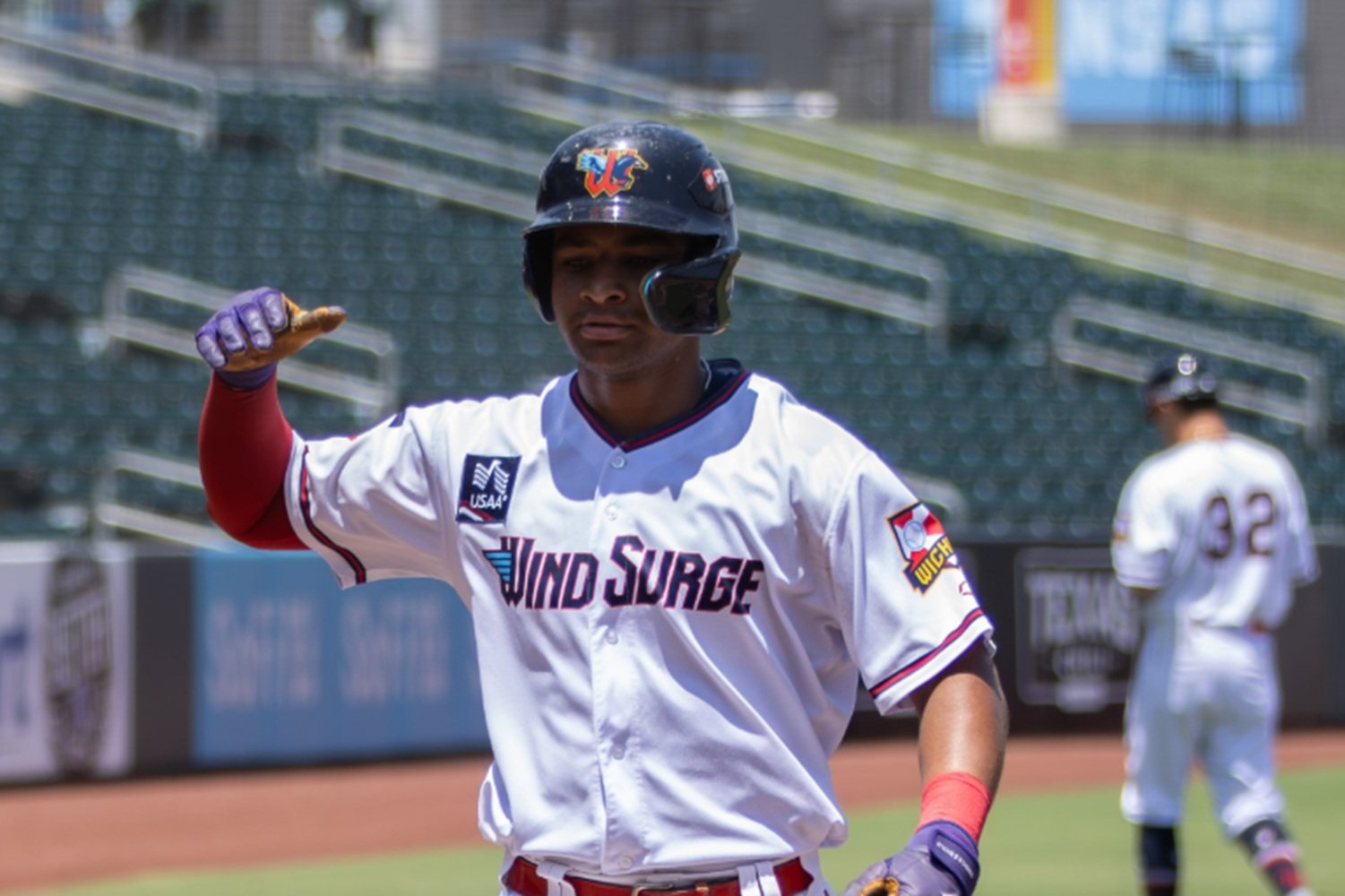
Diaw is not simply surviving his first exposure to Double-A pitching. He is thriving against it. Diaw began the 2026 season with High-A Cedar Rapids, where he hit .300/.405/.454 with an .859 OPS and a 127 wRC+. That earned him a promotion to Wichita.
The move up the organizational ladder did not cause his offensive production to disappear. Through his first 40 games with the Wind Surge, Diaw posted a .312/.432/.422 line over that stretch in one of the most challenging environments of his professional career, producing a 128 wRC+.
Andrew Cresci, the hitting coach at Double-A Wichita, also praised Diaw's preparation and attention to detail.
“Double-A is probably the biggest jump they'll make until they go to the big leagues, just in terms of the quality of the pitching,” Cresci said. “He did an excellent job. The guy is a perfectionist in his attention to detail. I can definitely appreciate his work in the cage and his preparation.”
Perhaps even more encouraging was his plate discipline. Diaw drew 23 walks while striking out just 18 times. That is a remarkable ratio for a young catcher adjusting to Double-A pitching. Diaw has always possessed an advanced understanding of the strike zone. He posted an 11.8% walk rate in 2025, and his ability to get on base has continued into his second professional season.
There is another number that has helped him reach base, too. He gets hit. A lot. Diaw was hit by a pitch 18 times during his first full professional season. Through 98 games in 2026, he has already been plunked 19 times, including 11 times at Double-A.
Some of that is likely a byproduct of his willingness to work deep into counts and his aggressive approach to getting on base. But there is a bigger point here. When Diaw is healthy and in the lineup, he has consistently hit.
Finding More Power
The question has never necessarily been whether Diaw can hit. It has been how much damage he can create. Diaw is likely always going to be a hit-over-power offensive player. His approach is built around contact, controlling the strike zone and doing damage early in counts rather than selling out for power.
Still, the Twins have seen signs that there could be more pop coming. Diaw made swing changes during his second professional season, including adjustments designed to unlock more power to his pull side. His Pull% has increased by 6.4% this season His power numbers have dipped since his promotion to Double-A (his slugging percentage dropped 30 points), but some of the underlying contact metrics have moved in the right direction.
He had a 17-game hit streak from July 11 to August 8th that was the longest in the Texas League this season. In the streak, he batted .373 (25-for-67) with 12 runs scored, 2 home runs and 6 RBI. Diaw fell one game short of the franchise record for the longest streak. A player who already has the ability to make consistent contact, avoid strikeouts and draw walks becomes considerably more interesting if he can add even modest additional power.
The goal isn't necessarily to turn Diaw into a 25-home-run catcher. It is to make pitchers pay more often when they enter the strike zone.
A Catcher Worth Watching
There are still legitimate questions surrounding Diaw. The stolen-base numbers cannot simply be ignored. His arm strength needs to continue developing, and the offensive power remains more projection than certainty. But his trajectory is changing.
Diaw entered professional baseball as an athletic catcher with an advanced offensive approach who needed significant defensive development. Now, the Twins believe he is one of their better receivers.
His offensive profile makes the development even more intriguing. A catcher who can hit for average, control the strike zone, avoid strikeouts and consistently reach base already has a foundation. If the swing changes continue to produce better contact quality and more power, his offensive ceiling rises.
Ultimately, Diaw's trajectory will depend on whether the defensive improvements continue to catch up with his offensive ability. The Twins clearly believe that process is moving in the right direction.
And if the work behind the plate eventually matches what the organization already sees from his bat, Diaw could become much more than another piece of catching depth. He could become a legitimate part of Minnesota's long-term catching picture.
What stands out about Diaw in 2026? Leave a comment and start the discussion.
Are you optimistic about the Twins right now?

Interested in learning more about the Minnesota Twins' top prospects? Check out our comprehensive top prospects list that includes up-to-date stats, articles and videos about every prospect, scouting reports, and more!
View Twins Top ProspectsFollow Twins Daily For Minnesota Twins News & Analysis



- nclahammer, glunn, mikelink45 and 5 others
-
 8
8


Recommended Comments
Create an account or sign in to comment
You need to be a member in order to leave a comment
Create an account
Sign up for a new account in our community. It's easy!
Register a new accountSign in
Already have an account? Sign in here.
Sign In Now