


Twins Video
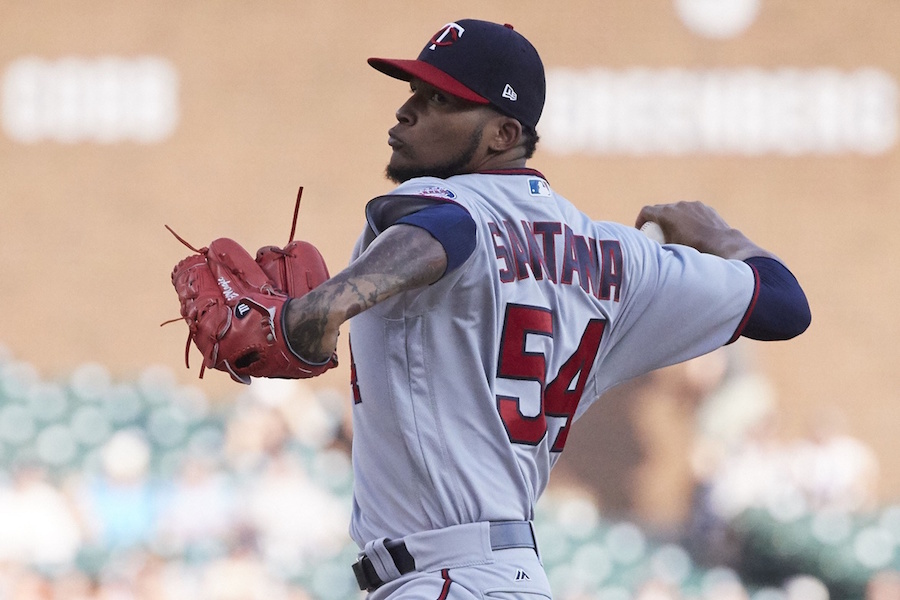
First, let's acknowledge the obvious: Santana was spectacular in 2017. He had arguably the best season for a Twins starting pitcher since Johan left town. Big Erv made the All Star team, finished seventh in Cy Young voting, and buoyed an otherwise shaky rotation.
But that's exactly why his value is at an all-time high. Historically, career years at the age of 34 don't often become trends, and Santana's in particular carried many indicators of being aided by luck (evidenced by a 4.46 FIP).
He's still a reliable, proven workhorse and that's why he has value to any team – including the Twins – but right now his value is peaking. Derek Falvey talked when he came aboard about being "opportunistic," and this would be the definition.
Santana has only one guaranteed year left on his contract, but here's the thing: His 2019 option triggers if he throws 200 innings next year. In the event he regresses to his FIP – or even his 4.02 career ERA – but still reaches that milestone, you're locked into him for $14 million at age 36, right in the middle of a peak window for winning with Byron Buxton and Co.
Santana's team-friendly contract can turn into a hindrance rather quickly.
It might be easier to sell ownership on a $150 million splash for Darvish (already named by Levine as a priority target) if you can get that potential $27 million commitment to Santana off the books. And swapping out a 34-year-old with one/two years of team control for a 31-year-old with five/six makes plenty of sense in the greater team-building scheme.
But even beyond the financials, there is an obvious sell-high angle at play here. Of course, other GMs will notice that as well. You can only be opportunistic if there are opportunities to exploit.
Who might actually be interested in Santana, and at what price?
In my mind, it won't be a World Series contender looking to add that final rotation piece. Many can afford to pursue a top free agent arm, and few would actually view the veteran starter as a meaningful upgrade to their playoff rotation.
Instead, I look at teams trying to claw their way back into contention, and in desperate need of a veteran who can provide quality innings. My suggested match in the Handbook was the Cincinnati Reds, who have been withering away a Hall of Fame career for Joey Votto with three straight 90-loss seasons.
There's pressure to get things turned around in a hurry, but the Reds aren't exactly positioned to go get Jake Arrieta. Santana would represent a modest financial commitment, and he'd immediately slot next to young fireballer Luis Castillo atop the rotation. Erv has been credited as a mentor in Minnesota – that factors as well with the 24-year-old Castillo being a fellow Dominican.
In the blueprint I tossed out right-hander Robert Stephenson as a hypothetical return for Santana. He's a high-upside young pitcher, and former first-round pick, who has struggled with control thus far in the majors (5.10 ERA, 1.60 WHIP in 120 innings). He did, however, put together an excellent late run in the Cincy rotation.
Given his organization's scarcity of promising arms, Stephenson might be asking too much. But he's just one name. The Reds have a number of prospects capable of enriching the Twins system.
There's also Raisel Iglesias. Jon Morosi reported Minnesota's interest in the Reds closer a couple of weeks ago, and while it'd take plenty more to pry him loose (Romero? Gonsalves?), Santana's presence might help move the needle.
It's all speculation, of course, but therein lies the fun. Which other teams do you view as possible partners in a Santana trade? What would you be looking to get in return?





Recommended Comments
Create an account or sign in to comment
You need to be a member in order to leave a comment
Create an account
Sign up for a new account in our community. It's easy!
Register a new accountSign in
Already have an account? Sign in here.
Sign In Now