


Twins Video
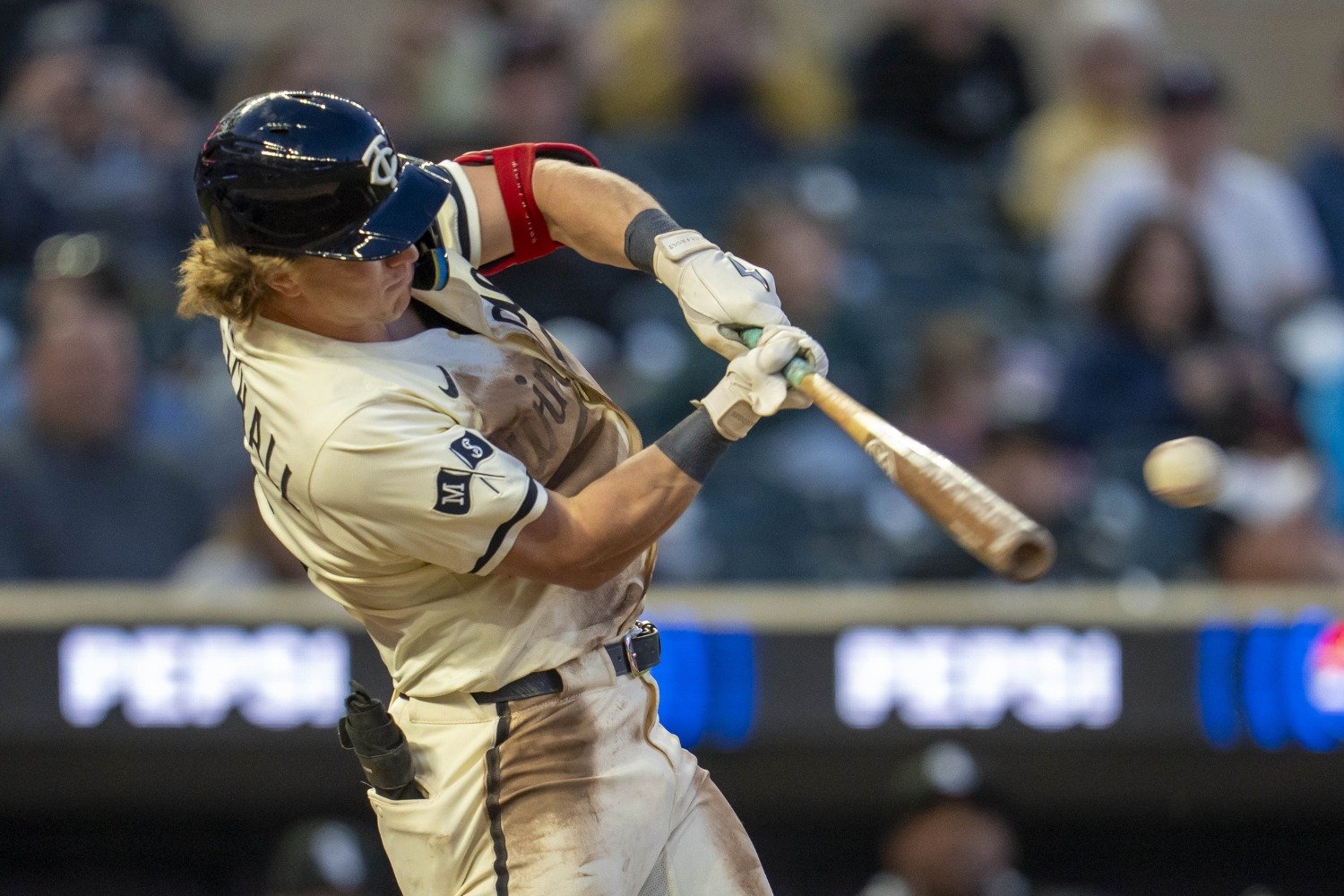
For just a moment, there, the Twins seemed to have a thrilling rookie to give their offense its much-needed ignition. Luke Keaschall came up not only ready to run (stealing five bases in his first five big-league games), but hitting exceptionally well. He doesn't have much in-game power yet, but he had lots of good takes and an exceptionally compact swing. He batted .368 over his first six contests, and although no one can sustain that, he looked like a legitimate .300 hitter. Of the 434 hitters with at least 25 swings this season, Keaschall's is the seventh-shortest, according to Statcast. He's direct to the ball, which has allowed him to find the barrel and hit line drives, despite subpar bat speed.
The brevity of that stroke is beautiful. Starting relatively close to the plate, note the way he strides into the pitch, only to create space for himself to whip the bat through and get the head out on inside offerings using his front hip and shoulder. He times up the rotation of those two body parts well, creating some torque, but the big thing is that shoulder. Watch the way he shrugs it back and upward, forcing his hands down and starting the quick flick of the bat. Once those bigger body parts initiate his rotation, the top hand on the bat just throws it through the hitting zone, in a fluid, well-controlled motion. It's not a violent swing, but he can be extremely accurate with his barrel this way. Standing so close and using that leg kick and stride pattern allow him to cover the outer edge of the plate, despite his unimposing stature and his short stroke.
Alas, we didn't get long to study the joy of it all. We got a warning shot on Wednesday night.
Then, the hammer fell for real on Friday.
If you watch most good big-league hitters hit and think, "Why doesn't everyone just do that?", the answer is most often that they can't. Hitting good big-league pitching is very hard, and most hitters don't have whatever special move you notice Aaron Judge or Byron Buxton making. It takes a degree of athleticism, proprioception, explosiveness or sheer strength that others lack. When you watch what Keaschall was doing in that first clip, though, if you asked why no one else was doing it, I'd have to give you a different answer: because they know better.
Standing close to the plate in a big-league game is a risk. That's not breaking news; every player who does it understands that they're taking at least some degree of risk by doing so. Still, increasingly, hitters do stand close to the plate more often than they did (say) 25 years ago. There's better equipment protecting them, without inhibiting their swings, like custom-molded elbow pads; hand and wrist pads; and C-flaps on batting helmets. There are fewer pitchers who will notice you crowding the plate and intentionally throw at you, so the risk of being injured amid a brushback is lower. Meanwhile, teams accept no substitutes for power, and even now, many hitters can only generate power on pitches they can pull. That means covering the outer edge of the plate not just with a modified, opposite-field stroke, but with your 'A' swing, and in turn, that means crowding the dish.
The thing is, if you want to stand close to the plate, you need a good plan to protect yourself. You need, for instance, a stride that pulls you off the ball a bit the instant you read that the ball is coming inside. That's the approach young Cardinals hitter Thomas Saggese takes. (Saggese is among a small handful of batters who stand both similarly close to the plate and similarly far forward in the box to what Keaschall does.)
Other ways to do this include taking a longer swing—one where the bat starts its arc earlier and spends more time behind your body, even as it's coming up to speed, and where your hands therefore stay protected by your body longer, too. Those guys tend not to handle the inside pitch all that well, but they can learn to manage that part of the zone and to do their big damage on the outer half. Randy Arozarena is a good example of this type of hitter.
Unfortunately, Keaschall doesn't have the bat speed (at least so far) to hit like Arozarena. He could hit more like Saggese; maybe that's what he'll need to learn to do. But if you pause any video of a pitch on which the ball is coming in high and tight and he's considering a swing at all, you can see why continuing to do things the same way when he returns isn't an option.

Last month at Baseball Prospectus, I wrote a piece about the increasing incidence of batters being hit by pitches (or fouling balls off themselves) and breaking bones. It's trending up at a steep rate over the last handful of years, especially because more and more pitchers throw so hard (with such shaky command) that it's difficult to get out of the way and easy to get hurt if you can't. Keaschall, though, got hit by one of the game's soft-tossing control artists, and one of its nicest guys. Kyle Hendricks wasn't hunting for his head, or his hands, and he doesn't even throw 90 miles per hour.
The problem is Keaschall. What you see in the still frame above—the way his swing mechanics and his stride signature take him right into the ball, and the way the former requires his hands to come away from his body and toward the hitting zone earlier than other hitters' hands might, exposing them for so long—is why he got hurt. His big leg kick and the direction of his move puts him in harm's way.
Maybe a fully healthy Keaschall—with this injury healed, but also with Tommy John surgery all the way behind him—can find a bit more bat speed, a bit more consistently. That would open up his mechanical options box. Otherwise, though, he'll have to make a major adjustment. He's too committal, too exposed, and too obviously inviting the pitcher into his kitchen with his current swing and setup. If he doesn't make a change, he'll get hurt again within a few weeks of his return to the field. That's just the nature of the modern game. Like a boxer in the ring or a receiver going over the middle, you have to be fearless—but you also have to learn to protect yourself, or you're not going to stay on the field long enough to do anything impressive there.
Do you approve of Twins ownership?

Follow Twins Daily For Minnesota Twins News & Analysis



- thelanges5, Hrbeks Divot, SF Twins Fan and 3 others
-
 5
5
-
 1
1


Recommended Comments
Create an account or sign in to comment
You need to be a member in order to leave a comment
Create an account
Sign up for a new account in our community. It's easy!
Register a new accountSign in
Already have an account? Sign in here.
Sign In Now