


Twins Video
The Minnesota Twins enter the trade deadline in an unusual position. They're still trying to compete in 2026, but that doesn't necessarily mean every veteran on the roster is untouchable. Multiple reports suggest the Twins could remain active sellers around the margins, even if they don't launch another deadline fire sale. Dan Hayes of The Athletic noted that the Tampa Bay Rays have been scouting Minnesota heavily in recent weeks, making them one of the more intriguing potential trade partners.
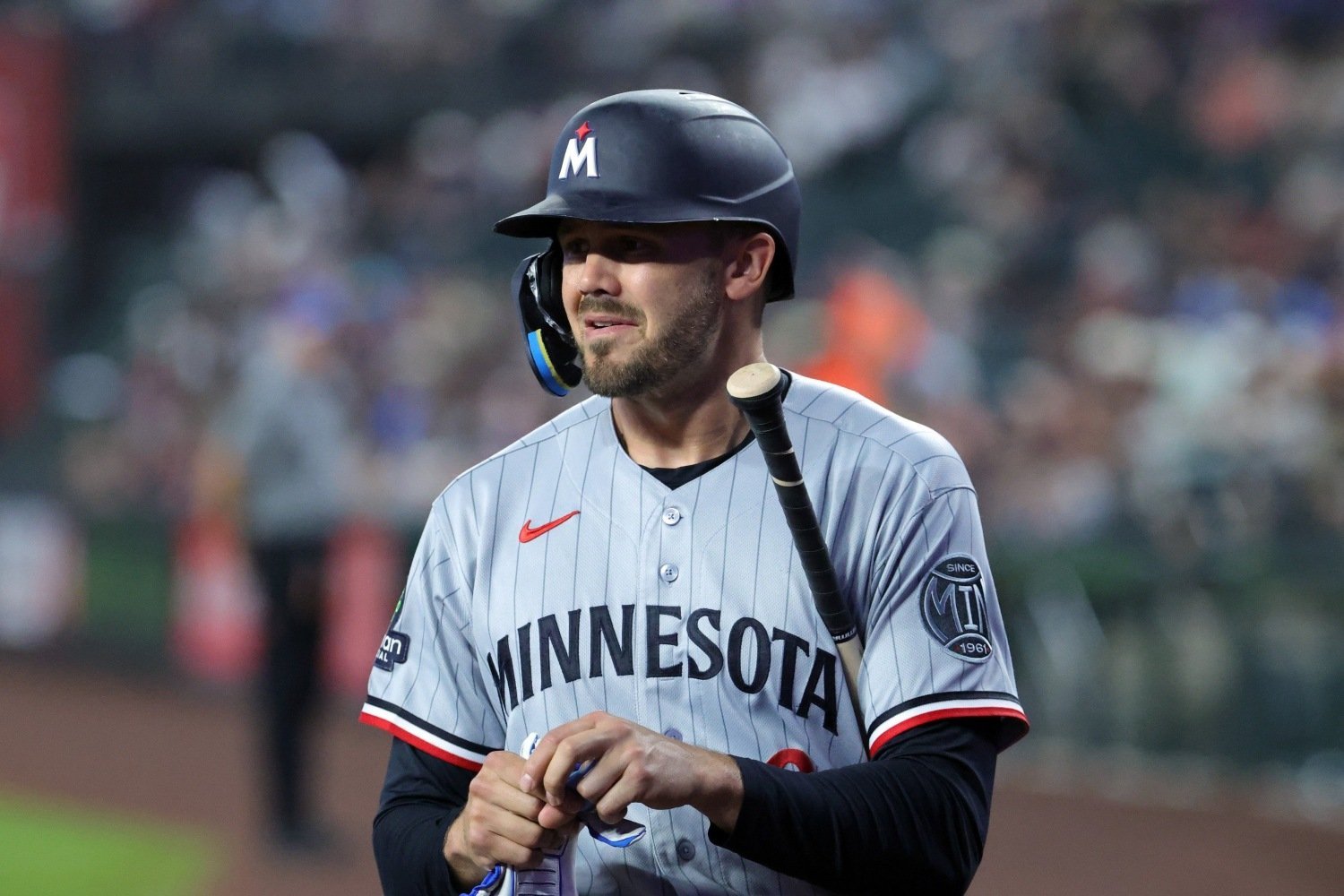
If the Rays are looking to add offense for a postseason push, two Twins stand out as logical fits: Ryan Jeffers and Trevor Larnach. Rather than weakening Minnesota's roster, moving either (or even both) could allow the organization to lean into areas of organizational strength while addressing bigger needs.
The Rays Need More Middle-of-the-Order Production
Tampa Bay has rarely been afraid to make creative deadline moves, especially when they can acquire controllable hitters at reasonable salaries. Larnach checks nearly every box.
The 29-year-old is putting together the best offensive season of his career, hitting .293/.381/.457 (.842) with eight home runs, 19 doubles, and a career-high 135 OPS+. His improved approach has been just as impressive as the production. He's walking 11.4% of the time while cutting his strikeout rate to a career-low 17.4%.
Like most left-handed hitters, Larnach has struggled against southpaws, batting just .167/.268/.333 in 42 plate appearances. However, his production against right-handed pitching has been elite. His .313/.398/.475 line versus righties would immediately lengthen Tampa Bay's lineup and give the Rays another middle-of-the-order bat capable of getting on base consistently.
Just as importantly, Larnach remains affordable. He's earning $4.475 million this season and remains under team control through arbitration next year, making him attractive for a club that consistently looks for value.
Minnesota Has Plenty of Internal Replacements
Trading Larnach becomes much easier because of the Twins' depth. Matt Wallner looked overmatched during his early-season stint, hitting just .167/.259/.292 before being optioned to Triple-A in May. Since returning to St. Paul, however, he's looked much more like the player Minnesota expected. Over 243 plate appearances, Wallner owns a .284/.374/.602 line with 19 home runs.
Alan Roden has also forced his way into the conversation. Acquired in last year's Louis Varland trade, Roden hit .272/.397/.512 at Triple-A before earning another opportunity with Minnesota. Despite posting those numbers, he's received only 37 plate appearances since being promoted to the Twins in early July.
Then there's Walker Jenkins. The former No. 5 overall pick has quickly reminded everyone why he's considered one of baseball's premier prospects. Jenkins has touched Triple-A pitching with a .267/.371/.432 line and looks increasingly ready for an extended opportunity in the major leagues.
With three legitimate corner outfield options waiting behind Larnach, the Twins are in a position where dealing from depth could improve other parts of the roster without sacrificing offensive production.
Jeffers Could Bring Back Significant Value
Jeffers presents a different but equally compelling trade case. Bobby Nightengale recently reported there's a growing belief around baseball that Jeffers could be available even if Minnesota doesn't fully commit to selling. That makes sense.
Jeffers is an impending free agent who has elevated his offensive game this season. Across 186 plate appearances, he's hitting .293/.395/.535, with nine home runs. His elite plate discipline stands out even more than the power, as his 14.4% walk rate nearly matches a career-low 16.6% strikeout rate. His offensive production has been 64% better than league average, according to wRC+.
This year's breakout only strengthens what has already been an impressive offensive résumé. Dating back to the start of 2023, Jeffers owns a .259/.346/.446 line for a 122 wRC+, making him one of baseball's better offensive catchers over that span. For comparison, major-league catchers are hitting just .229/.304/.380 this season. Few contenders have enough offense behind the plate, and Jeffers would instantly become one of the better bats available at the position.
Caratini Gives Minnesota Flexibility
Trading Jeffers would have been much more difficult earlier in the season. Victor Caratini has changed that equation. After a slow start, the veteran took advantage of increased playing time while Jeffers recovered from a hamate fracture. Since May 20, Caratini has hit .273/.342/.460, with six home runs, eight doubles, a 8.9% walk rate, and an 19.6% strikeout rate over 158 plate appearances.
Minnesota also has Alex Jackson on the roster to provide quality defense as a backup catcher, giving the Twins a capable tandem if Jeffers is moved. Caratini is signed through 2027, making him more than just a short-term stopgap. That contract provides the Twins with the flexibility to maximize Jeffers's trade value while maintaining stability behind the plate.
Why Tampa Bay Makes Sense
The Rays have consistently targeted hitters who control the strike zone, possess positional flexibility, and remain affordable through arbitration or short-term contracts. Both Larnach and Jeffers fit that profile.
For Minnesota, Tampa Bay has one thing the Twins desperately need: bullpen depth. The Rays have built a reputation for developing power arms and routinely possess relievers who become attractive trade chips at the deadline. Even if bullpen help isn't the centerpiece of a deal, the Rays also have one of baseball's deeper farm systems, giving Minnesota multiple avenues to improve its long-term outlook.
The fit is obvious from both sides. Moving Jeffers or Larnach wouldn't necessarily signal that the Twins are giving up on 2026. Instead, it would represent a front office willing to capitalize on organizational depth. Minnesota has viable replacements waiting at both catcher and corner outfield. Caratini has shown he can handle a larger workload behind the plate, while Wallner, Roden, and Jenkins all deserve opportunities to establish themselves in the outfield.
If Tampa Bay is indeed one of the clubs most interested in adding offense, the Rays could offer exactly what Minnesota needs in return. The result could be one of the rare deadline trades where both teams improve their present while the Twins also look to strengthen their future.
Can the Twins and Rays align on a trade before the deadline? Can Minnesota trade Jeffers and stay competitive? Leave a comment and start the discussion.








Recommended Comments
Create an account or sign in to comment
You need to be a member in order to leave a comment
Create an account
Sign up for a new account in our community. It's easy!
Register a new accountSign in
Already have an account? Sign in here.
Sign In Now