


Twins Video
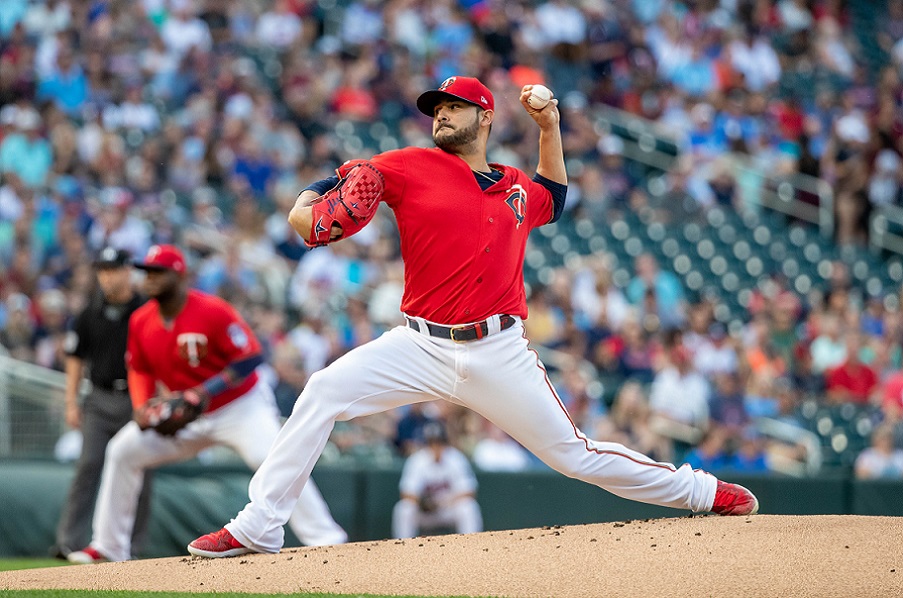
When the Twins first signed Martin Perez, I was one of the people that was on board with this being a good signing, and during the first two months of his Twins tenure, he looked like an excellent addition to the starting rotation. However, in light of how Perez has pitched over the past two months, and given the sense of urgency the Twins are suddenly under, it might be best for them to find a new role for Perez, outside of the starting rotation. This could be a hard move for the Twins front office to make, as it would removing the one addition they made to the starting rotation this past winter, and that’s okay, but now is not the time for pride, now is the time to put the team in the best position to succeed for the stretch run. So, the question still remains, should the Twins take Perez out of the starting rotation?
To answer that question, first we should take a look at what has caused Perez to fall off the map after his great start to the season. We will start by looking at the usually obvious culprit, velocity, specifically with his fastball. Perez is a fastball-heavy pitcher, who uses three fastball variations, a cutter, a sinker, and a four-seamer, which make up 73.1 percent of the pitches he has thrown this year. This makes Perez’s velocity an especially important part of his ability to pitch well. Below are a couple of charts, courtesy of Baseball Savant, featuring the month to month average velocity of Perez’s three different fastballs.

The chart on the left conveys the decline in velocity that Perez has experienced in both his sinker and four-seamer, while the chart on the right illustrates the increase in velocity Perez has experienced with his cutter as the season has progressed. Now let’s compare those charts to the how hitters have hit each of those pitches this season, again on a month to month bases.

Again, the chart on the left features Perez’s sinker and four-seamer, while the chart on the right features Perez’s cutter. This time, these charts show the wOBA Perez has allowed with each of these pitches on a month to month basis in 2019. By comparing these charts, we can gather some valuable information. First, the changes in velocity don’t seem to be having a great effect on Perez’s performance, at least not on his sinker and cutter, which make up just over 75 percent of the fastballs that he throws. Despite the decrease in sinker velocity, Perez’s sinker has actually seen gradual improvement as the season has progressed (except for his two starts so far in August). On the same theme, Perez hasn’t had nearly the same success with his newly introduced cutter as the season has progressed, despite the slight uptick in velocity on that pitch. How can we explain that?
The answer to that question might be two-fold. The first, and perhaps most obvious answer is that during the first two months of the season opposing hitters were caught off guard by Martin Perez’s cutter, as it was a new pitch that he had never thrown before. However, after a couple months of success with this new pitch, opposing teams started to adjust by accounting for this pitch in Perez’s repertoire. Another explanation, which coincides with opposing teams adjusting to Perez’s cutter has been the decline of spin rate on the pitch. Here is yet another graph, courtesy of Baseball Savant, that shows the spin rate of Perez’s cutter on a month to month basis in 2019.

The combination of these two changes has hindered Martin Perez’s effectiveness with the pitch that gave him his newfound success early on in the season. This is also evident in Perez’s swing and miss rate with his cutter, which has been cut in half over the last few months from where it was during April and May.
Now that we see there is clear evidence that Martin Perez is no longer the same pitcher that he was at the beginning of the season, and his performance isn’t just some regression to the mean, it is evident that Perez is no longer pitching at the level that belongs to be in the starting rotation of a team that is in a neck and neck race for a division title. So, what are some of the other options the Twins have for not only Perez, but also the now-open spot in the rotation.
First, we will start with how to fill Martin Perez’s current spot in the rotation. The two most likely candidates to fill that role are rookie lefties Devin Smeltzer and Lewis Thorpe. Smeltzer is currently filling in a spot in the rotation for Michael Pineda, who is in the Injured List. However, once Pineda returns from injury Smeltzer could easily transition over to Perez's spot in the rotation. Smeltzer has done an adequate job filling in when the Twins have needed him, but I don’t think he would be my first choice for the job. The pitcher I would turn to would be Lewis Thorpe. Thorpe has been one of the Twins top prospects for a couple of years now, and I think has much more upside potential than Smeltzer does. In five career seasons at the minor league level, Thorpe has a 3.50 ERA while striking out 10.8 batters per nine innings and walking just 2.9 batter per nine innings. So far, in four appearances at the MLB level, Thorpe has shown that he has the stuff to compete at this level. Here are some thoughts from Tom Froemming had on the subject a few nights ago.
The next thing to figure out would be what to do with Martin Perez. While he has definitely struggled as a starting pitcher, I don’t think it would be the appropriate move to just cut bait by designating him for assignment. Instead, a better option would be to find a place for Perez to pitch out of the bullpen. With the right-handed heavy starting rotation, my ideal option would be to move him back to the role he served to start the year, which is as more of a dual starter to match up with someone in the rotation. For me, that choice would be Kyle Gibson. Gibson has had his fair share of struggles of late, and matching Perez with him could help boost both of their performances down the stretch. If Gibson knows he only needs to work through the lineup a couple times before handing the ball over to Perez, he could be more aggressive by showing his best stuff right from the get-go. Then, after Gibson gives them two turns through the lineup, go to Perez who will give the opposing hitters a completely different look from the mound, right as they are starting to adjust to Gibson.
Will this solution guarantee success? No, probably not. However, this could be a better alternative than just throwing Perez out to the wolves every fifth day. Even if this change in strategy is ineffective in getting better results from Perez, at bare minimum, it limits the amount of impact that Perez’s poor performance has on the Twins over the final two months of the season. Given the Twins limited options to improve their pitching staff, post trade deadline, it is worth exploring all of their options internally to make improvements.






Recommended Comments
Create an account or sign in to comment
You need to be a member in order to leave a comment
Create an account
Sign up for a new account in our community. It's easy!
Register a new accountSign in
Already have an account? Sign in here.
Sign In Now