


Twins Video
The offseason did not start off well for Hicks: In November he was released from his Venezuelan winter ball team after hitting just .220/.381/.280 in 16 games. The explanation from his team was that he was released because of the poor production but there were rumblings from local media that the Venezuelan team was also upset with his attitude. Whatever the case might be between him and Bravos de Margarita, earlier in the offseason general manager Terry Ryan was emphatic that the Twins organization had no concerns over Hicks’ drive and makeup.
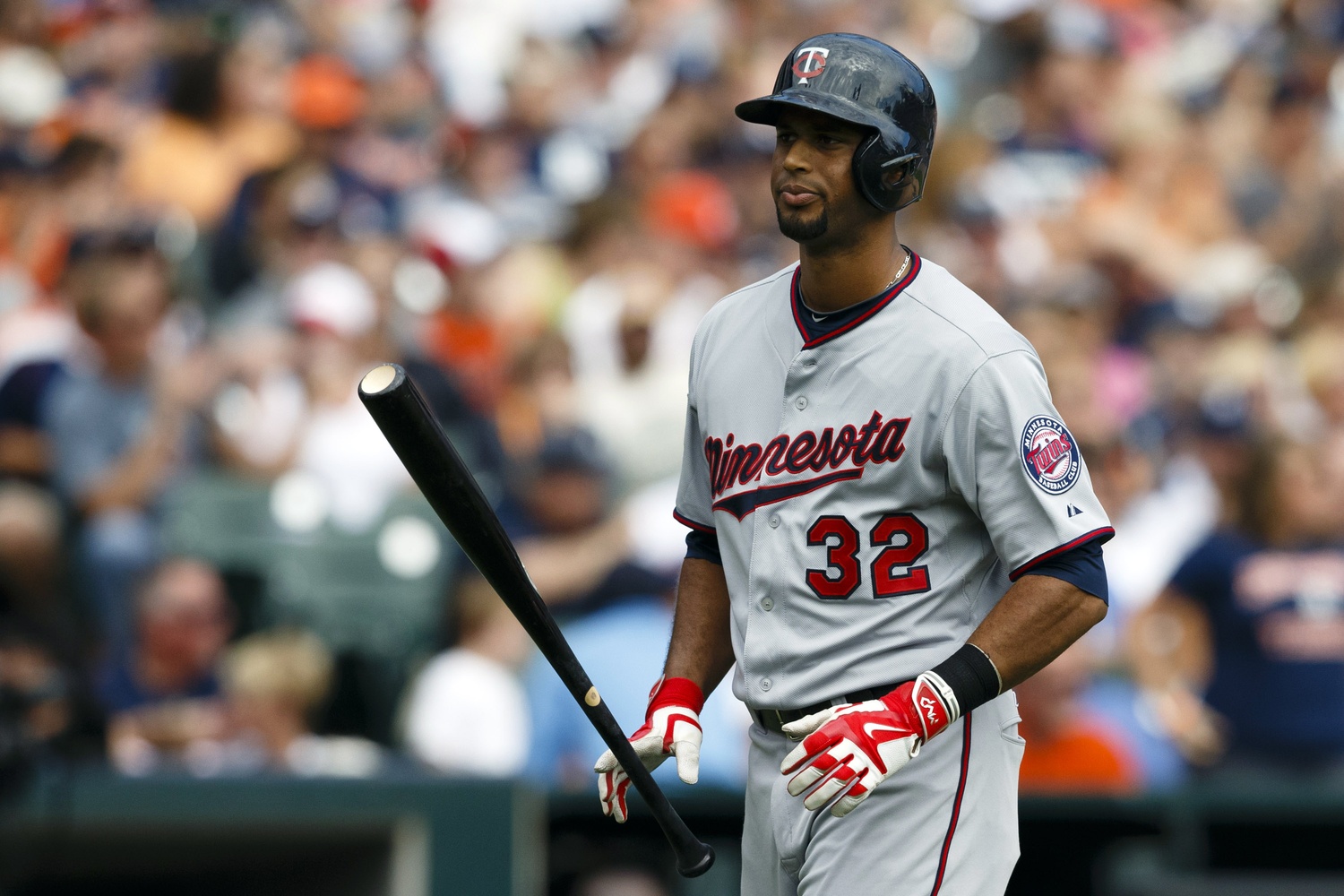
Meanwhile, during his introductory conference call with season ticket holders manager Paul Molitor reiterated his hopes that Hicks will be able to hold the center field job. That, of course, will depend on how much he can do with the stick. Since coming up to the Twins in 2013, Hicks has posted an OPS+ of 69 (heh) which is 79 out of 89 hitters who have played at least 25 games in center. Ahead of him? Sam Fuld (76), Jordan Schafer (82), Alex Presley (83) and Danny Santana (130). With the exception of Santana those other three players were readily available, making Hicks the epitome of a player below replacement-level.
It is a shame considering Hicks has the requisite tools necessary to be a solid contributor. All that is, except hitting. If the baseball saying goes " Hit and we’ll find a position for you" is true, the opposite is certainly valid for those who cannot hit.
There does not seem to be any reason to blame bad luck for the low offensive numbers, either. According to ESPN/TruMedia’s database, since 2013 Hicks’ hard-hit average has been at .115 -- well below the average of .155, and qualifies as 31 of 36 center fielders with 400 plate appearances. Because of this, it is easy to see why he wound up with the second lowest batting average on balls in play in that pool.
Part of what makes him so volatile at the plate is being a switch-hitter who has not found comfort at either side of the plate -- particularly from the left-hand side where he will find the bulk of his plate appearances. Ted Simmons, the former switch-hitting catcher who eventually became the San Diego Padres bench coach, offered this up to ESPN’s Tim Kurkjian about hitting from both sides: It’s difficult.
"Six percent of all players is a very small sample,'' Simmons told ESPN regarding having success when hitting from both sides. "And how many of that 6 percent are even capable of hitting .300? Now that 6 percent goes down to maybe 2 percent. So now we're talking about a very, very, very small sample. I also have yet to find a person that completely, totally, unequivocally has bilateral symmetry. One side is always dominant. People can't write right-handed and left-handed with the same physicality.”
Hicks shares Simmons’ sentiments on switch-hitting as well. Even before his decision to drop the left-handed swing in 2014, he knew the sinister swing was his weaker side.
“I play golf right-handed. I do everything right-handed,” Hicks told Alan Maimon and Chuck Myron in their book Hits and Misses in the Baseball Draft before the start of the 2012 season. “I think one of the main reasons I’m good at hitting baseball right-handed is because of the eye-hand coordination I developed playing golf. I never felt the same confidence hitting left-handed. And neither did my coaches. In high school, they’d say, ‘Hey, we’ve got the bases loaded. Can Aaron please hit right-handed, so we can win this game?’ [before the 2012 season], I fooled around with playing left-handed golf. I think it helped my left-handed baseball swing come along.”
Beyond the strains of switch-hitting, what is happening in his swing that is hindering his ability to make quality contact? In 2012 Hicks said to the Star Tribune’s Phil Miller in a Baseball America article that he had been tinkering too much with his swing the previous season.
“I never got any consistency last year because I was just tweaking my swing too much,” the Hicks said. “I tried my hands high, then tried them low. I tried holding my bat still, then I tried letting my hands move more freely. I was constantly changing it up.”
Despite trying multiple swings along the way, it appears that the bulk of the modifications were focused on his hands. Judging from recent video, the problem could be a few feet lower.
Watch his swing up to the point of contact from the left-hand side.
http://i.imgur.com/JHhf3Jt.gif
At the end of the clip, keep an eye on his front foot as it begins to turn and roll. For the majority of hitters, the process of turning over their front foot begins after contact, not before (with Jason Heyward being one of those outlying exceptions). While there are almost unlimited examples to compare to, below is a comparison of Hicks to teammate Joe Mauer before contact.


When this was presented to hitting instruction Bobby Tewksbary, who has worked with Jason Donaldson and Chris Colabello, Tewksbary said he believes this to be the symptom of a larger issue with his swing. This is an indicator that his front side is pulling out. In the video clip above, it is clear that his front side is drifting well below the point of contact.
The planted front foot ensures a strong leverage point and keeps the hips from opening up too soon. If the front side opens up, the swing as a tendency to lag through the zone and the outer-half of the plate becomes a safe haven for pitchers. This is why pitchers likely targeted Hicks in that location:

Perhaps even more disheartening is that pitchers threw plenty of pitches over the heart of the plate with which Hicks has been unable to produce.
Hicks’ practice of turning over on his foot before contact happens from the right-side as well. As he stated before, he is a much more natural hitter from the right so he demonstrates better contact and more power. That said, he still drifts:


****
Twins hitting coach Tom Brunansky has been credited with working wonders on a handful of his players. Hicks, on the other hand, has been a complete mystery. Gifted with the tools to succeed at the highest level, the ability to hit consistently has eluded him. To this point, Brunansky and the rest of the organization’s coaches have not been able to figure out that problem either.
If the Twins have spotted this and have tried to get him to stop turning off his front side, then it would seem that he has not been unable to replicate the work in the cages into the game. It is also possible that he was working on it in Venezuela, hence the low yield at the plate. If they have not, it could pay dividends to attempt to have Hicks try to work on keeping his front foot firm up to the point of contact. Either way, progress needs to be made.
As much as Hicks could use a good season at the plate, the Twins could really benefit from having a strong contributor at a key position.







Recommended Comments
Create an account or sign in to comment
You need to be a member in order to leave a comment
Create an account
Sign up for a new account in our community. It's easy!
Register a new accountSign in
Already have an account? Sign in here.
Sign In Now