



Nick Nelson
-
Posts
8,327 -
Joined
-
Last visited
-
Days Won
56
Content Type
Profiles
News
Minnesota Twins Videos
2026 Minnesota Twins Top Prospects Ranking
2022 Minnesota Twins Draft Picks
Minnesota Twins Free Agent & Trade Rumors, Notes, & Tidbits
Guides & Resources
2023 Minnesota Twins Draft Picks
The Minnesota Twins Players Project
2024 Minnesota Twins Draft Picks
2025 Minnesota Twins Draft Pick Tracker
2026 Minnesota Twins Draft Tracker: Picks & Bonuses
Forums
Blogs
Events
Store
Downloads
Gallery
Everything posted by Nick Nelson
-

Front Page: The Hazy Future of Fernando Romero
Nick Nelson replied to Nick Nelson's topic in Twins Daily Front Page News
This is excellent news, thanks for adding. Twins still face a conundrum with Romero going forward but at least the urgency is diminished somewhat. -
When it comes to the Twins bullpen and its deficiencies, you can accuse the front office of poor planning. But you can't accuse them of a lack of planning. They had an – altogether defensible – plan for late-inning coverage. It just so happens three pieces of that plan fell through, and one misfire in particular leaves Minnesota in the lurch while trying to plan for the future.In mostly bypassing the reliever free agent market (a wise enough choice, in retrospect) the Twins envisioned a bullpen whose back-end would be powered by the likes of Taylor Rogers, Trevor May, Addison Reed, Trevor Hildenberger, and Fernando Romero, with other options to emerge during the course of the year. In some ways, this blueprint has come to fruition. Rogers is one of the most valuable relievers in baseball. May, outside of a few hiccups, has been a dominant force. As for those those other quality contributors developing on the fringes? We've seen plenty: Ryne Harper, Zack Littell, Tyler Duffey, and so on. But the almost total lack of impact from Reed, Hildenberger and Romero has left a sizable late-inning void that the team is struggling to fill. Like I said, you can call it the result of poor planning. Reed gave us little reason to believe he'd be an asset this year, but I can't fault the team for attempting to extract some semblance of value from their $16 million investment. (I also credit them for quickly moving on as it became apparent he wasn't up to the task.) While Hildenberger was rough in the second half last year, he had been a lights-out high-leverage fireman before. And Romero? This was the boldest and most audacious bet of them all – taking the best pitching prospect in the system, and fast-tracking him into a bullpen role where he could maximize his stuff and bolster a unit in need. But from the jump, this experiment was ill-fated. Romero looked brutal in spring training, prompting the Twins to abandon their original plan and send him to the minors. The hope was he'd acclimate, gain confidence, and join the Minnesota bullpen in short order. This didn't happen. After four appearances at Triple-A, the Twins recalled Romero. He stuck around for three weeks but looked ordinary. He went back down for a month, and returned to make a single appearance, facing the Mariners on June 13th. Romero started the eighth, gave up two hits and two walks without recording an out, and was returned to Rochester. He hasn't resurfaced since. As we near the end of August, Reed is long gone. Hildenberger is on the rehab trail (and looking promising). Romero, meanwhile, is in limbo. Over the past two months back at Triple-A, he's been totally unremarkable, posting a 4.18 ERA and 1.71 WHIP in 28 innings while yielding a .261/.374/.342 slash line. To his credit he's limiting the big knocks (just one homer and six extra-base hits during this span) but his control continues to suffer, and he's not getting anywhere near the number of whiffs you look for from a big hard-thrower out of the pen. This stall-out doesn't spell doom for Romero. Twins fans know better by now than to form definitive conclusions about a talented young player who hasn't yet turned 25. But unfortunately, patience is ceasing to be a luxury the team can afford. Next spring he'll be out of options, meaning Minnesota will need to either carry him out of camp or expose him to waivers (where he wouldn't make it far, I imagine). One might say, "The reliever transition has failed, move him back to starter." Which sounds fine, except... they can't send him to Triple-A and have him readjust to that role. Does anyone feel comfortable with Romero (who by the way has never put together a complete season as a starter) in the Twins rotation right out of the gate next year? Is there any legitimate reason to think a guy who can't silence minor-league hitters as a reliever is suddenly going to be an effective MLB starter? Romero's inexplicably sluggish performance this season leaves the Twins in a tough spot when it comes to planning for 2020 and beyond. The reason it's worth talking about now is that the front office faces a pivotal decision in the week ahead. Next Sunday, rosters will expand for September call-ups. One day later, Rochester plays its final game of the regular season. Under normal circumstances (at least, normal for the past nine years), calling up Romero would essentially be a no-brainer. Development is the utmost concern, so you get him a few more opportunities and let him work with the big-league coaches, hopefully building some kind of confidence to carry forward. But now? The Twins are in a tight division race. They can't afford to give innings to someone they can't trust. And if their handling of him this year makes one thing clear, it's that they don't trust Romero to pitch important innings for them right now. Will be they be able to trust him to do so next year? They're running out of time, and chances, to inform that decision. Click here to view the article
-
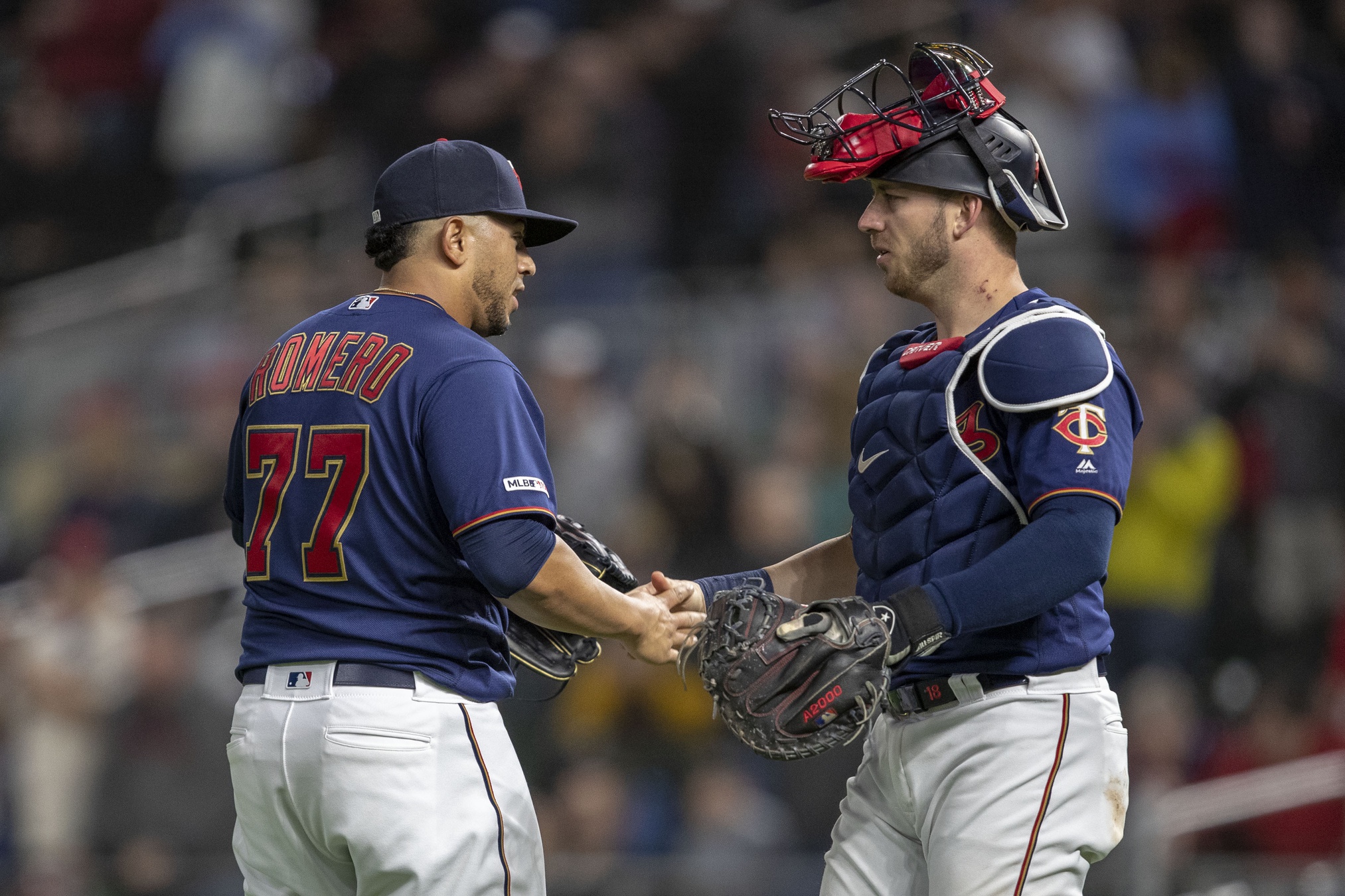 In mostly bypassing the reliever free agent market (a wise enough choice, in retrospect) the Twins envisioned a bullpen whose back-end would be powered by the likes of Taylor Rogers, Trevor May, Addison Reed, Trevor Hildenberger, and Fernando Romero, with other options to emerge during the course of the year. In some ways, this blueprint has come to fruition. Rogers is one of the most valuable relievers in baseball. May, outside of a few hiccups, has been a dominant force. As for those those other quality contributors developing on the fringes? We've seen plenty: Ryne Harper, Zack Littell, Tyler Duffey, and so on. But the almost total lack of impact from Reed, Hildenberger and Romero has left a sizable late-inning void that the team is struggling to fill. Like I said, you can call it the result of poor planning. Reed gave us little reason to believe he'd be an asset this year, but I can't fault the team for attempting to extract some semblance of value from their $16 million investment. (I also credit them for quickly moving on as it became apparent he wasn't up to the task.) While Hildenberger was rough in the second half last year, he had been a lights-out high-leverage fireman before. And Romero? This was the boldest and most audacious bet of them all – taking the best pitching prospect in the system, and fast-tracking him into a bullpen role where he could maximize his stuff and bolster a unit in need. But from the jump, this experiment was ill-fated. Romero looked brutal in spring training, prompting the Twins to abandon their original plan and send him to the minors. The hope was he'd acclimate, gain confidence, and join the Minnesota bullpen in short order. This didn't happen. After four appearances at Triple-A, the Twins recalled Romero. He stuck around for three weeks but looked ordinary. He went back down for a month, and returned to make a single appearance, facing the Mariners on June 13th. Romero started the eighth, gave up two hits and two walks without recording an out, and was returned to Rochester. He hasn't resurfaced since. As we near the end of August, Reed is long gone. Hildenberger is on the rehab trail (and looking promising). Romero, meanwhile, is in limbo. Over the past two months back at Triple-A, he's been totally unremarkable, posting a 4.18 ERA and 1.71 WHIP in 28 innings while yielding a .261/.374/.342 slash line. To his credit he's limiting the big knocks (just one homer and six extra-base hits during this span) but his control continues to suffer, and he's not getting anywhere near the number of whiffs you look for from a big hard-thrower out of the pen. This stall-out doesn't spell doom for Romero. Twins fans know better by now than to form definitive conclusions about a talented young player who hasn't yet turned 25. But unfortunately, patience is ceasing to be a luxury the team can afford. Next spring he'll be out of options, meaning Minnesota will need to either carry him out of camp or expose him to waivers (where he wouldn't make it far, I imagine). One might say, "The reliever transition has failed, move him back to starter." Which sounds fine, except... they can't send him to Triple-A and have him readjust to that role. Does anyone feel comfortable with Romero (who by the way has never put together a complete season as a starter) in the Twins rotation right out of the gate next year? Is there any legitimate reason to think a guy who can't silence minor-league hitters as a reliever is suddenly going to be an effective MLB starter? Romero's inexplicably sluggish performance this season leaves the Twins in a tough spot when it comes to planning for 2020 and beyond. The reason it's worth talking about now is that the front office faces a pivotal decision in the week ahead. Next Sunday, rosters will expand for September call-ups. One day later, Rochester plays its final game of the regular season. Under normal circumstances (at least, normal for the past nine years), calling up Romero would essentially be a no-brainer. Development is the utmost concern, so you get him a few more opportunities and let him work with the big-league coaches, hopefully building some kind of confidence to carry forward. But now? The Twins are in a tight division race. They can't afford to give innings to someone they can't trust. And if their handling of him this year makes one thing clear, it's that they don't trust Romero to pitch important innings for them right now. Will be they be able to trust him to do so next year? They're running out of time, and chances, to inform that decision.
 -
The Twins had an opportunity to build some real buffer room in the standings, facing a soft slate at home while Cleveland opened with a sweeping from the Mets. More unraveling from the rotation prevented Minnesota from being able to take full advantage, picking up only one game, but the Twins can be satisfied to tread water for the time being, especially knowing they're on the verge of getting a key piece back just as the Indians lose one. Weekly Snapshot: Mon, 8/19 through Sun, 8/25 *** Record Last Week: 3-3 (Overall: 79-51) Run Differential Last Week: +7 (Overall: +151) Standing: 1st Place in AL Central (3.5 GA) Willians Watch: 7-for-19 (.368) at AAA Willians Astudillo moved his rehab up to Triple-A, where he continued to rake with seven hits in four games. He mixed in at catcher, third base and right field for Rochester, and should be back in Minnesota by the end of next weekend. In more objectively important injury recovery news, Byron Buxton went through a full complement of baseball activities on Friday without a hitch, and opened up his own rehab stint at Cedar Rapids on Sunday. Starting at DH and batting second, Buxton went 1-for-2 with a walk and a signature hustle double. The easiest thing would be for Minnesota to wait until rosters expand next Sunday to activate Buxton. But at the same time, every game is important right now, and he's such a difference-maker. If he looks fully back up to speed early in the week, will they accelerate his timeline and maybe get him back for the Tigers series... or even for Chicago on Tuesday? (Dick Bremer astutely noted in Sunday's broadcast that Cedar Rapids is a short jaunt...) Buxton's imminent return, along with news that Cleveland has likely lost Jose Ramirez for the rest of the season with a hamate bone fracture, would seem to bode very well for the Twins. But of course, they have to go out and capitalize on the opportunities thrown their way. In a quiet week for transactions, the only other move worth mentioning is that Ryne Harper was optioned to Triple-A on Saturday, coming off another lackluster performance against the Tigers. Cody Stashak is back (Zack Littell was not an option since he went down less than 10 days ago). Harper was arguably Minnesota's second-best reliever in the first half, but hitters have gotten wise to his two-pitch mix, leading to a 7.36 ERA in August. He'll likely be back in September. HIGHLIGHTS When the Twins made their biggest offseason splash by signing Nelson Cruz, we all naturally wondered: Can he maintain the elite power production that's been his norm, or will age start taking a toll and limiting him? The answer, as it turns out: yes and yes. Cruz has already sat out more games this year than any of the past five, held back from interleague action and nagged persistently by a wrist that might've healed more cooperatively in his younger days. But when on the field, the 39-year-old has played through his barking wrist with unbelievable effectiveness – especially in his return to action last week off a stunningly short absence. Showing no ill effect from a ruptured tendon, Cruz swung the stick like a man possessed at Target Field, piling up five extra-base hits and seven RBIs amidst a 9-for-27 week hat featured some epic exit velocities. Despite losing 28 games to a pair of IL stints, the veteran slugger remains on pace to exceed 40 home runs and 100 RBIs. Alcala's first week at Triple-A also went smoothly, as he tossed four shutout innings across three appearances, striking out five and – importantly – walking only one. I mentioned here last week that the Ryan Pressly trade was starting to turn around for the Twins, with Alcala positioning himself to help the MLB bullpen and Gilberto Celestino going on a complete tear at Cedar Rapids. Well, now Celestino too has moved up a level. He joined Fort Myers on Wednesday and is 7-for-17 with four doubles through his first four games with the Miracle. Incidentally, Pressly underwent knee surgery last week and will miss the next 4-to-6 weeks for the Astros. That isn't the only midseason trade from 2018 paying dividends. Jhoan Duran was dazzling in his sixth start at Double-A on Friday, carrying a no-no into the late innings before finishing with two hits allowed and 11 strikeouts in eight shutout frames. According to the data at Baseball Reference (and this seems too absurd to be true), Duran threw 58 of 68 pitches for strikes and induced THIRTY-ONE swings and misses. Even if those numbers are stretched, it was one of the most dominating performances you'll see from a pitcher all year. Although not to the same extent as Graterol and Alcala, Duran is a sleeper candidate to help the needy big-league staff before this year is over. LOOKING AHEAD They didn't make hay at home following a 5-1 road trip, but now the Twins will travel again for a repeat of the past week's match-ups, with redemption on the mind. Last Wednesday, Chicago's Lucas Giolito threw the best start of his career against Minnesota, and on Friday Detroit's journeyman mediocrity Drew VerHagen unleashed an out-of-nowhere burst of dominance with 11 strikeouts. Can the Twins exact some revenge in hostile territory, where they've been so comfortable all year long? Cleveland, reeling from the news of Ramirez's loss and a gut-punch loss on Sunday, opens its week with the Tigers (ugh) but then travels to Tampa for a series with the Rays. Opportunity knocks once again. TUESDAY, 8/27: TWINS @ WHITE SOX – RHP Michael Pineda v. RHP Lucas Giolito WEDNESDAY, 8/28: TWINS @ WHITE SOX – RHP Jake Odorizzi v. LHP Ross Detwiler THURSDAY: 8/29: TWINS @ WHITE SOX – RHP Jose Berrios v. RHP Dylan Cease FRIDAY, 8/30: TWINS @ TIGERS – RHP Kyle Gibson v. RHP Drew VerHagen SATURDAY, 8/31: TWINS @ TIGERS – LHP Martin Perez v. RHP Edwin Jackson SUNDAY, 9/1: TWINS @ TIGERS – RHP Michael Pineda v. LHP Matthew Boyd Catch Up On Twins Daily Game Recaps Game 125 | CWS 6, MIN 4: Twins Unable to Mount Comeback, Drop Series Opener 6-4 Game 126 | MIN 14, CWS 4: Cruz Leads Twins Offensive Explosion Game 127 | CWS 4, MIN 0: Giolito Throws Complete Game as Sox Take Series Game 128 | DET 9, MIN 6: Berríos, Bullpen Can’t Hold Baseball’s Worst Offense Game 129 | MIN 8, DET 5: Sano 3-Run Bomba, Bullpen Boost Twins to Victory Game 130 | MIN 7, DET 4: Pérez Impresses, Twins Beat Detroit for Series Win Click here to view the article
- 15 replies
-
- 1
-

-
- nelson cruz
- jake cave
- (and 2 more)
-
 Weekly Snapshot: Mon, 8/19 through Sun, 8/25 *** Record Last Week: 3-3 (Overall: 79-51) Run Differential Last Week: +7 (Overall: +151) Standing: 1st Place in AL Central (3.5 GA) Willians Watch: 7-for-19 (.368) at AAA Willians Astudillo moved his rehab up to Triple-A, where he continued to rake with seven hits in four games. He mixed in at catcher, third base and right field for Rochester, and should be back in Minnesota by the end of next weekend. In more objectively important injury recovery news, Byron Buxton went through a full complement of baseball activities on Friday without a hitch, and opened up his own rehab stint at Cedar Rapids on Sunday. Starting at DH and batting second, Buxton went 1-for-2 with a walk and a signature hustle double. The easiest thing would be for Minnesota to wait until rosters expand next Sunday to activate Buxton. But at the same time, every game is important right now, and he's such a difference-maker. If he looks fully back up to speed early in the week, will they accelerate his timeline and maybe get him back for the Tigers series... or even for Chicago on Tuesday? (Dick Bremer astutely noted in Sunday's broadcast that Cedar Rapids is a short jaunt...) Buxton's imminent return, along with news that Cleveland has likely lost Jose Ramirez for the rest of the season with a hamate bone fracture, would seem to bode very well for the Twins. But of course, they have to go out and capitalize on the opportunities thrown their way. In a quiet week for transactions, the only other move worth mentioning is that Ryne Harper was optioned to Triple-A on Saturday, coming off another lackluster performance against the Tigers. Cody Stashak is back (Zack Littell was not an option since he went down less than 10 days ago). Harper was arguably Minnesota's second-best reliever in the first half, but hitters have gotten wise to his two-pitch mix, leading to a 7.36 ERA in August. He'll likely be back in September. HIGHLIGHTS When the Twins made their biggest offseason splash by signing Nelson Cruz, we all naturally wondered: Can he maintain the elite power production that's been his norm, or will age start taking a toll and limiting him? The answer, as it turns out: yes and yes. Cruz has already sat out more games this year than any of the past five, held back from interleague action and nagged persistently by a wrist that might've healed more cooperatively in his younger days. But when on the field, the 39-year-old has played through his barking wrist with unbelievable effectiveness – especially in his return to action last week off a stunningly short absence. Showing no ill effect from a ruptured tendon, Cruz swung the stick like a man possessed at Target Field, piling up five extra-base hits and seven RBIs amidst a 9-for-27 week hat featured some epic exit velocities. Despite losing 28 games to a pair of IL stints, the veteran slugger remains on pace to exceed 40 home runs and 100 RBIs. https://twitter.com/fsnorth/status/1165058346598010880 Leading the offensive charge alongside Cruz last week was one now-customary name – Miguel Sano, who clubbed three homers and drove in seven across six games – and a more unexpected one: Jake Cave (or "Caveman," in the parlance of Player's Weekend). Buxton's injury opened a window of opportunity for Cave, and the outfielder has lunged through it with vigor. Aided by more regular playing time, Cave has seen his OPS climb rapidly during the month of August, and last week he was at his best, belting three home runs and two doubles while raising his seasonal slash line to .278/.378/.460, including .423/.492/.769 since the All-Star break. His monster production hasn't been coming cheaply. https://twitter.com/dohyoungpark/status/1165468085878448130 Cave is showing that his solid work as a rookie last year, and his outright dominance of Triple-A this year, were not flukes. His bat has been a boon for the Twins lineup this month with others absent or lagging. It's hard to see him getting a ton of action once Buxton returns, but he's proven himself as a solid backup and pinch-hitting option. Also enjoying nice weeks offensively: Jorge Polanco (two homers and a double), Max Kepler (two homers and two doubles, propelling him past the 35-HR milestone), and Eddie Rosario (5-for-12 against Chicago before sitting out the Detroit series with a hamstring strain). On the pitching side, the biggest positive was Trevor May continuing to build on his excellent August. Looking confident and more than capable, the right-hander logged 2 1/3 scoreless innings across three appearances, striking out two and walking none. After a very rough stretch in July, followed by a bit of a mental break courtesy of Rocco Baldelli, May has re-emerged as the powerful late-inning weapon Minnesota needs him to be. He threw 30 of 41 pitches (73%) for strikes last week. LOWLIGHTS Alarms are loudly blaring in the starting rotation. Jose Berrios continues to grind through start after start, minus the velocity, command, and consistency that fueled his All-Star first half. Facing the lowest-scoring offense in baseball on Friday, Berrios was handed an early lead, but he gave it up on a crippling grand slam in a game where he was disturbingly hittable. By the time he was lifted with one out in the sixth, he'd allowed five runs on 10 hits and two walks, pushing his ERA up to a season-high 3.53. Just a monumentally disappointing performance against a pitifully bad Tigers lineup. It marked the sixth time in nine starts since the beginning of July that Berrios was unable to complete six innings, a feat he accomplished in all but two of his 17 outings through June. Sagging velocity continues to take a toll on him, as he and his coaches continue to search for answers. https://twitter.com/ParkerHageman/status/1165119200505094147 The Twins are in huge trouble if Berrios can't get back on track. This goes without saying. But it sure doesn't help that his counterparts in the rotation are so very uninspiring right now. Kyle Gibson looked similarly poor against the lowly Tigers on Saturday, coughing up 10 hits and five runs (four earned) over 5 1/3 innings. Earlier in the week he gave up five runs against a White Sox offense that isn't much better than Detroit's (third-to-last among AL teams in runs and OPS). Those same Sox touched up Jake Odorizzi for four runs on eight hits over five frames on Wednesday. The rotation contributed just one quality start all week – when Martin Perez held Detroit to two runs over six innings on Sunday. At home, in this stage of the season, against this caliber of competition, that's just not acceptable. Skeptical Twins fans and national onlookers will rightfully be dubious of the club's ability to make any real noise until they demonstrate they can suppress even pedestrian lineups. Minnesota isn't going to be able to outslug opponents on command. Pressure is mounting on Wes Johnson, Jeremy Hefner, and the Twins starting pitchers to turn things around, with the erstwhile ace Berrios ranking as the utmost priority. TRENDING STORYLINE He's not going to be a magical elixir for this rotation's afflictions, but Buxton's return will provide a big boost for the pitchers. He's arguably the most valuable defender in baseball and he changes games, although Kepler and Cave deserve credit for their solid glovework in the interim. Fans await Buck's activation with bated breath, but regardless of what happens there, the Twins will be receiving a huge influx next Sunday when rosters expand for September. The front office will almost certainly be upping bullpen depth by recalling a handful of arms that have helped them already this year – the likes of Littell, Harper, Kohl Stewart, Devin Smeltzer, Lewis Thorpe, Randy Dobnak, etc. Rehabbing righty Trevor Hildenberger is another likely candidate, with intriguing impact potential. Fernando Romero might not be in the plans, which is sad but fair. And then there are other potentially impactful additions that are not yet on the 40-man roster, such as the two we'll lead off with below. DOWN ON THE FARM Settling in at the highest level of the minors following their recent promotions, Brusdar Graterol and Jorge Alcala are acclimating very quickly. Graterol threw two scoreless innings in his Rochester debut on Wednesday, then followed with another clean appearance (1.1 IP) on Saturday. He already has International League hitters out of sorts (and turns 21 on Monday, so give him a shout on Twitter!). https://twitter.com/TFTwins/status/1164352611669204992 Alcala's first week at Triple-A also went smoothly, as he tossed four shutout innings across three appearances, striking out five and – importantly – walking only one. I mentioned here last week that the Ryan Pressly trade was starting to turn around for the Twins, with Alcala positioning himself to help the MLB bullpen and Gilberto Celestino going on a complete tear at Cedar Rapids. Well, now Celestino too has moved up a level. He joined Fort Myers on Wednesday and is 7-for-17 with four doubles through his first four games with the Miracle. Incidentally, Pressly underwent knee surgery last week and will miss the next 4-to-6 weeks for the Astros. That isn't the only midseason trade from 2018 paying dividends. Jhoan Duran was dazzling in his sixth start at Double-A on Friday, carrying a no-no into the late innings before finishing with two hits allowed and 11 strikeouts in eight shutout frames. According to the data at Baseball Reference (and this seems too absurd to be true), Duran threw 58 of 68 pitches for strikes and induced THIRTY-ONE swings and misses. Even if those numbers are stretched, it was one of the most dominating performances you'll see from a pitcher all year. Although not to the same extent as Graterol and Alcala, Duran is a sleeper candidate to help the needy big-league staff before this year is over. LOOKING AHEAD They didn't make hay at home following a 5-1 road trip, but now the Twins will travel again for a repeat of the past week's match-ups, with redemption on the mind. Last Wednesday, Chicago's Lucas Giolito threw the best start of his career against Minnesota, and on Friday Detroit's journeyman mediocrity Drew VerHagen unleashed an out-of-nowhere burst of dominance with 11 strikeouts. Can the Twins exact some revenge in hostile territory, where they've been so comfortable all year long? Cleveland, reeling from the news of Ramirez's loss and a gut-punch loss on Sunday, opens its week with the Tigers (ugh) but then travels to Tampa for a series with the Rays. Opportunity knocks once again. TUESDAY, 8/27: TWINS @ WHITE SOX – RHP Michael Pineda v. RHP Lucas Giolito WEDNESDAY, 8/28: TWINS @ WHITE SOX – RHP Jake Odorizzi v. LHP Ross Detwiler THURSDAY: 8/29: TWINS @ WHITE SOX – RHP Jose Berrios v. RHP Dylan Cease FRIDAY, 8/30: TWINS @ TIGERS – RHP Kyle Gibson v. RHP Drew VerHagen SATURDAY, 8/31: TWINS @ TIGERS – LHP Martin Perez v. RHP Edwin Jackson SUNDAY, 9/1: TWINS @ TIGERS – RHP Michael Pineda v. LHP Matthew Boyd Catch Up On Twins Daily Game Recaps Game 125 | CWS 6, MIN 4: Twins Unable to Mount Comeback, Drop Series Opener 6-4 Game 126 | MIN 14, CWS 4: Cruz Leads Twins Offensive Explosion Game 127 | CWS 4, MIN 0: Giolito Throws Complete Game as Sox Take Series Game 128 | DET 9, MIN 6: Berríos, Bullpen Can’t Hold Baseball’s Worst Offense Game 129 | MIN 8, DET 5: Sano 3-Run Bomba, Bullpen Boost Twins to Victory Game 130 | MIN 7, DET 4: Pérez Impresses, Twins Beat Detroit for Series Win
 -
Ever so briefly, the Cleveland Indians overtook the American League Central. Following their triumphant series at Target Field, which moved them into a first-place tie, the Indians defeated the Red Sox on Monday to pull ahead of Minnesota in the standings. By week's end, the hot-hitting Twins had moved back into the lead with a bit of breathing room, and they're poised to keep adding in the days ahead. Weekly Snapshot: Mon, 8/12 through Sun, 8/18 *** Record Last Week: 5-1 (Overall: 76-48) Run Differential Last Week: +17 (Overall: +144) Standing: 1st Place in AL Central (2.5 GA) Willians Watch: ON THE COMEBACK TRAIL It's been nearly two months since our guy Willians Astudillo played in a game for the Twins. But finally, the Tortuga Drought is nearing its end. Astudillo opened up a minor-league rehab stint at Pensacola on Thursday, and naturally, he homered in his first at-bat. This was vintage Willians in every way; on a 1-0 count, he hammered the first pitch in the strike zone deep to left, and proceeded to jog around the bases with his poorly tucked jersey hanging out the back of his pants. In other words, it was a thing of beauty: This is exciting stuff and we'll be tracking it very closely. Graterol, still only 20 and touching nearly 104 MPH on the gun as a reliever, has the potential to be a real difference-maker in the Twins bullpen for September and (hopefully) beyond. DOWN ON THE FARM As the Twins continue to search for answers in the late innings, last summer's Ryan Pressly trade is haunting them like a walk in the Metrodome. Minnesota gave up control of a reliever who now ranks among the league's very best, while their bullpen suffers. Not only that, but Pressly is doing it for a chief rival in the American League. It's not all bleak, though. There have been positive recent developments with the prospects who came back in exchange for Pressly. Jorge Alcala, the headlining arm, has mostly been a disappointments since arriving, and owns a 5.87 ERA overall at Pensacola this year. But in late July, the Twins finally stopped trying to use him as a starter, shifting him to a more suitable bullpen role. He has since allowed only two runs on seven hits and two walks in 10 2/3 innings, with seven strikeouts. The Twins announced on Sunday he's moving up to Triple-A along with Graterol, so Alcala too has the potential to impact this pennant race with his high-powered arm. And then there's Gilberto Celestino, a younger outfielder who came over alongside Alcala. He struggled mightily through the first two months at Cedar Rapids this year, putting up a fruitless .219/.299/.290 slash line, but has completely turned things around this summer. Since the start of June he's at .322/.389/.506, including .407/.467/.630 in his past 20 games. The 20-year-old brings standout speed and increasingly evident power. When you talk about "helium guys" in the Twins system, Celestino's near the top of the list. LOOKING AHEAD The good news is that Minnesota took advantage of its favorable schedule to re-stake a 2.5-game lead in the Central last week. The better news is that they're well positioned to build on this momentum in the week ahead. You can't really ask for an easier slate than the White Sox and Tigers at home, although the Twins will have to deal with Lucas Giolito and Matthew Boyd. Meanwhile, Cleveland is heading into Citi Field to face Marcus Stroman, Noah Syndergaard, and the Mets before returning home to welcome (with a huge sigh of relief) the Royals. Oh, and by the way, Cruz is expected back on Monday. MONDAY, 8/19: WHITE SOX @ TWINS – RHP Ivan Nova v. RHP Kyle Gibson TUESDAY, 8/20: WHITE SOX @ TWINS – RHP Reynaldo Lopez v. RHP Michael Pineda WEDNESDAY, 8/21: WHITE SOX @ TWINS – RHP Lucas Giolito v. RHP Jake Odorizzi FRIDAY, 8/23: TIGERS @ TWINS – LHP Matthew Boyd v. RHP Jose Berrios SATURDAY, 8/24: TIGERS @ TWINS – RHP Edwin Jackson v. LHP Martin Perez SUNDAY, 8/25: TIGERS @ TWINS – RHP Spencer Turnbull v. RHP Kyle Gibson Catch Up On Twins Daily Game Recaps Game 119 | MIN 7, MIL 5: Marwin Comes Up Clutch To Put the Twins Back in First Place Game 120 | MIL 6, MIN 5: Twins Can’t Sweep, Polanco Commits Costly Error Game 121 | MIN 13, TEX 6: Pineda Solid While Offense Provides Plenty Game 122 | MIN 4, TEX 3: Twins Prevail Behind Clutch Schoop HR, Great Bullpen Performance Game 123 | MIN 12, TEX 7: Twins Win Slugfest in Texas Game 124 | MIN 6, TEX 3: Polanco Leads Twins Over Lynn in Texas Click here to view the article
- 20 replies
-
- 5
-
-
- marwin gonzalez
- brusdar graterol
- (and 1 more)
-
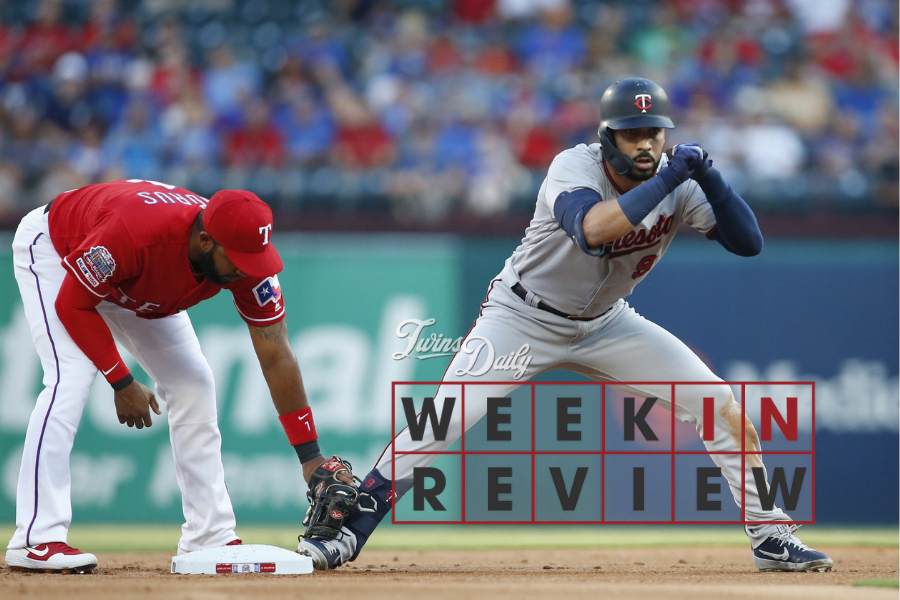 Weekly Snapshot: Mon, 8/12 through Sun, 8/18 *** Record Last Week: 5-1 (Overall: 76-48) Run Differential Last Week: +17 (Overall: +144) Standing: 1st Place in AL Central (2.5 GA) Willians Watch: ON THE COMEBACK TRAIL It's been nearly two months since our guy Willians Astudillo played in a game for the Twins. But finally, the Tortuga Drought is nearing its end. Astudillo opened up a minor-league rehab stint at Pensacola on Thursday, and naturally, he homered in his first at-bat. This was vintage Willians in every way; on a 1-0 count, he hammered the first pitch in the strike zone deep to left, and proceeded to jog around the bases with his poorly tucked jersey hanging out the back of his pants. In other words, it was a thing of beauty: https://twitter.com/TFTwins/status/1162169675796688898 Following his splashy debut, in which he also drew a walk (!), Astudillo went 4-for-8 with a homer, double and three RBIs on Friday and Saturday. Aside from the fun factor, there are more practical reasons to be excited about Astudillo's pending return. Namely, his presence as a third catcher will make it easier for Rocco Baldelli to use Mitch Garver at other positions, or to pinch-hit Garver for Jason Castro late in a game. However, while La Tortuga has wasted no time showing he's ready to go, Minnesota's roster situation may impede his arrival. It's very possible – likely, even – that the Twins will wait until rosters expand in September to recall the beloved backstop. In other roster moves for the week: The Twins activated Sam Dyson, who looked vastly better after a 10-day spell, tossing four scoreless innings while allowing just one run. Granted, that run did hurt – a game-tying solo shot in Texas – but the offense quickly picked him up. To make room for Dyson, Cody Stashak was optioned to Triple-A. Randy Dobnak headed back to Triple-A with Michael Pineda coming off the injured list on Thursday. Pineda was solid in his first start back but seemed to run out of gas quickly. He got through five innings with three runs allowed, and gave way to Devin Smeltzer who covered the final four frames. Smeltzer was quickly swapped out for Lewis Thorpe, who arrived on Friday. By rotating arms through that final spot in the bullpen, the Twins are managing to keep a fresh long-relief option available pretty much at all times, which is savvy. Ryan Eades was claimed off waivers by Baltimore. With Eades out, Minnesota's 40-man roster stands at 39, leaving one conspicuously open spot... HIGHLIGHTS When the Twins added him as an unexpected splash very late in the offseason. Marwin Gonzalez was viewed as something of an extra luxury – he fixed a problem that did not yet exist, as John aptly put it at the time. But here in the late stages of the summer, he's proving himself to be essential. With his team facing its most critical remaining stretch of the schedule, minus Byron Buxton and Nelson Cruz, Gonzalez has stepped up in a massive way. Following a big series in Cleveland the prior week, where he was 6-for-15 with several clutch hits, Gonzalez absolutely torched the Brewers and Rangers in their home parks, collecting 13 hits in 26 at-bats with nine RBIs while starting all six games. The versatile veteran came through with big hit after big hit all week, leading the charge for an offense that was on its game in averaging 7.8 runs and making up for some shortcomings on pitching and defense. Also contributing to the potent productivity: Rookie sparkplug Luis Arraez amazingly shows no signs of slowing down. You'd think that, with simple regression to the mean, his batting average and OBP would start to sink, but he just keeps taking excellent ABs and getting rewarded for them. Last week he was 6-for-22 with his third homer, two walks and two strikeouts, leaving his line for the season at .342/.412/.447. Once again, Miguel Sano's plate appearances are turning into appointment viewing. The complete contrast from two months ago, when watching him flail was more of a "peek through your fingers" experience, is incredible. Sano and his hitting coaches deserve all the credit in the world. Last week he went 7-for-23 with three home runs and seven walks – par for the course of late. He makes pitchers sweat and preys on the slightest mistakes, harkening back to his glory days as a rookie and a 2017 All-Star. If this dominant Sano is back for good, the heart of the Twins lineup is in great shape. Sano's turnaround should remind us all that baseball seasons are long, slumps come and go, and long-term track records matter. We're seeing a similar case, albeit to a lesser extent, in Jake Cave. The vitriol I was seeing from fans toward this guy, after he struggled through 100 sporadic plate appearances with the Twins, was kinda dumbfounding to me given what he did last year in Minnesota, and this year at Triple-A. Naturally he's coming around – after sitting in Milwaukee, Cave went 6-for-12 while starting three times in the Texas series, and is batting .429 in August. Patience, people! Speaking of patience, Eddie Rosario has rediscovered a semblance of it. After going from June 16th through August 11th without drawing a single unintentional walk, he drew one in each of his first three games last week. Incidentally, he also hit a pair of home runs on the week. It's true that Rosario is capable of producing with the swing-at-everything approach (he did bat .329 over the aforementioned walkless stretch) but I believe he'll be in better position long-term – especially in those high-leverage spotlights he loves so dearly – if he's forcing opposing pitchers to come to him. Even though he had a somewhat quiet week, I see the walks as a very promising sign. Finally, how about a round of applause for Ehire Adrianza? His emergence this year feels like sort of an "icing on the cake" nicety but should not be overlooked. The slick-fielding utilityman has put it all together at the plate, in a way I hoped he might last spring when the starting shortstop was suspended. Adrianza has always shown glimmers of power along with a decent plate approach, and this year at age 29 his skills have come to fruition. He only started twice last week but got into five games and made the most of every chance, going 6-for-12 with zero strikeouts. Since the start of June he's hitting .333/.410/.471. As a final note on the offense, we've gotta give props to Jonathan Schoop. He's seen his playing time fall off a cliff in the second half, both because Arraez has been unreal and because Schoop has been perpetually unable to come through in key moments. He finally bucked that trend on Friday in Texas, with a huge two-run homer late in the game that proved decisive. Schoop made two starts on the week, and has been in the lineup for only five of Minnesota's 14 August games. He's essentially a backup at this point. But he's a dang good one as far as depth and pinch-hitting options go. Hopefully he'll feel a little more confident after that redemptive moment in Arlington. Redemption was the banner headline of the week for the bullpen. We mentioned earlier Dyson's bounce back off the IL. Trevor May was also in pristine form, allowing zero hits and a walk while striking out three over two appearances. Outside of an (admittedly painful) solo homer allowed in the opener against Cleveland, May's been nearly perfect in August, allowing zero runs and only one hit with nine strikeouts and a 15% swinging strike rate. Overall, Twins relievers allowed 11 runs (9 ER) in 22 innings of work, with three of the scores coming on a single swing of the bat in Milwaukee. When Sergio Romo allowed that bomb, it was certainly a low point, but was set up by a bad defensive miscue (see below), and Romo was lights-out in his three other appearances. With Romo and Dyson in the mix, May rolling again, and Zack Littell quietly excelling (he has a 0.96 ERA in 17 appearances dating back to the start of June), this unit suddenly looks pretty strong heading into the final stretch. I'll be curious to see what Thorpe can do as the second lefty if they give him some real opportunities to assert himself. The looming presence of fellow southpaw Ryan O'Rourke, who's allowed one run over six innings at Triple-A since joining up on a minor-league contract, is also intriguing. LOWLIGHTS The defensive performance of Jorge Polanco at shortstop has been a never-ending roller coaster. At times, he goes through stretches where he looks completely serviceable, even mixing in a few flashy plays to resemble something of an asset. And then, there are the downswings where he looks totally unviable. Lately he's been in the latter mode, and it's a stark reminder of just how much sloppy play at the infield's most critical position can hurt you. Polanco committed five errors on the week, running his total to seven in the month of August after he was charged with just nine total through the first four months. All his gaffes last week came on fairly routine plays. The most egregious came when he inexplicably dropped a force-out at second base, delivered right into his glove, but the most damaging was a bounced throw to first that set up Milwaukee's go-ahead (and eventual game-winning) homer on Wednesday. If this is anything like his defensive slumps of the past, Polanco will shake this off eventually and get back to playing at an acceptable level. But his medley of miscues serves to reinforce the narrative that his days at shortstop are numbered, with a move to another position needing to come sooner rather than later. It would be nice if Polanco were offsetting his struggles in the field with impactful performance at the plate, but that hasn't been the case. He did come through with an enormously clutch three-run triple on Sunday, breaking a late tie, but the big bops have been few and far between. Dating back to the start of June he's slashing a mediocre .263/.317/.411, with deteriorating discipline. Given the aforementioned offensive rise from Adrianza, and his clear defensive edge, it'd make sense for the Twins to mix him in more at shortstop over the next few weeks. Not to send a statement to Polanco, but simply to rest up the All-Star and get him right for the stretch run. Speaking of offensive non-factors, C.J. Cron has been in that category for quite a while now. Although his two-run homer on Saturday was a nice sight, it was Cron's first long ball in two weeks, and he's been unable to contribute much in other ways. He went 3-for-19 last week and has been plain-old ineffective since returning from his latest IL stint, with a .656 OPS and zero extra-base hits outside the homers. On Sunday he came up in a crucial spot in the eighth, with runners on the corners, one out, and a contact play in motion. He grounded meekly to short and got the go-ahead run cut down at home. (Thankfully, Polanco came through two ABs later.) Cron has been scuffling for a long time while battling through an inflamed thumb that is pretty clearly still affecting him. Getting him some extra time off, along with Polanco, would seem prudent. Patrick Wozniak had a good piece here over the weekend outlining a platoon scenario for Cron. Would the Twins consider placing him on IL to make room for Astudillo until the end of August, or to make room for Cruz's impending return? While the situations surrounding Polanco and Cron are somewhat concerning, the most troubling lowlight of last week was probably Jose Berrios's start on Saturday. Coughing up seven runs (three earned) in 4 1/3 innings, he ran his ERA up to 8.44 in three August starts. One wonders if he himself could use a little breather – it'd be an affordable luxury for Minnesota with a soft spot in the schedule ahead. The Twins absolutely need him pitching like an ace into the postseason in order to have a chance. The bright side for Berrios was that his sagging velocity rebounded and he actually induced 16 swinging strikes, his highest total in two months. So maybe we just chalk this one up to hot bats in the Texas heat. TRENDING STORYLINE After working as a starter for the first six weeks, before going on the shelf with a shoulder impingement, Brusdar Graterol has been working in relief since his return. On Wednesday, in his second appearance back for Pensacola, he entered in the eighth and picked up the final four outs, notching the save in a 9-7 victory. He followed on Saturday with two perfect relief frames for the Blue Wahoos, mixing in a strikeout with five grounders. Then, on Sunday, the Twins promoted Graterol to Triple-A, perhaps for one last test-run ahead of a big-league debut. About that open 40-man spot... https://twitter.com/BlueWahoosBBall/status/1162898690207563776 This is exciting stuff and we'll be tracking it very closely. Graterol, still only 20 and touching nearly 104 MPH on the gun as a reliever, has the potential to be a real difference-maker in the Twins bullpen for September and (hopefully) beyond. DOWN ON THE FARM As the Twins continue to search for answers in the late innings, last summer's Ryan Pressly trade is haunting them like a walk in the Metrodome. Minnesota gave up control of a reliever who now ranks among the league's very best, while their bullpen suffers. Not only that, but Pressly is doing it for a chief rival in the American League. It's not all bleak, though. There have been positive recent developments with the prospects who came back in exchange for Pressly. Jorge Alcala, the headlining arm, has mostly been a disappointments since arriving, and owns a 5.87 ERA overall at Pensacola this year. But in late July, the Twins finally stopped trying to use him as a starter, shifting him to a more suitable bullpen role. He has since allowed only two runs on seven hits and two walks in 10 2/3 innings, with seven strikeouts. The Twins announced on Sunday he's moving up to Triple-A along with Graterol, so Alcala too has the potential to impact this pennant race with his high-powered arm. And then there's Gilberto Celestino, a younger outfielder who came over alongside Alcala. He struggled mightily through the first two months at Cedar Rapids this year, putting up a fruitless .219/.299/.290 slash line, but has completely turned things around this summer. Since the start of June he's at .322/.389/.506, including .407/.467/.630 in his past 20 games. The 20-year-old brings standout speed and increasingly evident power. When you talk about "helium guys" in the Twins system, Celestino's near the top of the list. LOOKING AHEAD The good news is that Minnesota took advantage of its favorable schedule to re-stake a 2.5-game lead in the Central last week. The better news is that they're well positioned to build on this momentum in the week ahead. You can't really ask for an easier slate than the White Sox and Tigers at home, although the Twins will have to deal with Lucas Giolito and Matthew Boyd. Meanwhile, Cleveland is heading into Citi Field to face Marcus Stroman, Noah Syndergaard, and the Mets before returning home to welcome (with a huge sigh of relief) the Royals. Oh, and by the way, Cruz is expected back on Monday. MONDAY, 8/19: WHITE SOX @ TWINS – RHP Ivan Nova v. RHP Kyle Gibson TUESDAY, 8/20: WHITE SOX @ TWINS – RHP Reynaldo Lopez v. RHP Michael Pineda WEDNESDAY, 8/21: WHITE SOX @ TWINS – RHP Lucas Giolito v. RHP Jake Odorizzi FRIDAY, 8/23: TIGERS @ TWINS – LHP Matthew Boyd v. RHP Jose Berrios SATURDAY, 8/24: TIGERS @ TWINS – RHP Edwin Jackson v. LHP Martin Perez SUNDAY, 8/25: TIGERS @ TWINS – RHP Spencer Turnbull v. RHP Kyle Gibson Catch Up On Twins Daily Game Recaps Game 119 | MIN 7, MIL 5: Marwin Comes Up Clutch To Put the Twins Back in First Place Game 120 | MIL 6, MIN 5: Twins Can’t Sweep, Polanco Commits Costly Error Game 121 | MIN 13, TEX 6: Pineda Solid While Offense Provides Plenty Game 122 | MIN 4, TEX 3: Twins Prevail Behind Clutch Schoop HR, Great Bullpen Performance Game 123 | MIN 12, TEX 7: Twins Win Slugfest in Texas Game 124 | MIN 6, TEX 3: Polanco Leads Twins Over Lynn in Texas
 -
Complete embarrassment for Rangers. This is the dumbest notion of an "unwritten rule" I've ever seen on a baseball field. It's less insulting to sit there with the bat on your shoulder while the pitcher continues to miss the zone with an 8-run deficit?
- 93 replies
-
- 14
-
-
- jake cave
- max kepler
- (and 2 more)
-
Over the past week, Minnesota had an opportunity to solidify its legitimacy as contenders with matchups against quality competition in front of home crowds at Target Field. Instead, the Twins stumbled through their worst week of the year, casting serious doubt on their championship viability while watching a long-held division lead evaporate. Let's assess the damage. Weekly Snapshot: Mon, 8/5 through Sun, 8/11 *** Record Last Week: 2-5 (Overall: 71-47) Run Differential Last Week: -14 (Overall: +127) Standing: Tied for 1st Place in AL Central Willians Watch: Out Indefinitely Exactly one week after losing Byron Buxton to a shoulder injury that will likely sideline him through at least the end of August, the Twins sustained another devastating blow with the loss of Nelson Cruz, who came up wincing on a swing-and-miss in Thursday's opener against Cleveland. Prior to last week, Cruz had almost single-handedly powered Minnesota through a 7-2 stretch against the Marlins, White Sox, and Royals with eight homers and 19 RBIs. His diagnosis of a ruptured tendon is actually being portrayed as relatively positive news, but we'll see. The Twins have fumbled away an opportunity to show something against quality competition since the All-Star break, sandwiching their successful run against the aforementioned basement-dwellers with a 7-12 record against the Mets, A's, Yankees, Braves, and Indians. The lack of effectiveness against these teams is going to make it hard for anyone to feel confident in Minnesota's outlook for the postseason, even if they're able to ride a soft remaining schedule to a division title or wild-card berth. Outside of Cruz going down, the past week in roster moves was a medley of pitching switches. Cody Stashak was optioned on Tuesday to make room for Kohl Stewart, who himself was sent back down the next day in exchange for Randy Dobnak. On Friday, Stashak was recalled to fill Cruz's vacant roster spot. The Twins aren't exactly trafficking distinguished arms here, but Dobnak's excellent debut on Friday was (as we'll discuss shortly) a shining beam of positivity amidst a pall of darkness. HIGHLIGHTS The week started on a high note, as Miguel Sano extended his resurgent offensive tear with one of the season's biggest hits: a walk-off, two-run homer to beat the Braves at Target Field on Monday. He entered the game with a .901 OPS since the start of June – trailing only Cruz (1.145) and Max Kepler (.909) among Twins hitters. Sano's production tailed off in the latter part of the week, as he went 1-for-14 with with seven strikeouts against Cleveland, but he has rightfully earned his way up to the No. 3 spot in the order with a discerning, punishing plate approach that closely resembles the pre-injury version of himself. Sano's return to form, along with the continuing emergence of Luis Arraez (six more hits last week, including the ninth-inning single that set up Sano's walk-off), has been hugely invigorating for an offense that's otherwise seen several important contributors get hurt or cool off. Sano and Arraez are the straws stirring the drink right now. Pitching-wise it was not a good week in general, but Jake Odorizzi certainly deserves credit for coming up with his best start in two months on Monday, when he held Atlanta to one run over six innings, even though it took him a season-high 109 pitches to accomplish it. He followed with another strong – albeit inefficient – effort on Saturday, tossing 5 2/3 scoreless innings while showing renewed life on his splitter and compiling 17 whiffs. Odorizzi has rebounded nicely after his nine-run clunker against the Yankees in late July, allowing two runs (and only one homer) over 17 1/3 innings in three starts since. The other big highlight of the week, especially for those who love a good underdog story, was the arrival of Dobnak. The 24-year-old right-hander originally came to the Twins organization from an independent league after going undrafted out of college. Despite lacking standout stuff or big strikeout rates, Dobnak rapidly cruised through the minors, opening this season at Single-A and jolting to the majors within four months on the strength of his stifling performance: 11-3 with a 2.02 ERA and 0.98 WHIP between three levels. In his MLB debut on Friday, Dobnak lived up to his statistical profile. He got a few swings and misses but was more dependent on weak contact, unleashing a bevy of sinkers in the zone en route to four shutout innings. When Eddie Rosario went deep with a solo shot on Friday night, it marked a new franchise record for home runs, surpassing the 225 benchmark set by Harmon Killebrew, Bob Allison, and the 1963 Twins. With more than seven weeks remaining on the schedule, this was undeniably a remarkable and impressive feat, but somehow it felt hollow amidst another frustrating week that exposed Minnesota's inability to overcome quality opponents on the basis of this one-dimensional advantage. LOWLIGHTS Outside of Odorizzi, we saw the bottom fall out for the Twins rotation last week. A feisty and tenacious offense did its part but could not dig out of the massive holes built by starters who simply wilted against good lineups in critical spots. On Tuesday, Jose Berrios turned in one of the worst starts of his career, coughing up a whopping nine runs (all earned) over 5 2/3 innings against the Braves. His night started with a home run on the first pitch to Ronald Acuna, and hardly got any better from there as he issued a season-high four walks while yielding nine hits. In his second start of the week on Sunday, Berrios showed improvement, getting through six frames with three runs allowed, but still looked nothing like the ace Minnesota needs him to be. Fighting through diminished velocity and a scarcity of swinging strikes, Berrios is setting off alarm bells right now. On Wednesday, Martin Perez dropped yet another dud, allowing seven runs (six earned) on 11 hits in six innings versus Atlanta. It was the lefty's third time in his last four starts allowing 5+ ER and 3 HR, further endangering a seemingly precarious rotation spot. After coming up with five quality starts in his first seven turns through May 17th, Perez has since delivered only three QS in 13 starts. Bumping him to the bullpen would be a mere formality at this point if a clear upgrade were readily available. But Michael Pineda remains on the IL and Devin Smeltzer tarnished his case on Friday with a thrashing at the hands of Cleveland, coughing up seven runs (six earned) in just 4 1/3 innings in a game that could've taken a major toll on the bullpen if not for Dobnak. We've seen a lot of good from Smeltzer this year, but his two letdowns have been exceedingly painful since both came against the Indians. Makes it a little tough to count on him. All those lowlights aside, the biggest flub of the week from my perspective was Kyle Gibson's start on Thursday to kick off the Cleveland series. It wasn't the worst performance we saw from a Twins pitcher but given all the circumstances, I view it as maybe the low point of Gibson's career in Minnesota. All of Gibson's worst traits were on display in a tone-setting struggle against Cleveland's lineup. He was constantly timid around the zone, piling up six walks in 4 1/3 innings while throwing more balls (43) than strikes (42). His tenseness on the mound manifested in the second when he botched a pickoff throw, allowing a run to score. I've always considered myself a Gibby defender. He's a homegrown, drafted-and-developed pitcher who's been a quality organizational citizen – a likable guy that embraced analytics and outside-the-box techniques to reinvent himself. He's an above-average starter who occasionally flashes dominance, and I personally believe he has earned the opportunity to play a key role in Minnesota's first real playoff push since he's been in the majors. But he's running out of time to alter the narrative that he can't get it done against dangerous lineups when the team really needs him to step up. This latest outing was unfortunately the kind that may well end up defining his legacy with the Twins. There are few series remaining against offenses that pose a real threat, and if Gibson can't buck his trend and come through in those opportunities (starting with Milwaukee on Wednesday), he probably won't get a chance to bolster his legacy – and free agent stock – in the postseason. TRENDING STORYLINE Our worst fears have been realized. The Twins have seen what was once an 11.5-game lead in the AL Central vanish entirely. Despite some grumblings to the contrary, this is due to Cleveland's torrid play more than any ostensible "collapse" from Minnesota, whose degradation from unstoppable force in the early months to a merely mortal and solid unit still leaves them 24 games above .500, and on a 97-win pace. With that said, this team is clearly confronting a moment of truth. They are watching their once-firm grasp on the Central disappear before their very eyes. The Twins are playing their worst ball of the season as the Indians play their best, and as a result, a division title – and even a playoff entry – are very much in doubt. The front office didn't take especially decisive action at the deadline, and while your mileage may vary on this strategy, I'm okay with protecting prime minor-league assets. Sustainability is an important consideration. Having said that, this is a crucial window of opportunity. You can't assume you'll find yourself in this position next year. The Twins need to do whatever they can to maximize their chances, not just of reaching October but of making a run there. Does that mean taking the drastic step of, say, calling up Alex Kirilloff or Trevor Larnach from Double-A? Larnach has been raking in August and Kirilloff's pure raw talent supersedes his ordinary numbers. These are lightning-in-a-bottle type additions capable of sparking a lineup that feels very incomplete sans Buxton and Cruz. An even more intriguing option, given the club's needs, would be Brusdar Graterol, the flame-throwing righty who returned to the Double-A mound last week, striking out three of the six batters he faced in a relief appearance for the Blue Wahoos. This pitching staff needs a difference-maker. Graterol could be it. And the silver lining of his shoulder injury, which sidelined him for more than two months, is that the downtime kept his innings total in check. The problem, in any of these scenarios, is twofold: First, you're talking about throwing inexperienced youngsters who are still acclimating to the Double-A level into a major-league pennant race. It's an insane amount of pressure, and the kind of thing that could adversely affect development if it goes poorly. Second, you're starting the service clock on players who are still probably a ways away from being full-time big-league contributors. In the case of Graterol, who's still just 20 years old, you'd be setting him up to potentially be out of options by age 23. Then again, those are the kinds of risks you necessarily take when you're in it. And the Twins are very much in it. We'll see hold bold this regime can be. DOWN ON THE FARM If the Twins were feeling hints of buyer's remorse for the Sergio Romo trade, which sent prospect Lewin Diaz to the Marlins, they might have gotten some relief over the weekend. Yes, Diaz has been on an absolute tear since joining Miami's Double-A affiliate, with five home runs in 13 games. And the pitching prospect Minnesota got back in the swap, Chris Vallimont, was shelled in his first start for the Miracle. But Romo's been very good and Vallimont bounced back in a big way on Friday, carrying a no-hitter into the eighth and finishing with seven superlative innings. Diaz definitely looks like a player, but all-in-all, the Twins will happily swap out a defensively limited hitter for pitching upside at this point. Vallimont has some real steam in prospect circles and in his second start with his new organization, he showed why. Speaking of pitchers, one other development worth watching on the minor-league front: Trevor Hildenberger opened up a rehab stint in the Gulf Coast League on Saturday, logging a scoreless inning against the Red Sox affiliate. It was his first official appearance since June 8th. Who knows what to expect from Hildenberger at this point, but if he can find any semblance of his old form it could provide a much-needed infusion for the big-league bullpen. Stephen Gonsalves also returned to the mound in the GCL following a long injury layoff, but seems much less likely to be a factor for the Twins down the stretch. LOOKING AHEAD Another tough week awaits, with Minnesota heading across the border to face Christian Yelich and the Brewers, then traveling south for four games against Texas in the August Arlington heat. These aren't great teams, but they're good teams, and both will present a brisk challenge for the reeling Twins. Afterwards, the schedule gets much easier – 12 straight games against the White Sox and Tigers – but a winning week ahead will be important, both for keeping pace with the unrelenting Indians, and for restoring confidence. TUESDAY, 8/13: TWINS @ BREWERS – LHP Martin Perez v. RHP Chase Anderson WEDNESDAY, 8/14: TWINS @ BREWERS – RHP Kyle Gibson v. LHP Gio Gonzalez THURSDAY, 8/15: TWINS @ RANGERS – LHP Devin Smeltzer v. RHP Pedro Payano FRIDAY, 8/16: TWINS @ RANGERS – RHP Jake Odorizzi v. LHP Mike Minor SATURDAY, 8/17: TWINS @ RANGERS – RHP Jose Berrios v. RHP Ariel Jurado SUNDAY, 8/18: TWINS @ RANGERS – LHP Martin Perez v. RHP Lance Lynn Catch Up On Twins Daily Game Recaps Game 112 | MIN 5, ATL 3: May Throws Fire, Sano Launches a Walk-Off Bomb in Twins WinGame 113 | ATL 12, MIN 7: Berrios Bad Night Leads to Braves BlowoutGame 114 | ATL 11, MIN 7: Perez Struggles and Offense is Too Late in Rubber MatchGame 115 | CLE 7, MIN 5: Gibson Struggles, Late-Inning Rallies Fall ShortGame 116 | CLE 6, MIN 2: Twins Set Home Run Record, Lose to ClevelandGame 117 | MIN 4, CLE 1: Odorizzi Solid, Offense Takes Advantage of Key OpportunitiesGame 118 | CLE 7, MIN 3: Frustrating Loss Marred by Heartbreaking Moments Click here to view the article
- 18 replies
-
- 2
-
-
- kyle gibson
- jake odorizzi
- (and 3 more)
-
 Weekly Snapshot: Mon, 8/5 through Sun, 8/11 *** Record Last Week: 2-5 (Overall: 71-47) Run Differential Last Week: -14 (Overall: +127) Standing: Tied for 1st Place in AL Central Willians Watch: Out Indefinitely Exactly one week after losing Byron Buxton to a shoulder injury that will likely sideline him through at least the end of August, the Twins sustained another devastating blow with the loss of Nelson Cruz, who came up wincing on a swing-and-miss in Thursday's opener against Cleveland. Prior to last week, Cruz had almost single-handedly powered Minnesota through a 7-2 stretch against the Marlins, White Sox, and Royals with eight homers and 19 RBIs. His diagnosis of a ruptured tendon is actually being portrayed as relatively positive news, but we'll see. The Twins have fumbled away an opportunity to show something against quality competition since the All-Star break, sandwiching their successful run against the aforementioned basement-dwellers with a 7-12 record against the Mets, A's, Yankees, Braves, and Indians. The lack of effectiveness against these teams is going to make it hard for anyone to feel confident in Minnesota's outlook for the postseason, even if they're able to ride a soft remaining schedule to a division title or wild-card berth. Outside of Cruz going down, the past week in roster moves was a medley of pitching switches. Cody Stashak was optioned on Tuesday to make room for Kohl Stewart, who himself was sent back down the next day in exchange for Randy Dobnak. On Friday, Stashak was recalled to fill Cruz's vacant roster spot. The Twins aren't exactly trafficking distinguished arms here, but Dobnak's excellent debut on Friday was (as we'll discuss shortly) a shining beam of positivity amidst a pall of darkness. HIGHLIGHTS The week started on a high note, as Miguel Sano extended his resurgent offensive tear with one of the season's biggest hits: a walk-off, two-run homer to beat the Braves at Target Field on Monday. He entered the game with a .901 OPS since the start of June – trailing only Cruz (1.145) and Max Kepler (.909) among Twins hitters. Sano's production tailed off in the latter part of the week, as he went 1-for-14 with with seven strikeouts against Cleveland, but he has rightfully earned his way up to the No. 3 spot in the order with a discerning, punishing plate approach that closely resembles the pre-injury version of himself. Sano's return to form, along with the continuing emergence of Luis Arraez (six more hits last week, including the ninth-inning single that set up Sano's walk-off), has been hugely invigorating for an offense that's otherwise seen several important contributors get hurt or cool off. Sano and Arraez are the straws stirring the drink right now. Pitching-wise it was not a good week in general, but Jake Odorizzi certainly deserves credit for coming up with his best start in two months on Monday, when he held Atlanta to one run over six innings, even though it took him a season-high 109 pitches to accomplish it. He followed with another strong – albeit inefficient – effort on Saturday, tossing 5 2/3 scoreless innings while showing renewed life on his splitter and compiling 17 whiffs. Odorizzi has rebounded nicely after his nine-run clunker against the Yankees in late July, allowing two runs (and only one homer) over 17 1/3 innings in three starts since. The other big highlight of the week, especially for those who love a good underdog story, was the arrival of Dobnak. The 24-year-old right-hander originally came to the Twins organization from an independent league after going undrafted out of college. Despite lacking standout stuff or big strikeout rates, Dobnak rapidly cruised through the minors, opening this season at Single-A and jolting to the majors within four months on the strength of his stifling performance: 11-3 with a 2.02 ERA and 0.98 WHIP between three levels. In his MLB debut on Friday, Dobnak lived up to his statistical profile. He got a few swings and misses but was more dependent on weak contact, unleashing a bevy of sinkers in the zone en route to four shutout innings. When Eddie Rosario went deep with a solo shot on Friday night, it marked a new franchise record for home runs, surpassing the 225 benchmark set by Harmon Killebrew, Bob Allison, and the 1963 Twins. https://twitter.com/Twins/status/1160358103545798658 With more than seven weeks remaining on the schedule, this was undeniably a remarkable and impressive feat, but somehow it felt hollow amidst another frustrating week that exposed Minnesota's inability to overcome quality opponents on the basis of this one-dimensional advantage. LOWLIGHTS Outside of Odorizzi, we saw the bottom fall out for the Twins rotation last week. A feisty and tenacious offense did its part but could not dig out of the massive holes built by starters who simply wilted against good lineups in critical spots. On Tuesday, Jose Berrios turned in one of the worst starts of his career, coughing up a whopping nine runs (all earned) over 5 2/3 innings against the Braves. His night started with a home run on the first pitch to Ronald Acuna, and hardly got any better from there as he issued a season-high four walks while yielding nine hits. In his second start of the week on Sunday, Berrios showed improvement, getting through six frames with three runs allowed, but still looked nothing like the ace Minnesota needs him to be. Fighting through diminished velocity and a scarcity of swinging strikes, Berrios is setting off alarm bells right now. On Wednesday, Martin Perez dropped yet another dud, allowing seven runs (six earned) on 11 hits in six innings versus Atlanta. It was the lefty's third time in his last four starts allowing 5+ ER and 3 HR, further endangering a seemingly precarious rotation spot. After coming up with five quality starts in his first seven turns through May 17th, Perez has since delivered only three QS in 13 starts. Bumping him to the bullpen would be a mere formality at this point if a clear upgrade were readily available. But Michael Pineda remains on the IL and Devin Smeltzer tarnished his case on Friday with a thrashing at the hands of Cleveland, coughing up seven runs (six earned) in just 4 1/3 innings in a game that could've taken a major toll on the bullpen if not for Dobnak. We've seen a lot of good from Smeltzer this year, but his two letdowns have been exceedingly painful since both came against the Indians. Makes it a little tough to count on him. All those lowlights aside, the biggest flub of the week from my perspective was Kyle Gibson's start on Thursday to kick off the Cleveland series. It wasn't the worst performance we saw from a Twins pitcher but given all the circumstances, I view it as maybe the low point of Gibson's career in Minnesota. All of Gibson's worst traits were on display in a tone-setting struggle against Cleveland's lineup. He was constantly timid around the zone, piling up six walks in 4 1/3 innings while throwing more balls (43) than strikes (42). His tenseness on the mound manifested in the second when he botched a pickoff throw, allowing a run to score. I've always considered myself a Gibby defender. He's a homegrown, drafted-and-developed pitcher who's been a quality organizational citizen – a likable guy that embraced analytics and outside-the-box techniques to reinvent himself. He's an above-average starter who occasionally flashes dominance, and I personally believe he has earned the opportunity to play a key role in Minnesota's first real playoff push since he's been in the majors. But he's running out of time to alter the narrative that he can't get it done against dangerous lineups when the team really needs him to step up. This latest outing was unfortunately the kind that may well end up defining his legacy with the Twins. There are few series remaining against offenses that pose a real threat, and if Gibson can't buck his trend and come through in those opportunities (starting with Milwaukee on Wednesday), he probably won't get a chance to bolster his legacy – and free agent stock – in the postseason. TRENDING STORYLINE Our worst fears have been realized. The Twins have seen what was once an 11.5-game lead in the AL Central vanish entirely. Despite some grumblings to the contrary, this is due to Cleveland's torrid play more than any ostensible "collapse" from Minnesota, whose degradation from unstoppable force in the early months to a merely mortal and solid unit still leaves them 24 games above .500, and on a 97-win pace. With that said, this team is clearly confronting a moment of truth. They are watching their once-firm grasp on the Central disappear before their very eyes. The Twins are playing their worst ball of the season as the Indians play their best, and as a result, a division title – and even a playoff entry – are very much in doubt. The front office didn't take especially decisive action at the deadline, and while your mileage may vary on this strategy, I'm okay with protecting prime minor-league assets. Sustainability is an important consideration. Having said that, this is a crucial window of opportunity. You can't assume you'll find yourself in this position next year. The Twins need to do whatever they can to maximize their chances, not just of reaching October but of making a run there. Does that mean taking the drastic step of, say, calling up Alex Kirilloff or Trevor Larnach from Double-A? Larnach has been raking in August and Kirilloff's pure raw talent supersedes his ordinary numbers. These are lightning-in-a-bottle type additions capable of sparking a lineup that feels very incomplete sans Buxton and Cruz. An even more intriguing option, given the club's needs, would be Brusdar Graterol, the flame-throwing righty who returned to the Double-A mound last week, striking out three of the six batters he faced in a relief appearance for the Blue Wahoos. This pitching staff needs a difference-maker. Graterol could be it. And the silver lining of his shoulder injury, which sidelined him for more than two months, is that the downtime kept his innings total in check. The problem, in any of these scenarios, is twofold: First, you're talking about throwing inexperienced youngsters who are still acclimating to the Double-A level into a major-league pennant race. It's an insane amount of pressure, and the kind of thing that could adversely affect development if it goes poorly. Second, you're starting the service clock on players who are still probably a ways away from being full-time big-league contributors. In the case of Graterol, who's still just 20 years old, you'd be setting him up to potentially be out of options by age 23. Then again, those are the kinds of risks you necessarily take when you're in it. And the Twins are very much in it. We'll see hold bold this regime can be. DOWN ON THE FARM If the Twins were feeling hints of buyer's remorse for the Sergio Romo trade, which sent prospect Lewin Diaz to the Marlins, they might have gotten some relief over the weekend. Yes, Diaz has been on an absolute tear since joining Miami's Double-A affiliate, with five home runs in 13 games. And the pitching prospect Minnesota got back in the swap, Chris Vallimont, was shelled in his first start for the Miracle. But Romo's been very good and Vallimont bounced back in a big way on Friday, carrying a no-hitter into the eighth and finishing with seven superlative innings. Diaz definitely looks like a player, but all-in-all, the Twins will happily swap out a defensively limited hitter for pitching upside at this point. Vallimont has some real steam in prospect circles and in his second start with his new organization, he showed why. Speaking of pitchers, one other development worth watching on the minor-league front: Trevor Hildenberger opened up a rehab stint in the Gulf Coast League on Saturday, logging a scoreless inning against the Red Sox affiliate. It was his first official appearance since June 8th. Who knows what to expect from Hildenberger at this point, but if he can find any semblance of his old form it could provide a much-needed infusion for the big-league bullpen. Stephen Gonsalves also returned to the mound in the GCL following a long injury layoff, but seems much less likely to be a factor for the Twins down the stretch. LOOKING AHEAD Another tough week awaits, with Minnesota heading across the border to face Christian Yelich and the Brewers, then traveling south for four games against Texas in the August Arlington heat. These aren't great teams, but they're good teams, and both will present a brisk challenge for the reeling Twins. Afterwards, the schedule gets much easier – 12 straight games against the White Sox and Tigers – but a winning week ahead will be important, both for keeping pace with the unrelenting Indians, and for restoring confidence. TUESDAY, 8/13: TWINS @ BREWERS – LHP Martin Perez v. RHP Chase Anderson WEDNESDAY, 8/14: TWINS @ BREWERS – RHP Kyle Gibson v. LHP Gio Gonzalez THURSDAY, 8/15: TWINS @ RANGERS – LHP Devin Smeltzer v. RHP Pedro Payano FRIDAY, 8/16: TWINS @ RANGERS – RHP Jake Odorizzi v. LHP Mike Minor SATURDAY, 8/17: TWINS @ RANGERS – RHP Jose Berrios v. RHP Ariel Jurado SUNDAY, 8/18: TWINS @ RANGERS – LHP Martin Perez v. RHP Lance Lynn Catch Up On Twins Daily Game Recaps Game 112 | MIN 5, ATL 3: May Throws Fire, Sano Launches a Walk-Off Bomb in Twins Win Game 113 | ATL 12, MIN 7: Berrios Bad Night Leads to Braves Blowout Game 114 | ATL 11, MIN 7: Perez Struggles and Offense is Too Late in Rubber Match Game 115 | CLE 7, MIN 5: Gibson Struggles, Late-Inning Rallies Fall Short Game 116 | CLE 6, MIN 2: Twins Set Home Run Record, Lose to Cleveland Game 117 | MIN 4, CLE 1: Odorizzi Solid, Offense Takes Advantage of Key Opportunities Game 118 | CLE 7, MIN 3: Frustrating Loss Marred by Heartbreaking Moments
 -
Twins fans watching their prized deadline acquisition:
-
Maybe there was nothing to see. These were literally the last four appearances before they traded for him so, again, the heightened relevance seems self-evident to me. I didn't "cherry-pick" four appearances from mid-May. The swinging strikes are a piece of the puzzle that caught my attention — granted, with the benefit of hindsight, having watched him get shelled while fooling nobody in his first two appearances for MN. What we know (now) is that Dyson was pitching through an arm issue, which worsened as soon as he got here leading to an implosion and a very poorly timed IL stint. Were there indicators in his recent performance that could've been seen? Reduced movement on his pitches? Small lapses in command? I don't know, but then again I don't have the full resources of a sophisticated analytical operation. I think it's quite a stretch to equate me saying I find it hard to let Falvey & Levine "off the hook entirely" with saying they "didn't do their jobs." Anyone who reads my writing here regularly knows I have an extremely favorable view of this front office, which is why the whole situation hits me in such a weird way. I thought it was made clear I hold Dyson most accountable.
-
To claim I'm cherry-picking would suggest I selected this date range based on what he said, which I didn't. Did you miss the part where I was referencing a casual remark made before he said any of this?
-
It's not a cherry-pick. On Sunday when putting together my column I noted that he had only one swinging strike on 38 pitches as a Twin, and thought it seemed strikingly low. Then, I looked at his game logs and noticed this scarcity of whiffs seemed to date back a little further, so I made mention of it. So when he came out the following day and said, "Yeah, I've been pitching through this for a while," I felt the correlation might be worth revisiting. Injuries don't always manifest in one's performance instantly. You can disagree with the meaningfulness of the data but settle down over there.
-
True to an extent, but players need to know their bodies, limits and thresholds. It's part of being a professional athlete. If he was in pain lifting a plate at home, he probably shouldn't have been on the mound pitching in important spots for a first-place team. I get how he'd feel confident pitching through it based on the results in those final appearances with the Giants, but after his meltdown in the Twins debut? Come on.
-
Great stuff mike! That's an awesome historical comp. Also, I loved this line: "You can not legislate injuries. No rules can eliminate the dangers for men who are taught to always play hard." Perfectly stated.
-
The Minnesota Twins acted at the deadline and acquired the impact relief help they badly needed. One week later, in the wake of a catastrophic series of events, they are heading into their most important series of the season without their premier addition at their disposal. The fishy circumstances behind this situation reflect poorly on either Sam Dyson, the Twins, the Giants, or perhaps all three parties. Whatever the case, it's very bad news for Minnesota.He wasn't the sexiest pickup in everyone's eyes, but from all available evidence, Dyson was the high-caliber reinforcement this bullpen required at a minimum. He's been a mostly consistent performer at the back end of MLB bullpens for the past five years and was enjoying an excellent season as setup man for San Francisco, ranking among the league's leading relievers in Win Probability Added. Against this backdrop, Dyson's immediate collapse for the Twins was a total shock to the system. He completely imploded in his debut, blowing a three-run save against the Marlins in an eventual loss, which carried the added negative of burning a Taylor Rogers appearance. The following night, he came back out against a similarly bad Royals offense and looked similarly terrible, coughing up three runs on four hits while recording only two outs, endangering a blowout victory. In both games, the performance matched the results. Dyson didn't look as bad as the assortment of Quad-A relief arms who've briefly passed through Minnesota this year – he looked worse. The right-hander's execution was nonexistent as he consistently missed targets and fell behind in counts before serving up beach balls. When news surfaced on Sunday that Dyson was battling biceps tendinitis and would be heading to the injured list, the revelation wasn't surprising, but it was upsetting. And the details we've seen bleed out in the days since cast an ominous cloud over the entire ordeal. To recap... Dyson told reporters on Monday he's been dealing with "an issue" in his shoulder that dates back to around two weeks before he was traded, adding that he was "just grinding through it the whole time" while costing the Twins dearly in his two appearances. As I see it, there are three possible explanations for what happened here. 1: The Giants did in fact know, or suspect, that Dyson was playing hurt before they traded him, and failed to inform the Twins of it. Not unprecedented, but this would be grounds for Minnesota to seek recourse through the league office, and there've been no rumblings of such. 2: The Giants knew or suspected that he was hurt and made it known to the Twins, who traded for him anyway. This isn't unthinkable, because the ailment affecting Dyson – if it's indeed only a routine bout of tendinitis – isn't all that uncommon or concerning on its face. But I find this hard to believe. Is a front office that's known for fiercely protecting its minor-league assets going to trade three prospects for a guy with an aching arm? And even if so, are they going to throw him into a game right off the plane with said bum wing? Then AGAIN the next day after he looked horrendous in his debut?! I find it impossible to believe the Twins were aware of this affliction until after his second appearance. Which leads us to our third and most likely scenario... 3: Dyson did not tell the Giants he was hurting, and also gave the Twins no indications of it until he'd been walloped in two straight outings. This would be fairly typical for a professional ballplayer – gutting it out in the name of "toughness" while hurting yourself and your team in the process. It's a toxic mindset, and one that this new Twins front office has admirably rooted out. The 2019 Twins have largely avoided lengthy absences and setbacks because they seem to foster an open, honest environment where players are forthright about nagging pains and noticeable discomfort. Minnesota's strategy of playing it cautiously at almost every turn has worked out well. So if this is indeed what happened, Dyson is bringing an immediate culture clash that is far more problematic to me than a couple of rough pitching performances. That I can handle. But taking the mound in important spots for a contending team when you know something's wrong (and this wasn't exactly minor; he claims he could feel it when "picking a plate up in the kitchen or putting [his] (expletive) clothes on")? Pretty inexcusable in my eyes. A terrible first impression from a guy who was too stubbornly focused on creating the opposite. Having said all that, I have a hard time letting Derek Falvey and Thad Levine off the hook entirely, even if they weren't made aware of this arm problem. I remarked in my Week in Review column on Sunday, published before Dyson revealed that the issue had been affecting him for half a month, that his "issue actually appears to date back a ways; in his last four appearances with the Giants, he got only one swing-and-miss on 42 pitches after inducing 18 in his first eight July outings (15% rate)." In my mind, when a pitcher who's accustomed to missing bats suddenly stops doing so in such stark fashion, it's one of the clearest indicators something is wrong. One swinging strike on 42 pitches is egregious; by comparison, Ehire Adrianza got two swinging strikes on 14 pitches when he threw an inning against the Mets in July. Now, after pitching twice for the Twins, Dyson has induced two whiffs on his last 80 pitches. He's broken. He was starting to break before he got here. But because he failed to report it and the Twins failed to notice it, he yielded two costly meltdowns on the hill, and is unavailable for the most pivotal stretch of the season. Hopefully the bullpen can get by without him, and a little rest serves as the fix he needs. But for now, this is looking like one of the biggest deadline duds in memory, and a fiasco that – unlike most of Byron Buxton's bad breaks – could've and should've been avoided. Click here to view the article
-
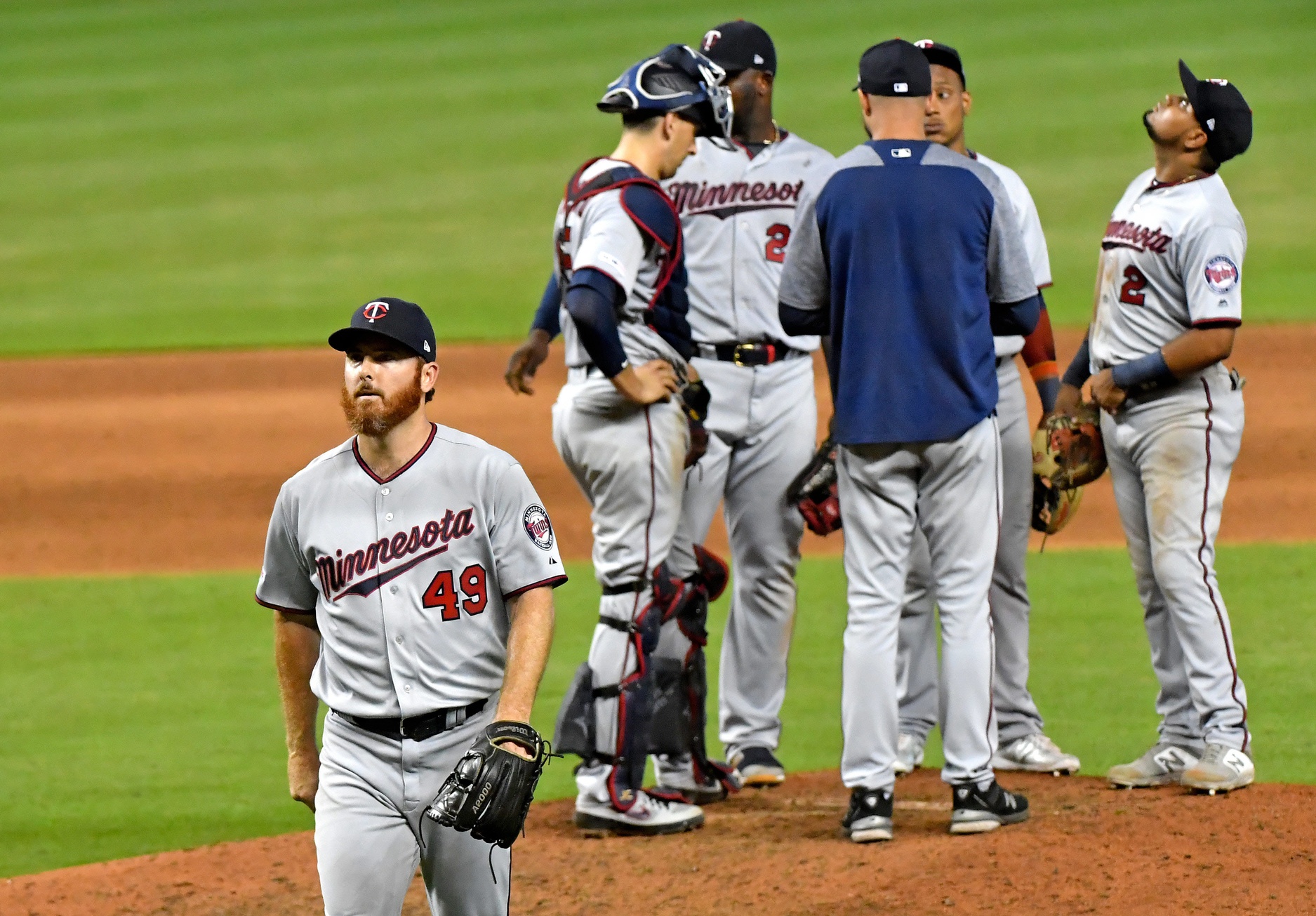 He wasn't the sexiest pickup in everyone's eyes, but from all available evidence, Dyson was the high-caliber reinforcement this bullpen required at a minimum. He's been a mostly consistent performer at the back end of MLB bullpens for the past five years and was enjoying an excellent season as setup man for San Francisco, ranking among the league's leading relievers in Win Probability Added. Against this backdrop, Dyson's immediate collapse for the Twins was a total shock to the system. He completely imploded in his debut, blowing a three-run save against the Marlins in an eventual loss, which carried the added negative of burning a Taylor Rogers appearance. The following night, he came back out against a similarly bad Royals offense and looked similarly terrible, coughing up three runs on four hits while recording only two outs, endangering a blowout victory. In both games, the performance matched the results. Dyson didn't look as bad as the assortment of Quad-A relief arms who've briefly passed through Minnesota this year – he looked worse. The right-hander's execution was nonexistent as he consistently missed targets and fell behind in counts before serving up beach balls. When news surfaced on Sunday that Dyson was battling biceps tendinitis and would be heading to the injured list, the revelation wasn't surprising, but it was upsetting. And the details we've seen bleed out in the days since cast an ominous cloud over the entire ordeal. To recap... Dyson told reporters on Monday he's been dealing with "an issue" in his shoulder that dates back to around two weeks before he was traded, adding that he was "just grinding through it the whole time" while costing the Twins dearly in his two appearances. https://twitter.com/DaneMizutani/status/1158501551805206530 By all accounts, the Giants were not explicitly aware of Dyson's ailment. Although La Velle doesn't sound entirely convinced in his tweet here: https://twitter.com/LaVelleNeal/status/1158863783265284097 As I see it, there are three possible explanations for what happened here. 1: The Giants did in fact know, or suspect, that Dyson was playing hurt before they traded him, and failed to inform the Twins of it. Not unprecedented, but this would be grounds for Minnesota to seek recourse through the league office, and there've been no rumblings of such. 2: The Giants knew or suspected that he was hurt and made it known to the Twins, who traded for him anyway. This isn't unthinkable, because the ailment affecting Dyson – if it's indeed only a routine bout of tendinitis – isn't all that uncommon or concerning on its face. But I find this hard to believe. Is a front office that's known for fiercely protecting its minor-league assets going to trade three prospects for a guy with an aching arm? And even if so, are they going to throw him into a game right off the plane with said bum wing? Then AGAIN the next day after he looked horrendous in his debut?! I find it impossible to believe the Twins were aware of this affliction until after his second appearance. Which leads us to our third and most likely scenario... 3: Dyson did not tell the Giants he was hurting, and also gave the Twins no indications of it until he'd been walloped in two straight outings. This would be fairly typical for a professional ballplayer – gutting it out in the name of "toughness" while hurting yourself and your team in the process. It's a toxic mindset, and one that this new Twins front office has admirably rooted out. The 2019 Twins have largely avoided lengthy absences and setbacks because they seem to foster an open, honest environment where players are forthright about nagging pains and noticeable discomfort. Minnesota's strategy of playing it cautiously at almost every turn has worked out well. So if this is indeed what happened, Dyson is bringing an immediate culture clash that is far more problematic to me than a couple of rough pitching performances. That I can handle. But taking the mound in important spots for a contending team when you know something's wrong (and this wasn't exactly minor; he claims he could feel it when "picking a plate up in the kitchen or putting [his] (expletive) clothes on")? Pretty inexcusable in my eyes. A terrible first impression from a guy who was too stubbornly focused on creating the opposite. Having said all that, I have a hard time letting Derek Falvey and Thad Levine off the hook entirely, even if they weren't made aware of this arm problem. I remarked in my Week in Review column on Sunday, published before Dyson revealed that the issue had been affecting him for half a month, that his "issue actually appears to date back a ways; in his last four appearances with the Giants, he got only one swing-and-miss on 42 pitches after inducing 18 in his first eight July outings (15% rate)." In my mind, when a pitcher who's accustomed to missing bats suddenly stops doing so in such stark fashion, it's one of the clearest indicators something is wrong. One swinging strike on 42 pitches is egregious; by comparison, Ehire Adrianza got two swinging strikes on 14 pitches when he threw an inning against the Mets in July. Now, after pitching twice for the Twins, Dyson has induced two whiffs on his last 80 pitches. He's broken. He was starting to break before he got here. But because he failed to report it and the Twins failed to notice it, he yielded two costly meltdowns on the hill, and is unavailable for the most pivotal stretch of the season. Hopefully the bullpen can get by without him, and a little rest serves as the fix he needs. But for now, this is looking like one of the biggest deadline duds in memory, and a fiasco that – unlike most of Byron Buxton's bad breaks – could've and should've been avoided.
 -
Nelson Cruz could've probably avoided hurting his wrist if he swung less hard. Mitch Garver could avoid foul tips exposing him to concussion risk if he moved to another position. Do you want to take away the parts of these guys' games that primarily fuel their value in the name of lowering risk that is always going to be inherent to playing this game at the highest level?
-
I touched on this over the winter when advocating for the Twins to sign Buxton to an extension: I'm not sure why Buxton or his agent would view an extension in the Polanco/Kepler realm as some sort of affront. All this season has done is reinforce the fact that Buxton's health will likely always be an issue, and potentially a threat to his career. The Twins would be doing him a favor by guaranteeing him a bunch of money; I'd think relenting a couple FA seasons at a bargain rate would be a fair thing to give up in exchange.
-
I'm not saying that at all. In fact I do suspect that his wrist issues last year were tied to previous significant injuries, and I'm always going to be a little worried about that left wrist. But there's nothing he can do about any of that now. He hasn't collided with any teammates or hurt his wrist by diving in the past two years.
-
Your takeaway from the past two years is that Buxton should play through pain MORE often?
-
As I discussed in the article, neither of those plays were reckless. At least in my opinion. You might disagree. There have been countless occasions where he shielded himself to minimize impact against the wall. You don't run around at absurd speeds making the most plays of any CF in baseball and not dive or hit the wall ever.
-
And sometimes, it's just a trend based mostly on luck. J.J. Hardy comes to mind as a prime example; the Twins moved on from him in part because was purportedly "injury-prone." From 2008-2010 he missed an average of 47 games/season due to various (non-related) injuries. In 2011 and 2012 with the Orioles, he played in 317 of 324 games. Also won two Gold Gloves and made an All-Star team. Instructive example, IMO.
-
I'm not sure citing injuries from 4-5 years ago really makes the point that he's defiantly playing in a reckless style. He HAS made adjustments and begun to play smarter. He IS showing more awareness of the wall, and more care when sliding on the basepaths. He's just getting hurt in other ways, and yet many are prone to fall back on the same outdated argument without crediting him for evolving.
