



Nick Nelson
-
Posts
8,327 -
Joined
-
Last visited
-
Days Won
56
Content Type
Profiles
News
Minnesota Twins Videos
2026 Minnesota Twins Top Prospects Ranking
2022 Minnesota Twins Draft Picks
Minnesota Twins Free Agent & Trade Rumors, Notes, & Tidbits
Guides & Resources
2023 Minnesota Twins Draft Picks
The Minnesota Twins Players Project
2024 Minnesota Twins Draft Picks
2025 Minnesota Twins Draft Pick Tracker
2026 Minnesota Twins Draft Tracker: Picks & Bonuses
Forums
Blogs
Events
Store
Downloads
Gallery
Everything posted by Nick Nelson
-
 When bad things happen, we inevitably grasp (and sometimes flail) for answers — solutions and safeguards that might prevent future occurrences. Sometimes these ideas are logical and realistic, and often they're not. We see this reaction play out in the gravest of circumstances (gun violence, terrorism, etc.), and in relatively frivolous ones (sports). On the latter front, there is the case of Byron Buxton, whose familiar inability to stay on the field this year has triggered another round of declarations about what the Twins *MUST* do to nix the problem. From my view, this campaigning is futile and largely misguided.It's understandable enough that fans see Buxton — who is without a doubt one of this club's most essential players — barreling into outfield walls, and envision simple coaching fixes that might remedy the problem. The truth is unfortunately a lot more complicated. Let's review the various incidents that have landed Buxton on the disabled/injured list over the past two seasons: April 18, 2018: Placed on DL due to migrainesMay 20, 2018: Placed on DL due to fracture in left toe (suffered on foul ball during rehab stint)July 14, 2018: Placed on DL at AAA due to left wrist strain (suffered swinging the bat)August 1, 2018: Placed on DL at AAA due to lingering issues with left wristJune 18, 2019: Placed on IL due to right wrist contusion (suffered on HBP)July 16, 2019: Placed on IL due to concussion-like symptoms (suffered on impact with ground on diving catch)August 3, 2019: Placed on IL due to left shoulder subluxation (suffered in collision with OF wall)So there you have it. Seven different stints in the past two years, and only ONE was actually the result of crashing into the wall. Even in that case, if you watch the replay, I think it's pretty tough to make a case he was playing with reckless abandon; Buxton was chasing a ball in the gap, came up short, and stumbled into a wall that was closer than he expected in an unfamiliar outfield. It's simply the kind of risk you run when you're the fastest player in the game. Similarly, the play in Cleveland coming out of the All-Star break where he hit his head on the ground was not some crazy over-the-top effort. It was a ball he should've caught, and did catch, helping the Twins seal up a big victory. Outside of those two plays, none of these mishaps can be attributed to Buxton's style of play. They are bad-luck breaks, which have unfortunately been plentiful in his young career. It's fine to be frustrated or disappointed with this pattern — I know I am — but let's ease up on the armchair coaching directives, and insinuations that Buxton is somehow at fault for playing the game hard. In reality, he has come away from countless diving plays and run-ins with the wall over these past two seasons without major injury. And in the process, he has made numerous game-changing catches, helping him establish a reputation as the most valuable defender in baseball when on the field. By asking him to fundamentally change the way he plays, and "throttle down" based on game situations (a rather absurd request for a multitude of reasons, frankly), you're reducing his positive impact and taking away the very thing that makes him such an asset. Meanwhile, evidence suggests this course of action is not really preventing many, if any, of the costly injuries. So, if you're amongst the crowd advocating for such measures, I urge you to take a look at the facts and exercise some perspective. There ARE feasible steps that can be taken to reduce injury risks and keep Buxton on the field, such as having him play deeper in the outfield and equipping him with an oven-mitt contraption to protect his fingers while sliding on the bases. These have already been implemented. But telling a player who is the greatest center fielder in baseball, and one of the best athletes in the world, to take it down a notch when his level of effort and drive are exactly what earns him those designations? It's just silly. Unfortunately, we're all going to have to live with the fact that Buxton carries a uniquely high level of injury risk, and there's no fixing that. It's the nature of the beast. There's no black-and-white adjustment to be made like tweaking Miguel Sano's swing or altering Jorge Polanco's throwing mechanics. The best thing the Twins can do for Buxton is carry quality CF depth (which they have), control what they can control, continue to give him the best recovery support possible, and hope for a little better luck going forward. Click here to view the article
 -
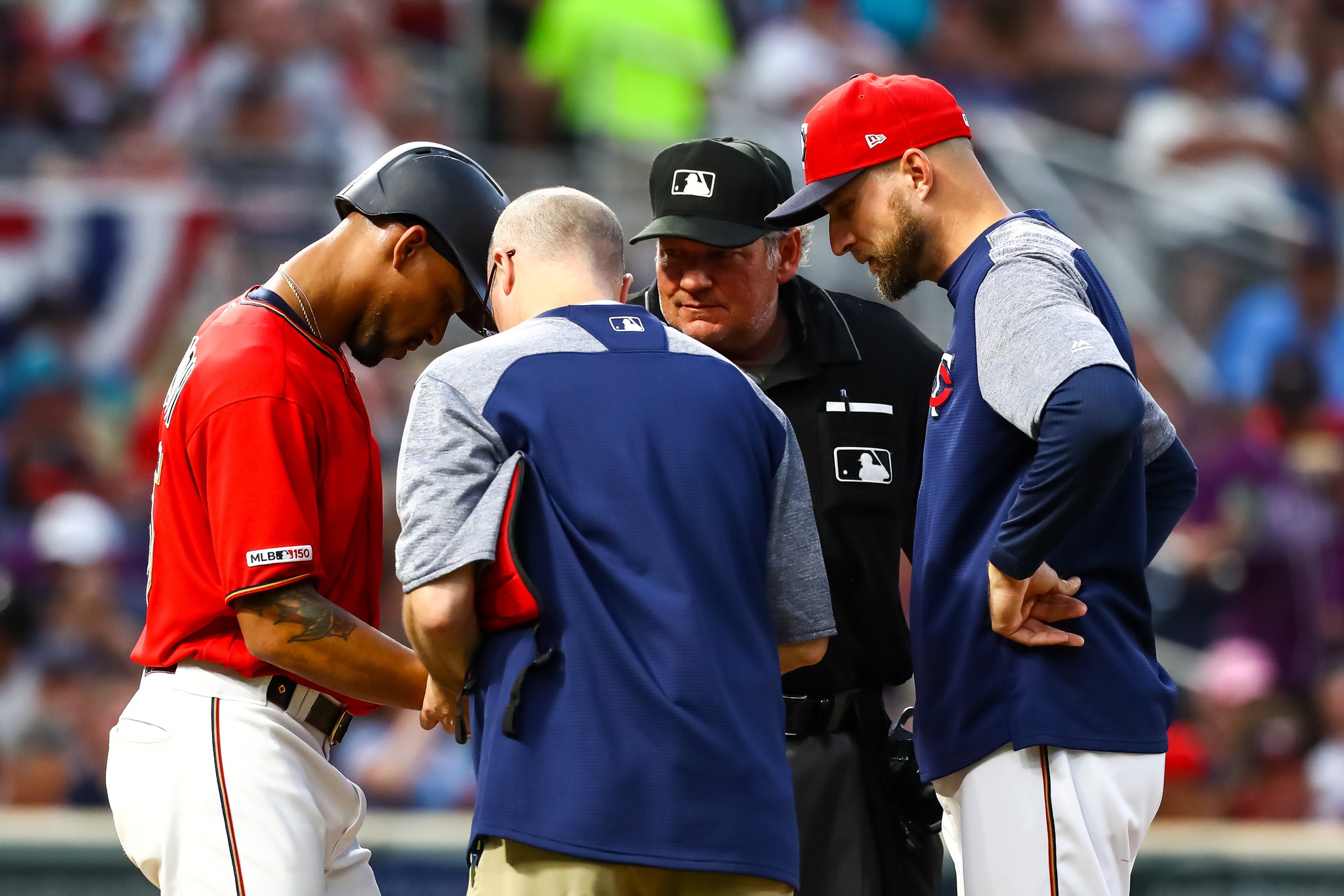 It's understandable enough that fans see Buxton — who is without a doubt one of this club's most essential players — barreling into outfield walls, and envision simple coaching fixes that might remedy the problem. The truth is unfortunately a lot more complicated. Let's review the various incidents that have landed Buxton on the disabled/injured list over the past two seasons: April 18, 2018: Placed on DL due to migraines May 20, 2018: Placed on DL due to fracture in left toe (suffered on foul ball during rehab stint) July 14, 2018: Placed on DL at AAA due to left wrist strain (suffered swinging the bat) August 1, 2018: Placed on DL at AAA due to lingering issues with left wrist June 18, 2019: Placed on IL due to right wrist contusion (suffered on HBP) July 16, 2019: Placed on IL due to concussion-like symptoms (suffered on impact with ground on diving catch) August 3, 2019: Placed on IL due to left shoulder subluxation (suffered in collision with OF wall) So there you have it. Seven different stints in the past two years, and only ONE was actually the result of crashing into the wall. Even in that case, if you watch the replay, I think it's pretty tough to make a case he was playing with reckless abandon; Buxton was chasing a ball in the gap, came up short, and stumbled into a wall that was closer than he expected in an unfamiliar outfield. It's simply the kind of risk you run when you're the fastest player in the game. Similarly, the play in Cleveland coming out of the All-Star break where he hit his head on the ground was not some crazy over-the-top effort. It was a ball he should've caught, and did catch, helping the Twins seal up a big victory. Outside of those two plays, none of these mishaps can be attributed to Buxton's style of play. They are bad-luck breaks, which have unfortunately been plentiful in his young career. It's fine to be frustrated or disappointed with this pattern — I know I am — but let's ease up on the armchair coaching directives, and insinuations that Buxton is somehow at fault for playing the game hard. In reality, he has come away from countless diving plays and run-ins with the wall over these past two seasons without major injury. And in the process, he has made numerous game-changing catches, helping him establish a reputation as the most valuable defender in baseball when on the field. By asking him to fundamentally change the way he plays, and "throttle down" based on game situations (a rather absurd request for a multitude of reasons, frankly), you're reducing his positive impact and taking away the very thing that makes him such an asset. Meanwhile, evidence suggests this course of action is not really preventing many, if any, of the costly injuries. So, if you're amongst the crowd advocating for such measures, I urge you to take a look at the facts and exercise some perspective. There ARE feasible steps that can be taken to reduce injury risks and keep Buxton on the field, such as having him play deeper in the outfield and equipping him with an oven-mitt contraption to protect his fingers while sliding on the bases. These have already been implemented. But telling a player who is the greatest center fielder in baseball, and one of the best athletes in the world, to take it down a notch when his level of effort and drive are exactly what earns him those designations? It's just silly. Unfortunately, we're all going to have to live with the fact that Buxton carries a uniquely high level of injury risk, and there's no fixing that. It's the nature of the beast. There's no black-and-white adjustment to be made like tweaking Miguel Sano's swing or altering Jorge Polanco's throwing mechanics. The best thing the Twins can do for Buxton is carry quality CF depth (which they have), control what they can control, continue to give him the best recovery support possible, and hope for a little better luck going forward.
 -
Hmmmm... From the article: If it's easy enough for a dope like me to see patterns like this in the numbers, surely the Twins must've, right? Has it been reported anywhere whether the Giants were aware of Dyson's "issue" and were transparent with the Twins about it? This all seems a little unsettling...
-
I've seen a rather stunning lack of faith in Cave from Twins fans in these past couple days. Are we all just forgetting what he did last year? And ignoring what he's been doing in Triple-A? All because he hasn't gotten it going yet in 100 sporadic PA with the Twins? I mean, c'mon, Kepler has had stretches of 100 PA this year where he put up worse numbers.
- 25 replies
-
- 11
-

-
- nelson cruz
- sam dyson
- (and 2 more)
-
The Twins struck an eleventh-hour deadline deal, and their new setup man had an... interesting first week. Minnesota was also hit by an unfortunate rash of key injuries, just as a critical stretch of the schedule looms. It was a hectic week full of big events. But somehow it all paled in comparison to the theatrics of Nelson Cruz, who carried his incredible homer-hitting clinic from July into August, powering the Twins to a 5-1 week as they maintained their three-game lead over the hard-charging Indians. Weekly Snapshot: Mon, 7/29 through Sun, 8/4 *** Record Last Week: 5-1 (Overall: 69-42) Run Differential Last Week: +16 (Overall: +141) Standing: 1st Place in AL Central (3.0 GA) Willians Watch: Out Indefinitely As the trade deadline counted down to zero on Wednesday afternoon, Twins fans were momentarily led to believe their team had come up empty in its pursuit of upgrades. Minutes after the 3:00PM, however, we got word that they did indeed make another impact addition to the bullpen: Since his brutal stretch of three outings in mid-July where he allowed seven very costly runs over 3 2/3 innings, May has pitched only twice in 14 days, throwing six pitches total, with neither appearance coming at a crucial juncture. The Twins will need him to get back on the horse this week, no doubt. May will be well rested. Can he get back into the zone he was in for several weeks before the meltdown? The club's fortunes could greatly hinge on it. DOWN ON THE FARM Some excellent news on the prospect front: Brusdar Graterol is back. The organization's most promising young arm missed more than two months with a shoulder impingement, but returned to the mound last week with a pair of scoreless appearances in the Gulf Coast League. To say he was dominant against these overwhelmed rookie-level hitters would be an understatement. With his customary triple-digit heat back on display, Graterol should work back up to Double-A quickly, at which point he becomes an intriguing late-season bullpen candidate for Minnesota. The 20-year-old has the makings of a difference-maker, and his lengthy time on the shelf this summer has kept his innings in check, which could make the idea of him pitching into October more palatable. In order to have him eligible for the playoffs, the Twins would need to call up Graterol before September 1st. LOOKING AHEAD The Twins have 25 games remaining against teams with records above .500. Thirteen of them come in the next two weeks. This is easily the most difficult remaining stretch of their schedule, and Cleveland will surely be looking to take advantage. The Twins will hope to fend off a very good Braves team at home before welcoming the Indians for a HUGE four-game series. The Twins will be playing at home, and have both of their All-Star starters going twice. They have an opportunity to press the foot down on Cleveland's throat. Can they capitalize? MONDAY, 8/5: BRAVES @ TWINS – RHP Mike Soroka v. RHP Jake Odorizzi TUESDAY, 8/6: BRAVES @ TWINS – LHP Max Fried v. RHP Jose Berrios WEDNESDAY, 8/7: BRAVES @ TWINS – RHP Kevin Gausman v. LHP Martin Perez THURSDAY, 8/8: INDIANS @ TWINS – RHP Adam Plutko v. RHP Kyle Gibson FRIDAY, 8/9: INDIANS @ TWINS – RHP Shane Bieber v. LHP Devin Smeltzer SATURDAY, 8/10: INDIANS @ TWINS – TBD v. RHP Jake Odorizzi SUNDAY, 8/11: INDIANS @ TWINS – RHP Zach Plesac v. RHP Jose Berrios Catch Up On Twins Daily Game Recaps Game 106 | MIN 2, MIA 1: Pitchers Stifle Marlins Bats, Twins Come Out on TopGame 107 | MIN 7, MIA 4: Berrios Throws Gem as Bombas FlyGame 108 | MIA 5, MIN 4: Dyson Implodes In Twins DebutGame 109 | MIN 11, KC 9: Cruz Powers Twins to Another Close Win Over the RoyalsGame 110 | MIN 11, KC 3: Delayed Start Didn’t Cool Off the Minnesota OffenseGame 111 | MIN 3, KC 0: Twins Cap Off The Sweep - Smeltzer Style Click here to view the article
- 25 replies
-
- 2
-
-
- nelson cruz
- sam dyson
- (and 2 more)
-
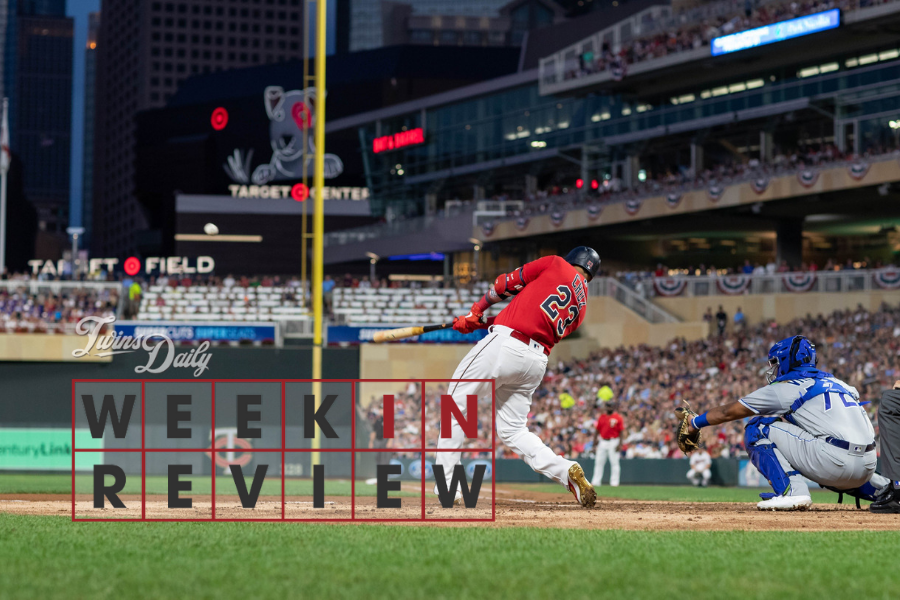 Weekly Snapshot: Mon, 7/29 through Sun, 8/4 *** Record Last Week: 5-1 (Overall: 69-42) Run Differential Last Week: +16 (Overall: +141) Standing: 1st Place in AL Central (3.0 GA) Willians Watch: Out Indefinitely As the trade deadline counted down to zero on Wednesday afternoon, Twins fans were momentarily led to believe their team had come up empty in its pursuit of upgrades. Minutes after the 3:00PM, however, we got word that they did indeed make another impact addition to the bullpen: https://twitter.com/DanHayesMLB/status/1156660084610613249 Sam Dyson arrived in the clubhouse midway through Thursday's game in Miami, and was called upon to close out a 4-1 victory in the ninth. It... did not go well. In fact it went about as poorly as one could possibly imagine. And sadly things hardly improved in his second Twins appearance. By the time he landed on the injured list with biceps tendinitis on Sunday, Dyson had allowed six runs on six hits and two walks while recording just two outs for Minnesota. Obviously it's a terrible first impression, and not the best look for the front office to be acquiring a guy who was apparently damaged goods. But if you're looking for a silver lining, at least his arm injury – the severity of which is being downplayed by the Twins – may help explain the stark deviation from a strong and consistent track record. Dyson has thrown 38 pitches as a Twin and induced only one swinging strike. This issue actually appears to date back a ways; in his last four appearances with the Giants, he got only one swing-and-miss on 42 pitches after inducing 18 in his first eight July outings (15% rate). The timing here is awful, for multiple reasons, but hopefully a little rest will help Dyson return to his usual form, which is excellent. He has posted an ERA+ of 142 or better in four the past five seasons, and was at 170 this year with the Giants. Dating back to 2014, he has a 3.19 ERA and 1.25 WHIP with just 26 homers allowed in 364 innings. He has experience as a closer and has pitched (well) in the postseason. Importantly, the Twins didn't give up a whole lot to acquire him. Jaylin Davis, who was spotlighted in our "Down on the Farm" report here two weeks ago thanks to his unbelievable power surge at Triple-A, was the headliner, along with lower-tier prospects Prelander Berroa and Kai-Wei Teng. As was the case with Lewin Diaz, traded days earlier to the Marlins for Sergio Romo, it was bittersweet to see Davis leave. Like Diaz, the 25-year-old outfielder was enjoying a breakout season in the minors, but he was hopelessly crowded out of the big-league picture. In San Francisco, he'll have a much clearer path, and could very well be up in the majors before year's end. Adding Dyson and Romo, following the recent subtractions of Blake Parker, Matt Magill, Mike Morin and Adalberto Mejia, equates to a significant upgrade for this wobbly unit. It wasn't the blockbuster shakeup many fans were hoping for – as reflected by a rather inordinate amount of rancor on social media and local radio airwaves – but it was in fact one of the boldest retoolings made by a contender last week. Outside of the Astros, who clearly won the deadline with their bombshell addition of Zack Greinke, few teams made emphatic moves – with both the Yankees and Red Sox among those who conspicuously froze up despite having clear, potentially crippling weaknesses. https://twitter.com/NickNelsonMN/status/1157093910977634307 In my mind, Twins fans should be feeling good about the club's actions. Maybe not great, but the front office did what it needed to do. And with the former August waiver trade period eliminated, these contending rosters are pretty much locked in, so now it's crunch time. Personally, I feel pretty good about the squad Rocco Baldelli is bringing to battle, especially after the way they played over the past week. But in the coming days, they're going to be shorthanded, having placed several important contributors on the shelf: Dyson, as mentioned, was placed on the IL with right biceps tendinitis. Devin Smeltzer was called up to take his spot, and made a start on Sunday, looking very good as usual. Zack Littell was also recalled over the weekend. It doesn't sound like the team expects Dyson to miss much more than his requisite 10 days. Lewis Thorpe and Sean Poppen were optioned to the minors amidst the roster juggling. The biggest gut-punch of the week (and maybe the season) was the placement of Byron Buxton on IL with what's being portrayed as a fairly long-term injury. He partially dislocated his shoulder in a Thursday collision with the outfield wall, and is likely to miss most or all of August. On the bright side, Jake Cave will get an extended opportunity to substantiate his monster production at Triple-A, where he was slashing .352/.393/.592 in 48 games. But there's no replacing what Buxton brings to the field. That much has become painfully obvious. C.J. Cron was activated from the IL and homered in his first game back on Saturday. HIGHLIGHTS When the deadline came and went on Wednesday, there was no Greinke for the Twins. No Madison Bumgarner or Noah Syndergaard, either. What most of us suspected all along is now set in stone: Jose Berrios is going to have to shoulder the load as this team's No. 1 starter down the stretch and – if they get there – its Game 1 starter in the playoffs. He has mostly locked up the part this year, and certainly did in his latest start on Tuesday night. Granted, it was against a miserable Marlins lineup, but Berrios was electric, striking out 11 while cruising through seven shutout innings on just 81 pitches. He walked none and allowed only two singles, tying the Opening Day gem against Cleveland for his top Game Score posted this year (84). Berrios hasn't missed a start, and has pitched at least into the seventh in more than half (14 of 22). He ranks 10th among all MLB starters in innings pitched. The guy's an absolute workhorse. The question, going forward, is how things will shake out behind him. The rest of Minnesota's rotation has been generally healthy and effective (all five Twins starters rank among the AL's top 25 in WAR, which is pretty amazing), but they haven't followed the leader's model of stability. Michael Pineda, on the upswing with a 3.12 ERA since the start of June, is probably the most credible choice as No. 2 starter right now. He reasserted his case on Thursday, holding Miami to one run over six innings after producing seven innings of one-run ball in Chicago the week before. Pineda has issued one or zero walks in 15 of his 20 starts this year, and more than three only once. As a result of this and the coaching staff's careful workload management, the big righty has exceeded 100 pitches only once all year, boding well for his enduring value down the stretch. On that note, the Twins placed Pineda on the IL Sunday, citing a triceps strain, but one wonders if Minnesota isn't just trying to get him a break. That seemed to be the case when they shut him down for a couple weeks at the end of May, and Pineda came back much stronger in that instance. As was the case then, he might only miss one start this time around. Efficiency hasn't been such a strength for Jake Odorizzi, who got back on track with his 12th win on Monday but failed to complete six innings for a seventh consecutive start. His continuing lack of length is an underrated factor in the bullpen's stress test over the past month. But this was nonetheless an encouraging outing for the righty, who managed to keep the ball in the yard after surrendering 10 homers in his previous seven turns. Kyle Gibson also took care of business, holding Kansas City to three runs (two earned) over 6 2/3 innings on Saturday. He struck out six and induced 17 swinging strikes – his highest total since June 8th in Detroit. Meanwhile, Smeltzer continues to make his case for a solidified role with the big-league club. He was absolutely brilliant on Sunday, blanking the Royals over six two-hit innings and lowering his ERA as an MLB pitcher to 2.28. Solid pitching last week was matched by quality work from the Twins lineup, with the ageless Cruz taking control. He turned 39 just over a month ago, on July 1st, and has since launched 14 home runs in 26 games. On Saturday, the DH delivered his second three-homer game in 10 days, and his second straight five-RBI effort. The previous night, he'd gone deep while adding a pair of doubles. Incredibly, Cruz drove in 10 runs in a week that saw him start only three games, having sat out the Miami series. In his past 15 contests Cruz is slugging 1.154 with a dozen home runs and 24 RBIs. It's a remarkable streak even before you factor in his age, which makes it unprecedented. https://twitter.com/AaronGleeman/status/1157849112877785089 By adding four more tallies to the ledger last week, Cruz not only extends his run of 30-HR seasons to six (fourth-highest among active players) but sets a new record for home runs by a Twins DH. What a slam-dunk signing. https://twitter.com/morsecode/status/1157851242527436801 Other offensive standouts for the week included Max Kepler (7-for-21 with two homers, three doubles and six walks), Eddie Rosario (8-for-20 with six RBIs), and Buxton (4-for-12 with a homer, two doubles and a steal in three games before getting hurt). LOWLIGHTS Last time the Twins went through a difficult patch in their schedule, they were without Buxton, and his absence was felt during a tumultuous skid against the Mets, Athletics, and Yankees. Now, they're facing down a very similar scenario. Minnesota will again be missing Buxton for what could very well be a season-defining gauntlet against the Braves, Indians, Brewers and Rangers. The Twins really need Cave to show something here. As mentioned earlier, he was torching Triple-A pitching, and he had an impressive rookie showing at the plate as a rookie. But this year he's been unable to find it with the Twins, slashing .198/.320/.302 in 37 games after going 1-for-3 in his return on Sunday. If Cave can't get rolling, the Twins do have the luxury of Marwin Gonzalez as an option in right field, but he too has quietly fallen into a lull at the plate. Last week he was just 2-for-16, dropping his OPS to its lowest point (.716) since early June. Beyond Dyson's catastrophic debut, the pitching lowlight of last week came from Martin Perez, who was the only rotation member to drop a dud against the lowly Miami and KC offenses. On Friday night, he coughed up three homers and five runs in five innings against the Royals. Keeping the ball in the yard has generally been a strength this year for the groundballer Perez, even when he's scuffled, but of late that's ceased to be the case: In his past four turns, the lefty has surrendered eight homers – one more than in his first 15 starts combined. The downward turn for Perez, who owns a 5.53 ERA in 10 starts dating back to the beginning of June, in combination with another phenomenal performance from Smeltzer two days later is understandably generating some fan sentiment for a swap. I don't think we're quite there yet, especially with Pineda temporarily sidelined, but it's something to keep an eye on. And one way another, the Twins need to keep Smeltzer around. This kid continues to look like he belongs in the majors. TRENDING STORYLINE What's going on with Trevor May? The Twins were going to need him for high-leverage innings in the second half and (hopefully) postseason, regardless of who they acquired at the trade deadline. With their biggest pickup on the shelf for upcoming showdowns against dangerous offenses, that's all the more true. But for now, Baldelli appears to be giving his hard-throwing righty a mental or physical break. Last week, May threw just one pitch, retiring Hunter Dozier on a fly ball to end the seventh inning on Saturday. The previous week, he threw only five pitches, completing a quick inning against the White Sox with Minnesota down 4-1. https://twitter.com/TFTwins/status/1157493222014365696 Since his brutal stretch of three outings in mid-July where he allowed seven very costly runs over 3 2/3 innings, May has pitched only twice in 14 days, throwing six pitches total, with neither appearance coming at a crucial juncture. The Twins will need him to get back on the horse this week, no doubt. May will be well rested. Can he get back into the zone he was in for several weeks before the meltdown? The club's fortunes could greatly hinge on it. DOWN ON THE FARM Some excellent news on the prospect front: Brusdar Graterol is back. The organization's most promising young arm missed more than two months with a shoulder impingement, but returned to the mound last week with a pair of scoreless appearances in the Gulf Coast League. To say he was dominant against these overwhelmed rookie-level hitters would be an understatement. With his customary triple-digit heat back on display, Graterol should work back up to Double-A quickly, at which point he becomes an intriguing late-season bullpen candidate for Minnesota. The 20-year-old has the makings of a difference-maker, and his lengthy time on the shelf this summer has kept his innings in check, which could make the idea of him pitching into October more palatable. In order to have him eligible for the playoffs, the Twins would need to call up Graterol before September 1st. LOOKING AHEAD The Twins have 25 games remaining against teams with records above .500. Thirteen of them come in the next two weeks. This is easily the most difficult remaining stretch of their schedule, and Cleveland will surely be looking to take advantage. The Twins will hope to fend off a very good Braves team at home before welcoming the Indians for a HUGE four-game series. The Twins will be playing at home, and have both of their All-Star starters going twice. They have an opportunity to press the foot down on Cleveland's throat. Can they capitalize? MONDAY, 8/5: BRAVES @ TWINS – RHP Mike Soroka v. RHP Jake Odorizzi TUESDAY, 8/6: BRAVES @ TWINS – LHP Max Fried v. RHP Jose Berrios WEDNESDAY, 8/7: BRAVES @ TWINS – RHP Kevin Gausman v. LHP Martin Perez THURSDAY, 8/8: INDIANS @ TWINS – RHP Adam Plutko v. RHP Kyle Gibson FRIDAY, 8/9: INDIANS @ TWINS – RHP Shane Bieber v. LHP Devin Smeltzer SATURDAY, 8/10: INDIANS @ TWINS – TBD v. RHP Jake Odorizzi SUNDAY, 8/11: INDIANS @ TWINS – RHP Zach Plesac v. RHP Jose Berrios Catch Up On Twins Daily Game Recaps Game 106 | MIN 2, MIA 1: Pitchers Stifle Marlins Bats, Twins Come Out on Top Game 107 | MIN 7, MIA 4: Berrios Throws Gem as Bombas Fly Game 108 | MIA 5, MIN 4: Dyson Implodes In Twins Debut Game 109 | MIN 11, KC 9: Cruz Powers Twins to Another Close Win Over the Royals Game 110 | MIN 11, KC 3: Delayed Start Didn’t Cool Off the Minnesota Offense Game 111 | MIN 3, KC 0: Twins Cap Off The Sweep - Smeltzer Style
 -
Article: Week in Review: Action!
Nick Nelson replied to Nick Nelson's topic in Twins Daily Front Page News
Man. You might be right but that would just be insane. He's been so good and everyone loves him (teammates, fans, and clearly Baldelli who writes him into the lineup everyday – more than Schoop).- 17 replies
-
- 6
-
-
- nelson cruz
- miguel sano
- (and 2 more)
-
Article: Week in Review: Action!
Nick Nelson replied to Nick Nelson's topic in Twins Daily Front Page News
I definitely feel this. But I'm just wondering, functionally, how do you make room for all these guys on the roster? I don't think they can afford to roll with one fewer reliever. Someone's gotta go when Cron returns. Right? And also, how is Schoop going to feel sitting on the bench regularly when he's been a productive all-around piece and is playing for a contract? There are practical realities at play that make this situation a tricky one to navigate.- 17 replies
-
- 5
-
-
- nelson cruz
- miguel sano
- (and 2 more)
-
A frenetic and exhausting series loss against the Yankees at Target Field was followed by an explosive return to form for the Twins in Chicago against the White Sox. Meanwhile, the rumor mill kicked into high gear as the trade deadline bears down, and the front office struck its first big move for veteran relief help. Catch up on a busy and action-packed week for your Twins, whose lead in the AL Central has narrowed to two games. Weekly Snapshot: Mon, 7/22 through Sun, 7/28 *** Record Last Week: 4-3 (Overall: 64-41) Run Differential Last Week: +14 (Overall: +125) Standing: 1st Place in AL Central (2.0 GA) Willians Watch: Out Indefinitely We'll start with the leading headline: Minnesota made a move to address its battered bullpen on Saturday, acquiring 36-year-old right-hander Sergio Romo from the Marlins, along with minor-league pitcher Chris Vallimont and a player to be named later, in exchange for Double-A first baseman Lewin Diaz. There's no knocking this deal. Diaz has enjoyed a breakout year, regaining his wayward prospect status, but he'll be Rule 5 eligible in the offseason if not added to the 40-man roster, and it's nearly impossible to see him fitting into Minnesota's near-term plans. Meanwhile, he fills a big need in Miami's system and now has a much clearer path to the majors, so good for him. Romo is not a dominant arm, nor the kind of late-inning difference-maker who will significantly ease Taylor Rogers' burden, but he's a quality reliever and seasoned addition to a unit that was increasingly lacking for MLB experience. He doesn't throw hard, with a fastball that averages just 86.5 MPH, but has always been effective despite his soft-tossing profile, thanks in part to a quality slider he leans on heavily. He'll be a very helpful piece in a bullpen that needs all the help it can get. Romo essentially serves as the veteran righty replacement for Blake Parker, who was the latest (and most surprising) to be designated for assignment following his brutal outing against New York on Tuesday. While warranted, the move is somewhat startling because Parker was, 1) Minnesota's only major bullpen acquisition during the offseason, and 2) getting solid results for the most part despite troublesome underlying indicators. It's good to see the front office overlooking those caveats and making a decisive move on a clearly declining player. A quick rundown of other transactions last week: On the same day they DFA'ed Parker, the Twins optioned Kohl Stewart back to Triple-A. Replacing them in the bullpen were Devin Smeltzer (who had an outstanding outing against the Yankees on Wednesday before he being sent back down himself in exchange for the fresher arm of Sean Poppen) and veteran journeyman Carlos Torres. Torres, who never ended up making an appearance for the Twins, was designated over the weekend to make room for Romo.Jake Cave was optioned to Triple-A on Thursday, with Byron Buxton ready to return from his stint on the Injured List. Buxton was in center field for all four games against the White Sox.Back at the beginning of the week (feels like a century ago, doesn't it?), Lewis Thorpe and Cody Stashak joined the bullpen, with Zack Littell heading down and C.J. Cron landing back on IL due to a nagging thumb issue. Stashak and Thorpe combined to allow two runs over 7 2/3 innings, providing the pen with a much-needed boost.HIGHLIGHTS The offense reawakened, marching past the 200-homer mark with a barrage of blasts against New York and Chicago. The latest long-ball frenzy was fueled by the likes of: Nelson Cruz, who homered an astounding eight times on the week – including three in Thursday's series opener versus the White Sox. In seven games, he drove in 13 runs in. When he missed most of May with a wrist injury, it seemed as though Cruz would have a tough time reaching his customary total of ~40 home runs, but he's gotten himself right back on track by going deep 19 times in 43 games since returning on June 4th. C.Miguel Sano continues to show sensational power and added four more bombs to the ledger last week. His second one against the Yankees on Tuesday – a go-ahead two-run blast after Minnesota had given up a lead – would've been one of the season's top highlights if not for Rogers blowing the save soon after. Sano has homered 18 times in just 56 games, and sports a .579 slugging percentage – highest on the team after Cruz and this next guy.There's no slowing down for Mitch Garver. He went deep twice in Minnesota's lone victory over New York, pushing his homer total to seven in July and 19 on the season. He's tied for second among MLB catchers, despite playing in far fewer games than anyone nearby him on the leaderboard.Plenty of others contributed to the run-scoring bonanza as the Twins pushed 55 runs across in seven games. Jorge Polanco was 9-for-30 with three homers, two doubles and seven RBIs. Max Kepler chipped in four homers and a double while driving in eight. Luis Arraez continued to be an on-base machine, reaching via walk or hit in 11 of his 27 plate appearances and scoring six times. Buxton returned with authority, collecting six hits (four of them doubles) against Chicago. With 205 home runs in the books through week's end, the 2019 Twins are already fourth in franchise history and closing in fast on the record of 225, set back in 1963. At their current pace of 1.9 HR/G, they'll surpass that mark within two weeks, and then they can set their sights on the major-league record of 266, set by last year's Yankees. The Twins could very plausibly eclipse that figure by the end of August. Bonkers. LOWLIGHTS The Twins' pitching staff did not fare so well against the Yankees. As the offense kept piling up runs to keep the games tight, Minnesota's arms could not manage to suppress a relentless Yankees lineup. To an extent this is excusable – New York does have one of the league's best offenses – but the nature of these struggles and the continuation of some frustrating trends made the lapses a bit tough to take. Martin Perez was aided by a triple play in the first inning of the week, and the Twins offense supported him with seven runs through four frames, but he still couldn't record a single out in the fifth, setting the stage for a straining series on the bullpen. While recording 12 outs, Perez allowed seven hits (three homers) and four walks. Ugly. He did bounce back with a decent start on Saturday, allowing three runs over six innings against the Sox. Kyle Gibson was relatively effective the following day, yielding five runs over five innings. It was a serviceable start but not the kind that's going to build confidence in him facing a top lineup in October (Gibson had nearly identical results in his first start against the Yankees this year, back in early May). He fared much better in his second outing of the week, holding the White Sox to one run over six frames, but no one's really doubting his ability to handle a lower-tier offense like that. The big dud of the entire week was Jake Odorizzi's complete unraveling on Wednesday. The Twins were leaning hard on their All-Star to give them some innings after New York wore out the relief corps on Monday and Tuesday, but – in what's becoming a recurring theme – he failed to answer the call. Odorizzi was only able to get through four innings, marking the sixth straight turn in which he failed to complete six. In three of those starts he hasn't even pitched into the fifth. Despite logging only four innings, Odorizzi still managed to give up nine earned runs, digging a hole the Twins offense couldn't escape. His total meltdown stood in stark contrast to Smeltzer, who came on in relief and promptly shut the Yanks down for five innings. Odorizzi's ERA, which stood at 1.92 on June 15th, is now up to 3.84. An interesting question presents itself: If the Twins are able to make a big splash and acquire a frontline starter to bolster their rotation, who is the odd man out? There are no obvious answers, but if we're being honest, Odorizzi is probably the most logical choice for a bullpen assignment. That sounds a little crazy for a guy who was at the All-Star Game earlier this month, but he's been struggling for about six weeks and the lack of length is a real issue. Something tells me this decision wouldn't go over well with Odorizzi, who was brilliant in the first half and is an impending free agent. But that's where we are. Speaking of odd men out, could Jonathan Schoop be heading in that direction? He was one of the few laggards in a strong week for the offense, going just 4-for-20 with a homer, three singles, zero walks and six strikeouts in his five starts. Per his MO, Schoop's highlight of the week – a two-run homer on Sunday with the Twins leading 7-0 – came in what amounts to garbage time. Since the start of June, he has a .274 on-base percentage with 40 strikeouts and only three unintentional walks in 146 plate appearances. The quality of at-bats is consistently poor; he's always seemingly hoping to run into a mistake. Even though his OPS is ninth-best among MLB second-basemen, Schoop's Win Probability Added ranks 10th-worst out of all qualified big-leaguers. He hasn't been terrible by any means, but his play has been generally uninspiring and that puts him in a tough position. Arraez, Sano, and Marwin Gonzalez are all clearly higher lineup priorities than Schoop. One can argue that even Ehire Adrianza is ahead in the pecking order, especially given his greater likelihood to be a factor for the Twins beyond this year. So, when Cron comes back, if everyone's healthy... how do they really justify keeping Schoop around? TRENDING STORYLINE The trade deadline is nearly upon is. The action is sure to heat up over the next few days ahead of the cutoff, which falls on Wednesday at 3:00 PM. Minnesota has been connected to a variety of big-name targets, from Noah Syndergaard (YAY!) to Lance Lynn (NAY!) and beyond. I'm confident the Twins will add at least one more impactful reliever, and less confident about a starter. But we've never seen this front office as a bona fide front-running contender, so there's not much precedent to go off. The long-awaited winning window is clearly upon us, so a major move would certainly be warranted. Stay tuned to Twins Daily over the next days as we cover every substantive rumor and rumbling in real-time leading up to the deadline. Prospect hounds will be sweating over the organization's top talents, whose names are gonna keep bouncing around in speculative discussions. It seems just about anyone could be on the table, though I highly doubt the guy we'll be talking about next is going anywhere. DOWN ON THE FARM On the surface, Royce Lewis has had a bit of a disappointing season. Through Saturday, he was batting just .238 with a .665 OPS at Fort Myers. He homered twice for the Miracle last week, but otherwise went just 1-for-19 with zero walks. Despite the scant production, Lewis featured in the Futures Games during All-Star Week, and clearly the Twins aren't too deterred by his performance, because they announced on Sunday he joined the Pensacola Blue Wahoos in Double-A. It's a bold move, to be sure. Lewis just turned 20 on June 5th. Only one younger player has taken an at-bat in the Southern League this year (Luis Vazquez, a 19-year-old defensive specialist in the Cubs system). While he's had some very nice flashes, Lewis certainly wasn't exhibiting mastery of the Florida State League. But given his maturity, makeup and talent, I don't somehow don't think he'll be overwhelmed or intimidated by the challenge. A challenge it will be. The average pitcher in his new league is about four years older than he is. Just two years after joining the professional ranks, he'll be facing some of the best arms in the minors, while also working to refine his raw-but-promising skills at shortstop. In his Pensacola debut on Sunday, Lewis batted leadoff ahead of Alex Kirilloff and Trevor Larnach, finishing 2-for-5 with a double. LOOKING AHEAD Two weeks ago in this space I wrote that Cleveland was facing a critical juncture. The Twins had just extended their lead to 7.5 games with a series victory coming out of the break, but were embarking on a far more challenging road ahead. Well, the Indians have since done their part, taking full advantage. They've gone 11-3 against the lowly Tigers, Royals and Blue Jays, shaving 5 1/2 games off their deficit to draw within striking distance. Now, the dynamic flips. Cleveland's schedule is about to get MUCH tougher – their next 20 games all come against teams above .500, with a four-gamer at Target Field mixed in. The Twins have a much easier remaining slate, and so now it's their turn to take advantage if they want to reassert themselves in the Central. They'll want to start this week by demonstrating their superiority against two utterly terrible teams. TUESDAY, 7/30: TWINS @ MARLINS – RHP Jake Odorizzi v. RHP Zac Gallen WEDNESDAY, 7/31: TWINS @ MARLINS – RHP Jose Berrios v. RHP Sandy Alcantara THURSDAY, 8/1: TWINS @ MARLINS – RHP Michael Pineda v. RHP Jordan Yamamoto FRIDAY, 8/2: ROYALS @ TWINS – RHP Glenn Sparkman v. LHP Martin Perez SATURDAY, 8/3: ROYALS @ TWINS – LHP Danny Duffy v. RHP Kyle Gibson SUNDAY, 8/4: ROYALS @ TWINS – RHP Brad Keller v. RHP Jake Odorizzi Catch Up On Twins Daily Game Recaps Game 99 | MIN 8, NYY 6: Twins Turn Triple Play, Mitch Garver Homers Twice in Win Over YankeesGame 100 | NYY 14, MIN 12: Twins Fall Short to Yankees in Game of the YearGame 101 | NYY 10, MIN 7: Twins Drop Series in Another Slugfest With YankeesGame 102 | MIN 10, CWS 3: Bomba Squad Cruz to WinGame 103 | MIN 6, CWS 2: Pineda Fuels Twins Easy Win In ChicagoGame 104 | CWS 5, MIN 1: Nova Nixes Twins ChancesGame 105 | MIN 11, CWS 1: Bats Bounce Back Behind Gibson’s Strong Outing Click here to view the article
- 17 replies
-
- 1
-
-
- nelson cruz
- miguel sano
- (and 2 more)
-
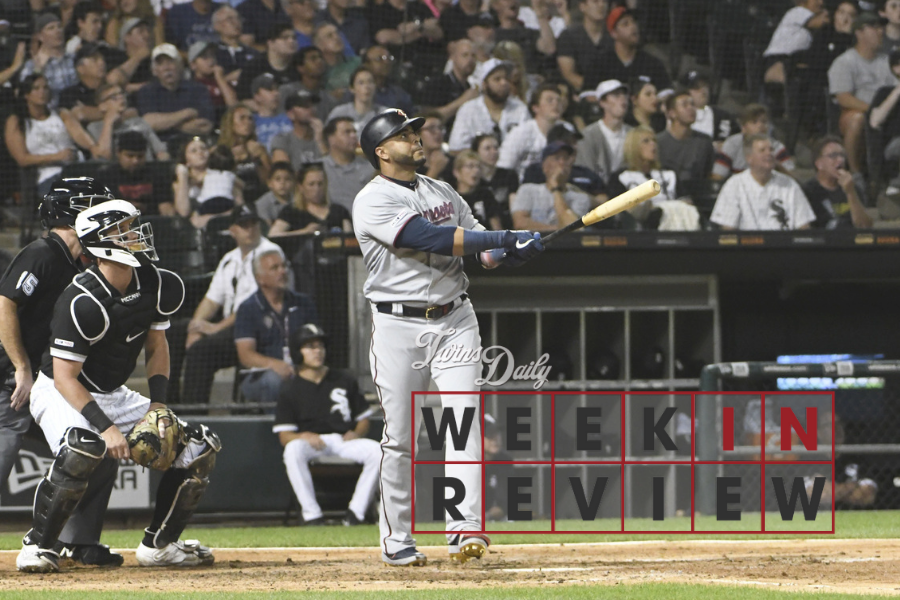 Weekly Snapshot: Mon, 7/22 through Sun, 7/28 *** Record Last Week: 4-3 (Overall: 64-41) Run Differential Last Week: +14 (Overall: +125) Standing: 1st Place in AL Central (2.0 GA) Willians Watch: Out Indefinitely We'll start with the leading headline: Minnesota made a move to address its battered bullpen on Saturday, acquiring 36-year-old right-hander Sergio Romo from the Marlins, along with minor-league pitcher Chris Vallimont and a player to be named later, in exchange for Double-A first baseman Lewin Diaz. There's no knocking this deal. Diaz has enjoyed a breakout year, regaining his wayward prospect status, but he'll be Rule 5 eligible in the offseason if not added to the 40-man roster, and it's nearly impossible to see him fitting into Minnesota's near-term plans. Meanwhile, he fills a big need in Miami's system and now has a much clearer path to the majors, so good for him. https://twitter.com/Marlins/status/1155296079644123138 Romo is not a dominant arm, nor the kind of late-inning difference-maker who will significantly ease Taylor Rogers' burden, but he's a quality reliever and seasoned addition to a unit that was increasingly lacking for MLB experience. He doesn't throw hard, with a fastball that averages just 86.5 MPH, but has always been effective despite his soft-tossing profile, thanks in part to a quality slider he leans on heavily. He'll be a very helpful piece in a bullpen that needs all the help it can get. Romo essentially serves as the veteran righty replacement for Blake Parker, who was the latest (and most surprising) to be designated for assignment following his brutal outing against New York on Tuesday. While warranted, the move is somewhat startling because Parker was, 1) Minnesota's only major bullpen acquisition during the offseason, and 2) getting solid results for the most part despite troublesome underlying indicators. It's good to see the front office overlooking those caveats and making a decisive move on a clearly declining player. A quick rundown of other transactions last week: On the same day they DFA'ed Parker, the Twins optioned Kohl Stewart back to Triple-A. Replacing them in the bullpen were Devin Smeltzer (who had an outstanding outing against the Yankees on Wednesday before he being sent back down himself in exchange for the fresher arm of Sean Poppen) and veteran journeyman Carlos Torres. Torres, who never ended up making an appearance for the Twins, was designated over the weekend to make room for Romo. Jake Cave was optioned to Triple-A on Thursday, with Byron Buxton ready to return from his stint on the Injured List. Buxton was in center field for all four games against the White Sox. Back at the beginning of the week (feels like a century ago, doesn't it?), Lewis Thorpe and Cody Stashak joined the bullpen, with Zack Littell heading down and C.J. Cron landing back on IL due to a nagging thumb issue. Stashak and Thorpe combined to allow two runs over 7 2/3 innings, providing the pen with a much-needed boost. HIGHLIGHTS The offense reawakened, marching past the 200-homer mark with a barrage of blasts against New York and Chicago. The latest long-ball frenzy was fueled by the likes of: Nelson Cruz, who homered an astounding eight times on the week – including three in Thursday's series opener versus the White Sox. In seven games, he drove in 13 runs in. When he missed most of May with a wrist injury, it seemed as though Cruz would have a tough time reaching his customary total of ~40 home runs, but he's gotten himself right back on track by going deep 19 times in 43 games since returning on June 4th. C. Miguel Sano continues to show sensational power and added four more bombs to the ledger last week. His second one against the Yankees on Tuesday – a go-ahead two-run blast after Minnesota had given up a lead – would've been one of the season's top highlights if not for Rogers blowing the save soon after. Sano has homered 18 times in just 56 games, and sports a .579 slugging percentage – highest on the team after Cruz and this next guy. There's no slowing down for Mitch Garver. He went deep twice in Minnesota's lone victory over New York, pushing his homer total to seven in July and 19 on the season. He's tied for second among MLB catchers, despite playing in far fewer games than anyone nearby him on the leaderboard. Plenty of others contributed to the run-scoring bonanza as the Twins pushed 55 runs across in seven games. Jorge Polanco was 9-for-30 with three homers, two doubles and seven RBIs. Max Kepler chipped in four homers and a double while driving in eight. Luis Arraez continued to be an on-base machine, reaching via walk or hit in 11 of his 27 plate appearances and scoring six times. Buxton returned with authority, collecting six hits (four of them doubles) against Chicago. With 205 home runs in the books through week's end, the 2019 Twins are already fourth in franchise history and closing in fast on the record of 225, set back in 1963. At their current pace of 1.9 HR/G, they'll surpass that mark within two weeks, and then they can set their sights on the major-league record of 266, set by last year's Yankees. The Twins could very plausibly eclipse that figure by the end of August. Bonkers. LOWLIGHTS The Twins' pitching staff did not fare so well against the Yankees. As the offense kept piling up runs to keep the games tight, Minnesota's arms could not manage to suppress a relentless Yankees lineup. To an extent this is excusable – New York does have one of the league's best offenses – but the nature of these struggles and the continuation of some frustrating trends made the lapses a bit tough to take. Martin Perez was aided by a triple play in the first inning of the week, and the Twins offense supported him with seven runs through four frames, but he still couldn't record a single out in the fifth, setting the stage for a straining series on the bullpen. While recording 12 outs, Perez allowed seven hits (three homers) and four walks. Ugly. He did bounce back with a decent start on Saturday, allowing three runs over six innings against the Sox. Kyle Gibson was relatively effective the following day, yielding five runs over five innings. It was a serviceable start but not the kind that's going to build confidence in him facing a top lineup in October (Gibson had nearly identical results in his first start against the Yankees this year, back in early May). He fared much better in his second outing of the week, holding the White Sox to one run over six frames, but no one's really doubting his ability to handle a lower-tier offense like that. The big dud of the entire week was Jake Odorizzi's complete unraveling on Wednesday. The Twins were leaning hard on their All-Star to give them some innings after New York wore out the relief corps on Monday and Tuesday, but – in what's becoming a recurring theme – he failed to answer the call. Odorizzi was only able to get through four innings, marking the sixth straight turn in which he failed to complete six. In three of those starts he hasn't even pitched into the fifth. Despite logging only four innings, Odorizzi still managed to give up nine earned runs, digging a hole the Twins offense couldn't escape. His total meltdown stood in stark contrast to Smeltzer, who came on in relief and promptly shut the Yanks down for five innings. Odorizzi's ERA, which stood at 1.92 on June 15th, is now up to 3.84. An interesting question presents itself: If the Twins are able to make a big splash and acquire a frontline starter to bolster their rotation, who is the odd man out? There are no obvious answers, but if we're being honest, Odorizzi is probably the most logical choice for a bullpen assignment. That sounds a little crazy for a guy who was at the All-Star Game earlier this month, but he's been struggling for about six weeks and the lack of length is a real issue. Something tells me this decision wouldn't go over well with Odorizzi, who was brilliant in the first half and is an impending free agent. But that's where we are. Speaking of odd men out, could Jonathan Schoop be heading in that direction? He was one of the few laggards in a strong week for the offense, going just 4-for-20 with a homer, three singles, zero walks and six strikeouts in his five starts. Per his MO, Schoop's highlight of the week – a two-run homer on Sunday with the Twins leading 7-0 – came in what amounts to garbage time. Since the start of June, he has a .274 on-base percentage with 40 strikeouts and only three unintentional walks in 146 plate appearances. The quality of at-bats is consistently poor; he's always seemingly hoping to run into a mistake. Even though his OPS is ninth-best among MLB second-basemen, Schoop's Win Probability Added ranks 10th-worst out of all qualified big-leaguers. He hasn't been terrible by any means, but his play has been generally uninspiring and that puts him in a tough position. Arraez, Sano, and Marwin Gonzalez are all clearly higher lineup priorities than Schoop. One can argue that even Ehire Adrianza is ahead in the pecking order, especially given his greater likelihood to be a factor for the Twins beyond this year. So, when Cron comes back, if everyone's healthy... how do they really justify keeping Schoop around? TRENDING STORYLINE The trade deadline is nearly upon is. The action is sure to heat up over the next few days ahead of the cutoff, which falls on Wednesday at 3:00 PM. Minnesota has been connected to a variety of big-name targets, from Noah Syndergaard (YAY!) to Lance Lynn (NAY!) and beyond. I'm confident the Twins will add at least one more impactful reliever, and less confident about a starter. But we've never seen this front office as a bona fide front-running contender, so there's not much precedent to go off. The long-awaited winning window is clearly upon us, so a major move would certainly be warranted. Stay tuned to Twins Daily over the next days as we cover every substantive rumor and rumbling in real-time leading up to the deadline. Prospect hounds will be sweating over the organization's top talents, whose names are gonna keep bouncing around in speculative discussions. It seems just about anyone could be on the table, though I highly doubt the guy we'll be talking about next is going anywhere. DOWN ON THE FARM On the surface, Royce Lewis has had a bit of a disappointing season. Through Saturday, he was batting just .238 with a .665 OPS at Fort Myers. He homered twice for the Miracle last week, but otherwise went just 1-for-19 with zero walks. Despite the scant production, Lewis featured in the Futures Games during All-Star Week, and clearly the Twins aren't too deterred by his performance, because they announced on Sunday he joined the Pensacola Blue Wahoos in Double-A. It's a bold move, to be sure. Lewis just turned 20 on June 5th. Only one younger player has taken an at-bat in the Southern League this year (Luis Vazquez, a 19-year-old defensive specialist in the Cubs system). While he's had some very nice flashes, Lewis certainly wasn't exhibiting mastery of the Florida State League. But given his maturity, makeup and talent, I don't somehow don't think he'll be overwhelmed or intimidated by the challenge. A challenge it will be. The average pitcher in his new league is about four years older than he is. Just two years after joining the professional ranks, he'll be facing some of the best arms in the minors, while also working to refine his raw-but-promising skills at shortstop. In his Pensacola debut on Sunday, Lewis batted leadoff ahead of Alex Kirilloff and Trevor Larnach, finishing 2-for-5 with a double. LOOKING AHEAD Two weeks ago in this space I wrote that Cleveland was facing a critical juncture. The Twins had just extended their lead to 7.5 games with a series victory coming out of the break, but were embarking on a far more challenging road ahead. Well, the Indians have since done their part, taking full advantage. They've gone 11-3 against the lowly Tigers, Royals and Blue Jays, shaving 5 1/2 games off their deficit to draw within striking distance. Now, the dynamic flips. Cleveland's schedule is about to get MUCH tougher – their next 20 games all come against teams above .500, with a four-gamer at Target Field mixed in. The Twins have a much easier remaining slate, and so now it's their turn to take advantage if they want to reassert themselves in the Central. They'll want to start this week by demonstrating their superiority against two utterly terrible teams. TUESDAY, 7/30: TWINS @ MARLINS – RHP Jake Odorizzi v. RHP Zac Gallen WEDNESDAY, 7/31: TWINS @ MARLINS – RHP Jose Berrios v. RHP Sandy Alcantara THURSDAY, 8/1: TWINS @ MARLINS – RHP Michael Pineda v. RHP Jordan Yamamoto FRIDAY, 8/2: ROYALS @ TWINS – RHP Glenn Sparkman v. LHP Martin Perez SATURDAY, 8/3: ROYALS @ TWINS – LHP Danny Duffy v. RHP Kyle Gibson SUNDAY, 8/4: ROYALS @ TWINS – RHP Brad Keller v. RHP Jake Odorizzi Catch Up On Twins Daily Game Recaps Game 99 | MIN 8, NYY 6: Twins Turn Triple Play, Mitch Garver Homers Twice in Win Over Yankees Game 100 | NYY 14, MIN 12: Twins Fall Short to Yankees in Game of the Year Game 101 | NYY 10, MIN 7: Twins Drop Series in Another Slugfest With Yankees Game 102 | MIN 10, CWS 3: Bomba Squad Cruz to Win Game 103 | MIN 6, CWS 2: Pineda Fuels Twins Easy Win In Chicago Game 104 | CWS 5, MIN 1: Nova Nixes Twins Chances Game 105 | MIN 11, CWS 1: Bats Bounce Back Behind Gibson’s Strong Outing
 -
Article: Week in Review: Losing Ground
Nick Nelson replied to Nick Nelson's topic in Twins Daily Front Page News
I don't think I sound like that guy, since I said throughout spring training I was concerned about the bullpen (and especially bullpen depth), and said multiple times in this here article that they need to get bullpen help. It's possible for that to be true, and for it also to be true that this bullpen has been better than expected, and frankly better than the rotation and offense in recent weeks while the team has struggled. "Every game in this set was decided by the pen." That's just such a weird, myopic way of looking at things. I would say Saturday's game was decided by the offense, which scored four runs and went 0-for-5 with RISP. Rogers is going to give up a run or two here and there, he's not superhuman. Littell had gone 11 straight appearances without allowing a run. I don't get this "THE BULLPEN LOST THE GAME" attitude because relievers gave up a few runs against the league's hottest offense. On Friday if Odorizzi gives them a better start, or the offense doesn't put up 3 runs on 0-for-4 RISP, we're not talking about the bullpen at all. Seriously, the Twins went 0-for-9 in scoring opportunities in those two narrow losses, and you're telling me the bullpen lost the games. You said it yourself Chief: "Every reliever, in every pen, pitches in important spots." The guys that gave up leads this week are (mostly) going to be here, and they're going to be pitching in big spots. Mostly they'll deliver, as they have throughout the season. Sometimes they won't, especially against really damn good offenses like Oakland, and in those cases they need some help. This is also true, btw, of any relievers they pick up on the market.- 40 replies
-
- 13
-
-
- miguel sano
- max kepler
- (and 2 more)
-
Article: Week in Review: Losing Ground
Nick Nelson replied to Nick Nelson's topic in Twins Daily Front Page News
If you think the Twins are unique in feeling urgency and pressure to shore up their bullpen, you are mistaken. As Exhibit A I will point you to the Boston Red Sox.- 40 replies
-
- 2
-
-
- miguel sano
- max kepler
- (and 2 more)
-
Article: Week in Review: Losing Ground
Nick Nelson replied to Nick Nelson's topic in Twins Daily Front Page News
The lineup coughed up endless scoring opportunities. Their bullpen shouldn't be in position to blow so many leads. It's unfortunate the unit is going through a collective slump while constantly being placed in so many precarious spots, but all of the guys mentioned in the article have generally been throwing very well lately. These columns have detailed the strong work from the bullpen in each of the past two weeks. The Twins weren't performing very well in spite of it. Classic case of a unit getting no credit when things are good and all the blame when things are bad. The Twins' bullpen ranks 8th in ERA, 6th in xFIP, and 6th in WAR over the past month, compared to the numbers listed above for the offense. The pitching staff held Oakland to 4.75 R/G in this series which is below their average, and held the Mets to 4 runs in a loss on Tuesday. You wanna win these games, your bats need to step up. Period.- 40 replies
-
- 16
-
-
- miguel sano
- max kepler
- (and 2 more)
-
Article: Week in Review: Losing Ground
Nick Nelson replied to Nick Nelson's topic in Twins Daily Front Page News
Well, that's what we're talking about here. Having bodies in the bullpen doesn't mean much if you have no desire to use them. They held off on putting Stewart in a game until they essentially had no other choice, and that meant pushing both May and Littell into questionable usage.- 40 replies
-
- 7
-
-
- miguel sano
- max kepler
- (and 2 more)
-
The Minnesota Twins are playing their worst ball of the season, while the Cleveland Indians continue to steamroll inferior teams, and suddenly the AL Central race is very much alive. Brace yourselves, and let's take a look back at the season's toughest week, which saw Cleveland draw within three (and very nearly two) games of the division lead with the trade deadline bearing down. Weekly Snapshot: Mon, 7/15 through Sun, 7/21 *** Record Last Week: 2-4 (Overall: 60-38) Run Differential Last Week: -10 (Overall: +111) Standing: 1st Place in AL Central (3.0 GA) Willians Watch: Out Indefinitely There's been an exodus in the Twins bullpen. Adalberto Mejia, designated for assignment a week ago, was claimed on Saturday by the Angels. Mike Morin, designated a few days later, was traded to Philadelphia on the same day for cash considerations. And Matt Magill, the most recent cut after getting bombed by the Mets on Wednesday, found himself dealt to Seattle for cash on Sunday. That's the bottom three pieces of Minnesota's shaky bullpen, all cleared out in a matter of days. So, they're halfway to getting better. But meanwhile, everyone's wondering: When are they going to add some upgrades to replace these departed relievers? So far the only reinforcement called in to fill the void is Kohl Stewart, who has pitched one inning since being recalled on Thursday. The Twins curiously have four spots sitting open on their 40-man roster. With the trade deadline less than 10 days away, Minnesota is all but assured to make at least one deal, but in the meantime they are grinding out games and leaning hard on a stretched, shorthanded relief corps. On Sunday this meant leaving Trevor May on the hill for a grueling 49-pitch outing, and also sending Zack Littell (a full-time starter prior to this year) out to pitch for a third straight day. With an even more daunting offense coming to town, and no off days on the schedule in the coming week, the Twins are desperately in need of bullpen help. They announced on Sunday they've optioned Littell (who has a 1.50 ERA in 12 appearances since the start of June), and will have another arm coming up on Monday. Who will it be? Cody Allen is a possibility, though he's looked quite poor in Triple-A (5 BB and 3 K in 4 IP). Cody Stashak, who has a 1.61 ERA and 31-to-4 K/BB ratio in 22 1/3 innings at Rochester, would be the better option on merit. Either addition would require a 40-man move, but that's no problem. [uPDATE: Sounds like it'll be Stashak (per our own Jeremy Nygaard), pushing Minnesota's 40-man roster to 37.] Of course, neither of those two will do much to solve the team's need for credible late-inning support. And so the trade market will (rightfully) be an ongoing focal point of discussion in the days ahead. Urgency continues to build... HIGHLIGHTS The reemergence of Miguel Sano continues to be tremendously invigorating. He had a tough go in the Mets series, striking out five times in eight trips while collecting just one single, but rebounded in a big way over the weekend. Even with his 0-for-5 on Sunday, Sano reached eight times in 17 plate appearances against Oakland. Even more impressive to me than his mammoth third-deck homer, which put the Twins ahead (briefly) on Saturday, was the fact that he drew five walks with only three strikeouts in the four games. He is absolutely locked in at the plate, and the contrast from one month ago – when he was mired in a staggeringly hideous slump – is nothing short of mind-blowing. Since breaking out with a two-homer game in Chicago on June 28th, Sano is hitting .316/.426/.684 with five bombs, four doubles, and 11 walks in 18 games. During that span, he's struck out at just a 28% rate. The big third baseman has quietly reverted to All-Star form; unfortunately, it happens to be occurring at a time where most of the offense has fallen into a collective funk. Not everyone though. Despite his prodigious pop, Sano still isn't the most dangerous right-handed power bat on the Twins. That'd be Mitch Garver, who added three more home runs last week to go along with a pair of singles and three walks. Garver has now surpassed his rookie homer total by 10, in half the number of games. He continues to show incredible plate discipline combined with an ability to crush drives to all fields. Just an amazing transformation, and that's not even mentioning his enormous defensive advancements. His clutch three-run blast in the seventh put Minnesota ahead for good and snapped a three-game losing streak. Sadly, those moments of capitalization have been far and few between for this once-potent lineup, which has had to scratch and claw for everything lately. LOWLIGHTS The Twins offense, clicking pretty much nonstop over the first 10 weeks of the season, has fallen into a prolonged stretch of mediocrity. From the start of the year through June 15th, they were baseball's best offense by any measure, leading MLB in runs, homers, OPS, wOBA, wRC+, and WAR. Since June 16th, here are their rankings in those categories (entering Sunday) Runs: 22nd HR: 8th OPS: 17th wOBA: 16th wRC+: 17th WAR: 16th They've still been hitting the ball out of the yard at a decent clip, but in all other regards, the Twins have regressed hard into below-average territory offensively. Saturday's loss to Oakland perfectly encapsulates the frustrating trend plaguing this lineup: Three solo home runs, surrounded by inning after inning of lifeless out-making. When they would manage to mount a fledgling rally, it was always squandered – including the bottom of the ninth, where they loaded the bases with one out and came up empty. This freefalling regression starts at the top. Max Kepler was 4-for-19 on the week, and slashing .227/.257/.392 in the past month, before breaking out on Sunday with a 3-for-6 effort that included a double, a three-run homer, and a walk-off single. Jorge Polanco, who opened the scoring Sunday with an RBI double and added two walks, was 3-for-17 on the week and 13-for-59 (.220) in July coming into the game. These two hitters were the primary catalysts in Minnesota's offense for much of the first half, but of late, they've become much easier assignments for opposing pitchers. That's reflected by their K/BB ratios – Kepler has drawn three walks with 21 strikeouts over his past 25 games, while Polanco is at 10 BBs and 29 Ks since the start of June. Both players posted K/BB ratios that were close to even in the first two months. Other hitters continue to show pop, but are embodying the all-or-nothing (and more often the latter) nature of this offense right now. C.J. Cron chipped in a homer and two doubles last week, but otherwise went 1-for-16 with no walks. The RBI and run scored on his solo blast were the lone ones he tallied in five games. Nelson Cruz hit two solo homers, but finished with only those two RBIs in a week where he went 5-for-23 (.217). Yeah, the bullpen had a rough run, and is taking plenty of flack for it. But what we saw with May, Littell, Ryne Harper, and even Taylor Rogers blowing leads in eventual losses was a collection of pitchers who've been generally reliable, showing they're human against an extremely good and hot offense. It happens. That's not the problem. The problem is that the staff is undermanned (as we discussed earlier) and they are constantly pitching with razor-thin margins because the offense has been unable to build leads and breathing room. Relievers have also been asked to pitch more, with starters failing to last deep into games. Jose Berrios, who completed six-plus innings in all but one of his 17 starts through the end of June, has failed to do so in any of his three July outings. Jake Odorizzi hasn't gotten through six in any of his past five turns. Michael Pineda has pitched past the sixth only twice all year. The Twins need to add arms, and I'm certain they will. But let's not kid ourselves into thinking that even the addition of multiple high-caliber relievers is going to cure what's ailing this team, because it runs much deeper than a volatile bullpen – one which has, all things considered, actually performed reasonably well. In order to get back on track and rebuild some buffer in the AL Central, the Twins need their lineup to get rolling again, above all. Fortunately, there are numerous reasons to believe this will happen. Strong showings from Polanco and (especially) Kepler on Sunday were promising, as is the schedule, which eases up considerably following the impending Yankees series. But much will also hinge on the development we'll discuss next. TRENDING STORYLINE This team needs Byron Buxton back ASAP. The difference in their record with (48-23) and without (12-15) him in the lineup makes that abundantly clear. Not only is his defensive impact a regular game-changer, but Buxton also has the potential to get hot offensively and alter the dynamic for this lineup. At the same time, the Twins know all too well about the troublesome nature of concussions, especially when they begin to add up. (Buxton was knocked unconscious in a scary outfield collision in 2014, and has had plenty of scary run-ins with the wall and ground since.) This front office is conservative by nature when it comes to managing injuries, and in this case that approach is warranted more than ever. But... they need him back. When will he return? It could be as soon as Monday – which would be big, with a crucial series against the Yankees set to get underway – and seems to be trending that way, as he was able to participate in all baseball activities before Sunday's game. But all will depend on how he feels Monday morning. Any signs of trouble will surely prompt the Twins to back off. I wouldn't be surprised if he's in center field for Game 1 against New York, nor would I be surprised if he isn't activated in the coming week at all. DOWN ON THE FARM What Jaylin Davis is doing at Rochester cannot be ignored. In past years, Davis has never really been on the Twins prospect radar, at least beyond its fringes. A 24th-round draft pick out of college in 2015, he has risen steadily through the system – advancing about one level per season – while posting solid yet unspectacular numbers as mostly a right fielder. He opened the 2019 campaign at Pensacola, where he got off to an unusually strong start, slashing .274/.382/.458 with 10 home runs in 58 games. This earned him his first promotion to Triple-A, and since arriving in the International League, Davis has experienced a power surge of epic proportions. After launching three more home runs last week for the Red Wings, Davis is now up to 13 in just 33 games. That equates to a .729 slugging percentage to go along with his .331 average since moving up. The 25-year-old has already gone deep 23 times in 91 games this year between the top two levels of the minors; to put this in context, he homered 11 times in 120 games last year, and 15 times in 125 games the year before that. What to make of this? It's hard to say for sure. We might just be seeing a torrid and temporary hot streak, fueled partially by the hitter-friendly nature of Triple-A (which now uses MLB baseballs). But it's definitely a promising development, and one that puts Davis squarely on the radar as a potential late-bloomer. LOOKING AHEAD Just what the Twins need at a time where they've got fans bordering on panic mode: a date with their eternal tormenters. The Yankees are coming in red-hot, having won six of their last eight games and 23 of their last 30 to build a hulking 10-game lead in the AL East. These are two teams moving in very different directions. Can Minnesota shift the momentum while also vanquishing ghosts of the past? It's gonna be an interesting series. Unfortunately it coincides with Cleveland heading to Toronto for a three-game set against the 38-63 Blue Jays, before traveling to Kansas City to take on the 37-64 Royals. On the bright side, things ease up considerably at that point for the Twins, who get 10 games against the White Sox, Marlins and Royals starting next weekend. Let's just hope they still own sole possession of first place when that favorable stretch gets underway. MONDAY, 7/22: YANKEES @ TWINS – LHP CC Sabathia v. LHP Martin Perez TUESDAY, 7/23: YANKEES @ TWINS – RHP Domingo German v. RHP Kyle Gibson WEDNESDAY, 7/24: YANKEES @ TWINS – LHP J.A. Happ v. RHP Jake Odorizzi THURSDAY, 7/25: TWINS @ WHITE SOX – RHP Jose Berrios v. RHP Lucas Giolito FRIDAY, 7/26: TWINS @ WHITE SOX – RHP Michael Pineda v. RHP Dylan Cease SATURDAY, 7/27: TWINS @ WHITE SOX – LHP Martin Perez v. RHP Ivan Nova SUNDAY, 7/28: TWINS @ WHITE SOX – RHP Kyle Gibson v. RHP Dylan Covey Catch Up On Twins Daily Game Recaps Game 93 | NYM 3, MIN 2: Tough Luck Loss for the TwinsGame 94 | NYM 14, MIN 4: Mets Blow Out Twins, Complete Another Target Field SweepGame 95 | MIN 6, OAK 3: Rosario Ignites Late-Inning ComebackGame 96 | OAK 5, MIN 3: Twins Have No Answer To A’s pitchingGame 97 | OAK 5, MIN 4: Twins Offense and Bullpen Can’t Do Enough to Secure the WinGame 98 | MIN 7, OAK 6: Max Kepler Delivers Dramatic Walk-Off Win Click here to view the article
-
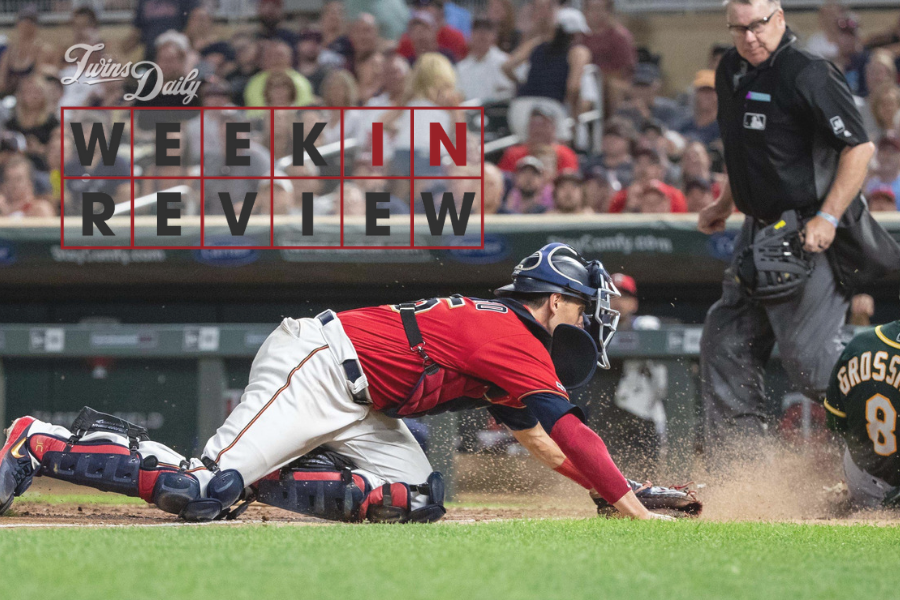 Weekly Snapshot: Mon, 7/15 through Sun, 7/21 *** Record Last Week: 2-4 (Overall: 60-38) Run Differential Last Week: -10 (Overall: +111) Standing: 1st Place in AL Central (3.0 GA) Willians Watch: Out Indefinitely There's been an exodus in the Twins bullpen. Adalberto Mejia, designated for assignment a week ago, was claimed on Saturday by the Angels. Mike Morin, designated a few days later, was traded to Philadelphia on the same day for cash considerations. And Matt Magill, the most recent cut after getting bombed by the Mets on Wednesday, found himself dealt to Seattle for cash on Sunday. That's the bottom three pieces of Minnesota's shaky bullpen, all cleared out in a matter of days. So, they're halfway to getting better. But meanwhile, everyone's wondering: When are they going to add some upgrades to replace these departed relievers? So far the only reinforcement called in to fill the void is Kohl Stewart, who has pitched one inning since being recalled on Thursday. The Twins curiously have four spots sitting open on their 40-man roster. With the trade deadline less than 10 days away, Minnesota is all but assured to make at least one deal, but in the meantime they are grinding out games and leaning hard on a stretched, shorthanded relief corps. On Sunday this meant leaving Trevor May on the hill for a grueling 49-pitch outing, and also sending Zack Littell (a full-time starter prior to this year) out to pitch for a third straight day. With an even more daunting offense coming to town, and no off days on the schedule in the coming week, the Twins are desperately in need of bullpen help. They announced on Sunday they've optioned Littell (who has a 1.50 ERA in 12 appearances since the start of June), and will have another arm coming up on Monday. Who will it be? Cody Allen is a possibility, though he's looked quite poor in Triple-A (5 BB and 3 K in 4 IP). Cody Stashak, who has a 1.61 ERA and 31-to-4 K/BB ratio in 22 1/3 innings at Rochester, would be the better option on merit. Either addition would require a 40-man move, but that's no problem. [uPDATE: Sounds like it'll be Stashak (per our own Jeremy Nygaard), pushing Minnesota's 40-man roster to 37.] Of course, neither of those two will do much to solve the team's need for credible late-inning support. And so the trade market will (rightfully) be an ongoing focal point of discussion in the days ahead. Urgency continues to build... HIGHLIGHTS The reemergence of Miguel Sano continues to be tremendously invigorating. He had a tough go in the Mets series, striking out five times in eight trips while collecting just one single, but rebounded in a big way over the weekend. Even with his 0-for-5 on Sunday, Sano reached eight times in 17 plate appearances against Oakland. Even more impressive to me than his mammoth third-deck homer, which put the Twins ahead (briefly) on Saturday, was the fact that he drew five walks with only three strikeouts in the four games. He is absolutely locked in at the plate, and the contrast from one month ago – when he was mired in a staggeringly hideous slump – is nothing short of mind-blowing. Since breaking out with a two-homer game in Chicago on June 28th, Sano is hitting .316/.426/.684 with five bombs, four doubles, and 11 walks in 18 games. During that span, he's struck out at just a 28% rate. The big third baseman has quietly reverted to All-Star form; unfortunately, it happens to be occurring at a time where most of the offense has fallen into a collective funk. Not everyone though. Despite his prodigious pop, Sano still isn't the most dangerous right-handed power bat on the Twins. That'd be Mitch Garver, who added three more home runs last week to go along with a pair of singles and three walks. Garver has now surpassed his rookie homer total by 10, in half the number of games. He continues to show incredible plate discipline combined with an ability to crush drives to all fields. Just an amazing transformation, and that's not even mentioning his enormous defensive advancements. https://twitter.com/NickNelsonMN/status/1152726524346490882 It was a lefty slugger who provided the biggest highlight of the week. With the Twins trailing on Thursday night, Eddie Rosario came off the bench to deliver perhaps his most dramatic hit in a career that's featured plenty: https://twitter.com/Twins/status/1152216522137448449 His clutch three-run blast in the seventh put Minnesota ahead for good and snapped a three-game losing streak. Sadly, those moments of capitalization have been far and few between for this once-potent lineup, which has had to scratch and claw for everything lately. LOWLIGHTS The Twins offense, clicking pretty much nonstop over the first 10 weeks of the season, has fallen into a prolonged stretch of mediocrity. From the start of the year through June 15th, they were baseball's best offense by any measure, leading MLB in runs, homers, OPS, wOBA, wRC+, and WAR. Since June 16th, here are their rankings in those categories (entering Sunday) Runs: 22nd HR: 8th OPS: 17th wOBA: 16th wRC+: 17th WAR: 16th They've still been hitting the ball out of the yard at a decent clip, but in all other regards, the Twins have regressed hard into below-average territory offensively. Saturday's loss to Oakland perfectly encapsulates the frustrating trend plaguing this lineup: Three solo home runs, surrounded by inning after inning of lifeless out-making. When they would manage to mount a fledgling rally, it was always squandered – including the bottom of the ninth, where they loaded the bases with one out and came up empty. This freefalling regression starts at the top. Max Kepler was 4-for-19 on the week, and slashing .227/.257/.392 in the past month, before breaking out on Sunday with a 3-for-6 effort that included a double, a three-run homer, and a walk-off single. Jorge Polanco, who opened the scoring Sunday with an RBI double and added two walks, was 3-for-17 on the week and 13-for-59 (.220) in July coming into the game. These two hitters were the primary catalysts in Minnesota's offense for much of the first half, but of late, they've become much easier assignments for opposing pitchers. That's reflected by their K/BB ratios – Kepler has drawn three walks with 21 strikeouts over his past 25 games, while Polanco is at 10 BBs and 29 Ks since the start of June. Both players posted K/BB ratios that were close to even in the first two months. Other hitters continue to show pop, but are embodying the all-or-nothing (and more often the latter) nature of this offense right now. C.J. Cron chipped in a homer and two doubles last week, but otherwise went 1-for-16 with no walks. The RBI and run scored on his solo blast were the lone ones he tallied in five games. Nelson Cruz hit two solo homers, but finished with only those two RBIs in a week where he went 5-for-23 (.217). Yeah, the bullpen had a rough run, and is taking plenty of flack for it. But what we saw with May, Littell, Ryne Harper, and even Taylor Rogers blowing leads in eventual losses was a collection of pitchers who've been generally reliable, showing they're human against an extremely good and hot offense. It happens. That's not the problem. The problem is that the staff is undermanned (as we discussed earlier) and they are constantly pitching with razor-thin margins because the offense has been unable to build leads and breathing room. Relievers have also been asked to pitch more, with starters failing to last deep into games. Jose Berrios, who completed six-plus innings in all but one of his 17 starts through the end of June, has failed to do so in any of his three July outings. Jake Odorizzi hasn't gotten through six in any of his past five turns. Michael Pineda has pitched past the sixth only twice all year. The Twins need to add arms, and I'm certain they will. But let's not kid ourselves into thinking that even the addition of multiple high-caliber relievers is going to cure what's ailing this team, because it runs much deeper than a volatile bullpen – one which has, all things considered, actually performed reasonably well. In order to get back on track and rebuild some buffer in the AL Central, the Twins need their lineup to get rolling again, above all. Fortunately, there are numerous reasons to believe this will happen. Strong showings from Polanco and (especially) Kepler on Sunday were promising, as is the schedule, which eases up considerably following the impending Yankees series. But much will also hinge on the development we'll discuss next. TRENDING STORYLINE This team needs Byron Buxton back ASAP. The difference in their record with (48-23) and without (12-15) him in the lineup makes that abundantly clear. Not only is his defensive impact a regular game-changer, but Buxton also has the potential to get hot offensively and alter the dynamic for this lineup. At the same time, the Twins know all too well about the troublesome nature of concussions, especially when they begin to add up. (Buxton was knocked unconscious in a scary outfield collision in 2014, and has had plenty of scary run-ins with the wall and ground since.) This front office is conservative by nature when it comes to managing injuries, and in this case that approach is warranted more than ever. But... they need him back. When will he return? It could be as soon as Monday – which would be big, with a crucial series against the Yankees set to get underway – and seems to be trending that way, as he was able to participate in all baseball activities before Sunday's game. But all will depend on how he feels Monday morning. Any signs of trouble will surely prompt the Twins to back off. I wouldn't be surprised if he's in center field for Game 1 against New York, nor would I be surprised if he isn't activated in the coming week at all. DOWN ON THE FARM What Jaylin Davis is doing at Rochester cannot be ignored. In past years, Davis has never really been on the Twins prospect radar, at least beyond its fringes. A 24th-round draft pick out of college in 2015, he has risen steadily through the system – advancing about one level per season – while posting solid yet unspectacular numbers as mostly a right fielder. He opened the 2019 campaign at Pensacola, where he got off to an unusually strong start, slashing .274/.382/.458 with 10 home runs in 58 games. This earned him his first promotion to Triple-A, and since arriving in the International League, Davis has experienced a power surge of epic proportions. After launching three more home runs last week for the Red Wings, Davis is now up to 13 in just 33 games. That equates to a .729 slugging percentage to go along with his .331 average since moving up. The 25-year-old has already gone deep 23 times in 91 games this year between the top two levels of the minors; to put this in context, he homered 11 times in 120 games last year, and 15 times in 125 games the year before that. What to make of this? It's hard to say for sure. We might just be seeing a torrid and temporary hot streak, fueled partially by the hitter-friendly nature of Triple-A (which now uses MLB baseballs). But it's definitely a promising development, and one that puts Davis squarely on the radar as a potential late-bloomer. LOOKING AHEAD Just what the Twins need at a time where they've got fans bordering on panic mode: a date with their eternal tormenters. The Yankees are coming in red-hot, having won six of their last eight games and 23 of their last 30 to build a hulking 10-game lead in the AL East. These are two teams moving in very different directions. Can Minnesota shift the momentum while also vanquishing ghosts of the past? It's gonna be an interesting series. Unfortunately it coincides with Cleveland heading to Toronto for a three-game set against the 38-63 Blue Jays, before traveling to Kansas City to take on the 37-64 Royals. On the bright side, things ease up considerably at that point for the Twins, who get 10 games against the White Sox, Marlins and Royals starting next weekend. Let's just hope they still own sole possession of first place when that favorable stretch gets underway. MONDAY, 7/22: YANKEES @ TWINS – LHP CC Sabathia v. LHP Martin Perez TUESDAY, 7/23: YANKEES @ TWINS – RHP Domingo German v. RHP Kyle Gibson WEDNESDAY, 7/24: YANKEES @ TWINS – LHP J.A. Happ v. RHP Jake Odorizzi THURSDAY, 7/25: TWINS @ WHITE SOX – RHP Jose Berrios v. RHP Lucas Giolito FRIDAY, 7/26: TWINS @ WHITE SOX – RHP Michael Pineda v. RHP Dylan Cease SATURDAY, 7/27: TWINS @ WHITE SOX – LHP Martin Perez v. RHP Ivan Nova SUNDAY, 7/28: TWINS @ WHITE SOX – RHP Kyle Gibson v. RHP Dylan Covey Catch Up On Twins Daily Game Recaps Game 93 | NYM 3, MIN 2: Tough Luck Loss for the Twins Game 94 | NYM 14, MIN 4: Mets Blow Out Twins, Complete Another Target Field Sweep Game 95 | MIN 6, OAK 3: Rosario Ignites Late-Inning Comeback Game 96 | OAK 5, MIN 3: Twins Have No Answer To A’s pitching Game 97 | OAK 5, MIN 4: Twins Offense and Bullpen Can’t Do Enough to Secure the Win Game 98 | MIN 7, OAK 6: Max Kepler Delivers Dramatic Walk-Off Win
 -
Article: Week in Review: Second Half Statement
Nick Nelson replied to Nick Nelson's topic in Twins Daily Front Page News
Giving up a run every fourth game (assuming 1IP appearances) equates to a 2.25 ERA so I might suggest your standards are a bit high. May is a legit setup man, esp if the control improvements we've seen of late are real. That doesn't mean the Twins shouldn't add another but I'm not sure you're getting a much higher-caliber arm out there. -
Article: Week in Review: Second Half Statement
Nick Nelson replied to Nick Nelson's topic in Twins Daily Front Page News
May below Harper? And at the same level as Parker??- 29 replies
-
- 2
-
-
- jorge polanco
- jake odorizzi
- (and 3 more)
-
The Twins opened their season with an impressive series win against Cleveland at Target Field, setting the tone for a first half that saw Minnesota build up a sizable lead in the AL Central. That lead had dwindled somewhat by the time last week's All-Star break came around, but the Twins opened their second half by adding to it with another big statement – this one made all the more impressive by preceding trends and an away setting. Weekly Snapshot: Mon, 7/8 through Sun, 7/14 *** Record Last Week: 2-1 (Overall: 58-34) Run Differential Last Week: +5 (Overall: +121) Standing: 1st Place in AL Central (6.5 GA) Willians Watch: Out Indefinitely The big surprise coming out of the break was that the Twins did not activate Eddie Rosario, who by all indications was ready to go when his 10 days on the Injured List lapsed, and held back as a mere precaution. Rosario was not in the lineup for any of Minnesota's three games against Cleveland, and his absence was felt – especially on Sunday when the Twins simply could not find that big hit. It sounds like there's a good chance he'll be activated Tuesday against the Mets, but this front office has been really tough to read. They're cryptic in communicating about injury status, and we've seen them opt for the conservative route on almost every occasion. This approach has served them well, so I don't have a problem with it, but it's consequentially impossible to say with certainty when Rosario will be back. The same is true for Byron Buxton, who hit the ground hard on a fantastic diving catch Saturday and was out of the lineup on Sunday, and C.J. Cron, who's eligible to be activated from the IL on Tuesday. One big noteworthy roster move from the past week: Adalberto Mejia was designated for assignment to make room for Jake Odorizzi's return from the IL. The big lefty just hasn't shown enough and his latest meltdown was the last straw. I'm guessing he'll be claimed on waivers by some also-ran non-contender that views him as a cheap starting option with remnants of upside. HIGHLIGHTS Plenty of Twins hitters rose to the occasion in Cleveland. There were home runs from some of the usual fixtures – Max Kepler (x2), Nelson Cruz, Mitch Garver – and also big production from an unexpected source: Jake Cave delivered a home run and clutch two-run double in Saturday's series-clinching victory. He had just a .542 OPS with the Twins coming in, and the big breakout was very much welcomed with the continuing absence of Rosario. Jorge Polanco, fresh off delivering an RBI hit in Tuesday's All-Star Game, came through when it mattered on Friday, launching a two-run double over the center fielder's head to put Minnesota in front for good in the seventh. Polanco added three more hits on Saturday. Also on Saturday, fellow All-Star Odorizzi had a nice return to form, hurling 5 1/3 innings of one-run ball to pick up his 11th win of the season (first in nearly a month). A solo homer by Jose Ramirez represented the only damage against Odorizzi, who otherwise allowed just two singles and two walks. Still, despite the successful results, his lack of swing-and-miss prowess was conspicuous. Odorizzi struck out only two hitters, a number he's posted in three of his past four turns. He had struck out three or more in 12 of his first 14 starts. While the lineup and rotation had their moments, the biggest story in this series – in an extension of the encouraging trend we highlighted last week – was the excellent work from Minnesota's bullpen. The unit stepped up after a short start on Friday with 5 1/3 scoreless innings, facilitating the critical comeback win. Trevor May, Zack Littell and Ryne Harper paved the way for Taylor Rogers to close it out with a two-inning save; collectively, those four struck out seven, with two hits and one walk allowed. The Twins turned to Rogers again on Saturday, with a four-run lead in the ninth, and he was perfect. Since that late-May stretch where he allowed home runs in back-to-back games, Rogers has a 0.90 ERA and 25-to-1 K/BB ratio in 20 innings of work. During that span he has allowed seven hits – five of them singles. As Aaron Gleeman notes here, Rogers has been the biggest difference-maker among AL relievers this year, and no one else is close: May's costly mistake on an 0-2 pitch on Sunday, taken deep by Carlos Santana for a decisive home run, was an unfortunate blemish amidst a strong stretch (and, really, season) for the right-hander. He bridged the gap on Friday by getting four big outs, and blew away the three other hitters he faced on Sunday. Over his past six appearances he has piled up a whopping 14 strikeouts with one walk in 7 1/3 innings. Santana's bomb stands as the only extra-base hit allowed during that span, and one of just three homers May's surrendered all year. He's a viable setup man, in spite of this hiccup. Littell is emerging as a legitimate late-inning option himself. He tossed two more scoreless innings last week and hasn't allowed a run in eight appearances since the start of June. During that span he has a dazzling 16% swinging strike rate, although the five walks are a bit concerning. Cleveland's bullpen has the best ERA in the league but it was Minnesota's that shined in this showdown: Twins relievers allowed just two runs (on solo homers against May and Tyler Duffey) in 12 innings, with 14 strikeouts and one walk. Phenomenal stuff. LOWLIGHTS Kyle Gibson was cruising along on Friday, fanning four through three scoreless innings, before everything unraveled in the fourth. A home run, a walk, an error, a bloop two-run single, and a hit-by-pitch all contributed to a series of events that saw Gibson lifted before escaping the frame. It's been a weird run of usage lately for Gibson, whose past four outings have included one-inning appearances as a reliever (in the 17th) and an opener (in the first). Outside of those, in his more traditional starts, he hasn't looked very good of late, allowing three-plus runs in six of his past seven turns. Over the course of the year, Gibson's been plagued by the same issue that afflicted Odorizzi last year: hitters are seeing him way better on successive trips through the order. His first time through, the righty is holding opponents to a .197/.278/.275 line, and we saw this play out on Friday as he mowed through the first three innings. Then, the second time through the order, opponents improve to .246/.311/.442, and the third time that goes up to .340/.376/.553. Against Cleveland, Gibson didn't even make it to that third go-round. To be a reliable force for Minnesota down the stretch, Gibson's going to need to find a way to give hitters a different look in their second and third at-bats. Working deep into games hasn't generally been an issue for Jose Berrios, who has failed to reach the sixth only three times all season. But two of those have come in his past two starts, which have both seen Berrios ousted after five innings while allowing three runs and battling uncharacteristic command struggles. The right-hander's 1.6 BB/9 rate through the first three months ranked among the best in baseball, but he's now issued three walks in back-to-back starts. On offense, there were plenty of trials experienced against Cleveland's outstanding staff, but no one looked worse than Jonathan Schoop, who went 1-for-9 with five strikeouts in his two starts. One of those K's came in a huge spot with the bases loaded and no outs in the seventh on Sunday, and it ran Schoop's futility with bases juiced this year to 0-for-8. He'd entered the game sporting a .167/.235/.449 line with runners in scoring position, and .158/.256/.184 in "Late & Close" situations. Schoop's overall production has been plenty respectable, but if it seems like he's been getting fat off lopsided blowouts, you're not mistaken. His most recent offensive explosion, before the break when he put up a homer, two doubles and four RBIs in a 15-6 laugher against Texas, was typical. He has a 1.119 OPS when hitting with a score margin of four-plus runs, and his numbers get progressively worse the closer the game is. The Twins are plainly a better team with Luis Arraez or Marwin Gonzalez at second base over Schoop, and you can make a pretty decent case for Ehire Adrianza as well. It'll be interesting to see how the veteran's playing time shapes up in the final months, especially considering the other three are clearly bigger factors in the team's future plans. TRENDING STORYLINE With Mejia out, the Twins have an immediate need for a second southpaw in the bullpen. They really don't have a single situational guy to face tough left-handed hitters at this point, since Rogers is more of a closer and all-around max-leverage stud. That's something they'll almost certainly want to address in short order. Internal options are waning. Like Mejia, Gabriel Moya and Andrew Vasquez have pretty much pushed themselves out of the picture this year, as both have been outrighted from the 40-man roster. Lewis Thorpe and Devin Smeltzer are certainly intriguing options, but both are still working as starters in Rochester. It seemed like Littell benefited from getting the chance to transition to a relief role in the minors; will the Twins take a similar approach with one of these two? Or will they strike quickly on the trade market to address their need? Or both? DOWN ON THE FARM Minnesota's representatives in the All-Star Futures Game, which took place ahead of last week's midsummer classic, performed accordingly in their returns to the field. Shortstop Royce Lewis and right-hander Jordan Balazovic – ranked No. 1 and No. 6, respectively, in our recently updated midseason prospect rankings – both participated in the talent showcase, then got back to work at Fort Myers. Lewis launched a pair of homers in six games for the Miracle and also drew three walks. The power outburst was nice to see but I'm more heartened by the patience; he has been undone by a lack of discipline this year, and entered last week with a 25-to-2 K/BB ratio in 28 games dating back to the start of June. His balky swing mechanics are among the reasons Keith Law dropped Lewis from No. 9 to No. 34 in his new midseason ranking updates at ESPN. Balazovic, on the other hand, was all the way up to No. 44 in Law's rankings, after appearing as a "Just Missed" guy on the fringe of the spring Top 100. Balazovic had his usage altered a bit coming off the Futures Game appearance, and worked in relief for Fort Myers on Friday night. His results were customary. Entering in the sixth and working the final four frames, Balazovic held the Bradenton Marauder scoreless on one hit while notching six strikeouts. Meanwhile, it's getting tougher and tougher to understand why Trevor Larnach is still on the same roster as these two. Minnesota's first-round pick from last year's draft has been tearing up Florida State League pitching and was tremendous last week, going 12-for-26 with a homer and six RBIs in six games. That home run was his first in five weeks, so there's certainly a noticeable dearth of power from the former star collegiate slugger, but he's batting .316 and the quality of at-bats has consistently been very good. I wonder if the Twins will let the 22-year-old start acclimating to Double-A before season's end. LOOKING AHEAD The Twins came just short of delivering a critical hit to Cleveland on the road, but should still be feeling good with an extra game in the standings as they return home for a fairly key juncture. They'll be lucky to avoid Noah Syndergaard and Jacob deGrom in their two-gamer against the Mets, but will then have a tough challenge ahead of them with four games against an A's team that gave them plenty of trouble in Oakland at the beginning of the month. Meanwhile, Cleveland will get Detroit and Kansas City at home. If they can't close the gap some in the next seven days they'll be facing some cold realities as they look inward at the deadline. TUESDAY, 7/16: METS @ TWINS – RHP Zack Wheeler v. RHP Michael Pineda WEDNESDAY, 7/17: METS @ TWINS – LHP Steven Matz v. LHP Martin Perez THURSDAY, 7/18: ATHLETICS @ TWINS – RHP Mike Fiers v. RHP Kyle Gibson FRIDAY, 7/19: ATHLETICS @ TWINS – RHP Chris Bassitt v. RHP Jake Odorizzi SATURDAY, 7/20: ATHLETICS @ TWINS – LHP Brett Anderson v. RHP Jose Berrios SUNDAY, 7/21: ATHLETICS @ TWINS – RHP Daniel Mengden v. RHP Michael Pineda Catch Up On Twins Daily Game Recaps Game 90 | MIN 5, CLE 3: Late Rally, Bullpen Power Stunning Comeback WinGame 91 | MIN 6, CLE 2: Series Clinched Behind Big Performances From Kepler, CaveGame 92 | CLE 4, MIN 3: Cleveland Prevails, Avoids Sweep Click here to view the article
- 29 replies
-
- 3
-
-
- jorge polanco
- jake odorizzi
- (and 3 more)
-
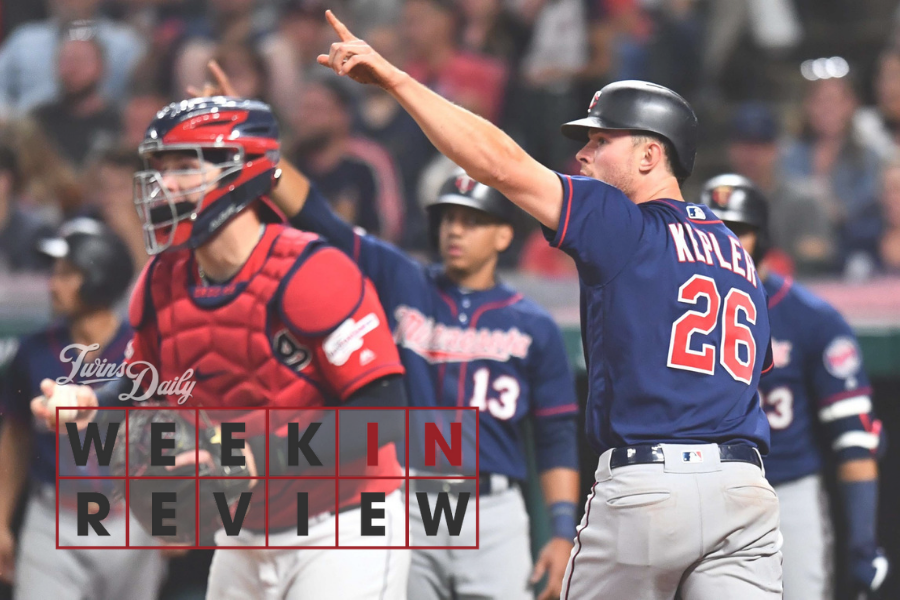 Weekly Snapshot: Mon, 7/8 through Sun, 7/14 *** Record Last Week: 2-1 (Overall: 58-34) Run Differential Last Week: +5 (Overall: +121) Standing: 1st Place in AL Central (6.5 GA) Willians Watch: Out Indefinitely The big surprise coming out of the break was that the Twins did not activate Eddie Rosario, who by all indications was ready to go when his 10 days on the Injured List lapsed, and held back as a mere precaution. Rosario was not in the lineup for any of Minnesota's three games against Cleveland, and his absence was felt – especially on Sunday when the Twins simply could not find that big hit. It sounds like there's a good chance he'll be activated Tuesday against the Mets, but this front office has been really tough to read. They're cryptic in communicating about injury status, and we've seen them opt for the conservative route on almost every occasion. This approach has served them well, so I don't have a problem with it, but it's consequentially impossible to say with certainty when Rosario will be back. The same is true for Byron Buxton, who hit the ground hard on a fantastic diving catch Saturday and was out of the lineup on Sunday, and C.J. Cron, who's eligible to be activated from the IL on Tuesday. One big noteworthy roster move from the past week: Adalberto Mejia was designated for assignment to make room for Jake Odorizzi's return from the IL. The big lefty just hasn't shown enough and his latest meltdown was the last straw. I'm guessing he'll be claimed on waivers by some also-ran non-contender that views him as a cheap starting option with remnants of upside. HIGHLIGHTS Plenty of Twins hitters rose to the occasion in Cleveland. There were home runs from some of the usual fixtures – Max Kepler (x2), Nelson Cruz, Mitch Garver – and also big production from an unexpected source: Jake Cave delivered a home run and clutch two-run double in Saturday's series-clinching victory. He had just a .542 OPS with the Twins coming in, and the big breakout was very much welcomed with the continuing absence of Rosario. Jorge Polanco, fresh off delivering an RBI hit in Tuesday's All-Star Game, came through when it mattered on Friday, launching a two-run double over the center fielder's head to put Minnesota in front for good in the seventh. Polanco added three more hits on Saturday. Also on Saturday, fellow All-Star Odorizzi had a nice return to form, hurling 5 1/3 innings of one-run ball to pick up his 11th win of the season (first in nearly a month). A solo homer by Jose Ramirez represented the only damage against Odorizzi, who otherwise allowed just two singles and two walks. Still, despite the successful results, his lack of swing-and-miss prowess was conspicuous. Odorizzi struck out only two hitters, a number he's posted in three of his past four turns. He had struck out three or more in 12 of his first 14 starts. While the lineup and rotation had their moments, the biggest story in this series – in an extension of the encouraging trend we highlighted last week – was the excellent work from Minnesota's bullpen. The unit stepped up after a short start on Friday with 5 1/3 scoreless innings, facilitating the critical comeback win. Trevor May, Zack Littell and Ryne Harper paved the way for Taylor Rogers to close it out with a two-inning save; collectively, those four struck out seven, with two hits and one walk allowed. The Twins turned to Rogers again on Saturday, with a four-run lead in the ninth, and he was perfect. Since that late-May stretch where he allowed home runs in back-to-back games, Rogers has a 0.90 ERA and 25-to-1 K/BB ratio in 20 innings of work. During that span he has allowed seven hits – five of them singles. As Aaron Gleeman notes here, Rogers has been the biggest difference-maker among AL relievers this year, and no one else is close: https://twitter.com/AaronGleeman/status/1150039964517687296 May's costly mistake on an 0-2 pitch on Sunday, taken deep by Carlos Santana for a decisive home run, was an unfortunate blemish amidst a strong stretch (and, really, season) for the right-hander. He bridged the gap on Friday by getting four big outs, and blew away the three other hitters he faced on Sunday. Over his past six appearances he has piled up a whopping 14 strikeouts with one walk in 7 1/3 innings. Santana's bomb stands as the only extra-base hit allowed during that span, and one of just three homers May's surrendered all year. He's a viable setup man, in spite of this hiccup. Littell is emerging as a legitimate late-inning option himself. He tossed two more scoreless innings last week and hasn't allowed a run in eight appearances since the start of June. During that span he has a dazzling 16% swinging strike rate, although the five walks are a bit concerning. Cleveland's bullpen has the best ERA in the league but it was Minnesota's that shined in this showdown: Twins relievers allowed just two runs (on solo homers against May and Tyler Duffey) in 12 innings, with 14 strikeouts and one walk. Phenomenal stuff. LOWLIGHTS Kyle Gibson was cruising along on Friday, fanning four through three scoreless innings, before everything unraveled in the fourth. A home run, a walk, an error, a bloop two-run single, and a hit-by-pitch all contributed to a series of events that saw Gibson lifted before escaping the frame. It's been a weird run of usage lately for Gibson, whose past four outings have included one-inning appearances as a reliever (in the 17th) and an opener (in the first). Outside of those, in his more traditional starts, he hasn't looked very good of late, allowing three-plus runs in six of his past seven turns. Over the course of the year, Gibson's been plagued by the same issue that afflicted Odorizzi last year: hitters are seeing him way better on successive trips through the order. His first time through, the righty is holding opponents to a .197/.278/.275 line, and we saw this play out on Friday as he mowed through the first three innings. Then, the second time through the order, opponents improve to .246/.311/.442, and the third time that goes up to .340/.376/.553. Against Cleveland, Gibson didn't even make it to that third go-round. To be a reliable force for Minnesota down the stretch, Gibson's going to need to find a way to give hitters a different look in their second and third at-bats. Working deep into games hasn't generally been an issue for Jose Berrios, who has failed to reach the sixth only three times all season. But two of those have come in his past two starts, which have both seen Berrios ousted after five innings while allowing three runs and battling uncharacteristic command struggles. The right-hander's 1.6 BB/9 rate through the first three months ranked among the best in baseball, but he's now issued three walks in back-to-back starts. On offense, there were plenty of trials experienced against Cleveland's outstanding staff, but no one looked worse than Jonathan Schoop, who went 1-for-9 with five strikeouts in his two starts. One of those K's came in a huge spot with the bases loaded and no outs in the seventh on Sunday, and it ran Schoop's futility with bases juiced this year to 0-for-8. He'd entered the game sporting a .167/.235/.449 line with runners in scoring position, and .158/.256/.184 in "Late & Close" situations. Schoop's overall production has been plenty respectable, but if it seems like he's been getting fat off lopsided blowouts, you're not mistaken. His most recent offensive explosion, before the break when he put up a homer, two doubles and four RBIs in a 15-6 laugher against Texas, was typical. He has a 1.119 OPS when hitting with a score margin of four-plus runs, and his numbers get progressively worse the closer the game is. The Twins are plainly a better team with Luis Arraez or Marwin Gonzalez at second base over Schoop, and you can make a pretty decent case for Ehire Adrianza as well. It'll be interesting to see how the veteran's playing time shapes up in the final months, especially considering the other three are clearly bigger factors in the team's future plans. TRENDING STORYLINE With Mejia out, the Twins have an immediate need for a second southpaw in the bullpen. They really don't have a single situational guy to face tough left-handed hitters at this point, since Rogers is more of a closer and all-around max-leverage stud. That's something they'll almost certainly want to address in short order. Internal options are waning. Like Mejia, Gabriel Moya and Andrew Vasquez have pretty much pushed themselves out of the picture this year, as both have been outrighted from the 40-man roster. Lewis Thorpe and Devin Smeltzer are certainly intriguing options, but both are still working as starters in Rochester. It seemed like Littell benefited from getting the chance to transition to a relief role in the minors; will the Twins take a similar approach with one of these two? Or will they strike quickly on the trade market to address their need? Or both? DOWN ON THE FARM Minnesota's representatives in the All-Star Futures Game, which took place ahead of last week's midsummer classic, performed accordingly in their returns to the field. Shortstop Royce Lewis and right-hander Jordan Balazovic – ranked No. 1 and No. 6, respectively, in our recently updated midseason prospect rankings – both participated in the talent showcase, then got back to work at Fort Myers. Lewis launched a pair of homers in six games for the Miracle and also drew three walks. The power outburst was nice to see but I'm more heartened by the patience; he has been undone by a lack of discipline this year, and entered last week with a 25-to-2 K/BB ratio in 28 games dating back to the start of June. His balky swing mechanics are among the reasons Keith Law dropped Lewis from No. 9 to No. 34 in his new midseason ranking updates at ESPN. Balazovic, on the other hand, was all the way up to No. 44 in Law's rankings, after appearing as a "Just Missed" guy on the fringe of the spring Top 100. Balazovic had his usage altered a bit coming off the Futures Game appearance, and worked in relief for Fort Myers on Friday night. His results were customary. Entering in the sixth and working the final four frames, Balazovic held the Bradenton Marauder scoreless on one hit while notching six strikeouts. Meanwhile, it's getting tougher and tougher to understand why Trevor Larnach is still on the same roster as these two. Minnesota's first-round pick from last year's draft has been tearing up Florida State League pitching and was tremendous last week, going 12-for-26 with a homer and six RBIs in six games. That home run was his first in five weeks, so there's certainly a noticeable dearth of power from the former star collegiate slugger, but he's batting .316 and the quality of at-bats has consistently been very good. I wonder if the Twins will let the 22-year-old start acclimating to Double-A before season's end. LOOKING AHEAD The Twins came just short of delivering a critical hit to Cleveland on the road, but should still be feeling good with an extra game in the standings as they return home for a fairly key juncture. They'll be lucky to avoid Noah Syndergaard and Jacob deGrom in their two-gamer against the Mets, but will then have a tough challenge ahead of them with four games against an A's team that gave them plenty of trouble in Oakland at the beginning of the month. Meanwhile, Cleveland will get Detroit and Kansas City at home. If they can't close the gap some in the next seven days they'll be facing some cold realities as they look inward at the deadline. TUESDAY, 7/16: METS @ TWINS – RHP Zack Wheeler v. RHP Michael Pineda WEDNESDAY, 7/17: METS @ TWINS – LHP Steven Matz v. LHP Martin Perez THURSDAY, 7/18: ATHLETICS @ TWINS – RHP Mike Fiers v. RHP Kyle Gibson FRIDAY, 7/19: ATHLETICS @ TWINS – RHP Chris Bassitt v. RHP Jake Odorizzi SATURDAY, 7/20: ATHLETICS @ TWINS – LHP Brett Anderson v. RHP Jose Berrios SUNDAY, 7/21: ATHLETICS @ TWINS – RHP Daniel Mengden v. RHP Michael Pineda Catch Up On Twins Daily Game Recaps Game 90 | MIN 5, CLE 3: Late Rally, Bullpen Power Stunning Comeback Win Game 91 | MIN 6, CLE 2: Series Clinched Behind Big Performances From Kepler, Cave Game 92 | CLE 4, MIN 3: Cleveland Prevails, Avoids Sweep
 -
It's possible. But it'd require some pretty underwhelming competition. As one example, Wil Myers won ROTY with the Rays in 2013 when he played only 88 games and made only 373 PA. His numbers weren't even that amazing (.293/.354/.478, 13 HR).
-
Needless to say, the Twins have – in general – been a huge surprise this year. Even the most starry-eyed optimist could not have predicted in March that at the All-Star break, they'd be ahead in the division by 5 1/2 games, on pace to win 102 and shatter the MLB home run record. Within this shocking success, there have been several unexpected developments. Here are my picks for the five biggest (good) surprises so far in 2019.1. Twins catchers lead the American League in OPS... by a mile. Minnesota's backstop position, fueled primarily by the production of Mitch Garver and Jason Castro, has yielded a .913 OPS through 89 games. That's 41 points higher than second-place Seattle, and 111 higher than the third-place White Sox. Twins catchers lead all counterparts with 24 home runs. This, to me, is the runaway winner for most surprising twist of the 2019 campaign. Back in the spring we were viewing this unit as a relative question mark, with Garver trying to back up a solid (concussion-punctuated) rookie campaign, and Castro coming off major knee surgery at 31. It's almost unfortunate that Castro's remarkably resurgent season – his current .860 OPS exceeds his previous career-best of .835, set when he was a 26-year-old All-Star back in 2013 – has been overshadowed by the theatrics of Garver, who's already almost doubled his rookie home run total in just 44 games. Not only has Garver been an all-around beast, rocking a .984 OPS that ranks 10th among MLB hitters with 150+ PA, but he's been incredibly clutch, slashing .417/.475/.778 with RISP, and his defensive improvements have been staggering. 2. Jake Odorizzi has allowed only 10 home runs. He hasn't been the best in the rotation at limiting the long ball; Martin Perez has given up only seven. But that's always been a strength for the groundballing left-hander. Odorizzi has always been an extreme fly ball pitcher and, by the time Minnesota acquired him, it appeared his susceptibility to the home run might derail his career. In 2016, he gave up 29 homers in 188 2/3 innings (1.4 HR/9) and in 2017 he surrendered 30 in 143 1/3 innings (1.9 HR/9). This year, Odorizzi has given up just 10 home runs in 88 2/3 innings, good for a 1.0 HR/9 rate. And that's AFTER allowing six in his past four starts. That Odorizzi has managed an above-average HR rate while giving up the most fly balls of any starter in the league (50.9%), in an era where balls are flying out of the park like never before, is completely bonkers. Consider that Justin Verlander, who will start Tuesday night's All-Star Game for the AL, has already given up 26 bombs at the break. His previous career high is 30. (He's uh... none too happy about this.) Odorizzi's proclivity for keeping it in the yard seems plainly unsustainable from a statistical standpoint, and maybe it is. Perhaps his recent flare-up is a sign of what's to come in the second half. But I will point out two things: 1) He's been dealing with a blister lately, and 2) His stinginess extends back beyond this year, to the bulk of 2018. Odorizzi allowed only six homers in 20 starts after June 1st last year. Add those innings to this year's sample and he's surrendered just 16 bombs in his last 190 innings, all while yielding a constant stream of fly balls in the most homer-happy era in MLB history. Nuts. 3. Ryne. Freaking. Harper. I can't believe it's taken me this long to get to him, but that just speaks to the ridiculous nature of the two accomplishments above. Harper has been nothing short of a godsend and, all things considered, one of the best Twins signings in memory. At a time where the team desperately needed right-handed relief help (especially because, unbeknownst to them, they'd be getting almost nothing collectively from Addison Reed, Trevor Hildenberger and Fernando Romero), the front office landed an absolute stud in the form of a 30-year-old minor-league signing, with zero major-league experience. Harper has been fantastic from any perspective. His 2.92 ERA and 1.05 WHIP are pristine, as is the 38-to-8 K/BB ratio in 37 innings. Major-league batters are slashing just .223/.267/.353 against him, and this is all with his numbers being negatively skewed by a June outing where he gave up three runs in the 18th inning because Rocco Baldelli was forced to call on him for a third straight day. This is an instance of self-scouting more than anything, as the Twins had Harper all last year in the minors. But they deserve plenty of credit for bringing him back, giving him a spring training invite, and believing in the validity of his stellar Grapefruit League results. His final appearance before the break, in which he notched a career-high four strikeouts with seven swings-and-misses on 15 pitches, looked to be an emphatic statement that his amazing first half was no flash in the pan. 4. Luis Arraez has all but locked up the second base job for 2020. Coming into this season, Arraez was more of a fun novelty than legitimate prospect. He didn't make our preseason Top 20 Prospects list, appearing instead as an honorable mention, because the general sentiment was that – despite his undeniably amazing contact skills and lovable scrappiness – he lacked the power and athleticism to be an impact guy at the next level. Arraez has spent his entire season proving us all wrong. In 54 games between Double-A and Triple-A, he hit .344/.409/.401. And it's a little tough to envision him going back down, given his .393/.453/.524 line in 95 plate appearances with the Twins. Despite having turned 22 in April, he looks mature beyond his years at the plate, swinging at fewer pitches outside the zone than any Minnesota batter other than Garver, with a lower whiff rate than even Willians Astudillo. As a result, he's drawn more walks than strikeouts, and he sprays liners all over the field. In other words, there's been nothing artificial about Arraez's instant success, although obviously he's not gonna be a .400 hitter. And the sudden emergence of a hinting power – he has two home runs with the Twins, after totaling six in 367 minor-league games – suggests that further upside may be lurking. As a point of comparison, the previous tenant at second base, Brian Dozier, was hitting zero home runs in 58 games at rookie ball when he was the same age as Arraez is now. As we've seen time and time again, pop tends to come on late. It wouldn't take much to turn Arraez – who was on basically no one's radar four months ago – into a young MLB star. With Jonathan Schoop due for a free agency after the season, I'm thinking Minnesota's plans are all but set for next year at second. 5. Byron Buxton is striking out at lower rate than the MLB average. For years, we all dreamed about how fun it would be if Buxton – someway, somehow – could turn himself into a contact hitter, fully weaponizing that elite speed by putting the ball in play at a high clip. Sadly, the notion seemed to be just that: a dream, of the pipy variety. In parts of four previous MLB seasons, Buxton had posted the following strikeout percentages: 31.9%, 35.6%, 29.4%, 30.0%. From 2015 through 2018, his K-rate was seventh-highest out of 287 hitters to make 1,000+ PA in the majors. It seemed the best realistic hope was a modest decrease, into the solidly higher-than-average range. This still could've easily made Buxton a star (he gained MVP votes with a 29.4% K-rate in 2017). Instead, he has completely remade himself at the plate, cutting down on whiffs to a drastic degree with only 59 strikeouts in 260 plate appearances. That's a 22.7% rate – fractionally lower than the big-league average of 22.8%. As a guy who lifts the ball at a higher rate than anyone else on the team, and has otherworldly speed, I'd expect a higher BABIP for Buxton than his current .302. Which is to say I think there's more in the tank, even though he's been tremendous as is, with an .816 OPS and 24 doubles at the break. As long as he can stay healthy, I believe Buxton will be the team's top MVP contender without question by year's end. ~~~ I've obviously left plenty of other surprises on the table. Jorge Polanco is an All-Star. Max Kepler has already set a career high in home runs (this one wasn't THAT surprising to me). Ehire Adrianza has raked. Eddie Rosario is on pace for 36 homers and 109 RBIs. Eight different players are on pace for more than 3.4 fWAR, which was Rosario's final mark last year when we named him team MVP. What positive developments have caught you off-guard in the first half? Sound off in the comments. Click here to view the article
- 31 replies
-
- 4
-
-
- jason castro
- mitch garver
- (and 3 more)
-
 1. Twins catchers lead the American League in OPS... by a mile. Minnesota's backstop position, fueled primarily by the production of Mitch Garver and Jason Castro, has yielded a .913 OPS through 89 games. That's 41 points higher than second-place Seattle, and 111 higher than the third-place White Sox. Twins catchers lead all counterparts with 24 home runs. This, to me, is the runaway winner for most surprising twist of the 2019 campaign. Back in the spring we were viewing this unit as a relative question mark, with Garver trying to back up a solid (concussion-punctuated) rookie campaign, and Castro coming off major knee surgery at 31. It's almost unfortunate that Castro's remarkably resurgent season – his current .860 OPS exceeds his previous career-best of .835, set when he was a 26-year-old All-Star back in 2013 – has been overshadowed by the theatrics of Garver, who's already almost doubled his rookie home run total in just 44 games. Not only has Garver been an all-around beast, rocking a .984 OPS that ranks 10th among MLB hitters with 150+ PA, but he's been incredibly clutch, slashing .417/.475/.778 with RISP, and his defensive improvements have been staggering. 2. Jake Odorizzi has allowed only 10 home runs. He hasn't been the best in the rotation at limiting the long ball; Martin Perez has given up only seven. But that's always been a strength for the groundballing left-hander. Odorizzi has always been an extreme fly ball pitcher and, by the time Minnesota acquired him, it appeared his susceptibility to the home run might derail his career. In 2016, he gave up 29 homers in 188 2/3 innings (1.4 HR/9) and in 2017 he surrendered 30 in 143 1/3 innings (1.9 HR/9). This year, Odorizzi has given up just 10 home runs in 88 2/3 innings, good for a 1.0 HR/9 rate. And that's AFTER allowing six in his past four starts. That Odorizzi has managed an above-average HR rate while giving up the most fly balls of any starter in the league (50.9%), in an era where balls are flying out of the park like never before, is completely bonkers. Consider that Justin Verlander, who will start Tuesday night's All-Star Game for the AL, has already given up 26 bombs at the break. His previous career high is 30. (He's uh... none too happy about this.) Odorizzi's proclivity for keeping it in the yard seems plainly unsustainable from a statistical standpoint, and maybe it is. Perhaps his recent flare-up is a sign of what's to come in the second half. But I will point out two things: 1) He's been dealing with a blister lately, and 2) His stinginess extends back beyond this year, to the bulk of 2018. Odorizzi allowed only six homers in 20 starts after June 1st last year. Add those innings to this year's sample and he's surrendered just 16 bombs in his last 190 innings, all while yielding a constant stream of fly balls in the most homer-happy era in MLB history. Nuts. 3. Ryne. Freaking. Harper. I can't believe it's taken me this long to get to him, but that just speaks to the ridiculous nature of the two accomplishments above. Harper has been nothing short of a godsend and, all things considered, one of the best Twins signings in memory. At a time where the team desperately needed right-handed relief help (especially because, unbeknownst to them, they'd be getting almost nothing collectively from Addison Reed, Trevor Hildenberger and Fernando Romero), the front office landed an absolute stud in the form of a 30-year-old minor-league signing, with zero major-league experience. Harper has been fantastic from any perspective. His 2.92 ERA and 1.05 WHIP are pristine, as is the 38-to-8 K/BB ratio in 37 innings. Major-league batters are slashing just .223/.267/.353 against him, and this is all with his numbers being negatively skewed by a June outing where he gave up three runs in the 18th inning because Rocco Baldelli was forced to call on him for a third straight day. This is an instance of self-scouting more than anything, as the Twins had Harper all last year in the minors. But they deserve plenty of credit for bringing him back, giving him a spring training invite, and believing in the validity of his stellar Grapefruit League results. His final appearance before the break, in which he notched a career-high four strikeouts with seven swings-and-misses on 15 pitches, looked to be an emphatic statement that his amazing first half was no flash in the pan. 4. Luis Arraez has all but locked up the second base job for 2020. Coming into this season, Arraez was more of a fun novelty than legitimate prospect. He didn't make our preseason Top 20 Prospects list, appearing instead as an honorable mention, because the general sentiment was that – despite his undeniably amazing contact skills and lovable scrappiness – he lacked the power and athleticism to be an impact guy at the next level. Arraez has spent his entire season proving us all wrong. In 54 games between Double-A and Triple-A, he hit .344/.409/.401. And it's a little tough to envision him going back down, given his .393/.453/.524 line in 95 plate appearances with the Twins. Despite having turned 22 in April, he looks mature beyond his years at the plate, swinging at fewer pitches outside the zone than any Minnesota batter other than Garver, with a lower whiff rate than even Willians Astudillo. As a result, he's drawn more walks than strikeouts, and he sprays liners all over the field. In other words, there's been nothing artificial about Arraez's instant success, although obviously he's not gonna be a .400 hitter. And the sudden emergence of a hinting power – he has two home runs with the Twins, after totaling six in 367 minor-league games – suggests that further upside may be lurking. As a point of comparison, the previous tenant at second base, Brian Dozier, was hitting zero home runs in 58 games at rookie ball when he was the same age as Arraez is now. As we've seen time and time again, pop tends to come on late. It wouldn't take much to turn Arraez – who was on basically no one's radar four months ago – into a young MLB star. With Jonathan Schoop due for a free agency after the season, I'm thinking Minnesota's plans are all but set for next year at second. 5. Byron Buxton is striking out at lower rate than the MLB average. For years, we all dreamed about how fun it would be if Buxton – someway, somehow – could turn himself into a contact hitter, fully weaponizing that elite speed by putting the ball in play at a high clip. Sadly, the notion seemed to be just that: a dream, of the pipy variety. In parts of four previous MLB seasons, Buxton had posted the following strikeout percentages: 31.9%, 35.6%, 29.4%, 30.0%. From 2015 through 2018, his K-rate was seventh-highest out of 287 hitters to make 1,000+ PA in the majors. It seemed the best realistic hope was a modest decrease, into the solidly higher-than-average range. This still could've easily made Buxton a star (he gained MVP votes with a 29.4% K-rate in 2017). Instead, he has completely remade himself at the plate, cutting down on whiffs to a drastic degree with only 59 strikeouts in 260 plate appearances. That's a 22.7% rate – fractionally lower than the big-league average of 22.8%. As a guy who lifts the ball at a higher rate than anyone else on the team, and has otherworldly speed, I'd expect a higher BABIP for Buxton than his current .302. Which is to say I think there's more in the tank, even though he's been tremendous as is, with an .816 OPS and 24 doubles at the break. As long as he can stay healthy, I believe Buxton will be the team's top MVP contender without question by year's end. ~~~ I've obviously left plenty of other surprises on the table. Jorge Polanco is an All-Star. Max Kepler has already set a career high in home runs (this one wasn't THAT surprising to me). Ehire Adrianza has raked. Eddie Rosario is on pace for 36 homers and 109 RBIs. Eight different players are on pace for more than 3.4 fWAR, which was Rosario's final mark last year when we named him team MVP. What positive developments have caught you off-guard in the first half? Sound off in the comments.
 -
Article: Week in Review: Breaking Even
Nick Nelson replied to Nick Nelson's topic in Twins Daily Front Page News
The craft beer stand by Gate 34 is a haven.- 39 replies
-
- 1
-
-
- miguel sano
- taylor rogers
- (and 3 more)
-
The high-flying Minnesota Twins have fallen back to Earth in recent weeks. Their first prolonged funk of the year carried into the final week before the All-Star break, and they've seen their once-massive lead in the AL Central cut in half by Cleveland. The midseason breather comes at a good time for the Twins, but their biggest challenges are yet to come. Weekly Snapshot: Mon, 7/1 through Sun, 7/7 *** Record Last Week: 3-3 (Overall: 56-33) Run Differential Last Week: +3 (Overall: +116) Standing: 1st Place in AL Central (5.5 GA) Willians Watch: Out Indefinitely Here's a rundown of roster moves from the past week to get you caught up: Lewis Thorpe was optioned to Triple-A on Monday following his exceptional start the previous day. Meanwhile, the Twins outrighted infielder Ronald Torreyes from the 40-man roster to make room for Adalberto Mejia's return from the 60-day Injured List.Andrew Vasquez was also outrighted from the 60-man three days later, but as of now it's unclear why. His spot remains vacant.Jake Odorizzi went on the IL after his Tuesday start in Oakland, having developed a blister on his right middle finger, and Zack Littell was recalled to replace him. Odorrizi's injury made room for Jose Berrios on the American League All-Star roster, his second consecutive nod.The Twins placed Blake Parker on paternity list Friday and called up Kohl Stewart, who tossed 1 1/3 spotless innings of relief that night and was sent back down on Sunday, replaced by Devin Smeltzer.LaMonte Wade Jr. had another very short stay with the Twins himself, called up to fill C.J. Cron's spot (right thumb inflammation) and then injuring his own thumb in the outfield on Saturday. Wade was replaced by Jake Cave, whose stay will also likely be very short, with Eddie Rosario due to return after the break.HIGHLIGHTS In a surprising twist, the Twins have completely flip-flopped their strengths over the past few weeks. While the offense and rotation have taken steps backward, the bullpen has emerged as a considerable positive. This development hasn't gained a ton of notice because of the team's generally pedestrian results of late – the value of a strong bullpen is negated to a degree when those other units aren't clicking – but Twins relievers deserve praise. Their impressive showings bode well for when the rest of the team hopefully gets back on track. Taylor Rogers, of course, continues to lead the way. He delivered his finest outing of the season on Saturday, striking out five in a spotless seven-out save, but the dominance was business-as-usual for Minnesota's bullpen ace. On the season Rogers now has a 1.82 ERA, 0.98 WHIP, and 51-to-7 K/BB ratio over 39 2/3 innings. He ranks fourth among all MLB relievers in Win Probability Added at 2.56 (trade target Will Smith of the Giants leads at 3.20). While he's been good all year long, Rogers has really kicked things up a notch in recent weeks. Since the start of June, he has a 1.23 ERA and is holding opponents to a .104/.140/.188 slash line. Although he won't be on the American League's roster for the All-Star Game on Tuesday, he easily could be and arguably should be. Rogers is one of the best in the game and continues to erase any shreds of doubt. Our guy Tom put together this awesome visual recapping his phenomenal outing against Texas: Several of Rogers' cohorts in the bullpen have been quietly putting together nice runs of their own, albeit not quite on the same level. Ryne Harper went through a rough patch in June but allowed only one run in three appearances to start July, and heads into the break on a high note after striking out four in 1 2/3 perfect innings Sunday. He holds a 2.92 ERA and 1.05 WHIP. Trevor May chipped in three scoreless frames with six strikeouts last week, and owns a 1.88 ERA over his past 15 appearances. Much has been made of May's control struggles this year, which is fair (he has issued seven walks in 14 innings even during the aforementioned stretch of excellence), but we might not be talking enough about how well he's limiting damage otherwise. On the season, opponents are hitting .204 with a .602 OPS against him, and he's allowed only two home runs. His soft contact % is highest among all Twins relievers with 15+ IP. Conversely, proneness to homers remains the biggest flaw in Tyler Duffey's game, and bit him hard on Saturday when he gave up a two-run blast to Willie Calhoun, briefly bringing Texas within one run. But he too has generally been an underrated contributor in the pen. Prior to that outing Duffey had a 2.57 ERA in 14 innings dating back to the start of June. Overall, opponents are batting .239 with a .288 OBP against him, and his 35-to-6 K/BB ratio in 28 1/3 innings is outstanding. He's not going to be a reliable setup man but he's a damn solid middle reliever. The same can be said for Matt Magill. He was in a bad way a month ago, but has gotten himself back on track admirably. Magill did struggle in Oakland last week, walking two and giving up a homer on Tuesday, but he's got a 2.25 ERA and .171 BAA in his past nine appearances. Littell, who's been shuttling back and forth between Triple-A and the majors, continues to make a very good impression during his opportunities with the Twins. Last week he made three scoreless appearances, and in fact he hasn't allowed a run in any of his seven MLB appearances outside of the eight-run clunker against Tampa in May that continues to plague his ERA. Smeltzer, who technically appeared as a reliever on Sunday when following opener Kyle Gibson in the second, delivered another very fine effort, tossing 4 1/3 innings of one-run ball with five strikeouts. In contrast with Mejia, who later gave up the game-losing homer amidst another ugly and erratic relief outing, Smeltzer's making a pretty strong case to stick around in that second lefty role. On offense, the best story right now without question is Miguel Sano, whose complete turnaround at the plate has been nothing short of astounding. Last week he picked up eight knocks – including two doubles, a triple, and a homer – but the most impressive aspect of his game continues to be the dramatically improved plate discipline. Sano struck out seven times in 25 plate appearances while drawing three walks. Dating back to the start of the White Sox series at the end of June, he's got an 8-to-5 K/BB ratio in eight games with one multi-strikeout performances (coming in Sunday's extra-inning contest). In the four series prior, he had eight multi-strikeout games and a 52% K-rate. With Mitch Garver also on top of his game (6-for-15 with a homer and double in three starts last week) and Jonathan Schoop finding himself again after a poor month of June (8-for-21 with two doubles and a MONSTER bomb), the Twins are boasting some real potency from the right side at the moment. Meanwhile, Luis Arraez continues to provide plenty of juice from the left. He went 10-for-28 and found himself in the starting lineup for every game. LOWLIGHTS The Twins offense, so hot over the first 10 weeks, has gone into a serious cooldown period over the past three. It was nice to see them seemingly break out of it with powerful showings on Friday and Saturday against Texas, but they went right back into their slumber on Sunday, scoring just once in 11 innings against a smattering of Rangers relievers. In the five series preceding this last one, Minnesota slashed just .252/.306/.408 over 16 games and averaged only 4.3 runs – a number that's worse than it seems when you consider there were two 18-inning games and another 12-inning affair mixed in. The Twins ranked 24th among MLB teams in both OPS and wOBA during that span. Friday's offensive outburst, one of the biggest all season was very refreshing. Still, a number of hitters will carry slumps (and/or injuries) into the midseason hiatus. Cron's recent struggles was most conspicuous; he was 2-for-13 last week, and hitting .156/.191/.200 in his past 10 games, before going on the IL with right thumb inflammation on Saturday. Twins coaches said they noticed the ailment affecting his swing, so it might have something to do with the downturn. Leadoff man Max Kepler went 6-for-29 last week, and his decreased output has been kinda setting the tone for Minnesota's suppressed offense. Since the start of the Boston series in mid-June, he's batting just .212 with a .271 OBP over 18 games. Of course, in the 10 games prior to that sample, he was slugging 1.000, so we know what's lurking within him. Hopefully a few days off can get Kepler back into his zone at the plate. Another player who was key in driving the lineup's success over the first half, Jorge Polanco, has also been noticeably quieter of late. He's still finding plenty of ways to contribute – hitting two home runs last week and making a CRAZY tag on a stolen base Sunday – but he hasn't been piling up the hits like he was earlier and has fallen back several spots in the AL batting race. Polanco's last three-hit game came nearly a month ago, on June 11th, and since then his average has dropped from .341 to .312. Aside from his two jacks last week, he managed only four singles in 27 plate appearances, with no runs scored or RBIs. Hopefully his starting nod in Tuesday's All-Star Game will reinvigorate Polanco and get him rolling again, because he's a crucial cog. Speaking of the All-Star Game, we already knew Odorizzi probably wasn't going to pitch – he was due to pitch on Sunday, which would've made him unavailable – but now it's official because he was placed on the Injured List after his latest start, which ended in a grand slam that might've had something to do with the blister he was pitching through. It'd be nice if we could attribute the totality of Odorizzi's recent struggles – he has a 7.85 ERA with six home runs allowed in his past four turns – to the finger issue, but more likely we're seeing some simple regression to the mean. The right-hander's minuscule home run rate was never going to be sustainable with the number of fly balls he allows, and the increased comfort level of opposing hitters suggests scouting reports have caught up to him a bit. Odorizzi figures to return as soon as his 10-day IL requirement is satisfied, meaning he'll ultimately miss just one start. Here's hoping the midsummer respite does him some good. TRENDING STORYLINE Cleveland is poised to make its stand. Staring up from 11 games out of first place as recently as June 15th, they've taken advantage of Minnesota's lapses to gain 5 1/2 games in the standings. Next, they'll host the Twins for a three-game series coming out of the break, and they follow with easy assignments against Detroit, Kansas City (twice), and Toronto leading up the trade deadline. Meanwhile, the Twins face a much tougher slate over the same span. After leaving Cleveland, they'll get a string of nine games versus the Mets, Athletics and Yankees before things ease up again. Can they maintain a solid buffer in the AL Central over the latter half of July, or will the Indians thrust themselves right back into the thick of this race? With the deadline bearing down, this is an absolutely critical period. DOWN ON THE FARM His true offensive upside was in question after a brutal introduction to Triple-A last year, but Nick Gordon is reaffirming his top prospect status in the 2019 follow-up for Rochester. He collected at least one hit in all seven of his games last week, finishing 12-for-29 (.413) with five doubles, a triple, and eight RBIs. Overall, the 23-year-old is sporting a .792 OPS with 21 doubles and 12 steals on 15 attempts through 49 games. Interestingly, Gordon has been splitting time evenly between second and shortstop recently after playing predominantly at short in the early going. He's getting close to big-league ready, but it's hard to see how he'll figure into the club's plans with Arraez emerging to stake a strong claim on Minnesota's future at second base. Aside from Gordon's standout play, and a few other strong performances in the minors, the biggest news for the Twins system last week was a high-profile addition: outfielder Emmanuel Rodriguez, a 16-year-old out of the Dominican Republic inked to a $2.5 million contract on Tuesday. Jesse Sanchez of MLB.com opines that the lefty swinger, who ranks eighth in the website's ranking of international prospects, could be "the next Eddie Rosario." LOOKING AHEAD On Tuesday, Polanco will start for the AL at shortstop in the All-Star Game and Berrios will probably make an appearance. The rest of the Twins will enjoy their four-day respite before heading to Cleveland for a critical series. Buckle up for a thrilling second half. TUESDAY 7/8 THROUGH THURSDAY 7/11: All-Star Break FRIDAY, 7/12: TWINS @ INDIANS SATURDAY, 7/13: TWINS @ INDIANS SUNDAY, 7/14: TWINS @ INDIANS Catch Up On Twins Daily Game Recaps Game 84 | OAK 8, MIN 6: Former Twins Have A Grand Night for OaklandGame 85 | MIN 4, OAK 3: Twins Refuse to Lose Three in a RowGame 86 | OAK 7, MIN 2: Twins Drop Independence Day Rubber Match in OaklandGame 87 | MIN 15, TEX 6: Offense Erupts and Perez Faces Former TeamGame 89 | MIN 7, TEX 4: Pineda, Rogers Lead Twins Over RangersGame 90 | TEX 4, MIN 1: Quiet Bats Can’t Back Up Great Pitching Click here to view the article
- 39 replies
-
- 1
-
-
- miguel sano
- taylor rogers
- (and 3 more)
