


Twins Video
"Consistency, you know? Prove that I can be consistent."
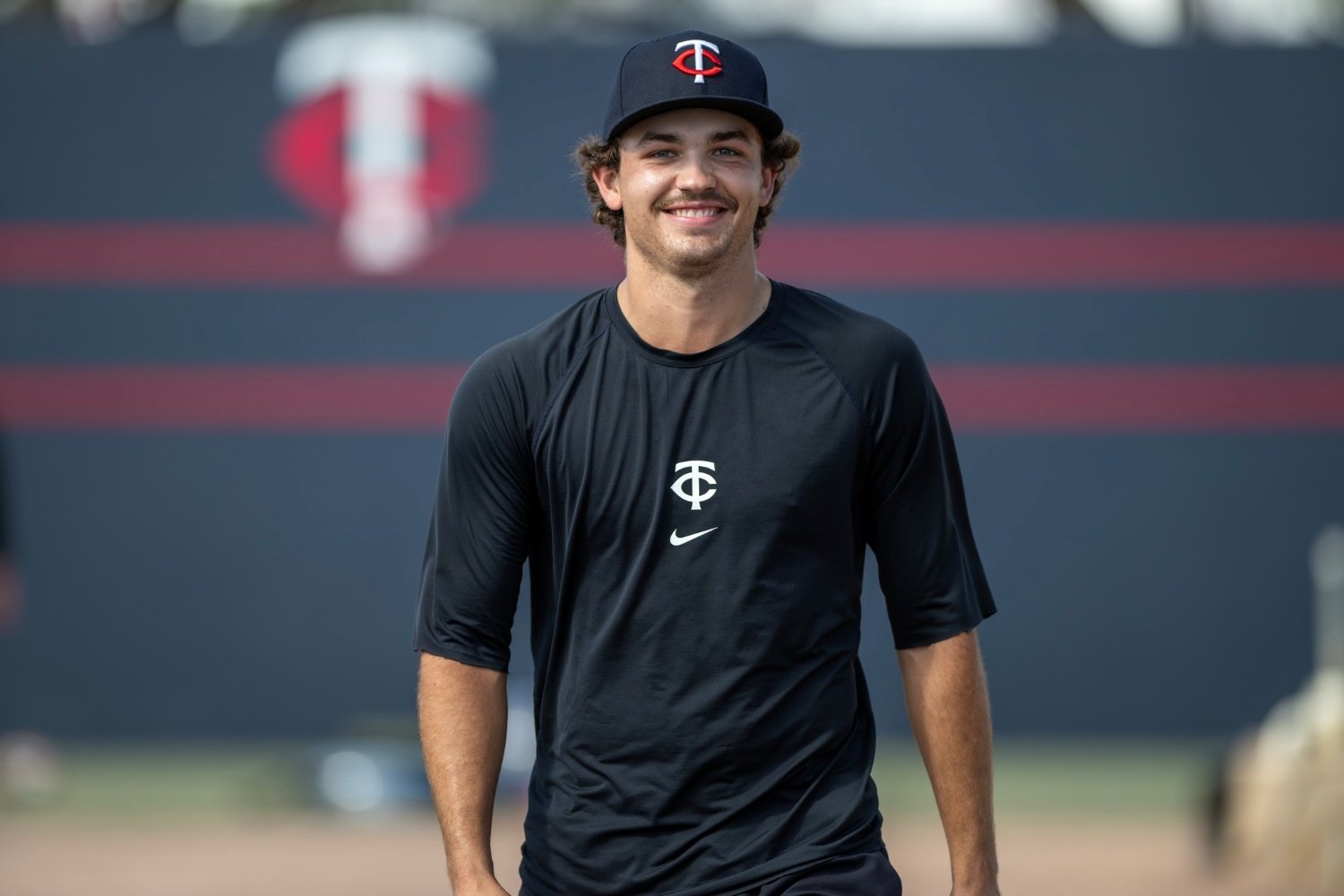
That's what Twins right-handed pitching prospect Andrew Morris told Twins Daily's John Bonnes in Ft. Myers recently, when asked what he needs to show in 2025 to make an impact on the big-league ball club.
It’s clear that Morris sets a high bar for himself. One could make a good-faith argument that consistency is all he’s shown since being drafted by the Twins in the fourth round of the 2022 MLB Draft (114th overall). In 2023, Morris’s first full professional season, he posted a 3.17 FIP in 84 1/3 innings across two levels of A ball. In 2024, he reached the doorstep of the majors, with a 2.86 FIP across 133 innings spanning High A, Double A, and Triple A.
Arsenal and MiLB Outcomes
Were it not for Zebby Matthews’s incandescent 2024 season, Morris might have garnered more attention for his sustained excellence last year. Looking at the big picture, he’s part of a remarkable crop of college right-handers the Twins drafted in 2022, four of whom (Morris, Matthews, Cory Lewis, and C.J. Culpepper) have a chance to start at the highest level.
There’s more to a Morris and Matthews comparison than the fact that both achieved minor-league excellence. Both are outstanding strike-throwers, and they roughly share a pitching arsenal. Morris lives in the zone. In 2024, his strike rate hovered around 70% (that’s 4-5% above MLB average). Therein lies one of his greatest remaining challenges and conundrums; does living in the zone that much eventually hurt a pitcher? When does leaving the zone (in different counts, with different pitches, using different locations) to induce chases by the batter create more leverage for an extreme strike-thrower?
Let’s run down Morris’s 2024 arsenal, as it’s central to his next steps. He throws a four-seam fastball, curveball, slider, changeup, and cutter. As with Zebby Matthews, the Twins essentially split Morris’s cutter into two distinct pitches: a high-vert cutter deployed against left-handed hitters, and a gyro slider for use against right-handed hitters or in two-strike counts. Very loosely, Morris deploys his fastball 35% of the time (94-mph average); his slider/cutter 35% of the time (87 mph), his changeup 17% (88 mph), and his curveball 13% (75 mph).
That's a deep arsenal of pitches. He has the ability to throw strikes whenever he wants. No wonder Morris has had consistent success throughout his career, to date. So what’s there to be concerned about? The amount of miss he generates.
Morris’s strikeout percentage has fallen with each ascending level of the minor leagues. That's hardly surprising. However, the fall was more stark when he moved from Double-A Wichita to Triple-A St, Paul. Morris struck out 28% of hitters at High-A Cedar Rapids; 25% for Wichita; and just 19% with St. Paul, albeit in a 33 2/3-inning sample. That’s not untenable, but it is more of a tightrope to navigate if he’s to become a solid middle-of-the-rotation starter, instead of a Quadruple-A innings eater. I’d emphasize that these are run-of-the-mill developmental milestones for pitching prospects, as opposed to something unique to Morris. To me, there are three areas of opportunity to explore.
Command over control
The first area of opportunity is an issue he shares with Matthews. Because he’s an extreme strike-thrower, Morris’s control and command are often conflated. I’d argue there’s an opportunity for Morris to refine the command of his secondary pitches. This isn’t about hitting the zone; it’s about spotting specific pitches in specific portions thereof, and knowing when to leave the strike zone to generate leveraged counts over hitters.
Adding a New Pitch
Morris’s second area of improvement stems from a tidbit shared with reporters (including Twins Daily’s John Bonnes) at Spring Training.
"I’m adding a sinker this year," Morris mentioned. "I need something to go in on righties, to open up the outer half of the plate."
New pitch alert! Morris is adding a sinker. Cool. But why? How might it work? Morris’s four-seamer has average velocity and not much in the way of arm-side movement (though it does have some cut), so a pitch with run is going to play well jamming right-handed hitters inside.
The Twins are following a template for Morris that the Houston Astros leveraged with Hunter Brown. Brown lowered his ERA by close to three runs after adding a sinker when he was struggling in early 2024. The premise was the same: give the guy something for right-handed hitters to think about inside, to open up the outside portion of the plate for his slider and breaking stuff.
Increased Velocity on Secondary Pitches
The final area of opportunity for Morris is increasing the consistency of velocity in his secondary offerings (firmness). Essentially, that means getting each within a range that enhances deception based on the velocity or movement characteristics of another pitch, therefore building the efficacy of not just the individual pitch but his arsenal as a whole.
Morris should get plenty of run at Triple A in 2025, and that’s a good thing. He has at least seven starting pitchers ahead of him on the depth chart. If there’s one thing we’ve learned from his first two seasons of minor-league baseball, it’s that he’ll achieve the consistency he’s looking for.
Twins Daily’s John Bonnes contributed to reporting for this article.
Do you approve of Twins ownership?

Interested in learning more about the Minnesota Twins' top prospects? Check out our comprehensive top prospects list that includes up-to-date stats, articles and videos about every prospect, scouting reports, and more!
View Twins Top ProspectsFollow Twins Daily For Minnesota Twins News & Analysis



- gman, DocBauer, Hrbeks Divot and 7 others
-
 10
10


Recommended Comments
Create an account or sign in to comment
You need to be a member in order to leave a comment
Create an account
Sign up for a new account in our community. It's easy!
Register a new accountSign in
Already have an account? Sign in here.
Sign In Now