


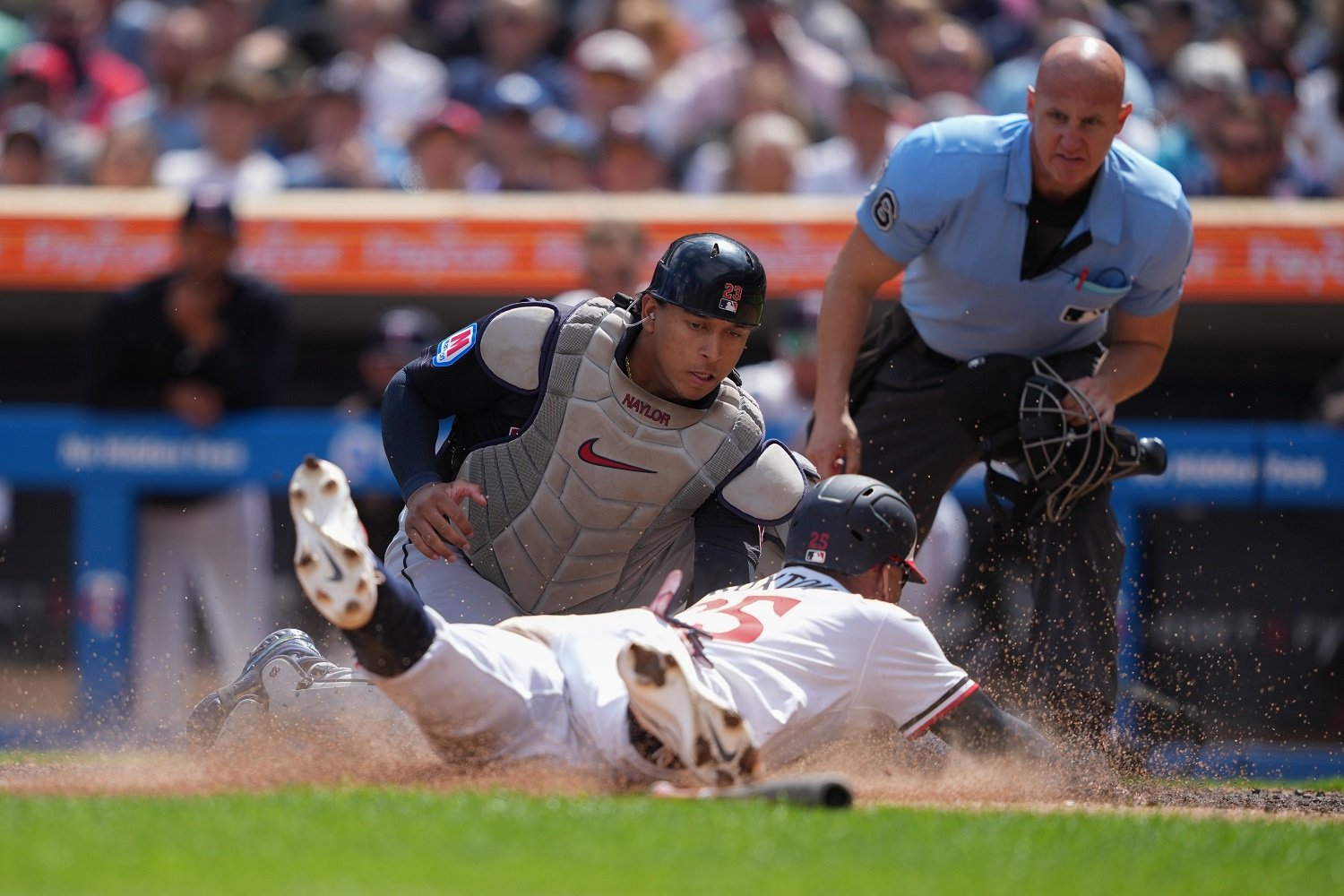
Twins Video
There’s a project called MLB Deserve-To-Win-O-Meter that uses hit dispersal and batted ball data — launch angle, ballpark factors, and exit velocity — to determine expected outcomes for each game. A month and a half ago, Sports Illustrated posted a piece arguing that the Twins should overtake the Guardians atop the division, based on this project. At that time, the Twins were 4.5 games back. Since then, they have narrowed the gap to just two games, with a couple of recent bullpen blowups being the difference between that and being tied.
Fast-forward to this week, and the folks at the Deserve-To-Win-O-Meter posted a season-to-date update. It tells an interesting story.
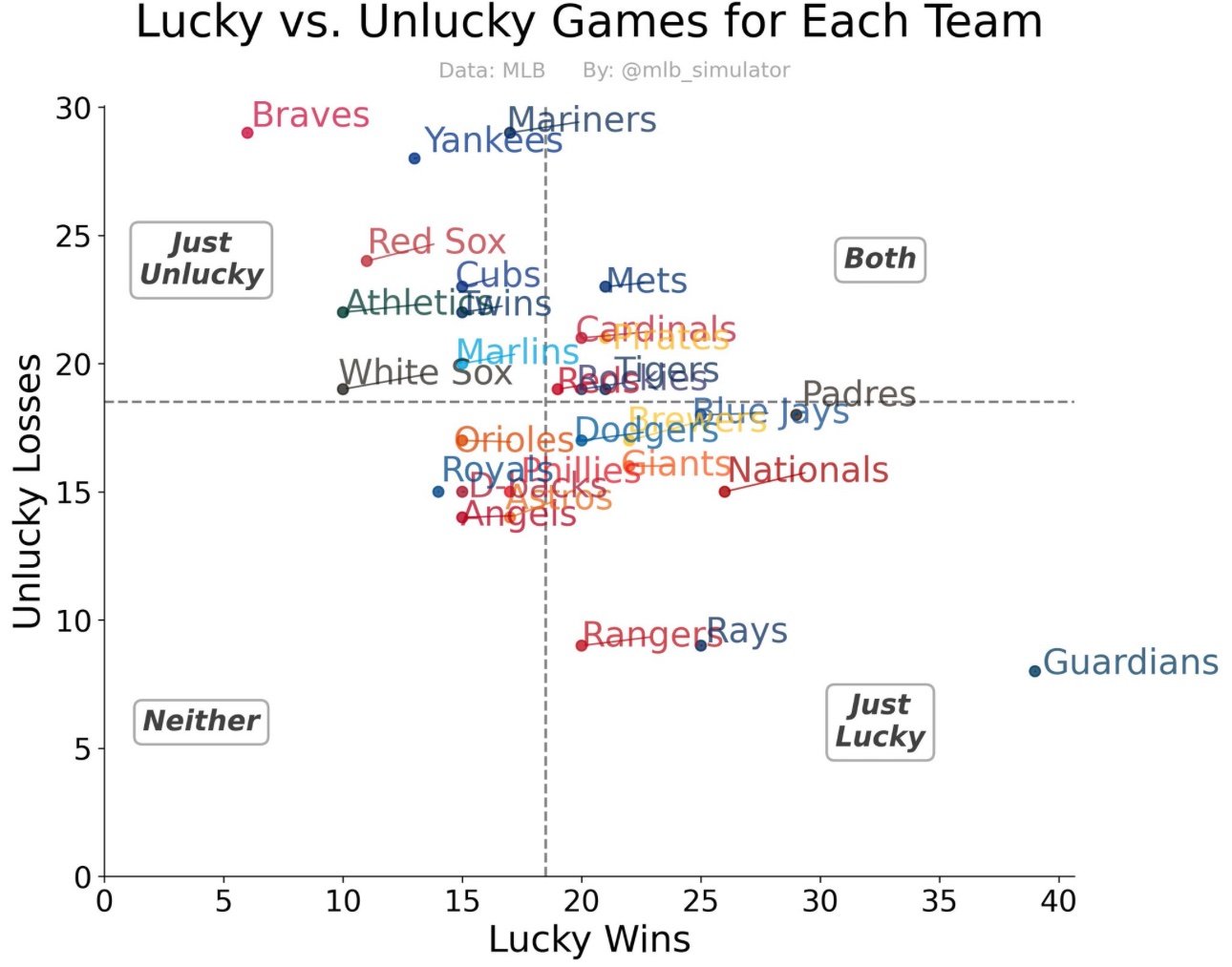
As you can see, the project looks at both "lucky wins" (where a few bloop hits dropping in with low xBA led to eking out a victory), and "unlucky losses" (where hard-hit balls with high xBA found fielders gloves consistently).
The Twins have been one of the unluckiest teams in baseball; the Royals have had neutral luck; and the Guardians have been luck merchants all season. In 2024, the Guardians have had lucky outcomes in 39 more games than the Twins.
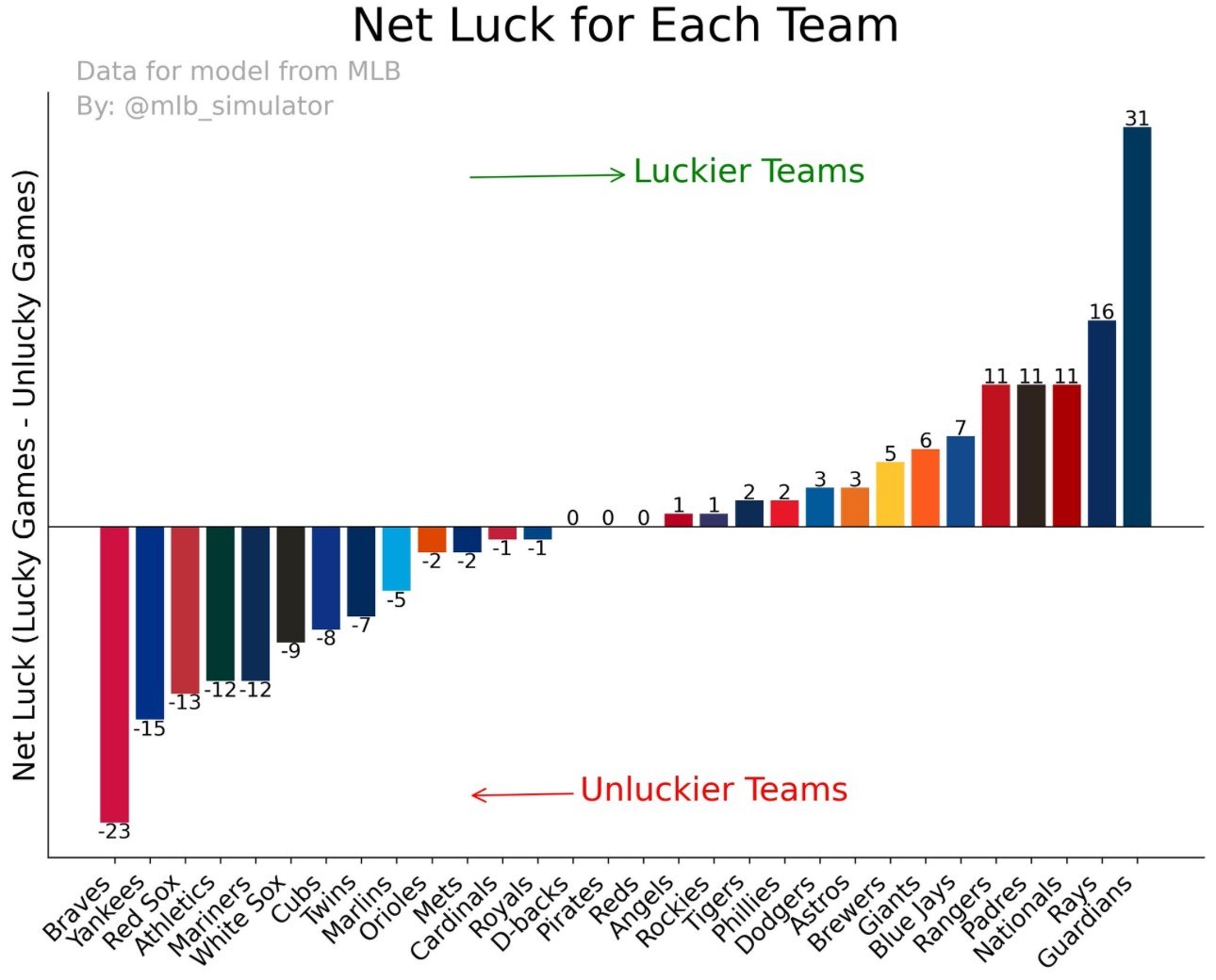
That’s astounding, but tells a pretty compelling story. It suggests that, if anything, the Twins should be several games up on the division. Let’s dig in.
The Guardians have nearly 40 wins that are considered "lucky" by this model, most in baseball by a double-digit margin. They are consistently getting the key hits when they matter most, piranha-style. They are also not finding "unlucky" losses, with just eight on the season, the fewest in baseball. This is against all odds, and suggests serious regression that should have already occurred, but the "luck" keeps happening.
The Twins, on the other hand, have 23 "unlucky" losses, where their results with runners in scoring position are inexplicably bad despite hitting well overall, and where guys like Trevor Larnach scorch the ball all game and walk away 0-fer. The Twins also have just 14 "lucky" wins. Both of these are among the worst in baseball.
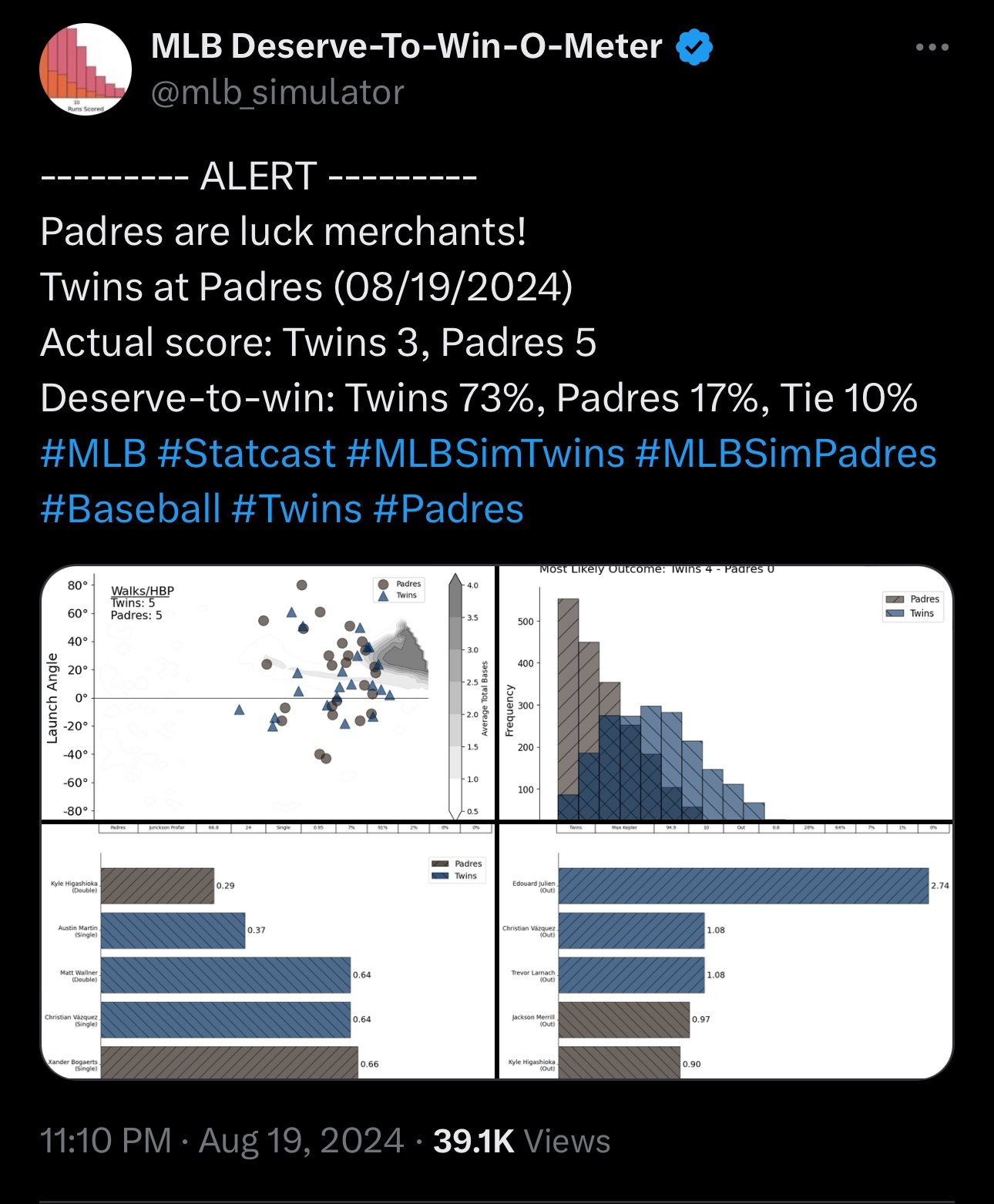
Here’s one example of an unlucky loss for the Twins. In the Aug. 19 game against the Padres, the Twins lost by two, but based on batted-ball data, the Padres only would have won 17% of the time. In this game, Edouard Julien came to the plate with two on and hit a ball with an .800 xBA that was a likely home run; it found a glove. Had it landed as the odds suggested, the Twins would have won. In the same game, Julien hit another ball with a .730 xBA for an out, and Max Kepler lost a hit with a .720 xBA.
Now, here’s an example of a lucky win for the Guardians on Aug. 14. In this case, the Guardians won 6-1, but they should only have won 36% of the time, based on the game’s batted-ball data. 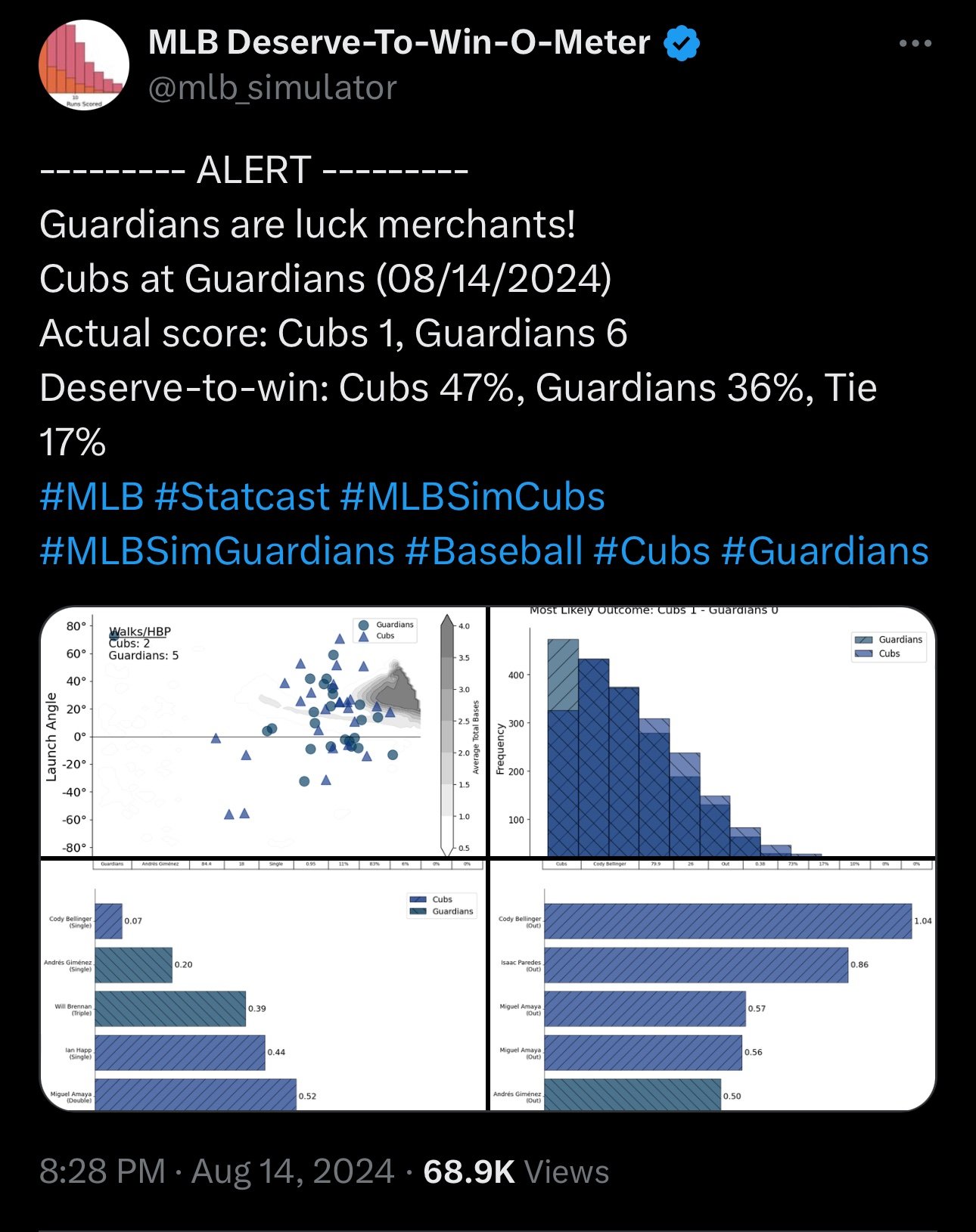 In this game, Cody Bellinger batted with two on. The ball left the bat at 98 MPH on a line-drive launch angle. The ball had an .880 xBA and could have scored two, had the expected outcome occurred. Across the game, the Guardians had 10 batted balls on which luck favored them, against just five for the Cubs.
These are just two of many examples of probabilities suggesting different outcomes, and to the Twins detriment. Overall, the Deserve-To-Win-O-Meter model says the Twins should be comfortably leading the division with just over a month to play. Perhaps they should be on pace for 100 wins. While it’s easy to focus on the negative, it’s important to be clear-eyed when the results suggest that positivity is deserved.
Now, for a few needed caveats. First, "luck" goes by a lot of other names in baseball. What we call "luck" here can also be called "clutch hitting," skeptical though we all might be about the existence of that as a sustainable skill. We might be calling Emmanuel Clase "luck" here; he's a difference-making closer, and just the brightest symbol of a difference-making bullpen that is simply better than the Twins'. Great defense (and especially great defensive positioning, even in the post-shift era) might also be labeled "luck" here; the Guardians play superb defense. Finally, "luck" as seen by this model can really be "using the big part of the field," or whatever other cliché you favor as code for the ability to hit the ball away from defenders or use speed to reach or advance, rather than using power to do so. Exit velocity has become the favored currency for hitting in the modern game, but lighting up Statcast is not the only way to be a good hitter.
You might love the Deserve-to-Win-o-Meter. Then again, you might be disinclined to believe in a new data toy. Check back for the second part as we dig into hard data to see if it draws the same conclusion.
What do you think about the role luck has played this season? Comment below!








Recommended Comments
Create an account or sign in to comment
You need to be a member in order to leave a comment
Create an account
Sign up for a new account in our community. It's easy!
Register a new accountSign in
Already have an account? Sign in here.
Sign In Now