


Twins Video
No one can accuse Ryan Jeffers of being selfish. Though he'll sometimes hide himself away to undergo treatment during open clubhouse times, when he's near his locker, he's as generous with the media as any member of the team. He's conscientious about meetings and collaboration with his pitchers and coaches. He gives everything he can to the team, in the pursuit of wins.
That said, he's always been refreshingly frank about the realities of the game and its economics. Jeffers was an underslot signing as a second-round pick in 2018. He didn't make more than $1 million in a season until 2023. He understands that he's very lucky to have earned nearly $20 million playing baseball, but he's also aware that he becomes a free agent this winter—and that that's his chance to secure generational wealth for his family. The way arbitration works and the opportunity to hit paydirt in free agency motivated his push to play more over the last two years. The same factors have influenced the way he's remade his game over the same span, and especially since the end of the 2024 season.
For instance, in concert with the Twins, Jeffers made a change last summer that he believes turned him into one of the game's best receivers. It's a fairly simple one: he went exclusively to a right-knee-down catching stance.
"Since July 1 of last year, when I went to right-knee-only, I've been third in baseball [in overall catcher defense]," Jeffers said Wednesday, citing the Twins' internal metrics. He's not just saying he's been better; he's positioning himself in the broader context of the league. And the data bears him out.
Jeffers said he and the team agreed on the change because his framing numbers weren't where either party felt they should be, going back to the beginning of 2024. In particular, he was losing too many strikes just inside the zone, partially because he was uncomfortable with the variety of setups he was trying to use behind the plate. The league has trended toward putting the left knee down more often, and Jeffers was doing the same, but his body works a bit differently than do other catchers'. He's akways been acutely aware of his size—not just his sheer dimensions, but the proportions of his body.
"I think most guys are more comfortable left-knee-down, but for me, right-knee-down is way better," he said. "I just feel like I can move better, present the ball better."
It helps, Jeffers noted, that right-knee-down is the preferred stance any time a runner is on base, because it's easier to throw from that stance than when starting with the left kinee down. Still, most catchers find that the left knee being down leaves their glove arm freer to move and receive the ball smoothly. Jeffers prefers the stability he feels with the right knee down. Of the 60 catchers who have caught at least 2,500 tracked pitches since the start of last July, only four have used the left-knee-down stance less often than Jeffers—and he's been better since making the change.
Here are two curves and tables, comparing Jeffers's strike rate on called pitches near the edges of the strike zone to that of Alejandro Kirk and to the league average. The top graphic is from the start of 2024 through the end of June 2025. The bottom is since July 1 of last year.
.png.0f76ac2f25b2a8eec40436e3fe457b81.png)
There's been an across-the-board improvement. Jeffers was, previously, about average at keeping strikes that were clearly inside the zone but near the edge strikes, but below-average on and just off the edges. Now, he's average on those pitches comfortably inside the zone, and above-average on the coin-flip calls and those just off the fringes. The Statcast framing data doesn't quite line up with what Jeffers and the Twins are looking at, but he went from 54th of 55 qualifying catchers in the year and a half before going exclusively right-knee-down to being 6th of 57 qualifiers since.
Even more importantly—or at least more visibly, and firing up everyone involved, including Jeffers—he's turning out to be the master of the challenge system. That's no surprise.
"I think our catchers have done a really good job," manager Derek Shelton said of the early returns on the ABS system at the start of this homestand. "I think we went into spring training, knowing—because the one thing I will note, not talking about last year, but I give the Twins a lot of credit with last year in spring training—is they paid attention to it, knowing that it was probably coming in. and we knew coming in that Jeffers had done a good job during spring training [of 2025]."
Though it couldn't be implemented right away in games that counted, Jeffers did dedicate himself to learning the system and anticipating the best ways to use it last spring. He talked about its eventual installation throughout last season. One reason why being so much more comfortable physically in the right-knee-down setup mattered was because it allowed Jeffers to hone his eye for the edges of the zone, an advantage he's now able to press by challenging when the umpire doesn't bite on a pitch he knows caught a corner.
He's been gearing up for this for a long time, and he's been an eager and excellent user of the system since Opening Day. Jeffers ended four Tigers at-bats by appealing called balls with two strikes late in the games on Tuesday and Wednesday nights, getting overturns each time. He's flipped eight calls for third strikes this season, which not only paces the league, but leads the next-best catchers by five.
Flipping pitches to finish off strikeouts and even end innings is a very obvious way for that skill to shine through, but it's not just about the outs themselves.
"But what that also does is, it saves pitches, and then it could possibly save who you’re using in the bullpen, or what the actual strategy of the game [looks like]," Shelton said Wednesday. "So when you're managing the game, you think, ‘I like these matchups,’ and then all of a sudden, that pitch flips one way or another—we don't have ABS and it ends up becoming a ball, then maybe that guy doesn't go through that stretch."
Jeffers believes his acuity and restraint—for instance, the Twins lost their first challenge in the first inning Wednesday night when Austin Martin wasted one at the plate, so Jeffers waited until the eighth inning to mount challenges that got Cody Laweryson two outs in that frame—will be viewed as a high-value, marketable skill this offseason. You can bet that his agent, Scott Boras, will include it in his binder of information about his client, even if that binder is now digitally delivered, rather than a physical tome.
His usage of the system only boosts Jeffers's popularity with his pitchers, of course, but the affinity there runs deeper than the challenge system, or than framing in general. Taj Bradley credits Jeffers with helping him go into starts with a clearer, more detailed plan of attack against opposing batters.
"I think he calls a good game," Bradley said after his 10-strikeout performance against the Tigers Tuesday night. "He does his research and his reports and stuff like that, and we sat down before the game and we talked through it, so it's not a surprise what he's calling, why he's calling it, and it's just confidence in everything he puts on the [PitchCom] buttons."
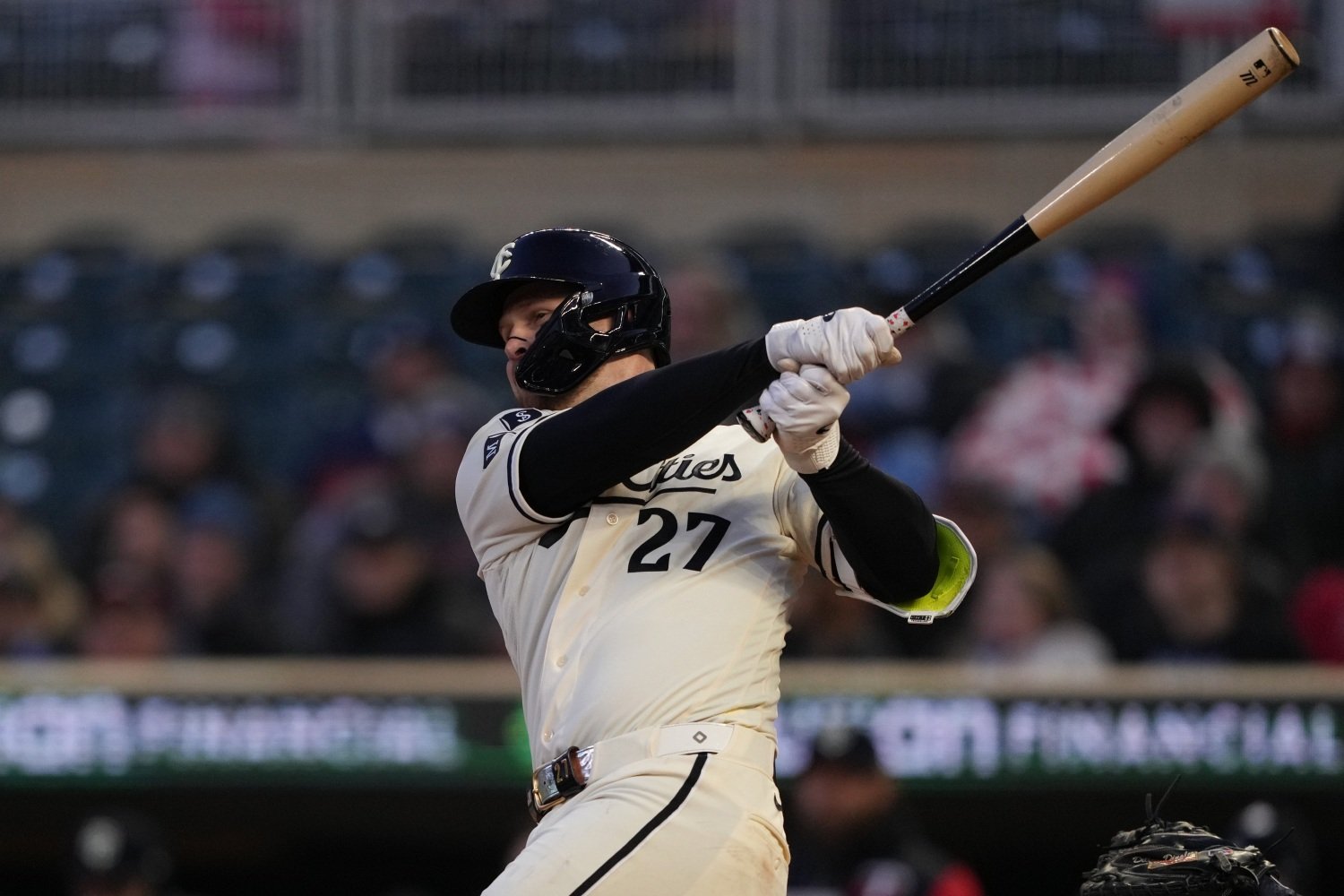
It's not hard, when considering the mechanical changes he's made in setting up to receive the ball and the deftness he's shown with the system already, to see why Jeffers believes he can hit the market as an in-demand, high-end defensive backstop. Nor, based on his track record, is he a glove-only catcher. Still, to get paid the way he envisions, he'll need to show the league that he's a true two-way threat. In terms of results, he's off to a slow start, batting .226/.351/.290. The process numbers paint a finer portrait, though—and his solid games Tuesday and Wednesday night started to reward the good work. Most notably, he cracked an opposite-field two-run double against Tarik Skubal Tuesday night, the game-breaking strike.
"The Jeffers at-bat was an unbelievable at-bat," Shelton said after that game. "I mean, to foul balls off—I thought he'd taken some really good swings earlier on the fastball and got underneath it a little bit—but to go two strikes and just flatten himself out and hit that double down the line, that was a really, really good at-bat."
That's a good summation of what happened, and describes something that Jeffers has changed this year that could help him do it more consistently. The slider from Skubal was actually down and out of the zone, on the outer part of the plate. Since the start of 2025, Jeffers only has four hits on pitches in that area, and this one is the only extra-base hit. Even last year, he couldn't have gotten to this ball the way he did Tuesday night. To understand why, take a look at how he was oriented when he made contact with the pitch.

The flattening out Shelton is talking about is, in part, his bat path. Jeffers's swing tilt on this pitch was 29°, which is unusually flat for a pitch down around or below the knees. To hit the ball low and away, though, you have to be able to stay somewhat flat, so the barrel of the bat can reach far enough to hit the ball solidly. That's a long way of saying what every baseball fan already knows: it's hard to hit the ball down and away. At the very least, doing so usually requires anticipation and commitment.
For Jeffers, though, there's been another element, too. He changed his stance this year, getting more upright in the box to start and striding longer. In this table, the distance between his feet is official, as reported by Statcast; his stride length is an estimate based on Statcast's visualization of his stance and swing.
| Season | Dist. Between Feet (in.) | Stride Length (in.) (est.) |
| 2023 | 35.3 | 12.1 |
| 2024 | 37.9 | 11.1 |
| 2025 | 36.2 | 14.8 |
| 2026 | 32.0 | 19.4 |
A longer stride means Jeffers is getting into his legs more flexibly within his swing. It costs him a bit of power, based on the approach he's used the last year-plus (more on that momentarily), but it allows him to hit the ball sharply to the opposite field in a way he couldn't do as well in 2025. He's more adaptable. He can adjust and, yes, flatten himself out, because by sinking deeper into his legs, he gains the option of swinging flatter on low pitches and still reaching them with the barrel.
Most of the time, of course, his plan is not to be in a 1-2 count, and thus, to let that pitch go and wait on a better one to hit. He came up with a huge hit against the two-time defending Cy Young Award winner, but the hope is that he won't always be in such a defensive position in the box. That starts with being patient. Jeffers swung at the first pitch in the at-bat roughly 30% of the time over his first five big-league seasons, but last year, that number fell to 19.1%. It's just 21.1% so far this year. Overall, Jeffers is swinging less, accepting walks, and trying to stay in counts where he can hunt for meatballs.
So far, he's not generating the power that could turn him into an especially high-end free-agent prize. He only hit nine home runs last year, as he changed his approach a bit and gave up some pull power to get on base more. Unlike some players, he doesn't swing noticeably harder or catch the ball farther out in front of himself when he's ahead in the count. To get back to slugging the way he did two years ago, that might need to change. For now, though, Jeffers is happy with the swing decisions and the contact he's finding with the swing he's engineered. The results, he believes, will come.
The Twins don't need Jeffers to hit 30 home runs. What he did at the plate last season was plenty, especially given how good a defender he's become at the most defense-forward position on the diamond. A catcher who adds value via run prevention and gets on base at a .350 clip, as Jeffers has done since the start of last year, can be extremely valuable even with below-average power. Though he has plenty of his own reasons to do it all, the team can be pleased with each of the adjustments he's made. They'll make Jeffers rich, but first, they'll also help the Twins win some extra games in 2026.








Recommended Comments
Create an account or sign in to comment
You need to be a member in order to leave a comment
Create an account
Sign up for a new account in our community. It's easy!
Register a new accountSign in
Already have an account? Sign in here.
Sign In Now