


Twins Video
The baseball calendar often treats the All-Star break as the unofficial midpoint of the season, but by the time players gather for the Midsummer Classic, every team has already played well beyond half of its schedule. The true halfway point comes after Game 81, offering the cleanest opportunity to evaluate what's gone right and what hasn't.
For the Twins, the first half has been a frustrating mix of encouraging individual performances and costly shortcomings. Injuries have reshaped nearly every part of the roster, several key players have underperformed, and Minnesota enters the second half below .500 despite boasting one of the American League's highest-scoring offenses. Some areas deserve praise. Others need significant improvement if the Twins hope to climb back into the postseason race.
Twins Starting Pitching — Grade: B
The starting rotation has been one of Minnesota's biggest strengths, even if injuries have prevented it from reaching its full potential.
Joe Ryan has pitched like one of the American League's best starters, quickly putting an early-season injury scare behind him and pitching at an All-Star caliber level whenever he's taken the ball. Taj Bradley has largely delivered on expectations after arriving in Minnesota, although he's shown some inconsistency since returning from the injured list. Bailey Ober also deserves credit for grinding through diminished velocity before landing on the injured list, finding ways to remain effective despite not having his best stuff.
Perhaps the biggest surprise has been the organization's pitching depth. Connor Prielipp, Mike Paredes, and Zebby Matthews have all contributed meaningful innings earlier than many expected, helping stabilize the rotation when injuries piled up.
Of course, the negatives can't be ignored. Simeon Woods Richardson struggled through 12 appearances, producing a -1.2 rWAR before eventually being designated for assignment. Minnesota has also had to navigate season-altering injuries to Pablo Lopez, Mick Abel, and David Festa, all of whom appear likely to miss all or most of the season.
Even with those setbacks, the Twins have remained around the middle of the league in fWAR, FIP, and xERA among starting staffs. Considering everything they've overcome, that's a respectable outcome.
Twins Relief Pitching — Grade: D
This bullpen was already facing an uphill battle before Opening Day. Minnesota did little over the winter to reinforce the relief corps, with veteran left-hander Taylor Rogers serving as the club's biggest addition. Unfortunately, Rogers has looked every bit like a pitcher battling Father Time, with an ERA north of 6.00 and a career-low strikeout rate of 18.6%.
The organization likely envisioned supplementing the bullpen by shifting some starting pitching depth into relief roles, but injuries throughout the rotation have delayed most of those plans. Andrew Morris has been the lone exception, although his transition has produced uneven results.
Ironically, the Twins' biggest bullpen success came from outside the organization. Yoendrys Gomez has become one of Minnesota's best stories after the coaching staff helped clean up some mechanical issues. The right-hander now ranks third among Twins pitchers in rWAR, trailing only Ryan and Bradley.
The overall results, however, remain disappointing. Minnesota ranks 24th in bullpen fWAR, 23rd in xERA, and 29th in xFIP. The relievers have also produced a -1.26 Win Probability Added, ranking 23rd in baseball. While other AL Central foes, Kansas City and Detroit, have received even less value from their bullpens, that's hardly much consolation. The Twins simply haven't been able to consistently protect leads or shorten games, and it has cost them throughout the first half.
Twins Lineup — Grade: B
The offense has done far more than its share. Entering Monday's action, Minnesota had scored 412 runs, more than any other American League club and three more than the second-place Yankees. The Twins also own baseball's eighth-best slugging percentage, giving them enough firepower to stay competitive even when other parts of the roster have struggled.
Byron Buxton has been the unquestioned headliner. He's putting together one of the finest offensive seasons in franchise history and remains on pace to become the first player in Twins history to hit 50 home runs in a season. Before suffering a broken hamate bone, Ryan Jeffers was putting together an All-Star-caliber campaign of his own.
The lineup has also benefited from several unexpected contributors. Kody Clemens has delivered timely production, Trevor Larnach continues to provide middle-of-the-order power, Brooks Lee has become one of the club's most consistent hitters, and Victor Caratini has helped soften the blow of Jeffers' absence.
Not everything has gone according to plan. Royce Lewis and Matt Wallner both opened the season expecting to anchor the middle of the order before struggling enough to earn demotions to Triple-A. Lewis quickly reminded everyone why he's such an important piece of the organization's future, dominating Triple-A pitching before returning with a much-improved approach at the plate.
Minnesota has cashed in with runners in scoring position, and that might be the biggest reason for their offensive success. Unfortunately, batting with RISP is not a predictive statistic, so the club could be heading for regression. The offense has carried this team for much of the season. Without it, Minnesota likely wouldn't be anywhere near the playoff conversation.
Twins Defense — Grade: F
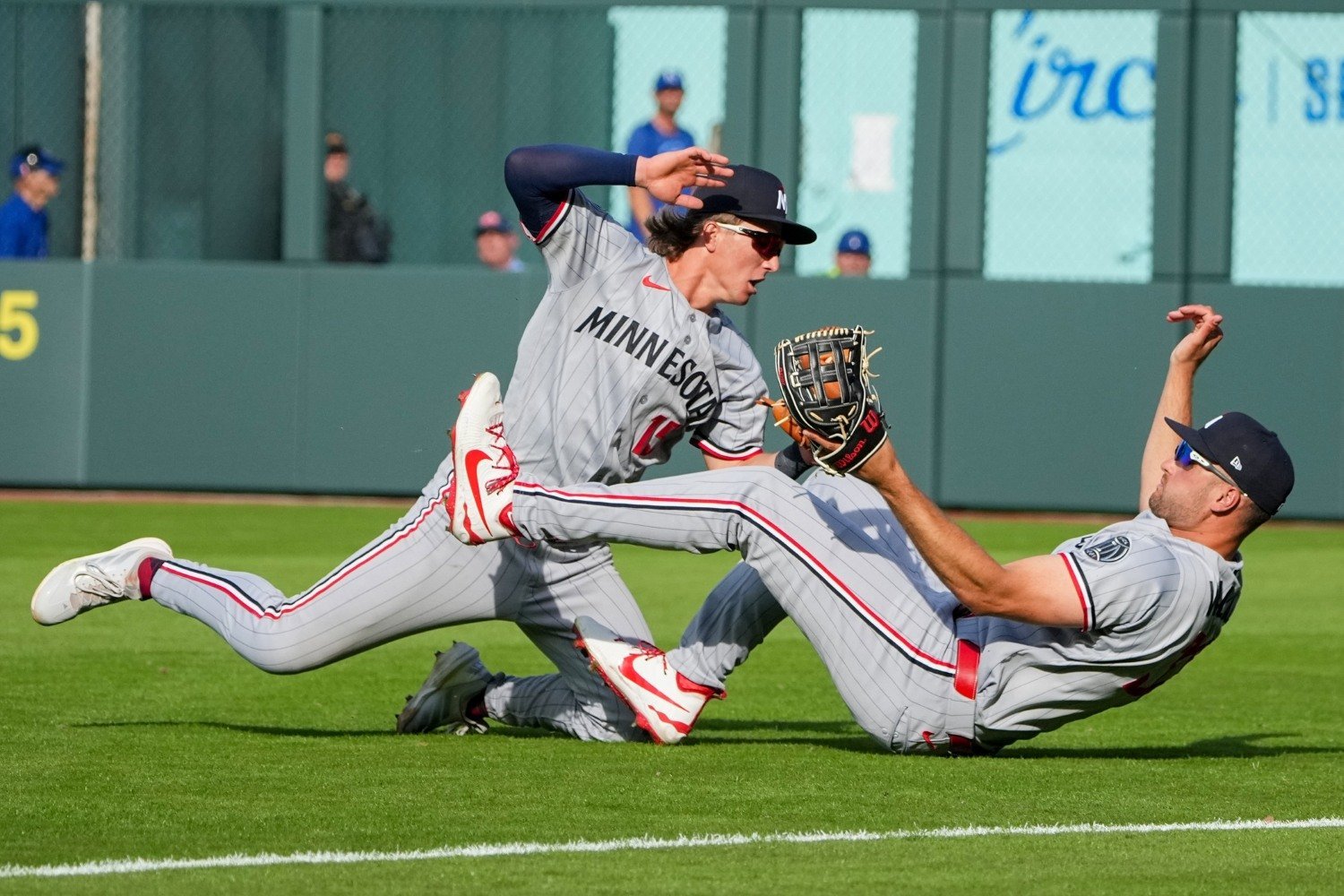
There's simply no way to sugarcoat it. Minnesota has been one of baseball's worst defensive teams. According to FanGraphs, the Twins own a -26.9 defensive rating (fielding plus positional adjustment), with only the Angels and Mariners ranking lower. Baseball Savant tells a similar story, placing Minnesota 27th in Outs Above Average at -18.
Several individual defenders have struggled. Luke Keaschall and Lee each posted a -7 OAA before both began transitioning to new defensive homes. Tristan Gray and Trevor Larnach each finished the first half at -4 OAA, while Wallner and Lewis both recorded -3 OAA before their respective demotions. Lewis has since begun learning new positions (first and second base) in an effort to maximize his long-term value.
The defensive struggles have extended well beyond one or two players. Too many extra outs have been given away, too many innings have been extended, and too much pressure has been placed on a pitching staff already battling injuries. If Minnesota hopes to make a second-half push, improving defensively may be the single biggest area of need.
Grading the First Half
The Twins' first half has been defined by contradiction. They've received outstanding performances from Ryan, Buxton, and several unexpected contributors while overcoming wave after wave of pitching injuries. At the same time, bullpen inconsistency and poor defense have repeatedly erased those positives, helping explain why a team with one of the American League's most productive offenses still finds itself below .500.
The encouraging news is that many of Minnesota's biggest issues appear more fixable than its strengths are sustainable. If the rotation can get healthier, the defense improves even marginally, and the front office finds a way to stabilize the bullpen, the ingredients for a second-half turnaround are still present.
But after 81 games, the grades reflect exactly where the Twins stand: good enough to remain within striking distance, yet far too inconsistent to feel comfortable about their postseason chances.
What grades would you give to the team’s individual parts? Leave a comment and start the discussion.
Which team do you dislike the most in the AL Central?
Follow Twins Daily For Minnesota Twins News & Analysis



- HelmetTip, nclahammer, DannySD and 1 other
-
 4
4


Recommended Comments
Create an account or sign in to comment
You need to be a member in order to leave a comment
Create an account
Sign up for a new account in our community. It's easy!
Register a new accountSign in
Already have an account? Sign in here.
Sign In Now