



IndianaTwin
-
Posts
6,560 -
Joined
-
Last visited
-
Days Won
27
Content Type
Profiles
News
Minnesota Twins Videos
2026 Minnesota Twins Top Prospects Ranking
2022 Minnesota Twins Draft Picks
Minnesota Twins Free Agent & Trade Rumors, Notes, & Tidbits
Guides & Resources
2023 Minnesota Twins Draft Picks
The Minnesota Twins Players Project
2024 Minnesota Twins Draft Picks
2025 Minnesota Twins Draft Pick Tracker
2026 Minnesota Twins Draft Tracker: Picks & Bonuses
Forums
Blogs
Events
Store
Downloads
Gallery
Everything posted by IndianaTwin
-
About anything referencing that scene from Moneyball deserves being quoted. Good movie. Great scene. Another pretty significant difference is Low A players having to deal with a six-days-out-of-seven schedule for five months after spring training.
-
Given that they only got 4.2 innings out of Castro over three seasons with a 5.79 ERA (91 ERA+), I'm hoping for a little more from Hatch.
-
I’m guessing Tigers Daily also has laments about an ugly game.
- 28 replies
-
- 2
-

-

-
- zebby matthews
- luke keaschall
- (and 2 more)
-
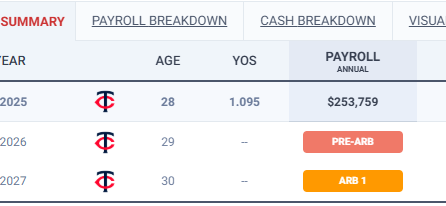
He only had 1.095 years of service entering the season. Am I missing something? EDIT to add, from MLB Trade Rumors: "This is Outman’s final minor league option year. He can back up Byron Buxton in center or spend the remainder of the season at Triple-A St. Paul. The Twins would need to decide whether to carry him on the Opening Day roster next season or expose him to waivers." So they have team control -- he's just not optionable.
-
From the OP: "Including expected arbitration payouts, FanGraphs projects Minnesota's 2025 Opening Day payroll to be $66.8 million, which would be a $67.2 million decrease from its 2024 Opening Day payroll, which settled around $134 million." Huh? @Cody Schoenmann, how do you come up with a $66.8M payroll for 2025? Something isn't tracking. I'm not sure that figure even tracks for 2026. If Lopez/Buxton are $38M, the six guys who are arb-eligible got paid $15.7M this year and will certainly increase, and you still have to fill out the roster with 18 more guys getting pre-arb salaries.
-
Third base in the list.
-
This is an interesting exercise. I'd started on a similar one. To add a level of exercise, when I made some guesses at arbitration figures, I came up with something in the neighborhood of $88-$90 million, plus the $10M for Correa. If a new owner were to come on board and make even a $130-$140M budget reasonable, it would be interesting to imagine what could happen. They've not spent much on relievers, so say judicious spending that totals $10M. They've signed Castro and then Vazquez, so say another $10M on a veteran catcher. Then another $20-$25M on a veteran hitter or three and I'm willing to roll the dice.
-
Twins (Bullpen) Vs Yankees (Rodon): 8/12/25 6:05 pm CDT
IndianaTwin replied to C-Gangster's topic in Archived Game Threads
Agreed. I'm guessing we also see more back-to-backs from Jeffers until (if) Vazquez returns. -
Twins (Bullpen) Vs Yankees (Rodon): 8/12/25 6:05 pm CDT
IndianaTwin replied to C-Gangster's topic in Archived Game Threads
Do you mean the guy who made his first start since June 19 this past Saturday and threw only 31 pitches? That's not how rehab assignments are usually structured. -
From the "you-can't-tell-them-apart-without-a-scorecard" department, who am I missing in an inventory of Twins pitchers? Older guys on the 40-man or who've thrown a lot in the bullpen: Sands, Topa, Tonkin, Funderburk, Hatch, Ramirez, Kriske, Davis, Misiewicz, Urena, (also Duarte, McCaughan) Starting pitcher list: Ryan, Lopez, Ober, SWR, Matthews, Festa, Abel*, Bradley, Rojas. Multi-inning experiment guys: Prielipp, Raya, Morris, Adams, Ohl, Lewis, Baker*. Other: Canterino, Laweryson, MacLeod, Percival, Rozek. *Where's Charlie Delta?
- 66 replies
-
- 2
-
-
- zebby matthews
- connor prielipp
- (and 3 more)
-
Houston needs to be a fast riser or Lewis needs an extension. The latter is a free agent after 2028.
- 32 replies
-
- 1
-

-
- brooks lee
- carlos correa
- (and 2 more)
-
I'm fond of oversimplifying. For 2026, looking at guys in the system... Rotation: Ryan, Lopez, Ober, SWR, Matthews, Festa, Bradley, Abel, guys in minors. Bullpen: Diddly squat. Check that -- almost diddly squat, given that it's full-on audition time for Sands, Topa, Funderburk, Tonkin and a lot of guys I don't have committed to memory, including the "prospects" like Ohl, Prielipp, Lineup: Jeffers (C), __(backup)___ (C), Clemens (1b), Keaschall (2b), Lee (ss), Lewis (3b), Roden (lf), Buxton (cf), Wallner (rf), Larnach (dh), ___Julien?____, ____Martin?____, ___Outman?_____. Misc. hitters in the system who have played in the majors: Gasper, Fitzgerald, Kiersey, Bride, Miranda, McCusker. Minor leaguers: Rodriguez, Jenkins, Culpepper, Eales, Sabato, Gonzalez, Mendez, Olivar. -------------------- People are making the assumption that one or more of the starting pitchers will get traded. That only happens if there's no ownership change. If there's an ownership change, there's a very good likelihood it comes with spending. New owners are going to want to make a splash. So how much would it cost a new owner to make a splash? Try this for size... Second catcher: Operating on the model that Falvey has had a pair of three-year veteran contracts in Castro and Vazquez -- $10M Hitter 1: $15M Hitter 2: $10M Hitter 3: $5M The hitter list assumes that you have health and productivity from Buxton, Lewis, Lee, either Wallner or Larnach and that at least one of Wallner/Larnach, Roden, Outman takes a step forward. It also assumes that at least one of the rookies (led by Keaschall) makes a contribution. Reliever 1: $5M Reliever 2: $3M Reliever 3: $2M That's based on Falvey's reluctance to bid on relievers. It also assume that there's significant commitment to the convert-a-starter model of the guys already in the system. That's $50M in spending. That's a lot. But it's not a lot when the list of guys above the line probably costs about $85-$90M, taking into account arbitration and a lot of pre-arb guys at minimum salary or a bit more. Add $10M if you want to count the commitment to Correa. To me, it's not at all unfeasible to see a new owner drop $50M in new money. Or even $60M if they want to make their primary signing be a $20M hitter. I'll take the OP's premise that at this point, it's not a teardown.
-
Also, in addition to not having the service time, the Twins would only get the extra pick if Keaschall was to win the Rookie of the Year or be in the top three in MVP voting before reaching arbitration.
-
And also have less than 45 days of service time. I think he has eight, so if he’s down until about the 25th of August, that can well be a factor. Orioles fans will tell you that’s why Samuel Basallo is still down. They expect him up around the 20th of August.
-
As I read the article in The Athletic, I interpreted it as mutual agreement that over the course of the contract, he’d age himself out of playing SS. Many on TD have similarly suggested the likelihood of a position switch at some point. I didn’t read his comments as antagonistic. I also read it as an ongoing conversation between him and the team regarding when the timing would be right, with no heir apparent yet on hand.
-
Concur. The article also speaks to Correa’s role in the interactions between Baldelli and Jax following Wednesday’s. Even with Correa’s own situation with the team being uncertain, he helped initiate the conversation between Baldelli and Jax. In the article, Baldelli and Jax also each take ownership for parts of how the situation took part. The article also speaks well of Baldelli reaching out to Jax after Thursday’s trade. I said this within a different thread, but no matter what one thinks of Falvey’s and Baldelli’s decision making, I think they handle the human relations part of their role well. That’s an aspect we can’t see fully, since so much of it happens behind the scenes or is only reported through the media. We never know the whole story of how these discussions happen.
-
The Twins Finally Picked a Lane
IndianaTwin replied to Matthew Taylor's topic in Twins Daily Front Page News
In MLB.com's rankings, only one top-50 prospect was moved, period. The A's got Leo DeVries (No. 3), the highest-ranked prospect in their rankings to ever be moved at the deadline. MLB.com has Tait at 56 and Abel at 91. Adding Rojas, they also have the Twins getting Nos. 2, 3 and 6 among all prospects who were traded. https://www.mlb.com/news/mlb-clubs-with-biggest-hauls-at-trade-deadline-2025?t=mlb-pipeline-coverage A different mlb.com article calls the Twins' additions as the second-best haul of prospects. They say an argument could be made to call the Twins No. 1, but they gave the edge to the A's, solely based on DeVries. Six Twins acquisitions made it into the Twins' Top 30 (top 24, actually).- 301 replies
-
- 1
-
-
- 2025 trade deadline
- griffin jax
- (and 2 more)
-
Twins (Ryan) vs Guardians (Williams): 8/1/25, 6:10pm
IndianaTwin replied to Brock Beauchamp's topic in Archived Game Threads
He's on the radio. -
Twins (Ryan) vs Guardians (Williams): 8/1/25, 6:10pm
IndianaTwin replied to Brock Beauchamp's topic in Archived Game Threads
I give Sands first opportunity to take a shot at closing. -
The Twins Finally Picked a Lane
IndianaTwin replied to Matthew Taylor's topic in Twins Daily Front Page News
I wondered the same. Given the amount of new personnel in the organization, I'll not be surprised if see some spring training-like elements the rest of the season. I think it's more likely than not that both Abel and Bradley will make multiple starts for the Twins this season. Of note is that Bradley also threw 7 innings Wednesday night in Durham, so he's not available this weekend anyway. Might as well have an extra bullpen guy for a few days. And with Ryan, likely Ober and then SWR this Sunday, Abel isn't going to start this weekend either.- 301 replies
-
- 1
-
-
- 2025 trade deadline
- griffin jax
- (and 2 more)
-
The Twins Finally Picked a Lane
IndianaTwin replied to Matthew Taylor's topic in Twins Daily Front Page News
Here are significant pieces I saw... Correa didn't ask for a trade, but he and Falvey have continued to have a healthy relationship. When they spoke on Wednesday, Falvey told Correa, “The direction we are going is not the one you signed up for.” As part of that, Falvey told Correa that the Astros did indeed reach out, but the discussions were not serious. Falvey told Correa he would be in contact if it became feasible. Correa told Falvey the Astros were the only team he would approve. “Carlos was never sitting there saying anything about demanding a trade or wanting to do something else,” Falvey said. “If it was right for the Twins and it was right for him, he was open to the conversation.” “When he told (me) that we were going to go into rebuild mode, I said then I deserve to go somewhere where I have a chance to win and my kids can watch me go out there in the playoffs and perform,” Correa said. “He agreed with me and he said out of respect for me he would get to work.” The Jax situation on Wednesday was the result of multiple relievers being unavailable and it only being a seven-run game, so Baldelli couldn't go to a position player. He didn't want to use Jax and pulled him after 12 pitches. Jax had a public outburst. Even amidst his own uncertainty, Correa played a key role in navigating a conversation between the two. Following good conversation, Jax apologized through the media, including acknowledging that the noise about potential trades has had a significant effect on him. Following the trade on Thursday, Baldelli again sought out Jax to bid him farewell. Baldelli took ownership in how he could have handled Wednesday differently, as did Jax. The primary takeaway for me is that whatever I think about the decision making of Falvey and Baldelli, I think they do well at the human relations/communication part of their roles.- 301 replies
-
- 2
-
-
- 2025 trade deadline
- griffin jax
- (and 2 more)
-
The Twins Finally Picked a Lane
IndianaTwin replied to Matthew Taylor's topic in Twins Daily Front Page News
If you subscribe to The Athletic, here's an excellent article walking through the past several days, including the dynamics around the Correa trade and the Jax/Baldelli relationship and particularly focusing on the relationship and communication side of things. https://www.nytimes.com/athletic/6529725/2025/08/01/minnesota-twins-trade-carlos-correa-astros/?campaign=14439855&source=athletic_breaking_targeted_email&userId=13286817 -
The Twins Finally Picked a Lane
IndianaTwin replied to Matthew Taylor's topic in Twins Daily Front Page News
Think defense. -
The Twins Finally Picked a Lane
IndianaTwin replied to Matthew Taylor's topic in Twins Daily Front Page News
Not sure I agree, but that’s too good of a line not to give it props!- 301 replies
-
- 5
-
-
-
- 2025 trade deadline
- griffin jax
- (and 2 more)
-
Good opening take. I don’t have a good opening read at being able to examine the trades on a case-by-case basis as you have, but I appreciate your encouragement to take a step back and get a sense of where things are in the big picture. My thought is similar in terms of starting pitching. If they choose to keep the Lopez/Ryan/Ober triumvirate, that’s a LOT of potential to pull the remaining two from and still leave a lot of No. 6-8 options. Bullpen mostly starts from scratch, but I wonder if there will be some promotions to start testing the waters. Along with some of the guys in your starting pitcher list, there’s also Adams, et al. Oh, and Sands for sure. Maybe Topa as he’s further removed from injury. Offensively — Buxton, Jeffers, Wallner, Larnach, Lewis, Lee is a start. Keaschall looked great. Seems like Outman and Roden will get opportunities to see if they stick, ERod. Some guy named Jenkins. Prospects — Six guys in MLB.com’s Top 100 (some already mentioned). I’m feeling shell-shocked and am with you on wondering “why” on guys like Varland. And yeah, a lot depends on the willingness to spend in the winter. But it’s not a bare cupboard. There’s potential signing flexibility when the only guys under contract for next year are Lopez and Buxton and only Ryan and Ober become expensive in arbitration. Or maybe Jeffers, depending on your definition of expensive. Beyond that, it’s Lewis, Larnach, Sands and Tonkin in arbitration, none of whom will go up more than a couple million. And some portion of Correa’s salary. We’ll wait to see the details, but in an ideal world, a major chunk of the $33M they are covering will be paid this year, leaving just a bit for future years.

