



Cody Christie
-
Posts
7,817 -
Joined
-
Last visited
-
Days Won
5
Content Type
Profiles
News
Minnesota Twins Videos
2026 Minnesota Twins Top Prospects Ranking
2022 Minnesota Twins Draft Picks
Minnesota Twins Free Agent & Trade Rumors, Notes, & Tidbits
Guides & Resources
2023 Minnesota Twins Draft Picks
The Minnesota Twins Players Project
2024 Minnesota Twins Draft Picks
2025 Minnesota Twins Draft Pick Tracker
2026 Minnesota Twins Draft Tracker: Picks & Bonuses
Forums
Blogs
Events
Store
Downloads
Gallery
Everything posted by Cody Christie
-
 Brooks Lee has showcased his strong hitting abilities to start his big-league career. Let’s look back at his time in the Twins farm system, to see how he got to this point. Image courtesy of Rob Thompson, St. Paul Saints Brooks Lee has showcased his strong hitting abilities to start his big-league career. Let’s look back at his time in the Twins farm system, to see how he got to this point. The top of the 2022 MLB Draft didn’t play out as many expected. The Twins were surprised and ecstatic when Brooks Lee fell to them with the eighth overall pick. He was the back-to-back Player of the Year in the Big West, and many evaluators considered him the top collegiate hitter in his draft class. Lee has come as advertised during his professional career. "We were hoping to get a player who would make it to our pick who maybe we didn’t think would absolutely get there," Twins scouting director Sean Johnson said. "Brooks Lee fits that bill. Our room was thrilled when we were able to select him, that he made it down that far. You just didn’t know how the board is going to fall." The Twins signed Lee for $5.675 million and began promoting him aggressively through tbeir system. Lee got his feet wet with four games in the Florida Complex League, where he went 6-for-17 (.353) with two doubles. Minnesota quickly promoted him to High-A Cedar Rapids, where he hit .289/.395/.454, with four doubles and four home runs across 25 contests. Wichita was headed to the Texas League playoffs, so Lee advanced to Double-A for the stretch run. He helped Wichita qualify for the Championship Series, before losing to the Frisco RoughRiders. It was a memorable professional debut that established Lee as one of the game’s best prospects. Entering the 2023 season, Lee was a consensus top-50 prospect according to the three national top-100 lists. Minnesota sent him back to Double-A, where he had ended the 2022 campaign. In 87 games, he hit .292/.365/.476, with 31 doubles and 11 home runs. In early August, the Twins promoted Lee to Triple-A, where he was over four years younger than the average age of the competition in the International League. There, Lee struggled for the first time in his professional career, as he hit .237/.304/.428 with 16 extra-base hits in 38 games. He knew something needed to change entering the 2024 season, and used the offseason to fix his flaws. As a switch hitter, Lee’s left-handed swing has always been his better side. During the 2023 season, he posted an .806 OPS as a lefty and a .603 OPS as a righty. He spent the offseason refining his right-handed swing to make it more closely match his left-handed swing. In spring training, Lee started to show off his improved mechanics, but a herniated disc in his back put him on the IL to begin the year. Back injuries can be tricky and have long-term impacts, but the Twins decided on a course of action that didn’t include surgery. Lee worked through his rehab and made his first appearance with the Saints at the beginning of June. Lee quickly made it difficult for the Twins to leave him in the minors. In 20 games with the Saints, he hit .329/.394/.635, with five doubles and seven home runs. His right-handed swing entirely changed, as he went 13-for-38 (.342) against lefties with eight extra-base hits. For some perspective, he had seven extra-base hits in 109 plate appearances against southpaws last season. If healthy, Lee would have likely been called up earlier in the season, but his performance shows that he was knocking down the door to the big leagues. Defensively, Lee has continued to play shortstop regularly, but will get limited reps at that position in the majors. Royce Lewis’s injury means that Lee will regularly play third base, a position he has only started ten times as a professional. The Twins have also given him a lot of pre-game reps at second base, which might be his long-term position. Lee moved quickly through the Twins system, but that can be expected for an advanced college bat. What stands out about his professional career? What have you noticed during his first few games in the majors? Leave a comment and start the discussion. View full article
 -
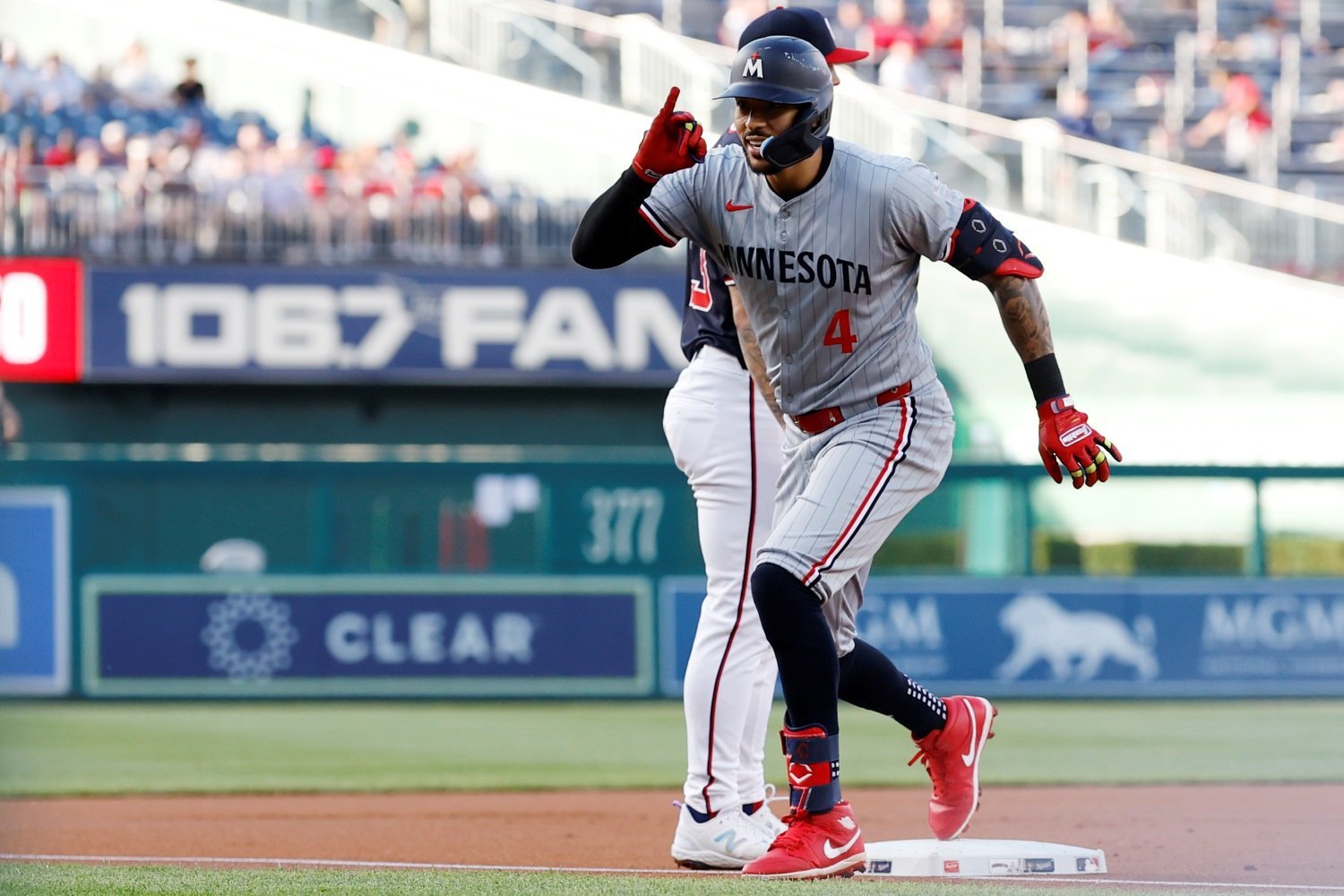 The Minnesota Twins have been represented by multiple players in every All-Star Game since 2019. Some years, the players were part of the initially announced roster, and other times, there have been replacement players for injured or unavailable players. Last season, Sonny Gray and Pablo López represented the club, while Byron Buxton and Luis Arráez were the team’s representatives in 2022. So, who will represent the Twins in Texas at the 2024 All-Star Game? 2024 All-Star: Carlos Correa, SS The AL has a pair of shortstops in the MVP conversation with Gunnar Henderson and Bobby Witt Jr. Both players were locks to make the roster, so it came down to whether or not the AL club wanted to have a third shortstop. Correa previously made the All-Star team in 2017 and 2021 with the Astros, but he has yet to be selected since joining the Twins. He’s having a resurgent offensive season with a 150 OPS+ and is the most well-known player on the team from a national perspective. The Twins have multiple other names on the roster who could be candidates to be injury replacements. So, let’s look at their chances of joining Correa in Texas. Joe Ryan, SP Ryan has been the Twins’ best-starting pitcher throughout the 2024 campaign and ranks fourth on the team in rWAR. Since Ryan pitched on Saturday, his last scheduled start for the first half lines up to be Friday in San Francisco, making it more likely that he would be available to pitch an inning in the All-Star Game. Currently, Ryan ranks in the top 10 among AL pitchers in fWAR, and there will be more than ten starting pitchers on the roster, especially when other players pitch over the weekend. Willi Castro, UTL Castro has arguably been the team’s MVP through the season’s first half. His defensive flexibility has been invaluable while posting a 124 OPS+. He is the first player in MLB history to appear in at least 20 games at second, third, shortstop, center field, and left field in the same season. Castro has the entire second half of the season to extend his record-breaking performance. The AL All-Star team might need someone with Castro’s defensive utility, and he certainly had a worthy first half. Ryan Jeffers, C Early in the season, Jeffers looked like a lock to make the All-Star Game because he was among the league leaders in OPS. He ended April with a .947 OPS and continued to hit well in May with a .830 OPS. Jeffers struggled in June, with only two extra-base hits in 16 games. Adley Rutschman was selected as the AL’s starter, and Salvador Perez will back him up. Jeffers has a strong case If the AL squad wants a third catcher. Griffin Jax, RP Jax has been the team’s most dominant reliever and has an All-Star-caliber resume. However, there are relievers in closer roles who have compiled video game numbers that will make the team ahead of him. Every team needs a representative in the All-Star Game, which, unfortunately, pushes Jax out of the picture. Did the correct player get selected for the All-Star Game? Will any other Twins be added as replacement players? Leave a COMMENT and start the discussion.
- 40 comments
-
- 6
-

-
- carlos correa
- joe ryan
- (and 3 more)
-
Minnesota is one of the American League’s best teams through the first half, but only one player will represent the club in the Midsummer Classic. Who made the cut, and who could be potential roster replacements? Image courtesy of Geoff Burke-USA TODAY Sports Minnesota is one of the American League’s best teams through the first half, but only one player will represent the club in the Midsummer Classic. Who made the cut, and who could be potential roster replacements? The Minnesota Twins have been represented by multiple players in every All-Star Game since 2019. Some years, the players were part of the initially announced roster, and other times, there have been replacement players for injured or unavailable players. Last season, Sonny Gray and Pablo López represented the club, while Byron Buxton and Luis Arráez were the team’s representatives in 2022. So, who will represent the Twins in Texas at the 2024 All-Star Game? 2024 All-Star: Carlos Correa, SS The AL has a pair of shortstops in the MVP conversation with Gunnar Henderson and Bobby Witt Jr. Both players were locks to make the roster, so it came down to whether or not the AL club wanted to have a third shortstop. Correa previously made the All-Star team in 2017 and 2021 with the Astros, but he has yet to be selected since joining the Twins. He’s having a resurgent offensive season with a 150 OPS+ and is the most well-known player on the team from a national perspective. The Twins have multiple other names on the roster who could be candidates to be injury replacements. So, let’s look at their chances of joining Correa in Texas. Joe Ryan, SP Ryan has been the Twins’ best-starting pitcher throughout the 2024 campaign and ranks fourth on the team in rWAR. Since Ryan pitched on Saturday, his last scheduled start for the first half lines up to be Friday in San Francisco, making it more likely that he would be available to pitch an inning in the All-Star Game. Currently, Ryan ranks in the top 10 among AL pitchers in fWAR, and there will be more than ten starting pitchers on the roster, especially when other players pitch over the weekend. Willi Castro, UTL Castro has arguably been the team’s MVP through the season’s first half. His defensive flexibility has been invaluable while posting a 124 OPS+. He is the first player in MLB history to appear in at least 20 games at second, third, shortstop, center field, and left field in the same season. Castro has the entire second half of the season to extend his record-breaking performance. The AL All-Star team might need someone with Castro’s defensive utility, and he certainly had a worthy first half. Ryan Jeffers, C Early in the season, Jeffers looked like a lock to make the All-Star Game because he was among the league leaders in OPS. He ended April with a .947 OPS and continued to hit well in May with a .830 OPS. Jeffers struggled in June, with only two extra-base hits in 16 games. Adley Rutschman was selected as the AL’s starter, and Salvador Perez will back him up. Jeffers has a strong case If the AL squad wants a third catcher. Griffin Jax, RP Jax has been the team’s most dominant reliever and has an All-Star-caliber resume. However, there are relievers in closer roles who have compiled video game numbers that will make the team ahead of him. Every team needs a representative in the All-Star Game, which, unfortunately, pushes Jax out of the picture. Did the correct player get selected for the All-Star Game? Will any other Twins be added as replacement players? Leave a COMMENT and start the discussion. View full article
-
Max Kepler surprised many with an offensive outburst last season. However, he’s failed to replicate those results. Can he rediscover his successful approach? Image courtesy of Rhona Wise-USA TODAY Sports Max Kepler surprised many with an offensive outburst last season. However, he’s failed to replicate those results. Can he rediscover his successful approach? Max Kepler is at a critical juncture in his big-league career. He’s been part of the Twins organization since signing as a 16-year-old, but his time is quickly coming to an end. Kepler will be a free agent at season’s end and will hit the open market searching for a big payday for the first time. To get the biggest contract, he needs to make some second-half adjustments to match his 2023 campaign. KKKKKKepler at the Plate Kepler hasn’t been known as a player who has struck out a lot during his career. He puts the ball in play, but sometimes the result is weak contact to avoid swings and misses. His K%, Chase%, and Whiff% are all in the 53rd percentile or lower in 2024. Last season, his Chase% and Whiff% ranked in the 75th percentile or higher. It’s also more concerning that his strikeout rate has been rising in recent weeks. From June 2nd-July 4th, Kepler has struck out 26 times in 93 plate appearances. During that 23-game stretch, he has five games with three strikeouts and seven games with two strikeouts or more. Kepler isn’t getting more power due to his increase in strikeouts, so something needs to change in his approach. (Not) Walking Through Memphis While his strike issues are concerning, Kepler has significantly dropped his walk rate. Last season, he posted a 9.2 BB%, which ranked in the 59th percentile. His walk rate has dropped to 5.9% this season, ranking in the 21st percentile. Kepler’s current .306 OBP is the lowest of his career and sits 26 points below the 2024 campaign. Pitchers have likely changed their approach with Kepler since he isn’t hitting for power and is striking out more regularly. Opponents don’t need to worry about walking Kepler, so they can make him get himself out without issuing a free pass. Gotcha with the Fastball? Kepler feasted on fastballs last season with a .624 xSLG compared to a .473 xSLG in 2024. His Whiff% against fastballs has increased by over 9% this season, and it might be the easiest pitch that has caused the issue. In 2023, Kepler posted a positive run value against pitches in the heart of the plate for the first time since 2019. So far this year, he’s been worth -7 runs on pitches deemed in the heart of the plate. Kepler has been swinging through some of the easiest pitches, which has led to struggles in previous seasons. Where’s the Beef? To give some perspective, Kepler posted a .688 OPS in the first half of last season, and his OPS is higher than that in 2024. During his terrific second half, he hit .306/.377/.549 (.926) with 17 doubles, two triples, and 12 home runs. He drew more walks and cut back on his strikeouts while being one of the AL’s best hitters. This year, his 18.3 launch angle is higher than any of the last three seasons, impacting his hard hit%, which has dropped by over 9%. When Kepler is at his best, he is hitting smooth line drives to all parts of the field. He’s under the ball too much this season, impacting his ability to post power numbers. Kepler will be remembered as one of the best defensive outfielders in the Target Field era, and he’s likely headed to the team's Hall of Fame. Like with many former top prospects, Kepler’s career includes an element of “What Could Have Been.” He’s shown flashes of the five-tool prospect label he was given before making his big-league debut. However, the offensive performance has been inconsistent or underwhelming for chunks of his Twins tenure. Another second-half turnaround could make him millions of dollars in free agency, but that would mean addressing most of the above-mentioned areas. Can Kepler repeat his second-half performance from 2023? What area is most important to address? Leave a COMMENT and start the discussion. View full article
-
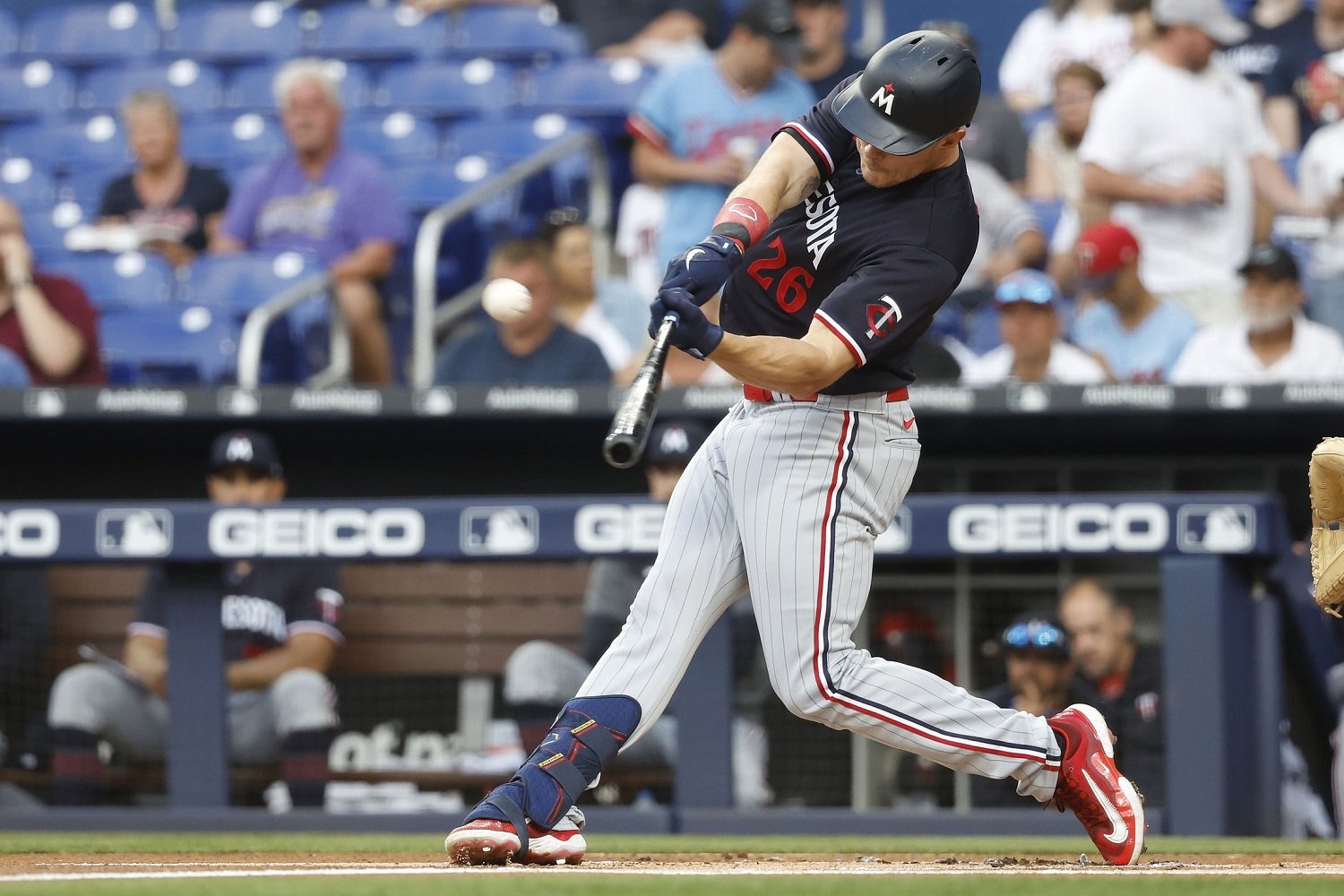 Max Kepler is at a critical juncture in his big-league career. He’s been part of the Twins organization since signing as a 16-year-old, but his time is quickly coming to an end. Kepler will be a free agent at season’s end and will hit the open market searching for a big payday for the first time. To get the biggest contract, he needs to make some second-half adjustments to match his 2023 campaign. KKKKKKepler at the Plate Kepler hasn’t been known as a player who has struck out a lot during his career. He puts the ball in play, but sometimes the result is weak contact to avoid swings and misses. His K%, Chase%, and Whiff% are all in the 53rd percentile or lower in 2024. Last season, his Chase% and Whiff% ranked in the 75th percentile or higher. It’s also more concerning that his strikeout rate has been rising in recent weeks. From June 2nd-July 4th, Kepler has struck out 26 times in 93 plate appearances. During that 23-game stretch, he has five games with three strikeouts and seven games with two strikeouts or more. Kepler isn’t getting more power due to his increase in strikeouts, so something needs to change in his approach. (Not) Walking Through Memphis While his strike issues are concerning, Kepler has significantly dropped his walk rate. Last season, he posted a 9.2 BB%, which ranked in the 59th percentile. His walk rate has dropped to 5.9% this season, ranking in the 21st percentile. Kepler’s current .306 OBP is the lowest of his career and sits 26 points below the 2024 campaign. Pitchers have likely changed their approach with Kepler since he isn’t hitting for power and is striking out more regularly. Opponents don’t need to worry about walking Kepler, so they can make him get himself out without issuing a free pass. Gotcha with the Fastball? Kepler feasted on fastballs last season with a .624 xSLG compared to a .473 xSLG in 2024. His Whiff% against fastballs has increased by over 9% this season, and it might be the easiest pitch that has caused the issue. In 2023, Kepler posted a positive run value against pitches in the heart of the plate for the first time since 2019. So far this year, he’s been worth -7 runs on pitches deemed in the heart of the plate. Kepler has been swinging through some of the easiest pitches, which has led to struggles in previous seasons. Where’s the Beef? To give some perspective, Kepler posted a .688 OPS in the first half of last season, and his OPS is higher than that in 2024. During his terrific second half, he hit .306/.377/.549 (.926) with 17 doubles, two triples, and 12 home runs. He drew more walks and cut back on his strikeouts while being one of the AL’s best hitters. This year, his 18.3 launch angle is higher than any of the last three seasons, impacting his hard hit%, which has dropped by over 9%. When Kepler is at his best, he is hitting smooth line drives to all parts of the field. He’s under the ball too much this season, impacting his ability to post power numbers. Kepler will be remembered as one of the best defensive outfielders in the Target Field era, and he’s likely headed to the team's Hall of Fame. Like with many former top prospects, Kepler’s career includes an element of “What Could Have Been.” He’s shown flashes of the five-tool prospect label he was given before making his big-league debut. However, the offensive performance has been inconsistent or underwhelming for chunks of his Twins tenure. Another second-half turnaround could make him millions of dollars in free agency, but that would mean addressing most of the above-mentioned areas. Can Kepler repeat his second-half performance from 2023? What area is most important to address? Leave a COMMENT and start the discussion.
 -
Offseason changes to José Miranda's swing might be the biggest reason for his improved results. Let’s dive in. Image courtesy of Nick Wosika-USA TODAY Sports Offseason changes to José Miranda's swing might be the biggest reason for his improved results. Let’s dive in. José Miranda has been considered a strong hitter since the Twins drafted him in the second round of the 2016 MLB Draft out of high school. Minnesota left him unprotected from the Rule 5 Draft following the 2020 season, but thankfully, no teams pounced at the opportunity to add him. His 2021 season put him on the prospect map as he hit .344/.401/.572 (.973) with 32 doubles and 30 home runs between Double- and Triple-A. Miranda had proven he could hit in the upper minors, but now he needed to transition that success to the big leagues. Miranda inserted himself into the team’s long-term plans during his rookie season. In 125 games, he hit .268/.325/.426 (.751) with 25 doubles, 15 home runs, and a 114 OPS+. Minnesota hoped he’d take the next step during his sophomore season, but a shoulder injury impacted him on both sides of the ball. Miranda posted a 57 OPS+ in 40 games with 24 strikeouts and seven extra-base hits. He had surgery on his shoulder in October and hoped that some swing adjustments could replicate his 2022 numbers. So, let’s look into Miranda’s approach at the plate and what he changed from last year to this year. 2023 Season: 40 G, .211/.263/.303 (.566), 4 2B, 3 HR, 24 K, 9 BB, 57 OPS+, -0.2 WAR Last season, Miranda’s swing included extra movement, with his hands moving north and south as part of his load. This extraneous movement made it difficult for him to catch up to high pitches in the zone. Against fastballs, he struck out 16 times in 87 at-bats while being limited to a .310 SLG. His extra movement also caused him to be on top of the ball more regularly. During his rookie season, he topped the ball 29.4% of the time, which jumped to 40.7% last season. Some of his struggles last season were likely due to compensating for his shoulder injury, but it still gave Miranda a chance to analyze his swing and make changes. 2024 Season: 71 G, .324/.364/.529 (.894), 20 2B, 1 3B, 9 HR, 35 K, 14 BB, 150 OPS+, 2.3 WAR The Twins sent Miranda to Triple-A to begin the season because there wasn’t a spot on the Opening Day roster. He reached base multiple times in four of his first seven games before multiple big-league injuries opened a spot for him. Miranda worked to limit the movement of his hands during his load so there is less north-to-south motion, which allows him to get into his swing quicker and catch up to pitches. He’s slugging over .500 against every pitch type, including a 210-point jump in slugging versus fastballs. His Topped% has decreased to 29.1%, slightly better than his rookie season and better than the league average. Since rejoining the Twins, he’s made keeping his bat out of the lineup challenging. Willi Castro (2.9 fWAR) and Carlos Correa (2.7 fWAR) are the only Twins with a higher fWAR than Miranda’s 2.1 total. His total might be even higher, but he’s provided negative value on defense. Yesterday, he tied the MLB record by hitting safely in twelve straight at-bats. His 151 wRC+ is the highest on the team, and he has had the lowest K% among qualified Twins hitters since he was recalled. Minnesota’s offense has been firing on all cylinders in recent weeks, and it’s tough to imagine where the lineup would be without Miranda’s improved swing. What stands out about his approach in 2024? What’s Miranda’s long-term role with the Twins? Leave a COMMENT and start the discussion. View full article
-
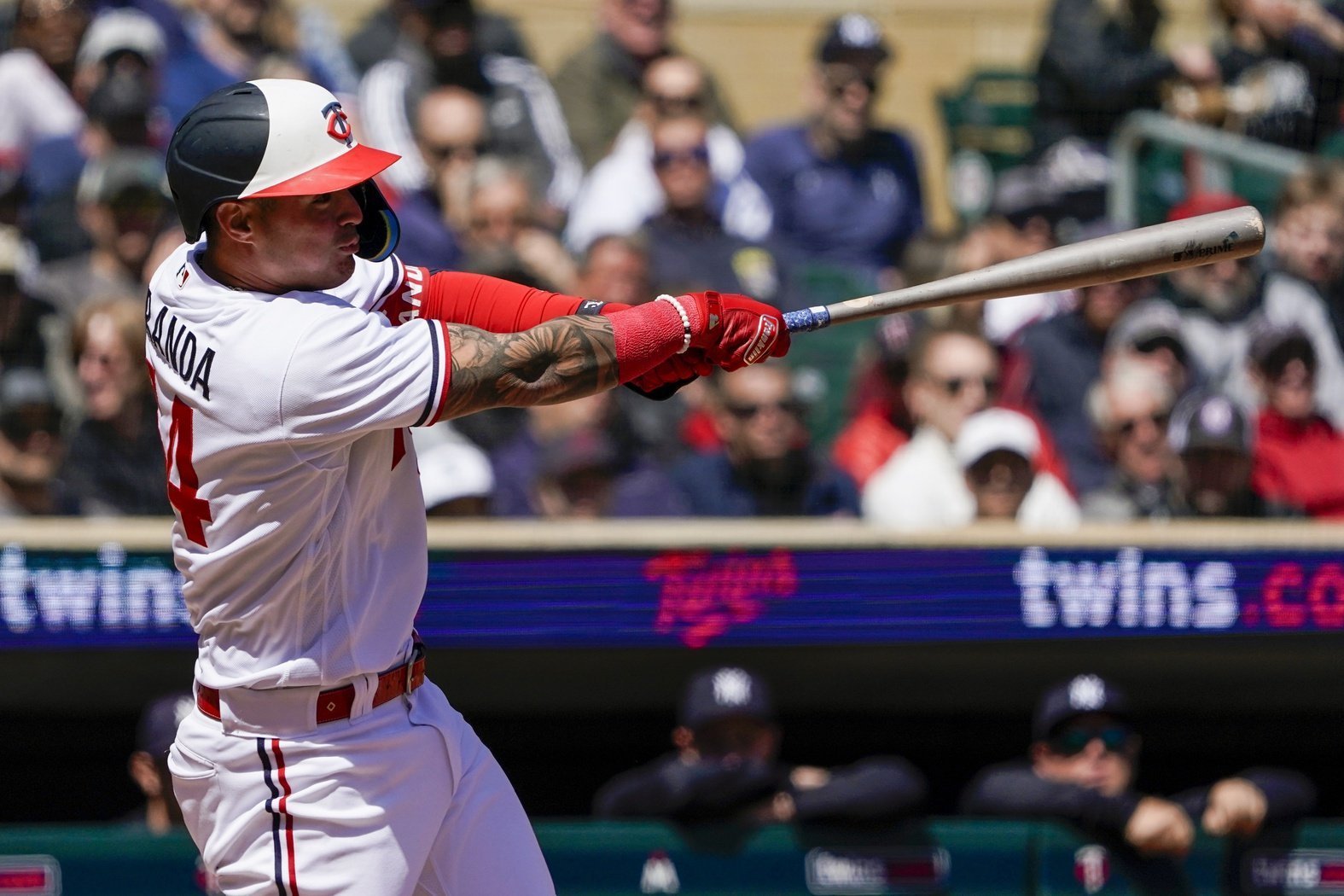 José Miranda has been considered a strong hitter since the Twins drafted him in the second round of the 2016 MLB Draft out of high school. Minnesota left him unprotected from the Rule 5 Draft following the 2020 season, but thankfully, no teams pounced at the opportunity to add him. His 2021 season put him on the prospect map as he hit .344/.401/.572 (.973) with 32 doubles and 30 home runs between Double- and Triple-A. Miranda had proven he could hit in the upper minors, but now he needed to transition that success to the big leagues. Miranda inserted himself into the team’s long-term plans during his rookie season. In 125 games, he hit .268/.325/.426 (.751) with 25 doubles, 15 home runs, and a 114 OPS+. Minnesota hoped he’d take the next step during his sophomore season, but a shoulder injury impacted him on both sides of the ball. Miranda posted a 57 OPS+ in 40 games with 24 strikeouts and seven extra-base hits. He had surgery on his shoulder in October and hoped that some swing adjustments could replicate his 2022 numbers. So, let’s look into Miranda’s approach at the plate and what he changed from last year to this year. 2023 Season: 40 G, .211/.263/.303 (.566), 4 2B, 3 HR, 24 K, 9 BB, 57 OPS+, -0.2 WAR Last season, Miranda’s swing included extra movement, with his hands moving north and south as part of his load. This extraneous movement made it difficult for him to catch up to high pitches in the zone. Against fastballs, he struck out 16 times in 87 at-bats while being limited to a .310 SLG. His extra movement also caused him to be on top of the ball more regularly. During his rookie season, he topped the ball 29.4% of the time, which jumped to 40.7% last season. Some of his struggles last season were likely due to compensating for his shoulder injury, but it still gave Miranda a chance to analyze his swing and make changes. 2024 Season: 71 G, .324/.364/.529 (.894), 20 2B, 1 3B, 9 HR, 35 K, 14 BB, 150 OPS+, 2.3 WAR The Twins sent Miranda to Triple-A to begin the season because there wasn’t a spot on the Opening Day roster. He reached base multiple times in four of his first seven games before multiple big-league injuries opened a spot for him. Miranda worked to limit the movement of his hands during his load so there is less north-to-south motion, which allows him to get into his swing quicker and catch up to pitches. He’s slugging over .500 against every pitch type, including a 210-point jump in slugging versus fastballs. His Topped% has decreased to 29.1%, slightly better than his rookie season and better than the league average. Since rejoining the Twins, he’s made keeping his bat out of the lineup challenging. Willi Castro (2.9 fWAR) and Carlos Correa (2.7 fWAR) are the only Twins with a higher fWAR than Miranda’s 2.1 total. His total might be even higher, but he’s provided negative value on defense. Yesterday, he tied the MLB record by hitting safely in twelve straight at-bats. His 151 wRC+ is the highest on the team, and he has had the lowest K% among qualified Twins hitters since he was recalled. Minnesota’s offense has been firing on all cylinders in recent weeks, and it’s tough to imagine where the lineup would be without Miranda’s improved swing. What stands out about his approach in 2024? What’s Miranda’s long-term role with the Twins? Leave a COMMENT and start the discussion.
 -
Is the 2024 season the Year of the Former Number One Overall Pick? If so, the Twins have multiple current and former players who are playing a role. Image courtesy of Matt Krohn-USA TODAY Sports Is the 2024 season the Year of the Former Number One Overall Pick? If so, the Twins have multiple current and former players who are playing a role. Teams face an enormous amount of pressure when making the first overall pick. The Twins have held the first overall pick on three drafts. Players taken first overall must possess the right combination of skills to live up to the hype of being selected at the top of their class. Some players live up to the expectations and have Hall of Fame careers, while others struggle to succeed at baseball’s highest level. MLB Network’s Greg Amsinger dubbed the 2024 season as "The Year of the Former Number One Overall Pick." He ranked nine storylines from 2024 that include a former number one overall pick. It includes everything from players having their numbers retired to current players playing at an MVP level. The Twins fit onto his list more than any other franchise. Joe Mauer, First Overall Pick in 2001 2024 Storyline: Elected to the National Baseball Hall of Fame on the First Ballot Later this month, Mauer will step onto the Cooperstown stage to join an elite group of baseball’s best players. Johnny Bench and Ivan Rodriguez are the only catchers before Mauer, who the writers chose as first-ballot Hall of Famers. For Mauer, it was a storybook career played entirely in front of his hometown fans, adding another layer that will be showcased in the coming weeks. Mauer wasn’t the consensus top pick in the 2001 MLB Draft, with many believing the Twins should select Mark Prior, a college pitcher from USC. Minnesota decided to select Mauer, and the rest is history. Prior had some solid moments, but injuries limited him to 102 appearances over five big-league seasons. In hindsight, Mauer was the correct pick and will take his rightful place in Cooperstown in a few short days. Carlos Correa, First Overall Pick in 2012 2024 Storyline: Returning to All-Star Form Correa’s big-league career could have taken a different path if the Astros had gone in a different direction at the top of the 2012 MLB Draft. Houston had the top pick and Minnesota sat in the second spot. Correa wasn’t the consensus top pick, so the Astros agreed to take him and signed him to an under-slot deal for $4.8 million. Minnesota had multiple options behind Correa, including Byron Buxton, Mike Zunino, and Kevin Gausman. Buxton was considered a five-tool talent, and the Twins were willing to sign him for $6 million, more than any other pick that season. Correa has returned to his All-Star form this season after dealing with plantar fasciitis throughout the 2023 campaign. In 65 games, he has posted a 150 OPS+, the second-highest total of his big-league career. In two previous seasons, Correa was selected for the All-Star Game (2017, 2021) but will have a more challenging road to making the team this year. Baltimore’s Gunnar Henderson is in the MVP conversation, and Kansas City’s Bobby Witt Jr. has also posted tremendous first-half totals. Correa has a chance to make the team if the AL decides to take three shortstops. Royce Lewis, First Overall Pick in 2017 2024 Storyline: Home Run Barrage to Begin the Season The Twins had multiple options besides Lewis at the top of the 2017 MLB Draft, with many national outlets predicting Minnesota would select a college pitcher. Some of the other top players in that draft included Hunter Greene, MacKenzie Gore, Brendan McKay, and Kyle Wright. Green has posted solid numbers to start his career, but many other options have failed to meet expectations. The Twins seem to have made a strong choice, considering how other players' careers have unfolded. Lewis homered on Opening Day before suffering a partially torn quadriceps, causing him to miss two months. He took the baseball world by storm after returning from the IL. In 24 games this season, he’s hit .292/.354/.685 with ten home runs and 15 total extra-base hits. He’s been limited to 93 big-league games over the last three seasons because of multiple injuries. A healthy Lewis is a game-changing player, but he’s been snakebitten to this point in his career. How would you rank these storylines for the Twins? Leave a COMMENT and start the discussion. View full article
-
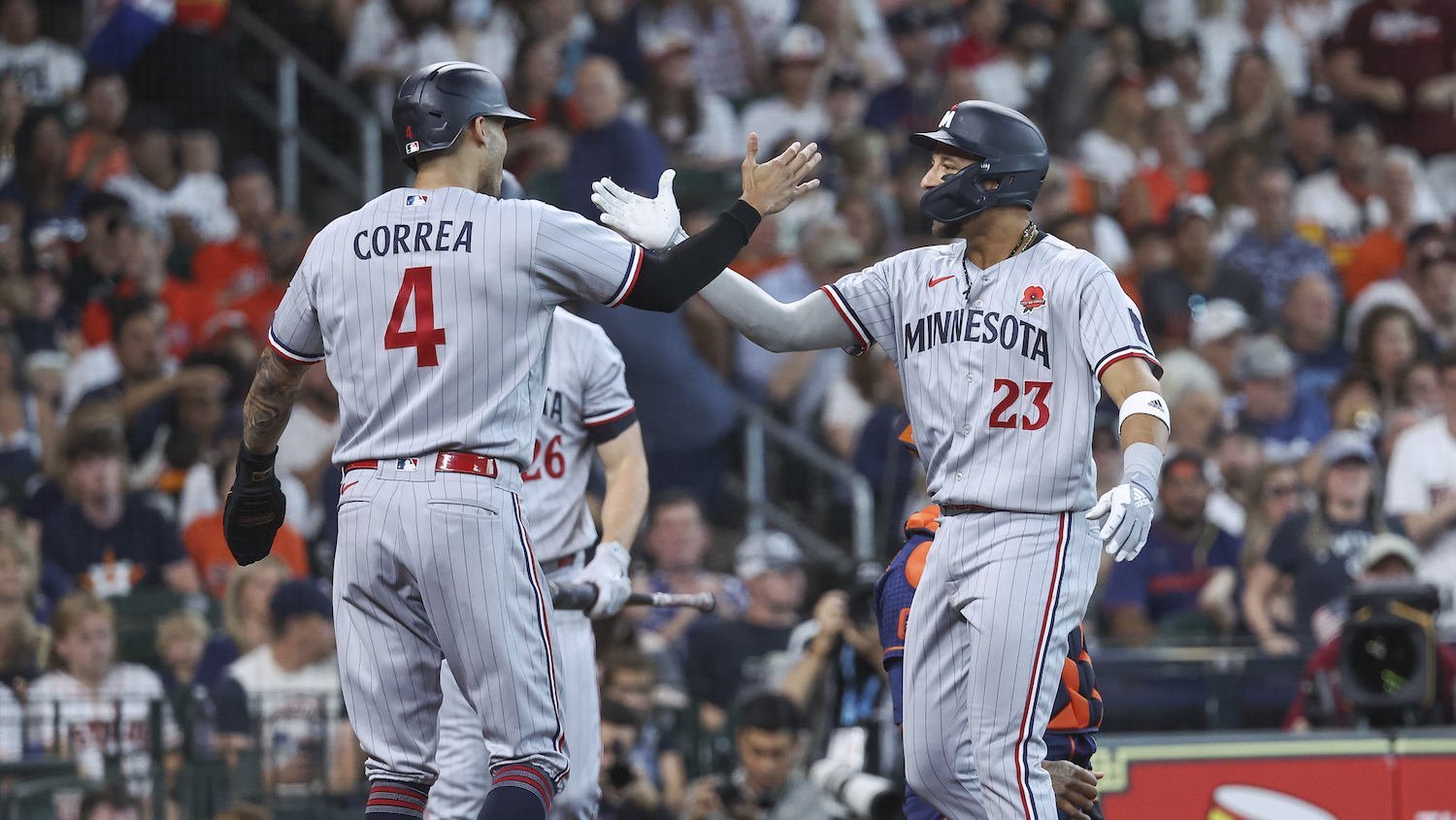 Predicting the future in baseball can be an exercise in futility. Last season, it looked like José Miranda was out of the team’s long-term plans, as he struggled with a shoulder injury. Now, he’s reestablished himself as a crucial piece of the team’s lineup. Matt Wallner and Edouard Julien had tremendous rookie seasons but have struggled in 2024. So, let’s look into the crystal ball and see who fits into next season’s roster. Catcher Current: Ryan Jeffers One Year from Now: Jeffers Jeffers started the year on a tear, but has recently cooled down. Christian Vázquez has been one of baseball’s worst hitters this season, and the Twins still have him under contract through next year. His defense continues to be among the league’s best, and that’s the biggest reason the Twins have kept him on the roster. Back-Up Plan: Vázquez, Jair Camargo First Base Current: Carlos Santana One Year from Now: Julien Minnesota added Santana on a one-year deal, and it seems unlikely the veteran will be back next season, even with his improved offensive performance. The Twins have other players to take over at first base, and Julien might be the best option. He initially struggled after being demoted to Triple-A, but his bat has started to turn around. He’s started to see some time at first base in the minors, but his bat must produce. Back-Up Plan: Miranda, Alex Kirilloff Second Base Current: Willi Castro One Year from Now: Brooks Lee Julien was supposed to be the team’s everyday second baseman. However, his struggles have forced them to pursue a different plan. Castro has filled in nicely, and will have a role as a utility player again next season. Lee ranks as the organization’s second-best prospect and is mashing the ball at Triple-A. He needs a defensive home in the big leagues, and second base is his most likely spot. Back-Up Plan: Castro, Julien, Austin Martin Third Base Current: Royce Lewis One Year from Now: Lewis The Twins have been using Lewis less regularly at third base in recent days, while he’s been in an offensive slump. Obviously, there are also perpetual, unrelenting injury concerns to take into account. He’s still the team’s best option for the long term, though, even with some defensive struggles. Both of his significant injuries this year showed up while running the baes, so playing the hot corner doesn't seem to be the culprit in his physical issues. Miranda has played more regularly than expected at the hot corner, but is likely better suited for a DH/1B role. Lee also has the defensive chops to take over third base if Lewis continues to struggle, or to settle in there if the team elects to bring Lewis back as the DH later this summer. Back-Up Plan: Lee, Miranda Shortstop Current: Carlos Correa One Year from Now: Correa Correa is having his best season in a Twins uniform and has a chance to represent the team at the All-Star Game. Outside of Willi Castro, he’s been the team’s first-half MVP and provided the club with the value they expected when he signed for at least $200 million. Lee has continued to play shortstop in the minors, and could fill in if Correa missed time. For now, the Twins hope Correa is on the field and continues to produce like one of the AL’s best players. Back-Up Plan: Lee, Castro Left Field Current: Trevor Larnach One Year from Now: Larnach Larnach seemed to be outside the team’s plans entering the season, but that has changed quickly. His improved approach against off-speed pitches has made him a dangerous hitter. He’s producing like the player the Twins hoped he’d be when they drafted him in the first round. His spot isn’t guaranteed for next season, so he must continue to prove that his 2024 performance is not a fluke. Back-Up Plan: Matt Wallner, Emmanuel Rodriguez, Castro, Martin Center Field Current: Byron Buxton One Year from Now: Buxton Few predicted that Buxton would be able to roam center field again, especially at an elite level. He’s proven his detractors wrong again this season, producing at a very high level. The Twins will continue to have backup plans for Buxton when he misses time. Rodríguez has regularly played center field during his professional career and has the skill set to stick at the position. Castro and Martin have filled in during the 2024 campaign and can be backup options next season. Back-Up Plan: Rodríguez, Castro, Martin, DaShawn Keirsey Right Field Current: Max Kepler One Year from Now: Wallner Kepler’s time in a Twins uniform is likely over at season’s end, leaving the team searching for a right fielder for the first time in over a decade. Wallner has been on a hot streak at Triple-A and has an arm that can be a weapon in right field. Minnesota will need to give him a chance in the second half to prove his offensive adjustments can stick at baseball’s highest level. Back-Up Plan: Larnach, Rodríguez, Martin Who will be in the Twins’ lineup midway through the 2025 campaign? What unexpected change is coming, and not captured here? Leave a comment and start the discussion.
- 65 comments
-
- 6
-
-

-
- byron buxton
- carlos correa
- (and 5 more)
-
The Twins have veteran pieces and a young core, but how will that change by next season? Here’s a look at what the team’s lineup will look like, midway through 2025. Image courtesy of Troy Taormina-USA TODAY Sports The Twins have veteran pieces and a young core, but how will that change by next season? Here’s a look at what the team’s lineup will look like, midway through 2025. Predicting the future in baseball can be an exercise in futility. Last season, it looked like José Miranda was out of the team’s long-term plans, as he struggled with a shoulder injury. Now, he’s reestablished himself as a crucial piece of the team’s lineup. Matt Wallner and Edouard Julien had tremendous rookie seasons but have struggled in 2024. So, let’s look into the crystal ball and see who fits into next season’s roster. Catcher Current: Ryan Jeffers One Year from Now: Jeffers Jeffers started the year on a tear, but has recently cooled down. Christian Vázquez has been one of baseball’s worst hitters this season, and the Twins still have him under contract through next year. His defense continues to be among the league’s best, and that’s the biggest reason the Twins have kept him on the roster. Back-Up Plan: Vázquez, Jair Camargo First Base Current: Carlos Santana One Year from Now: Julien Minnesota added Santana on a one-year deal, and it seems unlikely the veteran will be back next season, even with his improved offensive performance. The Twins have other players to take over at first base, and Julien might be the best option. He initially struggled after being demoted to Triple-A, but his bat has started to turn around. He’s started to see some time at first base in the minors, but his bat must produce. Back-Up Plan: Miranda, Alex Kirilloff Second Base Current: Willi Castro One Year from Now: Brooks Lee Julien was supposed to be the team’s everyday second baseman. However, his struggles have forced them to pursue a different plan. Castro has filled in nicely, and will have a role as a utility player again next season. Lee ranks as the organization’s second-best prospect and is mashing the ball at Triple-A. He needs a defensive home in the big leagues, and second base is his most likely spot. Back-Up Plan: Castro, Julien, Austin Martin Third Base Current: Royce Lewis One Year from Now: Lewis The Twins have been using Lewis less regularly at third base in recent days, while he’s been in an offensive slump. Obviously, there are also perpetual, unrelenting injury concerns to take into account. He’s still the team’s best option for the long term, though, even with some defensive struggles. Both of his significant injuries this year showed up while running the baes, so playing the hot corner doesn't seem to be the culprit in his physical issues. Miranda has played more regularly than expected at the hot corner, but is likely better suited for a DH/1B role. Lee also has the defensive chops to take over third base if Lewis continues to struggle, or to settle in there if the team elects to bring Lewis back as the DH later this summer. Back-Up Plan: Lee, Miranda Shortstop Current: Carlos Correa One Year from Now: Correa Correa is having his best season in a Twins uniform and has a chance to represent the team at the All-Star Game. Outside of Willi Castro, he’s been the team’s first-half MVP and provided the club with the value they expected when he signed for at least $200 million. Lee has continued to play shortstop in the minors, and could fill in if Correa missed time. For now, the Twins hope Correa is on the field and continues to produce like one of the AL’s best players. Back-Up Plan: Lee, Castro Left Field Current: Trevor Larnach One Year from Now: Larnach Larnach seemed to be outside the team’s plans entering the season, but that has changed quickly. His improved approach against off-speed pitches has made him a dangerous hitter. He’s producing like the player the Twins hoped he’d be when they drafted him in the first round. His spot isn’t guaranteed for next season, so he must continue to prove that his 2024 performance is not a fluke. Back-Up Plan: Matt Wallner, Emmanuel Rodriguez, Castro, Martin Center Field Current: Byron Buxton One Year from Now: Buxton Few predicted that Buxton would be able to roam center field again, especially at an elite level. He’s proven his detractors wrong again this season, producing at a very high level. The Twins will continue to have backup plans for Buxton when he misses time. Rodríguez has regularly played center field during his professional career and has the skill set to stick at the position. Castro and Martin have filled in during the 2024 campaign and can be backup options next season. Back-Up Plan: Rodríguez, Castro, Martin, DaShawn Keirsey Right Field Current: Max Kepler One Year from Now: Wallner Kepler’s time in a Twins uniform is likely over at season’s end, leaving the team searching for a right fielder for the first time in over a decade. Wallner has been on a hot streak at Triple-A and has an arm that can be a weapon in right field. Minnesota will need to give him a chance in the second half to prove his offensive adjustments can stick at baseball’s highest level. Back-Up Plan: Larnach, Rodríguez, Martin Who will be in the Twins’ lineup midway through the 2025 campaign? What unexpected change is coming, and not captured here? Leave a comment and start the discussion. View full article
- 65 replies
-
- 1
-
-
- byron buxton
- carlos correa
- (and 5 more)
-
Brooks Lee is getting called up to the Twins after mashing the ball at Triple-A over the last month. What can one of the team’s top prospects provide the lineup at this critical part of the season? Image courtesy of Dave Nelson-USA TODAY Sports Brooks Lee is getting called up to the Twins after mashing the ball at Triple-A over the last month. What can one of the team’s top prospects provide the lineup at this critical part of the season? Brooks Lee made news early this week when he was picked to be the Twins representative in the MLB Futures Game. It’s more likely that he won’t be appearing in that game as the Twins are calling him up to make his big-league debut. Now that he’s here, what can fans expect from Lee? Where will he play defensively? How long will he be with the Twins? Let’s explore. Lee is a 23-year-old infielder that the Twins took with the eighth pick in the 2022 MLB Draft from California Polytechnic Institute and State University. He could have started his professional career out of high school, but he was committed to playing collegiately for his father, the head coach at Cal Poly. Minnesota signed him for $5.675 million, the fifth-highest bonus handed out in his draft class. After starting his professional career, he almost immediately became one of baseball’s top prospects. In 2024, Lee impressed during spring training before a herniated disc in his back sidelined him in late March. He started a rehab assignment in late May and rejoined the Saints lineup in early June. In 20 Triple-A games, he hit .329/.394/.635 (1.029) with seven home runs and five doubles. Throughout the winter, the switch hitter worked to refine his right-handed swing since it was the weaker of his two sides. Last season, he posted a .603 OPS and had a 1.121 OPS in 37 plate appearances from that side in 2024. Defensively, the Twins drafted him as a shortstop, and he’s continued to play regularly at that position throughout his professional career. He’s made ten starts at third base over the last two seasons and two appearances at second base. Royce Lewis suffered a groin injury on Tuesday, so Lee will likely slot into third base during his debut. Many evaluators believe he has enough arm to handle the hot corner, which might be his best long-term position as he matures physically. Lee was considered the top collegiate-hitting prospect in his draft class, and the Twins have aggressively promoted him throughout his career. His hit tool is very advanced, which should help him avoid prolonged slumps at the big-league level. Minnesota’s offense has been performing well in recent weeks, so Lee can hit the bottom part of the lineup to get his feet wet. He doesn’t need to be a savior for the team in 2024. Instead, Lee can serve as a supplementary piece for a team in the middle of a playoff push. Only three players from the first round of his draft have made their debuts, and Zach Neto is the only player to play in more than 25 games. Groin injuries can be tricky, so there are no guarantees of how quickly Lewis can recover. Lee should have some time to get acclimated to the big-league level and can force the Twins to keep him on the roster with a solid offensive performance. Is he here to stay? Only time will tell. Congrats to Lee and his family. What are your thoughts on his call-up? Leave a COMMENT and start the discussion. Check out the exact moment that Saints manager Toby Gardenhire let Brooks Lee know that he is heading to the big leagues. View full article
-
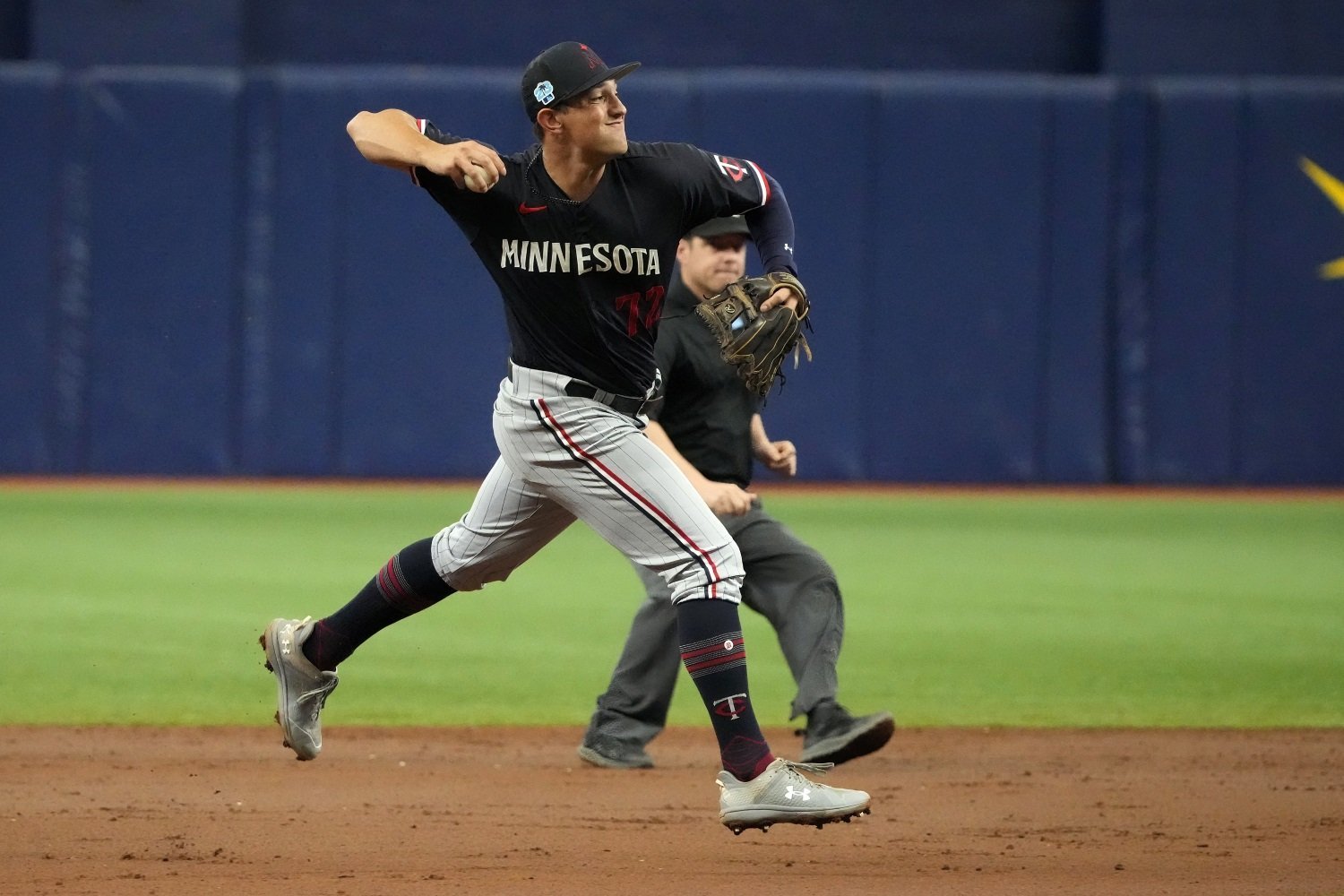 Brooks Lee made news early this week when he was picked to be the Twins representative in the MLB Futures Game. It’s more likely that he won’t be appearing in that game as the Twins are calling him up to make his big-league debut. Now that he’s here, what can fans expect from Lee? Where will he play defensively? How long will he be with the Twins? Let’s explore. Lee is a 23-year-old infielder that the Twins took with the eighth pick in the 2022 MLB Draft from California Polytechnic Institute and State University. He could have started his professional career out of high school, but he was committed to playing collegiately for his father, the head coach at Cal Poly. Minnesota signed him for $5.675 million, the fifth-highest bonus handed out in his draft class. After starting his professional career, he almost immediately became one of baseball’s top prospects. In 2024, Lee impressed during spring training before a herniated disc in his back sidelined him in late March. He started a rehab assignment in late May and rejoined the Saints lineup in early June. In 20 Triple-A games, he hit .329/.394/.635 (1.029) with seven home runs and five doubles. Throughout the winter, the switch hitter worked to refine his right-handed swing since it was the weaker of his two sides. Last season, he posted a .603 OPS and had a 1.121 OPS in 37 plate appearances from that side in 2024. Defensively, the Twins drafted him as a shortstop, and he’s continued to play regularly at that position throughout his professional career. He’s made ten starts at third base over the last two seasons and two appearances at second base. Royce Lewis suffered a groin injury on Tuesday, so Lee will likely slot into third base during his debut. Many evaluators believe he has enough arm to handle the hot corner, which might be his best long-term position as he matures physically. Lee was considered the top collegiate-hitting prospect in his draft class, and the Twins have aggressively promoted him throughout his career. His hit tool is very advanced, which should help him avoid prolonged slumps at the big-league level. Minnesota’s offense has been performing well in recent weeks, so Lee can hit the bottom part of the lineup to get his feet wet. He doesn’t need to be a savior for the team in 2024. Instead, Lee can serve as a supplementary piece for a team in the middle of a playoff push. Only three players from the first round of his draft have made their debuts, and Zach Neto is the only player to play in more than 25 games. Groin injuries can be tricky, so there are no guarantees of how quickly Lewis can recover. Lee should have some time to get acclimated to the big-league level and can force the Twins to keep him on the roster with a solid offensive performance. Is he here to stay? Only time will tell. Congrats to Lee and his family. What are your thoughts on his call-up? Leave a COMMENT and start the discussion. Check out the exact moment that Saints manager Toby Gardenhire let Brooks Lee know that he is heading to the big leagues.
 -
Twins Daily Minor League Hitter of the Month - June 2024
Cody Christie posted an article in Minor Leagues
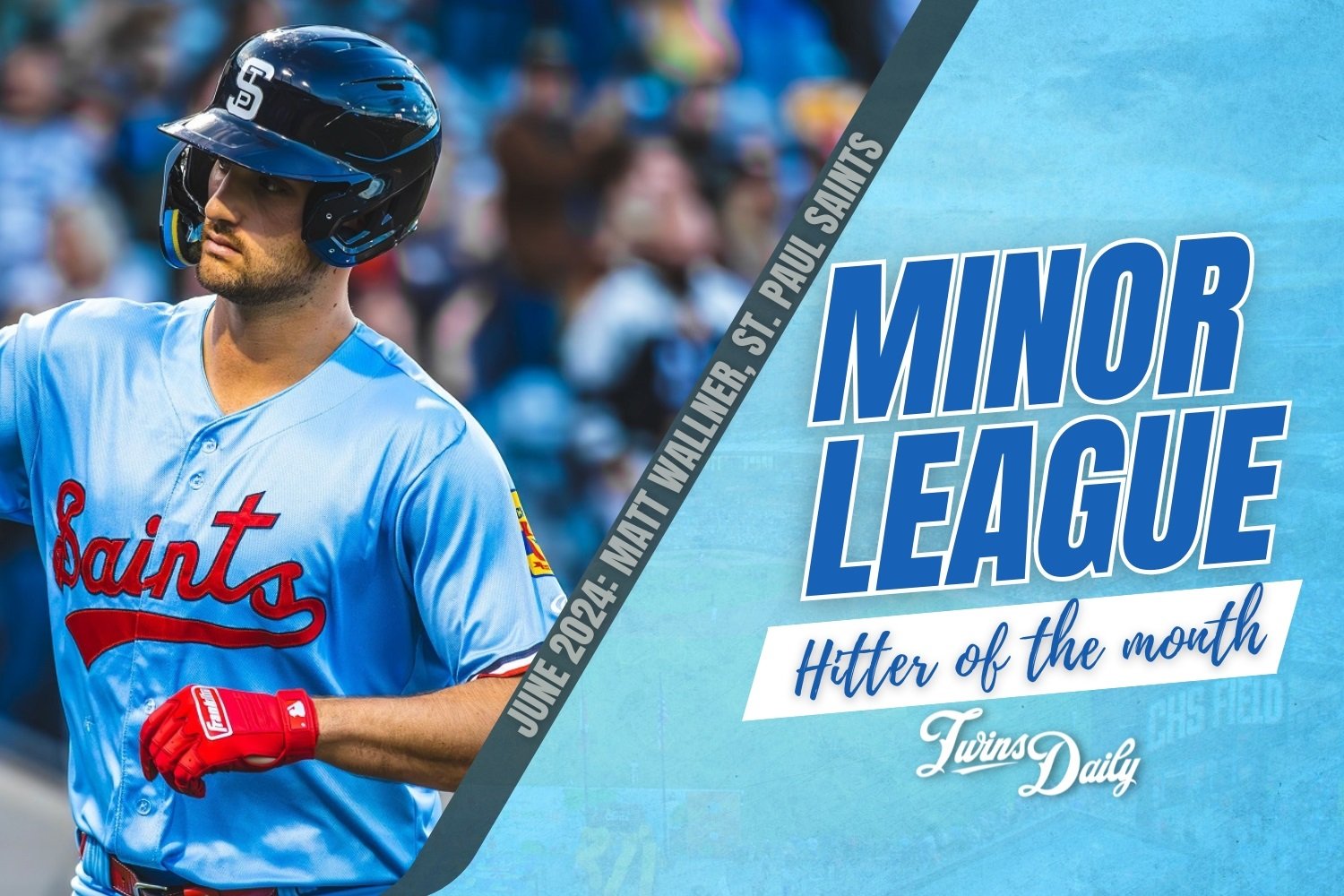 The minor-league season can become a grind for players, who spend a large chunk of the year away from their families in smaller towns scattered across the country. Some players from the organization will be traded before the end of July, while others will lose roster spots to newly drafted players. June is a month to showcase what a player can mean to an organization. There were strong offensive performances up and down the farm system during June, which made selecting one hitter more difficult. Here are a handful of honorable mentions, before exploring the details of Twins Daily’s top pick. Honorable Mention #3: Nate Baez, Cedar Rapids Kernels 20 G, 19-62 (.307 BA), 4 2B, 6 HR, 15 RBI, 1.075 OPS Baez might be an unfamiliar name compared to some others on this list, but the 2022 12th-round pick has been key to the Kernels lineup. He’s hit over .300 in each of the last two months while also being among the team leaders in multiple offensive categories. His 1.075 OPS for the month ranks highly among the hitters in the organization, but he gets less playing time since he plays regularly behind the plate. Baez has already set career highs in home runs and RBI. Only Ricardo Olivar has more home runs in a Kernels uniform this season. Baez is slightly older than the average age of the competition in the Midwest League, so the team could bump him up to Double-A in the season’s second half. Honorable Mention #2: Brooks Lee, Fort Myers Mighty Mussels/St. Paul Saints 21 G, 29-87 (.333 BA), 6 2B, 6 HR, 19 RBI, 1.017 OPS Lee began the year on the injured list with a herniated disc in his back, so there was some concern about how quickly he would be able to get back into form. He’s quickly put all those concerns behind him, showcasing a revamped swing from the right side. Lee is a switch-hitter, and last season he posted a .603 OPS from the right side which was over 250 points lower than when he batted left-handed. He worked on his right-handed swing this winter, and the results have been clear, as he has posted a 1.121 OPS with eight extra-base hits in 37 plate appearances. He’s knocking on the door to the big leagues. Honorable Mention #1: Yunior Severino, St. Paul Saints 23 G, 34-80 (.425 BA), 3 2B, 6 HR, 19 RBI, 1.231 OPS Severino started the season slowly with a .588 OPS in April, raising that by 129 points in May. However, he has been nearly impossible to get out during June. In the first 12 games of the month, he went 17-for-39 (.436 BA) with four home runs while getting on base over 59% of the time. He didn’t slow down much in the second half of the month, with a .415 BA and a 1.100 OPS in 11 games. Severino is on the 40-man roster, so it will be interesting to see if the Twins can find a use for him down the stretch. He should win this award, and in many other months, he would be the winner by a landslide. However, only one player can earn top honors. Hitter of the Month – Matt Wallner, St. Paul Saints 26 G, 34-105 (.324 BA), 6 2B, 12 HR, 28 RBI, 1.127 OPS Wallner is letting his bat do the talking, after a terrible start to the season at the big-league level. He started off on a tear when the calendar turned to June. In 14 games, he went 23-for-58 (.397 BA) with nine home runs, four doubles, and a 1.384 OPS. The Twins named him the organization’s Minor League Hitter of the Week (Jun. 1-7), as he posted a .591 ISO and a 242 wRC+. He followed that up by winning the International League Player of the Week for Jun. 10-16, after hitting .519 with five homers in six games. Power hitters like Wallner have an element of streakiness baked into their performance because of their swing-and-miss tendency. In June, he showed the ability to hit for average and power while striking out in 27.7% of his plate appearances. His power numbers give him the award over the walks and lack of strikeouts from Severino. Should Wallner or Severino have taken the top spot? Leave your rankings in the COMMENTS and start the discussion.
- 12 comments
-
- 7
-
-
- matt wallner
- yunior severino
- (and 2 more)
-
It’s hard to believe the baseball season is already half over, and this is the time of year when players tend to separate themselves. A trio of Saints hitters has been destroying the baseball, but which big bat will win June’s top hitter in the Twins system? Image courtesy of Rob Thompson, St. Paul Saints It’s hard to believe the baseball season is already half over, and this is the time of year when players tend to separate themselves. A trio of Saints hitters has been destroying the baseball, but which big bat will win June’s top hitter in the Twins system? The minor-league season can become a grind for players, who spend a large chunk of the year away from their families in smaller towns scattered across the country. Some players from the organization will be traded before the end of July, while others will lose roster spots to newly drafted players. June is a month to showcase what a player can mean to an organization. There were strong offensive performances up and down the farm system during June, which made selecting one hitter more difficult. Here are a handful of honorable mentions, before exploring the details of Twins Daily’s top pick. Honorable Mention #3: Nate Baez, Cedar Rapids Kernels 20 G, 19-62 (.307 BA), 4 2B, 6 HR, 15 RBI, 1.075 OPS Baez might be an unfamiliar name compared to some others on this list, but the 2022 12th-round pick has been key to the Kernels lineup. He’s hit over .300 in each of the last two months while also being among the team leaders in multiple offensive categories. His 1.075 OPS for the month ranks highly among the hitters in the organization, but he gets less playing time since he plays regularly behind the plate. Baez has already set career highs in home runs and RBI. Only Ricardo Olivar has more home runs in a Kernels uniform this season. Baez is slightly older than the average age of the competition in the Midwest League, so the team could bump him up to Double-A in the season’s second half. Honorable Mention #2: Brooks Lee, Fort Myers Mighty Mussels/St. Paul Saints 21 G, 29-87 (.333 BA), 6 2B, 6 HR, 19 RBI, 1.017 OPS Lee began the year on the injured list with a herniated disc in his back, so there was some concern about how quickly he would be able to get back into form. He’s quickly put all those concerns behind him, showcasing a revamped swing from the right side. Lee is a switch-hitter, and last season he posted a .603 OPS from the right side which was over 250 points lower than when he batted left-handed. He worked on his right-handed swing this winter, and the results have been clear, as he has posted a 1.121 OPS with eight extra-base hits in 37 plate appearances. He’s knocking on the door to the big leagues. Honorable Mention #1: Yunior Severino, St. Paul Saints 23 G, 34-80 (.425 BA), 3 2B, 6 HR, 19 RBI, 1.231 OPS Severino started the season slowly with a .588 OPS in April, raising that by 129 points in May. However, he has been nearly impossible to get out during June. In the first 12 games of the month, he went 17-for-39 (.436 BA) with four home runs while getting on base over 59% of the time. He didn’t slow down much in the second half of the month, with a .415 BA and a 1.100 OPS in 11 games. Severino is on the 40-man roster, so it will be interesting to see if the Twins can find a use for him down the stretch. He should win this award, and in many other months, he would be the winner by a landslide. However, only one player can earn top honors. Hitter of the Month – Matt Wallner, St. Paul Saints 26 G, 34-105 (.324 BA), 6 2B, 12 HR, 28 RBI, 1.127 OPS Wallner is letting his bat do the talking, after a terrible start to the season at the big-league level. He started off on a tear when the calendar turned to June. In 14 games, he went 23-for-58 (.397 BA) with nine home runs, four doubles, and a 1.384 OPS. The Twins named him the organization’s Minor League Hitter of the Week (Jun. 1-7), as he posted a .591 ISO and a 242 wRC+. He followed that up by winning the International League Player of the Week for Jun. 10-16, after hitting .519 with five homers in six games. Power hitters like Wallner have an element of streakiness baked into their performance because of their swing-and-miss tendency. In June, he showed the ability to hit for average and power while striking out in 27.7% of his plate appearances. His power numbers give him the award over the walks and lack of strikeouts from Severino. Should Wallner or Severino have taken the top spot? Leave your rankings in the COMMENTS and start the discussion. View full article
-
He’s injured too much. He can’t play in center field. He’s slowed down on the bases. Why did the Twins give him that contract? Despite his detractors, Byron Buxton is proving his worth in 2024. Image courtesy of Jesse Johnson-USA TODAY Sports He’s injured too much. He can’t play in center field. He’s slowed down on the bases. Why did the Twins give him that contract? Despite his detractors, Byron Buxton is proving his worth in 2024. In a perfect world, Byron Buxton would have played at an All-Star level for his entire career by avoiding injuries and producing in all facets of the game. After he was drafted with the second overall pick in 2012, Buxton's journey to stardom was riddled with setbacks and challenges that tested his resolve and the faith of those who believed in him. There have been stretches where he has been baseball’s best hitter, and times when his body failed him. It can be challenging for fans to grasp his true value. Buxton has carried the weight of expectations from a fanbase hungry for success. The Twins placed their faith and resources into Buxton, signing him to a seven-year, $100 million contract extension. Many questioned the decision (and continue to question it), citing Buxton's injury history and inconsistent performance. Yet, those who truly understood the game saw beyond the statistics; they saw a player whose potential transcended mere numbers. After undergoing an arthroscopic procedure to excise the plica (a membrane flap) in his right knee, Buxton entered the season with renewed optimism. In April, he posted a .678 OPS with 10 extra-base hits in 27 games. His offensive performance was below his output in recent years, and he racked up a 32-to-3 strikeout-to-walk ratio in 99 plate appearances. Buxton was providing value by playing more regularly in center field while showing his speed on the bases. However, it was a different style of player than last season, when he was relegated to DH duties. In May, Buxton made small strides at the plate, raising his OPS 74 points in 43 plate appearances. He missed 14 games with inflammation in his right knee, a disheartening injury based on his recent history. Buxton failed to produce offensively, and another trip to the IL gave more ammunition to his detractors. It was easy to imagine a scenario whereby Buxton returns and struggles to produce on either side of the ball. Instead, he’s shown his actual value in recent weeks. Since Jun. 7, Buxton has gone 24-for-70 (.343), with five doubles, one triple, and five home runs. He homered four times in the last six games, fueling a career-long stretch wherein he drove in at least one run in six straight games. His OPS for the season ranks among the league leaders in center field. His sprint speed continues to be elite (98th percentile), helping him be one of the game’s best defenders in that spot. He ranks in the 85th percentile or higher in fielding run value, OAA, arm strength, and arm value. Buxton is one of the best baseball players on the planet when he is healthy. Last season, Buxton struggled through his knee injury, attempting to provide the Twins with value from the DH spot. FanGraphs pegged him as being worth $5 million. In 2024, he has already been worth $14.1 million, and the season is only a little over half over. Minnesota has paid him $51 million to this point in his career, and Buxton has provided the Twins with nearly $163 million in total value. Buxton is living up to his contract, even if his performance declines in the second half. There are limits to what a team can get with $15 million per season on the market these days, and the Twins can get plenty of excess value when Buxton is playing at his current level. But it wasn't just his value that endeared him to fans and teammates alike; it was his unwavering humility and determination. Buxton never sought the spotlight or craved accolades. Instead, he let his performance on the field speak for itself, earning the respect of the competition. His leadership extends beyond the diamond, where he mentors younger players and serves as a role model for aspiring athletes in the community. Buxton and the Twins knew that his contract extension was not just a financial investment, but a testament to the power of perseverance. For the organization and its fans, he was more than just a player. He symbolized hope, and a reminder that greatness could be achieved with unwavering dedication and belief. He has been the Twins' symbol of intensified, concentrated greatness, in the face of occasionally career-threatening adversity. Will Buxton provide the Twins with $100 million of value during the life of his contract, for your money? Leave a comment and start the discussion. View full article
-
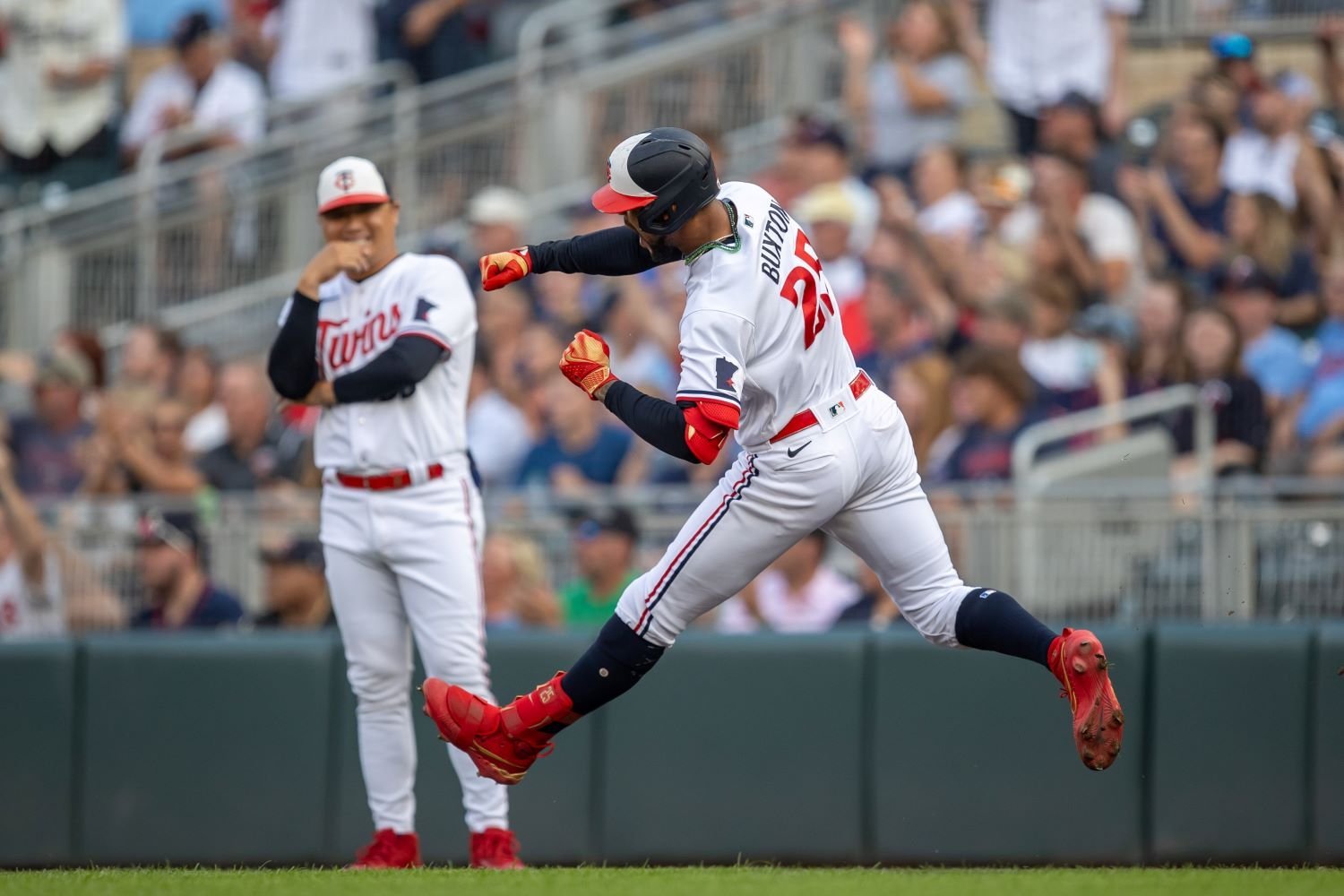 In a perfect world, Byron Buxton would have played at an All-Star level for his entire career by avoiding injuries and producing in all facets of the game. After he was drafted with the second overall pick in 2012, Buxton's journey to stardom was riddled with setbacks and challenges that tested his resolve and the faith of those who believed in him. There have been stretches where he has been baseball’s best hitter, and times when his body failed him. It can be challenging for fans to grasp his true value. Buxton has carried the weight of expectations from a fanbase hungry for success. The Twins placed their faith and resources into Buxton, signing him to a seven-year, $100 million contract extension. Many questioned the decision (and continue to question it), citing Buxton's injury history and inconsistent performance. Yet, those who truly understood the game saw beyond the statistics; they saw a player whose potential transcended mere numbers. After undergoing an arthroscopic procedure to excise the plica (a membrane flap) in his right knee, Buxton entered the season with renewed optimism. In April, he posted a .678 OPS with 10 extra-base hits in 27 games. His offensive performance was below his output in recent years, and he racked up a 32-to-3 strikeout-to-walk ratio in 99 plate appearances. Buxton was providing value by playing more regularly in center field while showing his speed on the bases. However, it was a different style of player than last season, when he was relegated to DH duties. In May, Buxton made small strides at the plate, raising his OPS 74 points in 43 plate appearances. He missed 14 games with inflammation in his right knee, a disheartening injury based on his recent history. Buxton failed to produce offensively, and another trip to the IL gave more ammunition to his detractors. It was easy to imagine a scenario whereby Buxton returns and struggles to produce on either side of the ball. Instead, he’s shown his actual value in recent weeks. Since Jun. 7, Buxton has gone 24-for-70 (.343), with five doubles, one triple, and five home runs. He homered four times in the last six games, fueling a career-long stretch wherein he drove in at least one run in six straight games. His OPS for the season ranks among the league leaders in center field. His sprint speed continues to be elite (98th percentile), helping him be one of the game’s best defenders in that spot. He ranks in the 85th percentile or higher in fielding run value, OAA, arm strength, and arm value. Buxton is one of the best baseball players on the planet when he is healthy. Last season, Buxton struggled through his knee injury, attempting to provide the Twins with value from the DH spot. FanGraphs pegged him as being worth $5 million. In 2024, he has already been worth $14.1 million, and the season is only a little over half over. Minnesota has paid him $51 million to this point in his career, and Buxton has provided the Twins with nearly $163 million in total value. Buxton is living up to his contract, even if his performance declines in the second half. There are limits to what a team can get with $15 million per season on the market these days, and the Twins can get plenty of excess value when Buxton is playing at his current level. But it wasn't just his value that endeared him to fans and teammates alike; it was his unwavering humility and determination. Buxton never sought the spotlight or craved accolades. Instead, he let his performance on the field speak for itself, earning the respect of the competition. His leadership extends beyond the diamond, where he mentors younger players and serves as a role model for aspiring athletes in the community. Buxton and the Twins knew that his contract extension was not just a financial investment, but a testament to the power of perseverance. For the organization and its fans, he was more than just a player. He symbolized hope, and a reminder that greatness could be achieved with unwavering dedication and belief. He has been the Twins' symbol of intensified, concentrated greatness, in the face of occasionally career-threatening adversity. Will Buxton provide the Twins with $100 million of value during the life of his contract, for your money? Leave a comment and start the discussion.
 -
The Twins have taken different approaches to recent trade deadlines, and reviewing the front office’s plans might help us understand the team’s 2024 deadline path. Image courtesy of Gary A. Vasquez-USA TODAY Sports The Twins have taken different approaches to recent trade deadlines, and reviewing the front office’s plans might help us understand the team’s 2024 deadline path. Every baseball fan base wants their team to make a splash at the trade deadline by making moves viewed as going "all in" for a World Series run. Can the club add a front-line starting pitcher to anchor a rotation? Is there a way to acquire a dominant late-inning bullpen arm? Or can they find a potent bat to insert into the middle of the lineup? Unfortunately, only one team walks away a winner at the end of October, and baseball’s playoffs can be a bit of a crapshoot. So, what have Derek Falvey and Thad Levine done at recent trade deadlines when the team has been in contention? 2023 Trade Deadline: The Twins had a quiet trade deadline last season with a strategy to rely on internal players to fit the team’s needs. Minnesota’s lone move last year was to trade Jorge López for Dylan Floro in what was considered a change-of-scenery trade for both bullpen arms. Minnesota relied on the returns of Royce Lewis, Brock Stewart, and Chris Paddack to bolster multiple parts of the roster. Minnesota tested the waters on some more prominent trade deadline names, but the cost was too high, and the team decided to stand pat. Additions: Floro Subtractions: López Grade: C. There were moves that could have better prepared the team for playoff success. 2022 Trade Deadline: Minnesota Twins fans will have a tough time forgetting the 2022 trade deadline, but it was this front office being as aggressive as possible. On the day of the trade deadline, the Twins made four deals to bring in starting pitcher Tyler Mahle, relievers Jorge López and Michael Fulmer, and backup catcher Sandy León. It cost the Twins eight prospects, including some prospects who have already started to provide big-league value. It didn’t work out, with the Twins finishing six games below .500 and the Mahle and López deals aging poorly. Additions: Mahle, López, Fulmer, León Subtractions: Christian Encarnacion-Strand, Spencer Steer, Steve Hajjar, Cade Povich, Yennier Cano, Juan Rojas, Juan Nunez, Sawyer Gipson-Long, Ian Hamilton Grade: F. These moves didn’t help the Twins to win in 2022 and hurt the team’s long-term outlook. 2020 Trade Deadline: The 2020 trade deadline was pushed back to the end of August because of the shortened season. Minnesota sat five games above .500 and in third place in the AL Central. During that season, the playoffs were expanded, so the team was still a lock to make the playoffs. Falvey and Levine decided against making any additions, which was warranted because of the strange nature of that season. Grade: N/A. Adding a new player who must travel and quarantine before joining the group seems like a mess. 2019 Trade Deadline: The Bomba Squad was making waves prior to the trade deadline, so the front office wanted to supplement a strong offensive lineup. Sergio Romo was a perfect addition to the team as he helped bolster the bullpen. In 27 games, he posted a 3.18 ERA with a 0.93 WHIP and 10.7 K/9. The front office liked him so much that they re-signed him for the 2020 season. Sam Dyson was the complete opposite of Romo. He pitched poorly after the deal, with a 7.15 ERA in 11 appearances. It was later revealed that he had been dealing with a shoulder injury since earlier in the season. He was shut down in September and had off-season surgery. Eventually, MLB suspended him for allegedly abusing his girlfriend. Additions: Romo, Vallimont, Dyson Subtractions: Lewin Diaz, Jaylin Davis, Perlander Berroa, Kai-Wei Tang Grade: C. The Romo trade was an A, and the Dyson trade was an F. Overall, the Romo trade is the lone deal that worked out in favor of the club. Mahle and López were aggressive acquisitions because the front office believed in the roster and wanted to push their chips to the middle. Unfortunately, both players pitched poorly with the Twins and didn’t help the club make an extended playoff run. Other moves have been inconsequential. The trade deadline can push a contending team over the top, but the Twins’ front office grades poorly when making deadline trades. Will the Twins payroll crunch force the front office to be creative at the trade deadline? Will they make a significant move? Leave a COMMENT and start the discussion. View full article
-
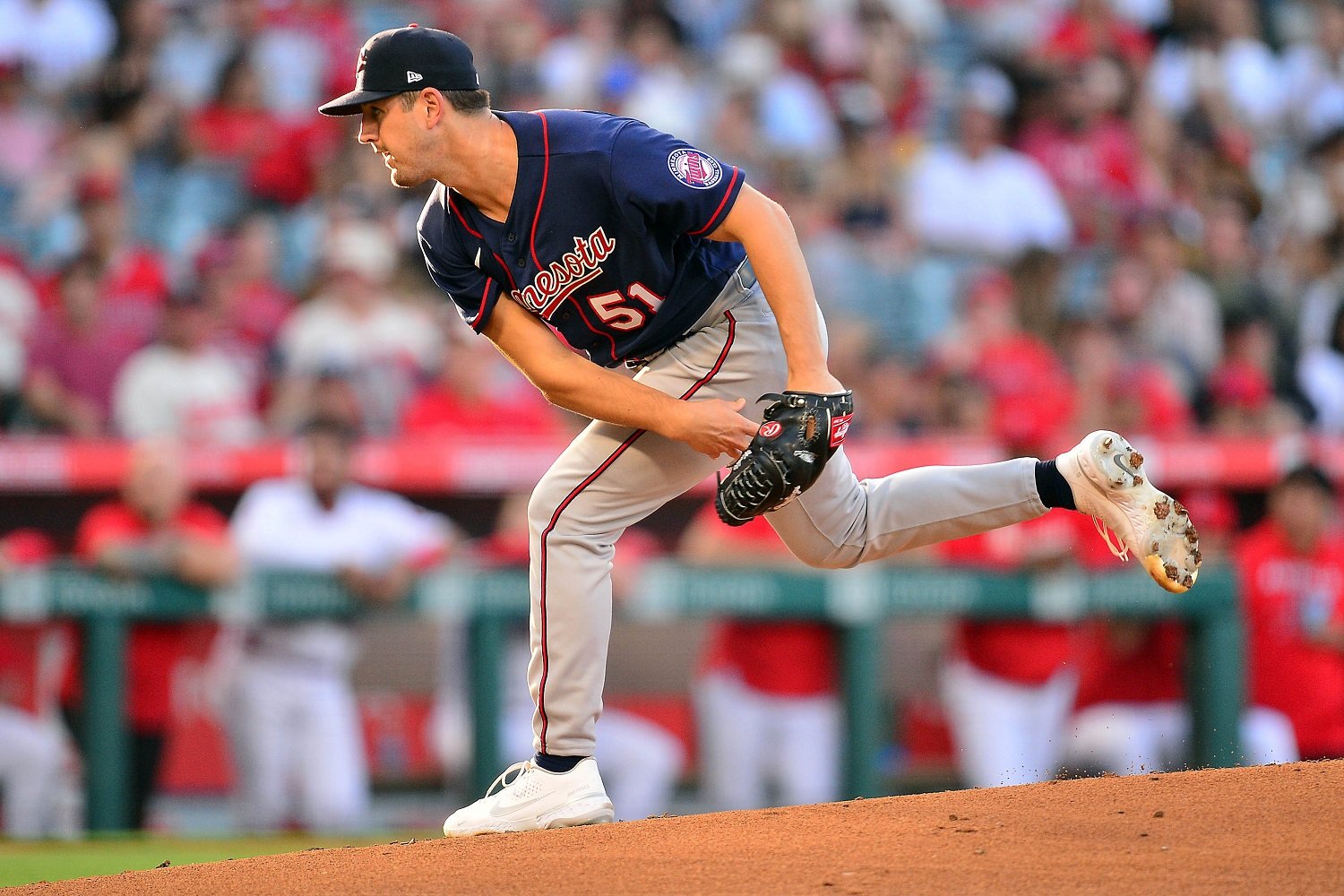 Every baseball fan base wants their team to make a splash at the trade deadline by making moves viewed as going "all in" for a World Series run. Can the club add a front-line starting pitcher to anchor a rotation? Is there a way to acquire a dominant late-inning bullpen arm? Or can they find a potent bat to insert into the middle of the lineup? Unfortunately, only one team walks away a winner at the end of October, and baseball’s playoffs can be a bit of a crapshoot. So, what have Derek Falvey and Thad Levine done at recent trade deadlines when the team has been in contention? 2023 Trade Deadline: The Twins had a quiet trade deadline last season with a strategy to rely on internal players to fit the team’s needs. Minnesota’s lone move last year was to trade Jorge López for Dylan Floro in what was considered a change-of-scenery trade for both bullpen arms. Minnesota relied on the returns of Royce Lewis, Brock Stewart, and Chris Paddack to bolster multiple parts of the roster. Minnesota tested the waters on some more prominent trade deadline names, but the cost was too high, and the team decided to stand pat. Additions: Floro Subtractions: López Grade: C. There were moves that could have better prepared the team for playoff success. 2022 Trade Deadline: Minnesota Twins fans will have a tough time forgetting the 2022 trade deadline, but it was this front office being as aggressive as possible. On the day of the trade deadline, the Twins made four deals to bring in starting pitcher Tyler Mahle, relievers Jorge López and Michael Fulmer, and backup catcher Sandy León. It cost the Twins eight prospects, including some prospects who have already started to provide big-league value. It didn’t work out, with the Twins finishing six games below .500 and the Mahle and López deals aging poorly. Additions: Mahle, López, Fulmer, León Subtractions: Christian Encarnacion-Strand, Spencer Steer, Steve Hajjar, Cade Povich, Yennier Cano, Juan Rojas, Juan Nunez, Sawyer Gipson-Long, Ian Hamilton Grade: F. These moves didn’t help the Twins to win in 2022 and hurt the team’s long-term outlook. 2020 Trade Deadline: The 2020 trade deadline was pushed back to the end of August because of the shortened season. Minnesota sat five games above .500 and in third place in the AL Central. During that season, the playoffs were expanded, so the team was still a lock to make the playoffs. Falvey and Levine decided against making any additions, which was warranted because of the strange nature of that season. Grade: N/A. Adding a new player who must travel and quarantine before joining the group seems like a mess. 2019 Trade Deadline: The Bomba Squad was making waves prior to the trade deadline, so the front office wanted to supplement a strong offensive lineup. Sergio Romo was a perfect addition to the team as he helped bolster the bullpen. In 27 games, he posted a 3.18 ERA with a 0.93 WHIP and 10.7 K/9. The front office liked him so much that they re-signed him for the 2020 season. Sam Dyson was the complete opposite of Romo. He pitched poorly after the deal, with a 7.15 ERA in 11 appearances. It was later revealed that he had been dealing with a shoulder injury since earlier in the season. He was shut down in September and had off-season surgery. Eventually, MLB suspended him for allegedly abusing his girlfriend. Additions: Romo, Vallimont, Dyson Subtractions: Lewin Diaz, Jaylin Davis, Perlander Berroa, Kai-Wei Tang Grade: C. The Romo trade was an A, and the Dyson trade was an F. Overall, the Romo trade is the lone deal that worked out in favor of the club. Mahle and López were aggressive acquisitions because the front office believed in the roster and wanted to push their chips to the middle. Unfortunately, both players pitched poorly with the Twins and didn’t help the club make an extended playoff run. Other moves have been inconsequential. The trade deadline can push a contending team over the top, but the Twins’ front office grades poorly when making deadline trades. Will the Twins payroll crunch force the front office to be creative at the trade deadline? Will they make a significant move? Leave a COMMENT and start the discussion.
- 31 comments
-
- 4
-
-
- tyler mahle
- sergio romo
- (and 3 more)
-
Two Former Top-100 Prospects Proving Baseball Development is Rarely Linear
Cody Christie posted an article in Twins
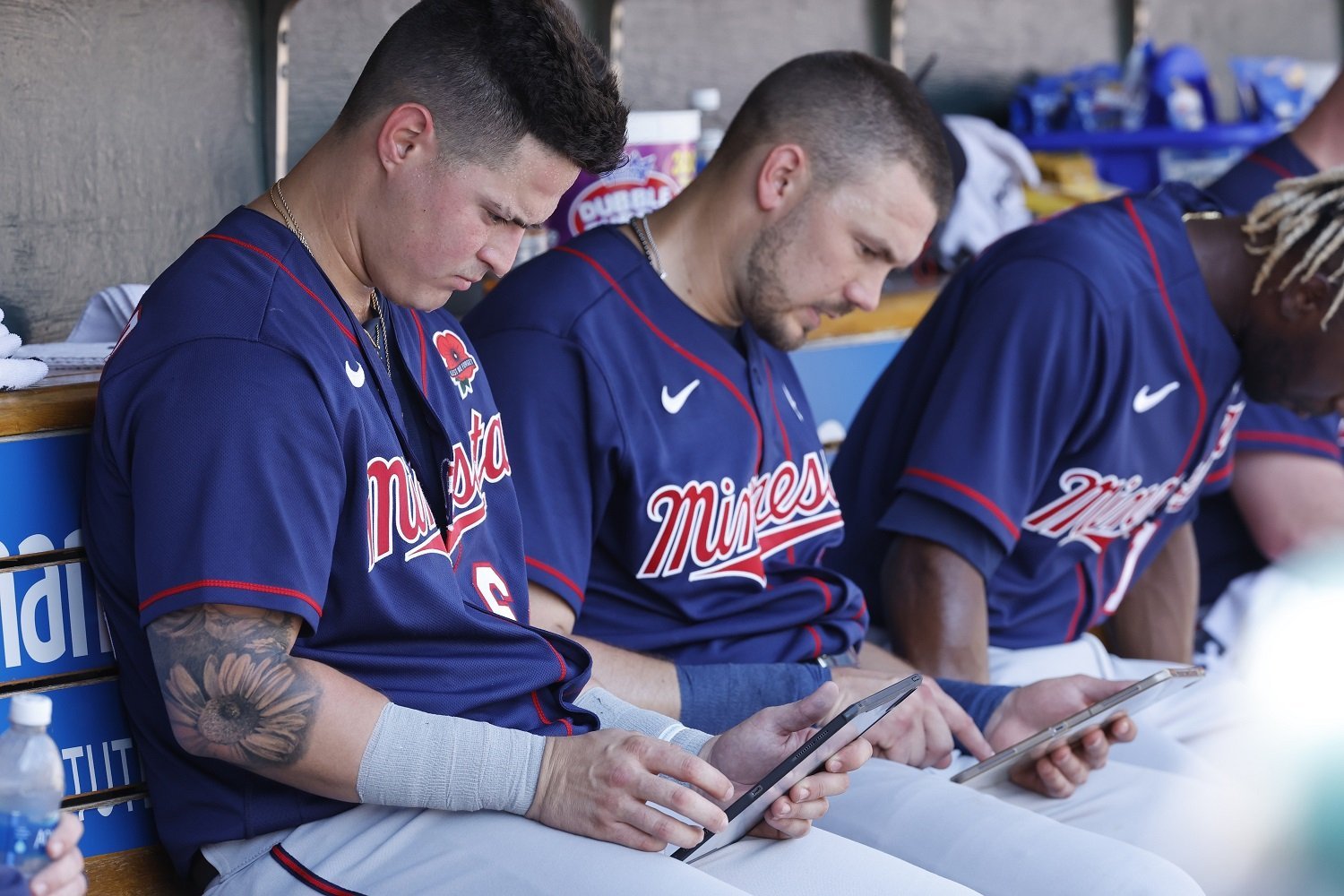 Every team would love for their top prospects to make a splash during their big-league debut and go on to have a 15-year Hall of Fame career. Unfortunately, multiple obstacles can hinder a player’s development throughout their professional career. Fans want players to be instant superstars, but organizations must be patient in helping players overcome obstacles put in a player’s path. Twins fans are getting an up-close-and-personal view of this playing out in the organization. Minnesota expected the trio of Edouardo Julien, Matt Wallner, and Alex Kirilloff to be contributing to the big-league roster. Instead, all three players are at Triple-A, trying to rediscover their offensive approach. Two other young hitters have seen their fair share of struggles in recent seasons, but positive signs in 2024 have them trending back in a positive direction. Trevor Larnach, OF The Twins drafted Larnach with the 20th overall pick in the 2018 MLB Draft from Oregon State University, where his powerful swing helped his team win the College World Series. It was the first time since 1969 that Minnesota selected a collegiate outfielder with their first pick in the MLB Draft. At the time, the Twins had plenty of positive things to say about him as they were drawn to him by his high exit velocities in college. "He's definitely a corner outfielder and we think he throws enough and moves enough to play right," scouting director Sean Johnson said. "This is really about an offensive player with upside and power." Previous Obstacles: Larnach has dealt with multiple injuries during his professional career, including a turf toe, a double core muscle injury, a wrist injury, and groin soreness. His time at the big-league level continued to be interrupted by injuries while mixing in some poor performance. Injuries played a part in his lackluster overall production because he attempted to play through bumps and bruises, impacting him on both sides of the ball. 2024 Recap: Historically, Larnach struggled to hit offspeed and breaking pitches which caused the Twins to demote him last season. In 2024, he is seeing fastballs less regularly (down 8%) and offspeed pitches more often (up 10%). Last year, he posted a .150 SLG against offspeed pitches and raised that to a .321 SLG so far this season. He’s also dropped his Whiff% on breaking pitches (down 21.9%) and offspeed pitches (down 7.8%). Larnach will likely never be an above-average hitter versus non-fastballs, but he’s made incremental improvements. Pitchers can’t throw him slop and retire him as easily as in previous seasons. José Miranda, INF The Twins drafted Miranda in the second round of the 2016 MLB Draft (73rd overall) out of high school in Puerto Rico. MLB Pipeline didn’t have him ranked among the top available prospects in the draft, but the Twins were happy with the signing at the time. "He has a really good swing," Twins scouting director Deron Johnson said. "He's aggressive. We're going to send him out as a shortstop, but realistically, he's probably a third baseman. But he's a really good player and really skilled." Previous Obstacles: Miranda was set to be a regular for the 2023 Twins before a shoulder injury in spring training slowed him down. He attempted to play through the injury and struggled to produce offensively. In 40 games, he posted a 57 OPS+ with a 15.8 K%. Defensively, the Twins couldn’t use him at third base because of his shoulder issues. Other players passed him by on the organizational depth chart, so he had much to prove for the 2024 campaign. 2024 Recap: Miranda entered play this weekend with a 124 OPS+, ten points higher than his OPS+ from his rookie season. He makes consistent contact with a Whiff% and K% in the 70th percentile or higher. There have been multiple areas of growth for him in 2024, including career-high totals in Barrel % (7.4), Barrel/PA (5.9), and Launch Angle (15.7). His base running value has also made significant jumps despite being a slower runner. During his rookie season, his base running value sat in the 34th percentile, and he’s increased that to the 72nd percentile this season. Miranda is finding ways to be an above-average regular, which adds tremendous value. Miranda and Larnach might never become All-Stars, but both have an opportunity to be above-average regulars at the big-league level. Teams need players like this to stay competitive and complete a roster. They were once viewed as top-100 prospects, and their path to regulars has seen some obstacles. Still, they are positively contributing to the 2024 Twins, and other players can follow in their footsteps. How have your expectations changed for Larnach and Miranda? Which player will have the most significant impact on the club in future years? Leave a COMMENT and start the discussion.
 -
Minnesota’s front office has received criticism for acquiring pitchers who have quickly ended up on the injured list. Does targeting a currently injured pitcher before the MLB trade deadline make sense? Image courtesy of © Darren Yamashita-USA TODAY Sports Minnesota’s front office has received criticism for acquiring pitchers who have quickly ended up on the injured list. Does targeting a currently injured pitcher before the MLB trade deadline make sense? Injuries are part of the baseball landscape, especially for pitchers who continue to push the limits of how hard pitches can be thrown while increasing spin rates. Minnesota’s current front office has tended to trade for injured pitchers or injury-prone players who lived up to that reputation immediately after arriving. Anthony DeSclafani (0 appearances), Sam Dyson (12 appearances), Chris Paddack (five appearances), and Tyler Mahle (9 appearances) all were limited after being acquired by the current regime. It’s time for the front office to double down and find another injured pitcher to add to the team for the second half. I wrote about why the Twins continue acquiring injured pitchers during spring training. Some of those reasons include increased pitching injuries across the baseball landscape and the front office's valuation of the team’s top prospects. At the trade deadline, these reasons remain true, and the names below might come at a discounted price because of their current injury situations. Blake Snell, Giants Injury: Groin Snell sustained a groin injury during his June 2 start versus the New York Yankees and was placed on the IL the next day. The reigning NL Cy Young winner had a tumultuous offseason searching for a long-term deal before signing a two-year, $62 million deal with the Giants. There is an opt-out after the 2024 season. Snell has made six starts this season and allowed 25 earned runs in 23 2/3 innings. San Francisco sits below .500 and has multiple teams ahead of them in the Wild Card standings. Snell has expressed frustration with the Giants wanting him to rush back and help the big-league team. A change of scenery may help Snell to regain his previous form. Justin Verlander, Astros Injury: Neck Verlander went on the 15-day IL in the middle of June after trying to pitch through a neck issue. The three-time AL Cy Young winner also missed the season’s start due to inflammation in his right shoulder. In ten starts this season, he has posted a 3.95 ERA with a 1.21 WHIP, a 21.3 K%, and a 7.1 BB%. Houston struggled to start the year and has slowly crawled back to .500. The Twins, Royals, and Red Sox sit ahead of the Astros in the Wild Card standings. Houston hasn’t missed the playoff since 2016, and the team has been in the ALCS for seven consecutive years. Verlander would need to agree to a trade, and it seems unlikely for the Astros to be sellers, but a poor stretch in July might force their hand. Alex Cobb, Giants Injury: Hip, Shoulder Cobb underwent hip labrum surgery in November and has been dealing with shoulder soreness in recent weeks. He had an MRI on the shoulder, and there was no structural damage, so the Giants gave him a cortisone shot. Cobb is starting to throw live bullpens, which should put him closer to making a rehab start if everything goes as planned. He would need to get into game action and prove his splitter is back for a team to take a chance on him. That said, Cobb has a chance to be a playoff-caliber starter and might come at a lower cost than some of the other names on this list. Paul Blackburn, A’s Injury: Foot Blackburn has a stress reaction in the fifth metatarsal of his right foot and has been on the IL since mid-May. He made eight starts this season and posted a 4.11 ERA with a 1.15 WHIP. Over the last three seasons, he has been a mid-rotation starter with a 91 ERA+, 7.9 K/9, and 3.0 BB/9. Blackburn is also intriguing because he is still arbitration-eligible next season, which means he likely comes at a higher cost. At this point, he might not be an upgrade over some of the Twins’ internal options. However, the front office values depth and acquiring Blackburn would add depth through the end of next season. The Twins acquired a playoff-caliber starter with questionable health in the form of Tyler Mahle, but fans may have PTSD because of how poorly it went for the club. At this year's deadline, it seems unlikely that Minnesota will be in the market for some of the bigger-named starting pitchers like Chicago’s Garrett Crochet and Detroit’s Jack Flaherty since they currently play on AL Central rivals. This will leave the front office searching for other options, including some of the names listed above. With injury risk, there can be reward or discontent. The Twins can hope for more positive results by acquiring one of these starting pitchers. Should the Twins trade for a pitcher with a recent injury? Leave a COMMENT and start the discussion. View full article
- 28 replies
-
- 1
-
-
- blake snell
- justin verlander
- (and 2 more)
-
 Injuries are part of the baseball landscape, especially for pitchers who continue to push the limits of how hard pitches can be thrown while increasing spin rates. Minnesota’s current front office has tended to trade for injured pitchers or injury-prone players who lived up to that reputation immediately after arriving. Anthony DeSclafani (0 appearances), Sam Dyson (12 appearances), Chris Paddack (five appearances), and Tyler Mahle (9 appearances) all were limited after being acquired by the current regime. It’s time for the front office to double down and find another injured pitcher to add to the team for the second half. I wrote about why the Twins continue acquiring injured pitchers during spring training. Some of those reasons include increased pitching injuries across the baseball landscape and the front office's valuation of the team’s top prospects. At the trade deadline, these reasons remain true, and the names below might come at a discounted price because of their current injury situations. Blake Snell, Giants Injury: Groin Snell sustained a groin injury during his June 2 start versus the New York Yankees and was placed on the IL the next day. The reigning NL Cy Young winner had a tumultuous offseason searching for a long-term deal before signing a two-year, $62 million deal with the Giants. There is an opt-out after the 2024 season. Snell has made six starts this season and allowed 25 earned runs in 23 2/3 innings. San Francisco sits below .500 and has multiple teams ahead of them in the Wild Card standings. Snell has expressed frustration with the Giants wanting him to rush back and help the big-league team. A change of scenery may help Snell to regain his previous form. Justin Verlander, Astros Injury: Neck Verlander went on the 15-day IL in the middle of June after trying to pitch through a neck issue. The three-time AL Cy Young winner also missed the season’s start due to inflammation in his right shoulder. In ten starts this season, he has posted a 3.95 ERA with a 1.21 WHIP, a 21.3 K%, and a 7.1 BB%. Houston struggled to start the year and has slowly crawled back to .500. The Twins, Royals, and Red Sox sit ahead of the Astros in the Wild Card standings. Houston hasn’t missed the playoff since 2016, and the team has been in the ALCS for seven consecutive years. Verlander would need to agree to a trade, and it seems unlikely for the Astros to be sellers, but a poor stretch in July might force their hand. Alex Cobb, Giants Injury: Hip, Shoulder Cobb underwent hip labrum surgery in November and has been dealing with shoulder soreness in recent weeks. He had an MRI on the shoulder, and there was no structural damage, so the Giants gave him a cortisone shot. Cobb is starting to throw live bullpens, which should put him closer to making a rehab start if everything goes as planned. He would need to get into game action and prove his splitter is back for a team to take a chance on him. That said, Cobb has a chance to be a playoff-caliber starter and might come at a lower cost than some of the other names on this list. Paul Blackburn, A’s Injury: Foot Blackburn has a stress reaction in the fifth metatarsal of his right foot and has been on the IL since mid-May. He made eight starts this season and posted a 4.11 ERA with a 1.15 WHIP. Over the last three seasons, he has been a mid-rotation starter with a 91 ERA+, 7.9 K/9, and 3.0 BB/9. Blackburn is also intriguing because he is still arbitration-eligible next season, which means he likely comes at a higher cost. At this point, he might not be an upgrade over some of the Twins’ internal options. However, the front office values depth and acquiring Blackburn would add depth through the end of next season. The Twins acquired a playoff-caliber starter with questionable health in the form of Tyler Mahle, but fans may have PTSD because of how poorly it went for the club. At this year's deadline, it seems unlikely that Minnesota will be in the market for some of the bigger-named starting pitchers like Chicago’s Garrett Crochet and Detroit’s Jack Flaherty since they currently play on AL Central rivals. This will leave the front office searching for other options, including some of the names listed above. With injury risk, there can be reward or discontent. The Twins can hope for more positive results by acquiring one of these starting pitchers. Should the Twins trade for a pitcher with a recent injury? Leave a COMMENT and start the discussion.
- 28 comments
-
- 2
-
-
- blake snell
- justin verlander
- (and 2 more)
-
 The Twins reached the halfway point of the season on Thursday with a 45-36 record. On pace for 90 wins, the Twins are ahead of last year’s 87-win pace and outpacing their pre-season projections. Minnesota started the year in a miserable 7-13 slump but has turned things around in a big way. Since the rough start, Minnesota has played at a 101-win pace while leading the American League in wins (38) and runs scored (325). It’s been a first half full of slumps and streaks, but the Twins are on pace for a playoff spot for the second straight season. First-Half MVP: Willi Castro, UTL Honorable Mentions: Carlos Correa, Ryan Jeffers, Royce Lewis, Joe Ryan Castro has stood out above the crowd on a team with multiple former All-Stars and multi-million dollar players. Baseball-Reference ranks him second on the team in WAR, while FanGraphs has him as the team’s top player. His value has multiple layers because of his defensive flexibility. He’s joined a small club of players who have amassed 20 or more games in left field, center field, third base, and shortstop in the same season. His 133 OPS+ is 25 points higher than last season, and he’s already compiled a career-high in WAR. Correa’s hot stretch in recent weeks has put him in the MVP conversation, and Lewis is quickly moving up the list, but Castro has impacted the Twins in every facet of the game. First Half Top Pitcher: Joe Ryan, SP Honorable Mentions: Griffin Jax, Simeon Woods Richardson, Jorge Alcala Many hoped that Ryan could take the next step this season, and he has lived up to those expectations. Among the team’s pitchers, he ranks first in rWAR and fWAR. In 16 starts, Ryan has posted a 3.31 ERA with a 0.96 WHIP and a 26.1 K%. Other members of the starting staff have struggled through different parts of the season, but Ryan has been a steadying presence nearly every time he takes the mound. An argument can be made that Jax is the team’s top pitcher of the first half because the rest of the bullpen has seen inconsistent performance. However, Ryan deserves the nod over other potential candidates. First Half ROY: Simeon Woods Richardson, SP Honorable Mentions: Austin Martin The Twins have only seen a handful of rookie players impact the roster meaningfully. Woods Richardson was expected to spend most of the first half in St. Paul after struggling through the 2023 campaign. Instead, Minnesota needed him to step into Louie Varland’s rotation spot, and he ran with the opportunity. In 13 starts (66 innings), SWR has posted a 3.41 ERA with a 1.14 WHIP and a 20.5 K%. Ryan is the only pitcher with a higher rWAR and Woods Richardson ranks third according to fWAR. He made changes to his mechanics this winter, upgrading his pitch mix and making him more effective. Martin has fit an essential role with the Twins but hasn’t provided nearly as much value as Woods Richardson. First Half LVP: Christian Vázquez, C Honorable Mentions: Kyle Farmer, Edouard Julien, Alex Kirilloff, Jay Jackson Minnesota’s slow start saw poor performances throughout the lineup, but many players have turned it around. Unfortunately, other players have been demoted to Triple-A to rediscover their offensive approach or see their role change at the big-league level. Vázquez has the team’s lowest WPA (-1.5), more than double the next lowest hitter (Farmer, -0.66 WPA). FanGraphs ranks him as the team’s second lowest position player according to WAR behind Kirilloff. Defensively, he continues to rank among the AL’s top catchers, and that’s one of the biggest reasons the Twins have stuck with him to this point. Who would make your ballot? Would you change any of the above award winners? Leave a COMMENT and start the discussion.
- 56 comments
-
- 11
-
-
- willi castro
- joe ryan
- (and 5 more)
-
MLB’s 2024 season is over half done, so it’s time to hand out some first-half hardware. Who is the team’s MVP, Top Pitcher, Rookie of the Year, and LVP? Image courtesy of © Matt Krohn-USA TODAY Sports MLB’s 2024 season is over half done, so it’s time to hand out some first-half hardware. Who is the team’s MVP, Top Pitcher, Rookie of the Year, and LVP? The Twins reached the halfway point of the season on Thursday with a 45-36 record. On pace for 90 wins, the Twins are ahead of last year’s 87-win pace and outpacing their pre-season projections. Minnesota started the year in a miserable 7-13 slump but has turned things around in a big way. Since the rough start, Minnesota has played at a 101-win pace while leading the American League in wins (38) and runs scored (325). It’s been a first half full of slumps and streaks, but the Twins are on pace for a playoff spot for the second straight season. First-Half MVP: Willi Castro, UTL Honorable Mentions: Carlos Correa, Ryan Jeffers, Royce Lewis, Joe Ryan Castro has stood out above the crowd on a team with multiple former All-Stars and multi-million dollar players. Baseball-Reference ranks him second on the team in WAR, while FanGraphs has him as the team’s top player. His value has multiple layers because of his defensive flexibility. He’s joined a small club of players who have amassed 20 or more games in left field, center field, third base, and shortstop in the same season. His 133 OPS+ is 25 points higher than last season, and he’s already compiled a career-high in WAR. Correa’s hot stretch in recent weeks has put him in the MVP conversation, and Lewis is quickly moving up the list, but Castro has impacted the Twins in every facet of the game. First Half Top Pitcher: Joe Ryan, SP Honorable Mentions: Griffin Jax, Simeon Woods Richardson, Jorge Alcala Many hoped that Ryan could take the next step this season, and he has lived up to those expectations. Among the team’s pitchers, he ranks first in rWAR and fWAR. In 16 starts, Ryan has posted a 3.31 ERA with a 0.96 WHIP and a 26.1 K%. Other members of the starting staff have struggled through different parts of the season, but Ryan has been a steadying presence nearly every time he takes the mound. An argument can be made that Jax is the team’s top pitcher of the first half because the rest of the bullpen has seen inconsistent performance. However, Ryan deserves the nod over other potential candidates. First Half ROY: Simeon Woods Richardson, SP Honorable Mentions: Austin Martin The Twins have only seen a handful of rookie players impact the roster meaningfully. Woods Richardson was expected to spend most of the first half in St. Paul after struggling through the 2023 campaign. Instead, Minnesota needed him to step into Louie Varland’s rotation spot, and he ran with the opportunity. In 13 starts (66 innings), SWR has posted a 3.41 ERA with a 1.14 WHIP and a 20.5 K%. Ryan is the only pitcher with a higher rWAR and Woods Richardson ranks third according to fWAR. He made changes to his mechanics this winter, upgrading his pitch mix and making him more effective. Martin has fit an essential role with the Twins but hasn’t provided nearly as much value as Woods Richardson. First Half LVP: Christian Vázquez, C Honorable Mentions: Kyle Farmer, Edouard Julien, Alex Kirilloff, Jay Jackson Minnesota’s slow start saw poor performances throughout the lineup, but many players have turned it around. Unfortunately, other players have been demoted to Triple-A to rediscover their offensive approach or see their role change at the big-league level. Vázquez has the team’s lowest WPA (-1.5), more than double the next lowest hitter (Farmer, -0.66 WPA). FanGraphs ranks him as the team’s second lowest position player according to WAR behind Kirilloff. Defensively, he continues to rank among the AL’s top catchers, and that’s one of the biggest reasons the Twins have stuck with him to this point. Who would make your ballot? Would you change any of the above award winners? Leave a COMMENT and start the discussion. View full article
-
The Twins’ current front office regime is starting to see the results of their drafting and development process. One prospect outside the team’s top-20 rankings deserves more attention in the season’s second half. Image courtesy of Ed Bailey, Wichita Wind Surge The Twins’ current front office regime is starting to see the results of their drafting and development process. One prospect outside the team’s top-20 rankings deserves more attention in the season’s second half. Andrew Morris began his college career at Colorado Mesa University, a Division II school. During his freshman season, as a 17-year-old, Morris helped his team to the championship game. He put himself on the map with a solid junior season when he posted a 2.19 ERA with a 1.18 WHIP and 115-to-19 strikeout-to-walk ratio in 78 innings. Texas Tech recruited him to Lubbock for his senior season, where he tossed 88 1/3 innings with the Red Raiders with a 4.58 ERA and a 1.22 WHIP. Big league teams started to notice Morris because Texas Tech had multiple draft prospects in their rotation. The Twins selected Morris in the fourth round of the 2022 MLB Draft and signed him for $500,000. After signing, he made one brief appearance with the FCL Twins, but his first extended professional action came during the 2023 campaign. Minnesota assigned him to Fort Myers, where he was over a year younger than the average age of the competition. In 48 2/3 innings, he posted a 2.59 ERA with a 1.05 WHIP and 9.4 K/9. He pitched into the fifth inning In seven of his 11 appearances and had two walks or fewer in each start. Morris had proven himself at Low-A, so the Twins promoted him to Cedar Rapids at the end of July. His first start for the Kernels went poorly, as he allowed four runs on ten hits in five innings. Over his next five starts (27 innings), he combined for a 2.00 ERA while holding opponents to a .663 OPS. The Kernels were heading to the playoffs, and Morris showed up with a strong pitching performance. He fanned seven while giving up one run on three hits without a walk in five frames. Cedar Rapids went on to win the championship, a first for the club since 1994. Minnesota sent Morris back to Cedar Rapids to begin the 2024 season, and he picked up right where he had left off. He allowed two runs or fewer in six of his seven starts while averaging over five innings per appearance. His last four starts proved to the Twins that he was ready to be promoted. In 24 innings, he allowed three earned runs (1.13 ERA) while holding batters to a .209/.242/.242 (.484) slash line. Morris also continued to pound the strike zone with a 71 strike % and only four walks. Moving up to Double-A can be one of the most challenging transitions in a farm system, but Morris has made it look easy. In seven games, he has a 1.41 ERA with a 4.0 BB% while touching 97 mph with his fastball. His fastball has good movement so that the pitch can be deceptive to batters. His slider hits in the upper 80s and can be used to miss bats from lefties and righties. He rounds out his pitch mix with a slow curveball and a changeup that both coax ground balls from the opposition. It’s easy to see from Morris’ delivery why he is effective on the mound. He tilts his shoulder and has an over-the-top delivery that causes some deception for batters. Morris has been known as a strike-thrower since his amateur days, and that trend has continued throughout his professional career. Some evaluators pointed to his strikeout rate as something to improve this season, and he’s met those expectations. Last season, he posted a 17.8 K% with Cedar Rapids, raising that by 10% this year. He’s continued those improvements at Double-A with a 24.0 K%. Morris is another developmental story to watch, especially as he gets closer to the big leagues. He’s made improvements since signing with the organization, including upticks with his velocity, an increase in his strikeout rate, and an improvement in his overall command. Other pitchers currently rank higher than him on the team’s prospect rankings, but a solid finish to the season will put him in the top 10. Is Morris one of the Twins’ top-20 prospects? Is he someone the club would be willing to trade before the trade deadline? Leave a COMMENT and start the discussion. View full article
-
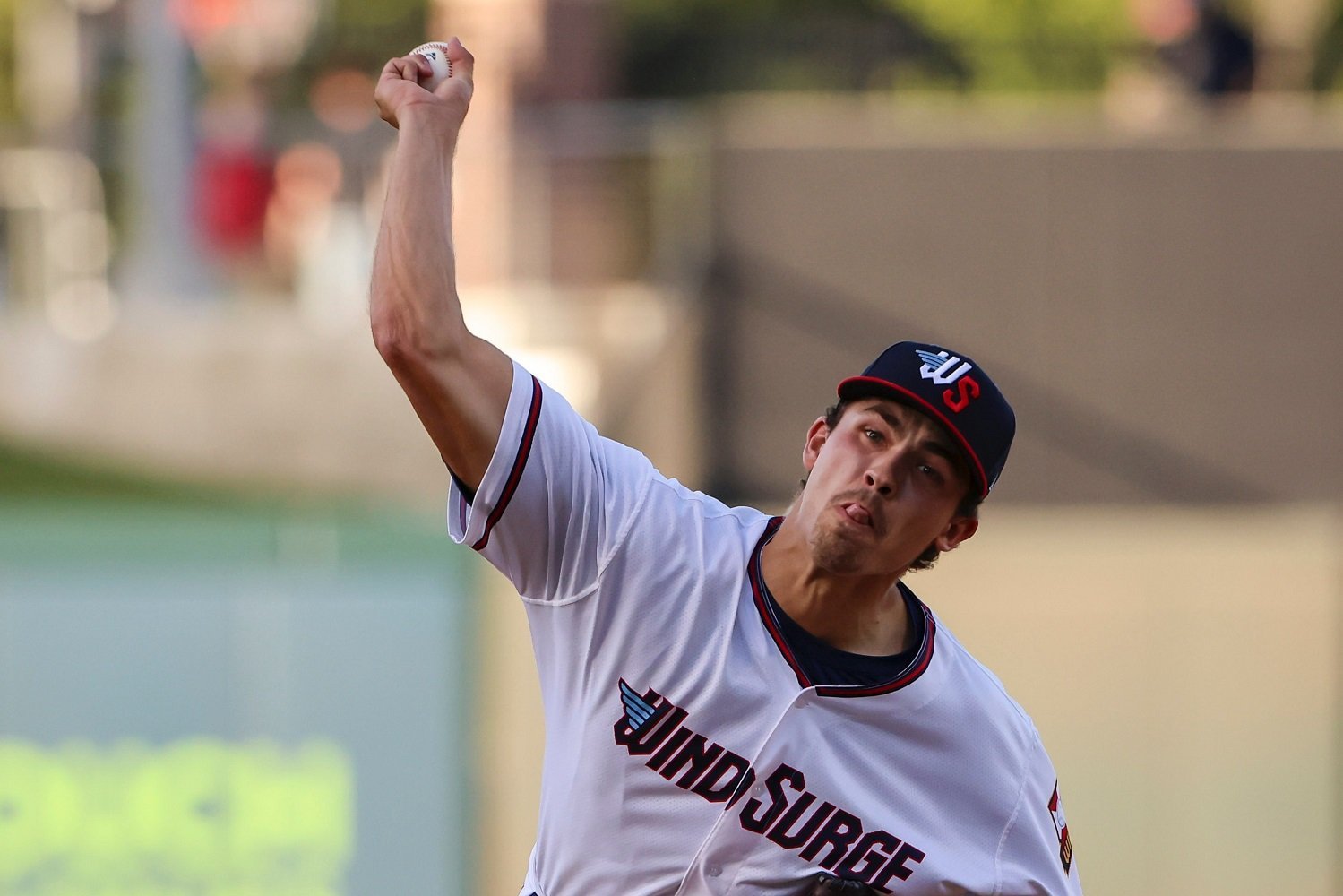 Andrew Morris began his college career at Colorado Mesa University, a Division II school. During his freshman season, as a 17-year-old, Morris helped his team to the championship game. He put himself on the map with a solid junior season when he posted a 2.19 ERA with a 1.18 WHIP and 115-to-19 strikeout-to-walk ratio in 78 innings. Texas Tech recruited him to Lubbock for his senior season, where he tossed 88 1/3 innings with the Red Raiders with a 4.58 ERA and a 1.22 WHIP. Big league teams started to notice Morris because Texas Tech had multiple draft prospects in their rotation. The Twins selected Morris in the fourth round of the 2022 MLB Draft and signed him for $500,000. After signing, he made one brief appearance with the FCL Twins, but his first extended professional action came during the 2023 campaign. Minnesota assigned him to Fort Myers, where he was over a year younger than the average age of the competition. In 48 2/3 innings, he posted a 2.59 ERA with a 1.05 WHIP and 9.4 K/9. He pitched into the fifth inning In seven of his 11 appearances and had two walks or fewer in each start. Morris had proven himself at Low-A, so the Twins promoted him to Cedar Rapids at the end of July. His first start for the Kernels went poorly, as he allowed four runs on ten hits in five innings. Over his next five starts (27 innings), he combined for a 2.00 ERA while holding opponents to a .663 OPS. The Kernels were heading to the playoffs, and Morris showed up with a strong pitching performance. He fanned seven while giving up one run on three hits without a walk in five frames. Cedar Rapids went on to win the championship, a first for the club since 1994. Minnesota sent Morris back to Cedar Rapids to begin the 2024 season, and he picked up right where he had left off. He allowed two runs or fewer in six of his seven starts while averaging over five innings per appearance. His last four starts proved to the Twins that he was ready to be promoted. In 24 innings, he allowed three earned runs (1.13 ERA) while holding batters to a .209/.242/.242 (.484) slash line. Morris also continued to pound the strike zone with a 71 strike % and only four walks. Moving up to Double-A can be one of the most challenging transitions in a farm system, but Morris has made it look easy. In seven games, he has a 1.41 ERA with a 4.0 BB% while touching 97 mph with his fastball. His fastball has good movement so that the pitch can be deceptive to batters. His slider hits in the upper 80s and can be used to miss bats from lefties and righties. He rounds out his pitch mix with a slow curveball and a changeup that both coax ground balls from the opposition. It’s easy to see from Morris’ delivery why he is effective on the mound. He tilts his shoulder and has an over-the-top delivery that causes some deception for batters. Morris has been known as a strike-thrower since his amateur days, and that trend has continued throughout his professional career. Some evaluators pointed to his strikeout rate as something to improve this season, and he’s met those expectations. Last season, he posted a 17.8 K% with Cedar Rapids, raising that by 10% this year. He’s continued those improvements at Double-A with a 24.0 K%. Morris is another developmental story to watch, especially as he gets closer to the big leagues. He’s made improvements since signing with the organization, including upticks with his velocity, an increase in his strikeout rate, and an improvement in his overall command. Other pitchers currently rank higher than him on the team’s prospect rankings, but a solid finish to the season will put him in the top 10. Is Morris one of the Twins’ top-20 prospects? Is he someone the club would be willing to trade before the trade deadline? Leave a COMMENT and start the discussion.
