


Twins Video
Every spring, a handful of players force organizations to make uncomfortable decisions. They may not have the prospect pedigree or the lengthy big-league résumé, but something in their profile demands a closer look. Sometimes it's a mechanical tweak. Sometimes it's an approach change. Increasingly often, it's something that shows up in the data before it shows up in the box score.
That's where bat-tracking metrics from Baseball Savant begin to matter more than ever. The Athletic recently highlighted Bat Speed, Swing Tilt, and Intercept Point as part of a growing toolkit that can help teams identify future impact hitters, even in tiny samples. These numbers aren't perfect, but taken together, they paint a predictive picture of what a player might become before traditional production catches up.
Swing tilt, in particular, has become an increasingly useful piece of the puzzle. A higher-tilt swing is generally more capable of lifting the baseball and doing damage on pitches located in the lower part of the strike zone. That aligns naturally with the movement profile of many breaking balls. It's not surprising that many of the game’s best power hitters generate their thump with a steeper bat path designed to create loft.
Of course, there's another path to offensive success. Hitters with lower-tilt swings tend to produce more contact, because that flatter bat path plays better against fastballs that enter the zone on a more direct plane. That trade-off between contact and power has historically made bat-path evaluation difficult across the league.
Multiple MLB front offices have wrestled with grading swings in a way that fairly captures both outcomes. The research group at Driveline Baseball sought to bridge that gap by separating bat-path evaluation into two metrics. Contact+ attempts to measure a hitter’s ability to consistently put the bat on the ball. Power+ focuses on their ability to drive it with authority.
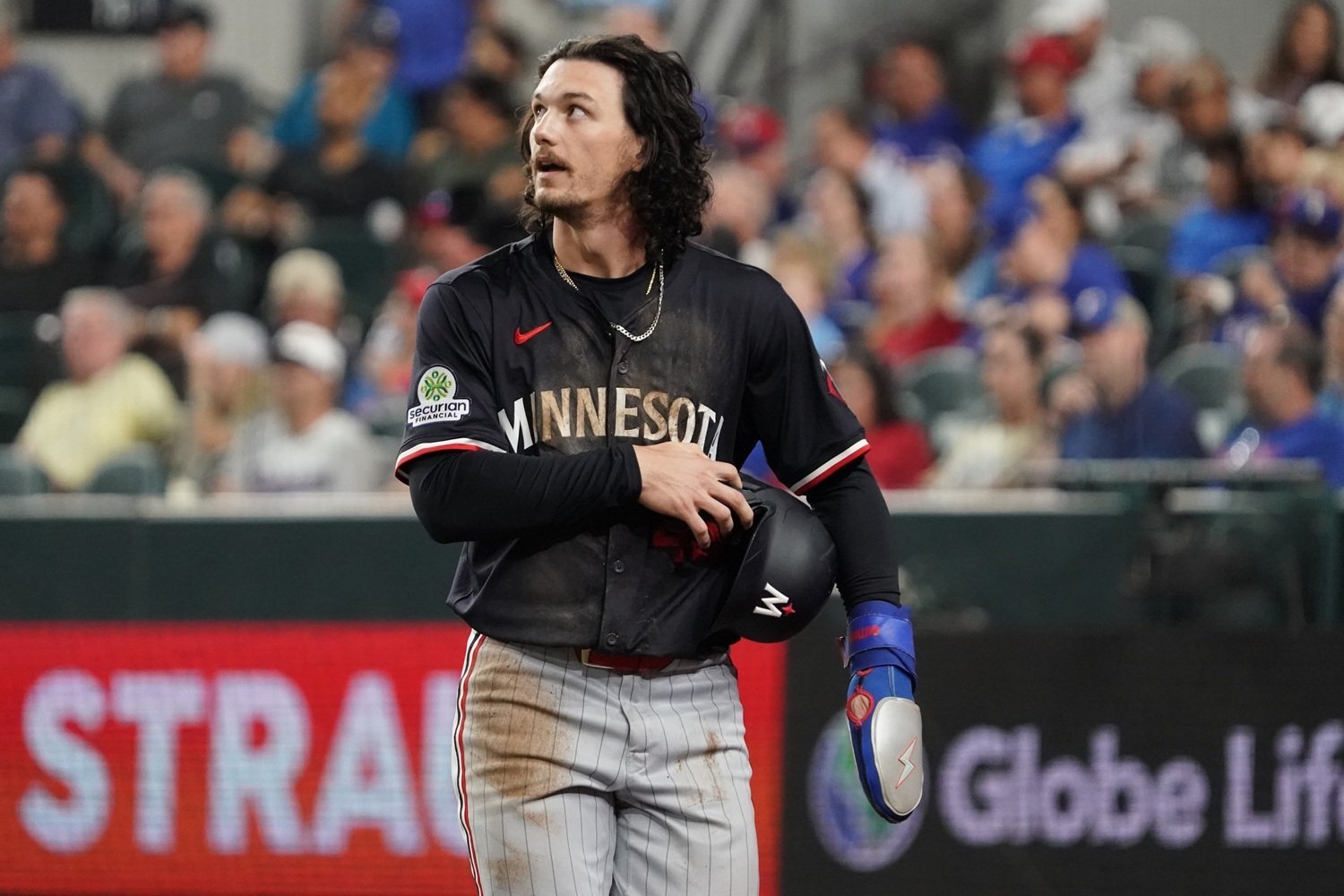
James Outman posted a 28 Contact+ alongside a 61 Power+. This, notably, is not a case wherein 100 is average; it's a version of the 20-80 scouting scale. Outman's Power+, therefore, marks him as a potential plus slugger. That profile aligns with what his career 34.5% strikeout rate already suggests. He's not built to be a high-contact hitter. Though he whiffs far too much, his combination of tilt and bat speed makee him dangerous in the box.
Outman demonstrated that power potential throughout his time in the minors, including a .945 OPS and 131 wRC+ at Triple-A last season. Those numbers are not just the product of favorable environments. They reflect a swing capable of generating damage in a way that contact-oriented profiles cannot.
Minnesota could use a defensively capable fourth outfielder who can handle center field on occasion. Outman is out of minor-league options, which means a strong showing this spring could force the organization to carry him rather than risk losing him on waivers. The other outfielders on the 40-man roster include Alan Roden, Austin Martin, Emmanuel Rodriguez, and Gabriel Gonzalez.
There will likely be room for two of those names on the Opening Day roster, with Martin and Outman having the inside track at the start of spring training. In a roster battle that often comes down to marginal differences, a player with real underlying power traits can quickly become the more intriguing choice over a younger but lower-impact alternative.
The strikeouts may never disappear. That's the cost of doing business with a swing designed to lift and drive the baseball. But in an era in which teams are increasingly comfortable trading some contact for impact, Outman’s underlying profile suggests there may be more upside than his surface numbers currently indicate. For him, the key will be to let the ball travel more. Given the speed and shape of his swing, he can afford to wait a hair longer, thereby making better swing decisions and a bit more contact, without sacrificing all his pop.
Recently, I reviewed the Twins trade that brought Outman to Minnesota from Los Angeles. It was starting to look like this might be a trade that didn’t help either organization. However, if Bat Speed, Swing Tilt, and Intercept Point truly are as predictive as the research suggests, the Twins may be able to salvage something from it, after all.
Can Outman be a breakout player for the Twins in 2026? Leave a comment and start the discussion.






Recommended Comments
Create an account or sign in to comment
You need to be a member in order to leave a comment
Create an account
Sign up for a new account in our community. It's easy!
Register a new accountSign in
Already have an account? Sign in here.
Sign In Now