


Twins Video
It’s another slow grounder. Brady House topped the ball only four feet and it’s bouncing with a little charge to third. The Washington Nationals rookie dashes toward first, and his speed ensures he’ll be safe on the sloppy hit.
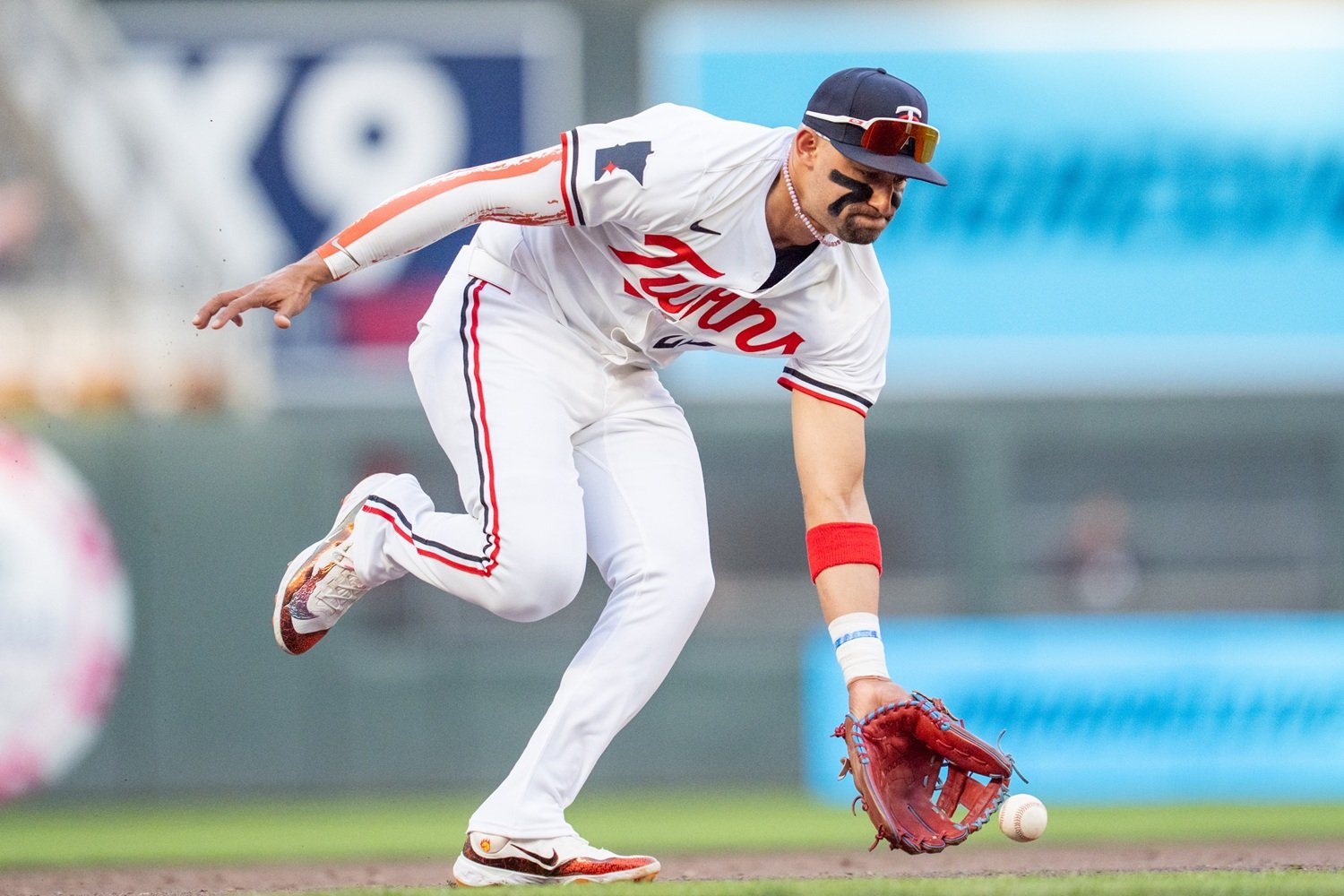
But Royce Lewis charges into the ball. His run to the ball from playing more toward third looks like he’s drifting in Mario Kart. He gets to the ball just as it's reaching third base, and lashes his arm out to peg it across the infield to Ty France. At first, House is called safe. But Joey Casey's eagle eyes see something different, and it’s overturned.
As the Twins debated their offseason choices in 2024, many threw out the idea that Lewis was likely destined to be moved off his position. His first two seasons, even with smaller than desired sample sizes, suggested he was a capable but certainly not stellar infielder; he was worth 0 Defensive Runs Saved across the two seasons. Rumors swirled near the end of last season that he could be switched to second, and even played a game there when things got desperate.
But at least to the naked eye, Lewis has looked different this year. More athletic, more quick to the ball. The throws look way more in line. The analytics support him. His DRS went from negative to positive, and he now ranks 10th in Outs Above Average. In a recent press conference, Rocco Baldelli praised the recent changes in Lewis’s footwork and timing, rather than his arm.
How can we understand how Lewis is making different plays? As we all know, advanced stats seem to capture the overall picture, but rarely the details of what might be creating a defensive titan in the making. What types of plays is Lewis doing differently?
According to Statcast data, Lewis is playing a few feet deeper this season, on average, while moving just slightly closer to the third-base line. That's set him up for a kind of play he used to flounder at: the charge. We're talking slow rollers and ugly bouncers to third, the kind that are more accidental than intended by the batters. These balls require everything: infield hustle, a good one-handed grab, and an accurate throw to beat a fast runner, And as other Twins players have seen a dip in their defense, Lewis has transformed himself into one of the best in the game.
To try and quantify this, I wanted to take every infield ball hit toward Lewis. But not every ball is the same. A 101-mph screamer requires a big leap, rather than a charge. While Statcast has data for fielding, it can't perfectly describe the trajectory of the ball, or where the fielder started.
To isolate charges, I needed to create some constraints. First, any lineouts or popouts were eliminated, leaving only ground balls. Secondly, the ball needed to be hit in a way that required the third baseman to charge it down. That required combining two sets of batted balls. The first was any ground ball under 70 mph off the bat. This accounted for bunts, as well as softly hit balls where the third baseman often needed to come toward the ball, rather than stay put. The second took any ball over 70 mph, but at a launch angle of -30° or lower. This accounted for accidental bouncers, the kind smashed directly into the ground. Not all of them are fair to chargers like Lewis—or any other third-base defender—but a majority of them are. (One of the hits charged as a single against Lewis this year was a ball grounded right in front of the plate, only to pop up 25 feet in the air; the only thing Lewis could do was wait for it to come back to Earth.)
What makes a successful charge? Any groundout was obviously a success. I also decided any sacrifice bunt—a play where the batter was out at first (even if they advanced the runner)—was a successful charge. Any other out or the start of a double play counted, too. If the defender had to go for the ball and ensured an out in doing so, they were doing something right. Only errors or hits were considered unsuccessful.
To get a sense of what makes a good charger, here are the 2024 statistics, focusing on third basemen with at least 30 plays—good or bad—in a year. I eliminated everyone in the 70% range to highlight the top and bottom of the list, and to give us a sense of the range of success rates we're talking about.
| Player | Charge Attempts | Charge Success Rate |
| Jared Triolo | 47 | 87.2% |
| Ke'Bryan Hayes | 73 | 84.9% |
| Jordan Westburg | 41 | 82.9% |
| Matt Chapman | 140 | 82.9% |
| Brett Baty | 33 | 81.8% |
| Gio Urshela | 74 | 81.1% |
| Enrique Hernandez | 52 | 80.8% |
| Oswaldo Cabrera | 62 | 80.6% |
| Abraham Toro | 36 | 80.6% |
| Ernie Clement | 61 | 80.3% |
| Lenyn Sosa | 36 | 69.4% |
| Mark Vientos | 79 | 68.4% |
| Ramon Urias | 50 | 68.0% |
| Ryan McMahon | 112 | 67.0% |
| Royce Lewis | 39 | 66.7% |
| Jake Burger | 53 | 66.0% |
| Jose Miranda | 46 | 65.2% |
| Christopher Morel | 51 | 64.7% |
| Jeimer Candelario | 36 | 61.1% |
As we can see, the best overall defenders tend to rate near the top, including Ke'Bryan Hayes and old friend Gio Urshela. Notably, two names appear near the bottom: Lewis and Jose Miranda. Of course, Miranda eventually found himself at first base, and his suboptimal offense has essentially played himself out of the majors.
Lewis had struggled at charging in his previous two seasons, posting an equally dismal 65% in 2023. Here's a representative play:
This was ruled a single rather than an error. But as we see here, properly fielding the ball did not necessarily yield in a better result:
It’s worth noting that Lewis learned third base as a fallback plan, and in a bit of a hurry. Lewis played over 2,600 innings in the minor leagues as a shortstop. He played a total of 79 innings at third before that became his cemented position in the majors. Moreover, Lewis himself noted that he was often limited in his practice.
“All my injuries have been lower body, so I can’t go out there and take ground balls,” he said at one point during his struggles last year. Lewis often wanted to rely on his arm to do the work, rather than the body.
During the offseason, Lewis studied tape of players like Matt Chapman and Nolan Arenado. As Bobby Nightengale reported, Lewis noticed how often they used their bodies rather than relying on “maximum-effort throws despite their cannon arms.” He worked with Michael Cuddyer and finally found the style that worked for him. As he told the media in the spring, “I feel like a true shortstop playing third base.”
Lewis now sits at the top of the leaderboard in Charge Success Rate this season for those with at least 30 attempts:
| Player | Charge Attempts | Charge Success Rate |
| Royce Lewis | 38 | 86.8% |
| Ernie Clement | 30 | 86.7% |
| Joshua Jung | 47 | 85.1% |
| Yoan Moncada | 33 | 84.8% |
| Alex Bregman | 59 | 84.7% |
| Austin Riley | 72 | 83.3% |
| Ke'Bryan Hayes | 92 | 81.5% |
| Luis Rengifo | 45 | 80.0% |
| Ramon Urias | 44 | 79.5% |
| Brett Baty | 39 | 79.5% |
| Nolan Arenado | 73 | 79.5% |
| Alec Bohm | 61 | 78.7% |
| Maikel Garcia | 70 | 78.6% |
| Matt Shaw | 51 | 78.4% |
| Eugenio Suarez | 77 | 77.9% |
| Matt Chapman | 95 | 77.9% |
Now, 38 attempts is minimal, compared to the number of defensive plays that Chapman and Hayes put up in an average season. But still, as this montage shows, it's been an impressive step up:
For Lewis, it begins with the routes. His throws still show off his arm, but the throwing errors have gone from six to zero (one of three players at third with over 400 innings to remain errorless on throws). But what works is that the flow looks right. Watch the following play: the camera can’t even tell us where Lewis is running from, but he makes a perfect route, with such momentum that the throw itself becomes an afterthought:
In fact, if we look at the Twins over the last few years, we can see how much he has cemented himself as one of the team's top third basemen, especially as others have seen their defense slip.
| Twins Player | 2021 | 2022 | 2023 | 2024 | 2025 |
| Josh Donaldson | 78.8% | ||||
| Willians Astudillo | 55.6% | ||||
| Luis Arráez | 79.2% | 75.0% | |||
| Gio Urshela | 72.9% | ||||
| Jose Miranda | 66.7% | 80.6% | 65.2% | 44.4% | |
| 66.7% | |||||
| Kyle Farmer | 95.0% | 80.0% | |||
| Jorge Polanco | 60.0% | ||||
| Willi Castro | 65.2% | 80.0% | |||
| Brooks Lee | 90.9% | 56.5% | |||
| Royce Lewis | 65.6% | 66.7% | 86.8% | ||
| Jonah Bride | 88.9% |
Lewis’s future with the Twins feels uncertain, as with much of the team. He’s been forced into a quasi-leadership role despite how little he’s played in the majors. But the fact that he’s become a master of charging shows something special about him. Lewis has spent his entire career adapting to challenges, many of them unforeseen. There are many ways to play third base, but it's not always easy to find the one that works. Lewis has now done so. And as he charges toward the ball, he can now charge the team forward.
Do you approve of the job Derek Shelton is doing as Twins manager?

Follow Twins Daily For Minnesota Twins News & Analysis



- TL, Doctor Gast, Hrbeks Divot and 6 others
-
 9
9


Recommended Comments
Create an account or sign in to comment
You need to be a member in order to leave a comment
Create an account
Sign up for a new account in our community. It's easy!
Register a new accountSign in
Already have an account? Sign in here.
Sign In Now