


Twins Video
Heading into the 2023 MLB Draft, there was rampant speculation about where Grand Canyon University shortstop Jacob Wilson would land. Most mock drafts had the contact-oriented right-handed bat landing anywhere from pick No. 5 (held by the Minnesota Twins) through No. 20. Ultimately, he was selected by the Oakland Athletics with the sixth selection, signing for an under-slot bonus of $5.5 million. The Athletics quickly reaped the benefits of their selection, as the polished infielder ascended through the club's farm system, joining the major-league club before the end of his first full pro campaign.
Despite performing at a below-league-average rate in 2024 (86 wRC+ over 103 plate appearances), the then-22-year-old showed signs of being a major-league regular, posting some of the best strikeout and whiff rates in baseball. As the club trekked to West Sacramento in 2025, Wilson blossomed into a star. He's hitting .335/.379/.468 with a 135 wRC+, and he earned his first All-Star nod during his rookie campaign. Finding success through a low-walk but very low-strikeout profile, the now 23-year-old is one of baseball's most adept young hitters. Interestingly, though, the Twins might have landed themselves a similar player—or an even better one.
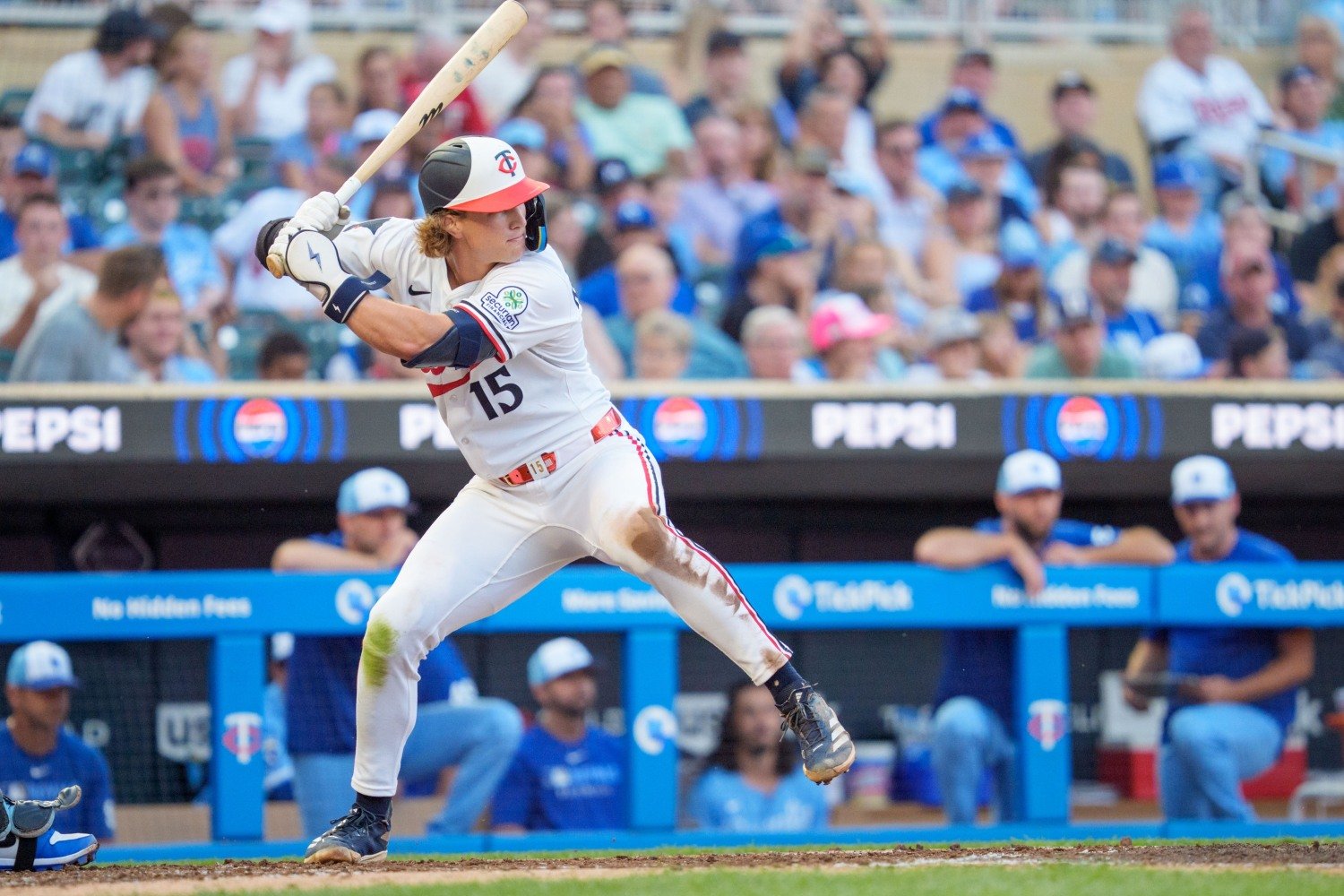
Forty-three selections after Oakland took Wilson, Minnesota drafted Arizona State University infielder Luke Keaschall, a right-handed hitting infielder who sported an elite strikeout rate in college. Sound familiar? Like Wilson, Keaschall also quickly moved through his club's minor league system, making his major-league debut roughly 21 months after being drafted despite undergoing Tommy John surgery in August 2024. After suffering a nondisplaced right forearm fracture just one week into his major-league career, he has yet to get a prolonged opportunity to show out the way Wilson has. However, given how well the Twins' young infielder has performed in an exceptionally small sample, he appears to be on a similar trajectory to Wilson's.
Before getting hurt in April, Keaschall hit .368/.538/.526, with a 7.7% strikeout rate and 207 wRC+ over 26 plate appearances. The 22-year-old picked up where he left off after returning to Minnesota's lineup on Aug. 5, hitting 455/.455/.864 with a 4.5% strikeout rate and 267 wRC+ over 22 plate appearances. Keaschall has been incandescent over his first 48 plate appearances, hitting 114% better than league average with an elite 6.3% strikeout rate. Unless he proves to be the second coming of Aaron Judge, Keaschall's performance will inevitably dip over a larger sample. However, there is reason to believe he could produce at a rate similar to Wilson over an extended stretch, meaning he could blossom into one of baseball's best young hitters.
Wilson and Keaschall's resemblances extend beyond their mirroring timelines and aesthetics. This year, there are six right-handed batters in the majors with a swing speed under 68 MPH and a swing tilt over 35 degrees. Those players are the following:
- Austin Martin
- Leo Rivas
- Luke Keaschall
- Alan Trejo
- Myles Straw
- Jacob Wilson
Martin and Keaschall being on this list is an interesting development for Minnesota. However, that doesn't mean they are similar players. Keaschall shares a significant number of similarities with Myles Straw, specifically in terms of bat speed and tilt. However, Straw makes contact with the ball at a much deeper point than Keaschall, creating a considerable difference in their batted-ball data. Martin, Rivas, and Trejo make contact at similar points as Straw. All four of them have steep swing tilt, meaning that they take the time to get the barrel below their hands and catch the ball deeper in the hitting zone, rather than flatten their strokes and go get it earlier. That being the case, these four players possess significantly longer swings than Keaschall and Wilson. The latter two, therefore, can attack pitches up in the zone more successfully.
These four players' inability to reach pitches Wilson and Keaschall can doesn't mean they can't succeed at the major-league level. Straw has carved out an eight-season big-league career, and Martin has impressed since earning a promotion from Triple-A St. Paul. Yet, it does indicate they likely won't be able to reach the heights Wilson and Keaschall have in their young careers, which underscores the important similarities between the two young hitters. Within the exceptionally niche group of six players Keaschall and Wilson belong to, the two right-handed hitters are most similar to each other, indicating the duo could have similar career trajectories. That would make the Twins getting Keaschall a full round later than the player taken right behind their spot in the first rather impressive.
It's also worth noting that, in this very small sample size, Keaschall appears to be making earlier swing decisions and better use of his extreme brevity of swing. He catches the ball farther out in front and has a steeper attack angle at contact (9°) than does Wilson (3°), who creates most of the tilt in his swing right at the end. Wilson's short, slow swing therefore generates lots of weak contact and ground balls, whereas Keaschall has shown a knack for getting on plane early despite having no wasted motion in his swing at all. This means both that Keaschall lifts the ball more (15° launch angle, to Wilson's 8.2°) but that he can square the ball up more consistently. In fact, in a tiny sample, Keaschall leads MLB in the efficiency of his contact (the ratio of his actual exit velocities to the highest possible ones, given his swing speed and the speed of the incoming pitch). In that regard, he's not similar to Wilson, but to the one other short-swing, high-efficiency contact hitter in the majors: Luis Arraez.
Given that Wilson and Keaschall possess elite contact tools while also sporting slightly above-average power (although Wilson's appears to be at least partially boosted by his home park in West Sacramento), they could carve out long-term major league careers while being consistently above-average offensive contributors. Given Wilson's defensive superiority to Keaschall, there is reason to believe Wilson could provide more value to the Athletics than Keaschall will to the Twins over an extended stretch. So far, though, Keaschall looks like the more patient and more powerful offensive player, and that the Twins ended up with anything akin to a clone of Wilson in the same draft where they got Walker Jenkins feels like a coup.









Recommended Comments
Create an account or sign in to comment
You need to be a member in order to leave a comment
Create an account
Sign up for a new account in our community. It's easy!
Register a new accountSign in
Already have an account? Sign in here.
Sign In Now