


Jump to content
Twins Daily
  • Create Account
  • Twins News & Analysis

    Is Paul Molitor the Right Man to Lead the Twins?


    Nick Nelson

    Shortly after they hired Paul Molitor as manager in November of 2014, the Twins invited me to Target Field for a one-on-one interview with him. They had asked if I'd write a feature on the newly minted skipper for their season preview publication, and I gladly accepted.

    Upon meeting Molitor, I was impressed with the man. That continues to this day. But I've never really been able to figure out how impressed I am with the manager. Right now, it's difficult to assuage the nagging doubts.

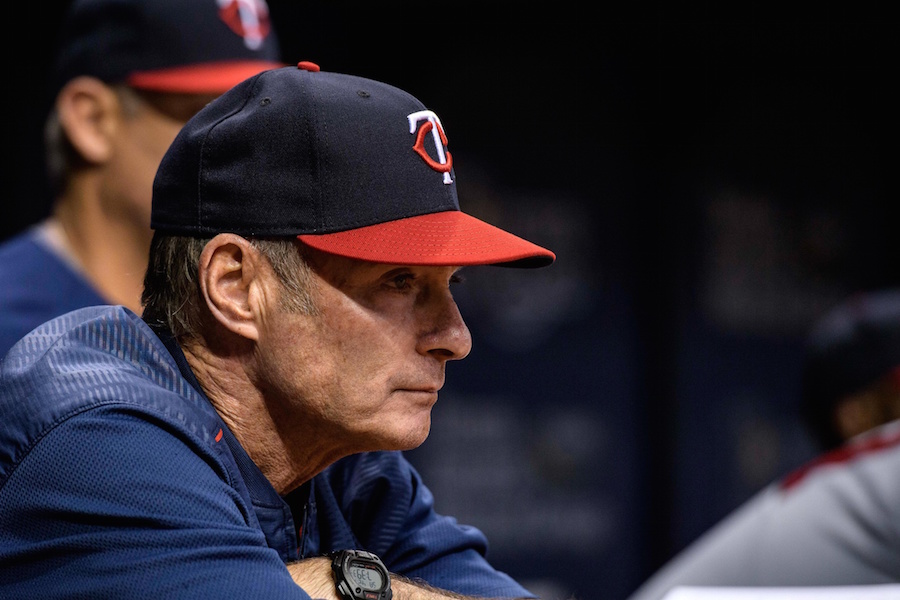
    Image courtesy of Doug DeFelice, USA Today

    Twins Video

    Molitor was still getting accustomed to his new office when we chatted in it that January afternoon. I don't think he'd done many media interviews yet, and his burgeoning excitement was easily detected.

    The hardball lifer genuinely enjoyed being asked thoughtful questions, and answering them thoroughly. I noticed – especially upon transcribing – that his responses were eloquent, intelligent, and enlightening.

    This would become a recurring trend in my experience with him.

    Molitor's intellect is undeniable. The term "baseball IQ" gets bandied around a lot but this Hall of Famer embodies it. In my first interaction, and many others I've had with him during spring training scrums since, he has always exuded a deep knowledge of the game. With no disrespect to his affable predecessor, I gain actual insight from talking to Molitor, in a way I never did before.

    As someone who coaches young kids during the summer, I'm beyond impressed with Molitor's ability to articulate concepts and break down strategic intricacies in a way that makes total sense. These are, seemingly, the hallmarks of an impactful coach.

    But unfortunately there is little evidence of Molitor being able to move the needle effectively while at the helm

    THAT FAMILIAR FEELING

    We all understood that Minnesota was taking a gamble when Molitor got the nod to replace Ron Gardenhire. The finalist he beat out for the job, Torey Lovullo, was a seasoned MLB coach who'd been serving as bench coach for John Farrell's Red Sox, one year removed from a championship.

    Molitor, on the other hand, offered little substantive experience. He briefly served on the coaching staffs for Minnesota and Seattle after retiring as a player, and he was in Gardy's dugout during the 92-loss 2014 season, but Molitor had never managed at any level.

    The Twins opted for their guy, a known favorite of the Pohlads. Hiring Molitor made sense in that, as a longtime roving minor-league instructor, he was very familiar to the organization's rising young core. But his lack of a track record was conspicuous.

    Lovullo ended up joining the Diamondbacks as manager two years later. From all appearances it's been a great move for Arizona. They made the playoffs as a wild-card last year, improving by 24 wins in Lovullo's first season, and are currently in first place.

    Molitor's tenure with the Twins thus far has been much more of a mixed bag.

    UP, DOWN, UP, DOWN

    This section is not an advertisement for one of my favorite spots in my Uptown (though I highly recommend Up-Down to fellow enjoyers of beer and video games).

    It is instead an apt description of this team under Paul Molitor the manager.

    So it goes, right? As Ernie Halwell put it so well: "Baseball is a lot like life. It's a day-to-day existence, full of ups and downs."

    The problem is that, under Molitor, Minnesota's "ups" haven't risen all that impressively high. And the "downs" have been harrowingly low.

    In 2015, Molitor led the Twins to their first winning season in five years. Miguel Sano and Byron Buxton debuted. Brian Dozier made his first All-Star team. The future was very bright.

    Then: Total. System. Failure.

    That 2016 campaign was an unmitigated disaster. A team that was expected to – at the very least – hang on the fringe of contention instead spiraled uncontrollably, losing 103 games in the franchise's worst season since transplanting from Washington.

    There's really no need to rehash it. We all remember.

    Because of that catastrophe, Minnesota's jump to 85 wins in 2017 looked like a momentous achievement, rather than a modest improvement from their 83 wins in 2015. And that drastic turnaround, punctuated by a brief postseason run, earned Molitor the distinction of AL Manager of the Year. (Naturally, Lovullo won it in the National League.) Then came the three-year contract extension, almost a formality at that point.

    And this context makes it strange to be discussing the possibility of Molitor's dismissal.

    A reigning Manager of the Year? Less than three months into a new deal? With forceful support from ownership?

    In many ways, the notion of firing Molitor seems absurd. But frankly, it would be more absurd not to seriously assess it as an option.

    The fact is that, as much as I may sympathize with the Pohlad family's affinity for Molitor, he just doesn't have much of a leg to stand on when it comes to managerial chops.

    IGNITING A FIRE

    Without question, Paul Molitor was one of the greatest baserunners in MLB history. Despite lacking elite speed he pilfered 504 bases with a 79% success rate in his playing career, and he stole home 10 times.

    I think anyone who's watched this 2018 team regularly would agree they run the bases as sloppily as any in memory. They've been thrown out, picked off, and caught adrift countless times.

    Molitor was a sharp and versatile fielder prior to becoming primarily a DH in his 30s.

    Miscues are all too common for this year's defensive unit, as they were in 2016.

    At the plate, Molitor's discipline was legendary, his power surprising, his bat relentless. He was known as "The Ignitor."

    This offense has most often failed to launch, with astoundingly mediocre numbers across the board. The Twins have hit fewer home runs than all but three AL teams, which seems unfathomable after the way they finished 2017.

    Suffice to say, knowledge and expertise don't transfer directly. We knew that.

    But if Molitor isn't – in some way – passing along his strengths, then what are we doing here?

    The jury is out on him as a tactician. Molitor's designed plays – steals, hit-and-runs, going on contact – haven't worked out very often. His bullpen, while capable, hasn't performed in leverage, as evidenced by mop-up longman Matt Magill leading the relief corps in WPA.

    Ryan Pressly has appeared in 36 of the team's first 68 games and has seen his performance decline. Meanwhile Magill works once a week, while looking perfectly capable of taking on more. The bullpen decisions have sometimes been baffling.

    I hesitate to attribute these things entirely to Molitor. He's not making decisions on an island. He receives input from his coaches, specialized pitching analyst Josh Kalk, and the players themselves. From my understanding, it is a more sophisticated system than one might assume. "Collaborative," as its mastermind Derek Falvey would undoubtedly say.

    And that's sorta the trouble with trying to gauge Molitor's culpability. He's only one piece in a very complex puzzle. Would making a change really be worthwhile?

    I do know this: It takes some contorting not to see him as part of the problem. In 2016 a reasonably talented team tanked to the dregs of franchise precedent. And right now a more talented team – built to win, with a record payroll – is sputtering along, incapable of capturing any kind of sustained momentum despite an incredible window of opportunity.

    There's no question that Molitor understands and – most endearingly, I think – continually studies the game to an obsessive degree. I trust his judgment on baseball decisions and could never really doubt his acumen. Few rightfully could.

    But given what we saw in 2016, and now are seeing in 2018, one must question his ability to rally the troops and become a uniting force.

    I'll be honest: typing that last sentence felt nauseatingly cliché. What does it even mean? These vague and intangible leadership platitudes in sports have always driven me crazy, but there's simply no denying their reality. Managers matter.

    Players aren't "quitting" on Molitor, as I've seen a few people ludicrously suggest. His bullpen management, if occasionally odd, isn't a fireable offense. And it'd be tough to make the case that Molitor has wrongfully alienated certain players, or the clubhouse at large.

    But something is out of whack with this team's engine, which simply hasn't been able to ignite. And while I fully believe the players bear the brunt of that burden... you can't fire the players.

    Speaking of fire, and ignition, maybe these words hint at what is amiss.

    As I pondered this subject, I went back and listened through that first interview I conducted with Molitor, still filed away in my phone's audio log.

    I had asked him to explain, from his view, what differentiated him from his predecessor and friend Ron Gardenhire.

    Naturally, Molitor opened with a complimentary remark about his general sameness with Gardy, but then addressed the question head-on:

    "If there's a difference that pops into my head, it would be that he wears his emotions on his sleeves. Whether it's protecting his players, going out on the field and dealing with umpires and things. And I have a tendency to be a little bit different in my demeanor in that regard.

    "Not to say one is better than the other, but again, you can't try to be someone you're not."

    A part of me wonders whether pushing this team to the next level requires something that Molitor – by his own earnest admission – is not.

    Another part of me thinks that's all a bunch of hooey.

    Needless to say, I'm conflicted. But I'm curious to hear what others think.

    Follow Twins Daily For Minnesota Twins News & Analysis

    Recent Twins Articles

    Recent Twins Videos

    Twins Top Prospects

    Marek Houston

    Cedar Rapids Kernels - A+, SS
    The 22-year-old went 2-for-5 on Friday night, his fourth straight multi-hit game. Heading into the week, he was hitting .246/.328/.404 (.732). Four games later, he is hitting .303/.361/.447 (.808).

    User Feedback

    Recommended Comments


    Featured Comments

    Frankly, I think the next dog you see could manage a baseball team to about 2 less wins than Maddon.


    That's how much I think of the position in the current baseball context. If Molitor is fired or retained I think it's largely irrelevant.

    Why are they paid millions then? This is a super visible leadership position. Is it as important as the players? No. Is it trivial? I don't think so, and those that pay them must not either.


    Frankly, I think the next dog you see could manage a baseball team to about 2 less wins than Maddon.  


    That's how much I think of the position in the current baseball context.  If Molitor is fired or retained I think it's largely irrelevant.


     I have a boxer. They aren't known for their intelligence. Let's say 4 wins less than Madden and move on. Manager challenges could get dicey though.

    Edited by launchingthrees


    Why are they paid millions then? This is a super visible leadership position. Is it as important as the players? No. Is it trivial? I don't think so, and those that pay them must not either.


    Good question.


    It would not shock me if in the next 20 years some team did away with the manager role as we know it.  


    Good luck. Hit on your nurses and say your prayers.

    My wife would have a problem with one of those suggestions and I'm fundamentally unable to do the other suggestion.  


    But I appreciate the good place that advice came from :-)

    Edited by jimmer


    Yeah but Logan Morrison isn't a rookie and he surely knows how to take a lead off of second and Rosario has been playing long enough to know the cut system. Paul isn't coaching little league, these guys know the universal fundamentals of the game by now. If they don't... a major league manager doesn't have a chance. 


    If Molitor has to pull the players out of a more advanced calculus class to teach one plus one equals two he doesn't have a chance.  :)


    I'm hesitant to blame Paul for this.  

    It's not that these things happen just once.  Things happen, mistakes get made.  That's not on Molitor.  It's when they're repeated over and over again that I look at the manager and wonder why it hasn't been corrected.  


    Be critical with evidence.  And consider context.  Parker's post on the bullpen stuff has seemingly been  ignored but is pretty important to consider.  But "Tom Kelly would've X" is immediately a really, really bad argument.  

    I wouldn't say that it's being ignored.  It's not by me anyway.  Even from my perspective, I found his post to be very interesting.  However, it talks about what managers do in game.  In my case, I have issue with what he's able to get across to the players behind the scenes that result in poor fundamental play and that things aren't corrected.  You can argue that these things should have been addressed in the minors or in high school (which I agree with), however fact of the matter is that they are not or have not been effectively anyway.  That leaves the big league guy to get things sorted out.  I agree that the managers role is shrinking in game. 


    As for the portion of the bullpen usage, I didn't interpret it to take into account when relievers are used or when they're brought in or pulled.  That's my primary issue.  I think he overuses a couple of guys and doesn't use his entire pen efficiently though too.  He doesn't seem to have a feel for it.  He too often leaves a guy in, whether it be a starter or reliever, until after the damage is done.  The next guy is brought in to stop the bleeding instead of trying to avoid the puncture wound in the first place.  


    I also agree with jimmer in that the most common complaint on fanboards is probably about bullpen management.  I acknowledge that it is not easy and there is some art to it.  But that's why a big league manager "makes the big bucks."  Bullpen management is probably the most important aspect of a managers role in a game these days.  It stands to reason that that is what people are going to zero in on.  And people are going to have differing opinions on how it's done.  


    Wow, is this comment wrong. Lance Lynn was one of the better starters on the market. Logan Morrison was a legitimate power hitter. Jake Odorizzi was also a solid mid-rotation starter. Frankly, the front office did far more than just about any previous front office did to improve the Twins over the offseason. The FO definitely did its job. 


    yeah i agree with you.  Pretty ridiculous post.


    I might be wrong, but if Tom Kelly was still managing, I believe the throws from Rosario that sail to the backstop would cease after one occurrence. He and Eddie would be out there after the game practicing hitting the cutoff, and if it happened again, they'd be back out there after the game practicing again, and Eddie wouldn't be in the lineup the next night.


    It's not that the players don't KNOW the fundamentals, it's that Molitor doesn't know how to get players to pay attention to them.


    This is where we find common ground, while at the same time arrive at a place where I'm not going to be comfortable when it comes to criticism of Molitor. 


    I don't know how Tom Kelly would have handled it. Would TK be out there after the game with a Whistle like Kurt Russell saying again until Rosario eventually pukes? 


    Did the 87 Twins have a better defense because of Tom Kelly, because of the coaches, because of the development structure, a different front office player acquisition philosophy... or did they just happen into a group of naturally inclined players. Or... Do we not remember the occasional mistakes that probably happened then as well? 


    And I don't know how Molitor is handling it. Does he handle it himself, have one of the coaches sit down with the offender.


    I just don't know but... If I have one observable from my chair criticism of Paul Molitor... you touched on it. There do not appear to be playing time consequences for sub-par play from the starters.


    I believe that it is fact - proven over several years - that Molitor is reluctant to try something/someone else. 


    Dave Roberts would not let Byron Buxton hit .136 and still play every day. Logan Morrison would not be in the lineup everyday with his performance. Byron Buxton would be in a Joc Pederson role by now and Logan would be yielding playing time to something called Max Muncy. 


    It's not that these things happen just once.  Things happen, mistakes get made.  That's not on Molitor.  It's when they're repeated over and over again that I look at the manager and wonder why it hasn't been corrected.  


    Molitor might be wondering the same thing.  :)


    I also agree with jimmer in that the most common complaint on fanboards is probably about bullpen management.  I acknowledge that it is not easy and there is some art to it.  But that's why a big league manager "makes the big bucks."  Bullpen management is probably the most important aspect of a managers role in a game these days.  It stands to reason that that is what people are going to zero in on.  And people are going to have differing opinions on how it's done.  


    That was a great post with criticism. It was fair and well argued.  


    I'd suggest a lot of what you mean by this "magic touch" idea is really just luck.  I'm not sure Molitor, or anyone else, has a whole lot of control over that.  It's not like Terry Francona suddenly forgot to manage a bullpen this year.  The Cubs are at the bottom of the league in fielding, is that because Joe Maddon has lost his touch on where he plays guys?  Or had a fundamentals breakdown?


    That was a great post with criticism. It was fair and well argued.  


    I'd suggest a lot of what you mean by this "magic touch" idea is really just luck.  I'm not sure Molitor, or anyone else, has a whole lot of control over that.  It's not like Terry Francona suddenly forgot to manage a bullpen this year.  The Cubs are at the bottom of the league in fielding, is that because Joe Maddon has lost his touch on where he plays guys?  Or had a fundamentals breakdown?

    Thank you, I appreciate the compliment!


    I agree that there is some luck involved with the bullpen management, no doubt.  A manager can push the right buttons for a given situation all he wants, but it still boils down to the player executing.  I do think that maximizing the odds of a potential outcome to be very real however.  I've mentioned putting players in a position to succeed in many other posts in other threads, this is what I'm referring to.  Putting the right player in the right position to maximize their chances of succeeding - and achieving a positive result for the team because of it. 


    One recent example of where I believe that Molitor fails at this is Lance Lynn's previous start.  Molitor allows Lynn to come out for the 7th inning of a 1-0 game.  I had no issue with that, I actually applaud the notion of letting the starter go deeper.  Lynn gives up a leadoff triple and is allowed to continue the inning.  In my view, this is where Molitor failed the first time.  Lynn was running out of gas and near the end anyway.  In my opinion, Lynn should have been pulled at that point.  Allow a fresh arm to come in and try to work out of a tough jam.  To Lynn's credit, he did get two outs.  However, the first of those was a sac fly that tied the game.  Could that have happened to the reliever?  Absolutely, but Lynn wouldn't be on the hook for the loss either (if you care about such things).  After striking out McCann, Lynn then plunks Iglesias.  I believe that Molitor failed here too.  I realize that Jacoby Jones wasn't lighting the world on fire, but any major league hitter can be dangerous and now the go-ahead run is on base.  Lynn remains in the game and gives up a 2-run HR and now an inning that started as a 1-0 lead is now a 3-1 deficit and NOW Molitor takes out his starter.  The damage had already been done.  At that point, Molitor may as well have let Lynn finish the inning.  These types of scenarios play out more often than what I see the Maddon's or Francona's of the world allow to happen.  They have a feel for the game that tells them to stop the bleeding before it starts.  If the reliever brought in gives up the lead in that scenario, then so be it.  That's the luck that you mentioned.  But at least the manager maximized the odds of succeeding in a late game situation.


    How can there be playing time consequences for mental errors?

    Look at the bench.

    Fair point, indeed.  However, perhaps what the "offending" player needs is to realize that by continuing to make mental errors they not only hurt the team with the error, but also by being benched for repeated offenses.  By benching, you hope that that gets the point across.


    Short term loss for long term gain.


    This is arguably true today but it certainly wasn't 3 weeks ago. Though why are you using total innings pitched and not IP/Game? We've played 5 games less than the Tigers, and 3 less than the Indians, and have played the fewest games in the AL. For the first 2 months of the season Molitor would just shrug with a blank look on his face and throw Reed or Pressley out there. It was cringworthy.


    We had 3 guys in the top 10 for RP usage 3 weeks ago, way outside accepted norms. Even today we have 3 of the 18 most used pitchers in the AL. Someone clearly told Molitor in no uncertain terms to cut it out because they haven't been pitched much at all in those 3 weeks. 


    Or, you know, maybe he listened to his coaches; maybe he's been concerned about overuse for a long time; maybe he listened to analytics staff; maybe this is just the random ebbs and flows of season-long usage. 


    DO NOT ASSUME that someone told him to "cut it out." 


    17 WAR? This year? Or all of last year?


    All of last year. 


    Look at the lineup from yesterday's game against the Red Sox. It was basically Mauer, Rosario, Escobar, Dozier and then pray that some bloop single falls or a guy gets lucky with a line drive. That they won against Chris Sale was a complete miracle. 


    The point is that the team has lost an awful lot of its key players this season. People have to give Molitor a break on that. 


    How can there be playing time consequences for mental errors?

    Look at the bench.


    I'd love to look at the bench but I'm limited to the few occasions that the camera pans over to it between pitches.  :)


    And because the majority of the camera time is focused on the guys who are playing nearly every day... I'm forced to focus on them. 


    I get the names on the bench are not sexy but... We have guys that are in the lineup nearly every day, that don't have to bother checking the lineup card to see if they are playing. Guys in the lineup everyday who are performing worse than the guys who are being forced to watch them struggle from the bench. 


    Dave Roberts would not let this happen, He will play Barnes instead of Grandal in the World Series and go back to Grandal later when he starts playing better. He will bench Puig to get a message through, He will let Kemp continue doing what he is doing after a long period of not doing it. He will give Chris Taylor a job at the expense of Mr. Potential Joc Pederson. He will give Max Muncy playing time at the expense of Justin Turner, Cody Bellinger and Logan Forsythe. He will find a way to get Enrique Hernandez in the lineup if he starts heating up. 


    Dave Roberts will not go down with the ship before trying something else. Paul will go down with the ship without an attempt at adjustment. 


    All of last year. 


    Look at the lineup from yesterday's game against the Red Sox. It was basically Mauer, Rosario, Escobar, Dozier and then pray that some bloop single falls or a guy gets lucky with a line drive. That they won against Chris Sale was a complete miracle. 


    The point is that the team has lost an awful lot of its key players this season. People have to give Molitor a break on that.


    I guess my point was that some of the players lost this year, were not playing anywhere near last year, in fact they were fairly lousy. But for example, if this years Eddies both twisted an ankle this year, we're toast. If this years Dozier does it, no one would notice. Take out Doziers first week of the season, and the Kirby Puckett statue could fill in with little loss of productivity.


    I guess my point was that some of the players lost this year, were not playing anywhere near last year, in fact they were fairly lousy. But for example, if this years Eddies both twisted an ankle this year, we're toast. If this years Dozier does it, no one would notice. Take out Doziers first week of the season, and the Kirby Puckett statue could fill in with little loss of productivity.

    Also important to note that Escobar is playing so much because of Sano and Polanco not being available.  Adrianza, while starting slow, has really come on of late too filling in for Polanco.


    Guys that haven't been hurt aren't producing either.  Dozier, Kepler and Morrison have struggled most of the season.  Injuries aren't the only story for this season, that is for sure.

    Baseball may be the only game where one has the time between plays to envision the possibilities that can occur during the next pitch. You can stand in the field and consider the score, the hitter, his leg speed, where and of what abilities the runners are, the wind, wet ball dry ball. All of the variables can be considered, so when up the ball is hit, you can react accordingly with aforethought. The basics, cutoff positions, behind or ahead of runners, etc, have all been drilled into you since you were 15 or before. What remains is does the player want to invest in the mental exercise needed to follow his past instruction, and if he does not, does the manager want to do something about it. It's that simple. How a manger handles these things is what defines him. Let's take Rosario for example. Noted free lancer. A couple years ago he stole third against a shift. walked to third is a better description. I think there were two outs, us up. Molitor had a fit, and IIRC Rosario was exiled to Rochester. Completely BS. But when Rosario throws a baseball all over the field repeatedly nothing is said. I like Rosario, he plays with passion and ability. He also plays with a lack of attention to detail. And will continue to do so. My point is how and when you discipline a player is important in his development. And in the isolated case of Rosario was handled poorly.

    I agree with earlier poster(s) that insinuate managers impact is overrated in today's game.


    But that's not to say the impact is non-existent, and I don't think Molly is a good in-game manager.  IMO, this was apparent right from the start, and although he's gotten marginally better, he gets outmaneuvered in leverage situations pretty consistently (including instances where our ridiculous roster isn't hamstring him).  So, I've always though his chance for being a plus manager would rely on softer skills: a 'whisperer' of sorts in terms of offensive and base-running development and approaches, and performance.  I do like his demeanor/professionalism in the dug-out, with umpires, in after-game pressers, etc....and I respect him as a baseball guy.  But, if he's not going to be that 'whisperer'...then, well...


    I guess my point was that some of the players lost this year, were not playing anywhere near last year, in fact they were fairly lousy. But for example, if this years Eddies both twisted an ankle this year, we're toast. If this years Dozier does it, no one would notice. Take out Doziers first week of the season, and the Kirby Puckett statue could fill in with little loss of productivity.


    Sure. But in both Buxton's and Sano's cases you can make a strong case that injuries have played a role in their struggles. 


    It CLEARLY did in Buxton's case after he came back early from the broken toe. And there are some who believe that Sano's leg injury has hampered his swing this season. 


    In both cases, the players are gone and not playing for the major league team.  


    And Polanco hasn't played at all. Neither has Ervin Santana. You can't forget either of those players. They were vital contributors to the team last year. And Jason Castro has always been a defense-first catcher. So his loss has been important, even if he wasn't hitting before he left (and he was clearly injured, too.)


    So MY point is this: People are jumping off the Paul Molitor bandwagon awfully fast given the sheer number of losses. Cut him some slack. 


    Today's lineup, for instance, includes Robby Grossman (again) in right field, even though he is a horrid defender.


    It includes Adrianza at short. I don't even know if he should be on the team.


    And it includes Bobby Wilson at catcher, who can't hit and isn't a good defender.


    As for Brian Dozier ... he always has one good half and one bad half. This year is no different.

    Sure. But in both Buxton's and Sano's cases you can make a strong case that injuries have played a role in their struggles.


    It CLEARLY did in Buxton's case after he came back early from the broken toe. And there are some who believe that Sano's leg injury has hampered his swing this season.


    In both cases, the players are gone and not playing for the major league team.


    And Polanco hasn't played at all. Neither has Ervin Santana. You can't forget either of those players. They were vital contributors to the team last year. And Jason Castro has always been a defense-first catcher. So his loss has been important, even if he wasn't hitting before he left (and he was clearly injured, too.)


    So MY point is this: People are jumping off the Paul Molitor bandwagon awfully fast given the sheer number of losses. Cut him some slack.


    Today's lineup, for instance, includes Robby Grossman (again) in right field, even though he is a horrid defender.


    It includes Adrianza at short. I don't even know if he should be on the team.


    And it includes Bobby Wilson at catcher, who can't hit and isn't a good defender.


    As for Brian Dozier ... he always has one good half and one bad half. This year is no different.

    But most people aren't evaluating him based on solely this year.


    Create an account or sign in to comment

    You need to be a member in order to leave a comment

    Create an account

    Sign up for a new account in our community. It's easy!

    Register a new account

    Sign in

    Already have an account? Sign in here.

    Sign In Now

×
×
  • Create New...
