



IndianaTwin
-
Posts
6,561 -
Joined
-
Last visited
-
Days Won
27
Content Type
Profiles
News
Minnesota Twins Videos
2026 Minnesota Twins Top Prospects Ranking
2022 Minnesota Twins Draft Picks
Minnesota Twins Free Agent & Trade Rumors, Notes, & Tidbits
Guides & Resources
2023 Minnesota Twins Draft Picks
The Minnesota Twins Players Project
2024 Minnesota Twins Draft Picks
2025 Minnesota Twins Draft Pick Tracker
2026 Minnesota Twins Draft Tracker: Picks & Bonuses
Forums
Blogs
Events
Store
Downloads
Gallery
Everything posted by IndianaTwin
-
@Matthew Lenz, I appreciate the attempt to try deciphering a logic behind those decisions. I haven't always agreed with you when you've done that, but I think it's a better approach than saying, "There is no logic." In this case, I follow along with the Jax and Duran decisions. I wonder if there is an additional component to the Varland/Coulombe/Sands decision. I don't know how Rocco sees them, but if he viewed them as more or less equal for the ninth, the next thing is, "We're playing to get to the 10th. All three of these have similar chances of getting me there. If they do, which one do I want available for the 10th, when I have to deal with Manfred Man rules? Which one will be best with a runner on base?" For me, out of those three, my first choice is Coulombe and my second choice (if needed in the 11th) is Sands. I also preface all of these discussions with "There's stuff we don't know." For all we know, Coulombe or Sands was nicked up a bit and weren't actually available. And to anticipate a question, I don't think Rocco owes it to us to announce that in the postgame presser. There are strategic reasons to keep that stuff under your hat.
- 77 replies
-
- 1
-

-
- griffin jax
- jhoan duran
- (and 1 more)
-
I agree with that saying. A corollary would be "Don't get beat without using your best guy." If you throw Varland in the seventh and he fails, you've deprived yourself of the opportunity to use Jax and Duran in the roles they have often played, maintaining a lead in the 8th and 9th. A critique of Rocco is that he doesn't go for the jugular. In effect, that's what he was doing to the Cleveland offense, saying, "You can't score in six? Well, let me stuff your offense in a deeper hole by giving you Jax and Duran next." Said another way, offensively, if there's an opportunity to score in the seventh or eighth and a manager doesn't pinch hit his stud for Kody Clemens because he wants to the save his stud for a possibility in the ninth, the manager gets chastised with, "You gotta use him now -- there may not BE an opportunity in the ninth." This is essentially what he did on the pitching side, saying, "I gotta use Duran in the eighth, because otherwise there might not BE a ninth." The Jax/Duran part of the strategy worked. The part that didn't work was the offense getting any runs to make it an easier job for Varland in the ninth.
- 77 replies
-
- 5
-
-
- griffin jax
- jhoan duran
- (and 1 more)
-
Guardians 4, Twins 3: Yet Another Wet Slap
IndianaTwin replied to Matthew Taylor's topic in Twins Daily Front Page News
He got to do it against the Twins pitcher and catcher, however. 😄- 81 replies
-
- 1
-

-
- simeon woods richardson
- harrison bader
- (and 1 more)
-
Louis Varland Has a Meatball Problem
IndianaTwin replied to Cody Christie's topic in Twins Daily Front Page News
I have a meatball problem too. I notice it each time I step on to the scale. -
Guardians 4, Twins 3: Yet Another Wet Slap
IndianaTwin replied to Matthew Taylor's topic in Twins Daily Front Page News
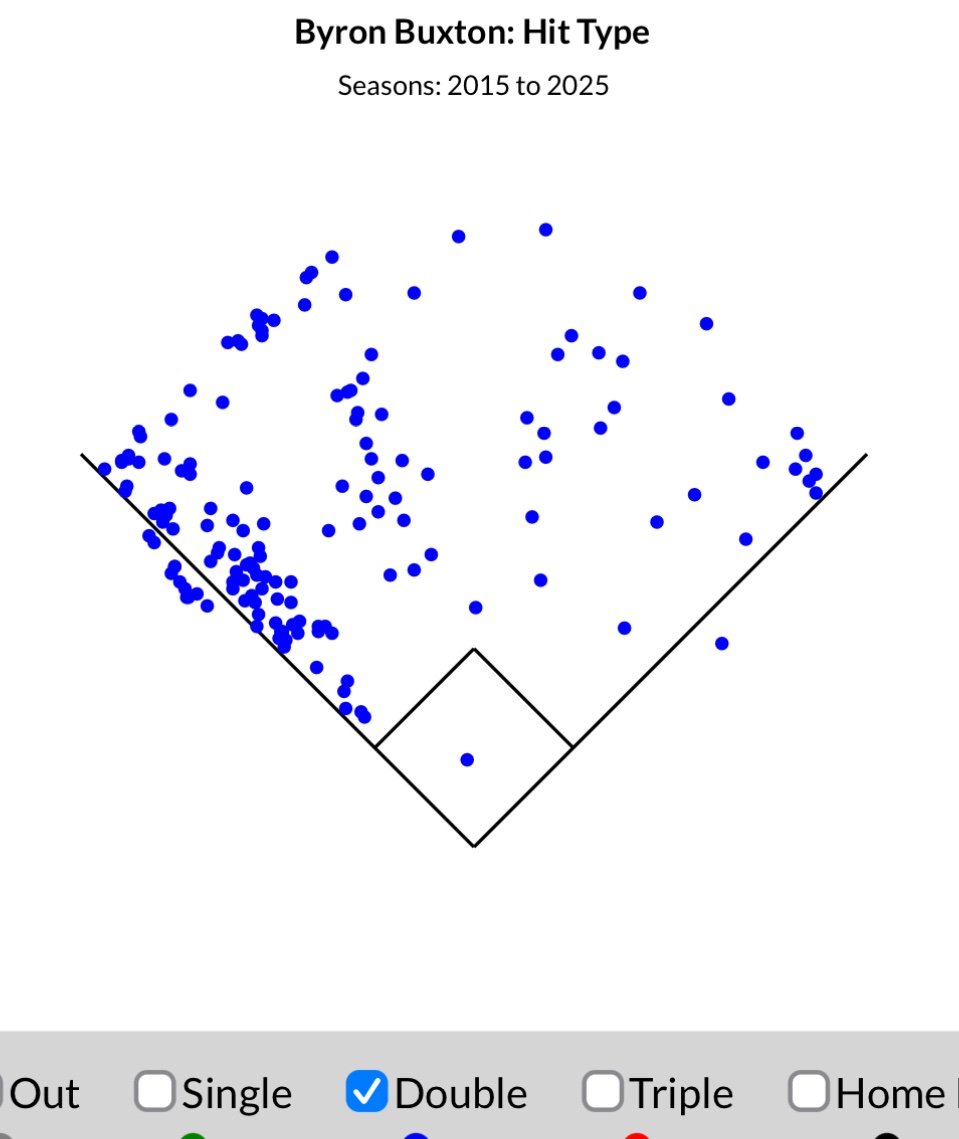
I’ve also argued that Buxton spends comparatively little time on first. He has enough power that people have to play him deep. When they do, there’s an even greater likelihood of him turning singles into doubles. For comparison, here’s Correa’s spray chart of career doubles. He has many more doubles than Buxton because of having 60 percent more plate appearances, but for him to get a double it has to be down line or deep in the gap. By comparison, here’s Buxton’s: Look at how less concentrated on certain areas it is. I especially notice the number of “singles” to short left center that Buxton turned into doubles.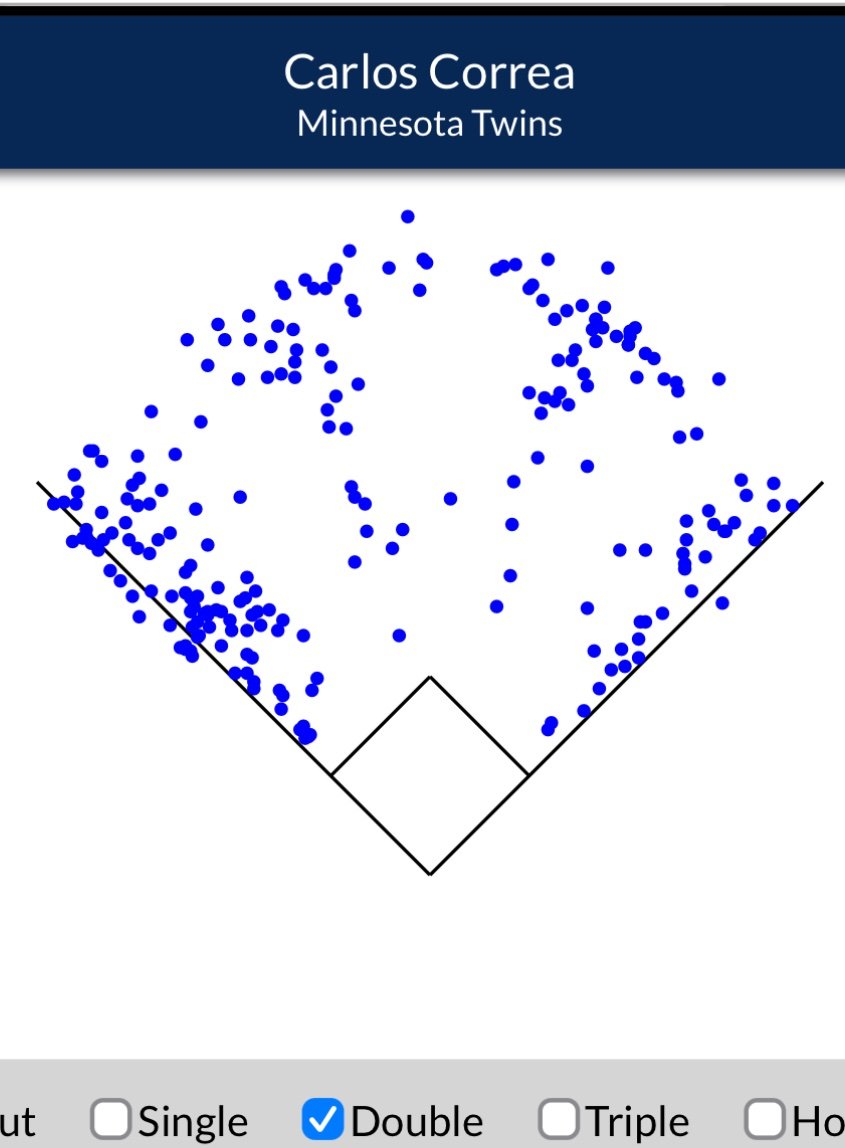
-
Guardians 4, Twins 3: Yet Another Wet Slap
IndianaTwin replied to Matthew Taylor's topic in Twins Daily Front Page News
And so when you aren’t scoring, you end up taking more risks, like France going on that play because Clemens and Vazquez are coming up… I’m still too much of an optimist to think they are out of it. I mean, flip even two of the meltdown games from the guy many were seeing as their most dependable reliever and who seems to be getting back on track and they are 15-17 and 4.5 games out. That’s a disappointing start, but has a much different feel (at least to me) than 13-19 and 6.5 out. As someone pointed out, their run differential is actually positive on an offense that has been missing arguably its best hitter (Wallner) and is getting one of their (potentially) best hitters back (hopefully) soon in Lewis, along with a cog that changes the team significantly in going from Clemens to Castro. Check that, going from either Gasper or Bride to Castro because hopefully we’ve already gone from Clemens to Lewis. And you can’t convince me that Correa is a .223 hitter with a .588 OPS. Conversely, Cleveland is five games over with a run differential that’s negative. I think it’s virtually impossible to play .581 ball with a significant negative run differential, no matter how good your fundamentals are. With the look of their offense and starting staff, I think it’s much more likely the negative run differential is closer to reality than the current record. I’m not saying they are going to finish under .500, but I don’t see how they can be a 95-win team, which is where they are playing. I haven’t seen Detroit, but they at least seem more legit. And Kansas City’s in the midst of a hot streak that teams have all the time, but has needed that to get back to .500. The Twins are 6-4 in the last 10 games and have lost three games in the standings to KC. But all that said, they clearly are in a spot where mistakes, bad luck and injuries are compounding. It’s starting to feel a little like the 2016 team, where they went into the season with a reasonable amount of optimism after having finished above .500 with guys like Buxton, Sano, Kepler and Polanco on the horizon and somehow turned it into a 103-loss season. Sometimes you get in a spiral that’s impossible to get out of.- 81 replies
-
- 2
-
-
- simeon woods richardson
- harrison bader
- (and 1 more)
-
Guardians 4, Twins 3: Yet Another Wet Slap
IndianaTwin replied to Matthew Taylor's topic in Twins Daily Front Page News
I was thinking the same while listening, though radio guys also talked about the basepaths being greatly slowed down because of all the diamond dust getting dumped on the field. Sounded like it wasn’t a great throw and Bader still got thrown out.- 81 replies
-
- 1
-
-
- simeon woods richardson
- harrison bader
- (and 1 more)
-
Guardians 4, Twins 3: Yet Another Wet Slap
IndianaTwin replied to Matthew Taylor's topic in Twins Daily Front Page News
Witness it working recently in a key situation with Buxton on third.- 81 replies
-
- 2
-
-
- simeon woods richardson
- harrison bader
- (and 1 more)
-
Guardians 4, Twins 3: Yet Another Wet Slap
IndianaTwin replied to Matthew Taylor's topic in Twins Daily Front Page News
I’ll buy this as potential thinking on Lee’s part, particularly as a coach’s kid, though I’d hope that Lee would get off the bag at least far enough to a) draw a throw and get the run or b) be able to break for third as soon as the throw goes home. Again, I didn’t see it to have a sense of whether that happened. Or whether reactions from players or staff gave any indication toward one of these.- 81 replies
-
- 1
-
-
- simeon woods richardson
- harrison bader
- (and 1 more)
-
Guardians 4, Twins 3: Yet Another Wet Slap
IndianaTwin replied to Matthew Taylor's topic in Twins Daily Front Page News
Oops. Typo. Your first one is what my a) was intended to be, which makes me wonder which run expectancy number I quoted. Maybe my brain cramp was because what I typed is what actually DID happen thanks to Lee’s not running. I hadn’t thought of your second one — that makes sense as well. Probably a little less likely, but very plausible. Thinking of that one, another would be 3B gives up the run, runner realizes he’s going to run into an out and retreats, 3B goes to second to try getting the lead runner, but runner gets back in time. Starting to head towards the esoteric, but it’s at least a little plausible (particularly if the Twins are on defense 🤣).- 81 replies
-
- 1
-
-
- simeon woods richardson
- harrison bader
- (and 1 more)
-
Guardians 4, Twins 3: Yet Another Wet Slap
IndianaTwin replied to Matthew Taylor's topic in Twins Daily Front Page News
At the risk of breaking a TD rule by injecting math into the discussion, but using the defense that this is a game RECAP rather than a game THREAD… There’s three primary outcomes on this play: a) defense throws home and runner is out, resulting in runners on 1st and 2nd with one out; b) defense throws home and runner is safe, resulting in a run scored AND runners on 1st and 2nd with no outs; and c) defense lets the runner score and gets the out at first, resulting in a run scored AND a runner on second with one out. This ignores the goofy scenarios where the fielder short hops the catcher, the runner is safe and then the defense throws the ball around the infield and everybody keeps moving up or the case where the defense throws home, gets the out and then manages to get a second out at third on the late breaking runner from second (followed by a third out when the batter gets nailed trying to take second amidst the mayhem), yada, yada. Or even the more simple variations like a fielder throwing it away. This is from a 2022 chart and I don’t know how much it changes from year to year, but the remaining run expectancy on a) is 1.00; on b) is 1.55 PLUS the run that scored, so 2.55, right? and c) 0.72 (plus the run that is scored, so 1.72?). (And I get that with the way the Twins have hit this year, you have to reduce each of these numbers by roughly half. 😡) Can you or someone else take it from here? What percentage of the time does a runner need to be safe at home to make it a risk worth taking? -
Guardians 4, Twins 3: Yet Another Wet Slap
IndianaTwin replied to Matthew Taylor's topic in Twins Daily Front Page News
Thanks. That’s helpful.- 81 replies
-
- 1
-
-
- simeon woods richardson
- harrison bader
- (and 1 more)
-
Guardians 4, Twins 3: Yet Another Wet Slap
IndianaTwin replied to Matthew Taylor's topic in Twins Daily Front Page News
@Aggies7, not picking on you, though between the Game Thread and this, I think this is the third post of yours that I've quoted in the last hour or so. You've just initiated some thought-provoking stuff. Take it as compliment, not stalking. I meant to ask the following in the game thread and you reminded me of it. I was following the radio broadcast and they commented about Lee not advancing to third on the play where France got thrown out at home. To me, that sounds like one of the two missing a sign. Did the TV guys have any commentary on that? They've usually run the contact play, but given the nature of who the two runners were and that Lee didn't advance, is there any likelihood they didn't have it on and France either missed a sign or went on his own? It's also plausible that the (almost) rookie either missed the sign or wasn't watching the runner in front of him. Flip side is that they have Clemens and Vazquez coming up, so maybe France has a better chance of scoring than those two do of getting a hit. Was it even close at home? Any clues from the broadcast?- 81 replies
-
- 2
-
-
- simeon woods richardson
- harrison bader
- (and 1 more)
-
I'm sure it's out there, but I wonder what the percentages are for getting an out on that situation, either at second or at home, along with the rare double play and the scenario of getting no outs (and worse, throwing one of the balls away). Realistically, with the tying run on third, if you try for an out, you pretty much have to run the play that tries to get the out at home, don't you? I mean, get the out at second and let the runner score and you've let it be a tie game, albeit with the bases clear. Maybe it's one of those "play for a tie at home and a win at home" scenarios. But all in all, it seems like they've essentially said they are not going to throw. And given what seems to be a pretty low overall success rate at throwing somebody out on just a straight steal, I'd probably handle it the way they did. But yeah, with how they are playing it, second is pretty much a gimme right now with even average runners on base, let alone Ramirez and Kwan.
-
Clearly. There's the whole, "You don't put the winning run on base," and Ramirez certainly steals, putting runners on second and third with one out. So while it takes the bat out of Ramirez' hand, it also gives them two chances to win the game on one single. And while it's tempting to walk Manzardo, that also fills the bases, where a walk ties the game. Ramirez is the toughest guy in their lineup, but at least by pitching to him, it took two hits to lose (barring a homer, which is certainly possible). So while choosing between lousy options, it was probably the right move to pitch to him.
-
Looks like today was game 173, but thanks for digging this up. It just seems like 180 rbi. Or maybe I'm thinking of Sal Perez. Interesting -- by both that number and the tOPS+, the Twins have actually handled him considerably better than other teams, including the White Sox, Royals and especially the Tigers, whom he has crushed. Most of the teams who have done better than the Twins are in the National League with sample sizes of 20 games or less. But he's still really, really good.
-
Yes, he would have. Which contributes to the reason to steal him in that situation. Be successful and you're much more likely to score on hit. Get thrown out and it least gives you a small head start in the 11th to have Bader there rather than Vazquez. (Though letting Vazquez hit would have (almost) guaranteed Buxton getting a bat in the 11th. This way he would have batted fourth.) But alas... (And that said, radio guys said the first throwover was clearly a balk, scoring Gasper and moving Bader to second. True? If so, that changes the inning. Same thing happens and Bader goes to third on the Bride fly ball. Still Vazquez hitting, but with a runner on third rather than first. But alas...)
-
And of course the only Kodai in MLB history is currently on the Mets' 40 (and 26) man.
-
Chief, I think you're better than this. Seems "spreadsheet management" would have taken Ober out after five or six innings on Monday instead of letting him pitch into the eighth. Seems "spreadsheet management" would have pulled Ryan after five or six on Sunday, instead of letting him go seven. I wasn't able to watch/listen last night, but what I see is Paddack having gone 99 pitches last outing (and it seems "spreadsheet management" wouldn't have let him face six batters three times in that game, which he did, by the way), his having already given up hits to two of the three guys he would have faced in the sixth, his having put the first two batters on in the fourth and a bullpen that was about as rested as could be. And there's stuff that none of us can see and none of us have access to. For example, it sounds like the decisions made around the rain delay were screwy, so who knows how many starts and stops there were to his prep during a three-hour rain delay. (And why don't people complain when guys get pulled early when they are struggling, when "spreadsheet management" would say that they need to get a full five innings out of that day's starter?) The Twins didn't lose last night because Rocco's "spreadsheet management" didn't let Paddack come out for the sixth. They lost because they only scored one run. The winning percentage when you score only one run is pretty low. (I'd give you the exact percentage, but it would have to come from a spreadsheet. 😀)
- 101 replies
-
- 8
-
-
- byron buxton
- chris paddack
- (and 2 more)
-
Darlin' Varland? (Sorta)
-
Twins Acquire Kody Clemens from Phillies
IndianaTwin replied to Seth Stohs's topic in Twins Daily Front Page News
You're looking fine, CRF. Very natural. -
Definitely -- networking is as significant in MLB as it is in other professions. Sometimes it's more about who you know than what you know. Being in the right place at the right time is huge. He didn't want to go back to the minors as a coach, so he didn't pursue that, but he felt very connected. Those connections certainly helped him get picked up as a player, given that he had a positive reputation as a good guy to to have in the organization. A person who was a finalist for a managerial job (but didn't get it) told the friend that if he got the job, he wanted the friend on staff.
-
Have a friend who was a backup catcher, the other common spot for roster churning, particularly in response to injury. His baseball-reference.com has 33 lines of transactions and he ended up in more than a dozen systems, several on multiple occasions. From talking to him, I very much get the toll that it takes on family, etc., but he recognized the rules are what they are and seems to be grateful that he had the chance to keep turning a boyhood dream into what ended up being a little over five years of service time. (I also suspect that in the big scheme of things, this "problem" is going to be somewhere outside the top 20 on the list of MLBPA negotiating issues for the next CBA.)
-
Hopefully it's brought to us by even more than 4 Ks.
