NeverSeenATwinsPlayoffWin
-
Posts
205 -
Joined
-
Last visited
Content Type
Profiles
News
Minnesota Twins Videos
2026 Minnesota Twins Top Prospects Ranking
2022 Minnesota Twins Draft Picks
Minnesota Twins Free Agent & Trade Rumors, Notes, & Tidbits
Guides & Resources
2023 Minnesota Twins Draft Picks
The Minnesota Twins Players Project
2024 Minnesota Twins Draft Picks
2025 Minnesota Twins Draft Pick Tracker
2026 Minnesota Twins Draft Tracker: Picks & Bonuses
Forums
Blogs
Events
Store
Downloads
Gallery
Everything posted by NeverSeenATwinsPlayoffWin
-
I think the cash is there so the simulator can accept the trade. The only talk of cash I've seen was moving to MN to pay the rest of DeSclafani's contract.
-
According to BTV, the Twins got double the value for Polanco than they should have gotten. It's not a perfect system, but getting a controllable leverage reliever, a 5th starter (with some money coming from the other side to pay his contract), a team's top-3 prospect (top-100), and a non-top 30 guy is a good get. We have to remember that Jorge has missed half of the Twins' games the last two years and his defense is going to decline even more with his age and injuries. I'm not super happy about it, but with time, this trade will prove to be a good decision, just like the Arraez for Lopez deal last year.
- 336 replies
-
- 23
-

-
- jorge polanco
- anthony desclafani
- (and 3 more)
-
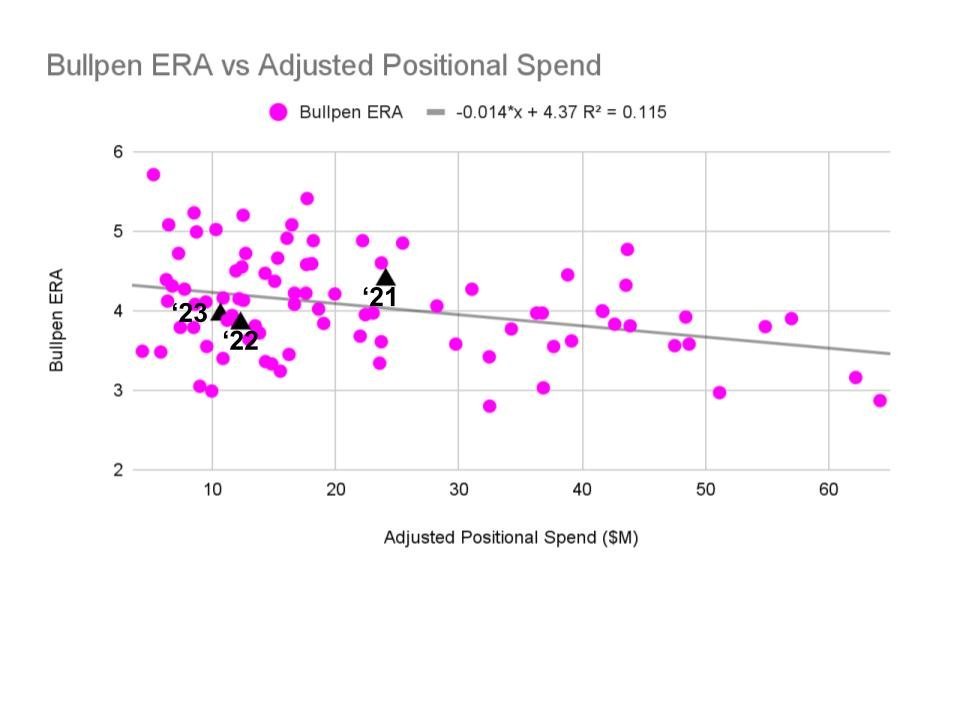
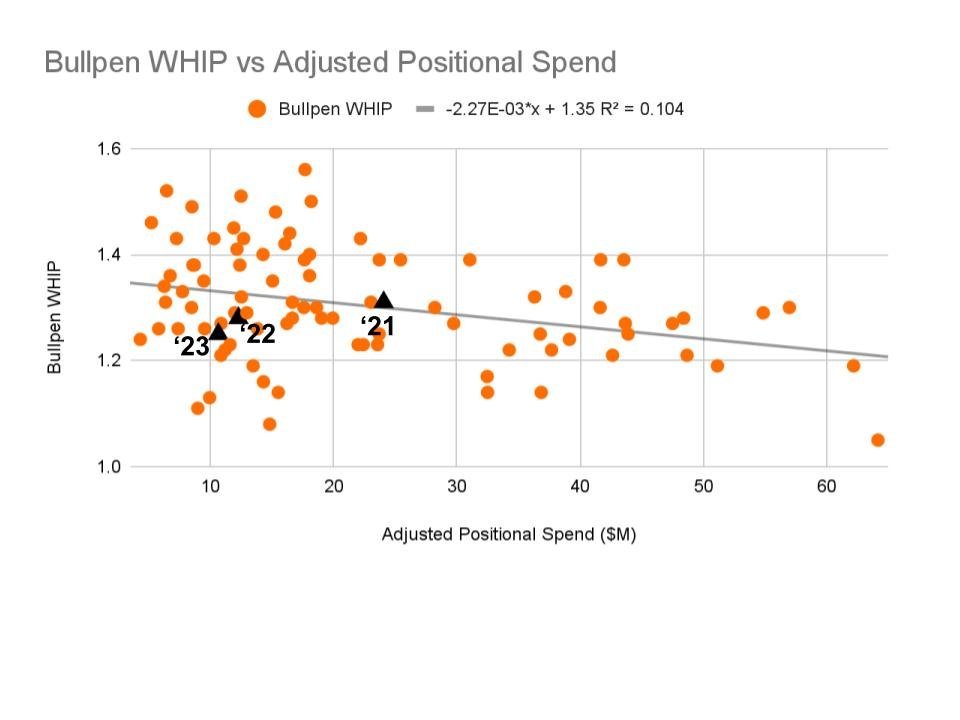
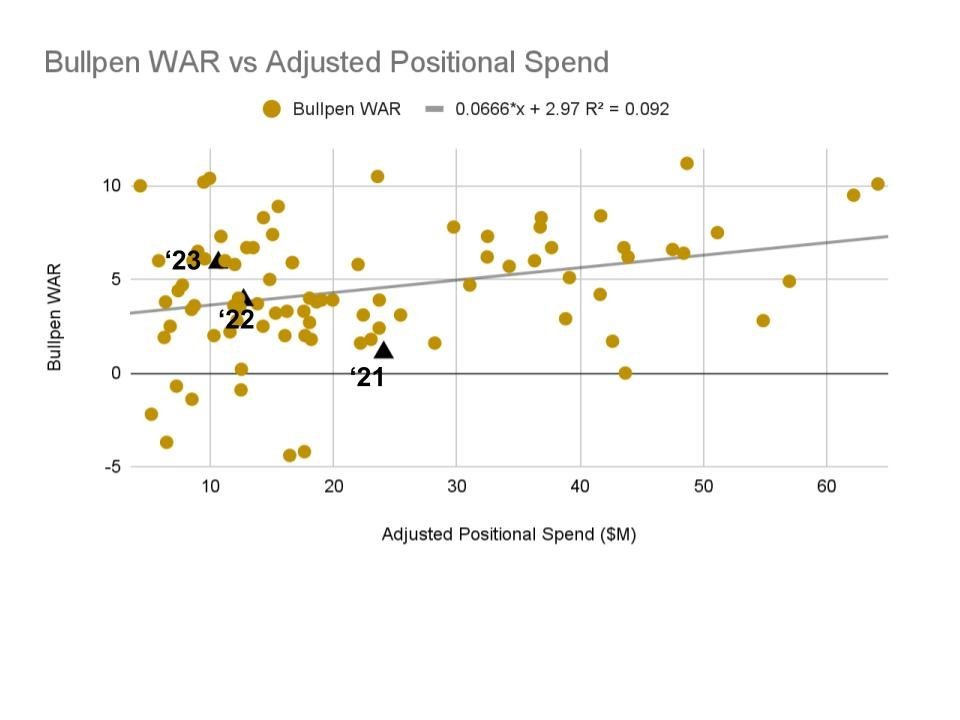
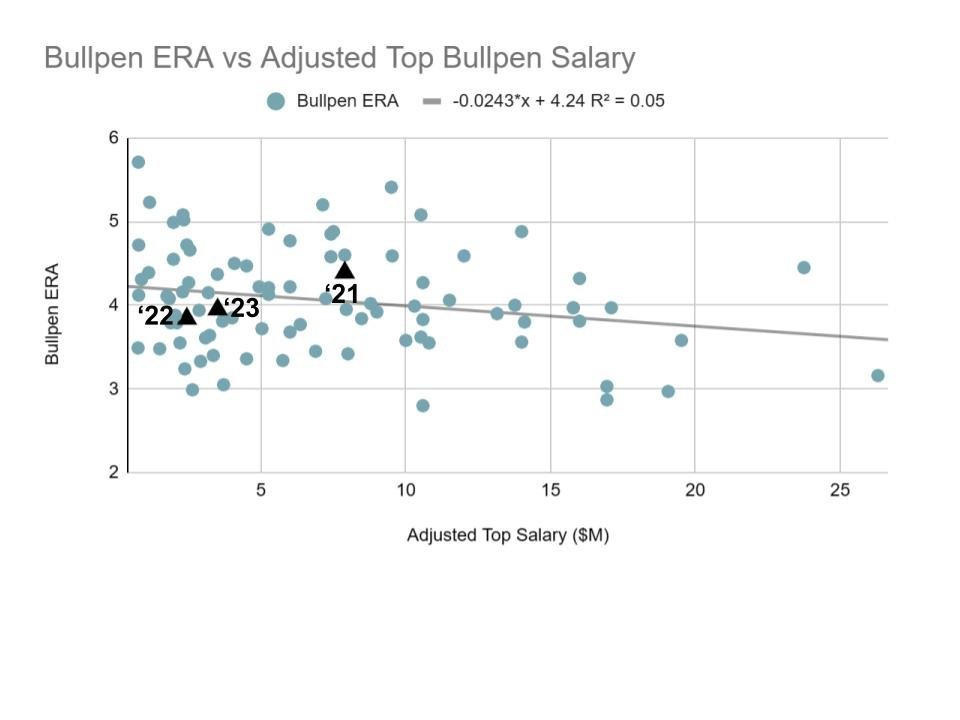
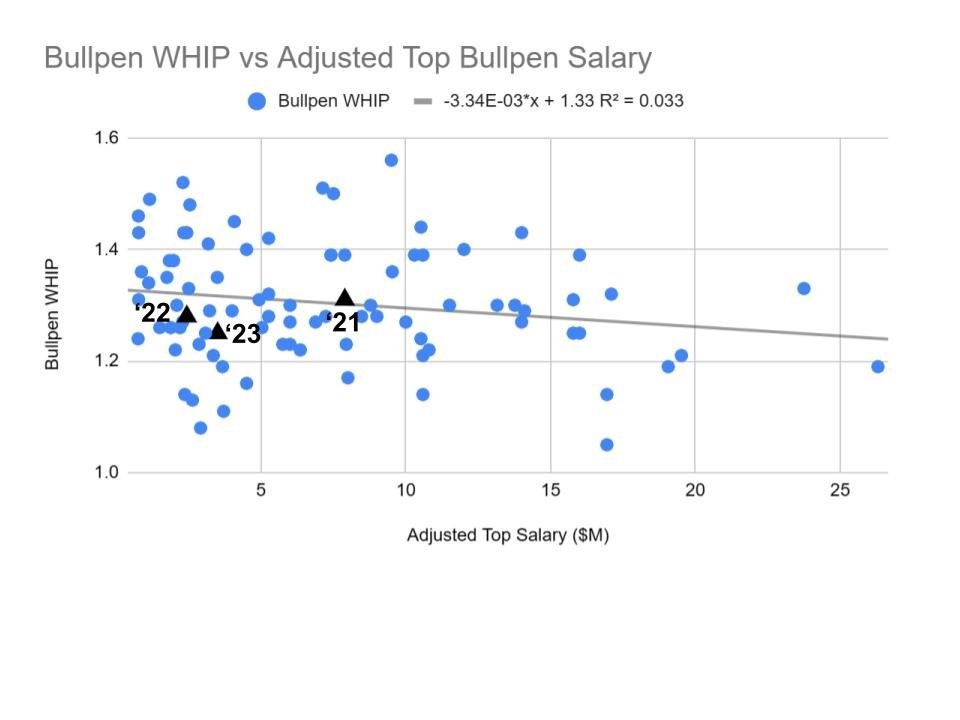
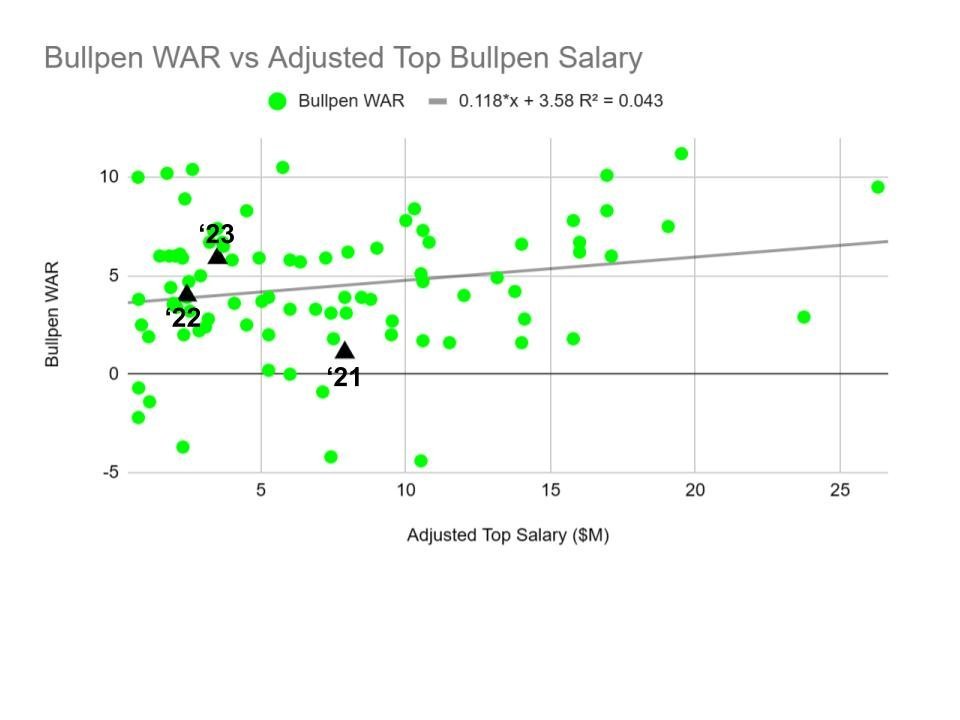
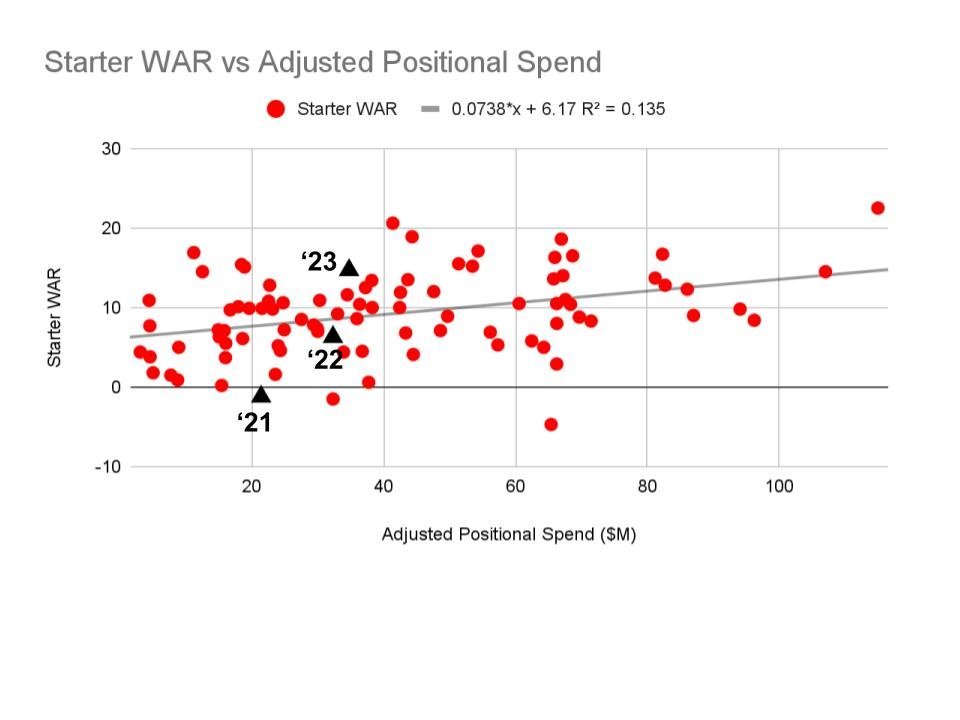
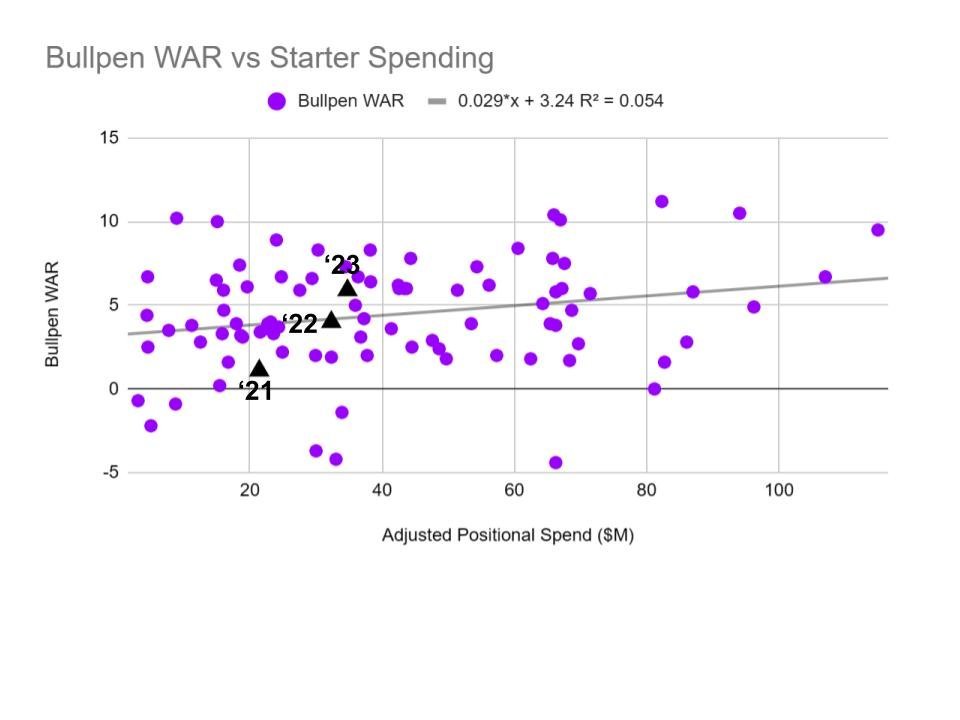
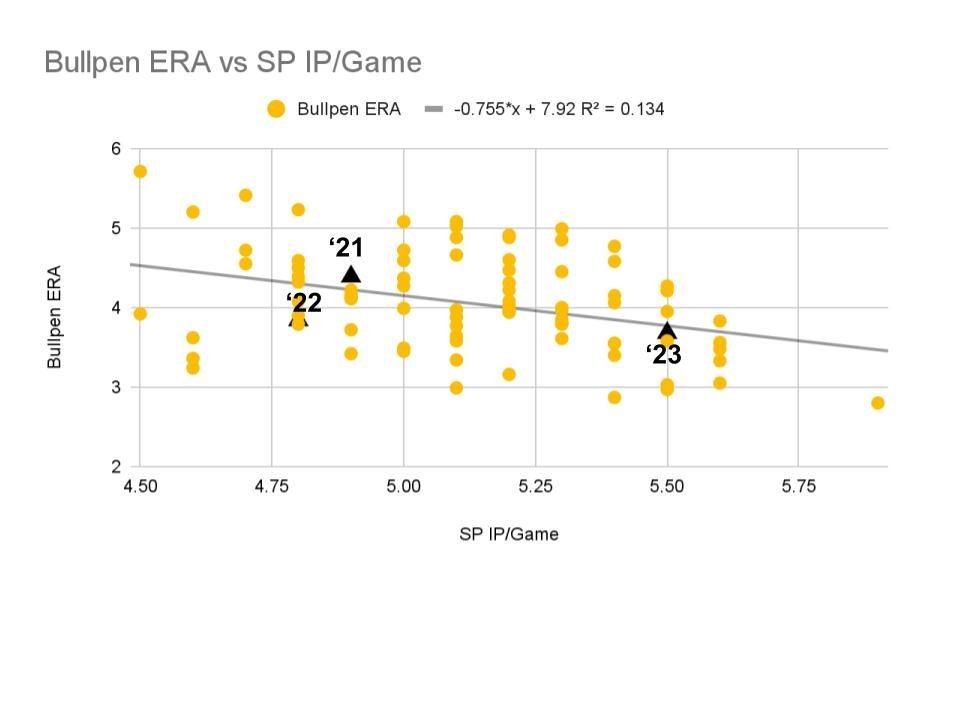
I am a bit disappointed that I finished researching this topic after the top two relievers on the market were signed. The current FO has been very insistent that they don't want to spend on the bullpen. The bullpen was average last season, and it could benefit from some additions. Here's how the bullpen currently looks: CL: Jhoan Duran SU: Griffin Jax, Caleb Thielbar, Brock Stewart MR: Cody Funderburk, Jorge Alcala, Josh Staumont, Matt Canterino AAA: Josh Winder, Jordan Balazovic, Cole Sands, Brent Headrick, Ryan Jensen Off40: Jovani Moran, AJ Alexy, Ronny Henriquez How Well Does Spending Money Correlate to Bullpen Success? As a general rule, players who are paid more money are better than players who are paid less. However, bullpen arms have historically been more volatile than teen girls. Juan Rincon fell apart at age 28. Matt Wisler randomly became the best reliever in baseball in 2020. Joe Nathan posted a 4.84 ERA in the middle of four all-star appearances in five years. One or two disaster outings could ruin a reliever's ERA for the year, or some good luck could make an average Joe look like Mariano Rivera. Here are a few bullpen metrics compared to the financial investment made in them: I compiled data from the last three seasons, as the 2020 season brought some big rule changes that recently impacted the way bullpens have been constructed. "Adjusted Positional Spend" scales the 2021 and 2022 salaries to match the 2023 market, so the '21 and '22 teams would not skew the data because of the lowered salaries in those seasons compared to last year. The r-squared values are exceptionally low, as the data is completely random before the $30M mark. Most mid-to-low market teams reside in this area of the data, and while teams like the Rays, Brewers, and Reds have been able to create lockdown pens on a tight budget, rebuilding clubs like the Royals and Athletics got what they paid for. A couple of trends are worth noticing. Chiefly, the Twins bullpen has improved each year over this span while the overall budget has been reduced. The emergence of Jhoan Duran and Griffin Jax on Pre-Arb contracts has been a big reason for this; the Twins have found more success developing relievers rather than acquiring them. Secondly, once you cross the $30M on the WAR graph, a very high percentage of those bullpens posted very strong WAR values, so there is some evidence to support what the Dodgers, Mets, Braves, Giants, etc., are doing by investing a very large amount of financial capital into relievers. What About Pooling All of Your Eggs Into One Basket? This is a very pertinent question for the Twins. A few back-end arms will create most of the value (WAR) generated by a bullpen. Therefore, it would seem logical to pool all of your money into one guy instead of clogging up your low-leverage roles with $3M/year contracts. Here's what the data looks like: The correlation here is extremely low. The Twins' highest paid relievers for those years were Alex Colome, Emilio Pagan, and Emilio Pagan, so highest paid certainly does not mean best. Although the data is very random, after the $16M mark, those half-dozen or so bullpens were all fantastic. The one exception was the 2023 Mets, who were without Edwin Diaz the entire year. Besides the exception, all of those bullpens were above the trendline on the WAR graph, and all posted a collective ERA under 4.00. Another key takeaway is that the trendline is much steeper on this WAR graph compared to the WAR vs Positional Spend graph. The correlation coefficients are very low, but when the money is spread out, you have to spend $15M, on average to raise the team's WAR by one. When the money is pooled into one player, however, that number drops to $8.5M per win. These large contracts are not particularly risky, either. Looking at BTV, the biggest "underwater" reliever contracts are Rafael Montero, Chad Green, Joe Jimenez, Taylor Rogers, Robert Suarez, and Emilio Pagan, none of whom are closers or elite setup men. Conversely, BTV loves the Edwin Diaz and Emmanuel Clase contracts and is ambivalent about the Hader and Jansen contracts. There's a reason why those top-shelf guys make so much money, and in my view, it's much safer than overpaying a mid-tier reliever. How Do Rotations Affect Bullpen Success? The Twins' increasing bullpen success has also coincided with the rotation going from dreadful to mediocre to wonderful. Would we be better off giving $20M/year to an above-average starter than to an elite closer? Let's dive deeper: There seems to be more correlation (and a steeper variance) between rotation salaries and rotation production than there is in the bullpen. It should be noted that the Twins increased their financial investment in their rotation each year during this span and were rewarded greatly. As it relates to starter spending, however, there seems to be very little correlation between how much teams spend on starters and the effectiveness of their bullpen. One big shift in the Twins' management last season was their usage of starters and letting them work deep into ballgames. This tends to be an effective way to rest your bullpen and ensure that middle relievers are not used in close ballgames. As such, there is a moderate correlation between bullpen ERA and how many innings the starters pitch. If the Twins continue to allow their starters to work into the 6th and 7th innings of games, the bullpen will be much better off. More Key Takeaways After the Stephenson and Hader deals were announced on Friday, lots of teams are going to talk to Hector Neris and Wandy Peralta about medium-length deals for ~$10M APY. While it may seem attractive to add another leverage arm to the bullpen, it seems doubtful that these deals will work out well for the teams that sign them. Both of them are on the wrong side of 30, and xERA, especially, shows that they were extremely lucky last season. I would be very hesitant to add a free-agent reliever at a price greater than $2M/year. Jax and Duran have been healthy the last two years, but Stewart and Thielbar have many injury concerns. As much as I am hopeful for Staumont, Alcala, and Canterino to find new life this year, it's not a good plan to have them be in high-leverage roles if two or more setup men go down. The Twins should look to trade for a reliever who's shown consistency in that role at the MLB level. I like Hoby Milner and Kyle Finnegan as cheap options to raise the floor of the leverage corps. Lastly, I think the Twins should have many conversations with Jhoan Duran and his agent about an extension. We saw how expensive Josh Hader's arbitration became; a $13M/year deal for Duran could be very savvy. If he produces 1.5-3 WAR a year for the rest of his career, that contract will look like a massive bargain by the time he's 29.

-
It'll be interesting to see what the "reduction" in payroll actually means. The payroll situation was tentative coming into last year as well as it looked like Bally Sports was getting ready to fold. In the offseason, a bunch of one-year deals were signed, and the long-term contracts (Lopez and Correa) both get a sizable pay raise in '25 (same with Chris Paddack). I'm guessing that they had anticipated some kind of budget crunch last offseason, and they made decisions accordingly (quiet deadline). The good news, I guess, is that the FO has had a year to plan around budget cuts, however large or small the cut will be
-
Not necessarily. The only MLB moves the Twins had made last year at this point (12/13/22) were the Farmer/Urshela trades on 11/18. Vazquez was signed on 12/16, Gallo on 12/20, Castro on 12/23, and Correa on 01/11. The Lopez and MAT trades happened in late January. It was reasonable to expect that most of the moves would be made within 20 days of New Year's Day at the onset of the offseason, and I haven't seen anything to render that expectation inaccurate.
-
Remembering Random Twins - Dillon Gee
NeverSeenATwinsPlayoffWin commented on William Malone's blog entry in William Malone IV blogs about Twins
The only reason I remember Gee is that he throws a "vulcanchange". Pretty badass name for a pitch, in my opinion. -
Chase Utley is not a hall of famer. Less than 2000 hits, never placed higher than 7th in MVP voting, no defensive prowess, and he's not a prolific postseason hitter. The only reason he's going to be close is because he played in big markets for good teams his whole career.
- 28 replies
-
- 1
-

-
- joe mauer
- yadier molina
- (and 1 more)
-
Introduction The biggest difference between the '22 Twins and the '23 Twins was depth. Arraez, Correa, and Buxton all contributed a lot more to the Twins in '22 than last year, but the difference between players like Jermaine Palacios and players like Kyle Farmer is enormous. Seeing Mark Contreras, Aaron Sanchez, Sandy Leon, Jake Cave, Tim Beckham, Caleb Hamilton, Tyler Thornburg, and Juan Minaya suit up in a Twins uniform gave the team no chance to be competitive down the stretch. Stevenson, Luplow, Garlick, and Keuchel were really the only undeserving AAA veteran depth that played more than a game for the '23 Twins. By acquiring several veterans, the Twins significantly raised the floor of the roster and helped the team improve by nine wins (MAT, Farmer, and Solano accounted for 5.3 bWAR, accounting for more than half of the improvement). Unfortunately, many of those veterans are leaving in free agency, and the Twins will need to find cheap replacements again. Let's look at some players, both hitters and pitchers, who can fill some voids on the Twins roster. Criteria 1. One excellent trait. MAT is an excellent defender and Kyle Farmer hits lefties well and can play every infield position. Veterans usually bring a strong all-around game, but to have upside, veterans being brought in need to have an A+ trait. 2. Cheap in terms trade compensation. The two prospects given up in the MAT trade are equivalent to basically any minor-league free agents available right now. Any player available should be worth less than two Twins top-20 to 30 prospects (about $5M on BTV) to ensure that the Twins can make multiple of these moves without destroying their farm. 3. Cheap in terms of financial compensation. A big reason to perform these types of trades is to avoid overpaying in free agency. Players like Manuel Margot, Willy Adames, Josh Bell, and Anthony Rizzo meet the criteria above but are all due to make more than $12M next year. A limit of $8M of salary will be imposed. Options #1 Jose Urquidy If you can't beat 'em, trade for their #5 starter. Urquidy has been shopped for the past couple of offseasons, but no deal has ever materialized. This year, however, Houston may be more inclined to deal the righty due to his underperformance in '23 and their crop of rookie pitchers that established themselves throughout last year. On the Twins, he'd be a high-level swingman with loads of postseason experience (46.1 IP), and he somewhat fits the mold of what the Twins are doing. His changeup generates a lot of chases and whiffs, and he rarely gives away free passes; Pete Maki should like what he'll be working with. Cost: the Astros have a penchant for developing weird, unheralded pitchers. CJ Culpepper is fair compensation for two years of Urquidy. #2 Tyrone Taylor Tyrone Taylor is a very similar player to Michael A Taylor. Average offense with base-stealing speed and elite outfield defense. A bit of a late bloomer, Tyrone still has three years of team control left. Both Taylors don't walk, they chase too much, and they generally post low batting averages. MAT had an unexpected power output this season, which really propped up his offensive value, while Tyrone has exceeded MAT's .442 2023 SLG every year of his career. He may cost a little bit more in a trade than the other names on this list, but he's a slightly better version of MAT with three years of control. Cost: for a player with lots of control, Milwaukee will want some high-ceiling prospects. Tanner Hall and Ariel Castro are a competitive package to offer. #3 Andrew Kittredge I don't want to see Cole Sands make the opening-day roster, do you? The Twins' front office refuses to spend prospects or money on relievers whose names don't rhyme with Horse-hay stick-of-pez, but Kittredge should be cheap and available. He was the best non-closer reliever in 2021, posting a 1.88 ERA (with peripherals to back it) with outstanding strikeout and walk numbers. Unfortunately for him, he missed most of the '22 and '23 seasons with TJ surgery. His stuff was not as sharp as it was when he came back, but he is 33. He throws strikes, gets chases, and gets lots of extension, and he'll probably only make $2M-$3M next year. Lots to like at a low price. Cost: BTV has his value as negative; take your pick of non-top 30 prospects and send one to the Rays. We'll say Alex Scherff for the former 45th-round pick. #4 Jace Peterson The Twins have plenty of depth in the infield if they keep Kyle Farmer and Jorge Polanco, but what are the odds that both of them are on the opening day roster? As much as I'd love to see Brooks Lee in Minneapolis (we should when he is ready), if Farmer, Polanco, and Gordon are not on the '24 Twins, we'd have to turn to a Jermaine Palacios type of player if one or two guys get hurt. Peterson provides super-utility defense (ability to play every infield spot and LF/RF), base stealing speed, and super-professional PAs (low chase and high walk rate). For $5M next season, Peterson could replace Willi Castro's '23 role if Castro is moved or given a permanent defensive spot. Cost: he has negative BTV value, and Arizona acquired him at the deadline for basically nothing. Wladimir Pinto is a lottery ticket and fair compensation. #5 Kyle Higashioka The Twins don't need a new catcher, but they could move Jeffers and/or Vazquez this offseason. If either one leaves the team, Higashioka is a superior player to any of the free-agent catchers. He is an outstanding framer who provides a decent bat behind the plate. He calls good games and certainly brings a higher floor than Tom Murphy. The Yankees will likely want to give former Twin Ben Rordvedt a shot in the majors next year, and Higashioka may be shopped. If the Twins create a vacancy behind the plate, Higashioka should be the first name on the shortlist to fill it. Cost: Catchers are in short supply, and he won't be cheap. Jose Salas and Ben Ross should be enough to entertain Brian Cashman Final Thoughts If the Twins are going to make some wonky MLB player for MLB player trades, they'll need to find cheap replacements to ensure that their roster stays intact through a 162-game season. By grabbing some high-floor players with applicable skill sets, the Twins can ensure that depth remains a strength of the organization. These type of December/January moves go a long way in August/September when the team is banged up, going through a slump, and you need a consistent presence in the lineup and clubhouse. All five of these guys could provide the same veteran savvy that MAT and Farmer brought last year for a similarly low cost.
- 1 reply
-
- 1
-
-
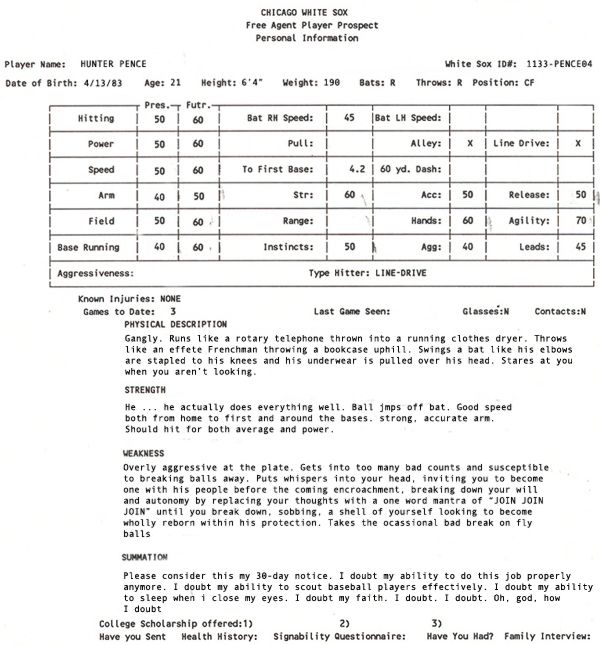
Every single metric that is not the "eye test" is technically a form of analytics. Those old-school scouting sheets like the one pictured below just compare a bunch of raw abilities, and then decision-makers look at their profiles compared to current players and the probability of them succeeding. Now, we have more precise and explanatory ways of determining the likelihood of player success. Instead of saying that a player has 55-grade power, we can say that he had a max exit-velo of 105mph. Instead of assuming a player has a good eye from a small sample size, we can use chase rate, walk rate, etc, to provide evidence. Just looking at all of the categories from the report, they can all be easily replaced by modern statcast data. I don't think teams should care if a player "Swings a bat like his elbows are stapled to his knees," I think they should care about how hard a guy can hit the ball, his ability to take balls, and if he can lift pitches he's trying to blast.
- 16 replies
-
- 1
-

-
- arif hasan
- minnesota vikings
- (and 1 more)
-
His walk rate was also 10.7% in AAA last year. If he were still throwing the ball over the plate, I think he would be great as a spot starter/long reliever, but if we can't trust him to go five-plus innings, he probably does not have a role on the '24 Twins.
- 11 replies
-
- 1
-
-
- david festa
- marco raya
- (and 3 more)
-
Top Trade Candidates
NeverSeenATwinsPlayoffWin replied to stringer bell's topic in Minnesota Twins Talk
We're probably going to have to do a mix of buying and selling, I don't see many teams that will consider an Arraez/Lopez trade. The Marlins, Mariners, and Blue Jays match up with the Twins' needs, but that's not exactly a huge market. My guess is that we'll trade Kepler and Polanco to contenders (preferably in the NL) and then turn around and use prospects to target other guys on that list. With the comp pick from Gray, the Twins should be loaded with capital between rounds 1-3 in the draft, so we should be willing to part with a lot of young A-ball prospects in trades with rebuilding teams. -
I really don't see a scenario where we're going to be punting on '24. If we don't get a TV deal, we'll still need to set ourselves up for a big deal by making the playoffs in back-to-back seasons. In principle, I don't have an issue with Lee and Martin making the opening-day roster. In practice, however, this would mean that infield depth and outfield depth would be really bad. I'm not super hot on the idea of our outfield being Kiersey/Martin/Larnach for a month if multiple pieces get hurt. Same thing with pitching: I am totally fine with a rotation of Lopez/Ryan/Ober/Paddack/Varland, but if Paddack and Ryan get hurt (like last year), our rotation becomes a less-than-stellar Lopez/Ober/Varland/SWR/Festa. The Twins front office should make lots of inexpensive moves (like the MAT trade and Solano signing from last offseason) to raise the floor of the depth so we don't get in a situation where we have to ruin the development of a prospect by playing him too soon or lose important games because a rookie needs to "take his lumps."
- 97 replies
-
- 6
-
-
- brooks lee
- austin martin
- (and 4 more)
-
You do understand that we're going to need 8-10 starters throughout the season, right? If Joe Ryan goes down early, and then we have to shut down Paddack in mid-June because of fatigue- our rotation will be Lopez/Ober/Varland/SWR/Festa. If Thielbar and Alcala go down, our bullpen will be really struggling. We are losing Maeda, Mahle, Pagan, and Gray; that's three starters and our bullpen arm with the most innings. If you count Paddack, that's one starter back, but unless you think that SWR or Festa can come in and be MLB-quality starters instantly, we're going to be very unhappy with the pitching once players (inevitably) get hurt. The existing pitching roster is weak, because I do not want Jordan Balazovic, Cole Sands, Josh Winder, and Brent Headrick penned into an opening day BP role. I would also like Varland to start the year at AAA as depth, and I think we are overestimating Chris Paddack's ability to throw 160 high-quality innings next year- we should not count on it.
-
Rhyss Hopkins, ?? could fill a need ?
NeverSeenATwinsPlayoffWin replied to mrtwinsfan's topic in Minnesota Twins Talk
Looking at some of the recent FA contracts, $15M-$20M is in the range of Rizzo, Benintendi, Conforto, Contreras, Abreu, and others. There is value to be had if he can return to '21 form, but moving away from the bandbox that is Citizen's Bank Park and a severe knee injury doesn't bode well for his chances. I'd rather resign Solano. -
Most of the hype around the Twins is about the offense and the number of young hitters who are already contributing. We were a consensus top-5 offense in baseball in the second half, probably top-2. For me, the pitching question is the most important as it pertains to the Twins' success in '24; the offense is going to be good.
- 46 replies
-
- 3
-
-
-
- sonny gray
- byron buxton
- (and 2 more)
-
Soto and Alonso: Realistic Trade Pieces?
NeverSeenATwinsPlayoffWin replied to cmoss84's topic in Minnesota Twins Talk
I wonder what Soto's market will look like, given that he's only a two-tool player. Joey Votto is the best comp, but he played an actual position for his entire career, and he's been average defensively. Votto received MVP votes in '21, his age-37 season, so I would say that his albatross contract worked out well for the Reds (even if they spent a lot of years losing). How comfortable are teams going to be to give $400M-$500M to a guy who will be a full-time DH in a year or two? -
Introduction The Twins' front office has said that it's going to get "creative" this offseason. Most of us have interpreted that to mean that we're going to see a bunch of trades similar to the Lopez/Arraez deal in the next couple of months. MLB player for MLB player trades are rare in today's game, but there are still plenty of examples of these trades taking place. Here are all of the examples (that I could find) of trades where each team received a player with more than a year of service time over the past three years. 2023- (SEA-ARI) Paul Sewald for Dominic Canzone, Josh Rojas, and Ryan Bliss (ATL-KC) Taylor Hearn for Nicky Lopez (CWS-LAD) Lance Lynn and Joe Kelly for Jordan Leasure, Nick Nastrini, and Trace Thompson (LAD-CLE) Noah Syndergaard for Ahmed Rosario (MIN-MIA) Jorge Lopez for Dylan Floro (MIN-MIA) Luis Arraez for Pablo Lopez, Byron Chourio, and Jose Salas (DET-PHI) Nick Maton, Matt Vierling, and Donny Sands for Gregory Soto and Cody Clemens 2022- (TOR-ARI) Daulton Varsho for Gabriel Moreno and Lourdes Gurriel (OAK-MIL-ATL) Joel Payamps (to MIL) and Sean Murphy (to ATL) for Esteury Ruiz (to OAK) for Justin Yeager (to MIL), Manny Pina (to OAK), Kyle Muller (to OAK), Freddy Tarnok (to OAK), and Royber Salinas (to OAK) (SEA-MIL) Jesse Winker and Abraham Toro for Kolten Wong and Cash ($1.75M) (SEA-TOR) Erik Swanson and Adam Macko for Teoscar Hernandez (NYY-STL) Jordan Montgomery for Harrison Bader (LAA-ATL) Raisel Iglesias for Jesse Chavez and Tucker Davidson (NYM-SF) JD Davis, Nick Zwack, Carson Seymour, and Thomas Szapucki for Darin Ruf (SD-WSH) MacKenzie Gore, CJ Abrams, Robert Hassell, James Wood, Jarlin Susana, and Luke Voit for Juan Soto and Josh Bell (ATL-HOU) Will Smith for Jake Odorizzi (BOS-CWS) Jake Diekman for Reese McGuire (MIL-SD) Josh Hader for Taylor Rogers, Esteury Ruiz, Dinelson Lamet, and Robert Gasser (ATL-CHC) Sean Newcomb for Jesse Chavez and Cash (unknown) (MIN-SD) Taylor Rogers and Brent Rooker for Chris Paddack, Emilio Pagan, and Brayan Medina (NYM-NYY) Miguel Castro for Albert Abreu (NYY-MIN) Gary Sanchez and Gio Urshela for Josh Donaldson, Isiah Kiner-Falefa, and Ben Rortvedt (TEX-MIN) Isaih Kiner-Falefa and Ronny Henriquez for Mitch Garver 2021- (BOS-MIL) Hunter Renfroe for Jackie Bradley, David Hamilton, and Alex Binelas (MIN-STL) JA Happ for Evan Sisk and John Gant (PIT-BOS) Austin Davis for Michael Chavis (CHC-CWS) Craig Kimbrel for Nick Madrigal and Codi Heuer (ATL-CLE) Pablo Sandoval for Eddie Rosario (CLE-HOU) Phil Maton and Yainer Diaz for Myles Straw (OAK-MIA) Jesus Luzardo for Starling Marte (HOU-SEA) Joe Smith and Abraham Toro for Kendal Graveman and Rafael Montero (NYM-TB) Tommy Hunter and Matthew Dier for Rich Hill (TOR-MIL) Rowdy Tellez for Bowden Francis and Trevor Richards (MIA-TOR) Corey Dickerson and Adam Cimber for Joe Panik and Kevin McInvale (NYY-SF) Mike Tauchman for Wandy Peralta and Connor Cannon (OAK-TEX) Khris Davis, Jonah Heim, and Dane Acker for Elvis Andrus, Aramis Garcia, and cash ($13.5M) Final Thoughts -Trading for a young starter leads to high success rates (Paddack/Rogers, Marte/Luzardo, Montgomery/Bader), while salary dumps usually work out for the team dumping salary (Davis/Andrus, Donaldson/Urshela, Winker/Wong). The Twins should be on the right side of both of these trends. -Do not sell low. The Giants fleeced JD Davis from the Mets and the Marlins fleeced Jesus Luzardo from the Athletics. Sell-low players generally don't move the needle much on big-time trades, and it's not worth the risk to let a guy like Jose Miranda go because you needed a sweetener in a deal. -There are certain teams that are more willing to entertain these kinds of deals. Other mid-to-small-market contenders (Rays, Mariners, Brewers, etc) and some larger-market teams (Braves, Yankees, and Blue Jays) have engaged in plenty of these trades. These would be the teams that seem most likely to make a deal with the Twins.
-
- 2
-
-
If you use your cell phone to play an AM radio station, does the universe spontaneously combust? I feel like that would be the equivalent of using AI to run a steam engine.
-
Freddy Peralta has three years of uber-cheap contract left. Again, if the Mariners gave up an MLB top-20, MLB top-100, and two more team top-30 prospects for 1.5 years of Luis Castillo, Peralta is going to be very, very, very expensive. Probably Lee, E-Rod, AND another Twins top-10 prospect. I am not giving up a super package for a guy who's never pitched more than 180 innings. I'd be happy if we were able to acquire any of their stars for a bag of expired fruit snacks, but Burnes, Williams, Peralta, and Contreras are going to be incredibly pricey. Basically, the rest of their roster is high-end middle relievers (which would be dumb to give up significant assets for a middle reliever) or average players whose production can be found in several cheap free agents (like Donovan Solano).
-
Considering how much the Mariners gave up for Luis Castillo, I suspect that Walter Jenkins or Brooks Lee would need to be involved in a trade. In order to gain any value, we'd then have to give Burnes a 30M APY contract. I'm not really interested in anything the Brewers have to offer.
-
Trading for a starting pitcher
NeverSeenATwinsPlayoffWin replied to Brandon's topic in Minnesota Twins Talk
There are a few options for controllable starters: The Mariners have holes at 2B and RF with a surplus of SP. Gilbert, Castillo, and Kirby are (probably) off the table, but Gonzalez, Ray, Woo, and Miller are likely fair game. Rebuilding teams like the Angels (Canning and Sandoval), Brewers (Ashby), Marlins (Cabrera and Rogers), Pirates (Keller), and Rockies (Marquez) have options, but I'd rather make a major-leaguer for major-leaguer trade if we're going for controllable starters. For rentals: -Corbin Burnes -Tyler Glasnow -Shane Bieber -Jose Quintana -Andrew Heaney With how much Pablo Lopez improved last year, I like the idea of trading for a talented young starter that the Twins can turn into a top-20 pitcher in baseball. If the Twins think they can fix Edward Cabrera's control issues, he could turn into a true superstar. -
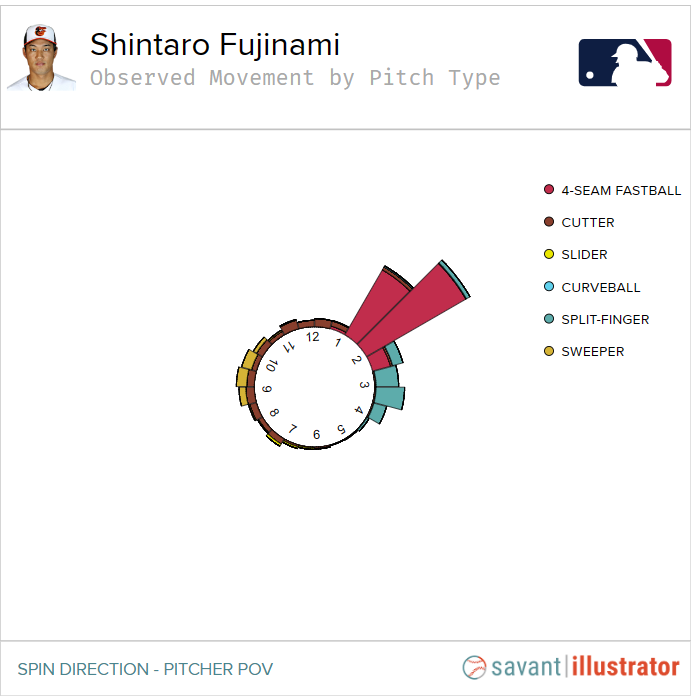
I'm sorry, but Fujinami is garbage, and I don't understand what people see in him besides his velocity. He's extremely wild, which leads to pitchers counts- and then HR and walks: the two worst things that relievers can do. He doesn't get chases because he can't command his stuff, and his secondary stuff is awful, just look at how little observed movement he has on his pitches: Chris Stratton fits the mold of what the Twins want to do (fill up the strike zone and induce fly balls), but Lopez is a sinkerballer that walks a lot of guys; I don't see the Twins having a ton of interest in him. I'd rather call up Miami and see what they want for Scott or Puk.
- 8 replies
-
- 1
-
-
- shintaro fujinami
- chris stratton
- (and 1 more)
-
My guess is that we'll sign one of the best available FA in January. Whoever that is will be up to the 29 other clubs.
- 24 replies
-
- 1
-
-
- sonny gray
- jordan montgomery
- (and 2 more)
-
$20M APY for Wacha is nuts, especially for a small-market team like the Twins. Also, you can extend Royce Lewis for less annual money. He does not give you a ton of innings, his numbers are due to regress and he does not have a strong post-season track record (I believe he was the one who gave up the Travis Ishikawa HR in the NLCS). No, thank you.
-
BTV only has seven free-agent acquisitions with a surplus value of over $20M: Gausman, Freeman, Senga, Wheeler, Harper, Seager, and Eflin. Most of the big-time contracts that are over water are given to players in their first few years (Rodriguez, Carroll, Tatis, Acuna, etc) or, sometimes, to players who have been traded in their arbitration year (Olson, Betts, Lopez, etc). Instead of ponying up a bunch of cash for a player who will most likely not create surplus value for the Twins, let's extend Royce, trade for another starter, and give him a below-market contract (like what we did with Pablo Lopez). The only way to compete with teams paying the luxury tax is to create lots of surplus value- this is the best way to do that with large contracts.
- 28 replies
-
- 6
-
-
- nelson cruz
- andrelton simmons
- (and 3 more)