



NeverSeenATwinsPlayoffWin
-
Posts
205 -
Joined
-
Last visited
Content Type
Profiles
News
Minnesota Twins Videos
2026 Minnesota Twins Top Prospects Ranking
2022 Minnesota Twins Draft Picks
Minnesota Twins Free Agent & Trade Rumors, Notes, & Tidbits
Guides & Resources
2023 Minnesota Twins Draft Picks
The Minnesota Twins Players Project
2024 Minnesota Twins Draft Picks
2025 Minnesota Twins Draft Pick Tracker
2026 Minnesota Twins Draft Tracker: Picks & Bonuses
Forums
Blogs
Events
Store
Downloads
Gallery
Everything posted by NeverSeenATwinsPlayoffWin
-
The only real limitation that wOBA has is that it does not account for negative plays (GIDP) or in-game situations. Both players have negative clutch ratings (Gallo's is worse), but wOBA does not overinflate the value of sluggers the way SLG or OPS do, which is why I chose wOBA/wRC+ to compare Jeffers and Arraez, as it does not overinflate HR production. wOBA and wRC+ help quantify how beneficial players are to run creation (the whole point of an offense in baseball): there are no smoke and mirrors trying to deceive you in my post. I don't understand why you think Joey Gallo is miserable offensively. Yes, a BA of .176 is putrid, but he balances it out by walking a lot. His OBP is .302, which is a bit below league average, but Gallo does have 20 HR in 321 PAs, which is certainly above average. You overrate BA way too much; it doesn't really tell you all that much about the quality of a hitter. A .176 hitter with 20 HR is a much better offensive player than a .250 hitter with 5 HR, especially when Gallo walks as often as he does.
-
The whole point of wRC+ is that every offensive contribution is weighed in proportion to how beneficial certain actions (single, walk, HR, etc) are to an offense. That's why I was not using OPS, SLG, OBP, AVG, etc in my post, because singles are more valuable than walks, and two singles are more valuable than a double and a strikeout. wRC+ doesn't give Gallo, or Arraez any extra boost in the way that other stats do. You win baseball games by scoring runs. If Gallo helps you score runs better than ~50% of MLB hitters, then his offensive contribution is league average. Similarly, if Luis Arraez is helping the Marlins score runs as much as Chris Carter helped the Astros score runs in 2014, maybe we should not be singing his praises to the moon just because he has the highest batting average in baseball.
-
wOBA (and wRC+, by extension) encompasses most aspects of offensive production and weighs them according to how much they help an offense score runs. It turns out that hitting .350 without walking and having no HR power does not help your team score runs as much as hitting .280 while walking 10% of the time and having serious power. I am not dissing Arraez, he makes due with a limited physical profile, and I much prefer him offensively to other slap-hitters like Willians Astudillo. However, his style does not lend itself to helping the offense score runs in the way that a HR hitter can.
-
How Do You Win a Baseball Game? Despite what some people think, you win ballgames by scoring more runs than your opponent. Not having more base hits. Not striking out less. Thus, it would make sense for discussions about offensive values to be centered around run production. While the geriatric among you may think I am referring to counting stats like runs and RBIs, these stats do not tell the whole story of how impactful a player is for an offense. Weighted on-base average (wOBA) is a terrific stat for quantifying how impactful a player is when he's in the batter's box. The formula for 2023 is listed below. One of my biggest gripes with slugging percentage is that it weighs extra-base hits disproportionately high compared to their impact on a baseball game. A triple, on average, is not 50% better than a double, nor is a double twice as impactful as a single, on average. This formula accounts for the true impact of certain plays on a baseball game, where a walk is 78.4% as valuable as a single, a double is 79.0% as valuable as a triple, etc. These coefficients are changed every year to reflect the impact/rarity of events. For example, in 2019 (the year of the juiced ball), the coefficient for HR was 1.940, a bit lower than it is today. There are many run-based stats that are derived from wOBA, such as wRC (and wRC+) and RAA. These statistics ignore in-game factors (runners on base, inning number, etc) and focus on how many runs a player should create given their total offensive production. How This Relates to Arraez and Jeffers The dichotomy between Arraez's perceived offensive value and his actual value illustrates that fans still care way too much about batting average. I am assuming that most fans would place Luis Arraez as one of the 20 best hitters in baseball right now, as he has the highest batting average. However, his good but not spectacular wOBA of .362 tells a much different story. His wRC+ is 128 (28% better than league average), which means that Joey Gallo (owner of a 103 wRC+) is 80.5% of the hitter that Luis Arraez is (in terms of weighted runs created). A wRC+ of 128 is very good, but noted offensive superstars like Kurt Suzuki (126 in 2017), Stephen Piscotty (126 in 2018), Chris Carter (125 in 2014), and Gregory Polanco (123 in 2018) have all had seasons with a wRC+ within 5% of Arraez's campaign. None of these players received an All-Star nod (in that season), a sliver slugger, or MVP votes, and I think it's important that we contextualize the season Arraez is having. Ryan Jeffers, on the other hand, is having a season that's flown a little bit under the radar. His wOBA of .371 and wRC+ of 139 are both fantastic. For reference, Torii Hunter, Eric Chavez, and Andruw Jones never had any season with a wRC+ eclipsing 139. He does have fewer than half of the PAs that Arraez has had, but he's been more impactful on a per-PA basis. He strikes out close to 30% of the time, but his quality of contact is exceptional. A hard-hit rate of 43.9% and an average launch angle of 16.8 degrees means that he's consistently hitting hard line drives. In contrast, Arraez's 23.9% hard-hit rate (much lower than it was in '22) does not give him much ability to do damage in the same way that Jeffers does. He has grounded into a double play three times more often than he's homered, while Jeffers has homered almost twice as often as he's hit into a twin-killing. But... But... But... Some of you may believe that keeping the line moving (not getting out) is very valuable, especially when you hit in front of power hitters. I am pleased to inform you that Ryan Jeffers' OBP is .377, very close to Arraez's .393. Arraez reaches base two more times over the span of 125 PAs, which is not exactly the difference you'd expect between the two players. They both have nearly identical foot speeds (Jeffers has actually been a wee bit quicker than Arraez in '23), and Jeffers has more stolen bases (3 vs 2) and is better in pretty much every baserunning statistic. Jeffers is not a good baserunner by any means, but Arraez's baserunning has been particularly atrocious in '23 (-2.1 BsR per Fangraphs). Jeffers has Arraez beat in most categories except hitting for average, as his power, defense, baserunning, and arm are significantly better. Jeffers also walks enough for the difference between the two's batting averages to be made up. The only credible argument against Jeffers is his lack of PAs.
-
DK made all the difference today. I don't think he bullpen pitches three of four scoreless innings in extras if Keuchel had not pitched five scoreless. The complexion of the extra innings would have looked a lot different if we were not able to use our three best relievers and Dylan Floro. Hopefully, we can get some runs early tomorrow and avoid having to use one of Duran/Thielbar/Pagan for a third consecutive game.
- 62 replies
-
- 6
-

-
- dallas keuchel
- bailey ober
- (and 2 more)
-
Kind of interesting that you mention OPS when I never mentioned it in my comment (I am in agreement that it naturally overrates slugging due to the fact that slugging is almost always a higher number than OBP). wOBA is actually a weighted average, which is why wOBA is much more precise than OPS, as it weighs offensive contributions more fairly. I am curious to hear why you feel wOBA "hides" offensive ability despite the fact that it accounts for XBH, HBP, intentional vs non-intentional BB, and uses PA instead of AB as the denominator. wOBA gives a much better snapshot of total offensive production than a traditional slash line, as 1) it is just one number and is easier to compare, 2) the denominators of the slash line are inconsistent, and 3) slugging disproportionately weighs XBH to offensive production (a triple is not 50% better than a double, on average, nor is a double twice as good as a single). WPA is not a great stat for hitters (as mentioned above, it's basically just RBIs with a college degree), but in my view, it is the best stat for relievers. Giving up 6 ER in one inning does not matter in the top of the 9th of a game your team was already losing 11-1. However, giving up one run in the bottom of the 9th in a tie game is much more damaging, yet ERA would not be able to tell this story. It's the reason why Jhoan Duran's 2022 season (1.86 ERA) is substantially better than Matt Wisler's 2020 season (1.07 ERA). Duran accumulated a WPA of 4.6 (in 67.2 innings), while Wisler's figure was only 0.7 (in 25.1 innings). ERA does not include strand rate, unearned runs (there still is some blame for the pitcher), or leverage. Again, it's the same message from me. Instead of using more accurate numbers that take many factors into account and weigh them properly, you chose to use unweighted and less holistic statistics because you are unhappy with the fact that some nerd is able to make more informed opinions on the game of baseball.
-
Batting average is technically a form of analytics. You just prefer to use outdated and imprecise analytics like batting average rather than more precise data like xwOBA, OBP, and wRC+. Every manager will use some form of analytics to make decisions. Some use traditional statistics like ERA, batting average, and RBIs, while others use newer analytics like WPA, wOBA, and SIERA. Analytics is using numbers to tell a story, and you prefer narrower, less holistic analytics, to tell a narrow-minded and incomplete story about certain baseball players because they play a style which you don't agree with.
- 61 replies
-
- 2
-
-

-
- kody funderburk
- austin martin
- (and 3 more)
-
Currently, there are eight AL teams with a record above .500. With the recent "struggles" of the Rangers and Rays, as well as the lack of dominance from recent perennial pennant chasers like the Astros and Yankees, the field lacks (a) juggernaut(s) at the top, like the NL. The field is very even this year, and the AL pennant will likely be determined by who gets hot at the right time. Baltimore Orioles: 79-48 (101-61 Pace) Traditionally, a 100+ win team would qualify as a juggernaut. They do have an elite back end of the bullpen and have only lost 11 one-score games (tied for first in MLB). They also have an AL-best 42-31 record against teams with a winning record, indicating the strength of their performance against top teams. However, there are a couple of big question marks. Their offense has scored fewer runs than the 4th-place Red Sox, and they've conceded more runs than all but two of the teams on this list. They currently only have one starter with a sub-4.00 ERA (Kyle Braddish), who is only in his second season. Relying on two or three of Kyle Gibson, Jack Flaherty, Dean Kremer, Grayson Rodriguez, or Cole Irvin to fill out the rest of your rotation seems suspect (at best), and it hurts the O's chance of a World Series quite considerably. Tampa Bay Rays: 78-51 (98-64 Pace) The team that was a juggernaut through the first two months of the season has cooled off considerably; however, the Rays still boast a terrific lineup. They've scored the second most runs in the AL, and have known clutch-hitting-master Randy Arozarena. After the injury to ace (and likely top-2 Cy Young guy before injury) Shane McClanahan, the third spot in their playoff rotation remains a still-strong Aaron Civale. There are seven bullpen arms with sub-3.50 ERAs (with at least 25 appearances), and they sport (probably) the best staff in the postseason despite losing a top-5 pitcher in baseball. Run differential is a flawed stat, but they are 3rd in baseball in that category, with an RD twice as high as the Orioles. Although they are not on a historic pace as they were in May, they still remain a very potent team. Texas Rangers: 72-55 (92-70 Pace) Probably the busiest team at the deadline, bringing in Max Scherzer, Aroldis Chapman, Jordan Montgomery, Chris Stratton, and Austin Hedges, the Rangers are making a big push to win now. Besides the Braves, they are the only team that could produce a lineup with every batter possessing an OPS+ above 100, which explains why they've scored almost as many runs as the Braves. They have an embarrassment of riches in their rotation with the aforementioned Scherzer and Montgomery, as well as Nathan Eovaldi, Dane Dunning, and Jon Gray. Their bullpen is probably the biggest reason why they are not on pace for 100 wins, as Aroldis Chapman, Jose Leclerc, and Chris Stratton are their only relievers with a sub-3.40 ERA. As we saw last night (08/24), their bullpen can and will cost them dearly if it doesn't improve. Because of their current seven-game losing streak, they are going to have to fight hard to keep their division crown (and bye-week) in their hands. Seattle Mariners: 71-56 (91-71 Pace) The Mariners have been the hottest team since the deadline, and if they can keep this up, they will be the definition of "it's not how you start, it's how you finish." Again, run differential is a flawed stat, but they are within one RD of the Orioles. They have conceded the second-fewest runs in baseball, and top to bottom, they rival the Rays for the top staff in baseball. A rotation of Luis Castillo, George Kirby, and Logan Gilbert looks terrific, and the Mariners' great depth in the bullpen would allow them to fill a potential 4th-spot with a bullpen day (or rookie Bryce Miller, who has a 3.78 ERA). Their lineup was pretty terrible in the first half, but their recent hot streak has been propelled by their offense, and their season numbers are now closer to league average (on offense). Houston Astros: 72-57 (90-72 Pace) The defending champions are in a very precarious position. With the surging Mariners and the strength of the Orioles/Rays, the Astros are currently in the 6th seed, and the way everyone is playing, it appears more like The Jays/Sox have a better chance of catching up to them than the Astros do of catching the Mariners/Rays/Orioles. Their rotation, an undeniable strength of their '17-'22 teams, now looks like a weakness, with Framber Valdez and Justin Verlander being the only guys who are unquestioned playoff starters. Likely two of JP France, Hunter Brown, Christian Javier, Brandon Bielak, or Jose Urquidy, will be needed to make multiple starts if the Astros are to make a deep playoff push. Although they've scored a lot of runs, they only have six guys with an OPS+ above 100, indicating that their lineup is very top-heavy. The backend of their bullpen is fantastic, as usual, but the Astros, as a whole, seem a lot weaker than in years past. Toronto Blue Jays: 70-58 (89-73 Pace) They are the best team at preventing runs and have a terrific postseason rotation of Gausman/Berrios/Ryu/Bassitt. Bichette, Chapman, Guerrero, and Belt form the bulk of their offensive firepower, as down years from George Springer, Alejandro Kirk, and Daulton Varsho have limited the overall offensive production. The hype about the Rays/Orioles has stolen a lot of the AL East media oxygen from the Blue Jays, but rest assured, they still present a very formidable squad. Their remaining schedule looks very favorable, as their next five series are against weak opponents, including the worst three teams in baseball (Rockies, Royals, and A's), and I would wager that they will be in a playoff spot come Labor Day. Their bullpen has a decent amount of depth, and Jordan Romano is back and healthy. The 11-year-old in me would like to mention that Tim Mayza has an ERA+ of 420, which is extremely good. Their rotation gives them great strength, and their offense, while unimpressive so far, has enough quality to compete in October. Boston Red Sox: 68-60 (86-76 Pace) Another team that has not been getting the time of day because they don't currently occupy a playoff spot, the Red Sox, are sneakily within 3.5 of a playoff berth. Their remaining schedule is not easy at all; however, they do have remaining series against the Rangers and Astros, giving them some amount of control over their future despite their 11.1% odds to make the postseason (per baseball reference). While they may not have the name recognition, Bryan Bello, Kutter Crawford, and James Paxton, all have sub-3.80 ERAs and could be an okay rotation in the postseason. Similarly, their lineup, while not possessing marquee names like years past, has performed very well, and they've scored the 6th most runs in the MLB to date. Unlike years past, this Red Sox bullpen is not god-awful, with Jansen, Winckowski, Martin, and Bernardino all possessing sub-3.10 ERAs and the ability to avoid bullpen implosions on the order of the 2016 Cincinnati Reds. Minnesota Twins: 66-62 (84-78 Pace) In 1987, the Twins won 85 games, they had a new uniform design, and the last remaining undefeated team started the year 13-0. The Twins are currently within a game's pace of completing this trifecta, though they'll need more than weird coincidences to make a deep playoff run. Sonny Gray, Pablo Lopez, and Kenta Maeda form a terrific three-man rotation, with the top two likely top-10 finishers in AL Cy Young voting and the bottom one having a second-place finish the last year he was healthy (albeit in the COVID-shortened season). The bullpen quartet of Duran, Jax, Thielbar, and Pagan likely ranks around the middle of the teams on this list, and starters like Joe Ryan and Bailey Ober give plenty of depth and flexibility to this staff. Their offensive struggles have been well-documented, though they've only scored one fewer run than the Blue Jays. The lineup is certainly flawed, over-relying on young guys like Jeffers, Lewis, Kirilloff, and Julien to provide a spark, while veterans like Correa, Buxton, Vazquez, and Polanco have not produced much. They are certainly not an impressive or scary postseason team, but they will be playing an opening series at home, and we've seen where good pitching can take teams in October. My Rankings: 1. Tampa Bay Rays 2. Seattle Mariners 3. Baltimore Orioles 4. Texas Rangers 5. Houston Astros 6. Toronto Blue Jays 7. Minnesota Twins 8. Boston Red Sox Conclusion: There are three echelons within my rankings, as the Rays and Mariners stick out as clear top teams, while the Red Sox look like long shots to play October baseball. I weigh pitching very heavily, and the two best pitching staffs occupy the top two spots on my list. I am not very high on the Orioles because of their weaknesses in the rotation, and I would likely rank them 6th/7th if they were on pace for 90 wins as opposed to 100 (the bye-week played a role in this decision). Sticking with the theme of bye week, the Rangers seem likely to lose theirs, but the quality of their rotation and lineup cannot be ignored. In the ALWC and ALDS, it is easier to mask deficiencies in your bullpen, and they remain a dangerous team despite their losing streak. I gave the Astros the edge over the Jays because of their experience, and I am not too concerned about their rotation, though it is considerably weaker than last year. The Twins have the worst record and offense, though they have the edge over the Red Sox, as their pitching staff, though underrated, is still by far the worst on this list.
-
Greatest Twins Individual Offensive Season Ever?
NeverSeenATwinsPlayoffWin commented on arby58's blog entry in Arby58
I would make a case for Mauer's MVP season. He led MLB in each slash category AVG/OBP/SLG while playing catcher. Mauer's OPS (1.031) was actually higher than both Carew's and Killebrew's MVP seasons. Mauer's '09 season is far and away the best offensive season by a catcher in baseball history, while there are many better offensive 1B seasons than Killebrew's and Carew's MVP seasons. -
The AL Central has been bad in 2023. Fortunately for the Twins, the lack of competence exhibited by the other four members of the division will likely result in a playoff berth. While the assumption would be that the division could not possibly get worse, I believe there is a really strong chance that the AL Central remains a garbage heap for the next half-decade. The Kansas City Royals: The last small-market team to win a WS, the Royals dismantled the core of their 2015 championship run at the end of the 2017 season (mainly via players walking in free agency) and proceeded to lose 100+ games in '18 and '19, resulting in two top-5 selections in the MLB draft. They used their 2nd overall pick on Bobby Witt Jr in '19, but Asa Lacy (4th OVR '20) looks like a bust. Since Witt graduated, their farm system has ranked among the worst in the league (currently ranked 29th by MLB.com), and they have really struggled to develop consistent MLB players. They are currently in the midst of a second rebuild and are at least five years away from making any serious noise. Key Young Players: Bobby Witt (23 y/o, FA '27), Brady Singer (27 y/o, FA '26), and Vinny Pasquantino (25 y/o, FA '28) Farm: 29/30 The Chicago White Sox Boy, their window shut fast. After blowing up whatever experiment they had going on (around '17), they netted themselves a bevy of highly-touted prospects. Eloy Jimenez, Dylan Cease, Michael Kopech, Yoan Moncada, Lucas Giolitto, and others were acquired by trading away Chris Sale, Jose Quintana, and Adam Eaton. Homegrown talents like Luis Robert Jr and Tim Anderson also added excitement to the young team and they looked to be a contender for the next half-decade. In '23, Giolitto was traded, Jimenez and Moncada are playing on underwater contracts, Kopech and Anderson are underperforming, leaving Cease and Robert to be the only true stars left from their rebuild. After berths in '20 and '21 (failing to win a series each time), they are looking to blow everything up again. Key Young Players: Luis Robert (25 y/o, FA '27), Dylan Cease (27 y/o, FA 25'), and Colson Montgomery (21 y/o, MLB #17) Farm: 26/30 The Detroit Tigers Like the Royals and Sox, the Tigers are currently in their second consecutive rebuild. Spencer Torkelson and Riley Greene have looked as good as advertised, yet the rest of their roster/farm looks barren. Their pitching has been banged up, Javier Baez owns one of the worst contracts in baseball, and they really only have two marquee prospects (and not much after that). While their pair of potential superstars may offer the not-so-nice people of Michigan some hope, they don't exactly have a bunch of talent on the farm. On the bright side, they do shed the contracts of Tyler Boyd, Miguel Cabrera, and Eduardo Rodriguez this offseason, so they do have FA money to spend if they are so inclined. Key Young Players: Riley Greene (22 y/o, FA '28), Tarik Skubal (26 y/o, FA '26), Spencer Torkelson (23 y/o, FA '28), Max Clark (18 y/o, MLB #15), and Colton Kieth (22 y/o, MLB #26) Farm: 25/30 The Cleveland Guardians In my mind, the Guardians are the only real threat to the Twins in the coming years. They refuse to spend money; however, they have an exceptionally young (and good) pitching staff and a wave of prospects heading to Cleveland (or already there). Jose Ramirez is currently on the most team-friendly extension imaginable, and only he, Bieber, and Quantrill are making more than $5M in '23. Other young starters like Williams, Allen, McKenzie, and Bibee give Cleveland a plethora of young arms through the '26 season. The real question with Cleveland would be their willingness to spend money, especially on a power hitter, something they sorely lack. Key Young Players: Emmanuel Clase (25 y/o, FA '28), Steven Kwan (25 y/o, FA '27), Tanner Bibee (24 y/o, FA '29), Brayan Rocchio (22 y/o, FA '29), Josh Naylor (26 y/o, FA '26), and Bo Naylor (23 y/o, FA '29) Farm: 4/30 The Minnesota Twins Say what you will about the Falvine FO, but the Twins have at least attempted to be competitive every year they've been in MN. Their payroll is around league average, and they've done a good job of developing hitters, especially. Most of the hope for the future lies in five all-star caliber pitchers under contract through '27, and several highly-touted young hitters. While the farm is not ranked very highly (unlike Cleveland), many recent graduates (Lewis, Julien, Kirilloff, and Wallner) were ranked in the top-100 before losing prospect status. Overall, the organization is quite deep and has a number of ceiling-less prospects/young players that could take the team to the next level. Veteran stars Buxton and Correa are currently signed through '28; however, their contracts look more like Javy Baez's than Jose Ramirez's at this point. Key Young Players: Joe Ryan (27 y/o, FA '27), Bailey Ober (27 y/o, FA '27), Pablo Lopez (27 y/o, FA '27), Jhoan Duran (25 y/o, FA '27), Royce Lewis (24 y/o, FA '28), Walter Jenkins (18 y/o, MLB #16), and Brooks Lee (22 y/o, MLB #18) Farm: 19/30 Conclusion The Twins have a unique advantage in the coming years. With three divisional opponents rebuilding and a Guardians team that refuses to spend, they should seize the opportunity and build rosters for October. Although Cleveland has a ton of highly-touted young players, the Twins can and will field better rosters through the sheer fact that their budget is twice as high. A unique and (somewhat) unprecedented opportunity awaits the Twins for the next four or five years to take a number of hearty bites of the postseason apple. In my opinion, failing to make the playoffs multiple times would be more shameful than the fact they haven't won a playoff game since I've been able to eat solid food. They simply have to take advantage of the competitive advantage they've been handed.
- 20 replies
-
- 12
-
-
Home-grown vs. acquired players
NeverSeenATwinsPlayoffWin replied to PDX Twin's topic in Minnesota Twins Talk
Most of the good pitchers (besides Ober, Jax, and Thielbar) were acquired via trade. I think this FO is good at developing hitters and acquiring pitching while generally not being good at the reverse. -
Pablo Lopez had an ERA of 3.66 and just turned in another scoreless outing. Sonny Gray's ERA is 3.04, and both him and Lopez will likely finish top-10 in AL Cy Young. Kenta Maeda has been fantastic since the break, and Bailey Ober has an ERA of 3.40. Joe Ryan was phenomenal up until the end of June and was a top-15 pitcher in baseball before he got hurt (and then played through injury). Jhoan Duran and Emilio Pagan both have ERAs below 3.08, and Jax/Thielbar round out a good leverage corps. This is probably the best pitching staff the Twins have had in 50 years. I don't understand what Cleveland/KC/Chicago/Detroit being terrible has to do with the fact that the Twins will likely have two top-10 AL Cy Young vote-getters, a closer that throws 105mph, and a leverage corps where every arm currently owns an ERA below 3.70 (All of whom have a positive WPA besides JAX, who owns a -0.1 WPA). The Twins are not responsible for the failures of the AL Central and would still be in the thick of the WC race if they were not in the Central (Especially in the NL). Even the most negative Twins fans have generally acknowledged the strength of the rotations, and I don't really understand your argument or why you feel that the Twins playing in a bad division means that the rotation is not as good as advertised.
-
The 2023 Twins Are Built for October
NeverSeenATwinsPlayoffWin replied to Ted Schwerzler 's topic in Twins Daily Front Page News
Teams are extremely volatile in the postseason. If I am not mistaken, MLB has the most postseason upsets of any of the American sports, and it's generally a surprise team like the '21 Braves, '19 Nationals, '17 Astros, etc, that ends up being the last team standing. For as dominant as teams like the Yankees, Dodgers, and Rays have been in the regular season over the past half-decade, they only have one WS between the three. For every star playoff performer like a David Ortiz, Carlos Correa, or Madison Bumgarner, there's a David Freese, Kenny Rogers, BJ Upton, Ben Zobrist, David Eckstein, or Gene Tenace who will put his team on his back somewhat unexpectedly. The Twins already have known playoff performer Carlos Correa (Career .849 OPS hitter in the postseason, .026 better than regular season), and I bet Royce Lewis, Alex Kirilloff, Ryan Jeffers, or Matt Wallner have some ability to pull an '08 BJ Upton. Or the Twins could flounder as they did in '19 and '20. It really is a crapshoot.- 17 replies
-
- 5
-
-
- sonny gray
- kenta maeda
- (and 1 more)
-
You are acting like the Buxton contract is some 400M/15yr boondoggle. He's getting paid ~15M/yr. That's the same money as is being given to Tyler Mahle, Kyle Farmer, and Chris Paddack in '23. In no way is 15M/yr crippling, nor does it prevent the Twins from being championship contenders. For that logic to run true, again, the Twins should be just as harmed by Mahle and Paddack not producing anything in the rotation, yet they have a top-5 staff in baseball.
-
Jax is a really good reliever. He's in the 94th percentile in a number of important statcast stats like xwOBA, xERA, and xSLG. His ERA (as of 08/14) is below 3.00, and he's helped the Twins win more than he has not (0.5 WPA). His leverage index is quite high (1.67), and he has dealt with jams really well (7.5 base-out runs saved). Sure, he's had some rough patches, but so has Duran (as well as any human being who has thrown more than a full season of major league baseball). While he's been a very good setup man, I believe that some adjustments to his repertoire can turn him from "good 7th/8th inning arm" to "dominant 8th/9th inning arm." When Griffin Jax debuted late in the 2021 season, most analysts and fans lauded the nastiness of his slider (now called a sweeper) and its ability to carry his arsenal. He's thrown his sweeper more times than any other pitch, and it's been extremely effective. In '22, his sweeper had a run value of seven (1.3 RV/100), and he's already up to a run value of eight in '23 (1.9 RV/100). It's been a dominant pitch. Jax's four-seam fastball, while not as lauded as his sweeper, has been very effective since his move to the bullpen. Most of its effectiveness centers around velocity (~96mph), as it doesn't have elite spin rate. He locates it well, especially glove-side (in on LHB), which makes it an effective weapon against lefties and a good set-up pitch against righties. A high-velocity four-seamer is generally effective secondary, and although the pitch is still a work in progress ('23 has been his first year with a positive run value on that pitch), it greatly aids his effectiveness. Jax's tertiary pitches are where he loses some of his zeal. It's hard to make the case that a pitcher relies on a 5-pitch mix to keep hitters off balance when he's using his primary pitch almost 60% of the time. He is not using a changeup 6% of the time to set up his sweeper, nor is his cutter (4%) a setup for his four-seamer. He uses his changeup, 2-seamer, and cutter a total of 20.1% of the time. His run value is negative on all three pitches, and his RV/100 is below two on both his changeup and 2-seamer. His 2-seamer is particularly atrocious; it only offers 18.2 inches of drop and 14.1 inches of run. For reference, Jordan Hicks creates more total movement on his sinker (in both the vertical and horizontal directions), despite it being an average of 4 mph faster. The average hitter against that pitch is basically post-call-up Eddy Julien, and it hurts Jax's ability to be effective. The run value stat estimates that Griffin Jax has given up three more runs than average due to his tertiary pitches, which would lower his ERA from 2.96 to 2.40 if he had not given up the three runs. In my mind, an ERA below 2.50 is good enough to be a set-it-and-forget-it closer, and I think the dominant-end-of-game-arm-Griffin Jax is much closer than many of his naysayers realize. If Jax were to cut out two or three of these pitches, I think he would be much more effective. Elite relievers like Alexis Diaz (and his brother Edwin), Paul Sewald, Clay Homes, Josh Hader, Craig Kimbrel, Emmanuel Clase, Bryan Abreu, Jose Alvarado, and many others utilize two-pitch mixes relying on a fastball and a breaking ball. The Diazes, Sewald, and Abreu specifically utilize the four-seam/slider combo with very good returns. Having a two-pitch mix is very common for relievers, and Jax should not be discouraged from heading down this path. Jax should shrink his pitch mix to throw more four-seamers and sweepers, as they are, by far, his most effective offerings.
-
There is a platoon question at hand here. Pagan is much better against RHB, and Jax is much better against LHB. To me, this is more of a platoon question than a question of which one I prefer as a setup man.
-
Dissecting Dallas Keuchel
NeverSeenATwinsPlayoffWin replied to NeverSeenATwinsPlayoffWin's topic in Minnesota Twins Talk
No, not all data points are in line with his previous two years. Basically every batted metric is at or better than his '15/'17 seasons. Again, his average exit velo allowed yesterday was 81.7mph (at an LA of 1.1, identical to his '15 number), which is well below his 85.7 and 85.5 marks in those seasons. Because of the way averages work, it's likely that you're going to see a hefty chunk of the sample size above the average (duh), so I'm not sure why 9 of 21 batted balls being hit above 90mph is especially concerning. His EV, LA, Sweet Spot %, Barrel rate, xwOBA-CON, xSLG, and walk rate are all in line with his peak numbers. I mentioned at the top how the xBA (and by extension xwOBA) stats are skewed because he didn't strike anyone out, and I feel I am not ignoring any statcast numbers. If you think that I am you are welcome to tell me what I missed and why that stat in particular supersedes the rest of them. Gerrit Cole, who is probably going to win the AL Cy Young, is giving up an average EV of 89.0mph and an average LA of 14 degrees. I am not trying to be nitpicky here, notable pitch-to-contact guys like Framber Valdez and Marcus Stroman both have average exit velos allowed above 90mph. Cole is able to be effective by having a high K-rate, and the latter two make hitters put the ball on the ground (which lowers its speed very quickly as it approaches a fielder). Keuchel needs to make hitters put the ball on the ground, which he did. I am really curious why you believe that his groundball rate is unsustainable. As mentioned in the topic, he's basically working with the same repertoire as he used in '15 with the exception of a less effective slider. His sinker and changeup are both really effective, and there is nothing unsustainable about an average LA allowed being between 1 and 5 degrees. The sinker is essentially the same sinker he threw in '15 and his changeup has more drop (thus inducing more grounders), so the pitch mix is there for him to continue inducing many grounders. The unsustainable numbers that I see in his underlying metrics are his K-rate (no way that is going to be any less than 14% in a larger sample size) and it is likely that his EV allowed is going to go up, as he's not going to induce five or six dribblers in the infield every game. I am also unsure that my stance is unclear. I said that a starter giving five innings of two or three run ball is good for a spot starter. That's a 4.50 ERA (2.5 runs over 5). My main issue with Keuchel coming in was the fact that he has not been as effective in working the count in '22 and '21 as he was earlier in his career. I outlined from the outset how he got into more 3-0 counts and fewer 0-2 counts in recent years. I was not optimistic about his ability to suddenly regain precise control. After Keuchel's start, he showed a good ability to work the count (this is all mentioned in the topic) and hitters hit the ball weakly on the ground (on average). His stuff has not diminished (besides his slider) and so there is a small hope that the '23 Keuchel could pitch like the '15 or '17 Keuchel. That is why I believe, based on past and present performance, that Keuchel deserves to pitch in the rotation for the next couple of weeks over guys like Varland, Sands, and Winder, who have shown that they are not suitable as a 5th starter on a contender. -
Dissecting Dallas Keuchel
NeverSeenATwinsPlayoffWin replied to NeverSeenATwinsPlayoffWin's topic in Minnesota Twins Talk
Balls hit 90+ mph that are at negative launch angle or at a launch angle above 40⁰ are vastly different than line drives hit at the same velocity. The XBH comment refers to the fact that the only two balls hit off of him with a chance of going for a double were a) the double in the 5th and b) the lineout in the 3rd. Guys were not barreling up baseballs and send deep flies to the warning track or the seats. As far as the "No 5th starter of mine will have an ERA above 5.00" line goes, we have to remember that Keuchel is the 8th member of the rotation and is not going to start a playoff game. He's probably going to make three to nine starts while we wait for Joe Ryan to recover. No one is advocating for Keuchel to pitch 200 innings and be a key component of the '24 Twins. He's here to make a few spot starts and give the team a chance to win over the next couple of weeks. As of right now, I am much more in favor of having Keuchel pitch five innings of 4.50 ERA ball than have late June/July's Joe Ryan taking the ball with an injured groin. I am also much more in favor of Keuchel's ability to keep the ball on the ground than to see Louis Varland give up a gut-wrenching two or three run home run towards the end of his starts. Unless you have ten different versions of 2014 Clayton Kershaw, getting 5 innings of sub-5.00 ERA ball out of your eighth best starter is good. You can preen and declare that every pitcher should have a sub-4.00 ERA, but in reality, getting five innings out of spot starters is a success. -
Dissecting Dallas Keuchel
NeverSeenATwinsPlayoffWin replied to NeverSeenATwinsPlayoffWin's topic in Minnesota Twins Talk
Of course, a WHIP of 2 and a 90% strand rate is unsustainable. I would also argue that giving up a base hit on a ball hit under 61mph three times in five innings is unsustainable. Giving up only two XBA-worthy batted balls in five innings is very sustainable. Having an average exit velocity of 81.7mph is extremely sustainable. Having a groundball rate of 61.9% is very sustainable. Keuchel's xERA was 5.49, meaning his performance was worth 3 ER over 5.0 IP. For the sake of argument, we'll just say that he gives up an RBI double to Christian Walker in the 3rd and then strands him. If your 5th starter is able to go out and give you five innings of two or three run ball, that's about as good as you can ask for. It's certainly better than what Joe Ryan has given the Twins over the past month, and it's definitely better than what anyone at AAA would give the Twins (with maybe the exception of Louis Varland). -
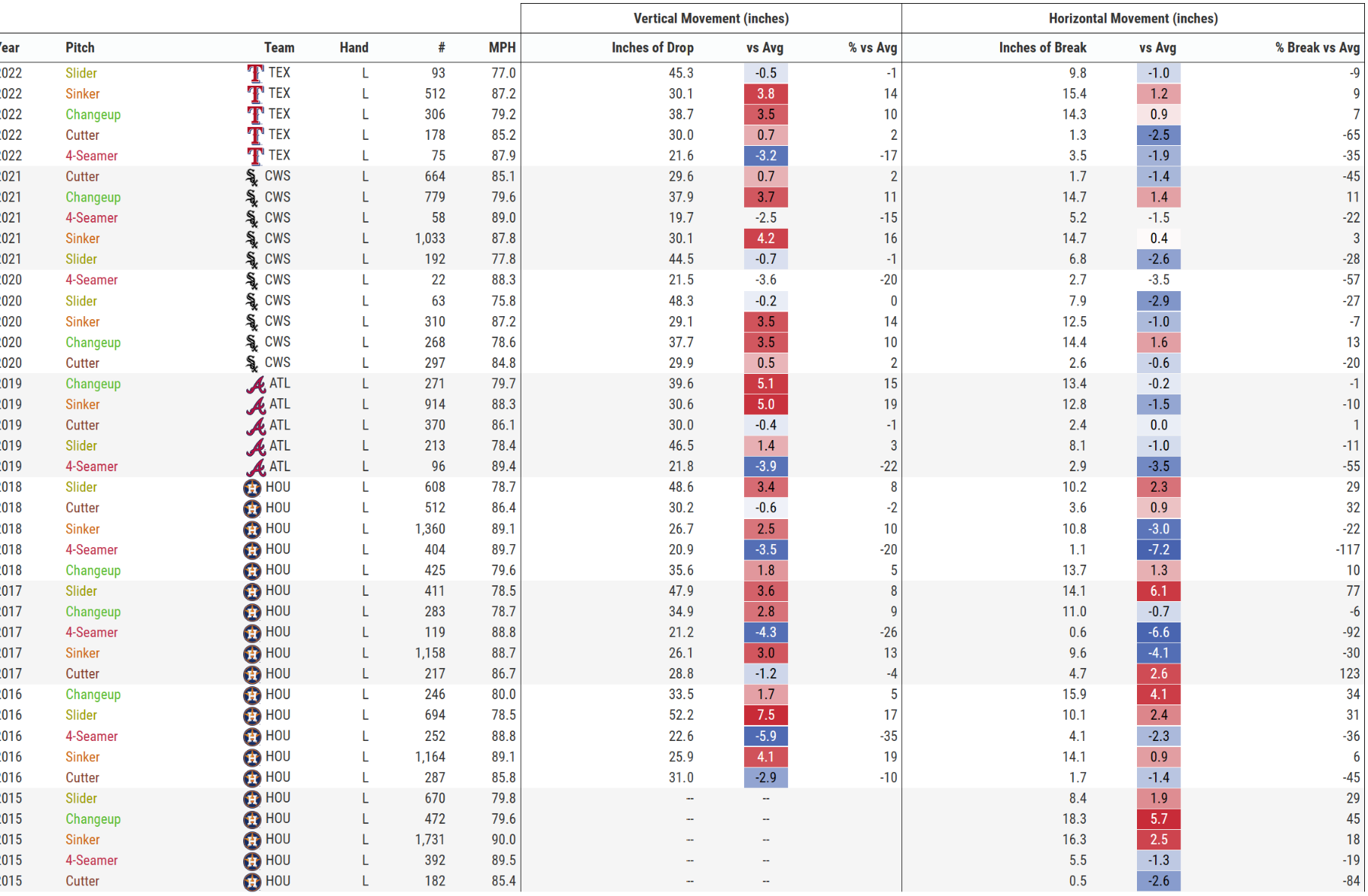
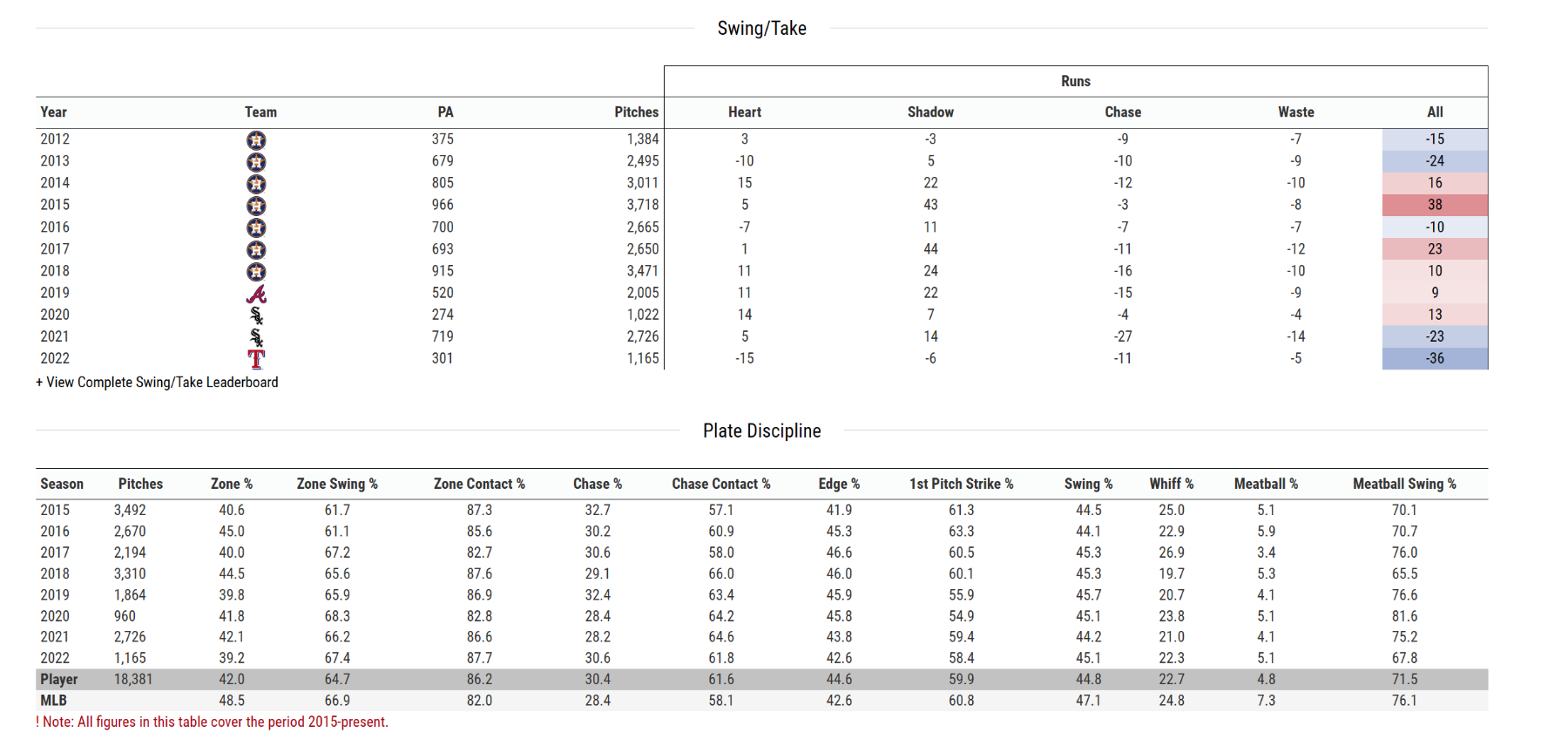
I'll apologize at the outset for a lengthy post, but I do believe that the Twins' FO and coaching staff are going to be having discussions revolving around this topic, and I feel TD should have it, too. Causes of Keuchel's Decline To say that I was skeptical of Dallas Keuchel's ability to be effective as a Twins starter would be an understatement. I definitely fall on the "Keuchel's AAA numbers are smoke and mirrors" side of the debate, and (24hrs ago) I would have rather seen a Varland/Winder/BP day start than Keuchel taking the ball. In my opinion, most of his issues related to a lack of the precise command that won him the AL Cy Young in '15. In that season, his sinker averaged 90.0mph, and in 2016 (the first year statcast recorded vertical movement), it averaged 25.9" of drop (4.1" above average). In 2022, his average sinker velocity was 87.8mph with 30.1" of drop (3.8" above average). This kind of regression is normal-- Clayton Kershaw's average four-seamer has lost 3.0mph in the same 2015-2023 span. Some of the off-speed stuff is not quite there. Keuchel's slider has regressed heavily. It averaged 52.2" of drop and 10.1" of sweep at 78.5mph in '16 while presenting a very hittable 45.3" of drop and 9.8" of sweep at 77.0mph in '22. His changeup was very heavy in arm-side run (18.3" in '15), and he has since traded ~4" of arm-side run for ~8" of drop. Here is a screenshot of his Baseball Savant page with the information about his pure "stuff" (left) and control (right): The information on the right paints a good picture of what is occurring. In '15 and '17, Keuchel prevented over 40 runs with pitches on the edges. His style revolved around pitching the hitter into two-strike counts and then making them swing at a pitch they weren't looking for on a fringe. That being said, the 1st Pitch Strike Percentage and Zone Percentage dropping 4.9% and 5.8%, respectively, since 2016 is quite worrying. He found himself in 3-0 counts 5.1% of the time in '22 (up from 3.0% in '15) and got to 0-2 in 19.5% of his PAs in '22 (down from 22.3% in '15). A changeup on the low outside corner is much more dangerous in 0-2 than it is in a 3-0 count, as the hitter is likely rolling that pitch over if he swings, yet he doesn't have to on 3-0. Pitching into good counts is how the Keuchels/Maedas/Civales of the baseball world make their living. Keuchel has not done a lot of that since the shortened COVID season and it's been his downfall. His inability to work counts in his favor allowed hitters to be much choosier and sit on pitches, which is exasperated by the fact that he only throws in the high 80s. He can't throw an F-you fastball at the numbers the way Duran, Lopez, or Jax can throw on 3-0. Getting into favorable counts is imperative and a key sign of whether or not Keuchel will be able to revive his career. His Twins Debut On a surface level, Keuchel was great in his debut. Pitching 5.0 innings of 1 ER ball is about as good as anyone could ask for, especially when the leverage corps all had a day of rest. If we go any deeper, however, we start to run into some complexity. He gave up 8 hits and 2 walks (2.00 WHIP) while striking out none (4.46 FIP). Of course, the 61.9% groundball percentage is much closer to his '15 GB rate (61.5%) than his '22 rate (50.7%). His hard-hit percentage (28.6%) is lower than any full-season mark of his, as well as his average EV (81.7mph). To see whether the hits were lucky (on the part of the hitters), let's take a look at every PA with Keuchel on the mound. Top 1 Ketel Marte: Flyout (84.9mph at 47 degrees) .020 xBA Corbin Carroll: Walk (N/A) N/A Tommy Pham: GIDP (97.0mph at 0 degrees) .420 xBA Top 2 Christian Walker: Groundout (39.6mph at -57 degrees) .220 xBA Lourdes Gurriel: Single (88.5mph at 16 degrees) .930 xBA Emmanuel Rivera: FC (83.1mph at -26 degrees) .070 xBA Jake McCarthy: Single (59.4mph at -55 degrees) .330 xBA Nick Ahmed: Groundout (96.9 mph at -3 degrees) .330 xBA Top 3 Carson Kelly: Single (64.5mph at -1 degrees) .120 xBA Ketel Marte: GIDP (78.4mph at 6 degrees) .290 xBA Corbin Carroll: Single (98.6mph at 7 degrees) .590 xBA Tommy Pham: Walk (N/A) N/A Christian Walker: Lineout (112.1mph at 8 degrees) .780 xBA Top 4 Lourdes Gurriel: Single (88.4mph at 18 degrees) .760 xBA Emmanuel Rivera: Flyout (94.0mph at 40 degrees) .020 xBA Jake McCarthy: Flyout (75.2mph at 54 degrees) .100 xBA Nick Ahmed: Lineout (97.0 mph at 17 degrees) .490 xBA Top 5 Carson Kelly: Double (103.5mph at 5 degrees) .590 xBA Ketel Marte: Groundout (80.4mph at -8 degrees) .120 xBA Corbin Carroll: Single (60.2mph at 30 degrees) .520 xBA Tommy Pham: RBI Groundout (94.6mph at -16 degrees) .120 xBA Christian Walker: Single (26.8mph at -42 degrees) .250 xBA Lourdes Gurriel: Groundout (93.0mph at -16 degrees) .140 xBA We can use an xBA of .350 to be our threshold of "allowable" xBA, where a hit recorded with an xBA less than .350 is judged to be "bad luck" and an out recorded on a ball with an xBA above .350 is "good luck." Using this threshold, Keuchel had three instances of "good luck" and three instances of "bad luck." His average xBA was 0.343 with two walks, though only one of the eight hits went for extra bases (and none of the "loud outs" would have gone for extra bases except maybe the Walker lineout). An average xBA above .300 is quite atrocious, as it is considerably higher than his .289 xBA mark in 2022, when he was among the bottom 1% of the league in this category. Sample size and the lack of strikeouts are likely the culprit of this large number, though a 15% K-rate would only reduce the xBA to a .292 mark. In terms of working the count, he reached zero 3-0 counts and had the hitter on an 0-2 count 21.7% of the time (very close to his '15 number). In this regard, he performed quite well and was able to get big outs by getting ahead of guys early. Additionally, the McCarthy hit in the 2nd, the Carroll hit in the 5th, and the Walker hit in the 5th all had xBAs above .250 despite being hit slower than 61mph. Expected batting average incorporates the batter's footspeed, and three balls hit under 61mphs resulting in hits is bad luck (despite what xBA says) as the pitcher has won if he can induce extremely weak contact. Conclusion Obviously, it's hard to make concrete conclusions about a five-inning start. We're still debating how effective Pablo Lopez, Griffin Jax, Sonny Gray, and Emilio Pagan have been, and they have had 69% (nice) of a season to give us data. As it pertains to Keuchel, the early returns are promising. He's using the same pitch mix (sinker/changeup/cutter/slider) that he's used for his whole career and has worked the count in a way we haven't seen from him since his '15-'17 stretch of dominance. His xBA allowed is quite worrying, though three soft singles likely skewed this small sample of data. His groundball rate has returned to the 60%+ range, and he only gave up two extra-base-worthy batted balls in 5.0 IP. On the whole, his performance doesn't raise a ton of additional concern from me; however, it hasn't inspired a ton of optimism, either. I would feel really uncomfortable if Keuchel had to start a playoff game, but as a 6th starter, I think he brings some promise. What do you guys think? Does he deserve to start another game? Was his debut a fluke, or was it a sign that he's a changed pitcher? Thanks for staying with me through this statcast-infused salad, and I hope we can have a good discussion about Keuchel's future with the franchise.
- 64 replies
-
- 13
-
-

-
I think you missed the part of the post about Gray and Maeda's lack of value. Jose Salas is not going to be an impact bat anytime soon, and he (according to BTV) has more value than both of those guys. My point is that if we were to sell, we'd most likely be punting on the playoffs in 2023 while very marginally increasing our chances in 2026 or 2027. In 2023 Max Kepler is a much better player than Trevor Larnach, especially in the field. He does not hit for average and he can be prone to some really ugly at-bats, but he is great defensively and brings more than Gallo/MAT/Vazquez/Farmer at the plate.
-
Civale's trade value was likely 4x-5x higher than Sonny Gray's and 6x-7x higher than Maeda's. Our prospect haul for those guys likely would not have made a meaningful impact in 2024/25/26. There's no reason to punt on playoffs this year just to marginally improve our chances in 2027.
-
Did Standing Pat Make (Some) Sense?
NeverSeenATwinsPlayoffWin posted a topic in Minnesota Twins Talk
With the Guardians losing ace Shane Bieber and trading Josh Bell/Aaron Civale, they seem out of contention. Not to mention that their schedule looks pretty difficult (@HOU/vsCWS/vsTOR/@TB/@CIN/vsDET/vsLAD/@TOR/@MIN/vsTB/vsMIN/@LAA/@SF/vsTEX/@KC/vsBAL/vsCIN/@DET) (13 series against contenders) and they generally have not played great baseball this year. The White Sox, Tigers, and Royals all sold and were not ever going to threaten the Twins. Why Selling Didn't Make Sense While it's hard to imagine where the Twins would be without Jhoan Duran and Joe Ryan, the Twins did not have an Eduardo Escobar or Nelson Cruz to trade this offseason. Per BTV, the values of Gallo (-0.7M), Gray (6.2M), Kepler (-0.4M), Maeda (4.1M), Pagan (-0.4M), Solano (0.8M), and Taylor (1.1M) don't give the Twins an opportunity to reap a big reward. For reference, Jose Salas of .181/.268/.265 (yes, his OBP is better than his slugging percentage) has a median value of 7.7M, and Aaron Sabato, a career .210 hitter in the minors, has a value of 1.5M. Selling Maeda, Gray, Taylor, and Kepler would not have improved the Twins' future outlook in any meaningful way, while drastically hampering the present. Why Buying Didn't Make Sense The Twins are not going to get anything done offensively unless Correa, Buxton, and Polanco step up. All three have had issues this year, and it is hard to imagine the team doing anything in September/October without at least two of those three returning to the all-star caliber players we know they are. As such, adding a bat like Dylan Carlson (who puts up league-average numbers) was not going to put the team over the top. The marginal difference between Max Kepler and Dylan Carlson was not worth the E-Rod+a top 30 prospect that it would have required. Adding a bullpen arm or two did make a lot of sense, especially since Stewart is probably done for the year. I am not going to sit here and defend the FO on this, but adding a mid-leverage rental arm with a 4.00 ERA doesn't add a ton of value. In the next couple of weeks, Thielbar will come back (thus pushing Moran into the low-leverage role he deserves), and he'll form a good leverage corps with Duran and Jax. Floro/Balazovic/Pagan can pitch mid-leverage, and Moran/Ortega/AAA guy can get spoon-fed low-leverage. Certainly not optimal, but this is the best 'pen the Twins have had in my lifetime outside of maybe 2020. What Next? I wrote a topic a couple of weeks ago about how the Twins should consider 2024 when making their moves, since they lose a large number of veterans. After this year, the Twins' payroll drops more than $60M, and they need to figure out a few key spots. They'll need to add a reliable starter (unless you think Paddack and Varland can step into the opening-day roster), a leverage arm (unless you want to hitch your wagon to Stewart/Moran/Alcala), and an outfielder or two (unless you feel great about Kyle Garlick, Gilberto Celestino, and Nick Gordon with half a leg). This is more than accomplishable with $60M. However, they may still make some trades if they can't sign any of the top guys. The Twins made their splashes in the winter and last summer. They have a lot of depth but not enough depth where they can get anything meaningful in a trade. Next year, they are set up nicely with a ton of unused budget and a relatively few holes to fill in reference to the amount of cash they have. The '23 Twins will likely make the postseason, and it's paramount that guys like Lopez, Ryan, Ober, Julien, Lewis, Duran, and Kirilloff get some experience. It's disappointing they didn't add anyone except Dylan Floro, but any middling move we, as fans, wanted would have drained more of the farm system and not seriously increased our chances. Selling would have netted next to nothing and hurt the development of our young players.- 51 replies
-
- 15
-
-
The market was weird this year, and I wish they had added a Brad Hand/Brent Suter/Andrew Chafin/David Peterson. There was no reason to seriously spend for a bat (especially when the market was so thin this year), but you should always look to add mid-leverage relievers at deadlines if you're competing. Unless they plan on running Duran into the ground the way the '16 Cubs used Chapman.
-
Rumor: MLBTR Twins Rumor Roundup
NeverSeenATwinsPlayoffWin replied to Brock Beauchamp's topic in Minnesota Twins Talk
I have been a big fan of Andrew Chafin for a while now. I didn't think he was available, and I am guessing the compensation was not too great. Twins should have been in.

