



Nick Nelson
-
Posts
8,327 -
Joined
-
Last visited
-
Days Won
56
Content Type
Profiles
News
Minnesota Twins Videos
2026 Minnesota Twins Top Prospects Ranking
2022 Minnesota Twins Draft Picks
Minnesota Twins Free Agent & Trade Rumors, Notes, & Tidbits
Guides & Resources
2023 Minnesota Twins Draft Picks
The Minnesota Twins Players Project
2024 Minnesota Twins Draft Picks
2025 Minnesota Twins Draft Pick Tracker
2026 Minnesota Twins Draft Tracker: Picks & Bonuses
Forums
Blogs
Events
Store
Downloads
Gallery
Everything posted by Nick Nelson
-

Twins in the 2000s: The 2003 Season
Nick Nelson replied to Nick Nelson's topic in Twins Daily Front Page News
Ahh, that would make sense. Admittedly I didn't watch with sound on. It just seemed like there was a huge gap in enthusiasm between the players on the field and fans in the stands. -
I see your point but ... is it really a "year of development"? I just have no idea what participation on this taxi squad is going to entail.
- 16 replies
-
- 1
-

-
- rich hill
- jhoulys chacin
- (and 2 more)
-
Looking to deliver an encore after winning the division and narrowly missing the World Series in 2002, these Twins came out flat and flirted with self-sabotage by keeping their best pitcher relegated to the bullpen. But a couple of key midseason moves helped right the ship as the Twins defended their title and settled in to reign over the AL Central.We're running a 20-part series in which we look back at each Minnesota Twins season of the 2000s. A rotation of different writers will highlight key moments, unearth forgotten details, and share nostalgic tales from the past two decades leading up to the present. This installment covers the 2003 season. Team Record: 90-72 Finish: 1st Place in AL Central All-Star: Eddie Guardado (RP) Awards: Torii Hunter (Gold Glove, CF) Playoffs: Lost to NYY 3-1 in ALDS Season Overview The 2003 season represented a big opportunity for a Twins franchise that was looking to repeat as division champs for the first time in more than three decades (1969-70). They had come within three wins of a World Series berth the prior season, and the AL Central was again ripe for the taking. Cleveland sunk below .500 in 2002 as they pivoted into a rebuild following a dynastic run in the division. The Royals and White Sox were mediocre coming into '03, and the Tigers were unspeakably atrocious. This was seemingly a moment for Minnesota to ramp up and capitalize, but instead, it sticks in the memory as a prime example of this organization's inability to make impact moves and get over the hump during Terry Ryan's winning window. One of Ryan's most eventful years at the helm featured more bad than good. Following a 2002 season that saw each of Minnesota's top three rotation staples – Brad Radke, Eric Milton, and Joe Mays – regress, starting pitching was an open question mark. Ryan passed on free agents or trades, trusting the trio to rebound and succeed alongside veteran Rick Reed and young talent Kyle Lohse. In early spring training, the Twins received a grim revelation: Milton needed knee surgery, and it would cost him most the season. The lefty's workload – 970 innings pitched in the majors through age 26 – had taken a toll. He made it back to pitch a few times in September and the playoffs, but would be traded that winter. The silver lining of Milton's absence meant that a path was open for Johan Santana, coming off a rather sensational showing as swing man in 2002. But here Ryan made one of his most infamous and infuriating decisions as GM. Rather than entrusting the 24-year-old Santana and his brilliant stuff, Ryan decided to sign 38-year-old free agent Kenny Rogers, a soft-tossing lefty who embodied the term "rubber arm." Rogers was expectedly mediocre, joining the status quo in a rotation with no standouts. Santana worked in a long relief and spot starter role, posting a 2.86 ERA over 66 innings in this capacity before finally joining the rotation full-time in mid-July. By then, Mays had a 6.57 ERA through 18 starts, courtesy of an egregiously long leash. Reed was proving to be totally gassed at 38 (he retired after the season). Radke was battling through the worst season of his career. Lohse was spiraling after a great start. At the All-Star break, Ron Gardenhire's Twins were looking woeful, back 7 1/2 games in the standings and sinking. Two moves are rightfully remembered as catalysts in the massive second-half turnaround to come: On July 11th, Santana joined the rotation for good after three dominant months in the bullpen. He didn't miss a beat with the role switch, posting an 8-2 record and 3.22 ERA in 15 starts, then starting Game 1 of the ALDS.On July 16th, Ryan traded outfielder Bobby Kielty to the Toronto Blue Jays for Shannon Stewart. As a disciplined, OBP-minded veteran leadoff hitter, Stewart filled a hole that had existed since Matt Lawton's departure. Displacing the incumbent rotation of Kielty and Dustan Mohr (aka Dusty Kielmohr) in right, the newcomer slashed .322/.384/.470 with numerous clutch hits in 65 games for the Twins, finishing fourth in AL MVP voting.Even with Stewart's addition, Minnesota's offense was far from dazzling. The entire division-winning lineup from 2002 had returned, with one glaring exception: David Ortiz, released by Ryan in the offseason to make room for Rule 5 draft pick José Morban, who never played as a Twin. Ortiz signed with Boston and immediately blossomed, posting a .961 OPS with 31 homers and 101 RBIs. He finished fifth for MVP, one spot behind Stewart. The disastrous Ortiz decision haunted Minnesota's power-hungry lineup in 2003, and for many years to come. Absent Ortiz, Gardenhire cycled through many promising young bats in the system, with mixed results. Young outfielders like Lew Ford and Michael Restovich made good impressions in short stints. Former first-round pick Matt LeCroy saw his most extensive action yet, hitting 17 homers in 107 games at age 27. First base prospect Justin Morneau got his feet wet, slashing .226/.287/.377 with four homers in 40 games as a rookie. With a mix of new and familiar faces, the Twins rallied to erase a big deficit down the stretch, going 37-18 after July 31st and putting the Central on ice with an 11-game winning streak (all against division opponents) in mid-September. On September 23rd, they clinched their second straight division title with a win over Cleveland at the Metrodome. You can watch the (strangely subdued?) celebration ensue after All-Star closer Eddie Guardado records the last out around the 1-hour, 53-minute mark in this video: Next up was Minnesota's first-ever postseason matchup against the New York Yankees. The Twins won Game 1 by a score of 3-1 in the Bronx, with the starter Santana tossing four scoreless innings, and then Minnesota's offense completely shut down. They scored one run apiece in the next three games as New York cruised to the ALCS (and eventually a World Series loss to the Marlins). Coming up short against the Yankees in October would become a new norm for the Twins, but across the roster, longtime fixtures were in flux. The arrival of Morneau suggested Mientkiewicz's days in Minnesota were numbered. Meanwhile, Pierzynski had to be wondering about his own future with Joe Mauer fully affirming his status as baseball's No. 1 prospect, conquering Double-A and making a clear case for MLB readiness. Team MVP: Shannon Stewart, LF Other Contenders: Johan Santana (SP/RP), Corey Koskie (3B), A.J. Pierzynski ©, Torii Hunter (CF) With this choice, I'm betraying my own analytical scruples. It's tough to make a pure statistical case for Stewart being the team's MVP in 2003. I mean, he played only 65 games with the Twins, ranking fifth among their position players in both fWAR and bWAR. Was he really more valuable than guys like Koskie, Pierzynski and Hunter, who put forth quality production all year long while providing excellent defense at key positions? In this case, the narrative wins out. Stewart finished fourth in AL MVP balloting – behind Álex Rodríguez, Carlos Delgado and Jorge Posada – as observers everywhere took notice of the Twins' total transformation following the trade. And this narrative isn't totally baseless; despite being with Minnesota for less than half a season, Stewart led the team's position players in Win Probability Added (2.17). 3 Most Pivotal Games July 17th: Won vs. Oakland Athletics, 6-2 In the first contest out of the break, Stewart made his Twins debut, with Minnesota sitting a season-high 7 1/2 games out of first. The big addition had a quiet night, finishing 0-for-5, but nonetheless the Twins notched a big win thanks to five first-inning runs against Tim Hudson (owner of a 2.71 ERA coming in). The victory sparked a five-game winning streak, as the Twins ignited their second-half surge. September 18th: Won vs. Chicago White Sox, 5-3 On September 15th, Minnesota completed a four-game sweep in Cleveland and took sole possession of first place for the first time since June. Next up: a chance to widen their half-game lead, with three home tilts against the White Sox team they'd just supplanted. The Twins won the first two games behind Radke and Rogers. In the third, Lohse outpitched Bartolo Colon while Jones homered twice in another sweep-clincher. It pushed Minnesota up by 3 1/2 games in the standings with only eight left to play. October 2nd: Lost @ New York Yankees, 4-1 The Twins rode their momentum into October with a stunning Game 1 victory at Yankee Stadium, as five pitchers combined to hold New York to a single run. The strong pitching would continue, but in Game 2, Minnesota's bats went silent and stayed that way. Andy Pettitte worked seven innings and Mariano Rivera followed with two as the Twins managed just one score – a solo homer by Hunter in the fifth. The Twins were similarly shut down by Roger Clemens and David Wells in the next two games, and it was over. For now. Unforgettable Highlights Burying Buehrle In 2003, White Sox starter Mark Buehrle was just getting started in a long career full of tormenting the Minnesota Twins, against whom he would win more games (30) than any other opponent. But on one rare and glorious day, May 16th, the Twins got the best of Buehrle, pounding him for 10 runs (nine earned) over 3 1/3 innings in an eventual 18-3 laugher. Kielty drove in five runs and Hunter drove in four. Pierzynski went 4-for-4. Jacque Jones Sets Record for Leadoff Homers On June 7th, in his native city of San Diego, Jones blasted his 20th and final leadoff homer as a Twin. The upcoming addition of Stewart would spell the end of Jones' days as an unorthodox low-OBP, high-SLG No. 1 hitter, but his franchise record for dingers out of the leadoff spot would hold for 14 years until Brian Dozier broke it in July of 2017. New Leaders of the Pitching Staff Make a Statement The Twins lost at home against Cleveland on August 13th by a score of 5-0. So why was this game special? Because up until relievers Juan Rincón and J.C. Romero combined to give up five runs in the top of the 14th inning, the Twins had shut down Cleveland's offense via a trio of hurlers who represented the best of Minnesota's pitching in 2003. Santana fired eight shutout innings. LaTroy Hawkins followed with four strikeouts over two scoreless frames. Guardado then delivered two perfect innings of his own. It's a shame the offense couldn't do anything in this one ... but a fitting preview of the postseason. Hawk Spreads His Wings Two years earlier, Hawkins torpedoed Minnesota's playoff chances with a second-half meltdown as closer. Here in 2003, pitching ahead of Guardado, Hawk reached the height of his prowess as setup man with a 1.86 ERA and team-leading 4.13 Win Probability Added. He was pivotal in the team's rally to the postseason, allowing one run over 24 mostly high-leverage innings in August and September as the Twins surged. In Game 1 of the ALDS, under the brightest spotlight at Yankee Stadium, Hawkins entered in the seventh with no outs and a man on first, Twins leading 3-0. After giving up a leadoff single, Hawkins mowed down six straight, four on strikeouts, bridging to Guardado who closed it out. The Twins have won only one playoff game since. After the season, Hawkins and Guardado both departed as free agents, going out on major high notes. One Detail You Probably Forgot I mentioned earlier that Restovich and Ford had nice showings as young outfielders getting looks in the big leagues, but neither were quite at the level of Mike Ryan, a 25-year-old middling prospect who had one of the wildest and most random Twins stints this side of Glenn Williams (see: 2005). Called up in mid-August, Ryan played semi-regularly down the stretch as Minnesota completed its AL Central comeback, slashing .393/.441/.754 with five homers and seven doubles in 68 plate appearances. His 1.195 OPS in 2003 remains the highest of any season in franchise history for a player with 50-plus plate appearances. Fun Fact Micheal Nakamura, a Japanese-born side-arming righty reliever out of Australia, was a fun project that sadly didn't work out. He signed with the Twins in 1997 and debuted in 2003, but posted a 7.82 ERA in 12 appearances, and was waived the following spring. He had a short stint in Toronto, allowing Gary Sheffield's 400th home run in his second-to-last MLB appearance, then signed with NPB in Japan in 2005, joining the Nippon Ham Fighters alongside an 18-year-old phenom named Yu Darvish. ~~~ Previous Installments: The 2000 SeasonThe 2001 SeasonThe 2002 Season Click here to view the article
-
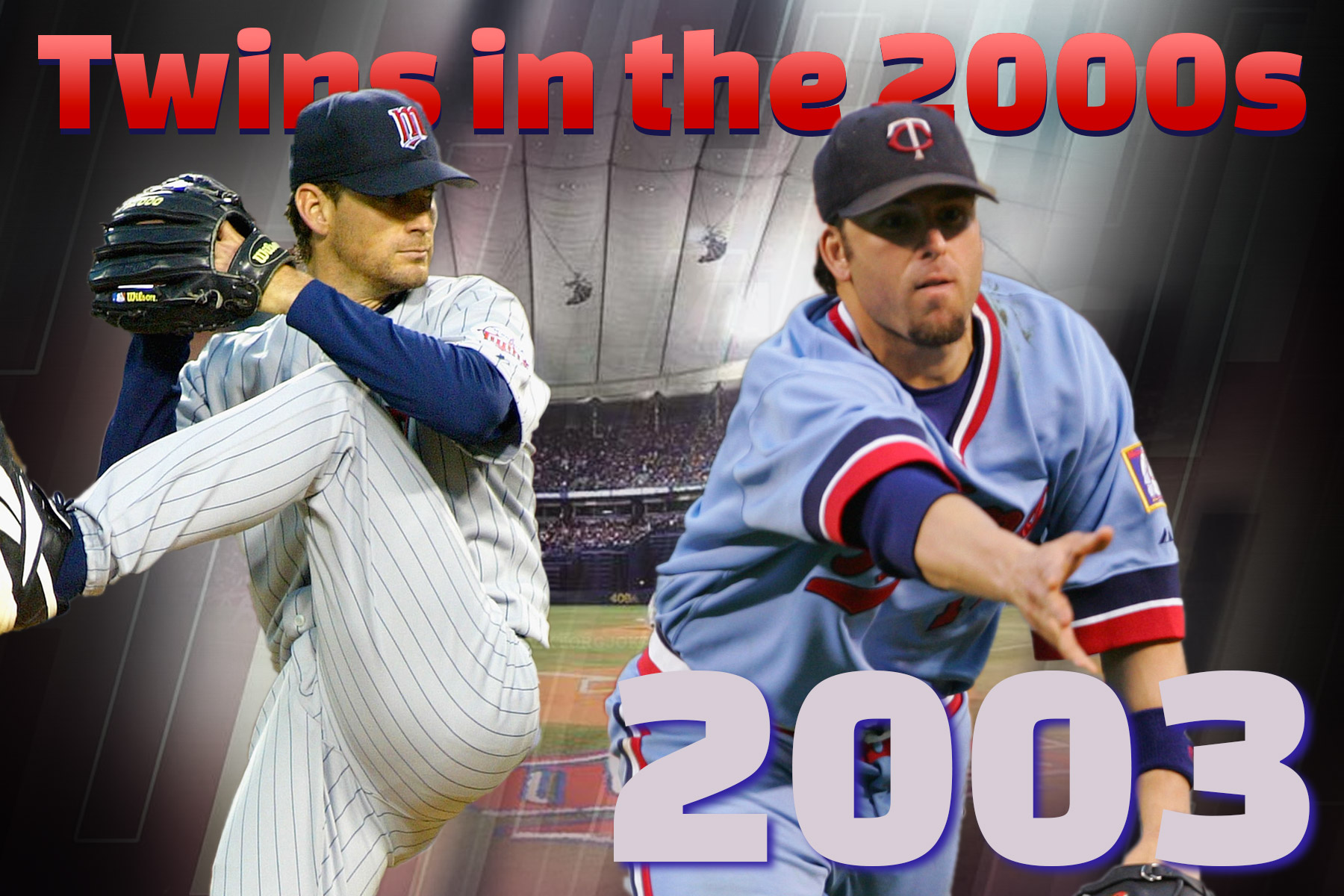 We're running a 20-part series in which we look back at each Minnesota Twins season of the 2000s. A rotation of different writers will highlight key moments, unearth forgotten details, and share nostalgic tales from the past two decades leading up to the present. This installment covers the 2003 season. Team Record: 90-72 Finish: 1st Place in AL Central All-Star: Eddie Guardado (RP) Awards: Torii Hunter (Gold Glove, CF) Playoffs: Lost to NYY 3-1 in ALDS Season Overview The 2003 season represented a big opportunity for a Twins franchise that was looking to repeat as division champs for the first time in more than three decades (1969-70). They had come within three wins of a World Series berth the prior season, and the AL Central was again ripe for the taking. Cleveland sunk below .500 in 2002 as they pivoted into a rebuild following a dynastic run in the division. The Royals and White Sox were mediocre coming into '03, and the Tigers were unspeakably atrocious. This was seemingly a moment for Minnesota to ramp up and capitalize, but instead, it sticks in the memory as a prime example of this organization's inability to make impact moves and get over the hump during Terry Ryan's winning window. One of Ryan's most eventful years at the helm featured more bad than good. Following a 2002 season that saw each of Minnesota's top three rotation staples – Brad Radke, Eric Milton, and Joe Mays – regress, starting pitching was an open question mark. Ryan passed on free agents or trades, trusting the trio to rebound and succeed alongside veteran Rick Reed and young talent Kyle Lohse. In early spring training, the Twins received a grim revelation: Milton needed knee surgery, and it would cost him most the season. The lefty's workload – 970 innings pitched in the majors through age 26 – had taken a toll. He made it back to pitch a few times in September and the playoffs, but would be traded that winter. The silver lining of Milton's absence meant that a path was open for Johan Santana, coming off a rather sensational showing as swing man in 2002. But here Ryan made one of his most infamous and infuriating decisions as GM. Rather than entrusting the 24-year-old Santana and his brilliant stuff, Ryan decided to sign 38-year-old free agent Kenny Rogers, a soft-tossing lefty who embodied the term "rubber arm." Rogers was expectedly mediocre, joining the status quo in a rotation with no standouts. Santana worked in a long relief and spot starter role, posting a 2.86 ERA over 66 innings in this capacity before finally joining the rotation full-time in mid-July. By then, Mays had a 6.57 ERA through 18 starts, courtesy of an egregiously long leash. Reed was proving to be totally gassed at 38 (he retired after the season). Radke was battling through the worst season of his career. Lohse was spiraling after a great start. At the All-Star break, Ron Gardenhire's Twins were looking woeful, back 7 1/2 games in the standings and sinking. Two moves are rightfully remembered as catalysts in the massive second-half turnaround to come: On July 11th, Santana joined the rotation for good after three dominant months in the bullpen. He didn't miss a beat with the role switch, posting an 8-2 record and 3.22 ERA in 15 starts, then starting Game 1 of the ALDS. On July 16th, Ryan traded outfielder Bobby Kielty to the Toronto Blue Jays for Shannon Stewart. As a disciplined, OBP-minded veteran leadoff hitter, Stewart filled a hole that had existed since Matt Lawton's departure. Displacing the incumbent rotation of Kielty and Dustan Mohr (aka Dusty Kielmohr) in right, the newcomer slashed .322/.384/.470 with numerous clutch hits in 65 games for the Twins, finishing fourth in AL MVP voting. Even with Stewart's addition, Minnesota's offense was far from dazzling. The entire division-winning lineup from 2002 had returned, with one glaring exception: David Ortiz, released by Ryan in the offseason to make room for Rule 5 draft pick José Morban, who never played as a Twin. Ortiz signed with Boston and immediately blossomed, posting a .961 OPS with 31 homers and 101 RBIs. He finished fifth for MVP, one spot behind Stewart. The disastrous Ortiz decision haunted Minnesota's power-hungry lineup in 2003, and for many years to come. Absent Ortiz, Gardenhire cycled through many promising young bats in the system, with mixed results. Young outfielders like Lew Ford and Michael Restovich made good impressions in short stints. Former first-round pick Matt LeCroy saw his most extensive action yet, hitting 17 homers in 107 games at age 27. First base prospect Justin Morneau got his feet wet, slashing .226/.287/.377 with four homers in 40 games as a rookie. With a mix of new and familiar faces, the Twins rallied to erase a big deficit down the stretch, going 37-18 after July 31st and putting the Central on ice with an 11-game winning streak (all against division opponents) in mid-September. On September 23rd, they clinched their second straight division title with a win over Cleveland at the Metrodome. You can watch the (strangely subdued?) celebration ensue after All-Star closer Eddie Guardado records the last out around the 1-hour, 53-minute mark in this video: Next up was Minnesota's first-ever postseason matchup against the New York Yankees. The Twins won Game 1 by a score of 3-1 in the Bronx, with the starter Santana tossing four scoreless innings, and then Minnesota's offense completely shut down. They scored one run apiece in the next three games as New York cruised to the ALCS (and eventually a World Series loss to the Marlins). Coming up short against the Yankees in October would become a new norm for the Twins, but across the roster, longtime fixtures were in flux. The arrival of Morneau suggested Mientkiewicz's days in Minnesota were numbered. Meanwhile, Pierzynski had to be wondering about his own future with Joe Mauer fully affirming his status as baseball's No. 1 prospect, conquering Double-A and making a clear case for MLB readiness. Team MVP: Shannon Stewart, LF Other Contenders: Johan Santana (SP/RP), Corey Koskie (3B), A.J. Pierzynski ©, Torii Hunter (CF) With this choice, I'm betraying my own analytical scruples. It's tough to make a pure statistical case for Stewart being the team's MVP in 2003. I mean, he played only 65 games with the Twins, ranking fifth among their position players in both fWAR and bWAR. Was he really more valuable than guys like Koskie, Pierzynski and Hunter, who put forth quality production all year long while providing excellent defense at key positions? In this case, the narrative wins out. Stewart finished fourth in AL MVP balloting – behind Álex Rodríguez, Carlos Delgado and Jorge Posada – as observers everywhere took notice of the Twins' total transformation following the trade. And this narrative isn't totally baseless; despite being with Minnesota for less than half a season, Stewart led the team's position players in Win Probability Added (2.17). 3 Most Pivotal Games July 17th: Won vs. Oakland Athletics, 6-2 In the first contest out of the break, Stewart made his Twins debut, with Minnesota sitting a season-high 7 1/2 games out of first. The big addition had a quiet night, finishing 0-for-5, but nonetheless the Twins notched a big win thanks to five first-inning runs against Tim Hudson (owner of a 2.71 ERA coming in). The victory sparked a five-game winning streak, as the Twins ignited their second-half surge. September 18th: Won vs. Chicago White Sox, 5-3 On September 15th, Minnesota completed a four-game sweep in Cleveland and took sole possession of first place for the first time since June. Next up: a chance to widen their half-game lead, with three home tilts against the White Sox team they'd just supplanted. The Twins won the first two games behind Radke and Rogers. In the third, Lohse outpitched Bartolo Colon while Jones homered twice in another sweep-clincher. It pushed Minnesota up by 3 1/2 games in the standings with only eight left to play. October 2nd: Lost @ New York Yankees, 4-1 The Twins rode their momentum into October with a stunning Game 1 victory at Yankee Stadium, as five pitchers combined to hold New York to a single run. The strong pitching would continue, but in Game 2, Minnesota's bats went silent and stayed that way. Andy Pettitte worked seven innings and Mariano Rivera followed with two as the Twins managed just one score – a solo homer by Hunter in the fifth. The Twins were similarly shut down by Roger Clemens and David Wells in the next two games, and it was over. For now. Unforgettable Highlights Burying Buehrle In 2003, White Sox starter Mark Buehrle was just getting started in a long career full of tormenting the Minnesota Twins, against whom he would win more games (30) than any other opponent. But on one rare and glorious day, May 16th, the Twins got the best of Buehrle, pounding him for 10 runs (nine earned) over 3 1/3 innings in an eventual 18-3 laugher. Kielty drove in five runs and Hunter drove in four. Pierzynski went 4-for-4. Jacque Jones Sets Record for Leadoff Homers On June 7th, in his native city of San Diego, Jones blasted his 20th and final leadoff homer as a Twin. The upcoming addition of Stewart would spell the end of Jones' days as an unorthodox low-OBP, high-SLG No. 1 hitter, but his franchise record for dingers out of the leadoff spot would hold for 14 years until Brian Dozier broke it in July of 2017. New Leaders of the Pitching Staff Make a Statement The Twins lost at home against Cleveland on August 13th by a score of 5-0. So why was this game special? Because up until relievers Juan Rincón and J.C. Romero combined to give up five runs in the top of the 14th inning, the Twins had shut down Cleveland's offense via a trio of hurlers who represented the best of Minnesota's pitching in 2003. Santana fired eight shutout innings. LaTroy Hawkins followed with four strikeouts over two scoreless frames. Guardado then delivered two perfect innings of his own. It's a shame the offense couldn't do anything in this one ... but a fitting preview of the postseason. Hawk Spreads His Wings Two years earlier, Hawkins torpedoed Minnesota's playoff chances with a second-half meltdown as closer. Here in 2003, pitching ahead of Guardado, Hawk reached the height of his prowess as setup man with a 1.86 ERA and team-leading 4.13 Win Probability Added. He was pivotal in the team's rally to the postseason, allowing one run over 24 mostly high-leverage innings in August and September as the Twins surged. In Game 1 of the ALDS, under the brightest spotlight at Yankee Stadium, Hawkins entered in the seventh with no outs and a man on first, Twins leading 3-0. After giving up a leadoff single, Hawkins mowed down six straight, four on strikeouts, bridging to Guardado who closed it out. The Twins have won only one playoff game since. After the season, Hawkins and Guardado both departed as free agents, going out on major high notes. One Detail You Probably Forgot I mentioned earlier that Restovich and Ford had nice showings as young outfielders getting looks in the big leagues, but neither were quite at the level of Mike Ryan, a 25-year-old middling prospect who had one of the wildest and most random Twins stints this side of Glenn Williams (see: 2005). Called up in mid-August, Ryan played semi-regularly down the stretch as Minnesota completed its AL Central comeback, slashing .393/.441/.754 with five homers and seven doubles in 68 plate appearances. His 1.195 OPS in 2003 remains the highest of any season in franchise history for a player with 50-plus plate appearances. Fun Fact Micheal Nakamura, a Japanese-born side-arming righty reliever out of Australia, was a fun project that sadly didn't work out. He signed with the Twins in 1997 and debuted in 2003, but posted a 7.82 ERA in 12 appearances, and was waived the following spring. He had a short stint in Toronto, allowing Gary Sheffield's 400th home run in his second-to-last MLB appearance, then signed with NPB in Japan in 2005, joining the Nippon Ham Fighters alongside an 18-year-old phenom named Yu Darvish. ~~~ Previous Installments: The 2000 Season The 2001 Season The 2002 Season
 -
Baseball's latest plan to return features a number of alterations designed to accommodate a shortened schedule and circumstances that are beyond unusual. Part of this reshaped framework (per CBS Sports): 30-man active rosters with a 20-man taxi squad for reinforcements. What might an expanded short-season roster look like for the Minnesota Twins?Once we swim through the mountains of logistical hurdles involving health, safety, and finances, this is one of the practical matters I find most intriguing: Which players will be part of the 2020 season, either from the start or as readily available fill-ins? We'll start with the obvious: the projected 26-man roster (per my final offseason status update, which was published approximately seven years ago). Position Players: Mitch Garver, Miguel Sanó, Luis Arraez, Josh Donaldson, Jorge Polanco, Eddie Rosario, Byron Buxton, Max Kepler, Nelson Cruz, Marwin Gonzalez, Ehire Adrianza, Jake Cave, Alex Avila Pitchers: José Berríos, Jake Odorizzi, Kenta Maeda, Homer Bailey, Jhoulys Chacín, Taylor Rogers, Tyler Duffey, Trevor May, Sergio Romo, Tyler Clippard, Matt Wisler, Zack Littell, Cody Stashak. Little has changed that would affect any of the above players' chances of making the team. But one new player might now be in the mix: Rich Hill, whose recovery from elbow surgery would've delayed a normal start. A season starting in July would line up with his expected return, and Hill believes he'll be ready to go. Luckily, he doesn't need to supplant anyone else, since the Twins will have four extra active roster spots to work with. So presumably Hill gets one. As for the others, I would guess we'll see a couple more arms and one other position player. Something like Randy Dobnak, Devin Smeltzer, and Willians Astudillo. The taxi squad is where things get interesting. First, with no minor-league seasons taking place, I'm wondering how these players stay sharp and ready for action. Regular scrimmages and sim games? Regardless, the makeup of such a player group will also be fascinating. My initial thought was that the Twins start by carrying every spare piece on the 40-man roster. But that doesn't necessarily make sense. Are they really gonna want to dedicate spots to raw talents like Gilberto Celestino and Dakota Chalmers, who aren't especially close to getting big-league shots? I would guess, at least, that these MLB-experienced or nearly-ready players from the 40-man will on the taxi squad: Jorge Alcala, Jhoan Duran, Sean Poppen, Fernando Romero, Lewis Thorpe, Travis Blankenhorn, Nick Gordon, LaMonte Wade Jr.. That's eight. Next, it is probably most instructive to look at the list of non-roster spring training invites from February. That list includes pitchers Charlie Barnes, Chacín (already in, per our projection), Sam Clay, Edwar Colina, Danny Coulombe, Ryan Garton, Blaine Hardy (out for season), Griffin Jax, Jake Reed and Caleb Thielbar; and position players Juan Graterol, Ryan Jeffers, Ben Rortvedt, Tomás Telis, Royce Lewis, Jack Reinheimer, Wilfredo Tovar, Alex Kirilloff, Trevor Larnach and Brent Rooker. The Twins will surely want at least a couple of extra catchers available, given the position's heightened injury risk and intensive physical toll. And of course they'll probably want to load up on pitchers to the extent they're able – especially with the likelihood of increased doubleheaders and decreased off days. At this point it becomes very much a guessing game, but I'll wager the Twins want to lean mostly on experience and reliability at these positions, while mixing in a bit of prospect upside, so I'll go with... Catchers: Juan Graterol, Tomas Telís, Ryan Jeffers Pitchers: Danny Coloumbe, Edwar Colina, Ryan Garton, Jake Reed, Caleb Thielbar So now we're at 16 members of the 20-man taxi squad. Who fills those last four spots? Given that the Twins now have all their bases covered with multiple contingencies at every position, they might want to make a few of their very best prospects available as potential wild-cards for an all-in sprint. Then again, maybe not? This is where I really get stuck. Do these prospects need to be added to the 40-man roster (or some expanded version) in order to feature on this taxi squad, thus starting their service clocks? If so, is it worth doing so just to keep them on hand as longshot possibilities to contribute? Is it even wise to push these crucial future talents into such an odd situation, as opposed to just letting them work out on their own and come back strong in 2021? But if that happens, do they not get paid at all? Is it a slap in the face? There's also the matter of Michael Pineda. It seems he'll still be on suspension for the first part of the year. Does he require a "roster spot" on the taxi squad? Are those really even considered roster spots under any traditional definition? He's still occupying space and consuming the resources of any other player. (He's also not supposed to get paid during the suspension, so what happens with that? I assume he's not just gonna throw himself in harm's way for free.) The litany of questions that begin to sprout up as you ponder these consequential factors is flat-out overwhelming, which is also true of MLB's daunting health-and-safety protocol at large. We'll need a lot more clarity before we can give serious credence to the very idea of a season happening, let alone how the Twins' roster will shake out. But the specificity around roster sizes at least gives us the ability to speculate a little, which is more than welcome after weeks of being completely in the dark. Given our limited information, I'm gonna guess the Twins choose to preserve their three best prospects – Lewis, Kirilloff, Larnach – but carry Rooker, along with the minor-league vets Tovar and Reinheimer. I'll also assume Pineda gets a taxi spot. So here it is, my shot-in-the-dark guess at what a Twins 2020 roster and taxi squad might look like under the altered format. Feel free to air your quibbles and make your own guesses in the comments. (Active-roster players in bold.) CATCHERS: Mitch Garver, Alex Avila, Willians Astudillo, Juan Graterol, Tomas Telís, Ryan Jeffers INFIELDERS: Miguel Sanó, Luis Arraez, Josh Donaldson, Jorge Polanco, Marwin Gonzalez, Ehire Adrianza, Travis Blankenhorn, Nick Gordon, Wilfredo Tovar, Jack Reinheimer OUTFIELDERS: Eddie Rosario, Byron Buxton, Max Kepler, Nelson Cruz, Jake Cave, LaMonte Wade Jr., Brent Rooker PITCHERS: José Berríos, Jake Odorizzi, Kenta Maeda, Homer Bailey, Jhoulys Chacín, Rich Hill, Taylor Rogers, Tyler Duffey, Trevor May, Sergio Romo, Tyler Clippard, Matt Wisler, Zack Littell, Cody Stashak, Randy Dobnak, Devin Smeltzer, Michael Pineda, Jorge Alcala, Jhoan Duran, Fernando Romero, Sean Poppen, Lewis Thorpe, Danny Coloumbe, Edwar Colina, Ryan Garton, Jake Reed, Caleb Thielbar MORE FROM TWINS DAILY — Latest Twins coverage from our writers — Recent Twins discussion in our forums — Follow Twins Daily via Twitter, Facebook or email Click here to view the article
-
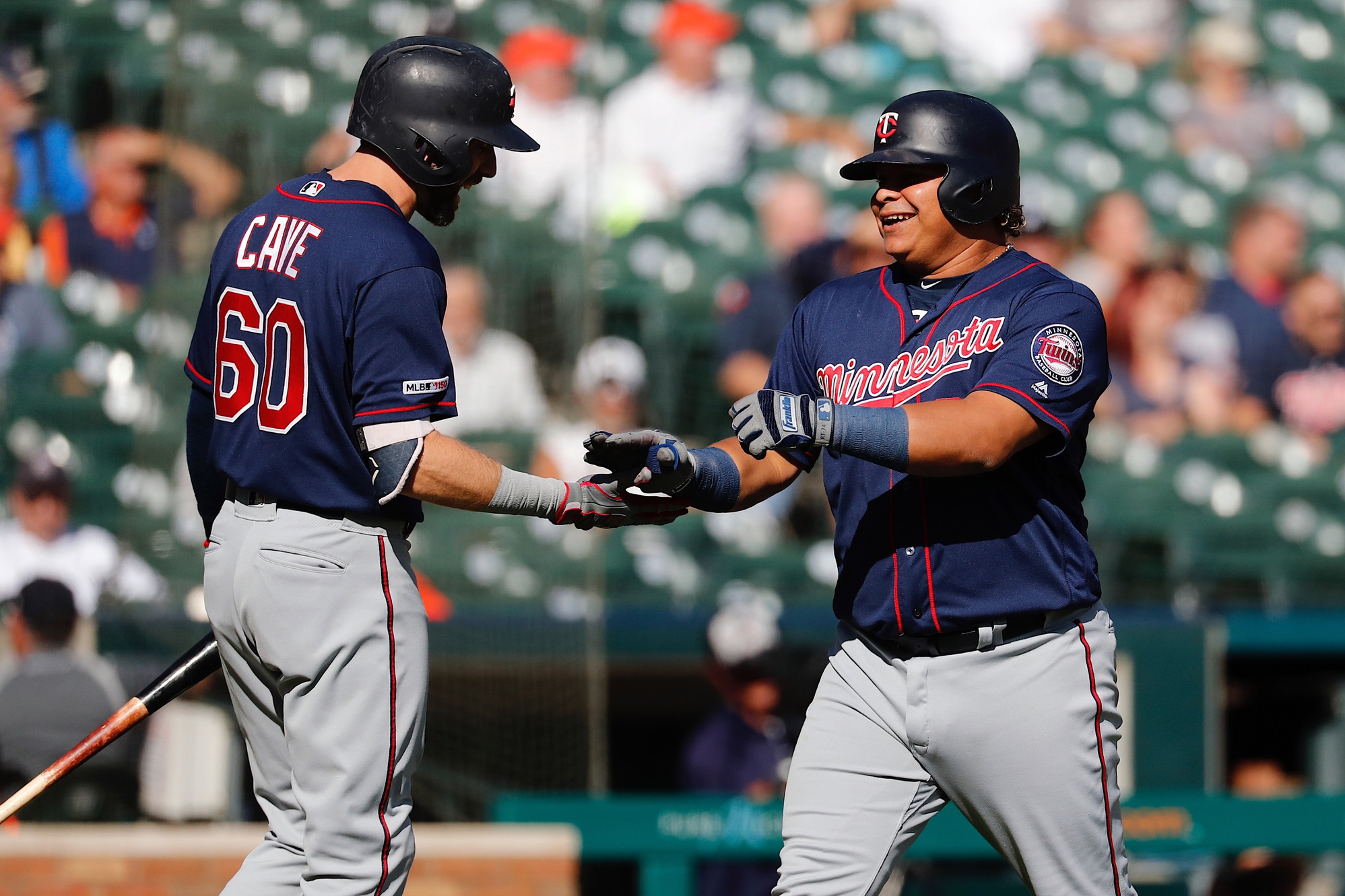 Once we swim through the mountains of logistical hurdles involving health, safety, and finances, this is one of the practical matters I find most intriguing: Which players will be part of the 2020 season, either from the start or as readily available fill-ins? We'll start with the obvious: the projected 26-man roster (per my final offseason status update, which was published approximately seven years ago). Position Players: Mitch Garver, Miguel Sanó, Luis Arraez, Josh Donaldson, Jorge Polanco, Eddie Rosario, Byron Buxton, Max Kepler, Nelson Cruz, Marwin Gonzalez, Ehire Adrianza, Jake Cave, Alex Avila Pitchers: José Berríos, Jake Odorizzi, Kenta Maeda, Homer Bailey, Jhoulys Chacín, Taylor Rogers, Tyler Duffey, Trevor May, Sergio Romo, Tyler Clippard, Matt Wisler, Zack Littell, Cody Stashak. Little has changed that would affect any of the above players' chances of making the team. But one new player might now be in the mix: Rich Hill, whose recovery from elbow surgery would've delayed a normal start. A season starting in July would line up with his expected return, and Hill believes he'll be ready to go. Luckily, he doesn't need to supplant anyone else, since the Twins will have four extra active roster spots to work with. So presumably Hill gets one. As for the others, I would guess we'll see a couple more arms and one other position player. Something like Randy Dobnak, Devin Smeltzer, and Willians Astudillo. The taxi squad is where things get interesting. First, with no minor-league seasons taking place, I'm wondering how these players stay sharp and ready for action. Regular scrimmages and sim games? Regardless, the makeup of such a player group will also be fascinating. My initial thought was that the Twins start by carrying every spare piece on the 40-man roster. But that doesn't necessarily make sense. Are they really gonna want to dedicate spots to raw talents like Gilberto Celestino and Dakota Chalmers, who aren't especially close to getting big-league shots? I would guess, at least, that these MLB-experienced or nearly-ready players from the 40-man will on the taxi squad: Jorge Alcala, Jhoan Duran, Sean Poppen, Fernando Romero, Lewis Thorpe, Travis Blankenhorn, Nick Gordon, LaMonte Wade Jr.. That's eight. Next, it is probably most instructive to look at the list of non-roster spring training invites from February. That list includes pitchers Charlie Barnes, Chacín (already in, per our projection), Sam Clay, Edwar Colina, Danny Coulombe, Ryan Garton, Blaine Hardy (out for season), Griffin Jax, Jake Reed and Caleb Thielbar; and position players Juan Graterol, Ryan Jeffers, Ben Rortvedt, Tomás Telis, Royce Lewis, Jack Reinheimer, Wilfredo Tovar, Alex Kirilloff, Trevor Larnach and Brent Rooker. The Twins will surely want at least a couple of extra catchers available, given the position's heightened injury risk and intensive physical toll. And of course they'll probably want to load up on pitchers to the extent they're able – especially with the likelihood of increased doubleheaders and decreased off days. At this point it becomes very much a guessing game, but I'll wager the Twins want to lean mostly on experience and reliability at these positions, while mixing in a bit of prospect upside, so I'll go with... Catchers: Juan Graterol, Tomas Telís, Ryan Jeffers Pitchers: Danny Coloumbe, Edwar Colina, Ryan Garton, Jake Reed, Caleb Thielbar So now we're at 16 members of the 20-man taxi squad. Who fills those last four spots? Given that the Twins now have all their bases covered with multiple contingencies at every position, they might want to make a few of their very best prospects available as potential wild-cards for an all-in sprint. Then again, maybe not? This is where I really get stuck. Do these prospects need to be added to the 40-man roster (or some expanded version) in order to feature on this taxi squad, thus starting their service clocks? If so, is it worth doing so just to keep them on hand as longshot possibilities to contribute? Is it even wise to push these crucial future talents into such an odd situation, as opposed to just letting them work out on their own and come back strong in 2021? But if that happens, do they not get paid at all? Is it a slap in the face? There's also the matter of Michael Pineda. It seems he'll still be on suspension for the first part of the year. Does he require a "roster spot" on the taxi squad? Are those really even considered roster spots under any traditional definition? He's still occupying space and consuming the resources of any other player. (He's also not supposed to get paid during the suspension, so what happens with that? I assume he's not just gonna throw himself in harm's way for free.) The litany of questions that begin to sprout up as you ponder these consequential factors is flat-out overwhelming, which is also true of MLB's daunting health-and-safety protocol at large. We'll need a lot more clarity before we can give serious credence to the very idea of a season happening, let alone how the Twins' roster will shake out. But the specificity around roster sizes at least gives us the ability to speculate a little, which is more than welcome after weeks of being completely in the dark. Given our limited information, I'm gonna guess the Twins choose to preserve their three best prospects – Lewis, Kirilloff, Larnach – but carry Rooker, along with the minor-league vets Tovar and Reinheimer. I'll also assume Pineda gets a taxi spot. So here it is, my shot-in-the-dark guess at what a Twins 2020 roster and taxi squad might look like under the altered format. Feel free to air your quibbles and make your own guesses in the comments. (Active-roster players in bold.) CATCHERS: Mitch Garver, Alex Avila, Willians Astudillo, Juan Graterol, Tomas Telís, Ryan Jeffers INFIELDERS: Miguel Sanó, Luis Arraez, Josh Donaldson, Jorge Polanco, Marwin Gonzalez, Ehire Adrianza, Travis Blankenhorn, Nick Gordon, Wilfredo Tovar, Jack Reinheimer OUTFIELDERS: Eddie Rosario, Byron Buxton, Max Kepler, Nelson Cruz, Jake Cave, LaMonte Wade Jr., Brent Rooker PITCHERS: José Berríos, Jake Odorizzi, Kenta Maeda, Homer Bailey, Jhoulys Chacín, Rich Hill, Taylor Rogers, Tyler Duffey, Trevor May, Sergio Romo, Tyler Clippard, Matt Wisler, Zack Littell, Cody Stashak, Randy Dobnak, Devin Smeltzer, Michael Pineda, Jorge Alcala, Jhoan Duran, Fernando Romero, Sean Poppen, Lewis Thorpe, Danny Coloumbe, Edwar Colina, Ryan Garton, Jake Reed, Caleb Thielbar MORE FROM TWINS DAILY — Latest Twins coverage from our writers — Recent Twins discussion in our forums — Follow Twins Daily via Twitter, Facebook or email
 -
Twins in the 2000s: The 2002 Season
Nick Nelson replied to John Bonnes's topic in Twins Daily Front Page News
Just gonna leave this here John Twins 2002 leaders in fWAR: 1. Corey Koskie - 5.1 2. Jacque Jones - 5.0 3. Torii Hunter - 4.2 4. Johan Santana - 3.4 5. Eric Milton - 3.2 6. Bobby Kielty - 2.7 7. Doug Mientkiewicz - 2.2 8. A.J. Pierzynski - 2.1 9. Dustan Mohr - 2.1 10. Brad Radke - 2.1 11. Rick Reed - 2.0 12. J.C. Romero - 1.6 13. LaTroy Hawkins - 1.6 14. Eddie Guardado - 1.2 -
In the first half of the 2001 season, exciting talent propelled the Minnesota Twins to new heights. In the second half, inexperience and compounding struggles dragged them to new lows. Let's dive into the painful learning experience that paved way for success to come, and marked the end of an era in Twins history.We're running a 20-part series in which we look back at each Minnesota Twins season of the 2000s. A rotation of different writers will highlight key moments, unearth forgotten details, and share nostalgic tales from the past two decades leading up to the present. Today's installment covers the 2001 season. Team Record: 85-77 Finish: 2nd Place in AL Central All Star(s): Cristian Guzmán (SS), Joe Mays (SP), Eric Milton (SP) Awards: Torii Hunter (Gold Glove, CF), Doug Mientkiewicz (Gold Glove, 1B) Playoffs: N/A Season Overview As 2001 arrived, the Minnesota Twins were a full decade removed from their last playoff appearance. Tom Kelly had trudged through the muck of a prolonged rebuild, but thankfully, the 2000 season – in spite of a last-place finish – offered more hope than ever that a culture of losing was ready to snap. In 2001, it did. As the long-simmering talent core finally coalesced, Minnesota jumped out to a shocking 14-3 start. Refusing to relent, the Twins kept it rolling throughout the first half, riding a 13-2 stretch into the All-Star break, by which point they'd built a five-game lead over favored Cleveland in the AL Central. Not since 1994 (Kirby Puckett and Chuck Knoblauch) had the Twins sent more than one representative to the Midsummer Classic. In 2001 they sent three: Cristian Guzmán, Eric Milton, Joe Mays. A little more on these critical cogs: After setting a franchise record with 20 triples in 2000, Guzmán came out of the gates with four three-baggers in his first five games, on his way to another league-leading total of 14. He also swiped 25 more bases, but this time the shortstop's offensive impact went beyond the speed categories: he slashed .302/.337/.477 with 10 home runs.Milton, acquired alongside Guzmán in the 1996 Knoblauch trade, remained a consistently above-average workhorse, logging career highs in innings (220 2/3), wins (15), and ERA (4.32) in what would be the last outstanding campaign of his career.Mays was an absolute force, ranking third among American League starters in ERA (3.16) and leading the league in ERA+ (143) while racking up 233 2/3 innings over his 34 starts, which included four complete games and two shutouts. In the context of a very offense-friendly league, the righty's stellar results – while averaging 4.7 K/9 – were nothing short of astonishing. He'd never come close to replicating them.Meanwhile, Minnesota's nucleus began flourishing, as TV and radio ads encouraged fans to "Get to Know 'Em." Guzmán, Corey Koskie, Doug Mientkiewicz, Torii Hunter, Matt Lawton, and David Ortiz were all healthily above-average hitters under 30. A.J. Pierzynski and Jacque Jones were solid as contributing pieces. The only offensive laggard among regulars was second baseman Luis Rivas, who earned some leeway as a 21-year-old rookie and solid defender. Rivas oddly batted first or second in Kelly's lineups 77 times despite a .266/.319/.362 slash line. After streaking into the All-Star break, Minnesota slumped badly coming out of it, losing 10 of 13 to watch their five-game lead in the standings evaporate. In late July, they found themselves in a dogfight with Cleveland and needing reinforcements. Terry Ryan, navigating a pennant race for the first time as general manager, faced high stakes at the trade deadline. On July 28th, Ryan dealt southpaw starter Mark Redman to Detroit for closer Todd Jones, who moved into a setup role ahead of LaTroy Hawkins. But Minnesota's biggest splash came two days later, when Ryan sent Lawton to the Mets in exchange for 36-year-old starter Rick Reed. It was, in the context of the time, a major blockbuster for the Twins, but the deal failed to pay dividends. Reed would post a 5.19 ERA in 12 starts down the stretch. Ryan was wise to seek relief help, but it turns out he needed a closer, not a setup man. He can hardly be blamed for not realizing as much at the time. On the date Ryan traded for Jones, Hawkins was 26-for-30 on save chances with a 3.05 ERA and zero homers allowed (though the 28-to-25 K/BB ratio was a bad omen). One day after Jones was acquired, Hawkins gave up four earned runs without recording an out. This foreshadowed a month of August for the rotten record books: 10 appearances, 7 innings pitched, 16 hits, 8 walks, 12 earned runs (15.43 ERA). From the trade deadline to the end of the season, Hawkins blew five saves (converting only two) and was tagged with three losses as opponents slashed .407/.507/.644 against him. He was far from the only culprit in a free-fall that saw Minnesota go from five games up at the break to six games out when the season ended, but Hawk's meltdown was certainly emblematic. He wasn't ready yet. Neither were these Twins. But in both cases, the best was yet to come. It wouldn't come under Kelly, who announced his retirement days after the tumultuous campaign reached an end, citing burnout. He was still only 51, but it came as no surprise to see TK bow out on his own terms after 15 years, especially with a contraction threat looming over the franchise. Third base coach Ron Gardenhire was selected over bench coach Paul Molitor as Kelly's successor, and would oversee the 2002 Twins season ... if it happened. MLB owners voted in November to eliminate two teams, with Minnesota square in the crosshairs. Team MVP: Corey Koskie (3B) Other Contenders: Joe Mays (SP), Cristian Guzmán (SS), Eric Milton (SP), Torii Hunter (CF) There is a valid case to be made here for Mays, who was an absolute stalwart in the rotation. But instead I opt for Koskie, who filled the stat sheet offensively as cleanup hitter – .850 OPS, 26 homers, 37 doubles, 100 runs scored, 103 RBIs, 27 steals on 33 tries – while emerging as one of the league's best fielders at third base. Mays and his contact-heavy approach benefited greatly from an ultra-sharp defense keyed in part by Koskie (not to mention the Gold Glovers Mientkiewicz across the diamond and Hunter in center). FanGraphs pegs Koskie's 2001 season with a 5.8 fWAR that was easily best on the team. In fact, it was the highest mark posted by any Twin between Knoblauch's last season at second base (1997) and Johan Santana's first full one in the rotation (2004). Now 28 years old, Koskie found himself as the elder statesman in a young group that was rounding into its own, and he led by example with his roundly stellar performance. 3 Most Pivotal Games June 26th: Won vs. Chicago White Sox, 7-6 There is no shortage of of impressive victories you could choose to reflect the team's feisty, energetic brilliance during a 55-32 first half, but this one seems as good as any. Down 6-3 entering the ninth in a home series opener against the Sox, Minnesota rallied for three runs to walk off closer Keith Foulke, with Denny Hocking's pinch-hit two-run triple delivering the fatal blow. This exhilarating win was Minnesota's third straight, and they'd go on to win 11 of their next 13. These kids were starting to believe. July 29th: Lost @ Seattle Mariners, 10-2 A week ago, this all-time great M's team had torn through the Metrodome and thoroughly dismantled Minnesota in a four-game sweep. Now, the Twins were trying to avoid a season sweep in their series finale at Seattle, with the deadline bearing down and their lead in the division gone. Instead, they got blown out. Milton gave up six earned runs. Hawkins was torched, detonating his total implosion. Freddy García allowed five hits in a breezy complete-game win. Sadly, it was a preview of things to come in a nightmare stretch run for the Twins. August 14th: Lost @ Cleveland Indians, 8-7 The Twins took a five-game losing streak into August and proceeded to lose 18 of 29 games in the month, including five of six against Cleveland as the Indians widened their newfound lead. This defeat was probably most painful. Trailing 4-3 into the ninth, the Twins tied the game on Hunter's RBI groundout, then took a three-run lead on Pierzynski's three-run triple. Hawkins came out and promptly blew a three-run save, and the Twins lost in the bottom of the 11th on Juan González's RBI single off Bob Wells. Unforgettable Highlights Twins Burst into National Spotlight On April 30th, a new issue of Sports Illustrated hit stands with Lawton adorning the front cover, his swing perfectly displaying "MINNESOTA" across the front of his road jersey, along with the headline "Do You Believe in Miracles?" The perpetual also-ran Twins had rushed to an early division lead behind an exciting young collection of talent, which was gelling exactly as its architect Ryan envisioned. People were taking notice. Download attachment: SI_cover_twins.png On the same date that SI issue came out, as if to affirm its premise, Brad Radke outdueled Andy Pettitte in a 2-1 victory over the Yankees, improving his record to 5-0 and his team's to 18-6. Mauer Drafted First Overall Many important things happened on the field during the 2001 season, but the most important moment for the franchise came off of it, on June 5th. Blessed with the first overall pick in the MLB draft coming off a 93-loss season, Ryan and the Twins selected Joe Mauer, the heralded prep catcher out of St. Paul. It was a controversial decision at the time, with stud college righty Mark Prior standing out as the glamorous pick, but TR would eventually be vindicated. Prior's career was over by 2006 while Mauer went on to become one of the greatest Twins ever. Radke Goes the Distance Although Milton and Mays emerged as All-Stars, Radke remained the rotation's steady rock, logging 226 innings with a 115 ERA+ and career highs in both complete games (6) and shutouts (2). The most impressive of those came on June 12th, at home against an Astros lineup that included Craig Biggio, Jeff Bagwell, Lance Berkman and Moises Alou. Completing nine innings on 90 pitches, Radke allowed four hits (three singles and a double) and issued zero walks. He went on to lead the American League in BB/9 rate (1.0) and K/BB ratio (5.27) Lineup Shows Explosive Potential During their decade-long playoff drought, the Twins hadn't really kept pace with the game's offensive uptick. In 2000 they ranked last in the majors with 116 home runs – nearly 20% fewer than the second-to-last team. But 2001 brought real signs of growth, and the team's win over the Brewers on July 12th might exemplify it best. Riding high with 13 wins in their past 15 games, the Twins delivered an onslaught against Milwaukee pitching. They scored 13 runs on seven homers, including two apiece from Jones, Hunter and Koskie. Koskie also doubled twice in a four-hit effort, and even rookie starting pitcher Kyle Lohse – making his fifth MLB start – got in on the action, finishing 2-for-4 with a double in the interleague match. Chad Allen's Gutsy Showing I'm not sure it qualifies as a "highlight" but it certainly made a lasting impression: On August 14th, right fielder Chad Allen tore his ACL while trying to chase down a Kenny Lofton drive in extra innings. There's no video of it online, from what I can tell, but I'll never forget the way Allen hobbled after the ball in extreme pain, determined to throw it back in before crumpling to the ground and getting stretchered off. Pure grit. Allen didn't play again for the Twins, but he did return to the organization 12 years later as a minor-league hitting instructor. One Detail You Probably Forgot While the Twins made one of their most successful high draft picks ever during the summer of 2001, we also got a chance to see one of their biggest disasters make a fleeting appearance. Adam Johnson, whom the team selected second overall one year earlier (five picks ahead of one Rocco Baldelli), made his MLB debut on July 16th at age 21, and went on to post an 8.28 ERA in 25 innings. This didn't seem all that worrisome, given he'd scarcely been in pro ball for a year, but Johnson was basically done. He finished his MLB career with a 10.25 ERA in 26 1/3 innings. Fun Fact When Radke took a line drive off the hand in a game against Kansas City on August 3rd, he suffered a thumb bruise that forced him to the disabled list for the first time in his career. By that point, he was 28 and had already made 221 major-league starts while throwing nearly 1,500 innings. The man was an absolute horse. ~~~ Previous Installments: The 2000 Season Click here to view the article
-
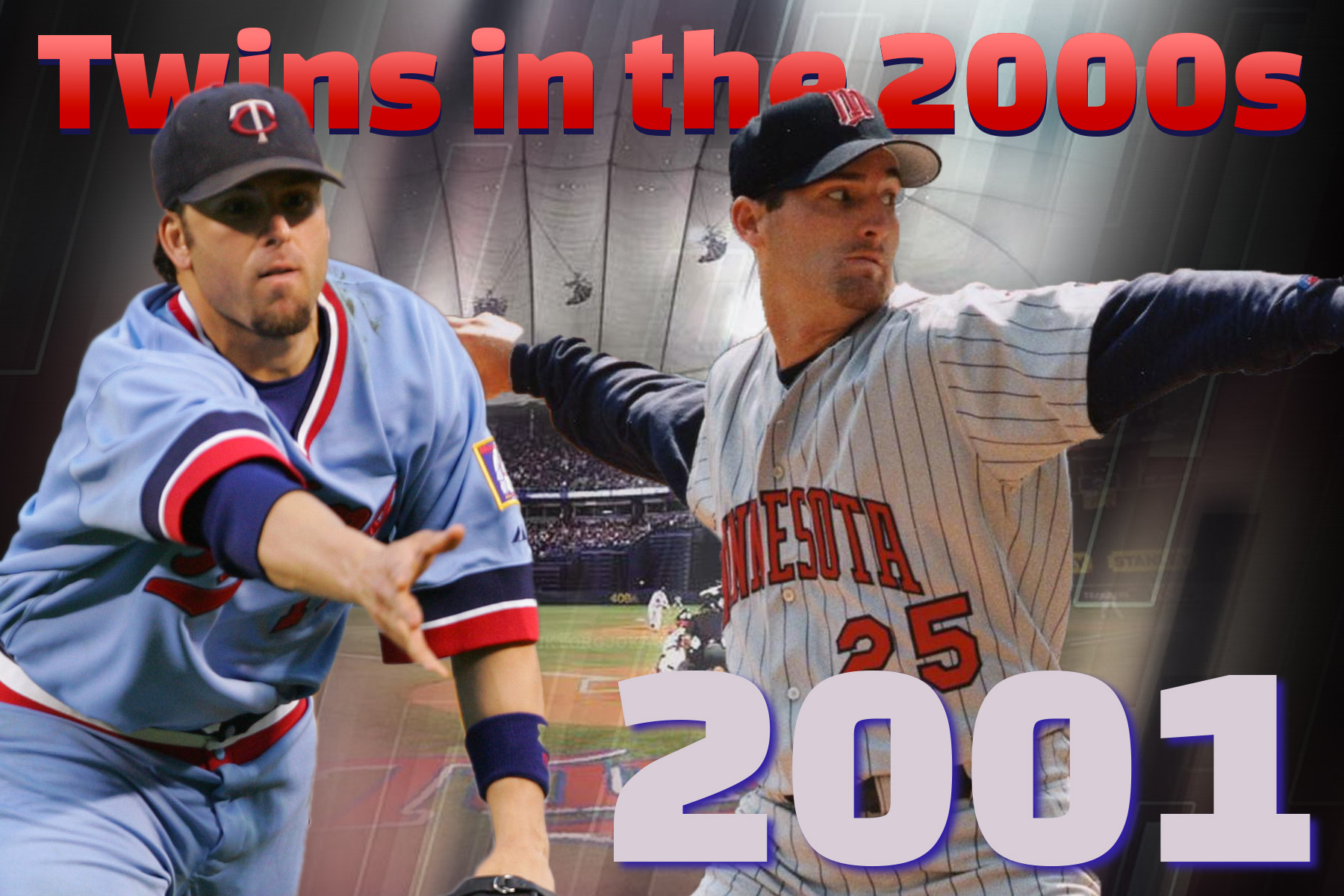 We're running a 20-part series in which we look back at each Minnesota Twins season of the 2000s. A rotation of different writers will highlight key moments, unearth forgotten details, and share nostalgic tales from the past two decades leading up to the present. Today's installment covers the 2001 season. Team Record: 85-77 Finish: 2nd Place in AL Central All Star(s): Cristian Guzmán (SS), Joe Mays (SP), Eric Milton (SP) Awards: Torii Hunter (Gold Glove, CF), Doug Mientkiewicz (Gold Glove, 1B) Playoffs: N/A Season Overview As 2001 arrived, the Minnesota Twins were a full decade removed from their last playoff appearance. Tom Kelly had trudged through the muck of a prolonged rebuild, but thankfully, the 2000 season – in spite of a last-place finish – offered more hope than ever that a culture of losing was ready to snap. In 2001, it did. As the long-simmering talent core finally coalesced, Minnesota jumped out to a shocking 14-3 start. Refusing to relent, the Twins kept it rolling throughout the first half, riding a 13-2 stretch into the All-Star break, by which point they'd built a five-game lead over favored Cleveland in the AL Central. Not since 1994 (Kirby Puckett and Chuck Knoblauch) had the Twins sent more than one representative to the Midsummer Classic. In 2001 they sent three: Cristian Guzmán, Eric Milton, Joe Mays. A little more on these critical cogs: After setting a franchise record with 20 triples in 2000, Guzmán came out of the gates with four three-baggers in his first five games, on his way to another league-leading total of 14. He also swiped 25 more bases, but this time the shortstop's offensive impact went beyond the speed categories: he slashed .302/.337/.477 with 10 home runs. Milton, acquired alongside Guzmán in the 1996 Knoblauch trade, remained a consistently above-average workhorse, logging career highs in innings (220 2/3), wins (15), and ERA (4.32) in what would be the last outstanding campaign of his career. Mays was an absolute force, ranking third among American League starters in ERA (3.16) and leading the league in ERA+ (143) while racking up 233 2/3 innings over his 34 starts, which included four complete games and two shutouts. In the context of a very offense-friendly league, the righty's stellar results – while averaging 4.7 K/9 – were nothing short of astonishing. He'd never come close to replicating them. Meanwhile, Minnesota's nucleus began flourishing, as TV and radio ads encouraged fans to "Get to Know 'Em." Guzmán, Corey Koskie, Doug Mientkiewicz, Torii Hunter, Matt Lawton, and David Ortiz were all healthily above-average hitters under 30. A.J. Pierzynski and Jacque Jones were solid as contributing pieces. The only offensive laggard among regulars was second baseman Luis Rivas, who earned some leeway as a 21-year-old rookie and solid defender. Rivas oddly batted first or second in Kelly's lineups 77 times despite a .266/.319/.362 slash line. After streaking into the All-Star break, Minnesota slumped badly coming out of it, losing 10 of 13 to watch their five-game lead in the standings evaporate. In late July, they found themselves in a dogfight with Cleveland and needing reinforcements. Terry Ryan, navigating a pennant race for the first time as general manager, faced high stakes at the trade deadline. On July 28th, Ryan dealt southpaw starter Mark Redman to Detroit for closer Todd Jones, who moved into a setup role ahead of LaTroy Hawkins. But Minnesota's biggest splash came two days later, when Ryan sent Lawton to the Mets in exchange for 36-year-old starter Rick Reed. It was, in the context of the time, a major blockbuster for the Twins, but the deal failed to pay dividends. Reed would post a 5.19 ERA in 12 starts down the stretch. Ryan was wise to seek relief help, but it turns out he needed a closer, not a setup man. He can hardly be blamed for not realizing as much at the time. On the date Ryan traded for Jones, Hawkins was 26-for-30 on save chances with a 3.05 ERA and zero homers allowed (though the 28-to-25 K/BB ratio was a bad omen). One day after Jones was acquired, Hawkins gave up four earned runs without recording an out. This foreshadowed a month of August for the rotten record books: 10 appearances, 7 innings pitched, 16 hits, 8 walks, 12 earned runs (15.43 ERA). From the trade deadline to the end of the season, Hawkins blew five saves (converting only two) and was tagged with three losses as opponents slashed .407/.507/.644 against him. He was far from the only culprit in a free-fall that saw Minnesota go from five games up at the break to six games out when the season ended, but Hawk's meltdown was certainly emblematic. He wasn't ready yet. Neither were these Twins. But in both cases, the best was yet to come. It wouldn't come under Kelly, who announced his retirement days after the tumultuous campaign reached an end, citing burnout. He was still only 51, but it came as no surprise to see TK bow out on his own terms after 15 years, especially with a contraction threat looming over the franchise. Third base coach Ron Gardenhire was selected over bench coach Paul Molitor as Kelly's successor, and would oversee the 2002 Twins season ... if it happened. MLB owners voted in November to eliminate two teams, with Minnesota square in the crosshairs. Team MVP: Corey Koskie (3B) Other Contenders: Joe Mays (SP), Cristian Guzmán (SS), Eric Milton (SP), Torii Hunter (CF) There is a valid case to be made here for Mays, who was an absolute stalwart in the rotation. But instead I opt for Koskie, who filled the stat sheet offensively as cleanup hitter – .850 OPS, 26 homers, 37 doubles, 100 runs scored, 103 RBIs, 27 steals on 33 tries – while emerging as one of the league's best fielders at third base. Mays and his contact-heavy approach benefited greatly from an ultra-sharp defense keyed in part by Koskie (not to mention the Gold Glovers Mientkiewicz across the diamond and Hunter in center). FanGraphs pegs Koskie's 2001 season with a 5.8 fWAR that was easily best on the team. In fact, it was the highest mark posted by any Twin between Knoblauch's last season at second base (1997) and Johan Santana's first full one in the rotation (2004). Now 28 years old, Koskie found himself as the elder statesman in a young group that was rounding into its own, and he led by example with his roundly stellar performance. 3 Most Pivotal Games June 26th: Won vs. Chicago White Sox, 7-6 There is no shortage of of impressive victories you could choose to reflect the team's feisty, energetic brilliance during a 55-32 first half, but this one seems as good as any. Down 6-3 entering the ninth in a home series opener against the Sox, Minnesota rallied for three runs to walk off closer Keith Foulke, with Denny Hocking's pinch-hit two-run triple delivering the fatal blow. This exhilarating win was Minnesota's third straight, and they'd go on to win 11 of their next 13. These kids were starting to believe. July 29th: Lost @ Seattle Mariners, 10-2 A week ago, this all-time great M's team had torn through the Metrodome and thoroughly dismantled Minnesota in a four-game sweep. Now, the Twins were trying to avoid a season sweep in their series finale at Seattle, with the deadline bearing down and their lead in the division gone. Instead, they got blown out. Milton gave up six earned runs. Hawkins was torched, detonating his total implosion. Freddy García allowed five hits in a breezy complete-game win. Sadly, it was a preview of things to come in a nightmare stretch run for the Twins. August 14th: Lost @ Cleveland Indians, 8-7 The Twins took a five-game losing streak into August and proceeded to lose 18 of 29 games in the month, including five of six against Cleveland as the Indians widened their newfound lead. This defeat was probably most painful. Trailing 4-3 into the ninth, the Twins tied the game on Hunter's RBI groundout, then took a three-run lead on Pierzynski's three-run triple. Hawkins came out and promptly blew a three-run save, and the Twins lost in the bottom of the 11th on Juan González's RBI single off Bob Wells. Unforgettable Highlights Twins Burst into National Spotlight On April 30th, a new issue of Sports Illustrated hit stands with Lawton adorning the front cover, his swing perfectly displaying "MINNESOTA" across the front of his road jersey, along with the headline "Do You Believe in Miracles?" The perpetual also-ran Twins had rushed to an early division lead behind an exciting young collection of talent, which was gelling exactly as its architect Ryan envisioned. People were taking notice. On the same date that SI issue came out, as if to affirm its premise, Brad Radke outdueled Andy Pettitte in a 2-1 victory over the Yankees, improving his record to 5-0 and his team's to 18-6. Mauer Drafted First Overall Many important things happened on the field during the 2001 season, but the most important moment for the franchise came off of it, on June 5th. Blessed with the first overall pick in the MLB draft coming off a 93-loss season, Ryan and the Twins selected Joe Mauer, the heralded prep catcher out of St. Paul. It was a controversial decision at the time, with stud college righty Mark Prior standing out as the glamorous pick, but TR would eventually be vindicated. Prior's career was over by 2006 while Mauer went on to become one of the greatest Twins ever. Radke Goes the Distance Although Milton and Mays emerged as All-Stars, Radke remained the rotation's steady rock, logging 226 innings with a 115 ERA+ and career highs in both complete games (6) and shutouts (2). The most impressive of those came on June 12th, at home against an Astros lineup that included Craig Biggio, Jeff Bagwell, Lance Berkman and Moises Alou. Completing nine innings on 90 pitches, Radke allowed four hits (three singles and a double) and issued zero walks. He went on to lead the American League in BB/9 rate (1.0) and K/BB ratio (5.27) Lineup Shows Explosive Potential During their decade-long playoff drought, the Twins hadn't really kept pace with the game's offensive uptick. In 2000 they ranked last in the majors with 116 home runs – nearly 20% fewer than the second-to-last team. But 2001 brought real signs of growth, and the team's win over the Brewers on July 12th might exemplify it best. Riding high with 13 wins in their past 15 games, the Twins delivered an onslaught against Milwaukee pitching. They scored 13 runs on seven homers, including two apiece from Jones, Hunter and Koskie. Koskie also doubled twice in a four-hit effort, and even rookie starting pitcher Kyle Lohse – making his fifth MLB start – got in on the action, finishing 2-for-4 with a double in the interleague match. Chad Allen's Gutsy Showing I'm not sure it qualifies as a "highlight" but it certainly made a lasting impression: On August 14th, right fielder Chad Allen tore his ACL while trying to chase down a Kenny Lofton drive in extra innings. There's no video of it online, from what I can tell, but I'll never forget the way Allen hobbled after the ball in extreme pain, determined to throw it back in before crumpling to the ground and getting stretchered off. Pure grit. Allen didn't play again for the Twins, but he did return to the organization 12 years later as a minor-league hitting instructor. One Detail You Probably Forgot While the Twins made one of their most successful high draft picks ever during the summer of 2001, we also got a chance to see one of their biggest disasters make a fleeting appearance. Adam Johnson, whom the team selected second overall one year earlier (five picks ahead of one Rocco Baldelli), made his MLB debut on July 16th at age 21, and went on to post an 8.28 ERA in 25 innings. This didn't seem all that worrisome, given he'd scarcely been in pro ball for a year, but Johnson was basically done. He finished his MLB career with a 10.25 ERA in 26 1/3 innings. Fun Fact When Radke took a line drive off the hand in a game against Kansas City on August 3rd, he suffered a thumb bruise that forced him to the disabled list for the first time in his career. By that point, he was 28 and had already made 221 major-league starts while throwing nearly 1,500 innings. The man was an absolute horse. ~~~ Previous Installments: The 2000 Season
 -
The Show Must Go On: Deadline Decisions
Nick Nelson replied to Nick Nelson's topic in Twins Daily Front Page News
Since the voting above (as of today) has Option 1 and Option 4 tied at 7 apiece -- + comments here and on social media mostly following suit -- I'm gonna pull the trigger on both. I'll aim to have another update for y'all later this week. Thanks for participating! -
As a new century rolled in, change was afloat through all walks of society. But for a Twins franchise mired at the bottom of the division ever since its championship core from the early '90s disbanded, another last-place finish represented the same old, same old. Change was on the way here too, though. Groundwork was being laid.Today we're launching a 20-part series in which we look back at each Minnesota Twins season of the 2000s. A rotation of different writers will highlight key moments, unearth forgotten details, and share nostalgic tales from the past two decades leading up to the present. Our first installment covers the 2000 season. Team Record: 69-93 Finish: 5th Place in AL Central All Star(s): Matt Lawton (OF) Awards: N/A Playoffs: N/A Season Overview After their World Series victory in 1991, the Twins won 90 games in 1992 but missed the playoffs. It would be their last finish above .500 in the '90s. The realignment in 1994 created a five-team AL Central, and Minnesota placed fourth or fifth in each of the newly created division's first six seasons. The world didn't end on Y2K, nor did this momentous milestone disrupt Minnesota's reliable pattern of losing. The 2000 season saw them finish last in the Central with a 69-93 record, but there was a real feeling of progress and momentum in a rebuild being orchestrated by Terry Ryan, who took over as general manager when Andy MacPhail departed in 1994. By this point, the seeds of Ryan's biggest trade – sending Chuck Knoblauch to the Yankees for four prospects in '96 – were bearing fruit, with all four appearing for the Twins in 2000: Shortstop Cristian Guzmán took a big step forward in his sophomore campaign at age 22. Though he remained raw and unrefined at the plate (.247/.299/.388 with an OPS+ of 70), his athleticism became unignorable as he notched a team-record 20 triples and stole 28 bases.Starter Eric Milton, now an established rotation fixture at age 24, reaffirmed his status as No. 2 behind Brad Radke, logging an even 200 innings with a 4.86 ERA that was solidly above-average for the offense-heavy era.Outfielder Brian Buchanan reached the majors for the first time at age 26, debuting on May 19th and making 93 plate appearances with a .232/.301/.305 slash line. He hit 27 homers at Class-AAA Salt Lake in 2000, but only one with the Twins.Reliever Danny Mota pitched four times as a September call-up, giving up five earned runs in 5 1/3 innings. It was his only MLB stint.Mota didn't amount to anything as a Twin, and Buchanan didn't amount to much, but the other two joined an emerging core that would soon lead Minnesota back into contention. Plenty of other familiar names were finding their footing as well. For example:Torii Hunter opened as the team's center fielder, but was sent down in late May with a .207/.243/.300 slash line and 32-to-6 K/BB ratio. After putting up a 1.130 OPS with 18 homers in 55 games at Triple-A, he returned in late July and hit .332/.371/.485 the rest of the way. From then on, there was no looking back.Corey Koskie spent his first full season as Twins third baseman, slashing .300/.400/.441 in 146 games at age 27 while coming into his own defensively.Jacque Jones took over as full-time left fielder at 25 and launched a team-leading 19 homers – 18 of them against righties.A.J. Pierzynski, 23, got his first substantive taste of the majors after sipping coffee in 1998 and '99. He took over as primary catcher following a mid-August callup, and his impressive production (.307/.354/.455) convinced manager Tom Kelly to stick with him thereafter.Most significantly, a 21-year-old Rule 5 pick named Johan Santana took his lumps as the Twins were forced to keep him on the major-league roster. Working mostly as a low-leverage reliever, the rookie posted a 6.49 ERA in 86 innings, showing no signs of the dominance to come. A meeting with Triple-A pitching coach Bobby Cuellar, who would help him develop a legendary changeup, was still on the horizon.For now, Radke was leading the pitching staff, while Matt Lawton set the pace offensively, batting third and slashing .305/.405/.460 with 44 doubles and a 63-to-91 K/BB ratio. The club's lone All-Star in 2000, he teamed with Jones and Hunter to form the outfield's "Soul Patrol," embedding some signature character in this scrappy underdog bunch. The puzzle hadn't yet come together. But pieces were in place. Team MVP: Brad Radke (SP) Other Contenders: Corey Koskie (3B), Jacque Jones (OF), Matt Lawton (OF), Eric Milton (SP) Radke will forever be underrated by many because it's hard now to fathom how wildly different the hitting environment was 20 years ago. He had plenty of outstanding seasons with an ERA above four, and this was one of them. It wasn't even one of Radke's better years, but his 4.45 ERA, 116 ERA+ and 1.37 WHIP over 226 2/3 innings still made him far-and-away the Twins' leader in both fWAR and bWAR. A reliable workhorse as usual at age 27, Radke averaged 6 2/3 innings per start and threw four complete games. Although he led the American League in losses (16) he also notched 12 wins for a last-place team. This was the fifth in a string of six seasons where Radke made 32+ starts and threw 218+ innings. 3 Most Pivotal Games April 3rd: Lost vs. Tampa Bay Devil Rays, 7-0 The first pitch from Radke on Opening Day at the Metrodome was launched over the fence by Rays center fielder Gerald Williams for a home run. It was a tone-setter for this game and this season, while also perfectly epitomizing Radke's career-long struggle to find his groove early in games. April 10th: Lost @ Kansas City Royals, 6-5 The Twins rebounded from their setback in the opener with a pair of walk-off wins. A week later they were 3-4, looking to get back to .500, when they rallied for two in the ninth against Royals closer Ricky Botallico to draw even. LaTroy Hawkins, who'd already thrown 2 2/3 innings in relief of Sean Bergman, was sent out again by Kelly for the bottom of the ninth. He gave up a walk-off homer to Johnny Damon right away, and the Twins lost five of their next six games to dig a hole. May 13th: Lost @ Chicago White Sox 4-3 In spite of these early trials, the Twins rallied back over the following month. After taking two of three from Cleveland at home, they set their sights on the division-leading White Sox, moving within 2 1/2 games of first place with a series-opening victory at Comiskey on May 12th. The following night, they jumped to an early 3-0 lead, which narrowed to 3-2 heading into the bottom of the ninth. There, Bob Wells coughed up a two-run walkoff homer to Jeff Abbott. This setback sparked a five-game losing streak, and the Twins were never factors in the standings again. Unforgettable Highlights Homer Dome I mentioned earlier that the first pitch thrown at the Metrodome in 2000 left the yard for a home run. That was also true of the last pitch. Lawton hit a walk-off homer against White Sox reliever Kevin Beirne in the final home game of the season on September 28th, a 6-5 win. Ripken's 3000th Hit The future Hall of Famer was one of several to check off this milestone under the teflon roof. Cal Ripken Jr. was a mere shell of his former self by now at age 39, but it was still a memorable moment at the Metrodome when he singled against Minnesota's Hector Carrasco on April 15th. The Comeback It was the most thrilling comeback of this season, and few since can match it. On May 10th, Minnesota was hosting the five-time reigning division champion Indians, and entered the bottom of the seventh trailing 8-1 before rallying for six runs to move within one. Eddie Guardado gave up a solo shot to David Justice in the top of the ninth, pushing Cleveland's lead back to two. In the bottom half, Ron Coomer drew the Twins back within one, driving in Lawton on an RBI single. Butch Huskey flew out before Midre Cummings stepped in with two outs and delivered a walk-off two-run homer. Twins win 10-9. At the time, it was a huge victory. Inaugural Twins Hall of Fame Inductees On August 12th, the Twins officially created their team Hall of Fame, inducting six individuals for the inaugural class: Harmon Killebrew, Rod Carew, Tony Oliva, Kent Hrbek, Kirby Puckett and Calvin Griffith. One Detail You Probably Forgot Denny Hocking is generally remembered as a no-hit utilityman, and for the most part he was. But in this year, and this year alone, Hocking actually brought a decent bat, slashing .298/.373/.416 for a .789 OPS that would end up as his career high by more than 100 points. Fun Fact The Twins had the lowest payroll in the league in 2000, at $16 million. Yes, that is about $2 million less than Jake Odorizzi was slated to make in 2020. Radke was the highest-paid player at $3.5 million, followed by Lawton at $2 million. Click here to view the article
-
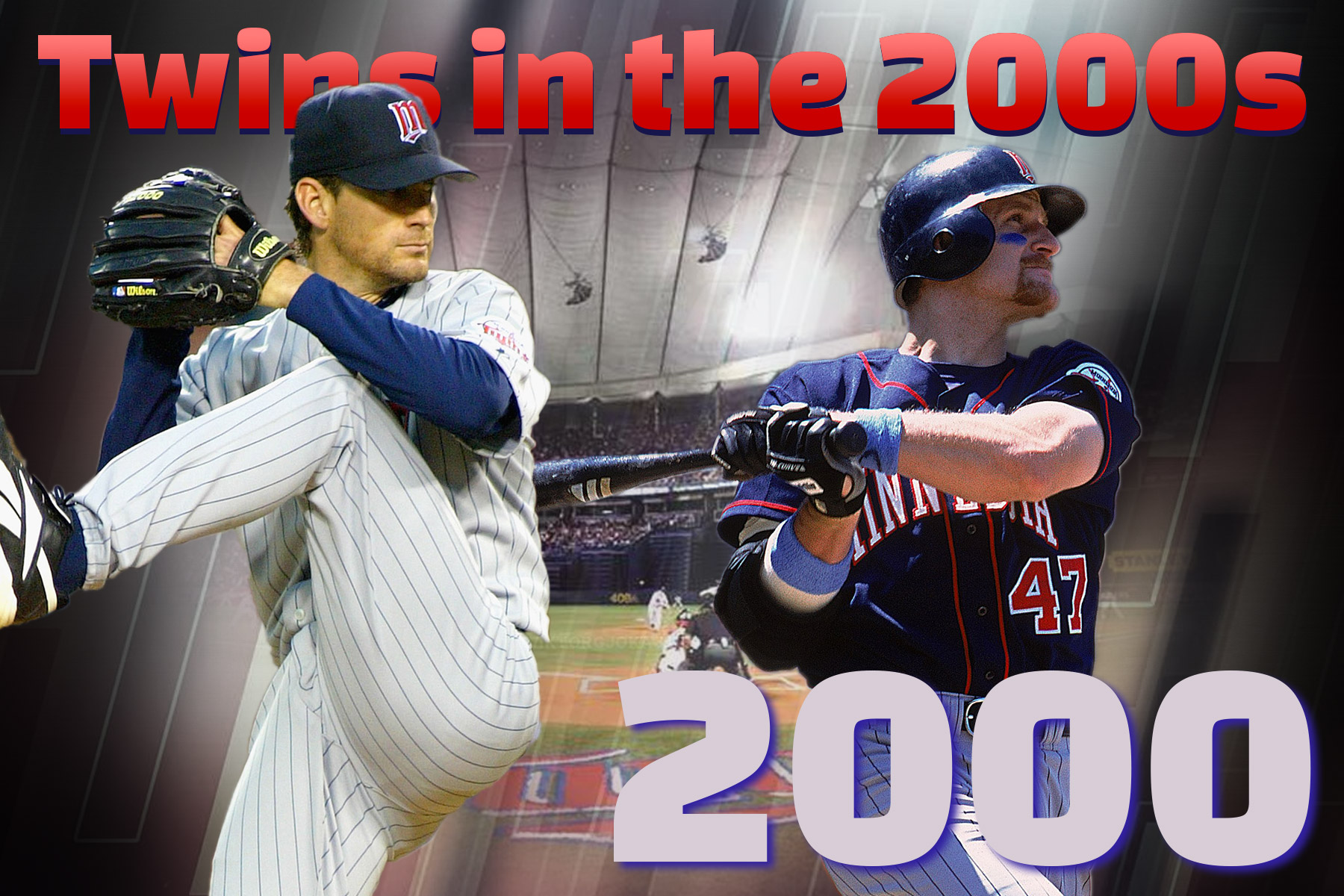 Today we're launching a 20-part series in which we look back at each Minnesota Twins season of the 2000s. A rotation of different writers will highlight key moments, unearth forgotten details, and share nostalgic tales from the past two decades leading up to the present. Our first installment covers the 2000 season. Team Record: 69-93 Finish: 5th Place in AL Central All Star(s): Matt Lawton (OF) Awards: N/A Playoffs: N/A Season Overview After their World Series victory in 1991, the Twins won 90 games in 1992 but missed the playoffs. It would be their last finish above .500 in the '90s. The realignment in 1994 created a five-team AL Central, and Minnesota placed fourth or fifth in each of the newly created division's first six seasons. The world didn't end on Y2K, nor did this momentous milestone disrupt Minnesota's reliable pattern of losing. The 2000 season saw them finish last in the Central with a 69-93 record, but there was a real feeling of progress and momentum in a rebuild being orchestrated by Terry Ryan, who took over as general manager when Andy MacPhail departed in 1994. By this point, the seeds of Ryan's biggest trade – sending Chuck Knoblauch to the Yankees for four prospects in '96 – were bearing fruit, with all four appearing for the Twins in 2000: Shortstop Cristian Guzmán took a big step forward in his sophomore campaign at age 22. Though he remained raw and unrefined at the plate (.247/.299/.388 with an OPS+ of 70), his athleticism became unignorable as he notched a team-record 20 triples and stole 28 bases. Starter Eric Milton, now an established rotation fixture at age 24, reaffirmed his status as No. 2 behind Brad Radke, logging an even 200 innings with a 4.86 ERA that was solidly above-average for the offense-heavy era. Outfielder Brian Buchanan reached the majors for the first time at age 26, debuting on May 19th and making 93 plate appearances with a .232/.301/.305 slash line. He hit 27 homers at Class-AAA Salt Lake in 2000, but only one with the Twins. Reliever Danny Mota pitched four times as a September call-up, giving up five earned runs in 5 1/3 innings. It was his only MLB stint. Mota didn't amount to anything as a Twin, and Buchanan didn't amount to much, but the other two joined an emerging core that would soon lead Minnesota back into contention. Plenty of other familiar names were finding their footing as well. For example: Torii Hunter opened as the team's center fielder, but was sent down in late May with a .207/.243/.300 slash line and 32-to-6 K/BB ratio. After putting up a 1.130 OPS with 18 homers in 55 games at Triple-A, he returned in late July and hit .332/.371/.485 the rest of the way. From then on, there was no looking back. Corey Koskie spent his first full season as Twins third baseman, slashing .300/.400/.441 in 146 games at age 27 while coming into his own defensively. Jacque Jones took over as full-time left fielder at 25 and launched a team-leading 19 homers – 18 of them against righties. A.J. Pierzynski, 23, got his first substantive taste of the majors after sipping coffee in 1998 and '99. He took over as primary catcher following a mid-August callup, and his impressive production (.307/.354/.455) convinced manager Tom Kelly to stick with him thereafter. Most significantly, a 21-year-old Rule 5 pick named Johan Santana took his lumps as the Twins were forced to keep him on the major-league roster. Working mostly as a low-leverage reliever, the rookie posted a 6.49 ERA in 86 innings, showing no signs of the dominance to come. A meeting with Triple-A pitching coach Bobby Cuellar, who would help him develop a legendary changeup, was still on the horizon. For now, Radke was leading the pitching staff, while Matt Lawton set the pace offensively, batting third and slashing .305/.405/.460 with 44 doubles and a 63-to-91 K/BB ratio. The club's lone All-Star in 2000, he teamed with Jones and Hunter to form the outfield's "Soul Patrol," embedding some signature character in this scrappy underdog bunch. The puzzle hadn't yet come together. But pieces were in place. Team MVP: Brad Radke (SP) Other Contenders: Corey Koskie (3B), Jacque Jones (OF), Matt Lawton (OF), Eric Milton (SP) Radke will forever be underrated by many because it's hard now to fathom how wildly different the hitting environment was 20 years ago. He had plenty of outstanding seasons with an ERA above four, and this was one of them. It wasn't even one of Radke's better years, but his 4.45 ERA, 116 ERA+ and 1.37 WHIP over 226 2/3 innings still made him far-and-away the Twins' leader in both fWAR and bWAR. A reliable workhorse as usual at age 27, Radke averaged 6 2/3 innings per start and threw four complete games. Although he led the American League in losses (16) he also notched 12 wins for a last-place team. This was the fifth in a string of six seasons where Radke made 32+ starts and threw 218+ innings. 3 Most Pivotal Games April 3rd: Lost vs. Tampa Bay Devil Rays, 7-0 The first pitch from Radke on Opening Day at the Metrodome was launched over the fence by Rays center fielder Gerald Williams for a home run. It was a tone-setter for this game and this season, while also perfectly epitomizing Radke's career-long struggle to find his groove early in games. April 10th: Lost @ Kansas City Royals, 6-5 The Twins rebounded from their setback in the opener with a pair of walk-off wins. A week later they were 3-4, looking to get back to .500, when they rallied for two in the ninth against Royals closer Ricky Botallico to draw even. LaTroy Hawkins, who'd already thrown 2 2/3 innings in relief of Sean Bergman, was sent out again by Kelly for the bottom of the ninth. He gave up a walk-off homer to Johnny Damon right away, and the Twins lost five of their next six games to dig a hole. May 13th: Lost @ Chicago White Sox 4-3 In spite of these early trials, the Twins rallied back over the following month. After taking two of three from Cleveland at home, they set their sights on the division-leading White Sox, moving within 2 1/2 games of first place with a series-opening victory at Comiskey on May 12th. The following night, they jumped to an early 3-0 lead, which narrowed to 3-2 heading into the bottom of the ninth. There, Bob Wells coughed up a two-run walkoff homer to Jeff Abbott. This setback sparked a five-game losing streak, and the Twins were never factors in the standings again. Unforgettable Highlights Homer Dome I mentioned earlier that the first pitch thrown at the Metrodome in 2000 left the yard for a home run. That was also true of the last pitch. Lawton hit a walk-off homer against White Sox reliever Kevin Beirne in the final home game of the season on September 28th, a 6-5 win. Ripken's 3000th Hit The future Hall of Famer was one of several to check off this milestone under the teflon roof. Cal Ripken Jr. was a mere shell of his former self by now at age 39, but it was still a memorable moment at the Metrodome when he singled against Minnesota's Hector Carrasco on April 15th. The Comeback It was the most thrilling comeback of this season, and few since can match it. On May 10th, Minnesota was hosting the five-time reigning division champion Indians, and entered the bottom of the seventh trailing 8-1 before rallying for six runs to move within one. Eddie Guardado gave up a solo shot to David Justice in the top of the ninth, pushing Cleveland's lead back to two. In the bottom half, Ron Coomer drew the Twins back within one, driving in Lawton on an RBI single. Butch Huskey flew out before Midre Cummings stepped in with two outs and delivered a walk-off two-run homer. Twins win 10-9. At the time, it was a huge victory. Inaugural Twins Hall of Fame Inductees On August 12th, the Twins officially created their team Hall of Fame, inducting six individuals for the inaugural class: Harmon Killebrew, Rod Carew, Tony Oliva, Kent Hrbek, Kirby Puckett and Calvin Griffith. One Detail You Probably Forgot Denny Hocking is generally remembered as a no-hit utilityman, and for the most part he was. But in this year, and this year alone, Hocking actually brought a decent bat, slashing .298/.373/.416 for a .789 OPS that would end up as his career high by more than 100 points. Fun Fact The Twins had the lowest payroll in the league in 2000, at $16 million. Yes, that is about $2 million less than Jake Odorizzi was slated to make in 2020. Radke was the highest-paid player at $3.5 million, followed by Lawton at $2 million.
 -
The Show Must Go On: Deadline Decisions
Nick Nelson replied to Nick Nelson's topic in Twins Daily Front Page News
It's a good question and I had a similar thought. Given how much he's outperforming his rating, you do wonder if Wood has used up all his magic in the 1st half. This game definitely seems to have some streakiness, and guys who are struggling tend to make it up with hot streaks (+ vice versa) so I do think it's built in to an extent. -
The Show Must Go On: Deadline Decisions
Nick Nelson replied to Nick Nelson's topic in Twins Daily Front Page News
Option 4: Press "Like This" on this comment (or voice your support below) if you want us to trade SS Nick Gordon and SP Tyler Wells to Dodgers for LHP Alex Wood, losing a pair of quality prospects but gaining a southpaw who's been one of the NL's most effective starters in 2020. -
The Show Must Go On: Deadline Decisions
Nick Nelson replied to Nick Nelson's topic in Twins Daily Front Page News
Option 3: Press "Like This" on this comment (or voice your support below) if you want us to trade SS Nick Gordon, SP Devin Smeltzer, and SP Griffin Jax to Tigers for LHP Matthew Boyd, giving up three quality prospects but gaining an established impact starter with team control. -
The Show Must Go On: Deadline Decisions
Nick Nelson replied to Nick Nelson's topic in Twins Daily Front Page News
Option 2: Press "Like This" on this comment (or voice your support below) if you want us to trade CF Byron Buxton and RF Alex Kirilloff to Mets for RHP Noah Syndergaard, losing our starting center fielder and a top prospect but gaining Thor's hammer. -
The Show Must Go On: Deadline Decisions
Nick Nelson replied to Nick Nelson's topic in Twins Daily Front Page News
Option 1: Press "Like This" on this comment (or voice your support below) if you want us to trade LF Eddie Rosario and SP Jordan Balazovic to Rays for SP Blake Snell, losing a key hitter and our top pitching prospect but gaining an elite starter with extended team control. -
In our interactive simulated 2020 season, the Twins are tied with Cleveland for first place as we reach the end of July. With the trade deadline days away and a critical juncture in the schedule ahead, stakes are high. Accordingly, I've got some blockbuster trade proposals ready to put up for vote. Let's get to it.To get caught up on what we're doing here, you can check out the introductory post in the series for an explanation of the premise and setup. But the quick version is this: We're playing a progressive simulated Twins season on MLB The Show 20 on PS4, and y'all are helping guide the ship. In each installment I'll update you on what's happened since the last, and put at least one key decision up for vote. Date In Game: 7/27 Team Record: 62-46 Leading OPS: Luis Arraez (.918 in 329 AB) Leading ERA (SP): Kenta Maeda (3.36 in 128.2 IP) Leading ERA (RP): Tyler Duffey (1.52 in 47.1 IP) LATEST RESULTS (4-6) Gm 99 @ TEX: L 3-2 (Berrios 7 IP, 2 ER) Gm 100 @ TEX: W 5-0 (Odorizzi 6 IP, 0 R, W) Gm 101 @ TEX: L 7-1 (Maeda 5 IP, 5 ER, L) Gm 102 @ ARI: L 7-2 (Bailey 4.1 IP, 6 ER, L) Gm 103 @ ARI: L 6-0 (Pineda 4 IP, 5 ER, L) Gm 104 @ ARI: W 4-2 (Arraez pinch-hit GW single) Gm 105 vs CWS: W 7-3 (Odorizzi 7 IP, 0 ER, W) Gm 106 vs CWS: L 2-0 (Sano, Kepler, Rosario: 0-13) Gm 107 vs CWS: L 6-4 (Bailey 4.1 IP, 4 ER, L) Gm 108 vs CWS: W 6-3 (Arraez 3-3, 2 RBI) AL CENTRAL STANDINGS Download attachment: alcstandings727.jpeg THE RUNDOWN Our Twins rode a hot streak into the All-Star break but have stumbled a bit on the other side, dropping six of 10 games while Cleveland went 7-3 to pull back into a first-place tie. Naturally, right after I said last time that the offense was fine and we needed to address pitching, the units flip-flopped over these 10 games. The rotation delivered several outstanding performances while the lineup sputtered, scoring two or fewer runs five times including a pair of shutouts – one a complete game by Arizona's Madison Bumgarner, the other a collective effort from Chicago led by Gio Gonzalez. Our team seems to have some issues with lefties? The tough stretch puts us back under the gun as the trade deadline arrives and Cleveland shows no signs of relenting. We are at a pivotal moment in the season. The next three series on the schedule, all at home: Dodgers, Astros, Indians. Titans are about to clash at Target Field, and we need to power up for it. I've been exploring possible deals to add starting pitching, and will run through the possibilities shortly, but first wanted to mention that we were offered a trade by another team. The Angels, running away with the AL West and leading the majors in wins (71), interestingly came calling for Jose Berrios. Their offer was enough of a nonstarter that I went ahead and rejected without even bringing it up here for a vote. Download attachment: joseberriosoffer.jpeg Now, I will say that if the Twins were out of contention, this might be a deal worth considering. Canning is a legitimately good young pitcher with many years of cheap team control. Jones is a solid prospect. Anderson is a reliever with a big arm. And the Twins would benefit financially from this trade. But the idea that our first-place club would trade its best starter to the only AL team with a better record, in exchange for prospects, is laughable. Nice try Billy Eppler, but no dice. WHO'S HOT Berrios, for one. Which makes the above trade offer all the more easily dismissed. Berrios delivered a pair of quality starts and dating back to the beginning of June, he has now delivered eight of them in nine starts while posting a 2.24 ERA over 64 1/3 innings. Berrios has his ERA for the season down to 3.38, trailing rotation leader Kenta Maeda (3.36) by just a hair. Jake Odorizzi has been a bit more up-and-down this summer, but he too came racing out of the gates in the second half, firing 13 scoreless innings against the Rangers and Diamondbacks. His ERA now sits at 3.42, so the top three starters are all right in the same neighborhood. Offensively it's been a bit of a trudge, with the typical exception of Arraez. Among AL players he trails only Mike Trout in average (.334) and on-base percentage (.432), and the second baseman's latest sample included a crucial pinch-hit two-run single in the ninth to help Minnesota avoid a sweep in Arizona. WHO'S NOT Plenty of hitters, but that's not my concern right now. The biggest problem on this team has become Homer Bailey, who's managed to collect 10 wins despite mostly pitching rather terribly. His struggles have gotten out of hand lately; in the most recent stretch, he went 0-2 in his two starts while failing to get through five innings in either. Add in his clunker against Toronto just ahead of the All-Star break, and Bailey has coughed up 16 earned runs on 20 hits in 11 1/3 innings over his past three turns, with as many walks (7) as strikeouts (7). For most of the first half, he was a decent enough stopgap for the back of the rotation. But it's clear that he needs to be replaced. Let's see how we might go about that ... DECISION TIME: PULLING THE TRIGGER ON A BLOCKBUSTER In our last edition, voters dictated that starting pitching would be our top priority in terms of deadline upgrades. Following this direction, I've made some inquiries around the league and come up with four proposals that I think we could get through. I've arranged them here into tiers of magnitude, and you can vote for your favorite(s) in the comments section. Tier 1: Trade LF Eddie Rosario and SP Jordan Balazovic to Rays for LHP Blake Snell From my cursory exploration of the market, Snell seems to be the best pitcher that could feasibly be had. I'm not exactly sure why the Rays would be compelled to trade him, but, you know. It is the Rays. And they'd be getting back a nice haul. Download attachment: blakesnelloffer.jpeg The Upside: Snell is an ace. Perhaps the very one we need. His ERA in 122 2/3 innings with the Rays this year is 3.52, which puts him in the same range as our current top three, but Snell's rating in the game (93) is vastly higher than any current Twins starter (Berrios, Odorrizi and Maeda are all 81s). Best of all, Snell is 27 and under reasonable team control for four years. The Downside: Losing Rosario and Balazovic would hurt, a lot, both now and in the future. Rosario is tied with Donaldson, Rogers and Sano as the highest-rated Twin (85). Rosie's been a crucial piece of the lineup with 16 homers and 67 RBIs. Meanwhile, Balazovic is already our organization's fourth-highest rated starting pitcher (75) and he's a 21-year-old rookie. (With 72 strikeouts in his first 68 MLB innings, I might add.) Balazovic is certainly the key to this deal in Tampa's eyes and I'd be wary of moving him. Tier 2: Trade CF Byron Buxton and RF Alex Kirilloff to Mets for RHP Noah Syndergaard Naturally, I went to revisit this fizzled discussion from the 2019 deadline. New York's demands haven't changed much since then: They want a star-caliber center fielder (Buxton) and another top-tier prospect for their flame-throwing righty. In real life, I'd view this Buxton + Kirilloff package as far more indispensable than the Rosario + Balazovic package proposed above, but in our virtual sim world, that's not so clear. Download attachment: noahsyndergaardoffer.jpeg The Upside: Syndergaard's UCL is intact in the game. So that's a plus. Not only is he healthy, Thor has been up to his usual tricks, with a 3.06 ERA and 120-to-37 K/BB ratio in 118 innings for the Mets. And while giving up Buxton and Kirilloff might seem like a hard pill to swallow, both are (IMO) a bit underrated in the game, and both are relatively replaceable, with Max Kepler able to play center and Trevor Larnach alongside Kirilloff at Triple-A. The Downside: Syndergaard's got a lower rating (87) than Snell, though he'd still instantly become our best player. Thor is also due for free agency at year's end, meaning we would be giving up Buxton and Kirilloff for a rental. We can certainly try to re-sign Syndergaard, but budgetary constraints are a thing. Then again, it's a video game so who really cares about the future? Tier 3: Trade SS Nick Gordon, SP Devin Smeltzer, and SP Griffin Jax to Tigers for LHP Matthew Boyd A good ol' quantity-for-quality trade. Since Boyd's name has frequently been the subject of trade rumors, I went and inquired about him, and it seems he could be had for a palatable prospect package. Download attachment: mattboydoffer.jpeg The Upside: We're not really giving up anything that hurts too much, and Boyd's a solid arm, with an 82 overall rating that edges any current Twins starter. He's arbitration eligible for two more years after 2020. The Downside: It's a big step down from the two game-changing options above. And while Boyd is rated well, his performance this year hasn't backed it up: He's 6-12 with a 4.80 ERA in 22 starts. Tier 4: Trade SS Nick Gordon and SP Tyler Wells to Dodgers for LHP Alex Wood Among starting pitchers that are actually on the trading block, Wood is the best available. Since he's being shopped, I figured the lefty might be available for a smallish return and, yep, that is the case. Download attachment: alexwoodoffer.jpeg The Upside: Not giving up much, and Wood's having himself a year, with his 2.53 ERA through 20 starts ranking third-best in the National League. Sorta begs the question of why the first-place Dodgers are trying to trade him, but that's not for me to worry about. The Downside: His overall rating is 81, so while he'd be a clear improvement over Bailey (73), Wood is just another guy at the same tier as Berrios, Odorizzi, and Maeda. He probably helps us win a few more games in the regular season, but does he make a difference in the playoffs? I'll list these four proposals in the comments. Whichever one gets the most support, that's the trade we'll make. And I'm not opposed to swinging multiple deals. COMING UP 7/28 vs LAD 7/29 vs LAD 7/31 vs HOU *TRADE DEADLINE* 8/1 vs HOU 8/2 vs HOU 8/3 vs CLE 8/4 vs CLE 8/5 vs CLE PREVIOUS INSTALLMENTS Part 1: We Can Build This Thing Together (0-0) Part 2: 10 Games In, 6 Games Back (4-6) Part 3: Roaring Back (11-9) Part 4: Over the Hill (17-13) Part 5: Checking In at the Quarter Point (23-17) Part 6: Rising Power (30-20) Part 7: First Place! (Barely) (34-26) Part 8: Drafting and Dropping (38-32) Part 9: Cruz Control (45-35) Part 10: Pulling Ahead (52-38) Part 11: Bashing into the All-Star Break (58-40) MORE FROM TWINS DAILY — Latest Twins coverage from our writers — Recent Twins discussion in our forums — Follow Twins Daily via Twitter, Facebook or email Click here to view the article
-
 To get caught up on what we're doing here, you can check out the introductory post in the series for an explanation of the premise and setup. But the quick version is this: We're playing a progressive simulated Twins season on MLB The Show 20 on PS4, and y'all are helping guide the ship. In each installment I'll update you on what's happened since the last, and put at least one key decision up for vote. Date In Game: 7/27 Team Record: 62-46 Leading OPS: Luis Arraez (.918 in 329 AB) Leading ERA (SP): Kenta Maeda (3.36 in 128.2 IP) Leading ERA (RP): Tyler Duffey (1.52 in 47.1 IP) LATEST RESULTS (4-6) Gm 99 @ TEX: L 3-2 (Berrios 7 IP, 2 ER) Gm 100 @ TEX: W 5-0 (Odorizzi 6 IP, 0 R, W) Gm 101 @ TEX: L 7-1 (Maeda 5 IP, 5 ER, L) Gm 102 @ ARI: L 7-2 (Bailey 4.1 IP, 6 ER, L) Gm 103 @ ARI: L 6-0 (Pineda 4 IP, 5 ER, L) Gm 104 @ ARI: W 4-2 (Arraez pinch-hit GW single) Gm 105 vs CWS: W 7-3 (Odorizzi 7 IP, 0 ER, W) Gm 106 vs CWS: L 2-0 (Sano, Kepler, Rosario: 0-13) Gm 107 vs CWS: L 6-4 (Bailey 4.1 IP, 4 ER, L) Gm 108 vs CWS: W 6-3 (Arraez 3-3, 2 RBI) AL CENTRAL STANDINGS THE RUNDOWN Our Twins rode a hot streak into the All-Star break but have stumbled a bit on the other side, dropping six of 10 games while Cleveland went 7-3 to pull back into a first-place tie. Naturally, right after I said last time that the offense was fine and we needed to address pitching, the units flip-flopped over these 10 games. The rotation delivered several outstanding performances while the lineup sputtered, scoring two or fewer runs five times including a pair of shutouts – one a complete game by Arizona's Madison Bumgarner, the other a collective effort from Chicago led by Gio Gonzalez. Our team seems to have some issues with lefties? The tough stretch puts us back under the gun as the trade deadline arrives and Cleveland shows no signs of relenting. We are at a pivotal moment in the season. The next three series on the schedule, all at home: Dodgers, Astros, Indians. Titans are about to clash at Target Field, and we need to power up for it. I've been exploring possible deals to add starting pitching, and will run through the possibilities shortly, but first wanted to mention that we were offered a trade by another team. The Angels, running away with the AL West and leading the majors in wins (71), interestingly came calling for Jose Berrios. Their offer was enough of a nonstarter that I went ahead and rejected without even bringing it up here for a vote. Now, I will say that if the Twins were out of contention, this might be a deal worth considering. Canning is a legitimately good young pitcher with many years of cheap team control. Jones is a solid prospect. Anderson is a reliever with a big arm. And the Twins would benefit financially from this trade. But the idea that our first-place club would trade its best starter to the only AL team with a better record, in exchange for prospects, is laughable. Nice try Billy Eppler, but no dice. WHO'S HOT Berrios, for one. Which makes the above trade offer all the more easily dismissed. Berrios delivered a pair of quality starts and dating back to the beginning of June, he has now delivered eight of them in nine starts while posting a 2.24 ERA over 64 1/3 innings. Berrios has his ERA for the season down to 3.38, trailing rotation leader Kenta Maeda (3.36) by just a hair. Jake Odorizzi has been a bit more up-and-down this summer, but he too came racing out of the gates in the second half, firing 13 scoreless innings against the Rangers and Diamondbacks. His ERA now sits at 3.42, so the top three starters are all right in the same neighborhood. Offensively it's been a bit of a trudge, with the typical exception of Arraez. Among AL players he trails only Mike Trout in average (.334) and on-base percentage (.432), and the second baseman's latest sample included a crucial pinch-hit two-run single in the ninth to help Minnesota avoid a sweep in Arizona. WHO'S NOT Plenty of hitters, but that's not my concern right now. The biggest problem on this team has become Homer Bailey, who's managed to collect 10 wins despite mostly pitching rather terribly. His struggles have gotten out of hand lately; in the most recent stretch, he went 0-2 in his two starts while failing to get through five innings in either. Add in his clunker against Toronto just ahead of the All-Star break, and Bailey has coughed up 16 earned runs on 20 hits in 11 1/3 innings over his past three turns, with as many walks (7) as strikeouts (7). For most of the first half, he was a decent enough stopgap for the back of the rotation. But it's clear that he needs to be replaced. Let's see how we might go about that ... DECISION TIME: PULLING THE TRIGGER ON A BLOCKBUSTER In our last edition, voters dictated that starting pitching would be our top priority in terms of deadline upgrades. Following this direction, I've made some inquiries around the league and come up with four proposals that I think we could get through. I've arranged them here into tiers of magnitude, and you can vote for your favorite(s) in the comments section. Tier 1: Trade LF Eddie Rosario and SP Jordan Balazovic to Rays for LHP Blake Snell From my cursory exploration of the market, Snell seems to be the best pitcher that could feasibly be had. I'm not exactly sure why the Rays would be compelled to trade him, but, you know. It is the Rays. And they'd be getting back a nice haul. The Upside: Snell is an ace. Perhaps the very one we need. His ERA in 122 2/3 innings with the Rays this year is 3.52, which puts him in the same range as our current top three, but Snell's rating in the game (93) is vastly higher than any current Twins starter (Berrios, Odorrizi and Maeda are all 81s). Best of all, Snell is 27 and under reasonable team control for four years. The Downside: Losing Rosario and Balazovic would hurt, a lot, both now and in the future. Rosario is tied with Donaldson, Rogers and Sano as the highest-rated Twin (85). Rosie's been a crucial piece of the lineup with 16 homers and 67 RBIs. Meanwhile, Balazovic is already our organization's fourth-highest rated starting pitcher (75) and he's a 21-year-old rookie. (With 72 strikeouts in his first 68 MLB innings, I might add.) Balazovic is certainly the key to this deal in Tampa's eyes and I'd be wary of moving him. Tier 2: Trade CF Byron Buxton and RF Alex Kirilloff to Mets for RHP Noah Syndergaard Naturally, I went to revisit this fizzled discussion from the 2019 deadline. New York's demands haven't changed much since then: They want a star-caliber center fielder (Buxton) and another top-tier prospect for their flame-throwing righty. In real life, I'd view this Buxton + Kirilloff package as far more indispensable than the Rosario + Balazovic package proposed above, but in our virtual sim world, that's not so clear. The Upside: Syndergaard's UCL is intact in the game. So that's a plus. Not only is he healthy, Thor has been up to his usual tricks, with a 3.06 ERA and 120-to-37 K/BB ratio in 118 innings for the Mets. And while giving up Buxton and Kirilloff might seem like a hard pill to swallow, both are (IMO) a bit underrated in the game, and both are relatively replaceable, with Max Kepler able to play center and Trevor Larnach alongside Kirilloff at Triple-A. The Downside: Syndergaard's got a lower rating (87) than Snell, though he'd still instantly become our best player. Thor is also due for free agency at year's end, meaning we would be giving up Buxton and Kirilloff for a rental. We can certainly try to re-sign Syndergaard, but budgetary constraints are a thing. Then again, it's a video game so who really cares about the future? Tier 3: Trade SS Nick Gordon, SP Devin Smeltzer, and SP Griffin Jax to Tigers for LHP Matthew Boyd A good ol' quantity-for-quality trade. Since Boyd's name has frequently been the subject of trade rumors, I went and inquired about him, and it seems he could be had for a palatable prospect package. The Upside: We're not really giving up anything that hurts too much, and Boyd's a solid arm, with an 82 overall rating that edges any current Twins starter. He's arbitration eligible for two more years after 2020. The Downside: It's a big step down from the two game-changing options above. And while Boyd is rated well, his performance this year hasn't backed it up: He's 6-12 with a 4.80 ERA in 22 starts. Tier 4: Trade SS Nick Gordon and SP Tyler Wells to Dodgers for LHP Alex Wood Among starting pitchers that are actually on the trading block, Wood is the best available. Since he's being shopped, I figured the lefty might be available for a smallish return and, yep, that is the case. The Upside: Not giving up much, and Wood's having himself a year, with his 2.53 ERA through 20 starts ranking third-best in the National League. Sorta begs the question of why the first-place Dodgers are trying to trade him, but that's not for me to worry about. The Downside: His overall rating is 81, so while he'd be a clear improvement over Bailey (73), Wood is just another guy at the same tier as Berrios, Odorizzi, and Maeda. He probably helps us win a few more games in the regular season, but does he make a difference in the playoffs? I'll list these four proposals in the comments. Whichever one gets the most support, that's the trade we'll make. And I'm not opposed to swinging multiple deals. COMING UP 7/28 vs LAD 7/29 vs LAD 7/31 vs HOU *TRADE DEADLINE* 8/1 vs HOU 8/2 vs HOU 8/3 vs CLE 8/4 vs CLE 8/5 vs CLE PREVIOUS INSTALLMENTS Part 1: We Can Build This Thing Together (0-0) Part 2: 10 Games In, 6 Games Back (4-6) Part 3: Roaring Back (11-9) Part 4: Over the Hill (17-13) Part 5: Checking In at the Quarter Point (23-17) Part 6: Rising Power (30-20) Part 7: First Place! (Barely) (34-26) Part 8: Drafting and Dropping (38-32) Part 9: Cruz Control (45-35) Part 10: Pulling Ahead (52-38) Part 11: Bashing into the All-Star Break (58-40) MORE FROM TWINS DAILY — Latest Twins coverage from our writers — Recent Twins discussion in our forums — Follow Twins Daily via Twitter, Facebook or email
 -
Saying that baseball team owners, who have more wealth than all their players combined and who don't have to make any personal sacrifices (in terms of personal safety, well-being and life disruption) in this scenario, should be willing to accept financial losses if they want to hold a season is not "bias," it is an opinion based on facts and personal conviction.
-
Not suffer at all?? Do you understand these are people, with families, being sent into a hazardous, awkward and confining situation for months? No matter the precautions or systems MLB implements, players and personnel will be putting themselves at risk, while owners watch from their comfy mansions. There is more to the world than money, and people in all walks of life are coming to terms with that right now. I'm perfectly fine with an opt-in season. I'll watch. I just don't think any players should feel obligated to participate and I don't think it should count as an official MLB season of record. I have been clear & consistent with this view for over a month.
-
Would they be happy to go back for 1% of what they earn? Even if their very comfortable bosses/ownership could easily afford to pay their full salaries and be just fine? Because that's the more pertinent hypothetical here. MLB owners would (maybe) be taking a loss in the short-term but they're still boosting the value of the team and league in which they have equity. Players don't share in that benefit. Again, I have serious gripes with the idea that cash influxes (like the huge media deals of the past decade) go basically straight to owners, yet players have to share the burden of an unexpected lull.
-
From their perspective, the deal they agreed to has been changed. Why is this on them and not the owners? These players are human beings. They have no obligation to put their health and safety at risk for you, me, or anyone else if they don't deem the financial benefits worthwhile.
-
Option 3: Press "Like This" on this comment (or voice your support below) if you want us to go all out and focus on upgrading BOTH the rotation and bullpen at the trade deadline.
-
Option 2: Press "Like This" on this comment (or voice your support below) if you want us to focus our efforts at the trade deadline on upgrading the bullpen.
