



Nick Nelson
-
Posts
8,327 -
Joined
-
Last visited
-
Days Won
56
Content Type
Profiles
News
Minnesota Twins Videos
2026 Minnesota Twins Top Prospects Ranking
2022 Minnesota Twins Draft Picks
Minnesota Twins Free Agent & Trade Rumors, Notes, & Tidbits
Guides & Resources
2023 Minnesota Twins Draft Picks
The Minnesota Twins Players Project
2024 Minnesota Twins Draft Picks
2025 Minnesota Twins Draft Pick Tracker
2026 Minnesota Twins Draft Tracker: Picks & Bonuses
Forums
Blogs
Events
Store
Downloads
Gallery
Everything posted by Nick Nelson
-
 Up to this point, Byron Buxton has shown he can catch anything. Except a break. A major-league career that's been characterized by setbacks and shutdowns was on track to open with another one in 2020, as the center fielder had been expected to miss the start of the season, but now fortune has finally turned in Buxton's favor.Buxton was behind the pack in spring training 1.0, ramping up slowly as he finished rehabbing from offseason shoulder surgery. Opening Day 1.0 seemed an unlikely target. Incidentally, he also got a late start to spring training 2.0, albeit for a very different reason. Buxton's repaired shoulder is now fully healed, but his arrival in Summer Camp was delayed slightly by the arrival of he and wife Linday's (amazingly-named) second son. It's no secret that injuries have plagued the 26-year-old in an MLB career that started in 2015, but has seen him appear in 100 games only once. While he had his troubles adapting to big-league stuff, rotten luck has mostly been at the root of Buxton's failure to put together a full quality campaign. One thing he HAS proven he can do, however, is play at an elite level over a 60-game span. He did so last year, playing in 57 of Minnesota's first 60 games and slashing .262/.318/.519 with 20 doubles, seven homers and three triples. Through that point, he ranked 16th among American Leaguers in fWAR. Of course, the injury bug bit soon after, and Buxton went on to start just 24 of the team's remaining 102 games. But those first 60 showed what the superstar talent is capable of, and it wasn't even the height of his potential. We've seen him better. Let's turn the clock back a little further – skipping over a 2018 campaign that was an unmitigated disaster for Buxton – and rewind to 2017. Here we find the closest thing to a complete season representative of his true ability. He played in 140 games, slashed .253/.314/.413 with 16 home runs and 29 steals, and earned the Platinum Glove as MLB's most valuable defender. His overall numbers for the '17 season were dragged down by immense early struggles. It was in the latter months, as Minnesota raced to an unlikely wild-card berth, that Buxton's game-changing ability truly emerged. He started 55 of the team's final 60 games that year, slashing .298/.342/.541 with 11 homers. He also went 13-for-13 on steals, which means you can inflate that slugging percentage for all intents and purposes. During this two-month stretch Buxton ranked sixth in the American League in fWAR, behind only: Josh DonaldsonBrian DozierMike TroutFrancisco LindorAaron JudgeBuxton's ability to make a seismic impact over 60 games is not theoretical. He's done it twice in the past two-and-a-half seasons. Staying on the field for much longer than 60 games in a row has been the issue, but for once, he's not staring down the rigors of a 162-game marathon. More importantly, Buxton is truly at the crest of his physical prime, fully healthy by all accounts. This is a perfect opportunity for his stardom to truly blossom. In an unprecedented sprint of a season, it helps to have the fastest runner in baseball. Of course, the flip side of all this is easy enough to see. A shortened schedule also means that any incident for Buxton – another collision with an outfield wall, or a jammed wrist sliding into second – would cost him a huge portion of his season. That's a tough reality. But it's frankly one we've all grown accustomed to, and one the Twins are exceptionally well prepared for, with Max Kepler able to man center and plentiful depth at the corners. The Twins can be one of the best teams in baseball without Byron Buxton. But if he can hit his stride over these 60 games, his as-yet-untapped upside could catapult them to rarified air. We've all learned better than to take that for granted. But right now, the stars are aligned for his star to shine. MORE FROM TWINS DAILY — Latest Twins coverage from our writers — Recent Twins discussion in our forums — Follow Twins Daily via Twitter, Facebook or email Click here to view the article
 -
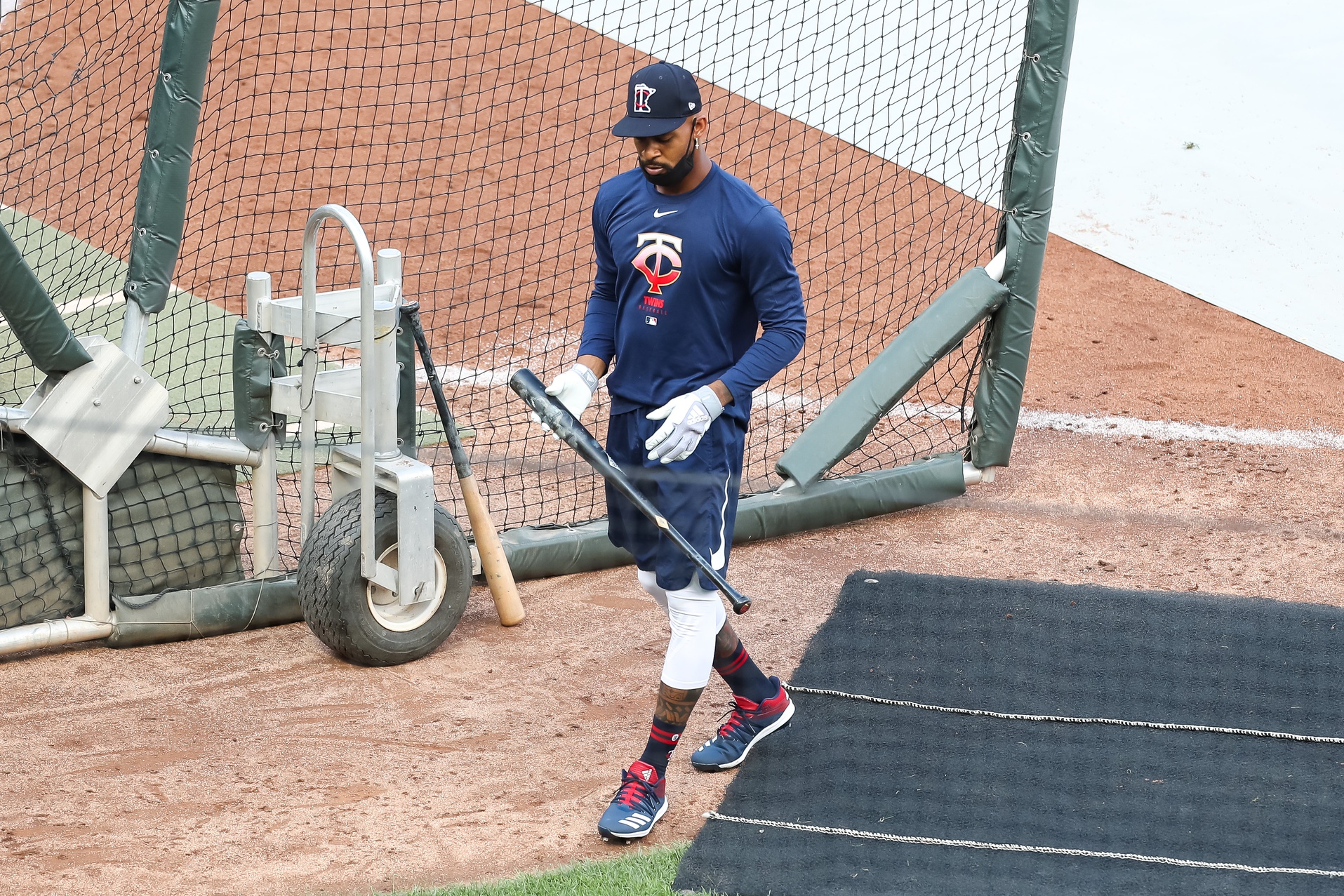 Buxton was behind the pack in spring training 1.0, ramping up slowly as he finished rehabbing from offseason shoulder surgery. Opening Day 1.0 seemed an unlikely target. Incidentally, he also got a late start to spring training 2.0, albeit for a very different reason. Buxton's repaired shoulder is now fully healed, but his arrival in Summer Camp was delayed slightly by the arrival of he and wife Linday's (amazingly-named) second son. https://twitter.com/dohyoungpark/status/1279243630339899392 With little time lost, Buxton landed in camp this week, passing his COVID test and taking the field Tuesday for drills and batting practice. On Twitter, The Athletic's Dan Hayes provided dubious photographic evidence of this fact, along with some more convincing BP video. https://twitter.com/DanHayesMLB/status/1280619535268184065 https://twitter.com/DanHayesMLB/status/1280638859240443909 It's no secret that injuries have plagued the 26-year-old in an MLB career that started in 2015, but has seen him appear in 100 games only once. While he had his troubles adapting to big-league stuff, rotten luck has mostly been at the root of Buxton's failure to put together a full quality campaign. One thing he HAS proven he can do, however, is play at an elite level over a 60-game span. He did so last year, playing in 57 of Minnesota's first 60 games and slashing .262/.318/.519 with 20 doubles, seven homers and three triples. Through that point, he ranked 16th among American Leaguers in fWAR. Of course, the injury bug bit soon after, and Buxton went on to start just 24 of the team's remaining 102 games. But those first 60 showed what the superstar talent is capable of, and it wasn't even the height of his potential. We've seen him better. Let's turn the clock back a little further – skipping over a 2018 campaign that was an unmitigated disaster for Buxton – and rewind to 2017. Here we find the closest thing to a complete season representative of his true ability. He played in 140 games, slashed .253/.314/.413 with 16 home runs and 29 steals, and earned the Platinum Glove as MLB's most valuable defender. His overall numbers for the '17 season were dragged down by immense early struggles. It was in the latter months, as Minnesota raced to an unlikely wild-card berth, that Buxton's game-changing ability truly emerged. He started 55 of the team's final 60 games that year, slashing .298/.342/.541 with 11 homers. He also went 13-for-13 on steals, which means you can inflate that slugging percentage for all intents and purposes. During this two-month stretch Buxton ranked sixth in the American League in fWAR, behind only: Josh Donaldson Brian Dozier Mike Trout Francisco Lindor Aaron Judge Buxton's ability to make a seismic impact over 60 games is not theoretical. He's done it twice in the past two-and-a-half seasons. Staying on the field for much longer than 60 games in a row has been the issue, but for once, he's not staring down the rigors of a 162-game marathon. More importantly, Buxton is truly at the crest of his physical prime, fully healthy by all accounts. This is a perfect opportunity for his stardom to truly blossom. In an unprecedented sprint of a season, it helps to have the fastest runner in baseball. Of course, the flip side of all this is easy enough to see. A shortened schedule also means that any incident for Buxton – another collision with an outfield wall, or a jammed wrist sliding into second – would cost him a huge portion of his season. That's a tough reality. But it's frankly one we've all grown accustomed to, and one the Twins are exceptionally well prepared for, with Max Kepler able to man center and plentiful depth at the corners. The Twins can be one of the best teams in baseball without Byron Buxton. But if he can hit his stride over these 60 games, his as-yet-untapped upside could catapult them to rarified air. We've all learned better than to take that for granted. But right now, the stars are aligned for his star to shine. MORE FROM TWINS DAILY — Latest Twins coverage from our writers — Recent Twins discussion in our forums — Follow Twins Daily via Twitter, Facebook or email
 -
Back in February, before the world unraveled, I wrote that the Twins were rolling into camp with a good case as the American League's best team. While much has changed in the four months since, I'm not sure Minnesota's case has been weakened. If anything, it's been strengthened.Preseason betting odds pegged Minnesota as the AL's third-best team, behind New York and Houston, which matched the general consensus view. MLB.com's updated power rankings have those teams in the same order now, with all trailing the Dodgers overall. I can certainly buy that the Twins are a notch below the Yankees and Astros, with all things being equal. But in late February, all things were not equal. New York was getting hit by early injury woes that figured to set them back early in the season. Houston was going through a leadership overhaul while embroiled in a massive scandal that villainized their entire organization. Many things have changed since then, but still they are not all equal. The Yankees' health situation has improved – for instance, left-hander James Paxton is now likely to be ready from the jump instead of missing three months, and the same is true for center fielder Aaron Hicks and DH Giancarlo Stanton. But they're still gonna be without starters Luis Severino (elbow surgery) and Domingo German (awfulness) all year. And while previously banged up players like Paxton, Stanton, and Aaron Judge are now purportedly healthy, you can't take for granted they'll experience smooth sailing with the short build-up to high-intensity action. This is a concern affecting every team in baseball, but the Twins, at this point *knock on wood*, are looking to be very near full strength and all systems go. Like New York, Minnesota figures to see some benefit from the late start, with Rich Hill potentially available for the full season instead of one-third of it, and Byron Buxton now expected to be ready from the jump. As for Houston, their ostensible disadvantages were more theoretical than New York's health setbacks. Who knows if their players would've been affected by the routinely hostile crowd environments, or the increased volume of beanballs, but neither will be factors anymore. What the Astros still WILL be dealing with is learning to play under a new manager – albeit a deeply respected one in Dusty Baker – while navigating this unprecedented scenario. Managers and GMs only matter so much, but there was a certain continuity represented by AJ Hinch and Jeff Luhnow. That's been snapped. And on a more basic and quantifiable level, Gerrit Cole is gone. The Twins, conversely, are fully finding their rhythm with a world-class front office and coaching staff. Rocco Baldelli is the reigning rookie Manager of the Year, while the baseball ops department has evolved into a cutting-edge machine, brimming with smart folks. Those smart folks still haven't guided the Twins to the ALCS, where Houston and New York met last October, so until further notice Minnesota remains a justifiable underdog. I will grant that none of the points above fundamentally alter that reality. Here's one thing that might: schedule. With the new regionalized reconfiguration in place for 60 games, the Twins are slated to face Central division teams exclusively. They have the easiest strength of schedule in the majors based on last year's results, and won't face any team in regular season action that won more than 93 games in 2019. The benefits of having cellar-dwellers Kansas City and Detroit in the division are magnified greatly by this new format, and while Cleveland gets to enjoy the same advantage, New York and Houston don't. The Astros are forced to deal with a healthy helping of the A's and Angels (I view the top-heavy Halos as a sneaky riser in the shortened season). Houston will also be stuck with the Dodgers in interleague play, while the Twins are saved from that original assignment. The Yankees, meanwhile, must fend off the pesky Rays and wrangle with the Red Sox, not to mention touring a deep NL East that features Washington, Atlanta, Philadelphia, and the Mets. That's a murderer's row compared to the NL Central, which was baseball's weakest division in 2019 and doesn't project a whole lot better in 2020. The Twins might not be a better team than the Yankees or Astros, but I would bet on them to win more regular-season games than either, based on the simple reality that they're lined up to experience far less resistance. No. 1 seed, here we come. MORE FROM TWINS DAILY — Latest Twins coverage from our writers — Recent Twins discussion in our forums — Follow Twins Daily via Twitter, Facebook or email Click here to view the article
-
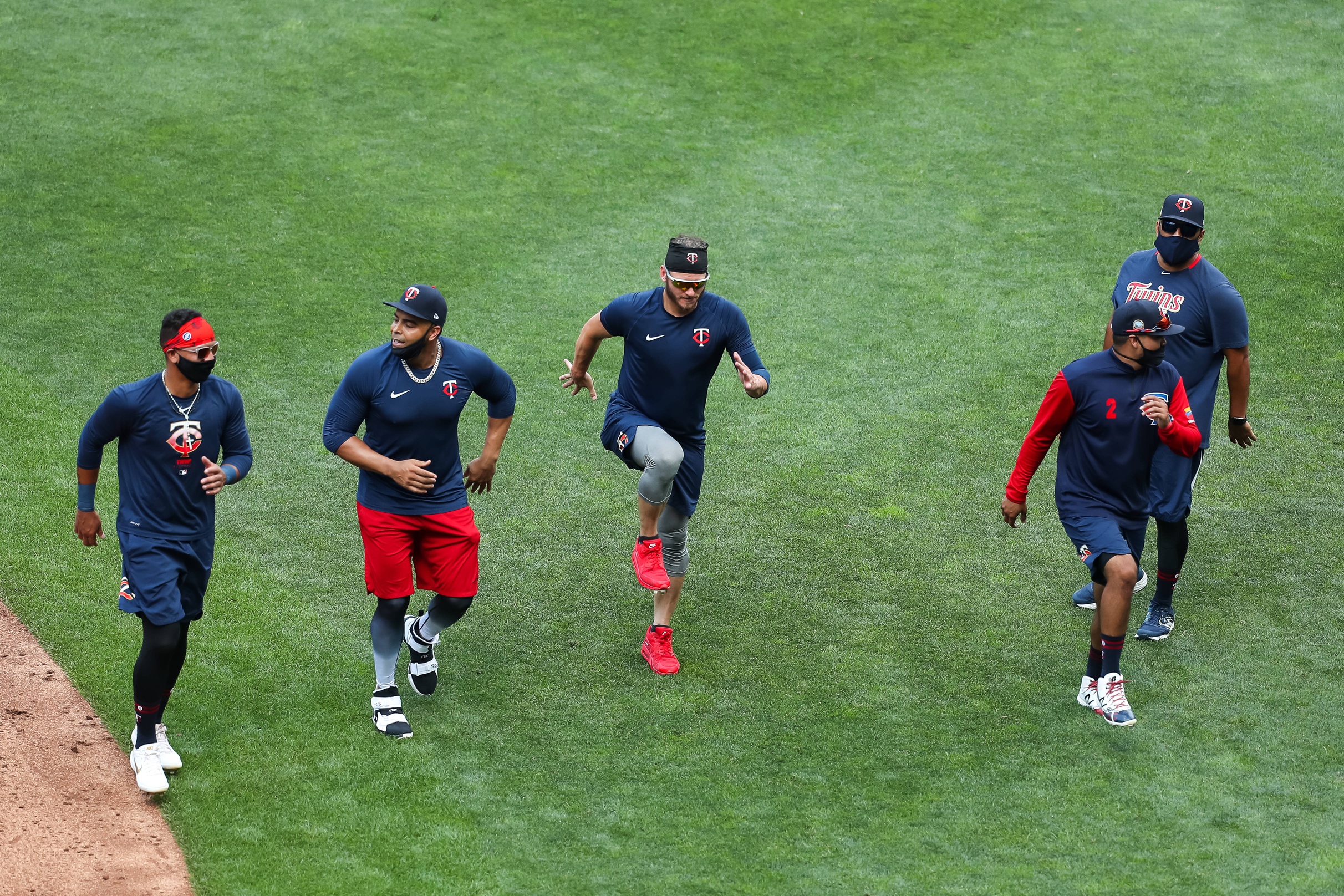 Preseason betting odds pegged Minnesota as the AL's third-best team, behind New York and Houston, which matched the general consensus view. MLB.com's updated power rankings have those teams in the same order now, with all trailing the Dodgers overall. I can certainly buy that the Twins are a notch below the Yankees and Astros, with all things being equal. But in late February, all things were not equal. New York was getting hit by early injury woes that figured to set them back early in the season. Houston was going through a leadership overhaul while embroiled in a massive scandal that villainized their entire organization. Many things have changed since then, but still they are not all equal. The Yankees' health situation has improved – for instance, left-hander James Paxton is now likely to be ready from the jump instead of missing three months, and the same is true for center fielder Aaron Hicks and DH Giancarlo Stanton. But they're still gonna be without starters Luis Severino (elbow surgery) and Domingo German (awfulness) all year. And while previously banged up players like Paxton, Stanton, and Aaron Judge are now purportedly healthy, you can't take for granted they'll experience smooth sailing with the short build-up to high-intensity action. This is a concern affecting every team in baseball, but the Twins, at this point *knock on wood*, are looking to be very near full strength and all systems go. Like New York, Minnesota figures to see some benefit from the late start, with Rich Hill potentially available for the full season instead of one-third of it, and Byron Buxton now expected to be ready from the jump. As for Houston, their ostensible disadvantages were more theoretical than New York's health setbacks. Who knows if their players would've been affected by the routinely hostile crowd environments, or the increased volume of beanballs, but neither will be factors anymore. What the Astros still WILL be dealing with is learning to play under a new manager – albeit a deeply respected one in Dusty Baker – while navigating this unprecedented scenario. Managers and GMs only matter so much, but there was a certain continuity represented by AJ Hinch and Jeff Luhnow. That's been snapped. And on a more basic and quantifiable level, Gerrit Cole is gone. The Twins, conversely, are fully finding their rhythm with a world-class front office and coaching staff. Rocco Baldelli is the reigning rookie Manager of the Year, while the baseball ops department has evolved into a cutting-edge machine, brimming with smart folks. Those smart folks still haven't guided the Twins to the ALCS, where Houston and New York met last October, so until further notice Minnesota remains a justifiable underdog. I will grant that none of the points above fundamentally alter that reality. Here's one thing that might: schedule. https://twitter.com/Twins/status/1280274932593819649 With the new regionalized reconfiguration in place for 60 games, the Twins are slated to face Central division teams exclusively. They have the easiest strength of schedule in the majors based on last year's results, and won't face any team in regular season action that won more than 93 games in 2019. The benefits of having cellar-dwellers Kansas City and Detroit in the division are magnified greatly by this new format, and while Cleveland gets to enjoy the same advantage, New York and Houston don't. The Astros are forced to deal with a healthy helping of the A's and Angels (I view the top-heavy Halos as a sneaky riser in the shortened season). Houston will also be stuck with the Dodgers in interleague play, while the Twins are saved from that original assignment. The Yankees, meanwhile, must fend off the pesky Rays and wrangle with the Red Sox, not to mention touring a deep NL East that features Washington, Atlanta, Philadelphia, and the Mets. That's a murderer's row compared to the NL Central, which was baseball's weakest division in 2019 and doesn't project a whole lot better in 2020. The Twins might not be a better team than the Yankees or Astros, but I would bet on them to win more regular-season games than either, based on the simple reality that they're lined up to experience far less resistance. No. 1 seed, here we come. MORE FROM TWINS DAILY — Latest Twins coverage from our writers — Recent Twins discussion in our forums — Follow Twins Daily via Twitter, Facebook or email
 -
In their ALDS matchup against the Rays, the virtual 2020 Twins finally snapped a long-running postseason losing streak for the franchise, but still failed to advance, as the players we traded away at the deadline exacted their sweet revenge. Let's break down the bitter end of this simulated season for the 2020 AL Champs.To get caught up on what we're doing here, you can check out the introductory post in the series for an explanation of the premise and setup. But the quick version is this: We're playing a progressive simulated Twins season on MLB The Show 20 on PS4, and y'all are helping guide the ship. In each installment I'll update you on what's happened since the last, and put at least one key decision up for vote. LATEST RESULTS (1-3) ALDS Game 1: L 3-2 (Sano 0-4, 4 K)ALDS Game 2: L 3-1 (Sano, Kepler, Cruz: 0-10)ALDS Game 3: W 11-5 (Cruz 3-6, 2 HR, 6 RBI)ALDS Game 4: L 9-5 (Odorizzi & Wood: 5 IP, 9 ER)THE PLAYOFF PICTURE We fell in four games to the Rays. Although our Twins did win Game 3 to end an 18-game postseason losing streak, they still went pretty quietly in this simulated ALDS, with a familiar breakdown in the offensive performance and execution that carried them through the regular season. And beyond their own self-created issues, there was the Eddie Factor. I'll provide game-by-game recaps below but suffice to say our former left fielder made us pay for the deadline deal that sent him to Tampa for Blake Snell. Elsewhere in the AL, Cleveland beat Boston in the Wild Card Game and then swept the Angels in the ALDS, so it'll be Cleveland vs. Tampa in the ALCS. Both NLCS series are tied 2-2 on this date in the sim (10/7/20). Download attachment: playoffbracket107.jpeg ALDS SERIES RECAP GAME 1: RAYS 3, TWINS 2 On a 44-degree evening in Minneapolis, the Rays and Twins engaged in a tightly contested pitcher's duel. Jose Berrios had his good stuff, but so did Charlie Morton. Both starters struck out eight batters over five-plus innings, but also ran up big pitch counts. After each had left in the sixth, Tampa led 2-1. The bullpens took over and put up zeroes, and Trevor May was looking particularly nasty, striking out four straight before he left a curveball over the plate against Eddie Rosario with two outs in the top of the eighth. Rosario put it on the overhang in right field, and his insurance run – putting Tampa ahead 3-1 – proved crucial as the Twins rallied for a one in the bottom of the ninth but couldn't get another. Download attachment: rosariohomerun.jpeg Rosario earned the Player of the Game nod. Berrios was tagged with a loss for the first time since May. Miguel Sano went 0-for-4 with four strikeouts out of the cleanup spot, helping negate a four-hit game for Luis Arraez (whose .331 average in the regular season ranked second only to Mike Trout in the AL). Download attachment: game1final.jpeg Game 2: RAYS 3, TWINS 1 My cynical blurb in the series preview turned out to be deadly accurate: Kenta Maeda, an 18-game winner and All-Star, battled through six erratic innings (5 H, 5 BB, 4 K, 3 R, 2 ER) while 22-year-old rookie Jordan Balazovic sliced the Twins lineup to pieces: 7 IP, 6 H, 1 ER, 1 BB, 8 K. You can't make it up. Download attachment: game2matchup.jpeg Sergio Romo and Taylor Rogers combined for three shutout innings behind Maeda but the Twins couldn't even muster a base runner in two innings against Tampa's bullpen. Once again the talent-laden Minnesota offense completely shut down on the biggest stage. Sano came up empty again in the cleanup spot (0-for-4 with 2 Ks), while the trio behind him – Donaldson, Kepler, Cruz – went 1-for-10. Having lost both games at home, the Twins headed to Tampa staring down elimination, and looking to their own deadline pickup to salvage the season. Game 3: TWINS 11, RAYS 5 Blake Snell was hardly spectacular in this one (6.1 IP, 5 H, 4 ER, 4 BB, 9 K) but he gave the Twins everything they needed as their bats FINALLY awakened. The Bomba Squad made it rain on Tropicana with 11 runs on 16 hits, breaking loose with a three-run seventh and five-run eighth. Arraez went 4-for-6, his second four-hit game of the series. Cruz went 3-for-5 with two homers and six RBIs. Kepler, Garver and Buxton each had multiple hits. Sano ... went 0-for-4 with a walk and three strikeouts. Download attachment: game3recap.jpeg Having finally gotten the monkey off their back, the Twins had a chance to take one more in Tampa and bring the series back to Target Field for Game 5. Game 4: RAYS 9, TWINS 5 Sadly, this is where it ended. In the series preview article, I polled readers to see who you wanted to start in Game 4. I suspect more people would've opted for Berrios on short rest if they knew we'd be up against elimination, but alas, that was a difficult caveat to factor in. Jake Odorizzi beat out Alex Wood for the most votes, so he got the nod, and it went pretty disastrously. The Rays jumped all over Odorizzi for four runs in the first inning, including a three-run homer from Rosario. With Wood warming up in the pen, Odorizzi went out for the second but was jumped on again. We pulled him and turned to Wood, who quickly gave up a couple hits followed by a devastating three-run homer off the bat of – you guessed it – Rosario. Through two innings Eddie had two jacks and six RBIs. By the end of the second it was already 9-1 Rays. The Twins mounted a couple humble threats and scratched across four more runs, with Marwin Gonzalez having himself a nice day (3-for-4, two runs, two RBIs) but there was no digging out of this hole. Download attachment: game4recap.jpeg As we put a bow on it: Our top performer in the series (same as all year long): Luis Arraez, who went 10-for-18 with four runs scored and only one strikeout in the series. Our biggest laggard: Miguel Sano, who went 1-for-17 with nine strikeouts after leading the club in home runs (36) and RBIs (100) during the regular season. And the ALDS MVP easily goes to Eddie Rosario, who hit three key home runs for the Rays in the series, including two in a six-RBI Game 4 outburst that sent his former team packing. Thanks to all who've followed along and interacted throughout this virtual season. It's been a lot more enjoyable than I expected, and I hope it gave some of you a fun diversion during baseball's strange absence over these past several months. Collectively, we made a bunch of decisions. Some helped our team get over the hump with a second straight division title, others came back to haunt us. So goes baseball, and life. I'll check in once more with a final simulated 2020 season update – sharing the rest of the postseason results and reflecting on some takeaways from this exercise – then I'll most likely sunset the series as we turn our attention back to real baseball. With that said, if things happen to unravel with MLB's plan to return for a 2020 season, I fully reserve the right to fire this thing back up in offseason mode. PREVIOUS INSTALLMENTS Part 1: We Can Build This Thing Together (0-0) Part 2: 10 Games In, 6 Games Back (4-6) Part 3: Roaring Back (11-9) Part 4: Over the Hill (17-13) Part 5: Checking In at the Quarter Point (23-17) Part 6: Rising Power (30-20) Part 7: First Place! (Barely) (34-26) Part 8: Drafting and Dropping (38-32) Part 9: Cruz Control (45-35) Part 10: Pulling Ahead (52-38) Part 11: Bashing into the All-Star Break (58-40) Part 12: Deadline Decisions (62-46) Part 13: Inauspicious Debuts (66-52) Part 14: Treading Water as the Clock Ticks (71-57) Part 15: Stretch Race & September Call-Ups (78-59) Part 16: Dancing for the Division (84-63) Part 17: Down to the Wire (90-66) Part 18: Game 163 (94-68) Part 19: Twins Walk Off Game 163 (95-68) Part 20: ALDS Preview – Twins vs. Rays MORE FROM TWINS DAILY — Latest Twins coverage from our writers — Recent Twins discussion in our forums — Follow Twins Daily via Twitter, Facebook or email Click here to view the article
-
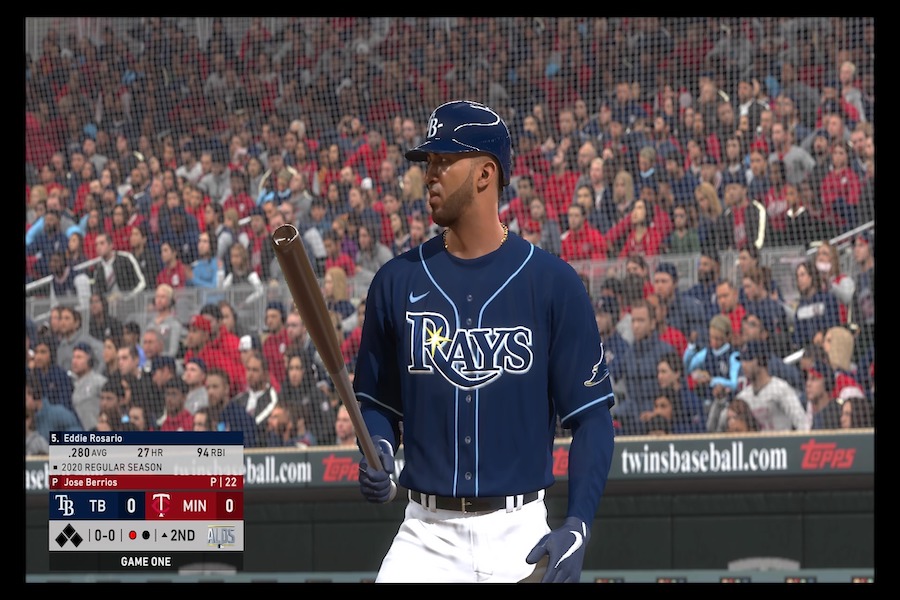 To get caught up on what we're doing here, you can check out the introductory post in the series for an explanation of the premise and setup. But the quick version is this: We're playing a progressive simulated Twins season on MLB The Show 20 on PS4, and y'all are helping guide the ship. In each installment I'll update you on what's happened since the last, and put at least one key decision up for vote. LATEST RESULTS (1-3) ALDS Game 1: L 3-2 (Sano 0-4, 4 K) ALDS Game 2: L 3-1 (Sano, Kepler, Cruz: 0-10) ALDS Game 3: W 11-5 (Cruz 3-6, 2 HR, 6 RBI) ALDS Game 4: L 9-5 (Odorizzi & Wood: 5 IP, 9 ER) THE PLAYOFF PICTURE We fell in four games to the Rays. Although our Twins did win Game 3 to end an 18-game postseason losing streak, they still went pretty quietly in this simulated ALDS, with a familiar breakdown in the offensive performance and execution that carried them through the regular season. And beyond their own self-created issues, there was the Eddie Factor. I'll provide game-by-game recaps below but suffice to say our former left fielder made us pay for the deadline deal that sent him to Tampa for Blake Snell. Elsewhere in the AL, Cleveland beat Boston in the Wild Card Game and then swept the Angels in the ALDS, so it'll be Cleveland vs. Tampa in the ALCS. Both NLCS series are tied 2-2 on this date in the sim (10/7/20). ALDS SERIES RECAP GAME 1: RAYS 3, TWINS 2 On a 44-degree evening in Minneapolis, the Rays and Twins engaged in a tightly contested pitcher's duel. Jose Berrios had his good stuff, but so did Charlie Morton. Both starters struck out eight batters over five-plus innings, but also ran up big pitch counts. After each had left in the sixth, Tampa led 2-1. The bullpens took over and put up zeroes, and Trevor May was looking particularly nasty, striking out four straight before he left a curveball over the plate against Eddie Rosario with two outs in the top of the eighth. Rosario put it on the overhang in right field, and his insurance run – putting Tampa ahead 3-1 – proved crucial as the Twins rallied for a one in the bottom of the ninth but couldn't get another. Rosario earned the Player of the Game nod. Berrios was tagged with a loss for the first time since May. Miguel Sano went 0-for-4 with four strikeouts out of the cleanup spot, helping negate a four-hit game for Luis Arraez (whose .331 average in the regular season ranked second only to Mike Trout in the AL). Game 2: RAYS 3, TWINS 1 My cynical blurb in the series preview turned out to be deadly accurate: Kenta Maeda, an 18-game winner and All-Star, battled through six erratic innings (5 H, 5 BB, 4 K, 3 R, 2 ER) while 22-year-old rookie Jordan Balazovic sliced the Twins lineup to pieces: 7 IP, 6 H, 1 ER, 1 BB, 8 K. You can't make it up. Sergio Romo and Taylor Rogers combined for three shutout innings behind Maeda but the Twins couldn't even muster a base runner in two innings against Tampa's bullpen. Once again the talent-laden Minnesota offense completely shut down on the biggest stage. Sano came up empty again in the cleanup spot (0-for-4 with 2 Ks), while the trio behind him – Donaldson, Kepler, Cruz – went 1-for-10. Having lost both games at home, the Twins headed to Tampa staring down elimination, and looking to their own deadline pickup to salvage the season. Game 3: TWINS 11, RAYS 5 Blake Snell was hardly spectacular in this one (6.1 IP, 5 H, 4 ER, 4 BB, 9 K) but he gave the Twins everything they needed as their bats FINALLY awakened. The Bomba Squad made it rain on Tropicana with 11 runs on 16 hits, breaking loose with a three-run seventh and five-run eighth. Arraez went 4-for-6, his second four-hit game of the series. Cruz went 3-for-5 with two homers and six RBIs. Kepler, Garver and Buxton each had multiple hits. Sano ... went 0-for-4 with a walk and three strikeouts. Having finally gotten the monkey off their back, the Twins had a chance to take one more in Tampa and bring the series back to Target Field for Game 5. Game 4: RAYS 9, TWINS 5 Sadly, this is where it ended. In the series preview article, I polled readers to see who you wanted to start in Game 4. I suspect more people would've opted for Berrios on short rest if they knew we'd be up against elimination, but alas, that was a difficult caveat to factor in. Jake Odorizzi beat out Alex Wood for the most votes, so he got the nod, and it went pretty disastrously. The Rays jumped all over Odorizzi for four runs in the first inning, including a three-run homer from Rosario. With Wood warming up in the pen, Odorizzi went out for the second but was jumped on again. We pulled him and turned to Wood, who quickly gave up a couple hits followed by a devastating three-run homer off the bat of – you guessed it – Rosario. Through two innings Eddie had two jacks and six RBIs. By the end of the second it was already 9-1 Rays. The Twins mounted a couple humble threats and scratched across four more runs, with Marwin Gonzalez having himself a nice day (3-for-4, two runs, two RBIs) but there was no digging out of this hole. As we put a bow on it: Our top performer in the series (same as all year long): Luis Arraez, who went 10-for-18 with four runs scored and only one strikeout in the series. Our biggest laggard: Miguel Sano, who went 1-for-17 with nine strikeouts after leading the club in home runs (36) and RBIs (100) during the regular season. And the ALDS MVP easily goes to Eddie Rosario, who hit three key home runs for the Rays in the series, including two in a six-RBI Game 4 outburst that sent his former team packing. Thanks to all who've followed along and interacted throughout this virtual season. It's been a lot more enjoyable than I expected, and I hope it gave some of you a fun diversion during baseball's strange absence over these past several months. Collectively, we made a bunch of decisions. Some helped our team get over the hump with a second straight division title, others came back to haunt us. So goes baseball, and life. I'll check in once more with a final simulated 2020 season update – sharing the rest of the postseason results and reflecting on some takeaways from this exercise – then I'll most likely sunset the series as we turn our attention back to real baseball. With that said, if things happen to unravel with MLB's plan to return for a 2020 season, I fully reserve the right to fire this thing back up in offseason mode. PREVIOUS INSTALLMENTS Part 1: We Can Build This Thing Together (0-0) Part 2: 10 Games In, 6 Games Back (4-6) Part 3: Roaring Back (11-9) Part 4: Over the Hill (17-13) Part 5: Checking In at the Quarter Point (23-17) Part 6: Rising Power (30-20) Part 7: First Place! (Barely) (34-26) Part 8: Drafting and Dropping (38-32) Part 9: Cruz Control (45-35) Part 10: Pulling Ahead (52-38) Part 11: Bashing into the All-Star Break (58-40) Part 12: Deadline Decisions (62-46) Part 13: Inauspicious Debuts (66-52) Part 14: Treading Water as the Clock Ticks (71-57) Part 15: Stretch Race & September Call-Ups (78-59) Part 16: Dancing for the Division (84-63) Part 17: Down to the Wire (90-66) Part 18: Game 163 (94-68) Part 19: Twins Walk Off Game 163 (95-68) Part 20: ALDS Preview – Twins vs. Rays MORE FROM TWINS DAILY — Latest Twins coverage from our writers — Recent Twins discussion in our forums — Follow Twins Daily via Twitter, Facebook or email
 -
The Show Must Go On: ALDS Preview - Twins vs. Rays
Nick Nelson replied to Nick Nelson's topic in Twins Daily Front Page News
Good question. I was curious so I went back and looked through their transaction history. They had quite a busy spell in June – in the same week they: Acquired Devers from Boston for Austin Meadows & Yandy Diaz.Acquired Aledmys Diaz from Houston for a pitching prospect.Traded Tyler Glasnow to the Cubs for top SS prospect Nico Hoerner. Between that and Snell-to-Twins at the deadline, they're kinda like rebuilding and contending at the same time I guess? Sounds like the Rays. Yeah, it's weird. For suspension of disbelief, I'm choosing to assume/imagine that he has some sort of minor injury that makes him unavailable for the next few days. -
The Show Must Go On: ALDS Preview - Twins vs. Rays
Nick Nelson replied to Nick Nelson's topic in Twins Daily Front Page News
Option 3: Press "Like This" on this comment (or voice your support below) if you want us to go with Jose Berrios on short rest in Game 4 (if necessary). -
The Show Must Go On: ALDS Preview - Twins vs. Rays
Nick Nelson replied to Nick Nelson's topic in Twins Daily Front Page News
Option 2: Press "Like This" on this comment (or voice your support below) if you want us to go with Alex Wood in Game 4 (if necessary). -
The Show Must Go On: ALDS Preview - Twins vs. Rays
Nick Nelson replied to Nick Nelson's topic in Twins Daily Front Page News
Option 1: Press "Like This" on this comment (or voice your support below) if you want us to go with Jake Odorizzi in Game 4 (if necessary). -
After edging Cleveland in the AL Central tiebreaker, the Twins are moving on to an ALDS matchup against Tampa Bay in our interactive 2020 simulation. Read on for a look at the lineups and pitching matchups, and to weigh in on our playoff rotation.To get caught up on what we're doing here, you can check out the introductory post in the series for an explanation of the premise and setup. But the quick version is this: We're playing a progressive simulated Twins season on MLB The Show 20 on PS4, and y'all are helping guide the ship. In each installment I'll update you on what's happened since the last, and put at least one key decision up for vote. THE PLAYOFF PICTURE Our Twins (95-68) won the Central with a 10th-inning walk-off win against Cleveland (94-69) in Game 163. That means the Indians will host Boston (91-72) in the Wild Card Round. The winner of that contest will go on to face the No. 1 seed Angels (103-59). Meanwhile, our Twins hold home-field advantage against the Tampa Bay Rays (92-71), who themselves won the East by edging the Red Sox in a Game 163 tiebreaker. All kinds of dramatics in the American League here in 2020. Elsewhere, things have played out in fairly expected fashion. Nats (96-66) won the East, Cubs (92-70) won the Central, Dodgers (105-57) led all of baseball in victories. The Braves (90-72) and Rockies (94-68) will battle in the NL WC Game. Download attachment: playoffbracket929.jpeg ALDS SERIES OVERVIEW So, our Twins end up facing the very same team we pulled off a blockbuster trade with at the deadline. As it turns out, that splashy transaction – sending Eddie Rosario and Jordan Balazovic to Tampa in exchange for Blake Snell – is the rare of example of an in-season deal between two contenders, and it worked out swell for both sides. Snell led the Twins to a victory over Cleveland in Game 163, while Rosario is Tampa's cleanup hitter and Balazovic is lined up to start Game 2 of the ALDS as a 22-year-old rookie (!). The Twins scored more runs than Tampa Bay (799 to 726) but the Rays allowed fewer (611 to 669). In fact, no American League team gave up fewer runs than Tampa, which finished first in the AL in ERA (3.61) ahead of second-place Minnesota (3.76). Both teams feature strong, deep rotations backed by high-caliber bullpens. Rays closer Nick Anderson ranked third in the AL in saves (46); Twins closer Taylor Rogers ranked seventh (43). Even after sending Rosario to Tampa, the Twins appear to have a clear offensive advantage over the Rays. We'll see if it shows through. TWINS LINEUP Luis Arraez, 2B (.331/.419/.483, 14 HR, 78 RBI)Jorge Polanco, SS (.270/.352/.437, 18 HR, 64 RBI)Mitch Garver, C (.266/.362/.444, 20 HR, 46 RBI)Miguel Sano, 1B (.254/.359/.485, 36 HR, 100 RBI)Josh Donaldson, 3B (.259/.369/.475, 35 HR, 98 RBI)Max Kepler, RF (.285/.379/.464, 21 HR, 82 RBI)Nelson Cruz, DH (.267/.342/.473, 28 HR, 99 RBI)Marwin Gonzalez, LF (.281/.342/.480, 17 HR, 48 RBI)Byron Buxton, CF (.222/.294/.327, 6 HR, 26 RBI)RAYS LINEUP Kevin Kiermaier, CF (.274/.351/.474, 23 HR, 68 RBI)Jose Martinez, RF (.281/.344/.429, 20 HR, 72 RBI)Rafael Devers, 3B (.259/.341/.437, 29 HR, 77 RBI)Eddie Rosario, LF (.280..331/.489, 27 HR, 94 RBI)Ji-Man Choi, 1B (.293/.361/.546, 34 HR, 87 RBI)Willy Adames, SS (.289/.368/.457, 9 HR, 40 RBI)Brandon Lowe, 2B (.270/.338/.526, 33 HR, 102 RBI)Hunter Renfroe, DH (.226/.302/.427,18 HR, 50 RBI)Mike Zunino, C (.195/.281/.309, 12 HR, 35 RBI)And now, here is my very rational analysis of the pitching matchups, given from the perspective of a Twins fan who is admittedly traumatized by past postseason memories. Game 1: Rays @ Twins Charlie Morton, RHP (14-8, 3.15) vs. Jose Berrios, RHP (20-5, 2.96) Morton turned in a fine season that was very much in line with his norm. He's excellent. Berrios also had a phenomenal season, and hasn't been tagged with a loss since May. But that's almost starting to feel ominous at this point, isn't it? Liriano was of a similar mold in 2010. Santana in 2006, as well. Oh man, I'm feeling nauseous. Game 2: Rays @ Twins Jordan Balazovic, RHP (4-6, 4.73) vs. Kenta Maeda, RHP (18-8, 3.39) Maeda was an All-Star. He had 12 wins at the break. He went 5-0 record with a 2.11 ERA in September. He had an incredible first season with the Twins and would be worthy of the ace billing in many rotations not inhabited by Berrios. Maeda will be going against the top prospect we traded away at the deadline – a 22-year-old whose numbers aren't all that great, but whose upside on any given day is immense. It would only make sense for us to get buried in this game, wouldn't it? Game 3: Twins @ Rays Blake Snell, LHP (12-10, 3.75) vs. Ryan Yarbrough, LHP (13-8, 3.78) This feels like a good time to point out that Tampa does not have Yonny Chirinos lined up to start any of its first three ALDS games. And here's why that's strange: he went 19-7 with a 2.77 ERA in 205 innings this year. He is in the Cy Young conversation. And yet for Game 2 they're running out a rookie and for Game 3, the Rays have penciled in Yarbrough, a solid yet ordinary southpaw. Then again, I've learned better than to ever doubt this sophisticated organization's ways. Did the Rays trade Snell to us knowing that they'd end up facing him in a playoff matchup at the Trop? Does Yarbrough have some unknown advantage against our lineup? Is this all part of their strategy? Game 4 (if necessary): Twins @ Rays Jake Odorizzi, RHP or Alex Wood, LHP vs. Yonny Chirinos, RHP (19-7, 2.77) Here Chirinos is finally scheduled to get his first postseason nod. And here the Rays figure to have their first clear pitching matchup advantage ... if they haven't swept us already. (Sorry, sorry! Force of habit.) On our end, it's an open question which pitcher should get the nod, because both Odorizzi and Wood have good cases. We'll discuss that shortly. Game 5 (if necessary): Rays @ Twins Charlie Morton, RHP (14-8, 3.15) vs. Jose Berrios, RHP (20-5, 2.96) Presumably if we get to a Game 5, the rotations will flip because both Game 1 starters will be back at full rest. But, many variables in play. DECISION TIME: PLANNING FOR GAME 4 I feel like we're pretty well set for the first three games. Our lineup is locked in, and Berrios, Maeda and Snell are clearly our three best starters. Game 4 is a bit of a tough call, though. Odorizzi's been very solid throughout the season, totaling 192 innings with a 3.65 ERA and 15-10 record. Download attachment: odorizziprofile.jpeg Meanwhile, Wood – a fellow deadline addition along with Snell – has the rotation's lowest ERA (2.77). In fact that mark tied with Tampa Bay's Chirinos for third-best in the AL in the regular season (behind Hyun-Jin Ryu and Mike Minor). Download attachment: woodprofile.jpeg Whichever starter we opt for, I'll have the other one ready to step in at early signs of trouble. In Wood's favor, the Rays have a pretty lefty-heavy lineup, with Rosario, Kiermaier, Devers, Choi, and Lowe all swinging from the left side. There is a third option: We could start Berrios on short rest in Game 4. This would give us the ability to start Maeda on full rest in Game 5. I'll follow your cue. Vote your preference in the comments section. PREVIOUS INSTALLMENTS Part 1: We Can Build This Thing Together (0-0) Part 2: 10 Games In, 6 Games Back (4-6) Part 3: Roaring Back (11-9) Part 4: Over the Hill (17-13) Part 5: Checking In at the Quarter Point (23-17) Part 6: Rising Power (30-20) Part 7: First Place! (Barely) (34-26) Part 8: Drafting and Dropping (38-32) Part 9: Cruz Control (45-35) Part 10: Pulling Ahead (52-38) Part 11: Bashing into the All-Star Break (58-40) Part 12: Deadline Decisions (62-46) Part 13: Inauspicious Debuts (66-52) Part 14: Treading Water as the Clock Ticks (71-57) Part 15: Stretch Race & September Call-Ups (78-59) Part 16: Dancing for the Division (84-63) Part 17: Down to the Wire (90-66) Part 18: Game 163 (94-68) Part 19: Twins Walk Off Game 163 (95-68) MORE FROM TWINS DAILY — Latest Twins coverage from our writers — Recent Twins discussion in our forums — Follow Twins Daily via Twitter, Facebook or email Click here to view the article
-
 To get caught up on what we're doing here, you can check out the introductory post in the series for an explanation of the premise and setup. But the quick version is this: We're playing a progressive simulated Twins season on MLB The Show 20 on PS4, and y'all are helping guide the ship. In each installment I'll update you on what's happened since the last, and put at least one key decision up for vote. THE PLAYOFF PICTURE Our Twins (95-68) won the Central with a 10th-inning walk-off win against Cleveland (94-69) in Game 163. That means the Indians will host Boston (91-72) in the Wild Card Round. The winner of that contest will go on to face the No. 1 seed Angels (103-59). Meanwhile, our Twins hold home-field advantage against the Tampa Bay Rays (92-71), who themselves won the East by edging the Red Sox in a Game 163 tiebreaker. All kinds of dramatics in the American League here in 2020. Elsewhere, things have played out in fairly expected fashion. Nats (96-66) won the East, Cubs (92-70) won the Central, Dodgers (105-57) led all of baseball in victories. The Braves (90-72) and Rockies (94-68) will battle in the NL WC Game. ALDS SERIES OVERVIEW So, our Twins end up facing the very same team we pulled off a blockbuster trade with at the deadline. As it turns out, that splashy transaction – sending Eddie Rosario and Jordan Balazovic to Tampa in exchange for Blake Snell – is the rare of example of an in-season deal between two contenders, and it worked out swell for both sides. Snell led the Twins to a victory over Cleveland in Game 163, while Rosario is Tampa's cleanup hitter and Balazovic is lined up to start Game 2 of the ALDS as a 22-year-old rookie (!). The Twins scored more runs than Tampa Bay (799 to 726) but the Rays allowed fewer (611 to 669). In fact, no American League team gave up fewer runs than Tampa, which finished first in the AL in ERA (3.61) ahead of second-place Minnesota (3.76). Both teams feature strong, deep rotations backed by high-caliber bullpens. Rays closer Nick Anderson ranked third in the AL in saves (46); Twins closer Taylor Rogers ranked seventh (43). Even after sending Rosario to Tampa, the Twins appear to have a clear offensive advantage over the Rays. We'll see if it shows through. TWINS LINEUP Luis Arraez, 2B (.331/.419/.483, 14 HR, 78 RBI) Jorge Polanco, SS (.270/.352/.437, 18 HR, 64 RBI) Mitch Garver, C (.266/.362/.444, 20 HR, 46 RBI) Miguel Sano, 1B (.254/.359/.485, 36 HR, 100 RBI) Josh Donaldson, 3B (.259/.369/.475, 35 HR, 98 RBI) Max Kepler, RF (.285/.379/.464, 21 HR, 82 RBI) Nelson Cruz, DH (.267/.342/.473, 28 HR, 99 RBI) Marwin Gonzalez, LF (.281/.342/.480, 17 HR, 48 RBI) Byron Buxton, CF (.222/.294/.327, 6 HR, 26 RBI) RAYS LINEUP Kevin Kiermaier, CF (.274/.351/.474, 23 HR, 68 RBI) Jose Martinez, RF (.281/.344/.429, 20 HR, 72 RBI) Rafael Devers, 3B (.259/.341/.437, 29 HR, 77 RBI) Eddie Rosario, LF (.280..331/.489, 27 HR, 94 RBI) Ji-Man Choi, 1B (.293/.361/.546, 34 HR, 87 RBI) Willy Adames, SS (.289/.368/.457, 9 HR, 40 RBI) Brandon Lowe, 2B (.270/.338/.526, 33 HR, 102 RBI) Hunter Renfroe, DH (.226/.302/.427,18 HR, 50 RBI) Mike Zunino, C (.195/.281/.309, 12 HR, 35 RBI) And now, here is my very rational analysis of the pitching matchups, given from the perspective of a Twins fan who is admittedly traumatized by past postseason memories. Game 1: Rays @ Twins Charlie Morton, RHP (14-8, 3.15) vs. Jose Berrios, RHP (20-5, 2.96) Morton turned in a fine season that was very much in line with his norm. He's excellent. Berrios also had a phenomenal season, and hasn't been tagged with a loss since May. But that's almost starting to feel ominous at this point, isn't it? Liriano was of a similar mold in 2010. Santana in 2006, as well. Oh man, I'm feeling nauseous. Game 2: Rays @ Twins Jordan Balazovic, RHP (4-6, 4.73) vs. Kenta Maeda, RHP (18-8, 3.39) Maeda was an All-Star. He had 12 wins at the break. He went 5-0 record with a 2.11 ERA in September. He had an incredible first season with the Twins and would be worthy of the ace billing in many rotations not inhabited by Berrios. Maeda will be going against the top prospect we traded away at the deadline – a 22-year-old whose numbers aren't all that great, but whose upside on any given day is immense. It would only make sense for us to get buried in this game, wouldn't it? Game 3: Twins @ Rays Blake Snell, LHP (12-10, 3.75) vs. Ryan Yarbrough, LHP (13-8, 3.78) This feels like a good time to point out that Tampa does not have Yonny Chirinos lined up to start any of its first three ALDS games. And here's why that's strange: he went 19-7 with a 2.77 ERA in 205 innings this year. He is in the Cy Young conversation. And yet for Game 2 they're running out a rookie and for Game 3, the Rays have penciled in Yarbrough, a solid yet ordinary southpaw. Then again, I've learned better than to ever doubt this sophisticated organization's ways. Did the Rays trade Snell to us knowing that they'd end up facing him in a playoff matchup at the Trop? Does Yarbrough have some unknown advantage against our lineup? Is this all part of their strategy? Game 4 (if necessary): Twins @ Rays Jake Odorizzi, RHP or Alex Wood, LHP vs. Yonny Chirinos, RHP (19-7, 2.77) Here Chirinos is finally scheduled to get his first postseason nod. And here the Rays figure to have their first clear pitching matchup advantage ... if they haven't swept us already. (Sorry, sorry! Force of habit.) On our end, it's an open question which pitcher should get the nod, because both Odorizzi and Wood have good cases. We'll discuss that shortly. Game 5 (if necessary): Rays @ Twins Charlie Morton, RHP (14-8, 3.15) vs. Jose Berrios, RHP (20-5, 2.96) Presumably if we get to a Game 5, the rotations will flip because both Game 1 starters will be back at full rest. But, many variables in play. DECISION TIME: PLANNING FOR GAME 4 I feel like we're pretty well set for the first three games. Our lineup is locked in, and Berrios, Maeda and Snell are clearly our three best starters. Game 4 is a bit of a tough call, though. Odorizzi's been very solid throughout the season, totaling 192 innings with a 3.65 ERA and 15-10 record. Meanwhile, Wood – a fellow deadline addition along with Snell – has the rotation's lowest ERA (2.77). In fact that mark tied with Tampa Bay's Chirinos for third-best in the AL in the regular season (behind Hyun-Jin Ryu and Mike Minor). Whichever starter we opt for, I'll have the other one ready to step in at early signs of trouble. In Wood's favor, the Rays have a pretty lefty-heavy lineup, with Rosario, Kiermaier, Devers, Choi, and Lowe all swinging from the left side. There is a third option: We could start Berrios on short rest in Game 4. This would give us the ability to start Maeda on full rest in Game 5. I'll follow your cue. Vote your preference in the comments section. PREVIOUS INSTALLMENTS Part 1: We Can Build This Thing Together (0-0) Part 2: 10 Games In, 6 Games Back (4-6) Part 3: Roaring Back (11-9) Part 4: Over the Hill (17-13) Part 5: Checking In at the Quarter Point (23-17) Part 6: Rising Power (30-20) Part 7: First Place! (Barely) (34-26) Part 8: Drafting and Dropping (38-32) Part 9: Cruz Control (45-35) Part 10: Pulling Ahead (52-38) Part 11: Bashing into the All-Star Break (58-40) Part 12: Deadline Decisions (62-46) Part 13: Inauspicious Debuts (66-52) Part 14: Treading Water as the Clock Ticks (71-57) Part 15: Stretch Race & September Call-Ups (78-59) Part 16: Dancing for the Division (84-63) Part 17: Down to the Wire (90-66) Part 18: Game 163 (94-68) Part 19: Twins Walk Off Game 163 (95-68) MORE FROM TWINS DAILY — Latest Twins coverage from our writers — Recent Twins discussion in our forums — Follow Twins Daily via Twitter, Facebook or email
 -
Here at Twins Daily, we recently wrapped up a 20-part series looking back at the past two decades of Minnesota Twins baseball, in unique fashion. Read on to find links to each entry and some high-level reflections, with the journey through recent franchise history now complete.First, here's a list of all the installments (and their authors). I highly recommend reading them all in order, even if you have to break it up into multiple sessions. It's a fun trip down memory lane. The 2000 Season (Nick Nelson)The 2001 Season (Nick Nelson)The 2002 Season (John Bonnes)The 2003 Season (Nick Nelson)The 2004 Season (Matthew Lenz)The 2005 Season (Nick Nelson)The 2006 Season (Matthew Taylor)The 2007 Season (Nick Nelson)The 2008 Season (Nick Nelson)The 2009 Season (Nick Nelson)The 2010 Season (Matthew Taylor)The 2011 Season (Cooper Carlson)The 2012 Season (Nick Nelson)The 2013 Season (Phil Miller)The 2014 Season (Nick Nelson)The 2015 Season (Patrick Wozniak)The 2016 Season (Tom Froemming)The 2017 Season (AJ Condon)The 2018 Season (Nick Nelson)The 2019 Season (Matthew Lenz) A WILD AND UNFINISHED STORY I came up with the idea for this series in early April, when it became apparent that we weren't going to have live baseball for a while. Without a new season to watch, I thought it might be fun to relive the not-so-distant past. The turn of the century is a tidy endpoint on its own, but also holds added significance in both the franchise's history and my personal fandom. The time period around 2000 represented a real turning point for the Twins, as they pulled out of a cellar-dwelling lull in the '90s and re-emerged as contenders under new manager Ron Gardenhire. Over the next decade they ruled over the AL Central, and became a model of small-market success in the eyes of many. By the midpoint of our series, 2010, the Twins seemed to be at their absolute pinnacle, opening a beautiful new ballpark with a reigning (hometown) MVP and an undisputed claim as one of the league's best teams. Then – of course – the bottom fell out, with a disastrous 2011 season giving way to many years of misery and leading to a complete dismantling of the organizations' deeply ingrained infrastructure. After all that, the series circled back to a happy ending in 2019. The past 20 years really have provided quite the story arc, haven't they? For me, it's been a defining experience to follow along as I've grown up. When the 2000 season started, I was finishing eighth grade and preparing for high school. With the internet still finding its traction, I began discovering and following fan-created content thanks to Twins Geek and Aaron Gleeman, who started their blogs around 2002. Three years later I started my own, and seven years after that, Twins Daily came to be. Coverage of the team has become so greatly enriched over these past two decades, and I'm happy to have played my own small part in it. That's why I was thrilled that when I put out the call to a bunch of writers I enjoy, so many volunteered to participate in this series. John Bonnes penned the entry for 2002, the very year he launched his Twins Geek blog and started building the momentum toward TD. The 2013 installment came from Phil Miller, whose reporting on the Twins beat for both the Pioneer Press and Star Tribune has represented the very best of legacy media. These two men are such genuine inspirations to me, I can't say enough how giddy it made me to include their bylines and read their retrospectives as part of this series. I'm very thankful to them, as well as Cooper, Patrick, Tom, Matthew (x2), and AJ for taking part. These articles were (at least for me) very fun to write, providing an opportunity to disconnect from the harshness of reality and frolic in fuzzy nostalgia. But, they did entail a ton of research and work. I hope you'll join me in expressing gratitude to all the guest authors, who happily took on the task merely for the sake of providing Twins fans with some amusement and entertainment during a strange, baseball-less time. Anyway, the story is unfinished. Reading through the entire Twins in the 2000s series – which we hope to make available as a downloadable PDF soon – will lead you perfectly into the coming 2020 season. It's going to be a unique one. And thanks to the developments of the past 20 years, you'll never have a shortage of content covering it. MORE FROM TWINS DAILY — Latest Twins coverage from our writers — Recent Twins discussion in our forums — Follow Twins Daily via Twitter, Facebook or email Click here to view the article
-
 First, here's a list of all the installments (and their authors). I highly recommend reading them all in order, even if you have to break it up into multiple sessions. It's a fun trip down memory lane. The 2000 Season (Nick Nelson) The 2001 Season (Nick Nelson) The 2002 Season (John Bonnes) The 2003 Season (Nick Nelson) The 2004 Season (Matthew Lenz) The 2005 Season (Nick Nelson) The 2006 Season (Matthew Taylor) The 2007 Season (Nick Nelson) The 2008 Season (Nick Nelson) The 2009 Season (Nick Nelson) The 2010 Season (Matthew Taylor) The 2011 Season (Cooper Carlson) The 2012 Season (Nick Nelson) The 2013 Season (Phil Miller) The 2014 Season (Nick Nelson) The 2015 Season (Patrick Wozniak) The 2016 Season (Tom Froemming) The 2017 Season (AJ Condon) The 2018 Season (Nick Nelson) The 2019 Season (Matthew Lenz) A WILD AND UNFINISHED STORY I came up with the idea for this series in early April, when it became apparent that we weren't going to have live baseball for a while. Without a new season to watch, I thought it might be fun to relive the not-so-distant past. The turn of the century is a tidy endpoint on its own, but also holds added significance in both the franchise's history and my personal fandom. The time period around 2000 represented a real turning point for the Twins, as they pulled out of a cellar-dwelling lull in the '90s and re-emerged as contenders under new manager Ron Gardenhire. Over the next decade they ruled over the AL Central, and became a model of small-market success in the eyes of many. By the midpoint of our series, 2010, the Twins seemed to be at their absolute pinnacle, opening a beautiful new ballpark with a reigning (hometown) MVP and an undisputed claim as one of the league's best teams. Then – of course – the bottom fell out, with a disastrous 2011 season giving way to many years of misery and leading to a complete dismantling of the organizations' deeply ingrained infrastructure. After all that, the series circled back to a happy ending in 2019. The past 20 years really have provided quite the story arc, haven't they? For me, it's been a defining experience to follow along as I've grown up. When the 2000 season started, I was finishing eighth grade and preparing for high school. With the internet still finding its traction, I began discovering and following fan-created content thanks to Twins Geek and Aaron Gleeman, who started their blogs around 2002. Three years later I started my own, and seven years after that, Twins Daily came to be. Coverage of the team has become so greatly enriched over these past two decades, and I'm happy to have played my own small part in it. That's why I was thrilled that when I put out the call to a bunch of writers I enjoy, so many volunteered to participate in this series. John Bonnes penned the entry for 2002, the very year he launched his Twins Geek blog and started building the momentum toward TD. The 2013 installment came from Phil Miller, whose reporting on the Twins beat for both the Pioneer Press and Star Tribune has represented the very best of legacy media. These two men are such genuine inspirations to me, I can't say enough how giddy it made me to include their bylines and read their retrospectives as part of this series. I'm very thankful to them, as well as Cooper, Patrick, Tom, Matthew (x2), and AJ for taking part. These articles were (at least for me) very fun to write, providing an opportunity to disconnect from the harshness of reality and frolic in fuzzy nostalgia. But, they did entail a ton of research and work. I hope you'll join me in expressing gratitude to all the guest authors, who happily took on the task merely for the sake of providing Twins fans with some amusement and entertainment during a strange, baseball-less time. Anyway, the story is unfinished. Reading through the entire Twins in the 2000s series – which we hope to make available as a downloadable PDF soon – will lead you perfectly into the coming 2020 season. It's going to be a unique one. And thanks to the developments of the past 20 years, you'll never have a shortage of content covering it. MORE FROM TWINS DAILY — Latest Twins coverage from our writers — Recent Twins discussion in our forums — Follow Twins Daily via Twitter, Facebook or email
 -
Three-Bagger: Pineda, B-Squad & Romero
Nick Nelson replied to Nick Nelson's topic in Twins Daily Front Page News
Do you have to complete a circle to be "circling"? This feels like a redux of the classic "batting around" argument ... -
It's been a long time since we've circled the bases with a Three-Bagger, which explores three different Twins stories in the news. As Spring Training 2.0 swings into gear, let's unpack a quirk in the timing of Michael Pineda's return, the implications of top prospects playing just minutes away from Target Field, and the saddening uncertainty surrounding Fernando Romero.Michael Pineda: It's Just Like Making a Trade! During the latest episode of Gleeman and the Geek, Aaron and John made a connection that I hadn't noticed: the conclusion of Pineda's carryover suspension will coincide almost exactly with MLB's rejiggered August 31st trade deadline. This brings to mind the classic utterance for Twins fans, "It's just like making a trade!" – often used to mock the team for sitting out deadlines, and pointing to players returning from injuries as impact additions. Interestingly, as Patrick Wozniak wrote here last week, this is basically a script-flip on the original plan for Rich Hill, who was supposed to join the fold around the standard deadline and negate a possible need for the team. Now, the veteran lefty is expected to be ready to go from Day 1. By being forced to serve his full remaining suspension in a shortened year, Pineda is getting a raw deal. It's almost hard to believe the league would stick to such a penalty, and that explains why reporters keep getting asked about it over and over again. Just doesn't make sense. Alas, the Twins are almost guaranteed to get one big addition around the strange new deadline. Twins Across the Twin Cities On Monday, the Twins shared publicly their 60-man player pool, which includes the entire 40-man roster plus 19 non-roster players. As expected, the discretionary "taxi squad" list is filled mostly with experienced minor-leaguers, along with a handful of top prospects. I gotta say that all this talk about "Summer Camp" and pools is not helping with me normal summer FOMO, but I digress. It's exciting to see all these names and to think about the possibility of young talents like Trevor Larnach or Brent Rooker making an impact. (Cody Christie wrote about the chances of various top prospects to reach the majors in 2020.) It's quite interesting to me that the auxiliary group will be based out of CHS Field in St. Paul, just miles away from Target Field. I've always thought it would be fun to have a minor-league team in the same vicinity as the big-league club, giving fans an opportunity to see upcoming talent without traveling. (Red Sox fans, for example, need drive only 40 minutes or so to see their Triple-A team in Pawtucket.) That won't really be in play this summer, obviously, but it's cool that Royce Lewis and Alex Kirilloff and other premier upcoming prospects will be staying sharp so nearby. On that note, I'm very curious: what is "staying sharp" going to look like? In order to be ready to step into legitimate major-league action on short notice – not to mention simply develop skills appropriately throughout the season – these extra players need to be routinely competing at a very high level, which exceeds the typical intrasquad scrimmage or sim game. What will that look like? Games? Stats? Will there be coverage? I have no doubt there'll be appetite for it. Wherefore Art Thou, Romero? One player who, like Pineda, is on the team's summer roster but currently unavailable: Fernando Romero, also on restricted list. In this case, though, the underlying reason is unclear. Romero didn't report to camp in March due to visa issues, and those issues evidently haven't been resolved. To my knowledge, there still haven't been any details reported on exactly what's going on here. I suppose it would make sense if the visa application system is currently bogged down and out of whack due to everything going on. Hopefully that's the case, and Romero isn't embroiled in something serious. Either way, it's a really tough situation for a guy at a key spot in his career. Romero was set to exhaust his final MLB option in 2020. At this point, you've really gotta wonder if we are going to see him pitch again in a Minnesota uniform. The former No. 1 Twins Daily prospect and forgotten flamethrower averaged 97 MPH with his fastball in the majors last year, ranking in the 95th percentile among all pitchers. MORE FROM TWINS DAILY — Latest Twins coverage from our writers — Recent Twins discussion in our forums — Follow Twins Daily via Twitter, Facebook or email Click here to view the article
-
 Michael Pineda: It's Just Like Making a Trade! During the latest episode of Gleeman and the Geek, Aaron and John made a connection that I hadn't noticed: the conclusion of Pineda's carryover suspension will coincide almost exactly with MLB's rejiggered August 31st trade deadline. This brings to mind the classic utterance for Twins fans, "It's just like making a trade!" – often used to mock the team for sitting out deadlines, and pointing to players returning from injuries as impact additions. Interestingly, as Patrick Wozniak wrote here last week, this is basically a script-flip on the original plan for Rich Hill, who was supposed to join the fold around the standard deadline and negate a possible need for the team. Now, the veteran lefty is expected to be ready to go from Day 1. By being forced to serve his full remaining suspension in a shortened year, Pineda is getting a raw deal. It's almost hard to believe the league would stick to such a penalty, and that explains why reporters keep getting asked about it over and over again. Just doesn't make sense. Alas, the Twins are almost guaranteed to get one big addition around the strange new deadline. Twins Across the Twin Cities On Monday, the Twins shared publicly their 60-man player pool, which includes the entire 40-man roster plus 19 non-roster players. As expected, the discretionary "taxi squad" list is filled mostly with experienced minor-leaguers, along with a handful of top prospects. https://twitter.com/Twins/status/1277628636141694978 I gotta say that all this talk about "Summer Camp" and pools is not helping with me normal summer FOMO, but I digress. It's exciting to see all these names and to think about the possibility of young talents like Trevor Larnach or Brent Rooker making an impact. (Cody Christie wrote about the chances of various top prospects to reach the majors in 2020.) It's quite interesting to me that the auxiliary group will be based out of CHS Field in St. Paul, just miles away from Target Field. I've always thought it would be fun to have a minor-league team in the same vicinity as the big-league club, giving fans an opportunity to see upcoming talent without traveling. (Red Sox fans, for example, need drive only 40 minutes or so to see their Triple-A team in Pawtucket.) That won't really be in play this summer, obviously, but it's cool that Royce Lewis and Alex Kirilloff and other premier upcoming prospects will be staying sharp so nearby. On that note, I'm very curious: what is "staying sharp" going to look like? In order to be ready to step into legitimate major-league action on short notice – not to mention simply develop skills appropriately throughout the season – these extra players need to be routinely competing at a very high level, which exceeds the typical intrasquad scrimmage or sim game. What will that look like? Games? Stats? Will there be coverage? I have no doubt there'll be appetite for it. Wherefore Art Thou, Romero? One player who, like Pineda, is on the team's summer roster but currently unavailable: Fernando Romero, also on restricted list. In this case, though, the underlying reason is unclear. Romero didn't report to camp in March due to visa issues, and those issues evidently haven't been resolved. To my knowledge, there still haven't been any details reported on exactly what's going on here. I suppose it would make sense if the visa application system is currently bogged down and out of whack due to everything going on. Hopefully that's the case, and Romero isn't embroiled in something serious. Either way, it's a really tough situation for a guy at a key spot in his career. Romero was set to exhaust his final MLB option in 2020. At this point, you've really gotta wonder if we are going to see him pitch again in a Minnesota uniform. The former No. 1 Twins Daily prospect and forgotten flamethrower averaged 97 MPH with his fastball in the majors last year, ranking in the 95th percentile among all pitchers. MORE FROM TWINS DAILY — Latest Twins coverage from our writers — Recent Twins discussion in our forums — Follow Twins Daily via Twitter, Facebook or email
 -
In customary fashion, the tiebreaker played between Minnesota and Cleveland to decide the fictional AL Central was an intense nailbiter decided on the final play. But ultimately the Twins emerged victorious, notching their 95th win to take the division crown and advance to the ALDS in our interactive 2020 sim. Find the full rundown below as we get ready for what's next.To get caught up on what we're doing here, you can check out the introductory post in the series for an explanation of the premise and setup. But the quick version is this: We're playing a progressive simulated Twins season on MLB The Show 20 on PS4, and y'all are helping guide the ship. In each installment I'll update you on what's happened since the last, and put at least one key decision up for vote. Date In Game: 9/29 Team Record: 95-68 LATEST RESULTS (1-0) Gm 163 vs CLE: W 3-2 (Snell 6 IP, 0 R, 8 K, W) Minnesota Twins Win AL Central Title! THE RUNDOWN Throughout this simulated season I've been running on MLB The Show 20, I have typically used the "Quick Manage" mode, which basically means I sim every at-bat in rapid-fire fashion, from a dashboard, and dictate decisions along the way. These games usually take about five minutes each to complete. But given the magnitude of Game 163, which was prompted by the final week's events, I figured I would go with the "Manage Full Game" mode, in which I actually watch the simulation play out and manage along the way. I took plenty of screenshots and live-streamed the game on Twitter (starting here). Below I'll provide an in-depth recount of this 10-inning roller coaster. 1ST INNING Blake Snell, who was voted overwhelmingly last week as the choice to start this game, takes the hill for the Twins. He's been good but not spectacular since coming over from the Rays in a blockbuster deadline trade. We're hoping that his dominant strikeout stuff will show up today in the biggest game of the season. Download attachment: snellstarting.jpeg Snell gets the leadoff man Delino DeShields Jr. on an attempted bunt hit, with Josh Donaldson charging in and making a nice bare-handed play. Then second baseman Cesar Hernandez tries the same thing successfully, delivering a better, softer bunt. Up comes Francisco Lindor, who sends an opposite-field drive to right; Max Kepler dives but misses and the ball rolls past him. He's able to recover and get it back in quickly enough to hold Hernandez at third. Two in scoring position, one out. Already sweating, Snell gets Jose Ramirez to pop out to first base, and then Carlos Santana to ground out to second. Early crisis averted. In the bottom half, Luis Arraez and Jorge Polanco ground out. Then Mitch Garver draws a walk, taking a tough pitch on a full count, before Miguel Sano strikes out on three pitches. Download attachment: targetfieldview1.jpeg CLEVELAND 0, MINNESOTA 0 2ND INNING Some loud contact in the top half, but Snell gets three lineouts and works around a walk to Bradley Zimmer. In the bottom half, a Nelson Cruz single is the only damage as Josh Donaldson (foul out), Kepler (fly out to RC), and left fielder Marwin Gonzalez (strike three looking) are set down. CLEVELAND 0, MINNESOTA 0 3RD INNING Snell, who had zero strikeouts through the first two innings, starts dialing up the nastiness. He gets DeShields Jr. swinging at a breaking ball in the dirt; Garver corrals it and throws him out at first. Then Hernandez goes down swinging at an outside changeup. Lindor flies out to foul territory near first base. In the bottom of the third, our Twins spring to life. Buxton rolls a grounder between short and third. Arraez follows by hitting a soft liner to short, which lands just in front of a charging Lindor. Caught in no man's land, Buxton is thrown out at second, with Arraez replacing him at first. Next up, Jorge Polanco, who crushes a drive to deep right field, high off the wall right of the overhang. Arraez races around from first to score the game's first run, as Polanco checks in with a triple. Download attachment: polancorbitriple.jpeg Cleveland keeps the infield back in the next at-bat, and pays for it as Garver scores Polanco on a groundout to short. Twins up 2-0. Sano strikes out again to end the inning. CLEVELAND 0, MINNESOTA 2 4TH INNING By now Snell is definitely finding his groove. He locks up the leadoff man Ramirez with a called third strike on a fastball at the knees. Then he climbs the ladder on Carlos Santana, striking him out on a high 96 MPH fastball. Orlando Mercado battles his way to a walk in the next at-bat before right fielder Daniel Johnson goes down looking at strike three on the corner. Twins go in order in the bottom half: Donaldson strikes out on three pitches, Kepler drives a deep liner to left-center that DeShields Jr. hunts down, and Cruz grounds out to second. CLEVELAND 0, MINNESOTA 2 5TH INNING Roberto Perez strikes out swinging at strike three in the dirt, another filthy breaking ball from Snell. DeShields Jr. grounds out to second. Hernandez follows with a solidly struck single to center. This activates the bullpen, with Snell's pitch count starting to climb. In response, he strikes out Lindor on three pitches. By now Snell has seven strikeouts, all since the third inning. Minnesota once again goes down in order in the bottom half, with Gonzalez striking out, Buxton lining out to the warning track, and Arraez grounding out to second. CLEVELAND 0, MINNESOTA 2 6TH INNING Another uneventful one. Ramirez strikes out looking again, Snell's eighth strikeout in his past 12 batters faced. Santana pops out to first and Mercado flies out to left. Snell is through six scoreless but he's at 95 pitches. Tyler Duffey and Tyler Clippard are warming in the bullpen. The Twins offense follows with another silent half-inning: Polanco grounds out to second, Garver grounds out to short, Sano lines out to left. CLEVELAND 0, MINNESOTA 2 7TH INNING With Snell's stamina draining, and lefty swingers Zimmer and Johnson due up to start the seventh, Rocco Baldelli (me) makes a somewhat controversial decision by bringing in a fresh arm. True to his reverse-split tendencies, Clippard has held LHBs to a .198 average this season, so we give him the nod. Zimmer leads off with a bunt single. Johnson flies out to Gonzalez in left. Clippard strikes out Perez, leaving a runner on first with two outs. DeShields Jr. then hits a soft grounder to third; Donaldson fields and fires to second for the force, but it skips past Arraez into right field. Thankfully, Kepler is there to back it up and hold Zimmer on second. Clippard strikes out Hernandez with a changeup, and pumps his fist. Download attachment: clippardcelebrates.jpeg Twins hitters continue to go quietly in the seventh. Donaldson grounds out to third (a nice play by Ramirez ranging to his right). Kepler lines into the shift at second. Cruz strikes out swinging. CLEVELAND 0, MINNESOTA 2 8TH INNING With the heart of Cleveland's order due up in a 2-0 game, we turn to Tyler Duffey, who's been our best reliever this year and one of the best relievers in the game. He'll be facing Lindor, Ramirez, and Santana. Download attachment: duffeyenters.jpeg But Duffey's control, so consistent through most of the season, is amiss. He issues a leadoff walk to Lindor. His first pitch to Ramirez bounces under Garver and goes to the backstop, but rebounds hard enough to keep Lindor at first. Ramirez smashes a hanging curveball to right but it sails a few feet right of the pole, narrowly missing a game-tying homer. Then he draws a walk. Runners on first and second, no outs. Taylor Rogers starts warming up. Santana pulls a grounder through the hole between first and second, scoring Lindor and bringing Cleveland within one. Wes Johnson comes out for a mound visit. The Indians try to play small-ball with Mercado but it backfires as he pops up a bunt to Duffey. With one out, Zimmer battles through a tough at-bat, fouls off a couple pitches with a full count, and then takes this pitch for ball four. Ump called it low. Ridiculous. Download attachment: ballfourcall.jpeg That's all for Duffey. In comes Rogers with the bases juiced. He gets Johnson to tap a grounder to short, but Polanco's momentum is carrying him toward first so he takes the sure out. Tie game. With runners on second and third, Rogers strikes out Perez to end it. Right-hander Phil Maton is on for Cleveland in the bottom of the eighth. Gonzalez drives one to deep center but DeShields Jr. tracks it down, for the 14th consecutive out recorded by a Twins hitter. That streak finally snaps in the next at-bat, when Maton's curveball slips away from him and hits Buxton in the arm. With Buxton's speed on first and our best contact hitter up in Arraez, we call a hit-and-run, but Arraez lines out to right. Buxton scampers back to first. With two outs, Buck tries stealing second, but Perez throws him out by a hair. Download attachment: buxtonout.jpeg CLEVELAND 2, MINNESOTA 2 9TH INNING Rogers is back on the hill for Minnesota. He gets DeShields Jr. to ground out to third. Then Hernandez hits a liner to first, which deflects off Sano's glove toward Arraez, who scoops it up and throws to Rogers for the out. Nice heads-up play. Lindor follows by slashing a line past Arraez into right-center. With two outs, the Indians shortstop is thinking double out of the box. But Buxton flies into the gap to retrieve the bouncing ball and throw it in to second, beating Lindor there by a mile for the third out. A bit of sweet revenge after Lindor tagged Buxton out in the previous inning. Download attachment: lindorout.jpeg Right-hander Hunter Wood replaces Maton on the mound for Cleveland. The Twins get a leadoff single from Polanco – their first hit since his RBI triple in the third – but he's stranded on first as Garver and Sano strike out, and Donaldson lines out to right. It's on to extra innings. CLEVELAND 2, MINNESOTA 2 10TH INNING By now Rogers has already worked 1 2/3 innings, but has retired every hitter he's faced and is still only at 15 pitches. We stick with him. Rogers opens the inning with a swinging strikeout against Ramirez. Then Santana pokes a ground ball through the hole on the right side for a single. Mercado hits a sharp grounder to second, and Arraez makes a diving stop, flipping to Polanco for the force, but they only get one. Zimmer follows with a ground ball single between short and third. With runners on first and second, two outs, Franmil Reyes comes in to pinch-hit for Johnson. We opt to stick with Rogers, now past 30 pitches, instead of going to a warmed-up Sergio Romo. Rogers strikes him out. Kepler leads off the bottom of the 10th with a strikeout. Then Cruz lines a ringing single to left. Jake Cave subs in to run at first base. His speed comes in handy as Gonzalez follows by pulling a liner down the first-base line, which escapes the reach of first baseman Santana. Cave races around to third base, representing the winning run. Up comes Buxton. It's been a tough year for Buxton, but in this crucial moment he comes up huge, hitting a ground ball between Lindor and Ramirez into left. Cave scores easily with the winning run, and the Twins defeat Cleveland to capture the 2020 AL Central crown. CLEVELAND 2, MINNESOTA 3 Download attachment: twinswin.jpeg Player of the Game honors go to Snell, who tossed six shutout frames with eight strikeouts, allowing just three walks and three singles. Good call by everyone who voted on him as our starter last time around. But let's not downplay the contributions of our virtual Buxton, who came through with a key defensive play in the ninth and then the game-winning hit in the 10th. It's been a tough year for the center fielder, who finishes with a .223/.294/.327 slash line in 129 games, but he ended it on a high note. I'll be back with an ALDS Preview later this week, and at that point we can make some decisions about how we're gonna attack the AL East champion Tampa Bay Rays, but for now, let us simply soak in the revelry of winning a fictional 2020 division championship and heading to the playoffs for a matchup against someone other than the Yankees. PREVIOUS INSTALLMENTS Part 1: We Can Build This Thing Together (0-0) Part 2: 10 Games In, 6 Games Back (4-6) Part 3: Roaring Back (11-9) Part 4: Over the Hill (17-13) Part 5: Checking In at the Quarter Point (23-17) Part 6: Rising Power (30-20) Part 7: First Place! (Barely) (34-26) Part 8: Drafting and Dropping (38-32) Part 9: Cruz Control (45-35) Part 10: Pulling Ahead (52-38) Part 11: Bashing into the All-Star Break (58-40) Part 12: Deadline Decisions (62-46) Part 13: Inauspicious Debuts (66-52) Part 14: Treading Water as the Clock Ticks (71-57) Part 15: Stretch Race & September Call-Ups (78-59) Part 16: Dancing for the Division (84-63) Part 17: Down to the Wire (90-66) Part 18: Game 163 (94-68) MORE FROM TWINS DAILY — Latest Twins coverage from our writers — Recent Twins discussion in our forums — Follow Twins Daily via Twitter, Facebook or email Click here to view the article
-
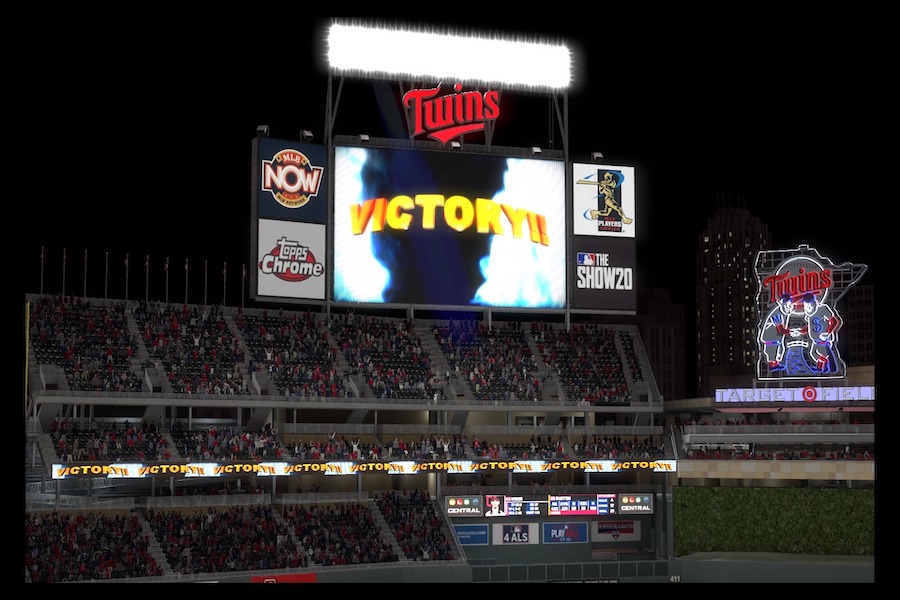 To get caught up on what we're doing here, you can check out the introductory post in the series for an explanation of the premise and setup. But the quick version is this: We're playing a progressive simulated Twins season on MLB The Show 20 on PS4, and y'all are helping guide the ship. In each installment I'll update you on what's happened since the last, and put at least one key decision up for vote. Date In Game: 9/29 Team Record: 95-68 LATEST RESULTS (1-0) Gm 163 vs CLE: W 3-2 (Snell 6 IP, 0 R, 8 K, W) Minnesota Twins Win AL Central Title! THE RUNDOWN Throughout this simulated season I've been running on MLB The Show 20, I have typically used the "Quick Manage" mode, which basically means I sim every at-bat in rapid-fire fashion, from a dashboard, and dictate decisions along the way. These games usually take about five minutes each to complete. But given the magnitude of Game 163, which was prompted by the final week's events, I figured I would go with the "Manage Full Game" mode, in which I actually watch the simulation play out and manage along the way. I took plenty of screenshots and live-streamed the game on Twitter (starting here). Below I'll provide an in-depth recount of this 10-inning roller coaster. 1ST INNING Blake Snell, who was voted overwhelmingly last week as the choice to start this game, takes the hill for the Twins. He's been good but not spectacular since coming over from the Rays in a blockbuster deadline trade. We're hoping that his dominant strikeout stuff will show up today in the biggest game of the season. Snell gets the leadoff man Delino DeShields Jr. on an attempted bunt hit, with Josh Donaldson charging in and making a nice bare-handed play. Then second baseman Cesar Hernandez tries the same thing successfully, delivering a better, softer bunt. Up comes Francisco Lindor, who sends an opposite-field drive to right; Max Kepler dives but misses and the ball rolls past him. He's able to recover and get it back in quickly enough to hold Hernandez at third. Two in scoring position, one out. Already sweating, Snell gets Jose Ramirez to pop out to first base, and then Carlos Santana to ground out to second. Early crisis averted. In the bottom half, Luis Arraez and Jorge Polanco ground out. Then Mitch Garver draws a walk, taking a tough pitch on a full count, before Miguel Sano strikes out on three pitches. CLEVELAND 0, MINNESOTA 0 2ND INNING Some loud contact in the top half, but Snell gets three lineouts and works around a walk to Bradley Zimmer. In the bottom half, a Nelson Cruz single is the only damage as Josh Donaldson (foul out), Kepler (fly out to RC), and left fielder Marwin Gonzalez (strike three looking) are set down. CLEVELAND 0, MINNESOTA 0 3RD INNING Snell, who had zero strikeouts through the first two innings, starts dialing up the nastiness. He gets DeShields Jr. swinging at a breaking ball in the dirt; Garver corrals it and throws him out at first. Then Hernandez goes down swinging at an outside changeup. Lindor flies out to foul territory near first base. In the bottom of the third, our Twins spring to life. Buxton rolls a grounder between short and third. Arraez follows by hitting a soft liner to short, which lands just in front of a charging Lindor. Caught in no man's land, Buxton is thrown out at second, with Arraez replacing him at first. Next up, Jorge Polanco, who crushes a drive to deep right field, high off the wall right of the overhang. Arraez races around from first to score the game's first run, as Polanco checks in with a triple. Cleveland keeps the infield back in the next at-bat, and pays for it as Garver scores Polanco on a groundout to short. Twins up 2-0. Sano strikes out again to end the inning. CLEVELAND 0, MINNESOTA 2 4TH INNING By now Snell is definitely finding his groove. He locks up the leadoff man Ramirez with a called third strike on a fastball at the knees. Then he climbs the ladder on Carlos Santana, striking him out on a high 96 MPH fastball. Orlando Mercado battles his way to a walk in the next at-bat before right fielder Daniel Johnson goes down looking at strike three on the corner. Twins go in order in the bottom half: Donaldson strikes out on three pitches, Kepler drives a deep liner to left-center that DeShields Jr. hunts down, and Cruz grounds out to second. CLEVELAND 0, MINNESOTA 2 5TH INNING Roberto Perez strikes out swinging at strike three in the dirt, another filthy breaking ball from Snell. DeShields Jr. grounds out to second. Hernandez follows with a solidly struck single to center. This activates the bullpen, with Snell's pitch count starting to climb. In response, he strikes out Lindor on three pitches. By now Snell has seven strikeouts, all since the third inning. Minnesota once again goes down in order in the bottom half, with Gonzalez striking out, Buxton lining out to the warning track, and Arraez grounding out to second. CLEVELAND 0, MINNESOTA 2 6TH INNING Another uneventful one. Ramirez strikes out looking again, Snell's eighth strikeout in his past 12 batters faced. Santana pops out to first and Mercado flies out to left. Snell is through six scoreless but he's at 95 pitches. Tyler Duffey and Tyler Clippard are warming in the bullpen. The Twins offense follows with another silent half-inning: Polanco grounds out to second, Garver grounds out to short, Sano lines out to left. CLEVELAND 0, MINNESOTA 2 7TH INNING With Snell's stamina draining, and lefty swingers Zimmer and Johnson due up to start the seventh, Rocco Baldelli (me) makes a somewhat controversial decision by bringing in a fresh arm. True to his reverse-split tendencies, Clippard has held LHBs to a .198 average this season, so we give him the nod. Zimmer leads off with a bunt single. Johnson flies out to Gonzalez in left. Clippard strikes out Perez, leaving a runner on first with two outs. DeShields Jr. then hits a soft grounder to third; Donaldson fields and fires to second for the force, but it skips past Arraez into right field. Thankfully, Kepler is there to back it up and hold Zimmer on second. Clippard strikes out Hernandez with a changeup, and pumps his fist. Twins hitters continue to go quietly in the seventh. Donaldson grounds out to third (a nice play by Ramirez ranging to his right). Kepler lines into the shift at second. Cruz strikes out swinging. CLEVELAND 0, MINNESOTA 2 8TH INNING With the heart of Cleveland's order due up in a 2-0 game, we turn to Tyler Duffey, who's been our best reliever this year and one of the best relievers in the game. He'll be facing Lindor, Ramirez, and Santana. But Duffey's control, so consistent through most of the season, is amiss. He issues a leadoff walk to Lindor. His first pitch to Ramirez bounces under Garver and goes to the backstop, but rebounds hard enough to keep Lindor at first. Ramirez smashes a hanging curveball to right but it sails a few feet right of the pole, narrowly missing a game-tying homer. Then he draws a walk. Runners on first and second, no outs. Taylor Rogers starts warming up. Santana pulls a grounder through the hole between first and second, scoring Lindor and bringing Cleveland within one. Wes Johnson comes out for a mound visit. The Indians try to play small-ball with Mercado but it backfires as he pops up a bunt to Duffey. With one out, Zimmer battles through a tough at-bat, fouls off a couple pitches with a full count, and then takes this pitch for ball four. Ump called it low. Ridiculous. That's all for Duffey. In comes Rogers with the bases juiced. He gets Johnson to tap a grounder to short, but Polanco's momentum is carrying him toward first so he takes the sure out. Tie game. With runners on second and third, Rogers strikes out Perez to end it. Right-hander Phil Maton is on for Cleveland in the bottom of the eighth. Gonzalez drives one to deep center but DeShields Jr. tracks it down, for the 14th consecutive out recorded by a Twins hitter. That streak finally snaps in the next at-bat, when Maton's curveball slips away from him and hits Buxton in the arm. With Buxton's speed on first and our best contact hitter up in Arraez, we call a hit-and-run, but Arraez lines out to right. Buxton scampers back to first. With two outs, Buck tries stealing second, but Perez throws him out by a hair. CLEVELAND 2, MINNESOTA 2 9TH INNING Rogers is back on the hill for Minnesota. He gets DeShields Jr. to ground out to third. Then Hernandez hits a liner to first, which deflects off Sano's glove toward Arraez, who scoops it up and throws to Rogers for the out. Nice heads-up play. Lindor follows by slashing a line past Arraez into right-center. With two outs, the Indians shortstop is thinking double out of the box. But Buxton flies into the gap to retrieve the bouncing ball and throw it in to second, beating Lindor there by a mile for the third out. A bit of sweet revenge after Lindor tagged Buxton out in the previous inning. Right-hander Hunter Wood replaces Maton on the mound for Cleveland. The Twins get a leadoff single from Polanco – their first hit since his RBI triple in the third – but he's stranded on first as Garver and Sano strike out, and Donaldson lines out to right. It's on to extra innings. CLEVELAND 2, MINNESOTA 2 10TH INNING By now Rogers has already worked 1 2/3 innings, but has retired every hitter he's faced and is still only at 15 pitches. We stick with him. Rogers opens the inning with a swinging strikeout against Ramirez. Then Santana pokes a ground ball through the hole on the right side for a single. Mercado hits a sharp grounder to second, and Arraez makes a diving stop, flipping to Polanco for the force, but they only get one. Zimmer follows with a ground ball single between short and third. With runners on first and second, two outs, Franmil Reyes comes in to pinch-hit for Johnson. We opt to stick with Rogers, now past 30 pitches, instead of going to a warmed-up Sergio Romo. Rogers strikes him out. Kepler leads off the bottom of the 10th with a strikeout. Then Cruz lines a ringing single to left. Jake Cave subs in to run at first base. His speed comes in handy as Gonzalez follows by pulling a liner down the first-base line, which escapes the reach of first baseman Santana. Cave races around to third base, representing the winning run. Up comes Buxton. It's been a tough year for Buxton, but in this crucial moment he comes up huge, hitting a ground ball between Lindor and Ramirez into left. Cave scores easily with the winning run, and the Twins defeat Cleveland to capture the 2020 AL Central crown. CLEVELAND 2, MINNESOTA 3 Player of the Game honors go to Snell, who tossed six shutout frames with eight strikeouts, allowing just three walks and three singles. Good call by everyone who voted on him as our starter last time around. But let's not downplay the contributions of our virtual Buxton, who came through with a key defensive play in the ninth and then the game-winning hit in the 10th. It's been a tough year for the center fielder, who finishes with a .223/.294/.327 slash line in 129 games, but he ended it on a high note. I'll be back with an ALDS Preview later this week, and at that point we can make some decisions about how we're gonna attack the AL East champion Tampa Bay Rays, but for now, let us simply soak in the revelry of winning a fictional 2020 division championship and heading to the playoffs for a matchup against someone other than the Yankees. PREVIOUS INSTALLMENTS Part 1: We Can Build This Thing Together (0-0) Part 2: 10 Games In, 6 Games Back (4-6) Part 3: Roaring Back (11-9) Part 4: Over the Hill (17-13) Part 5: Checking In at the Quarter Point (23-17) Part 6: Rising Power (30-20) Part 7: First Place! (Barely) (34-26) Part 8: Drafting and Dropping (38-32) Part 9: Cruz Control (45-35) Part 10: Pulling Ahead (52-38) Part 11: Bashing into the All-Star Break (58-40) Part 12: Deadline Decisions (62-46) Part 13: Inauspicious Debuts (66-52) Part 14: Treading Water as the Clock Ticks (71-57) Part 15: Stretch Race & September Call-Ups (78-59) Part 16: Dancing for the Division (84-63) Part 17: Down to the Wire (90-66) Part 18: Game 163 (94-68) MORE FROM TWINS DAILY — Latest Twins coverage from our writers — Recent Twins discussion in our forums — Follow Twins Daily via Twitter, Facebook or email
 -
The Show Must Go On: Game 163
Nick Nelson replied to Nick Nelson's topic in Twins Daily Front Page News
I wondered about that too but the game doesn't break down season stats by team, and I don't remember exactly where he was at when we traded him. Here are his final overall numbers for the season, which are pretty much exactly in line with expectations: .281/.332/.489, 27 HR, 94 RBI. I also checked in on Balazovic's final rookie numbers: 133.2 IP, 4.51 ERA, 1.46 WHIP, 136-to-54 K/BB. Not too bad for a 22-year-old. Looks like he's been a full-timer in their rotation since the trade. If we beat Cleveland we'll be facing these guys in the ALDS. That'd be pretty fun. Yeah that was striking to me as well, given the (relatively) realistic way the rest of the divisions played out. The wild part is that Shohei Ohtani tore his labrum in his first start and missed the entire season. Mike Trout had his best season yet (.347/.444/.697, 40 HR, 121 RBI, 11.9 WAR) and they also got big offensive performances from Upton, Simmons, Rendon and La Stella. Castro was solid too (.244/.342/.404, 17 HR in 126 G). Dylan Bundy went 19-3 in the rotation (?!). -
The Show Must Go On: Game 163
Nick Nelson replied to Nick Nelson's topic in Twins Daily Front Page News
Option 3: Press "Like This" on this comment (or voice your support below) if you want us to piggyback Jake Odorizzi and Michael Pineda, preserving our top starters for the postseason. -
The Show Must Go On: Game 163
Nick Nelson replied to Nick Nelson's topic in Twins Daily Front Page News
Option 2: Press "Like This" on this comment (or voice your support below) if you want us to start Jose Berrios on 3 days rest in Game 163. -
The Show Must Go On: Game 163
Nick Nelson replied to Nick Nelson's topic in Twins Daily Front Page News
Option 1: Press "Like This" on this comment (or voice your support below) if you want us to start Blake Snell on full rest in Game 163.- 9 replies
-
- 19
-

-
I can't believe it. In the absence of an actual 162-game season in 2020, we've been progressively simulating one here on Twins Daily. Over the course of 17 installments, commenters have helped guide our virtual team through a thrilling back-and-forth battle with Cleveland for first place. Now, with all 162 in the books, the Twins and Indians have arrived at identical 94-68 records. We're gonna play a tiebreaker for the division.To get caught up on what we're doing here, you can check out the introductory post in the series for an explanation of the premise and setup. But the quick version is this: We're playing a progressive simulated Twins season on MLB The Show 20 on PS4, and y'all are helping guide the ship. In each installment I'll update you on what's happened since the last, and put at least one key decision up for vote. Date In Game: 9/28 Team Record: 94-68 Leading OPS: Luis Arraez (.909 in 528 AB) Leading ERA (SP): Alex Wood (2.77 in 178.2 IP) Leading ERA (RP): Tyler Duffey (1.77 in 69.1 IP) LATEST RESULTS (4-2) Gm 157 @ SD: W 6-2 (Garver 3-5, 2 HR, 3 RBI) Gm 158 @ SD: L 2-1 (Snell 6 IP, 1 ER) Gm 159 @ SD: W 6-2 (Cruz 2-4, 5 RBI) Gm 160 @ KC: W 3-1 (Polanco 2-4, HR, 2 RBI) Gm 161 @ KC: W 3-2 (Cruz 4-4, 2 RBI) Gm 162 @ KC: L 4-1 (Wood 3 IP, 3 ER, L) AL CENTRAL STANDINGS Download attachment: alcstandings928.jpeg THE RUNDOWN The final week of the season was quite a ride, with Minnesota and Cleveland running in lockstep to the finish line, so it's best to take it day-by-day since we last left off, with the Twins trailing by a half-game in the division. Tuesday, September 22nd The Twins took their first game in San Diego 6-2. Alex Wood was lights-out (7 IP, 1 ER). Mitch Garver powered the offense with two homers (his 19th and 20th on the year) while Marwin Gonzalez – voted in by y'all last time as our regular LF for the final week – chipped in another. Meanwhile Cleveland beat the White Sox 5-2, riding seven innings of two-run ball from Adam Civale, to maintain its half-game lead. CLEVELAND UP 0.5 G Wednesday, September 23rd Our Twins had no answer for Padres starter Chris Paddack, who matched Blake Snell's six innings of one-run ball. Bullpens dueled for a couple innings before drama unfolded in the top half of the ninth. Tied 1-1, Minnesota loaded the bases with two outs, and up came the pitcher's spot. With a righty on the mound and multiple pinch-hitters exhausted, we turned to the rookie, Alex Kirilloff, struggling in his first go at the big leagues. He popped out. In the bottom half, old friend Brian Dozier went yard off Sergio Romo to give San Diego a walk-off win. Download attachment: dozierpadres.jpeg It was a tough sequence of blows made worse by the Indians completing a sweep in Chicago, with Cleveland's offense racking up 16 hits in a 9-5 victory. CLEVELAND UP 1.5 G Thursday, September 24th We bounced back in a 6-2 win to clinch with a series victory in SoCal. Nelson Cruz drove in five runs on a pair of doubles while Jose Berrios held the Padres to two runs over six innings, notching his 20th win. He went 9-0 after the All-Star break, and finishes the season as MLB's only 20-game winner. What a season. He might have a chance for one more ... Download attachment: alwinleaders928.jpeg Cleveland was idle, so we regained a half-game heading into the season's last series. For the Twins it was off to KC, while the Indians were set to host Toronto. CLEVELAND UP 1.0 G Friday, September 25th The Twins took the first game 3-1 behind 6 1/3 innings of one-run ball from Jake Odorizzi, who improved to 15-10 and 3.65 ERA, which will be his final numbers in 192 innings. Altogether pretty similar to his 2019 output. Jorge Polanco's two RBIs proved to be the difference. In Cleveland, the Indians lost a 12-11 barnburner against the Blue Jays, who got seven RBIs from left fielder Teoscar Hernandez. CLEVELAND AND MINNESOTA TIED FOR 1ST PLACE Saturday, September 26th It was another quiet night for Minnesota's offense, outside of Cruz's four singles and two RBIs, but Kenta Maeda navigated his way through trouble (5.1 IP, 4 H, 2 ER, 4 BB, 2 K) and handed a 3-2 lead over to Romo, Duffey and Rogers, who shut it down the rest of the way. Meanwhile, the Indians lost another one-run game – albeit a much less eventful one. Hyun-Jin Ryu and Shane Bieber dueled into the seventh, bullpens traded zeroes, and eventually Toronto pushed one across in the top of the 12th. With one game left to go, our Twins had pulled ahead in the AL Central. A win against KC in the finale would seal it. MINNESOTA UP 1.0 G Sunday, September 27th A couple weeks back, I proposed a rotation shuffle that would've involved skipping one of Odorizzi's final turns in order to get Berrios a 34th start in the season's final game. That notion was struck down by voters in the comments. I'm not saying it was the wrong choice, because we'll still have a chance to use our ace in the season's biggest game (more on that momentarily), but Alex Wood did not answer the call in a huge moment. Though he's been on a good run lately, Wood didn't seem to have much from the get-go in this one. He pitched into the fourth but couldn't record an out there, ending a great campaign with an ugly final line: 3 IP, 5 H, 4 R (3 ER), 1 BB, 2 K. Maybe it was all moot because the offense couldn't muster much of anything against Danny Duffy in a 4-1 loss. Naturally, the Indians won their finale against Toronto 10-3, fueled by Carlos Santana's five RBIs. The good news, I guess, is that Mike Clevinger started, so he won't be available for the ultimate showdown triggered by this day's events. CLEVELAND AND MINNESOTA TIED FOR 1ST PLACE For the third time in its history, the American League Central will be decided by a one-game tiebreaker, and for the third time it'll involve Minnesota. The Twins, having edged Cleveland 11-7 in the season series, will host Game 163 at Target Field. This isn't do-or-die, since the loser will fall back on the No. 1 wild-card seed – and a home date against the 91-72 Boston Red Sox – but the winner moves onto the ALDS and home field advantage against the AL East champion Tampa Bay Rays (92-71). (Yes folks, that means the Yankees have missed – I REPEAT MISSED – the playoffs, finishing 86-76. The 89-73 Astros also missed out. Ya hate to see it.) Download attachment: alwcstandings928.jpeg The Angels, who finished 103-59 to run away with the West, have the AL's No. 1 seed. Obviously, we wanna win this game against Cleveland and set ourselves up much more favorably for the postseason. So, let's talk about it. DECISION TIME: WHO STARTS GAME 163? In this division-deciding battle, the Indians are poised to go with right-hander Adam Civale, which qualifies as a bit of a break for our Twins. Civale has been fine but he's pretty clearly Cleveland's fifth starter, with the rotation's highest ERA (4.08) and WHIP (1.38), as well as its only losing record (11-12). But unfortunately Minnesota's offense has been prone to coming up quiet against unspectacular opponents. So who should we counter with? The decision looms large. The stamina situation for each starting option is depicted in the graphic below. We basically have three options: Snell on full rest, Berrios on three days rest, or getting a bit creative. Let's explore the merits of each. Download attachment: twinsrotation928.jpeg Option 1: Blake Snell Our blockbuster deadline addition is lined up for this start. He is our highest-rated starting pitcher (91) in the game, and would be pitching on full rest. But if you've been following along, you know that Snell's been quite inconsistent since coming over from the Rays. Among our starters, he has the highest strikeout rate (10.7 K/9) but also the highest ERA (3.87) and WHIP (1.39). To his credit, Snell did pitch well his last time out, allowing one run on four hits in six innings against the Padres. Option 2: Jose Berrios He's clearly our best starter and very possibly the best starter in the league. Berrios has had an amazing season overall but has been especially unstoppable since turning a corner in mid-May; over his final 25 turns, he went 16-2 with a 2.46 ERA, and we've gone 10-3 in his starts since the All-Star break. But he's not quite back to full strength after beating the Padres four days ago. Perhaps more importantly, if Berrios starts this game on short rest, he'll be unavailable to start the Wild Card Game (should we lose) or Game 1 of the ALDS (should we win). Option 3: Piggybacking Odorizzi and Pineda Kenta Maeda would be the obvious third option, given that he's an All-Star and 18-game winner who's gone 5-0 with a 2.11 ERA in five September starts, but unfortunately starting him on one day's rest just isn't an option. But Jake Odorizzi on two day's rest...? His stamina's in decent shape as you can see above. We wouldn't expect him to go very deep but could easily turn to Michael Pineda, our fully rested long reliever who's been outstanding with a 3.35 ERA in 45 2/3 innings, as a bridge to the bullpen. This unconventional pitcher-stacking strategy would be akin to the one used by Minnesota in a season-defining doubleheader sweep against Cleveland last summer. It would also leave us with a full complement of starting options available for whatever comes next. I definitely need some help with this decision. Feel free to voice your preference in the comments. PREVIOUS INSTALLMENTS Part 1: We Can Build This Thing Together (0-0) Part 2: 10 Games In, 6 Games Back (4-6) Part 3: Roaring Back (11-9) Part 4: Over the Hill (17-13) Part 5: Checking In at the Quarter Point (23-17) Part 6: Rising Power (30-20) Part 7: First Place! (Barely) (34-26) Part 8: Drafting and Dropping (38-32) Part 9: Cruz Control (45-35) Part 10: Pulling Ahead (52-38) Part 11: Bashing into the All-Star Break (58-40) Part 12: Deadline Decisions (62-46) Part 13: Inauspicious Debuts (66-52) Part 14: Treading Water as the Clock Ticks (71-57) Part 15: Stretch Race & September Call-Ups (78-59) Part 16: Dancing for the Division (84-63) Part 17: Down to the Wire (90-66) MORE FROM TWINS DAILY — Latest Twins coverage from our writers — Recent Twins discussion in our forums — Follow Twins Daily via Twitter, Facebook or email Click here to view the article
-
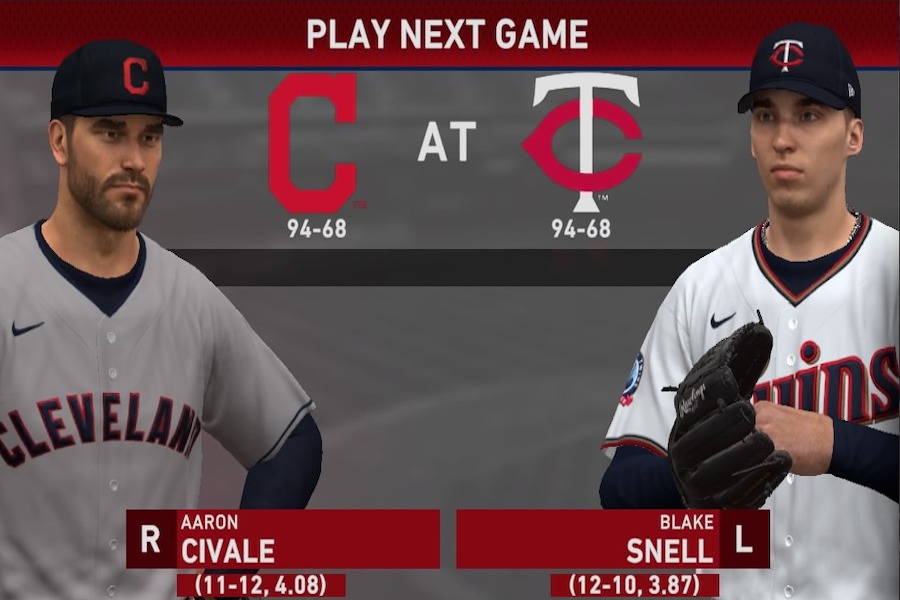 To get caught up on what we're doing here, you can check out the introductory post in the series for an explanation of the premise and setup. But the quick version is this: We're playing a progressive simulated Twins season on MLB The Show 20 on PS4, and y'all are helping guide the ship. In each installment I'll update you on what's happened since the last, and put at least one key decision up for vote. Date In Game: 9/28 Team Record: 94-68 Leading OPS: Luis Arraez (.909 in 528 AB) Leading ERA (SP): Alex Wood (2.77 in 178.2 IP) Leading ERA (RP): Tyler Duffey (1.77 in 69.1 IP) LATEST RESULTS (4-2) Gm 157 @ SD: W 6-2 (Garver 3-5, 2 HR, 3 RBI) Gm 158 @ SD: L 2-1 (Snell 6 IP, 1 ER) Gm 159 @ SD: W 6-2 (Cruz 2-4, 5 RBI) Gm 160 @ KC: W 3-1 (Polanco 2-4, HR, 2 RBI) Gm 161 @ KC: W 3-2 (Cruz 4-4, 2 RBI) Gm 162 @ KC: L 4-1 (Wood 3 IP, 3 ER, L) AL CENTRAL STANDINGS THE RUNDOWN The final week of the season was quite a ride, with Minnesota and Cleveland running in lockstep to the finish line, so it's best to take it day-by-day since we last left off, with the Twins trailing by a half-game in the division. Tuesday, September 22nd The Twins took their first game in San Diego 6-2. Alex Wood was lights-out (7 IP, 1 ER). Mitch Garver powered the offense with two homers (his 19th and 20th on the year) while Marwin Gonzalez – voted in by y'all last time as our regular LF for the final week – chipped in another. Meanwhile Cleveland beat the White Sox 5-2, riding seven innings of two-run ball from Adam Civale, to maintain its half-game lead. CLEVELAND UP 0.5 G Wednesday, September 23rd Our Twins had no answer for Padres starter Chris Paddack, who matched Blake Snell's six innings of one-run ball. Bullpens dueled for a couple innings before drama unfolded in the top half of the ninth. Tied 1-1, Minnesota loaded the bases with two outs, and up came the pitcher's spot. With a righty on the mound and multiple pinch-hitters exhausted, we turned to the rookie, Alex Kirilloff, struggling in his first go at the big leagues. He popped out. In the bottom half, old friend Brian Dozier went yard off Sergio Romo to give San Diego a walk-off win. It was a tough sequence of blows made worse by the Indians completing a sweep in Chicago, with Cleveland's offense racking up 16 hits in a 9-5 victory. CLEVELAND UP 1.5 G Thursday, September 24th We bounced back in a 6-2 win to clinch with a series victory in SoCal. Nelson Cruz drove in five runs on a pair of doubles while Jose Berrios held the Padres to two runs over six innings, notching his 20th win. He went 9-0 after the All-Star break, and finishes the season as MLB's only 20-game winner. What a season. He might have a chance for one more ... Cleveland was idle, so we regained a half-game heading into the season's last series. For the Twins it was off to KC, while the Indians were set to host Toronto. CLEVELAND UP 1.0 G Friday, September 25th The Twins took the first game 3-1 behind 6 1/3 innings of one-run ball from Jake Odorizzi, who improved to 15-10 and 3.65 ERA, which will be his final numbers in 192 innings. Altogether pretty similar to his 2019 output. Jorge Polanco's two RBIs proved to be the difference. In Cleveland, the Indians lost a 12-11 barnburner against the Blue Jays, who got seven RBIs from left fielder Teoscar Hernandez. CLEVELAND AND MINNESOTA TIED FOR 1ST PLACE Saturday, September 26th It was another quiet night for Minnesota's offense, outside of Cruz's four singles and two RBIs, but Kenta Maeda navigated his way through trouble (5.1 IP, 4 H, 2 ER, 4 BB, 2 K) and handed a 3-2 lead over to Romo, Duffey and Rogers, who shut it down the rest of the way. Meanwhile, the Indians lost another one-run game – albeit a much less eventful one. Hyun-Jin Ryu and Shane Bieber dueled into the seventh, bullpens traded zeroes, and eventually Toronto pushed one across in the top of the 12th. With one game left to go, our Twins had pulled ahead in the AL Central. A win against KC in the finale would seal it. MINNESOTA UP 1.0 G Sunday, September 27th A couple weeks back, I proposed a rotation shuffle that would've involved skipping one of Odorizzi's final turns in order to get Berrios a 34th start in the season's final game. That notion was struck down by voters in the comments. I'm not saying it was the wrong choice, because we'll still have a chance to use our ace in the season's biggest game (more on that momentarily), but Alex Wood did not answer the call in a huge moment. Though he's been on a good run lately, Wood didn't seem to have much from the get-go in this one. He pitched into the fourth but couldn't record an out there, ending a great campaign with an ugly final line: 3 IP, 5 H, 4 R (3 ER), 1 BB, 2 K. Maybe it was all moot because the offense couldn't muster much of anything against Danny Duffy in a 4-1 loss. Naturally, the Indians won their finale against Toronto 10-3, fueled by Carlos Santana's five RBIs. The good news, I guess, is that Mike Clevinger started, so he won't be available for the ultimate showdown triggered by this day's events. CLEVELAND AND MINNESOTA TIED FOR 1ST PLACE For the third time in its history, the American League Central will be decided by a one-game tiebreaker, and for the third time it'll involve Minnesota. The Twins, having edged Cleveland 11-7 in the season series, will host Game 163 at Target Field. This isn't do-or-die, since the loser will fall back on the No. 1 wild-card seed – and a home date against the 91-72 Boston Red Sox – but the winner moves onto the ALDS and home field advantage against the AL East champion Tampa Bay Rays (92-71). (Yes folks, that means the Yankees have missed – I REPEAT MISSED – the playoffs, finishing 86-76. The 89-73 Astros also missed out. Ya hate to see it.) The Angels, who finished 103-59 to run away with the West, have the AL's No. 1 seed. Obviously, we wanna win this game against Cleveland and set ourselves up much more favorably for the postseason. So, let's talk about it. DECISION TIME: WHO STARTS GAME 163? In this division-deciding battle, the Indians are poised to go with right-hander Adam Civale, which qualifies as a bit of a break for our Twins. Civale has been fine but he's pretty clearly Cleveland's fifth starter, with the rotation's highest ERA (4.08) and WHIP (1.38), as well as its only losing record (11-12). But unfortunately Minnesota's offense has been prone to coming up quiet against unspectacular opponents. So who should we counter with? The decision looms large. The stamina situation for each starting option is depicted in the graphic below. We basically have three options: Snell on full rest, Berrios on three days rest, or getting a bit creative. Let's explore the merits of each. Option 1: Blake Snell Our blockbuster deadline addition is lined up for this start. He is our highest-rated starting pitcher (91) in the game, and would be pitching on full rest. But if you've been following along, you know that Snell's been quite inconsistent since coming over from the Rays. Among our starters, he has the highest strikeout rate (10.7 K/9) but also the highest ERA (3.87) and WHIP (1.39). To his credit, Snell did pitch well his last time out, allowing one run on four hits in six innings against the Padres. Option 2: Jose Berrios He's clearly our best starter and very possibly the best starter in the league. Berrios has had an amazing season overall but has been especially unstoppable since turning a corner in mid-May; over his final 25 turns, he went 16-2 with a 2.46 ERA, and we've gone 10-3 in his starts since the All-Star break. But he's not quite back to full strength after beating the Padres four days ago. Perhaps more importantly, if Berrios starts this game on short rest, he'll be unavailable to start the Wild Card Game (should we lose) or Game 1 of the ALDS (should we win). Option 3: Piggybacking Odorizzi and Pineda Kenta Maeda would be the obvious third option, given that he's an All-Star and 18-game winner who's gone 5-0 with a 2.11 ERA in five September starts, but unfortunately starting him on one day's rest just isn't an option. But Jake Odorizzi on two day's rest...? His stamina's in decent shape as you can see above. We wouldn't expect him to go very deep but could easily turn to Michael Pineda, our fully rested long reliever who's been outstanding with a 3.35 ERA in 45 2/3 innings, as a bridge to the bullpen. This unconventional pitcher-stacking strategy would be akin to the one used by Minnesota in a season-defining doubleheader sweep against Cleveland last summer. It would also leave us with a full complement of starting options available for whatever comes next. I definitely need some help with this decision. Feel free to voice your preference in the comments. PREVIOUS INSTALLMENTS Part 1: We Can Build This Thing Together (0-0) Part 2: 10 Games In, 6 Games Back (4-6) Part 3: Roaring Back (11-9) Part 4: Over the Hill (17-13) Part 5: Checking In at the Quarter Point (23-17) Part 6: Rising Power (30-20) Part 7: First Place! (Barely) (34-26) Part 8: Drafting and Dropping (38-32) Part 9: Cruz Control (45-35) Part 10: Pulling Ahead (52-38) Part 11: Bashing into the All-Star Break (58-40) Part 12: Deadline Decisions (62-46) Part 13: Inauspicious Debuts (66-52) Part 14: Treading Water as the Clock Ticks (71-57) Part 15: Stretch Race & September Call-Ups (78-59) Part 16: Dancing for the Division (84-63) Part 17: Down to the Wire (90-66) MORE FROM TWINS DAILY — Latest Twins coverage from our writers — Recent Twins discussion in our forums — Follow Twins Daily via Twitter, Facebook or email

