



Nick Nelson
-
Posts
8,327 -
Joined
-
Last visited
-
Days Won
56
Content Type
Profiles
News
Minnesota Twins Videos
2026 Minnesota Twins Top Prospects Ranking
2022 Minnesota Twins Draft Picks
Minnesota Twins Free Agent & Trade Rumors, Notes, & Tidbits
Guides & Resources
2023 Minnesota Twins Draft Picks
The Minnesota Twins Players Project
2024 Minnesota Twins Draft Picks
2025 Minnesota Twins Draft Pick Tracker
2026 Minnesota Twins Draft Tracker: Picks & Bonuses
Forums
Blogs
Events
Store
Downloads
Gallery
Everything posted by Nick Nelson
-

Kenta Maeda Is Everything the Twins Needed
Nick Nelson replied to Nick Nelson's topic in Twins Daily Front Page News
The translation of the relevant portion is right there, below the video. I simply thought people might enjoy clicking through it and seeing him tell the story himself. It's quite joyful. -
Kenta Maeda Is Everything the Twins Needed
Nick Nelson posted a topic in Twins Daily Front Page News
The ace: It is a mythological creature described in ancient texts – a supernatural being, impervious to the most skilled batsmen and impregnable in the biggest moments. Rarely found in nature, the ace is fancied by every starry-eyed baseball fan near and far, revered as the ultimate key to championship glory. In reality, aces are ephemeral and unpredictable. For now, the Twins have found theirs, and that's a victory worth savoring.Madison Bumgarner used to be an ace. In fact, he is the exact type of specimen that fuels the term's modern mythology. His World Series performances are nothing short of legendary. They loom large in the minds of fans, and even front offices. The echoes of Bumgarner's long-removed ethos were enough to draw free-agent interest from the Twins and many other teams last winter, but the left-hander was steadfast in his desire to go to Arizona, so he did. (At an ostensible bargain, no less.) Thus far with the D-backs, he's gone 0-4 with a 8.52 ERA in seven starts, already besieged by back issues. Imagine if the Twins had simply signed him for $100 million and called it a day. Thankfully, they "missed" on Bumgarner and pivoted to Plan C, or D, or whatever it may have been. Any way you slice it, trading for Kenta Maeda has worked out better than any aspirational fan could have dreamed. Frequently prodded throughout the offseason by fans and media for procrastinating on their promised addition of "impact pitching," the front office ultimately landed one of the best pitchers in baseball, and a proven World Series performer to boot. Maeda's Mastery A first impression is only that, but the start to Maeda's career with the Twins won't soon be forgotten. Within his first nine starts as a Twin, the right-hander has: Taken a no-hitter into the ninth inningSet a franchise record with eight consecutive strikeoutsLed the team to a 7-2 record while on the mound, posting a 2.43 ERA and an MLB-leading 0.74 WHIPGone 4-0 with a 1.17 ERA against the Indians and White SoxPosted the eighth-highest bWAR (1.6) and ninth-highest fWAR (1.3) of any pitcher in baseballPosted the fourth-highest whiff rate of any pitcher in baseball (15.7%), trailing only Jacob deGrom, Lucas Giolito and Shane BieberHe pounds the zone with oft-untouchable stuff, and he rises to the occasion. That showed through again last Friday when Maeda took the mound and fired seven shutout innings against Cleveland, another dominant effort against a top contender in the division. In big moments, Maeda steps up. It's the pedigree of a guy who owns a 3.31 ERA in 32 ⅔ postseason innings. Classy Kenta The delightful impact of Maeda's arrival doesn't end with his performance on the field. He's also proving to be a person worth cheering for. How can you not love the earnest goodness of Maeda's story, shared in a YouTube video and translated on the Minnesota Sports Fan blog, about the fallout from his near-no-hitter-turned-near-loss after Taylor Rogers came in and promptly blew the save? As Kenta explains, Rogers felt bad enough about costing his new teammate a well-earned W (and even tagging Maeda with an earned run) that he left an apology letter at the starter's locker. "I told him not to worry about it," Maeda explains. "It’s not like my pitching line gets erased or anything and we won the game anyway. But Rogers just felt so bad that he initially offered to buy me some alcohol. Some of my translators and trainers told him that I don’t drink, though. So some of my staff just casually said maybe if we go out to drink you can pay the bill or something." Maeda continues: "But he insisted that it has to be something that benefits Kenta directly. So one of my trainers told him about this really high-quality Japanese rice from a store I like, and he purchased that for me as a gift. So along with this letter, he presented me with this ticket to trade-in for the rice. I can’t read the letter myself so I had it translated. Basically, it says 'I am so sorry for ruining your phenomenal pitching performance yesterday.' This really made me happy. I don’t think there are that many pitchers out there who care this much to go out of there way to do this." It's a great (but unsurprising) story about Rogers, who is a respected and beloved leader in the clubhouse. This connective moment between an organizational stalwart and the rotation's newly acquired phenom really warms my heart, transcending language barriers and cultural divides. It serves to reinforce what we're seeing on the field. He might be a big-market fish in a land of 10,000 small ponds, but Maeda is fitting right in, and he's just what this team needed. On Thursday afternoon in Chicago, he'll face the White Sox with the division more or less on the line. If the Twins can win behind him and split the series, they'll be one game behind in the Central with 10 days to go, and Minnesota will hold the tiebreaker. It'll be the biggest spot of Maeda's Twins career. At least up until he starts Game 1 of the playoffs in a couple weeks. He's under contract for three more seasons, so I'm sure there will be plenty more to come. MORE FROM TWINS DAILY — Latest Twins coverage from our writers — Recent Twins discussion in our forums — Follow Twins Daily via Twitter, Facebook or email Click here to view the article -
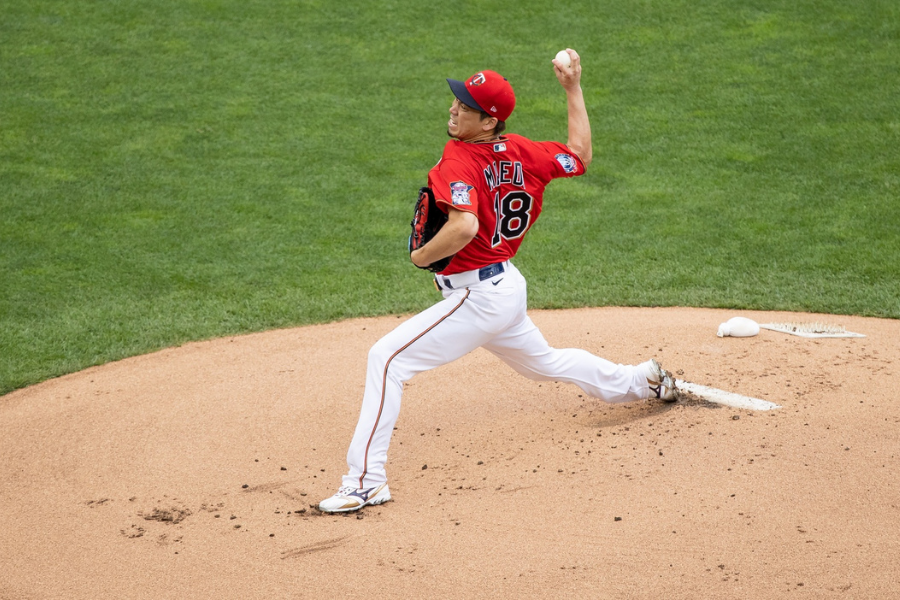 Madison Bumgarner used to be an ace. In fact, he is the exact type of specimen that fuels the term's modern mythology. His World Series performances are nothing short of legendary. They loom large in the minds of fans, and even front offices. The echoes of Bumgarner's long-removed ethos were enough to draw free-agent interest from the Twins and many other teams last winter, but the left-hander was steadfast in his desire to go to Arizona, so he did. (At an ostensible bargain, no less.) Thus far with the D-backs, he's gone 0-4 with a 8.52 ERA in seven starts, already besieged by back issues. Imagine if the Twins had simply signed him for $100 million and called it a day. Thankfully, they "missed" on Bumgarner and pivoted to Plan C, or D, or whatever it may have been. Any way you slice it, trading for Kenta Maeda has worked out better than any aspirational fan could have dreamed. Frequently prodded throughout the offseason by fans and media for procrastinating on their promised addition of "impact pitching," the front office ultimately landed one of the best pitchers in baseball, and a proven World Series performer to boot. Maeda's Mastery A first impression is only that, but the start to Maeda's career with the Twins won't soon be forgotten. Within his first nine starts as a Twin, the right-hander has: Taken a no-hitter into the ninth inning Set a franchise record with eight consecutive strikeouts Led the team to a 7-2 record while on the mound, posting a 2.43 ERA and an MLB-leading 0.74 WHIP Gone 4-0 with a 1.17 ERA against the Indians and White Sox Posted the eighth-highest bWAR (1.6) and ninth-highest fWAR (1.3) of any pitcher in baseball Posted the fourth-highest whiff rate of any pitcher in baseball (15.7%), trailing only Jacob deGrom, Lucas Giolito and Shane Bieber He pounds the zone with oft-untouchable stuff, and he rises to the occasion. That showed through again last Friday when Maeda took the mound and fired seven shutout innings against Cleveland, another dominant effort against a top contender in the division. In big moments, Maeda steps up. It's the pedigree of a guy who owns a 3.31 ERA in 32 ⅔ postseason innings. Classy Kenta The delightful impact of Maeda's arrival doesn't end with his performance on the field. He's also proving to be a person worth cheering for. How can you not love the earnest goodness of Maeda's story, shared in a YouTube video and translated on the Minnesota Sports Fan blog, about the fallout from his near-no-hitter-turned-near-loss after Taylor Rogers came in and promptly blew the save? As Kenta explains, Rogers felt bad enough about costing his new teammate a well-earned W (and even tagging Maeda with an earned run) that he left an apology letter at the starter's locker. "I told him not to worry about it," Maeda explains. "It’s not like my pitching line gets erased or anything and we won the game anyway. But Rogers just felt so bad that he initially offered to buy me some alcohol. Some of my translators and trainers told him that I don’t drink, though. So some of my staff just casually said maybe if we go out to drink you can pay the bill or something." Maeda continues: "But he insisted that it has to be something that benefits Kenta directly. So one of my trainers told him about this really high-quality Japanese rice from a store I like, and he purchased that for me as a gift. So along with this letter, he presented me with this ticket to trade-in for the rice. I can’t read the letter myself so I had it translated. Basically, it says 'I am so sorry for ruining your phenomenal pitching performance yesterday.' This really made me happy. I don’t think there are that many pitchers out there who care this much to go out of there way to do this." It's a great (but unsurprising) story about Rogers, who is a respected and beloved leader in the clubhouse. This connective moment between an organizational stalwart and the rotation's newly acquired phenom really warms my heart, transcending language barriers and cultural divides. It serves to reinforce what we're seeing on the field. He might be a big-market fish in a land of 10,000 small ponds, but Maeda is fitting right in, and he's just what this team needed. On Thursday afternoon in Chicago, he'll face the White Sox with the division more or less on the line. If the Twins can win behind him and split the series, they'll be one game behind in the Central with 10 days to go, and Minnesota will hold the tiebreaker. It'll be the biggest spot of Maeda's Twins career. At least up until he starts Game 1 of the playoffs in a couple weeks. He's under contract for three more seasons, so I'm sure there will be plenty more to come. MORE FROM TWINS DAILY — Latest Twins coverage from our writers — Recent Twins discussion in our forums — Follow Twins Daily via Twitter, Facebook or email
 -
Can the Twins Trust Taylor Rogers?
Nick Nelson replied to Nick Nelson's topic in Twins Daily Front Page News
I'm perplexed by the notion that Romo has been bad. He has a 3.12 ERA, 0.81 WHIP and opponents are hitting .164/.235/.295 against him. IMO Romo is clearly the team's closer right now, and probably should be. -
The Twins lost on Monday night and Taylor Rogers took the loss, falling to 1-4 and raising his ERA to 4.86 on the season. Ongoing struggles throw the former lockdown closer's status into question as October approaches. What to make of this situation?Before we go any further, let's get something clear: Taylor Rogers is a stud relief pitcher. Up until the 17-inning sample that represents this 2020 season, here's where he ranked across the two FULL seasons prior: Taylor Rogers, 2018-2019: 4th in fWAR among MLB relievers (4.0)6th in WPA among MLB relievers (6.15)5th in FIP among MLB relievers (2.59)4th in K/BB among MLB relievers (6.11)That's among ALL major-league relievers, y'all. The names accompanying him on these lists are the best of the best: Kirby Yates, Aroldis Chapman, Josh Hader, Felipe Vazquez, etc. So, I think it's important to keep that piece of context in mind as we proceed. It's been a struggle for Rogers in 2020. A disastrous eighth inning on Monday was just the latest in a string of rocky outings for the once-elite closer. With so many slip-ups in high-leverage spots, he now ranks 173rd out of 179 qualified relievers in Win Probability Added this year (-1.15). But even after crumbling against the White Sox in Chicago, the underlying numbers give almost every indication of a pitcher who's been performing well and experiencing rotten luck. Rogers has the seventh-highest BABIP (.412) among MLB relief pitchers. His K/BB ratio was second-best in the game before he issued a pair of walks on Monday, and is still quite strong at 20-to-3. His 4.86 ERA is accompanied by a 2.90 FIP. So what's contributing to this drop-off? Well, a look into the Statcast data reveals some noteworthy insights. Here are his three-year trends across a variety of metrics: Download attachment: rogersstatcast.png What catches my eye is the progressive decline in whiff rate (64th percentile to 51st to 35th) and Barrel % (79th percentile to 37th to 15th), which seem to correlate with the perception that hitters have been increasingly keyed in on his pitches dating back to midway through last season. And then there is his flattening curve spin, which has gravitated from top-shelf (89th percentile in 2018) to more ordinary (66th percentile in 2020). Here's a spot where the data matches the eye-test; Rogers has thrown a lot of breaking balls that hang in the zone and get crushed – his 0-2 pitch to Tim Anderson on Monday being a fine example. What's happened to Rogers' formerly phenomenal out pitch? Here we come across another odd finding in the Statcast data: it says Rogers ditched his slider this year and is only throwing the curve as his breaking pitch. Last year, 35.4% of the lefty's pitches were classified as sliders, and 14.7% as curveballs. This year, they've both melded into a single pitch being thrown 45.3% of the time. Download attachment: rogerspitchchart.png Is this meaningful? I don't know. Statcast isn't perfect at assigning pitch types and Rogers has always thrown hybrid-type breaking balls that dance between designations. But the addition of a slider to his repertoire in 2018 was a big story. Matthew Trueblood wrote about it here earlier this year: "By now, the story of Rogers’s transformation from fringy lefty specialist to formidable relief ace is familiar to nearly all Twins fans. During the first third of the 2018 season, Rogers tinkered with a new offering, a slider, which he then incorporated as an extra look for hitters hoping to lock in on his sinker and curveball. Since he became comfortable using that slider, he’s been one of the best relievers in baseball." I can't claim to classify Rogers' pitches by eye any better than Statcast does, but what I've seen sure seems to jibe with the data: Hitters are once again locking in on his sinker and curveball. If he's still throwing two different versions of a breaking ball, it doesn't look that way to me, the computer, or – evidently – opposing hitters. Possibly it's a change in the pitch's shape, or maybe a matter of release point. Either way, it's ceased to be a particularly effective weapon: opponents are holding their own against the curve with a .310 wOBA, and teeing off on the sinker at .409. Having said all this, it's worth circling back to that point made at the outset: Rogers is a stud relief pitcher. His poor results over less than a 17-inning sample do not outweigh a lengthy track record of excellence, especially when they bear so many signs of being flukey and unsustainable. But right now, he simply isn't getting the job done. While it's valid to discuss where he should sit in the bullpen hierarchy (and I'm curious to hear thoughts in the comments), there's no question that the Twins will be relying to Rogers as a late-inning crux in the playoffs. Whatever issues are plaguing him, time is running out to get them solved. MORE FROM TWINS DAILY — Latest Twins coverage from our writers — Recent Twins discussion in our forums — Follow Twins Daily via Twitter, Facebook or email Click here to view the article
-
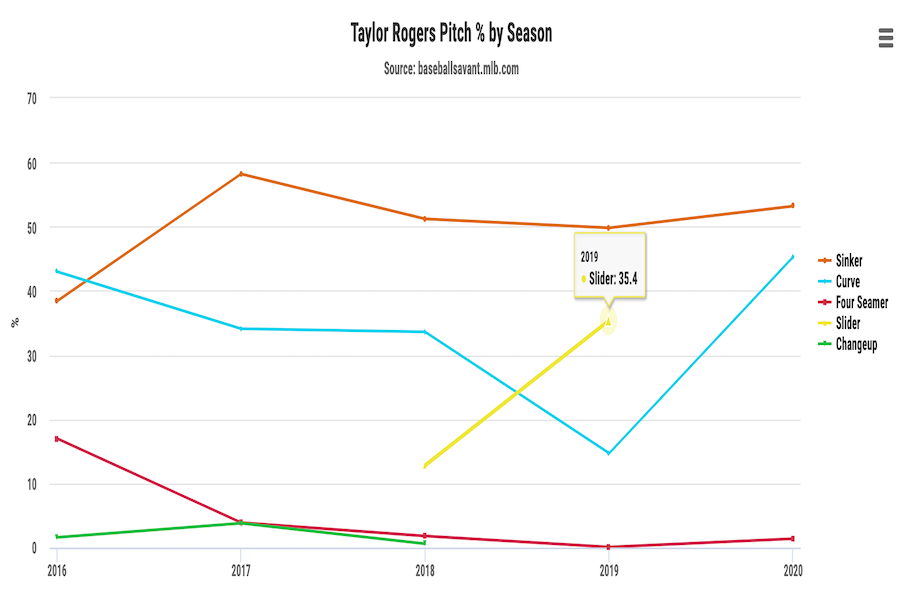 Before we go any further, let's get something clear: Taylor Rogers is a stud relief pitcher. Up until the 17-inning sample that represents this 2020 season, here's where he ranked across the two FULL seasons prior: Taylor Rogers, 2018-2019: 4th in fWAR among MLB relievers (4.0) 6th in WPA among MLB relievers (6.15) 5th in FIP among MLB relievers (2.59) 4th in K/BB among MLB relievers (6.11) That's among ALL major-league relievers, y'all. The names accompanying him on these lists are the best of the best: Kirby Yates, Aroldis Chapman, Josh Hader, Felipe Vazquez, etc. So, I think it's important to keep that piece of context in mind as we proceed. It's been a struggle for Rogers in 2020. A disastrous eighth inning on Monday was just the latest in a string of rocky outings for the once-elite closer. With so many slip-ups in high-leverage spots, he now ranks 173rd out of 179 qualified relievers in Win Probability Added this year (-1.15). But even after crumbling against the White Sox in Chicago, the underlying numbers give almost every indication of a pitcher who's been performing well and experiencing rotten luck. Rogers has the seventh-highest BABIP (.412) among MLB relief pitchers. His K/BB ratio was second-best in the game before he issued a pair of walks on Monday, and is still quite strong at 20-to-3. His 4.86 ERA is accompanied by a 2.90 FIP. So what's contributing to this drop-off? Well, a look into the Statcast data reveals some noteworthy insights. Here are his three-year trends across a variety of metrics: What catches my eye is the progressive decline in whiff rate (64th percentile to 51st to 35th) and Barrel % (79th percentile to 37th to 15th), which seem to correlate with the perception that hitters have been increasingly keyed in on his pitches dating back to midway through last season. And then there is his flattening curve spin, which has gravitated from top-shelf (89th percentile in 2018) to more ordinary (66th percentile in 2020). Here's a spot where the data matches the eye-test; Rogers has thrown a lot of breaking balls that hang in the zone and get crushed – his 0-2 pitch to Tim Anderson on Monday being a fine example. What's happened to Rogers' formerly phenomenal out pitch? Here we come across another odd finding in the Statcast data: it says Rogers ditched his slider this year and is only throwing the curve as his breaking pitch. Last year, 35.4% of the lefty's pitches were classified as sliders, and 14.7% as curveballs. This year, they've both melded into a single pitch being thrown 45.3% of the time. Is this meaningful? I don't know. Statcast isn't perfect at assigning pitch types and Rogers has always thrown hybrid-type breaking balls that dance between designations. But the addition of a slider to his repertoire in 2018 was a big story. Matthew Trueblood wrote about it here earlier this year: "By now, the story of Rogers’s transformation from fringy lefty specialist to formidable relief ace is familiar to nearly all Twins fans. During the first third of the 2018 season, Rogers tinkered with a new offering, a slider, which he then incorporated as an extra look for hitters hoping to lock in on his sinker and curveball. Since he became comfortable using that slider, he’s been one of the best relievers in baseball."I can't claim to classify Rogers' pitches by eye any better than Statcast does, but what I've seen sure seems to jibe with the data: Hitters are once again locking in on his sinker and curveball. If he's still throwing two different versions of a breaking ball, it doesn't look that way to me, the computer, or – evidently – opposing hitters. Possibly it's a change in the pitch's shape, or maybe a matter of release point. Either way, it's ceased to be a particularly effective weapon: opponents are holding their own against the curve with a .310 wOBA, and teeing off on the sinker at .409. Having said all this, it's worth circling back to that point made at the outset: Rogers is a stud relief pitcher. His poor results over less than a 17-inning sample do not outweigh a lengthy track record of excellence, especially when they bear so many signs of being flukey and unsustainable. But right now, he simply isn't getting the job done. While it's valid to discuss where he should sit in the bullpen hierarchy (and I'm curious to hear thoughts in the comments), there's no question that the Twins will be relying to Rogers as a late-inning crux in the playoffs. Whatever issues are plaguing him, time is running out to get them solved. MORE FROM TWINS DAILY — Latest Twins coverage from our writers — Recent Twins discussion in our forums — Follow Twins Daily via Twitter, Facebook or email
 -
AL Playoff Matchups a Little Clearer
Nick Nelson replied to John Bonnes's topic in Twins Daily Front Page News
I could be wrong, but I believe I heard that this first round would be played at the actual home parks, and any bubble situation would happen after. So I think it'll be at Target Field. Which would seem to be very good news, given how they've played there! -
The Minnesota Twins kept on rolling, and embarked successfully on the most critical stretch of their schedule. With just two weeks left in the regular season, the Twins are getting closer to full strength and cracking open the Sota Pop. Let's recount the bombas and break down the race for first place. Weekly Snapshot: Mon, 9/7 through Sun, 9/13 *** Record Last Week: 5-1 (Overall: 30-18) Run Differential Last Week: +14 (Overall: +48) Standing: 2nd Place in AL Central (1.0 GB) Bomba Counter: 74 (Pace: 93) After watching him limp around and battle through a bad knee for two months, the Twins finally moved Luis Arráez to the Injured List on Tuesday, retroactive to September 9th. There was no indication of a specific setback, so it seems as though they're just trying to give his legs a break as the playoffs approach. He's eligible to return next weekend. Brent Rooker hit his first major-league home run on Tuesday, but on Saturday suffered a forearm fracture when he was hit by a pitch, ending his season. It's a really tough break (literally) for the rookie, but he can take comfort in knowing he made a great first impression, slashing .316/.381/.579 in 21 plate appearances, and will surely be a factor in next year's plans. Jose Berríos, who figures to follow in Game 2, is 3-0 with a 2.78 ERA in his past four starts after notching a victory over St. Louis on Tuesday. Michael Pineda has a 20-to-4 K/BB ratio in 17 ⅔ innings over three starts since rejoining the club. With that trio leading the rotation, and the offense in attack mode, you've gotta feel good about how the Twins are currently shaping up for October. We saw it all come together in a convincing weekend sweep against Cleveland, a team Minnesota could very well face in the playoffs. LOWLIGHTS Nearly every time he's taken the mound as as big-leaguer, things have gone swimmingly for Randy Dobnak. That's how you arrive at a 2.80 ERA through 68 MLB innings. Of late, however, the right-hander has encountered his first bouts of adversity. Three starts ago he was knocked around by the Tigers, who piled up six earned runs on 12 hits in 4 ⅓ innings. In his latest turn, facing the Cardinals in St. Louis on Tuesday, he coughed up an early lead and took the L, yielding five earned runs in 2 ⅔ frames. This time around, his root problem was very different – not so much being hittable (he only allowed two), but completely erratic. In the third inning he loaded the bases on a single, hit-by-pitch and walk, then allowed runs in on another HBP and walk, followed by a fielder's choice and RBI single. It was an uncharacteristic unraveling from the typically poised Dobnak, who wasn't crushed in the outing by any means. Given that he was pitching on three days' rest, I'm inclined not to weigh it too heavily, but seeing the two worst outings of his career within 11 days of one another isn't great. The fact that Dobnak's one inning of struggle was really the only noticeable low point in the entire week says a lot of about what kind of roll the Twins are on right now. TRENDING STORYLINE Aside from trying to stay healthy and take the division, charting out the pitching staff's postseason hierarchy will be the key directive for Rocco Baldelli and his staff in these final two weeks. While the top three starters are well established as we covered earlier, it's unclear who might get the nod as a fourth starter if one is needed. Dobnak didn't help his case last time but he'll get another shot in a big spot against the White Sox on Tuesday. A strong performance against the league's top offense, on the road, would make quite a statement. Presumably, the plan is for Odorizzi to take the ball opposite Lucas Giolito on Wednesday as he makes a late push for a significant role in October. And two days later it'll be Rich Hill going up against the formidable Kyle Hendricks and the Cubs. Facing frontline starters on playoff teams will be a fitting test for these hurlers, as they make their bids to do just that in a few weeks. The bullpen pecking order, too, must be sorted. Just as in the rotation, the top guys are essentially locked in, but the next tier is fluid. Will Jorge Alcala earn high-leverage looks? What about Matt Wisler and Caleb Thielbar? They've looked amazing, albeit in small samples. Can Cody Stashak prove he's sharp enough to be a factor, or will his time spent sidelined cost him a postseason roster spot? Many questions remain to be answered, and the urgency in figuring them out may be increased if the status of Trevor May – who was lifted from Sunday's game due to back cramps – is going to be in question for the playoffs. LOOKING AHEAD The fate of the 2020 regular-season Minnesota Twins could be decided in Chicago this week. First up, it's four games against the White Sox, who carry a one-game division lead into the series. Then the Twins head to the North Side for three games against another first-place team at Wrigley. After that, only five games remain. The Sox are in the driver's seat entirely because of their success against the dregs of the division – they're 18-2 against the Royals and Tigers, 12-14 against all other opponents – so this is their chance to prove it for real and put clamps down on the Central. Minnesota has won both of the first two head-to-head matchups, and if they can do it again here, they'll come out leading the division with 10 days to go. It's all on the line in Chi-town. Should be fun. MONDAY, 9/14: TWINS @ WHITE SOX – RHP Jose Berrios v. RHP Dylan Cease TUESDAY, 9/15: TWINS @ WHITE SOX – RHP Randy Dobnak v. RHP Dane Dunning WEDNESDAY, 9/16: TWINS @ WHITE SOX – TBD v. RHP Lucas Giolito THURSDAY, 9/17: TWINS @ WHITE SOX – RHP Kenta Maeda v. TBD FRIDAY, 9/18: TWINS @ CUBS – LHP Rich Hill v. RHP Kyle Hendricks SATURDAY, 9/19: TWINS @ CUBS – RHP Michael Pineda v. RHP Alec Mills SUNDAY, 9/20: TWINS @ CUBS – RHP Jose Berrios v. RHP Yu Darvish Catch Up On Twins Daily Game Recaps Game 43 | MIN 6, DET 2: Pineda Pitches 7 Innings, Twins Take 4 of 5 Game 44 | MIN 7, STL 3 Game 45 | STL 6, MIN 4 Game 46 | MIN 3, CLE 1: Buxton, Jeffers Sting Bieber; Maeda Sails Through 7 Game 47 | MIN 8, CLE 4: Return of the Bomba Squad Game 48 | MIN 7, CLE 5: Twins Complete Sweep, Shift Focus to White Sox MORE FROM TWINS DAILY — Latest Twins coverage from our writers — Recent Twins discussion in our forums — Follow Twins Daily via Twitter, Facebook or email Click here to view the article
-
 Weekly Snapshot: Mon, 9/7 through Sun, 9/13 *** Record Last Week: 5-1 (Overall: 30-18) Run Differential Last Week: +14 (Overall: +48) Standing: 2nd Place in AL Central (1.0 GB) Bomba Counter: 74 (Pace: 93) After watching him limp around and battle through a bad knee for two months, the Twins finally moved Luis Arráez to the Injured List on Tuesday, retroactive to September 9th. There was no indication of a specific setback, so it seems as though they're just trying to give his legs a break as the playoffs approach. He's eligible to return next weekend. Brent Rooker hit his first major-league home run on Tuesday, but on Saturday suffered a forearm fracture when he was hit by a pitch, ending his season. It's a really tough break (literally) for the rookie, but he can take comfort in knowing he made a great first impression, slashing .316/.381/.579 in 21 plate appearances, and will surely be a factor in next year's plans. While they'll be without Arráez for a while, and Rooker for good, the Twins are inching closer toward being whole again. Max Kepler returned from IL on Sunday, batting leadoff and playing right field in the sweep-clinching win against Cleveland. It sounds like Mitch Garver could be activated in the coming days, and Jake Odorizzi is also on his way back after throwing an intrasquad game on Friday. With a playoff berth all but assured, Minnesota's primary goal is to be at full strength by the time the first round gets underway. Winning the division is perhaps secondary to getting and staying healthy, but it's an important priority nonetheless, and the Twins are currently in the middle of a decisive stretch toward that end. Here's a look at where their excellent past week has brought them, and where they're headed next. HIGHLIGHTS The Bomba Squad moniker felt more apropos than it has in past weeks, as the awakening Twins offense launched 18 home runs in six games against two of the league's best pitching staffs. Seventeen of 18 runs scored in the sweep over Cleveland came on long balls. Among the contributors to last week's power parade: Byron Buxton mashed three homers in his four starts, including a pair of critical two-run blasts in the Cleveland series. His aggressive swing-at-everything approach is working well as opponents continue to oblige him by serving pitches over the plate. The Twins have won 10 of the last 11 games Buxton has started, including seven straight. What a difference-maker. While Garver's return will be welcomed, Ryan Jeffers is more than taking care of business in his absence. Over the past week, Jeffers did a fine impression of the 2019 Silver Slugger, popping off for three home runs including a rocket shot off the league's best pitcher (Shane Bieber). In fact, he had two of the hardest-hit balls off Bieber all season, in within the span of a few innings. The kid can crush, and his defense behind the plate remains stellar. Even more so than Rooker, Jeffers has firmly entrenched himself in the 2021 picture with his tremendous showing as a big-league rookie. Taking a .200/.279/.281 slash line into Saturday's game, with two singles to show for his past 38 plate appearances, Marwin Gonzalez was badly in need of a slump-breaker. He found it on Saturday with a two-run homer to open the scoring, then put his team on the board with another two-run jack Sunday, later adding a sac fly. Gonzalez has as many RBIs in his past two games (5) as he did in his previous 17. Hopefully this is the start of a hot streak for him; the Twins could sure use it with Arráez out. Also delivering multiple home runs over the past week, some of the usual suspects: Nelson Cruz (3), Josh Donaldson (2), Miguel Sanó (2). When these guys are all doing their things and people are getting on base in front of them, this lineup is scary. Meanwhile, the rotation has been steady and occasionally sensational. Kenta Maeda keeps looking the part as a No. 1 starter. He was magnificent on Friday, out-dueling Bieber with seven shutout innings. Maeda is now 5-1 with a 2.43 ERA and league-leading 0.74 WHIP. He's all but guaranteed that to be Minnesota's Game 1 starter in the postseason. Jose Berríos, who figures to follow in Game 2, is 3-0 with a 2.78 ERA in his past four starts after notching a victory over St. Louis on Tuesday. Michael Pineda has a 20-to-4 K/BB ratio in 17 ⅔ innings over three starts since rejoining the club. With that trio leading the rotation, and the offense in attack mode, you've gotta feel good about how the Twins are currently shaping up for October. We saw it all come together in a convincing weekend sweep against Cleveland, a team Minnesota could very well face in the playoffs. LOWLIGHTS Nearly every time he's taken the mound as as big-leaguer, things have gone swimmingly for Randy Dobnak. That's how you arrive at a 2.80 ERA through 68 MLB innings. Of late, however, the right-hander has encountered his first bouts of adversity. Three starts ago he was knocked around by the Tigers, who piled up six earned runs on 12 hits in 4 ⅓ innings. In his latest turn, facing the Cardinals in St. Louis on Tuesday, he coughed up an early lead and took the L, yielding five earned runs in 2 ⅔ frames. This time around, his root problem was very different – not so much being hittable (he only allowed two), but completely erratic. In the third inning he loaded the bases on a single, hit-by-pitch and walk, then allowed runs in on another HBP and walk, followed by a fielder's choice and RBI single. It was an uncharacteristic unraveling from the typically poised Dobnak, who wasn't crushed in the outing by any means. Given that he was pitching on three days' rest, I'm inclined not to weigh it too heavily, but seeing the two worst outings of his career within 11 days of one another isn't great. The fact that Dobnak's one inning of struggle was really the only noticeable low point in the entire week says a lot of about what kind of roll the Twins are on right now. TRENDING STORYLINE Aside from trying to stay healthy and take the division, charting out the pitching staff's postseason hierarchy will be the key directive for Rocco Baldelli and his staff in these final two weeks. While the top three starters are well established as we covered earlier, it's unclear who might get the nod as a fourth starter if one is needed. Dobnak didn't help his case last time but he'll get another shot in a big spot against the White Sox on Tuesday. A strong performance against the league's top offense, on the road, would make quite a statement. Presumably, the plan is for Odorizzi to take the ball opposite Lucas Giolito on Wednesday as he makes a late push for a significant role in October. And two days later it'll be Rich Hill going up against the formidable Kyle Hendricks and the Cubs. Facing frontline starters on playoff teams will be a fitting test for these hurlers, as they make their bids to do just that in a few weeks. The bullpen pecking order, too, must be sorted. Just as in the rotation, the top guys are essentially locked in, but the next tier is fluid. Will Jorge Alcala earn high-leverage looks? What about Matt Wisler and Caleb Thielbar? They've looked amazing, albeit in small samples. Can Cody Stashak prove he's sharp enough to be a factor, or will his time spent sidelined cost him a postseason roster spot? Many questions remain to be answered, and the urgency in figuring them out may be increased if the status of Trevor May – who was lifted from Sunday's game due to back cramps – is going to be in question for the playoffs. LOOKING AHEAD The fate of the 2020 regular-season Minnesota Twins could be decided in Chicago this week. First up, it's four games against the White Sox, who carry a one-game division lead into the series. Then the Twins head to the North Side for three games against another first-place team at Wrigley. After that, only five games remain. The Sox are in the driver's seat entirely because of their success against the dregs of the division – they're 18-2 against the Royals and Tigers, 12-14 against all other opponents – so this is their chance to prove it for real and put clamps down on the Central. Minnesota has won both of the first two head-to-head matchups, and if they can do it again here, they'll come out leading the division with 10 days to go. It's all on the line in Chi-town. Should be fun. MONDAY, 9/14: TWINS @ WHITE SOX – RHP Jose Berrios v. RHP Dylan Cease TUESDAY, 9/15: TWINS @ WHITE SOX – RHP Randy Dobnak v. RHP Dane Dunning WEDNESDAY, 9/16: TWINS @ WHITE SOX – TBD v. RHP Lucas Giolito THURSDAY, 9/17: TWINS @ WHITE SOX – RHP Kenta Maeda v. TBD FRIDAY, 9/18: TWINS @ CUBS – LHP Rich Hill v. RHP Kyle Hendricks SATURDAY, 9/19: TWINS @ CUBS – RHP Michael Pineda v. RHP Alec Mills SUNDAY, 9/20: TWINS @ CUBS – RHP Jose Berrios v. RHP Yu Darvish Catch Up On Twins Daily Game Recaps Game 43 | MIN 6, DET 2: Pineda Pitches 7 Innings, Twins Take 4 of 5 Game 44 | MIN 7, STL 3 Game 45 | STL 6, MIN 4 Game 46 | MIN 3, CLE 1: Buxton, Jeffers Sting Bieber; Maeda Sails Through 7 Game 47 | MIN 8, CLE 4: Return of the Bomba Squad Game 48 | MIN 7, CLE 5: Twins Complete Sweep, Shift Focus to White Sox MORE FROM TWINS DAILY — Latest Twins coverage from our writers — Recent Twins discussion in our forums — Follow Twins Daily via Twitter, Facebook or email
 -
Although I'm not a robo-umps advocate in general, I actually agree that this year offered the perfect opportunity to test it out (while enhancing safety as well). It seems the biggest issue they're running into is clearly communicating calls in a rapid fashion. For example: Let's say it's a called third strike and a guy is stealing second. When the ump is immediately barking the out call, the catcher can put the ball in his pocket. When you have to look to a board and see it, they might be whipping it down to second while a runner is barreling in needlessly, creating injury risk, confusion, etc. That's just one of many examples. There are probably ways to solve this, but doing so in rushed fashion for an already abnormal season was probably a bit much.
-
No signs? Rosario by fWAR: 2017: 2.6 2018: 3.5 2019: 1.2 2020: 0.4 (162-G pace: 1.2) Rosario by bWAR: 2017: 1.5 2018: 4.1 2019: 1.7 2020: 0.5 (162-G pace: 1.5) As illustrated in the article, underlying batted ball and fielding data show that his declining offensive and defensive metrics are no mirage. I guess you could say there's no drop-off coming in the "near future" in that it's already happening right now.
-
I was a major skeptic of Major League Baseball's ability to carry out a 2020 season of record. I won't run away from it. As I stared down the immense challenges ahead in early April, my conclusion was that we needed to give up the ghost. Six months later, I can officially say: I was wrong. And I couldn't be more pleased.The concerns were valid, and the sailing has not always been smooth. But one by one, MLB has managed to navigate every foreboding obstacle. Overwhelming logistical barriers. The league's exhaustive protocols have been sound. There were a couple of early outbreaks, affecting the Marlins and Cardinals, but the virus seemingly never spread between clubhouses, and for the most part cases have been minimized. The traveling restrictions, the in-game considerations, the testing cadences ... they all seem to be working. Player and public health implications. Some players and personnel have gotten sick, yes. But can anyone realistically argue that the number would not be far higher if all these individuals were left to their own devices? The latest testing results yielded a new positive rate of 0.008%. I suppose the resource drain could be criticized, but to my knowledge, shortage of testing supplies is not a nation-wide issue. There doesn't appear to be much if any collateral damage from baseball being played. Playing in empty stadiums under altered rules. It's been strange, yes, but I still find myself enjoying the product. The league and its broadcasters have all-in-all done a tremendous job of delivering a familiar experience. Caliber of play has been high, and as a fan I've been looking forward to each night's game. Many of the new twists, like extra-inning men-on-second and an extended 60-man player pool, are intriguing and fun in their own ways. Validity of a shortened and contorted season. This is the one thing I'm still a bit stuck on. Should a 60-game season, with warped schedules and an expanded playoff format, really be counted the same as a typical one in the game's annals? At this point last year, the World Series Champion Washington Nationals were 16-25, and would've been outside the playoff picture. Presently, they are ... 16-25, and all but certain to miss the playoffs. Meanwhile, the Yankees are in real danger of missing out. And while this gives me great joy as a Twins fan, it gives me pause as a baseball fan. This is clearly one of the best teams in the league, eliminated from October because of some injuries and slumping in what would've normally been the first third of the schedule? How am I gonna feel if the Twins get ousted by the White Sox 2-1 in a first-round playoff series? It's all a little tough to come to grips with, but you know what? I can deal with it all. As a fan who cherishes the sport's legacy and tradition, I can accept it. Despite my reservations coming in, I just find myself happy to have baseball. It has proven an invaluable distraction from the state of the world, and the dynamic of a concentrated 60-game sprint only plays up this benefit. There's rarely a night off or a moment to take a breath, which is why – during the current odd two-day break – I find myself struck by a sense of sadness in the Twins' absence, and a looming dread at the spectre of an approaching finish line. I'll be honest, when I listened to Rob Manfred and Co. wax poetic about the game's power to heal and restore normalcy – while at the same time embroiled in a highly publicized money dispute – I almost gagged at the schmaltzy sentimentality. But for me personally, the return of baseball has been a very wonderful thing, more than I ever expected. I'm extremely grateful for it. MLB's successful experiment even gives me hope that the NFL can pull off its season, set to get underway on Thursday night. If not for baseball successfully paving the way, I would have minimal confidence. To the players, coaches, trainers, umpires, media, staffers, executives and – yes, even owners and commissioner – who have come together to make this season happen under extraordinary difficulty: thank you. So much. And to Mr. John Bonnes ... Yes, I am loving watching baseball this year. You were right, I was wrong. Yeah yeah. Luckily, I'm sure you won't get a big head about it. MORE FROM TWINS DAILY — Latest Twins coverage from our writers — Recent Twins discussion in our forums — Follow Twins Daily via Twitter, Facebook or email Click here to view the article
-
 The concerns were valid, and the sailing has not always been smooth. But one by one, MLB has managed to navigate every foreboding obstacle. Overwhelming logistical barriers. The league's exhaustive protocols have been sound. There were a couple of early outbreaks, affecting the Marlins and Cardinals, but the virus seemingly never spread between clubhouses, and for the most part cases have been minimized. The traveling restrictions, the in-game considerations, the testing cadences ... they all seem to be working. Player and public health implications. Some players and personnel have gotten sick, yes. But can anyone realistically argue that the number would not be far higher if all these individuals were left to their own devices? The latest testing results yielded a new positive rate of 0.008%. I suppose the resource drain could be criticized, but to my knowledge, shortage of testing supplies is not a nation-wide issue. There doesn't appear to be much if any collateral damage from baseball being played. Playing in empty stadiums under altered rules. It's been strange, yes, but I still find myself enjoying the product. The league and its broadcasters have all-in-all done a tremendous job of delivering a familiar experience. Caliber of play has been high, and as a fan I've been looking forward to each night's game. Many of the new twists, like extra-inning men-on-second and an extended 60-man player pool, are intriguing and fun in their own ways. Validity of a shortened and contorted season. This is the one thing I'm still a bit stuck on. Should a 60-game season, with warped schedules and an expanded playoff format, really be counted the same as a typical one in the game's annals? At this point last year, the World Series Champion Washington Nationals were 16-25, and would've been outside the playoff picture. Presently, they are ... 16-25, and all but certain to miss the playoffs. Meanwhile, the Yankees are in real danger of missing out. And while this gives me great joy as a Twins fan, it gives me pause as a baseball fan. This is clearly one of the best teams in the league, eliminated from October because of some injuries and slumping in what would've normally been the first third of the schedule? How am I gonna feel if the Twins get ousted by the White Sox 2-1 in a first-round playoff series? It's all a little tough to come to grips with, but you know what? I can deal with it all. As a fan who cherishes the sport's legacy and tradition, I can accept it. Despite my reservations coming in, I just find myself happy to have baseball. It has proven an invaluable distraction from the state of the world, and the dynamic of a concentrated 60-game sprint only plays up this benefit. There's rarely a night off or a moment to take a breath, which is why – during the current odd two-day break – I find myself struck by a sense of sadness in the Twins' absence, and a looming dread at the spectre of an approaching finish line. I'll be honest, when I listened to Rob Manfred and Co. wax poetic about the game's power to heal and restore normalcy – while at the same time embroiled in a highly publicized money dispute – I almost gagged at the schmaltzy sentimentality. But for me personally, the return of baseball has been a very wonderful thing, more than I ever expected. I'm extremely grateful for it. MLB's successful experiment even gives me hope that the NFL can pull off its season, set to get underway on Thursday night. If not for baseball successfully paving the way, I would have minimal confidence. To the players, coaches, trainers, umpires, media, staffers, executives and – yes, even owners and commissioner – who have come together to make this season happen under extraordinary difficulty: thank you. So much. And to Mr. John Bonnes ... Yes, I am loving watching baseball this year. You were right, I was wrong. Yeah yeah. Luckily, I'm sure you won't get a big head about it. MORE FROM TWINS DAILY — Latest Twins coverage from our writers — Recent Twins discussion in our forums — Follow Twins Daily via Twitter, Facebook or email
 -
Oooookay, hold the phones here. Let's break this down. Rosario's 7 RBIs over the past week: 2-run HR against CWS when they were already up 6-1RBI single and solo HR in losing effort against DET on Sunday3-run double on Monday on a grounder down the first base line that (fortunately) hit the bag instead of turning into an out During this span he also cost the Twins runs by missing plays in the outfield and making multiple outs on the base paths. So, no, he did no by any stretch of the imagination "save the season." Meanwhile, as the Twins lost six straight games in the previous week, Rosario went 2-for-17 with zero XBH and zero RBIs.
-
The Twins tried to trade him last winter and got no bites. He has minimal trade value because other teams can see all the numbers and indicators I've shared above, and no one wants to give up prospects for the right to pay $8M for that.
-
This is not a reaction to yesterday's game, or the last week, which is why much broader statistics were used to make the case that Rosario has been a sub par contributor dating back to last year. And no, if Kepler would've done the same the article would not have been published since, A: Kepler is under contract for several years, not a non-tender candidate in the offseason; and B: Kepler was arguably the team's most valuable player last year, Rosario probably not in the top ten. For your talk about "cherry-picking categories" (I literally shared his entire Statcast profile, which is almost all below average, and fWAR which is an all-consuming performance metric) you sure seem to be zeroing in on non-existent argument here and ignoring the one that was actually made. This ain't about the "eye test." Look at the numbers. They speak for themselves.
-
It's been clear for some time that Eddie Rosario's days with the Twins are numbered, as a result of several converging factors: top prospects on the rise, impending free agency, and – most significantly – his own declining performance. The latter of these issues is becoming so unignorable it should be accelerating his exit timeline. The Twins can start making preparations now.His gaudy HR and RBI numbers on a historically explosive offense last year obscured the reality: he was a mediocre player showing some seriously diminished skills. Rosario's .300 on-base percentage ranked as the eight-lowest among MLB hitters and his defense rated near the bottom of all outfielders. Among 135 qualified big-league position players last year, Rosario ranked 114th in fWAR. This was a big year for the left fielder, who knew he needed to turn around his declining performance trend and build his case for free agency. Before the season he announced his intentions to address weaknesses in the statistical categories that modern front offices care about. "Defense, walks, OPS, those are the numbers in the game right now that are bad for me. OK. I want to try to change that. That's it," he said. To his credit, Rosario has made definitive improvements to his plate patience. He's chasing out of the zone less, whiffing less, and has more than doubled his paltry 3.7% BB rate from a year ago. Unfortunately, this hasn't led to an uptick in overall production – quite the contrary, in fact. His OPS is down 70 points, and his defense rates as poorly as ever. The notion that last year's drop-off owed to an ankle injury hasn't been substantiated (unless the ankle is still bothering him, which is possible but hardly reaffirming). He's a below-average runner and Statcast's Outs Above Average metric places him in the 5th percentile among all fielders. Download attachment: rosariostatcast97.png His range is awful and the strong arm doesn't come close to making up for it. It all adds up to this: Among 158 qualified big league position players this year, Rosario ranks 122nd in fWAR. On top of this, he continues to be a maddeningly undisciplined and reckless player on the field; on Sunday he blatantly blew through a stop sign at third, getting thrown out easily to stifle a big rally, and then later watched a caromed ball sit in front of him in left field as runners circled the bases because he (wrongly) assumed it was a ground rule double. On Monday he ran into another out on the bases, attempting to stretch a double into a triple and getting thrown out by a mile. He's doing all this for a prorated salary of $7.75 million this year, and figures to command a similar amount in 2021, his final year of arbitration. How do you justify that expense with multiple top prospects waiting in the wings behind him? You don't. Eddie is on his way out. So why keep feeding him everyday playing time when you could be prepping those future fixtures who do not have the benefit of playing minor-league games this year? To an extent, this becomes a moot point with Max Kepler sidelined, but if he returns – and even up until then – it would behoove the Twins to start mixing in Rosario's replacements to both get them familiar and, frankly, improve the production from left field. A bit of exposure to an intense September stretch run atmosphere in the majors could benefit Alex Kirilloff or Trevor Larnach greatly, if they are expected to be a big part of Minnesota's championship plans for 2021. Brent Rooker is of course already here, and demonstrating that it's possible to acclimate quickly from the alternate site. I get that Rosario is a streaky player. It's entirely possible he'll get on a roll and validate his consistent nods at the heart of the batting order. But it's also very possible he won't. There's only so much time left to turn around his lackluster performance, and many underlying signs suggest that Rosario's decline is more attributable to diminishing athleticism than bad luck or the standard ebbs and flows of baseball. The Rosie ride has been a wild one over these past six years, filled with plenty of thrills and frustrations. Now, as that ride reaches an end, it's time for the Twins to prep themselves for the future in left field. MORE FROM TWINS DAILY — Latest Twins coverage from our writers — Recent Twins discussion in our forums — Follow Twins Daily via Twitter, Facebook or email Click here to view the article
-
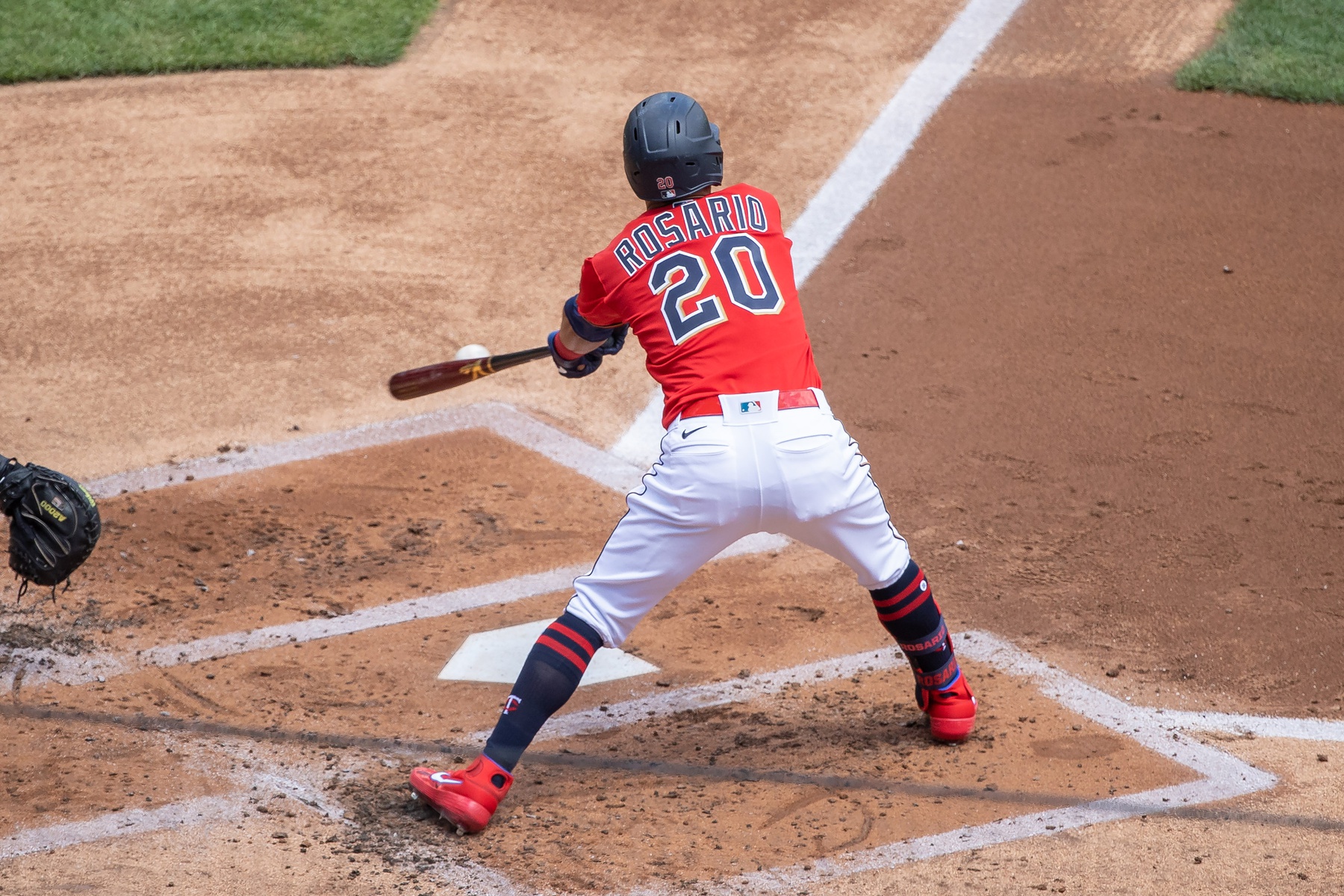 His gaudy HR and RBI numbers on a historically explosive offense last year obscured the reality: he was a mediocre player showing some seriously diminished skills. Rosario's .300 on-base percentage ranked as the eight-lowest among MLB hitters and his defense rated near the bottom of all outfielders. Among 135 qualified big-league position players last year, Rosario ranked 114th in fWAR. This was a big year for the left fielder, who knew he needed to turn around his declining performance trend and build his case for free agency. Before the season he announced his intentions to address weaknesses in the statistical categories that modern front offices care about. "Defense, walks, OPS, those are the numbers in the game right now that are bad for me. OK. I want to try to change that. That's it," he said. To his credit, Rosario has made definitive improvements to his plate patience. He's chasing out of the zone less, whiffing less, and has more than doubled his paltry 3.7% BB rate from a year ago. Unfortunately, this hasn't led to an uptick in overall production – quite the contrary, in fact. His OPS is down 70 points, and his defense rates as poorly as ever. The notion that last year's drop-off owed to an ankle injury hasn't been substantiated (unless the ankle is still bothering him, which is possible but hardly reaffirming). He's a below-average runner and Statcast's Outs Above Average metric places him in the 5th percentile among all fielders. His range is awful and the strong arm doesn't come close to making up for it. It all adds up to this: Among 158 qualified big league position players this year, Rosario ranks 122nd in fWAR. On top of this, he continues to be a maddeningly undisciplined and reckless player on the field; on Sunday he blatantly blew through a stop sign at third, getting thrown out easily to stifle a big rally, and then later watched a caromed ball sit in front of him in left field as runners circled the bases because he (wrongly) assumed it was a ground rule double. On Monday he ran into another out on the bases, attempting to stretch a double into a triple and getting thrown out by a mile. He's doing all this for a prorated salary of $7.75 million this year, and figures to command a similar amount in 2021, his final year of arbitration. How do you justify that expense with multiple top prospects waiting in the wings behind him? You don't. Eddie is on his way out. So why keep feeding him everyday playing time when you could be prepping those future fixtures who do not have the benefit of playing minor-league games this year? To an extent, this becomes a moot point with Max Kepler sidelined, but if he returns – and even up until then – it would behoove the Twins to start mixing in Rosario's replacements to both get them familiar and, frankly, improve the production from left field. A bit of exposure to an intense September stretch run atmosphere in the majors could benefit Alex Kirilloff or Trevor Larnach greatly, if they are expected to be a big part of Minnesota's championship plans for 2021. Brent Rooker is of course already here, and demonstrating that it's possible to acclimate quickly from the alternate site. I get that Rosario is a streaky player. It's entirely possible he'll get on a roll and validate his consistent nods at the heart of the batting order. But it's also very possible he won't. There's only so much time left to turn around his lackluster performance, and many underlying signs suggest that Rosario's decline is more attributable to diminishing athleticism than bad luck or the standard ebbs and flows of baseball. The Rosie ride has been a wild one over these past six years, filled with plenty of thrills and frustrations. Now, as that ride reaches an end, it's time for the Twins to prep themselves for the future in left field. MORE FROM TWINS DAILY — Latest Twins coverage from our writers — Recent Twins discussion in our forums — Follow Twins Daily via Twitter, Facebook or email
- 111 comments
-
- 1
-

-
- eddie rosario
- brent rooker
- (and 1 more)
-
The Twins carried a five-game losing streak into the past week, and extended it to six with a brutal series-opening loss against the White Sox. From there, Minnesota managed a 180-degree turnaround, sparking a five-game winning streak to stay right in the thick of a very tight AL Central race. Let's break it down. Weekly Snapshot: Mon, 8/31 through Sun, 9/6 *** Record Last Week: 5-2 (Overall: 25-17) Run Differential Last Week: +7 (Overall: +34) Standing: 3rd Place in AL Central (1.5 GB) Bomba Counter: 56 (Pace: 80) It wouldn't be a week in the 2020 season if there weren't some significant injury news to report. This time around it was Max Kepler going down, placed on the Injured List with a left adductor strain. It marks the first time in his career Kepler has landed on the DL/IL. Keeping in mind what happened late last year, when the right fielder was hampered by a shoulder injury in September and rendered almost totally ineffective in the playoffs, it would make sense if the Twins take a very cautious approach and keep him sidelined for most of the month. Donaldson never looked quite right early in the season, seemingly hampered by the calf issue that eventually forced him into a month-long IL stint, but the version we're seeing now is bringing the rain. It's crystal-clear that nothing is more important to the Twins' chances of a deep postseason run than keeping Donaldson and Buxton healthy and effective. They'll need some help, though, and the past week brought plenty of promising signs on that front. Big Mike made a big impression in his return to the fold Tuesday, allowing two runs over six innings while racking up a whopping 16 whiffs on 81 pitches. Pineda was efficient and in control throughout, picking up right where he left off in 2019 and looking very much like a playoff starter. The same can be said, thankfully, for José Berríos, who seems to be distancing himself from some early-season struggles. The righty was masterful in Wednesday's win over the White Sox, tossing six innings of one-run ball with eight strikeouts. His last three starts have all come against relatively strong opponents (Milwaukee, Cleveland, Chicago) and Berríos has allowed only four earned runs in 17 ⅔ innings. Opponents are hitting .175 against him with one home run during that span. Toss in another shutdown performance from Randy Dobnak (five scoreless innings on Friday) plus the continued excellence of Kenta Maeda (eight strikeouts in a quality start Saturday), and the Twins are looking pretty strong on the rotation front. The bullpen is mostly holding up too (Sunday notwithstanding), thanks in large part to some unlikely heroes. Caleb Thielbar and Matt Wisler each had a pair of key appearances as they continue to prove themselves as critical low-key additions to the Twins bullpen. Thielbar picked up the win in Minnesota's slump-snapping victory against Chicago on Tuesday, with a scoreless seventh in relief of Pineda. Thielbar added two more shutout frames in the back end of Friday's doubleheader, lowering his ERA to 1.38 in 13 total innings. He has 17 strikeouts and four walks. Amazing. Wisler, meanwhile, has been phenomenal in the opener role – I praised him for it in last week's column – and now he's shown he can close too. He picked up the save with a scoreless ninth on Tuesday, and he too tossed two clean innings Friday. Wisler has a 0.96 ERA and 24-to-11 K/BB ratio in 18 ⅔ innings on the season. Opponents are hitting .125 against him and his all-powerful slider. Not enough can be said about what incredible offseason pickups these were by the front office, costing essentially nothing and delivering enormous returns. LOWLIGHTS Wisler and Thielbar continuing to excel has been all the more vital as other bullpen fixtures falter. The unit hit its low point of the season on Sunday when Trevor May, Tyler Duffey, Sergio Romo and Devin Smeltzer combined to cough up eight earned runs on 11 hits in four innings against an unspectacular Detroit offense. May has given up home runs in three of his last four appearances and his ERA has ballooned to 5.74. Taylor Rogers had another rough outing on Monday, although the three runs scored against him were all unearned due to Kepler's outfield drop. Opponents are hitting .391 against Rogers in his past 10 appearances. Regression is surely a factor for this bullpen, which was performing at an absurdly high level early on, but it doesn't help that relievers are constantly working in stressful, high-leverage situations thanks to an offense that continues to so rarely create separation. Coming in, the Twins were viewed as one of the league's best offensive teams not only because of their depth in the lineup, but also their depth beyond the lineup. Ehire Adrianza was coming off a career-best season with the bat, while Marwin Gonzalez is here largely because of the offensive ability he brings along with his defensive versatility. Neither one is doing anything at the plate, and it's a huge problem for this team. Adrianza was hitless in his past 12 plate appearances before doubling high off the right field wall in his first at-bat Sunday. His two hits in that game were his only ones of the week. For the season, he is batting .190, and is 1-for-18 with runners in scoring position. Gonzalez went 2-for-17 on the week, dropping his overall line to a miserable .218 /.301/.306. He inexplicably batted cleanup on Tuesday, despite being one of the weakest bats on the roster. Gonzalez hasn't collected an extra-base hit in two weeks while playing almost everyday. The Twins have little choice but to play both regularly right now, with Kepler injured, Arráez aching, and both Buxton and Donaldson being eased in. The inability of either Adrianza or Gonzalez to make anything happen at the plate is greatly suppressing the lineup and hurting the team. Download attachment: gleemanWPAtweet.png TRENDING STORYLINE The Twins called up Ryan Jeffers, and now Rooker. Is anyone else from the alternate site going to be joining the action here in the final month? If any other players are expected to possibly play a role in the postseason picture, the Twins will basically need to make that decision within the next week; in order to be eligible for the playoffs, players must be on the active roster by Tuesday, September 15th. Will we see additional young talents factor for the Twins in the remaining weeks? It's worth noting that pitching prospects Jordan Balazovic and Matt Canterino were added to the 60-man player pool last week, though it seems highly unlikely either would jump straight to the majors at this juncture. A bat seems more plausible, especially given the struggles of Minnesota's depth players, and the ongoing injury concerns in the outfield. LOOKING AHEAD It's going to be a weird week. On Monday, the Twins wrap up their four-day, five-game home series against Detroit. Then, they travel to St. Louis for two games in one day on Tuesday. This is followed by two consecutive days off, and then a massive home series against Cleveland over the weekend. MONDAY, 9/7: TIGERS @ TWINS – RHP Michael Fulmer v. RHP Michael Pineda TUESDAY, 9/8 (1): TWINS @ CARDINALS – Jose Berrios v. TBD TUESDAY, 9/8 (2): TWINS @ CARDINALS – TBD v. TBD FRIDAY, 9/11: INDIANS @ TWINS – RHP Shane Bieber v. RHP Randy Dobnak SATURDAY, 9/12: INDIANS @ TWINS – RHP Zach Plesac v. RHP Kenta Maeda SUNDAY, 9/13: INDIANS @ TWINS – RHP Triston McKenzie v. RHP Rich Hill Catch Up On Twins Daily Game Recaps Game 36 | CWS 8, MIN 5: Drop KickGame 37 | MIN 3, CWS 2: Pineda, Buxton Shine in Return to RosterGame 38 | MIN 8, CWS 1: Berríos Dominates, Bats Bust OutGame 39 | MIN 2, DET 0Game 40 | MIN 3, DET 2Game 41 | MIN 4, DET 3: Fashionably LateGame 42 | DET 10, MIN 8: Bullpen Finally BreaksMORE FROM TWINS DAILY — Latest Twins coverage from our writers — Recent Twins discussion in our forums — Follow Twins Daily via Twitter, Facebook or email Click here to view the article
-
 Weekly Snapshot: Mon, 8/31 through Sun, 9/6 *** Record Last Week: 5-2 (Overall: 25-17) Run Differential Last Week: +7 (Overall: +34) Standing: 3rd Place in AL Central (1.5 GB) Bomba Counter: 56 (Pace: 80) It wouldn't be a week in the 2020 season if there weren't some significant injury news to report. This time around it was Max Kepler going down, placed on the Injured List with a left adductor strain. It marks the first time in his career Kepler has landed on the DL/IL. Keeping in mind what happened late last year, when the right fielder was hampered by a shoulder injury in September and rendered almost totally ineffective in the playoffs, it would make sense if the Twins take a very cautious approach and keep him sidelined for most of the month. Joining Kepler on IL was Alex Avila, who is dealing with lower back soreness (perhaps helping explain his 1-for-17 stretch at the plate leading up the move). He was replaced by Willians Astudillo, who brings some energy and hitting ability but is a major downgrade defensively. Luis Arráez experienced a setback with his balky knee, limping out of Wednesday's game against Chicago, but it appears relatively minor as the Twins didn't put him on the shelf and he returned to the lineup on Sunday. This is just something the second baseman will be dealing with, and the Twins will be attempting to manage, the rest of the way. Fortunately, the past week's negatives were counterbalanced and then some by refreshingly positive news on the health front. Josh Donaldson and Byron Buxton made their highly anticipated returns and wasted no time impacting the club, helping turn around a dire cold spell. Michael Pineda debuted in triumphant fashion. Kepler going on IL also opened the door for Brent Rooker to get called up from St. Paul, giving the Twins a much-needed righty power bat infusion. He debuted on Friday, playing both ends of the doubleheader, and has made a fast impression with three hits and three RBIs in his first four games. Ahead, we'll discuss the contributions of returning stars, as well as some other positive developments in a big rebound week for the Twins. HIGHLIGHTS As the Twins skidded into the trade deadline last Monday, and then passed on the opportunity to bring in any help, our collective hopes were pinned on the returns of key sidelined players, who were hailed as saviors for a spiraling squad. They ... pretty much lived up to the billing. Buxton came blazing back onto the scene Tuesday, robbing a home run and driving in the winning run as Minnesota snapped its six-game losing streak with a 3-2 win. There really is a different energy and vibe to this team when Buxton is on the field, which helps explain why the dramatic difference in the Minnesota's record when he plays (79-33) and when he doesn't (47-45) dating back to the start of last year. His abilities to impact games defensively and punish the ball are obvious difference-makers, but what really strikes me is the speed element he brings this a team, which otherwise has very little (the Twins rank last in the majors in steals and attempts). Since returning, Buxton has already reached on two grounders that would've been fairly standard outs for almost any other hitter, and the second of those was a biggie. He puts pressure on the defense. He turns routine infield choppers into base hits. These are the kinds of things that can be game-changers for a slumbering offense as much as a monster home run. That said, we'll also take the monster home run. Donaldson delivered one of those in his second game back – an atom smash to straightaway center field – after coming through with a two-run double in his return on Wednesday. Like Buxton, he quickly made his presence known both on offense and defense. Donaldson never looked quite right early in the season, seemingly hampered by the calf issue that eventually forced him into a month-long IL stint, but the version we're seeing now is bringing the rain. It's crystal-clear that nothing is more important to the Twins' chances of a deep postseason run than keeping Donaldson and Buxton healthy and effective. They'll need some help, though, and the past week brought plenty of promising signs on that front. Big Mike made a big impression in his return to the fold Tuesday, allowing two runs over six innings while racking up a whopping 16 whiffs on 81 pitches. Pineda was efficient and in control throughout, picking up right where he left off in 2019 and looking very much like a playoff starter. The same can be said, thankfully, for José Berríos, who seems to be distancing himself from some early-season struggles. The righty was masterful in Wednesday's win over the White Sox, tossing six innings of one-run ball with eight strikeouts. His last three starts have all come against relatively strong opponents (Milwaukee, Cleveland, Chicago) and Berríos has allowed only four earned runs in 17 ⅔ innings. Opponents are hitting .175 against him with one home run during that span. Toss in another shutdown performance from Randy Dobnak (five scoreless innings on Friday) plus the continued excellence of Kenta Maeda (eight strikeouts in a quality start Saturday), and the Twins are looking pretty strong on the rotation front. The bullpen is mostly holding up too (Sunday notwithstanding), thanks in large part to some unlikely heroes. Caleb Thielbar and Matt Wisler each had a pair of key appearances as they continue to prove themselves as critical low-key additions to the Twins bullpen. Thielbar picked up the win in Minnesota's slump-snapping victory against Chicago on Tuesday, with a scoreless seventh in relief of Pineda. Thielbar added two more shutout frames in the back end of Friday's doubleheader, lowering his ERA to 1.38 in 13 total innings. He has 17 strikeouts and four walks. Amazing. Wisler, meanwhile, has been phenomenal in the opener role – I praised him for it in last week's column – and now he's shown he can close too. He picked up the save with a scoreless ninth on Tuesday, and he too tossed two clean innings Friday. Wisler has a 0.96 ERA and 24-to-11 K/BB ratio in 18 ⅔ innings on the season. Opponents are hitting .125 against him and his all-powerful slider. Not enough can be said about what incredible offseason pickups these were by the front office, costing essentially nothing and delivering enormous returns. LOWLIGHTS Wisler and Thielbar continuing to excel has been all the more vital as other bullpen fixtures falter. The unit hit its low point of the season on Sunday when Trevor May, Tyler Duffey, Sergio Romo and Devin Smeltzer combined to cough up eight earned runs on 11 hits in four innings against an unspectacular Detroit offense. May has given up home runs in three of his last four appearances and his ERA has ballooned to 5.74. Taylor Rogers had another rough outing on Monday, although the three runs scored against him were all unearned due to Kepler's outfield drop. Opponents are hitting .391 against Rogers in his past 10 appearances. Regression is surely a factor for this bullpen, which was performing at an absurdly high level early on, but it doesn't help that relievers are constantly working in stressful, high-leverage situations thanks to an offense that continues to so rarely create separation. Coming in, the Twins were viewed as one of the league's best offensive teams not only because of their depth in the lineup, but also their depth beyond the lineup. Ehire Adrianza was coming off a career-best season with the bat, while Marwin Gonzalez is here largely because of the offensive ability he brings along with his defensive versatility. Neither one is doing anything at the plate, and it's a huge problem for this team. Adrianza was hitless in his past 12 plate appearances before doubling high off the right field wall in his first at-bat Sunday. His two hits in that game were his only ones of the week. For the season, he is batting .190, and is 1-for-18 with runners in scoring position. Gonzalez went 2-for-17 on the week, dropping his overall line to a miserable .218 /.301/.306. He inexplicably batted cleanup on Tuesday, despite being one of the weakest bats on the roster. Gonzalez hasn't collected an extra-base hit in two weeks while playing almost everyday. The Twins have little choice but to play both regularly right now, with Kepler injured, Arráez aching, and both Buxton and Donaldson being eased in. The inability of either Adrianza or Gonzalez to make anything happen at the plate is greatly suppressing the lineup and hurting the team. TRENDING STORYLINE The Twins called up Ryan Jeffers, and now Rooker. Is anyone else from the alternate site going to be joining the action here in the final month? If any other players are expected to possibly play a role in the postseason picture, the Twins will basically need to make that decision within the next week; in order to be eligible for the playoffs, players must be on the active roster by Tuesday, September 15th. Will we see additional young talents factor for the Twins in the remaining weeks? It's worth noting that pitching prospects Jordan Balazovic and Matt Canterino were added to the 60-man player pool last week, though it seems highly unlikely either would jump straight to the majors at this juncture. A bat seems more plausible, especially given the struggles of Minnesota's depth players, and the ongoing injury concerns in the outfield. LOOKING AHEAD It's going to be a weird week. On Monday, the Twins wrap up their four-day, five-game home series against Detroit. Then, they travel to St. Louis for two games in one day on Tuesday. This is followed by two consecutive days off, and then a massive home series against Cleveland over the weekend. MONDAY, 9/7: TIGERS @ TWINS – RHP Michael Fulmer v. RHP Michael Pineda TUESDAY, 9/8 (1): TWINS @ CARDINALS – Jose Berrios v. TBD TUESDAY, 9/8 (2): TWINS @ CARDINALS – TBD v. TBD FRIDAY, 9/11: INDIANS @ TWINS – RHP Shane Bieber v. RHP Randy Dobnak SATURDAY, 9/12: INDIANS @ TWINS – RHP Zach Plesac v. RHP Kenta Maeda SUNDAY, 9/13: INDIANS @ TWINS – RHP Triston McKenzie v. RHP Rich Hill Catch Up On Twins Daily Game Recaps Game 36 | CWS 8, MIN 5: Drop Kick Game 37 | MIN 3, CWS 2: Pineda, Buxton Shine in Return to Roster Game 38 | MIN 8, CWS 1: Berríos Dominates, Bats Bust Out Game 39 | MIN 2, DET 0 Game 40 | MIN 3, DET 2 Game 41 | MIN 4, DET 3: Fashionably Late Game 42 | DET 10, MIN 8: Bullpen Finally Breaks MORE FROM TWINS DAILY — Latest Twins coverage from our writers — Recent Twins discussion in our forums — Follow Twins Daily via Twitter, Facebook or email
 -
The thing about the ball not being as juiced is that everyone's hitting the same balls. The Twins aren't just worse than they were last year -- they're vastly worse relative to the competition. I mean for cripes sakes the Royals and Tigers have been better offensive teams this year.
- 16 replies
-
- 2
-

-
- jorge polanco
- luis arraez
- (and 2 more)
-
For sure. I'd never claim to be a nitty-gritty nuts and bolts hitting analyst like Parker. This is a very high-level overview, sparked simply by my reaction to going over the Statcast charts for a number of hitters throughout the lineup and noticing this striking trend. It matches my eye-test, which has been telling me they are frequently making very weak contact in situations where last year they were keying in and crushing. To your point about the situational spots, I went through some Baseball Ref numbers and found that while the Twins are still very successful when ahead in the count, the biggest discrepancy is in even counts. Last year: .292/.299/.528 This year: .233/.244/.378 Is this meaningful? Who knows. The sample is obviously small. But it kinda jibes with my perception that a certain tentativeness is at play in situations where hitters seemed much more comfortable & authoritative last year.
- 16 replies
-
- 2
-
-
- jorge polanco
- luis arraez
- (and 2 more)
-
Last year, it seemed as though the Twins' philosophy at the plate could more or less be boiled down to a simple mantra: grip it and rip it. They were aggressive early in counts, they swung hard, and they punished opposing pitchers on a daily basis. I don't know if that philosophy has materially changed this year, but the numbers certainly suggest it has.Under the terminology of MLB's Statcast system, a "Barrel" is defined as "a well-struck ball where the combination of exit velocity and launch angle generally leads to a minimum .500 batting average and 1.500 slugging percentage." In other words, it is the highest quality of contact. In 2019, the Twins led all of baseball in Barrel % at 10.1%. In 2020, they rank 21st in baseball at 6.6%. They've dropped from third to 13th in Average Exit Velocity (AEV). What is causing this drop-off in detonations for the Bomba Squad? One might surmise it is the result of injuries forcing lesser players into the lineup, and that is certainly a partial factor, but hardly the driving force. The biggest problem is that many of Minnesota's key sluggers from a year ago are hitting the ball with minimal authority, seemingly because they are sacrificing power for contact. The prime example is Jorge Polanco. He's been one of the toughest hitters in the majors to strike out, ranking in the 97th percentile for both K-rate and whiff rate. But his Barrel % and AEV are both in the 7th percentile. His Hard Hit % is in the 5th. Download attachment: polancostatcast.png Last year, Polanco piled up 69 extra-base hits and slugged .485. This year he's at eight and .388. He has improved his zone coverage and is making more contact, but there's little evidence that he's benefiting from it. Next up: Max Kepler, who often accompanies Polanco at the top of the lineup. Kepler too has been tough to fan this year – he's in the 89th percentile for whiff rate and 72nd for K-rate. But he too has lost some punch. His Barrel % is below average (48th percentile) and his AEV (36th percentile) and Hard Hit % (30th percentile) are around the bottom third of all hitters. Last year he was solidly above-average in all three categories. Download attachment: keplerstatcast.png Even Eddie Rosario, who sometimes reflects the embodiment of a "grip it and rip it" approach, has really come to profile as more of a slap hitter. He's been very tough to strike out (87th percentile for K-rate) and doesn't have much swing-and-miss in his game (71st percentile for whiff rate) ... but every Statcast measure rates his quality of contact as low. He's 24th percentile in Barrel % and around the bottom third for AEV and Hard Hit %. His xwOBA, xBA, xSLG ... all well below average. Download attachment: rosariostatcast.png Finally it's worth mentioning Luis Arráez. His profile this year is more typical and expected, but it's worth calling out the stark contrast: 95th/99th percentiles for strikeouts and whiffs, 22nd/4th percentiles AEV/Hard Hit %. Download attachment: arraezstatcast.png Whereas Miguel Sanó and Nelson Cruz are both swinging out of their shoes, striking out frequently but plastering the ball upon contact, nearly every other Twins player falls starkly on the other side of the spectrum. The result, as we're seeing, is an offense that has not been particularly threatening or intimidating on whole. Many fans have wondered whether the change in hitting coaches may be a contributor to the team's offensive drop-off. The answer, based on these insights: maybe. James Rowson seemed to be a champion of the aggressive approach that spurred the lineup's success last year, but that's not to say Edgar Varela isn't. One way or another, several Twins hitters could benefit from taking a page from Cruz and Sanó – often the lineup's only productive players of late – and sacrificing some contact for power. MORE FROM TWINS DAILY — Latest Twins coverage from our writers — Recent Twins discussion in our forums — Follow Twins Daily via Twitter, Facebook or email Click here to view the article
-
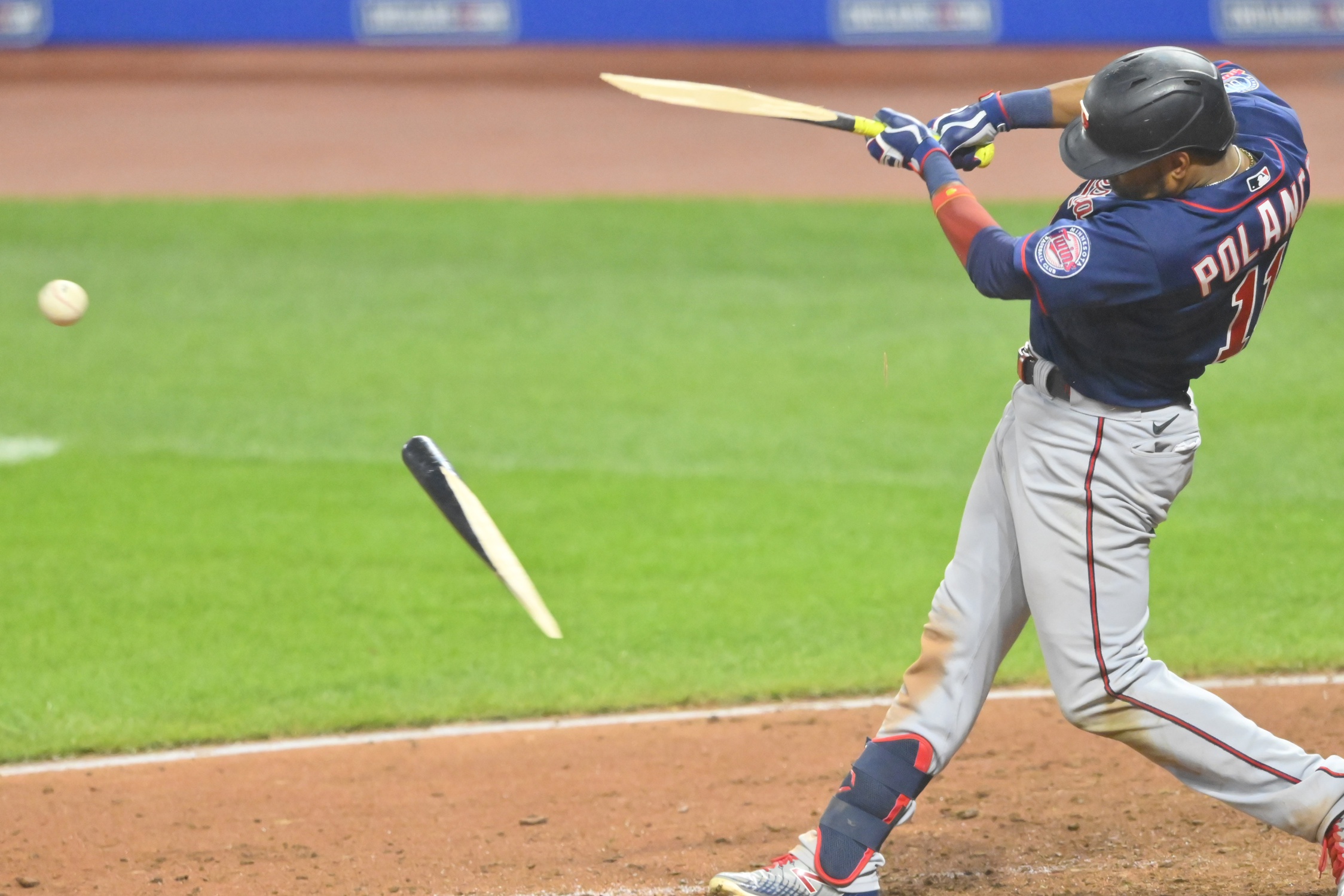 Under the terminology of MLB's Statcast system, a "Barrel" is defined as "a well-struck ball where the combination of exit velocity and launch angle generally leads to a minimum .500 batting average and 1.500 slugging percentage." In other words, it is the highest quality of contact. In 2019, the Twins led all of baseball in Barrel % at 10.1%. In 2020, they rank 21st in baseball at 6.6%. They've dropped from third to 13th in Average Exit Velocity (AEV). What is causing this drop-off in detonations for the Bomba Squad? One might surmise it is the result of injuries forcing lesser players into the lineup, and that is certainly a partial factor, but hardly the driving force. The biggest problem is that many of Minnesota's key sluggers from a year ago are hitting the ball with minimal authority, seemingly because they are sacrificing power for contact. The prime example is Jorge Polanco. He's been one of the toughest hitters in the majors to strike out, ranking in the 97th percentile for both K-rate and whiff rate. But his Barrel % and AEV are both in the 7th percentile. His Hard Hit % is in the 5th. Last year, Polanco piled up 69 extra-base hits and slugged .485. This year he's at eight and .388. He has improved his zone coverage and is making more contact, but there's little evidence that he's benefiting from it. Next up: Max Kepler, who often accompanies Polanco at the top of the lineup. Kepler too has been tough to fan this year – he's in the 89th percentile for whiff rate and 72nd for K-rate. But he too has lost some punch. His Barrel % is below average (48th percentile) and his AEV (36th percentile) and Hard Hit % (30th percentile) are around the bottom third of all hitters. Last year he was solidly above-average in all three categories. Even Eddie Rosario, who sometimes reflects the embodiment of a "grip it and rip it" approach, has really come to profile as more of a slap hitter. He's been very tough to strike out (87th percentile for K-rate) and doesn't have much swing-and-miss in his game (71st percentile for whiff rate) ... but every Statcast measure rates his quality of contact as low. He's 24th percentile in Barrel % and around the bottom third for AEV and Hard Hit %. His xwOBA, xBA, xSLG ... all well below average. Finally it's worth mentioning Luis Arráez. His profile this year is more typical and expected, but it's worth calling out the stark contrast: 95th/99th percentiles for strikeouts and whiffs, 22nd/4th percentiles AEV/Hard Hit %. Whereas Miguel Sanó and Nelson Cruz are both swinging out of their shoes, striking out frequently but plastering the ball upon contact, nearly every other Twins player falls starkly on the other side of the spectrum. The result, as we're seeing, is an offense that has not been particularly threatening or intimidating on whole. Many fans have wondered whether the change in hitting coaches may be a contributor to the team's offensive drop-off. The answer, based on these insights: maybe. James Rowson seemed to be a champion of the aggressive approach that spurred the lineup's success last year, but that's not to say Edgar Varela isn't. One way or another, several Twins hitters could benefit from taking a page from Cruz and Sanó – often the lineup's only productive players of late – and sacrificing some contact for power. MORE FROM TWINS DAILY — Latest Twins coverage from our writers — Recent Twins discussion in our forums — Follow Twins Daily via Twitter, Facebook or email
 -
An ugly week on the road knocked the Minnesota Twins out of their customary perch atop the division while fueling concerns around the team's ability to rise to the occasion here in this abbreviated campaign. Let's sort it all out as the trade deadline bears down and a key series against first-place Chicago looms. Weekly Snapshot: Mon, 8/24 through Sun, 8/30 *** Record Last Week: 1-5 (Overall: 20-15) Run Differential Last Week: -13 (Overall: +27) Standing: 3rd Place in AL Central (1.5 GB) Bomba Counter: 47 (Pace: 81) This 2020 season has been shortened and repeatedly shaken by events taking place outside of the baseball world. Last week became another example, with the Twins joining several other major-league teams in choosing to postpone a game in protest of the nation's enduring social injustice issues. I think our Friday post from RandBalls Stu succinctly and powerfully summarized the significance and palpable takeaway behind a statement such as this. Interestingly, the White Sox have been tied to both those pitchers, as well as Cleveland's Mike Clevinger, who appears somewhat likely to move tomorrow. That would qualify as good news in a sense, as the Indians would be losing a key weapon for any potential postseason match-up, but of course, adding Clevinger to a Sox rotation already fronted by Lucas Giolito would make Minnesota's other chief division rival all the more dangerous. Whether or not they make a trade for a starting pitcher, the Twins will get some rotation help in the coming week with Michael Pineda's suspension reaching an end. He's scheduled to make his season debut on Tuesday against Dallas Keuchel and the White Sox. LOOKING AHEAD The Twins return home with their tails between their legs, but on the bright side, they are 12-3 at Target Field this year. They'll have their work cut out for them in the first half of the week. Coming off a dominant no-hitter in his last outing, Giolito will toe the rubber in Monday's series opener as Hill tries to build upon his solid results from the past week. Pineda's return on Tuesday will be key, both for Minnesota's chances of winning the series and their outlook for the rest of the season and playoffs. If the Clevinger-to-Chicago rumors come to fruition, we could very well be looking at a second matchup between Jose Berríos and Mr. Sunshine within a week's time on Wednesday. A four-game set against Detroit at Target Field next weekend (with the Tigers lining up as "home team" in Friday's nightcap) will offer the Twins a chance for some much-needed redemption. MONDAY, 8/31: WHITE SOX @ TWINS – RHP Lucas Giolito v. LHP Rich Hill TUESDAY, 9/1: WHITE SOX @ TWINS – LHP Dallas Keuchel v. RHP Michael Pineda WEDNESDAY, 9/2: WHITE SOX @ TWINS – RHP Reynaldo Lopez v. RHP Jose Berrios FRIDAY, 9/4 (G1): TIGERS @ TWINS – LHP Matthew Boyd v. RHP Randy Dobnak FRIDAY, 9/4 (G2): TIGERS @ TWINS – TBD v. LHP Tarik Skubal SATURDAY, 9/5: TIGERS @ TWINS – RHP Casey Mize v. RHP Kenta Maeda SUNDAY, 9/6: TIGERS @ TWINS – RHP Spencer Turnbull v. LHP Rich Hill Catch Up On Twins Daily Game Recaps Game 30 | MIN 3, CLE 2: Bullpen Bends, Does Not BreakGame 31 | CLE 4, MIN 2: Cleveland CounterpunchGame 32 | CLE 6, MIN 3: Cleveland Gets To Romo, Takes SeriesGame 34 | DET 8, MIN 2Game 35 | DET 4, MIN, 2Game 36 | DET 3, MIN 2: This Is Not What You WantMORE FROM TWINS DAILY — Latest Twins coverage from our writers — Recent Twins discussion in our forums — Follow Twins Daily via Twitter, Facebook or email Click here to view the article
