


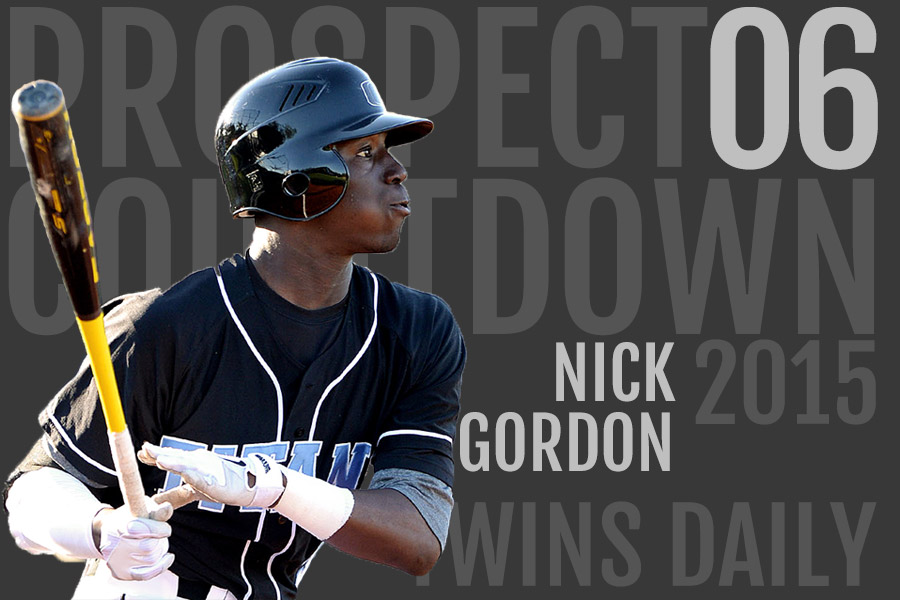
Twins Video
Age: 19 (DOB: 10/24/1995)
2014 Stats (Elizabethton): .294/.333/.366 (.699) with 6-2B, 4-3B, 1-HR
ETA: 2018
2014 Ranking: N/A
What’s To Like
Baseball America anointed Gordon the Appalachian League’s number two prospect, citing his natural instincts, first-step quickness, soft hands in the field, and lightning quick hands at the plate leading to a contact-oriented approach.
At short, he has displayed the tendencies of an elite defender with a rocket arm (he hit 94 mph with his fastball during a Perfect Game showcase in high school) which increases his range potential. The trick has been instilling in Gordon the idea that he can take his time, avoiding rushing his throws across the diamond -- which reportedly happened on several occasions this season -- but truly a lesson all shortstops must learn as they adapt to the faster game.
Considering it was his first year of professional baseball where he was two years younger than the league’s average, his .294/.333/.366 slash line in 255 plate appearances was solid. In all, he was fourth in hits (69), second in runs scored (46), tied for third in triples (4), and tenth in stolen bases (11). Gordon’s season ended with the E-Twins in the playoffs and his left hand in a cast after suffering a broken finger against the Johnson City Cardinals in the postseason. Despite ending the year sidelined, the Twins are excited about his future.
“With the maturity and skill level we saw from him in high school, we thought he’d be able to compete at that level and handle any adversity,” Twins Minor League Director Brad Steil told Twins Daily’s Seth Stohs on the decision to place Gordon in the advanced rookie league, “He was probably more prepared for pro ball than most high school players, having been around it most of his life because of his dad and brother.”
With major league bloodlines -- an All-Star brother, Dee, who currently plays second for the Miami Marlins and father, Tom, who pitched for 21 years in the majors as a three-time All-Star -- the Twins know that he has the genetics to complement his personal drive to reach and excel at the major league level.
“You value the gene,” said Mike Radcliff, the Twins’ Vice President of Player Personnel, last July. “When you come from a major league gene, that’s what it is all about. There’s a great value at the beginning of their careers and a feeling that they won’t be overmatched.”
What’s Left To Work On
Like any raw but talented prospect, Gordon has areas of his game that need improvement.
Despite having all of the natural talent to play shortstop, Radcliff pointed out that as he ascends in the system the Twins want to see Gordon smooth out his footwork and pivot at second base, necessary components of middle infield success . Offensively, while he demonstrated an excellent ability to garner hits, Gordon’s plate discipline was lacking. He struck out in 18% of his plate appearances -- a decent rate compared to the league’s average -- but walked in just 4%, making him one of the league’s least frequent walkers. Improvement in that area would help buoy his on-base percentage and put him on the bases more in order to take advantage of his speed.
While his pre-draft profile suggested he would provide power, ultimately the left-handed hitting Gordon’s swing stays inside the ball more which has made his spray chart look strikingly similar to that of Joe Mauer: ground balls to second and balls in the air to left. This distribution is not an optimal way to generate power. Admittedly Gordon is not exactly built like a brick blankhouse but adding weight has been a goal for him this offseason. The Twins stressed that they want to see him add to his “man muscles” which, in theory, should help him generate more power. For his part, Gordon has spent the offseason attempting to hasten that process. “I’ve just been working out, trying to put on some weight, and stay fast,” Gordon told Stohs in January. “Stay to my game. I’m loving the process.”
What's Next
Nick Gordon is gifted in ways that should make normal players envious but he still needs seasoning.
It is hard not to be enamored of his work in the field. Dinged for eight errors -- a faulty stat on many levels -- his E-6 totals pale in comparison to seasons of past Elizabethton shortstops like Brian Dozier (14), James Beresford (23) or Trevor Plouffe (16).
Will his patience at the plate increase? If you listen to Oakland’s GM Billy Beane, probably not wholesale. “It can be taught, but we’d have to take guys in diapers to do it,” the A’s general manager remarked in Michael Lewis’ book Moneyball. And Gordon acknowledges his aggressive approach which has led to a near .300 batting average. And what about his power numbers? Radcliff believes the extra bases will come as he matures and continues to fill out his frame.
The Twins will likely move him to Class-A Cedar Rapids where he can hone his defensive skills and make adjustments at the plate. If he is able to damage that league both with his glove and bat, a stop in Fort Myers is likely not out of the question.
TD Top Prospect #10: Nick Burdi
TD Top Prospect #9: Trevor May
TD Top Prospect #8: Eddie Rosario
TD Top Prospect #7: Jorge Polanco
TD Top Prospect #6: Nick Gordon
TD Top Prospect #5:
TD Top Prospect #4:
TD Top Prospect #3:
TD Top Prospect #2:
TD Top Prospect #1:
Which team do you dislike the most in the AL Central?
Interested in learning more about the Minnesota Twins' top prospects? Check out our comprehensive top prospects list that includes up-to-date stats, articles and videos about every prospect, scouting reports, and more!
View Twins Top Prospects



Recommended Comments
Create an account or sign in to comment
You need to be a member in order to leave a comment
Create an account
Sign up for a new account in our community. It's easy!
Register a new accountSign in
Already have an account? Sign in here.
Sign In Now