


Twins Video
It would be natural to assume a strong correlation between the strength of an outfielder's arm and the advance attempt rate against that defender. That is to say, we might assume that the stronger the outfield arm, the more conservative baserunners will be. However, while that might prove mostly true, Matt Wallner and Manuel Margot are counterexamples, reminding us that there is more to throwing runners out than having a Howitzer.
As Wallner looks to be the heir apparent to Max Kepler in right field, I felt it would be worthwhile to look at what might be the reason for this discrepancy. Naturally, my first thought was to consider the accuracy of his throws.
Arm Accuracy
This isn't quantified publicly (yet), so I put on my amateur scouting goggles, watched a few dozen plays, and found nine where Wallner was attempting to throw out an advancing base runner. Of those nine, I determined that six of those were inaccurate throws. That's not to say that the runner would have been out had the throw been better, but it is to say that Wallner made a legitimate attempt to throw out a runner and the throw was off-line. Maybe I was too harsh, but even if the throw was simply on the wrong side of the bag (like this one), I deemed it inaccurate. To be fair, I don’t have a good idea of what percentage of outfield throws are accurate, but my gut tells me that it’s better than 33.3% for some of the best arms in the game.
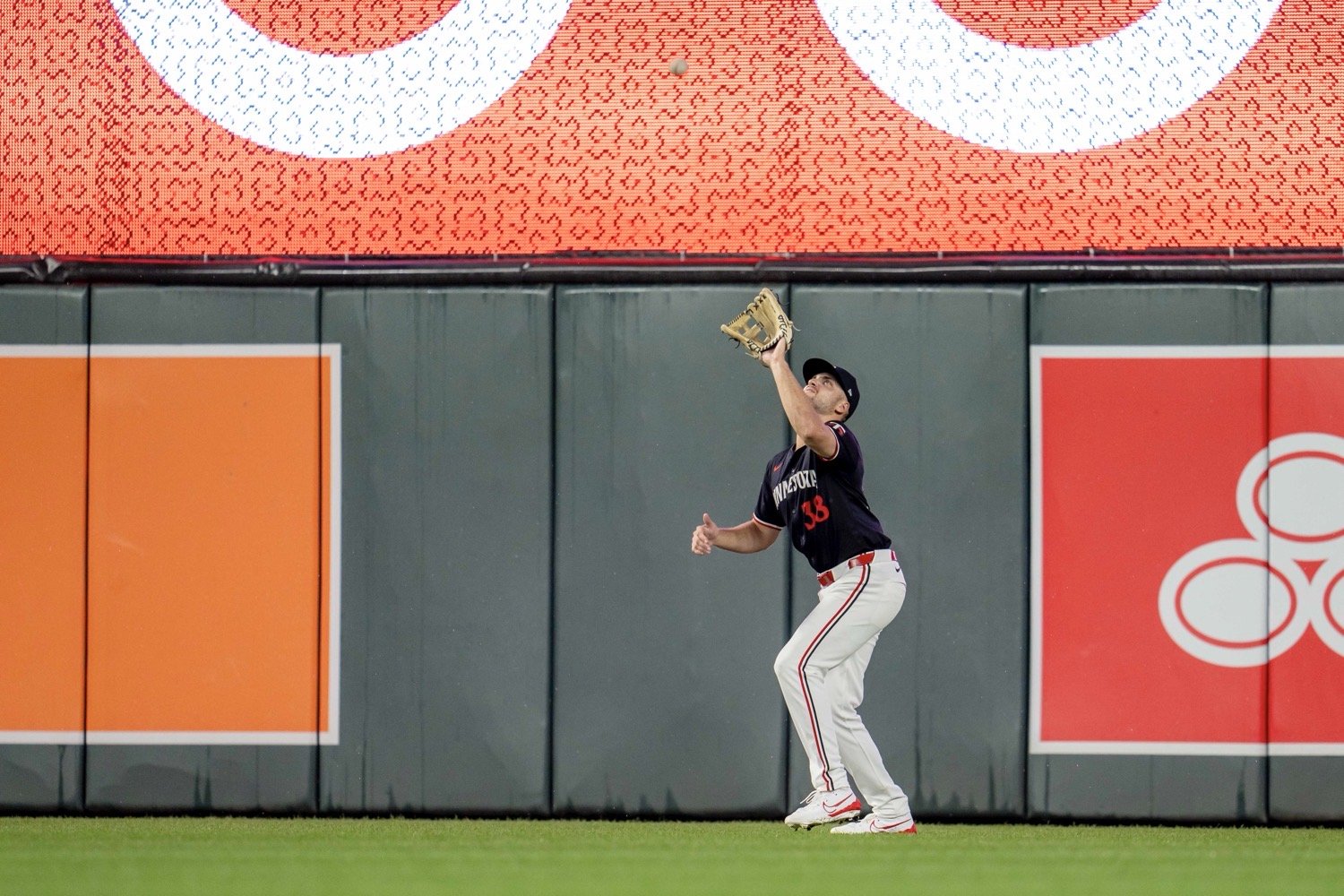
Regardless, this subjective analysis alone wasn’t enough to make a strong conclusion on why runners are particularly aggressive against Wallner. One thing that did stand out as I was reviewing all the videos was the number of times Wallner was close to catching a ball hit over his head but just missed, like in the highlight below. This led me to another important aspect of throwing as a fielder, which is how you approach the ball.
Approach
While I initially noticed this when reviewing videos for arm accuracy, the way he approaches a ball is something Baseball Savant has quantified. First, I looked at his starting position relative to the rest of the league, in case he’s positioning himself differently than most of his counterparts. Alas, on average right fielders positioned themselves 295 feet away from home plate, while Wallner averaged 293. That’s pretty negligible. Then, I moved on to what happens after the ball is hit. That’s when things started to make more sense.
Wallner’s Outs Above Average (OAA) was -3 in 2024, and he covered nearly four fewer feet on batted balls than did the average right fielder, which put him tied for last with Yordan Alvarez. Digging a little deeper, Baseball Savant breaks apart an outfielder's jump into three areas: reaction, burst, and route. What you find is that, while Wallner’s routes are considered a strength, his reaction and burst times are considerably below average (his data point is directly to the left of the brim of his hat in the picture below).

Not only does this impact his ability to catch baseballs, but it impacts his ability to approach the ball in a way that is going to set him up for a good throw. In fact, more often than not, the most direct route to a baseball (remember, that’s his strength as a fielder) is not the best way to approach a baseball to set yourself up for a throw. Instead, you often want to take an indirect route so your momentum is bringing you toward your intended target before you field the ball. A good example of this is shown in the highlight below, where Willi Castro sets himself up (7-8 second mark) to throw out one of the fastest players in baseball.
While Wallner’s top-end speed is fine (55th percentile), his five-foot running splits further support what may be the underlying reason why runners are willing to test his arm. Given his size, it takes him longer to get going, which inherently impacts his reaction and burst times. This has a chain effect on his overall approach to the ball, which then mitigates his ability to consistently take advantage of the 97 mile-per-hour velocity he averages on his throws. Whether this is an area of his game Wallner can improve remains to be seen, but it at least provides us with a theory as to why runners tend to be so aggressive, despite his arm.
Do you approve of the job Derek Shelton is doing as Twins manager?

Follow Twins Daily For Minnesota Twins News & Analysis



- lake_guy, nclahammer, Doctor Gast and 6 others
-
 9
9



Recommended Comments
Create an account or sign in to comment
You need to be a member in order to leave a comment
Create an account
Sign up for a new account in our community. It's easy!
Register a new accountSign in
Already have an account? Sign in here.
Sign In Now