


Twins Video
Baseball has never been more paranoid about pitch tipping.
The technology available to teams has made it easier than ever to identify the subtle movements that can give away what is coming. High-speed cameras can isolate a pitcher's tendencies down to the smallest details, while markerless biomechanical systems can uncover movements that might have gone unnoticed a generation ago. Then there are the dugouts themselves, now filled with more coaches, analysts and information than ever before. Somewhere among them is usually a person with what amounts to a master's degree in sniffing out anything that might help identify a pitch.
One of the biggest areas of concern has historically come when a pitcher has runners on base and has to work from the stretch.
For decades, pitchers would come set with their hands in front of, but somewhat away from, their bodies. That created opportunities for hitters to pick up on subtle tells. A glimpse of the throwing hand dipping below the glove could provide an indication of what was coming. More palm might be visible on a fastball, while a breaking ball could cause the hand to turn slightly. A changeup, with its wider grip, might cause a pitcher to flare his glove. Certain pitches might be held higher in the glove than others.
None of these tells necessarily had to be obvious but the game’s top hitters pick up on patterns quickly.
In the past, identifying those tendencies meant a player or coach had to notice them, remember them, and then pass the information along through the scouting process. Now, the combination of technology and video has accelerated that process considerably. Something discovered during a previous series can make its way into a pregame hitter's meeting almost immediately.
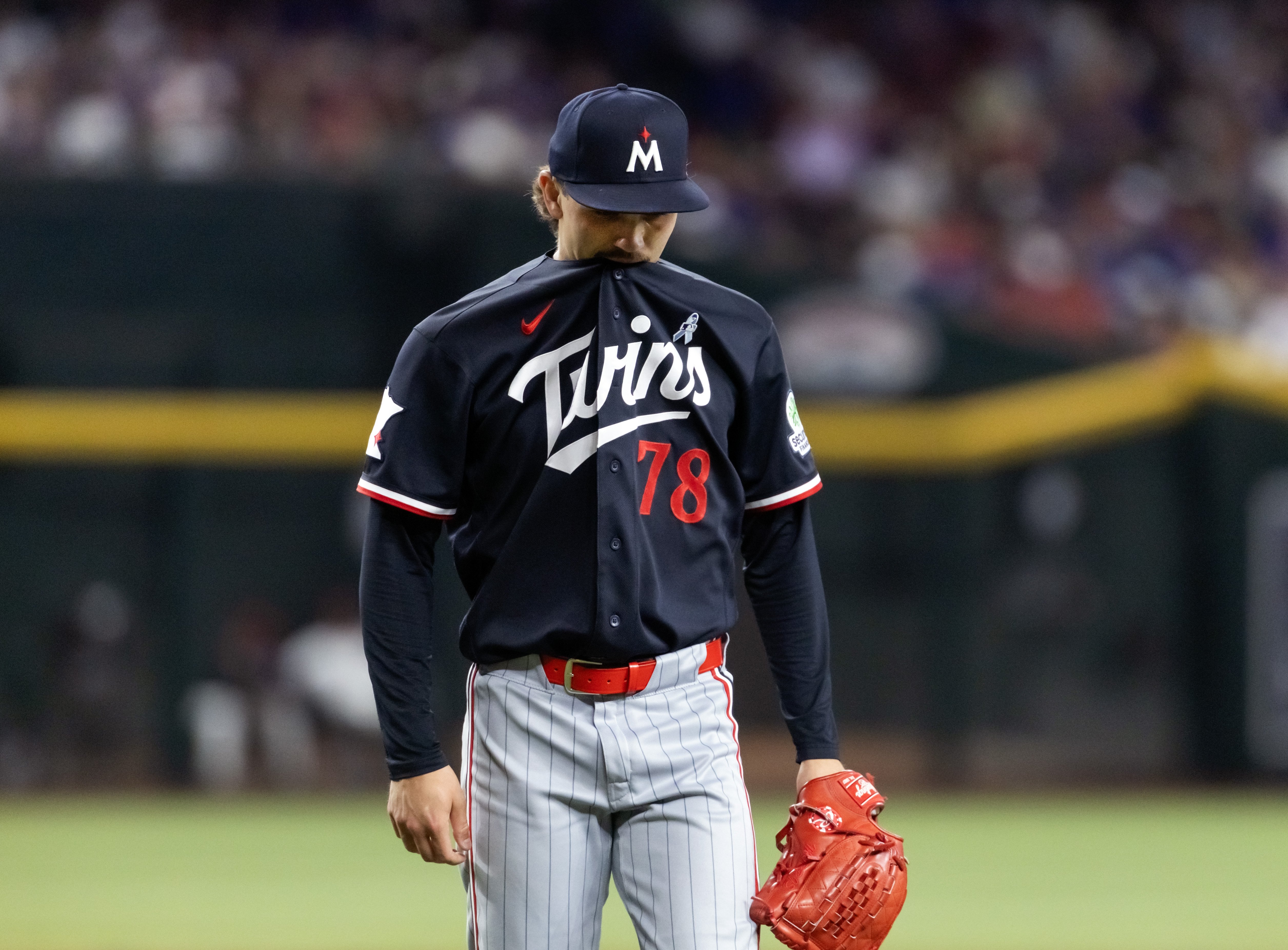
For their part, the Twins have taken steps to eliminate some of those variables for their own pitchers. The most notable is the organizational practice of having pitchers cup their gloves around their midsection when working from the stretch. The idea is simple: hide the grip and eliminate as much visual information as possible before the pitch is delivered.
When Andrew Morris was first summoned to the big leagues, he set his hands around his belt, a fairly traditional position for a pitcher working from the stretch. That was quickly adjusted after his first career outing, with Morris instructed to keep his glove as tight to his midsection as possible.

It's a practice the Twins have also used with Mick Abel and even Pablo López in recent history. But all of that camouflage only addresses the things a pitcher can control with his hands and body. Pitchers are still human, and humans have habits. Sometimes those habits have nothing to do with the pitching motion itself.
A pitcher chewing gum on one type of pitch but not another can be enough. Morris found that out the hard way toward the end of 2025.
“I would stop chewing it on offspeed pitches, and I continued to chew it on fastballs,” Morris told the Star Tribune after giving up 10 runs in two outings against the Iowa Cubs early in 2025. “I really just had no idea what was going on. They were just on everything for a couple starts. I know those are some conscious things I do with my mouth, so that’s tough. It’s not anything, like, physical. It was weird. It was tough.”
Morris had actually started chewing gum because he believed he had previously been giving away pitches with his tongue. The gum was supposed to give him something else to occupy himself with but became another tell. That history makes what has happened to Morris in August worth watching.
For most of the season, Morris had been one of the Twins' most reliable late-inning weapons. In June and July, he made 25 appearances, going 3-0 with two saves and 10 holds while posting a 2.22 ERA and 2.77 FIP. He struck out 31 hitters in 28⅓ innings and, at least arguably, became the strongest bridge the Twins had to get from the middle innings to the back end of the bullpen.
August has been a different story. It’s one of blown leads and losses. It’s an inflated walk rate with an over 7.00 ERA to boot (and if it weren’t for a catcher’s interference call in San Diego, it could be substantially worse). Relief pitchers can be fickle and small sample sizes can skew things quickly, but there seems to be more at play with Morris.
Let’s go back to his outing in San Diego. Morris was called upon to protect a 5-2 lead against a surging Padres offense. He retired Xander Bogaerts on a ground ball, and then Freddy Fermin reached first after catcher Ryan Jeffers was charged with interference.
From there, the floodgates opened: The next four Padres reached base, and the Twins' 5-2 lead became a 6-5 deficit.
To be clear, Fermin reaching base was not Morris' fault. Neither was Kaelen Culpepper attempting to cut down the runner at third with one out. Baseball is full of sequences where several independent events snowball into one ugly inning.
What makes this particular inning interesting is how some of the Padres' swings looked.
Take Fernando Tatis Jr. going the other way on a 1-2 elevated fastball:
Or Jake Cronenworth waiting on a 0-0 fastball at the top of the zone and slicing it into the gap for a two-run double:
After Tatis scores, the broadcast shows him running toward the next hitter and communicating something.
What that something was is impossible to know from the television broadcast. It could have been as simple as relaying information about the shape of Morris's fastball or offering a reminder to stay back and stay on top of the elevated pitch. It could have been something from the scouting report, perhaps a tendency involving Morris's gum chewing or another physical tell. Or it could have been nothing particularly meaningful at all. That distinction matters.
Manny Machado came to the plate next and did not see a single fastball. He saw four consecutive cutters, eventually grounding one to Culpepper at shortstop. Then Ty France followed and produced another swing that looked similar to what Tatis and Cronenworth had done earlier in the inning:
A similar thing showed up in the series against the geographically abandoned Athletics, when savvy veteran Jeff McNeil turned on a first-pitch fastball and lasered a double down the line.
Similar to the Padres outing, Morris's work was undone a bit by below average defense. Still, at this point, it is reasonable to wonder whether what we're seeing is some combination of scouting and tipping.
From the center-field camera angle, there is nothing particularly obvious about Morris's delivery that screams THIS PITCH IS COMING. His glove is tucked against his body, and the Twins have seemingly done what they can to eliminate the traditional visual tells that can accompany working from the stretch.
Of course, hitters aren't standing in center field. They're standing 60 feet, six inches away, looking directly at him. There may be some tiny movement, tick or habit visible from the batter's box that isn't apparent from the broadcast angle. Maybe it's the gum. Maybe it's tongue placement. Maybe it's something completely unrelated to the pitching motion that teams have picked up through their preparation.
Then again, there is another explanation that may be considerably less interesting.
Morris' pitch selection has been reduced to mostly hard stuff this month. He's throwing four-seamers, sinkers and cutters, with very little in the way of a true change of pace. In fact, over his last four outings, he's thrown just one changeup, which put him ahead of Tatis 0-2 after a pretty silly swing.

If opposing hitters have reached the conclusion that Morris is going to challenge them with hard stuff, they don't necessarily need a tell. They can just wait. And that could explain some of the swings we've seen recently, particularly the ones that appear geared toward staying on top of elevated fastballs. If hitters know a four-seam fastball or cutter is coming and expect it to be at the top of the zone, they can adjust their approach accordingly.
That is where the distinction between pitch tipping and scouting becomes important. A hitter doesn't need to know exactly what pitch is coming to have an advantage. Sometimes knowing what a pitcher likes to throw in a particular situation is enough.
For Morris, the answer may be somewhere in between. He has the stuff to operate as a power arm in the bullpen, and three different fastballs can be enough to get through an inning when they're executed properly. But if hitters have started sitting on those pitches, whether because of scouting, tendencies or an actual tell, Morris needs another answer. That could mean bringing the changeup back into the mix more frequently, incorporating his sweeper or curveball, or changing the sequencing enough to keep hitters from becoming comfortable sitting on one part of his arsenal.
The Twins have already shown how seriously they take pitch tipping. They've changed where their pitchers hold their gloves, adjusted Morris' setup and, in the past, dealt with a pitcher whose gum chewing was inadvertently telling hitters what was coming.
The technology can find the tells. The scouting department can find the tendencies. And sometimes, all it takes is one hitter seeing something and walking down the dugout steps to tell the next guy. Whether that is happening with Morris right now is impossible to say from the outside.
But given what happened in San Diego, and what we've seen from hitters since, it is at least worth watching.









Recommended Comments
Create an account or sign in to comment
You need to be a member in order to leave a comment
Create an account
Sign up for a new account in our community. It's easy!
Register a new accountSign in
Already have an account? Sign in here.
Sign In Now