
Jump to content
Twins Daily
  • Create Account
  • Twins News & Analysis

    The Wright Fit?


    Nick Nelson

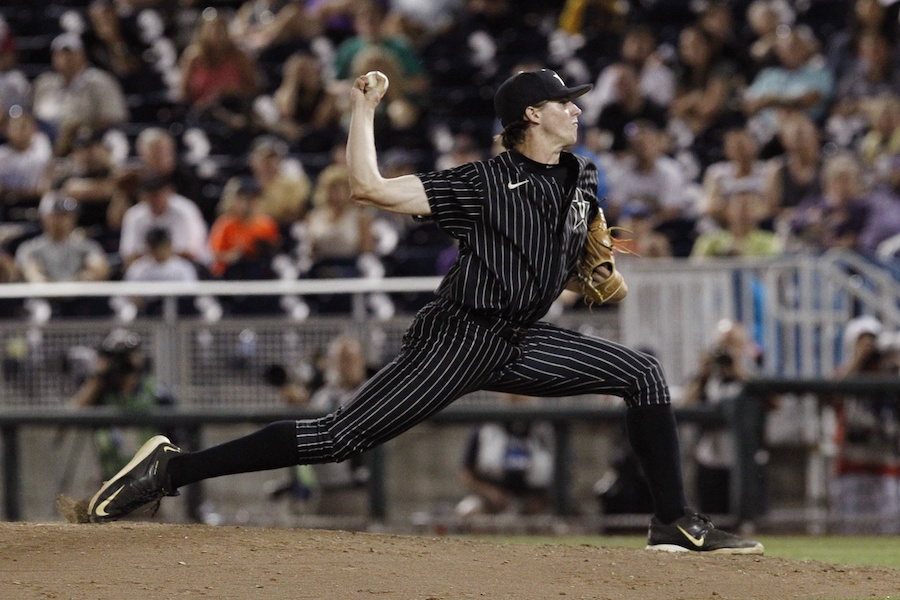
    The Minnesota Twins will select first in the MLB Draft next Monday, and right now, signs point to them choosing Vanderbilt right-hander Kyle Wright.

    You'll be able to read an in-depth profile of Wright here from draft guru Jeremy Nygaard on Thursday, but for today let's jump forward and contemplate how the collegiate ace would fit in for a rebuilding Twins franchise.

    Image courtesy of Bruce Thorson, USA Today

    Twins Video

    Obviously anything can change in the next week, but right now all indications point to Minnesota passing on heralded prep phenom Hunter Greene at No. 1 overall. Derek Falvey and Thad Levine have undoubtedly received countless glowing scouting reports, and seen his unique greatness on display in person, but ultimately it appears the upside/risk balance is too heavily skewed for a pick that could well define their tenure.

    That leaves college stars Wright and Brendan McKay as the remaining members of the consensus top three. Everything I'm hearing leads me to believe the Twins are leaning away from McKay, a two-way threat with some questions on both sides.

    Wright is who Baseball America has the Twins taking in their latest mock. Ditto Keith Law of ESPN. And our guy Jeremy. The signs are pretty clear. The Twins have been all over the 6-foot-4 righty for many months and have watched him hit his stride leading up to the draft, including a nine-strikeout performance against Clemson in the NCAA Tournament on Saturday that saw him touching 95-96 MPH as late as the sixth inning.

    Wright is a big-time talent, and as a more defined commodity than Greene or McKay, he carries less relative risk.

    There is also this: If the Twins feel they are currently at the front end of their rebuild coming to fruition, Wright fits rather nicely into the timeline they have going.

    Jose Berrios has arrived, and shows no signs of wanting to go back. Adalberto Mejia is flashing very positive signs. Minnesota has the beginnings of a young stable to move forward with, but obviously they'll need plenty more.

    The organization's top two prospects are not far away. Fernando Romero is coming on at Chattanooga following an inconsistent start. He has allowed two earned runs with a 20-to-5 K/BB ratio in 19 innings over his past three turns. Meanwhile, Stephen Gonsalves has joined him in the Lookouts rotation after shoulder issues cost him the first six weeks. He lowered his ERA to 2.45 with five shutout frames in his fourth start Monday.

    Romero and Gonsalves both are 22. Wright, as a 21-year-old college product, would probably head straight to Single-A upon signing. If things play out the right way he could be reaching the majors very shortly after they do, if not simultaneously.

    For some context, here's what the timeline looks like if you get it right with a collegiate ace at the No. 1 pick:

    In June 6th, 2011, the Pirates took Gerrit Cole (UCLA) first overall. His major-league debut came two years and five days later, on June 11th, 2013. He was immediately very good.

    On June 9th, 2009, the Nationals took Stephen Strasburg (SDSU) first overall. His major-league debut came 364 days later, on June 8th, 2010. He was immediately very good.

    On June 7th, 2007, the Rays took David Price (Vanderbilt, just like Wright) first overall. His major-league debut came in September of 2008. He was – yep – immediately very good.

    Now, obviously, these are lofty examples but Wright is an advanced arm with all of the attributes you're looking for. If the Twins feel he has a shot to follow that precedent and rocket to the big leagues, it would be quite favorable in the scope of their big-picture contention efforts.

    Is he that guy? You can draw your own conclusions when Jeremy gives you the full breakdown later this week. In the meantime, check out the rest of our latest coverage previewing Minnesota's top pick next Monday:

    Jeremy's 10 Round Twins Mock

    Draft Profile: Brendan McKay, SP/1B by Cody Christie

    Draft Profile: Royce Lewis, SS/OF by Nick Nelson

    Draft Profile: Pavin Smith, 1B by Tom Froemming
    Follow Twins Daily For Minnesota Twins News & Analysis

    Recent Twins Articles

    Recent Twins Videos

    Twins Top Prospects

    Kendry Rojas

    St. Paul Saints - AAA, LHP
    Reports indicate that Kendry Rojas will be called up to the Twins on Tuesday. The 23-year-old has pitched twice for the Saints this year.

    User Feedback

    Recommended Comments


    Featured Comments


    Rodon and Gausman are about comparable too from a stats standpoint.


    Based on that I think a range of outcomes for Wright would be, Appel/Gausman at the low end with Cole / Rodon as the ceiling.


    Would Twins fans be  happy with that?


    Why would those guys be his ceiling? Or Gausman his floor for that matter? The range of possibilities stretches far above and below those guys.


    Appel, yes, that could be considered a floor. I'm ready to write him off as a complete bust. And I did want him over Buxton at the time.


    It seems likely me Strasburg, Price and maybe Cole were much clearer number 1 picks. How does the scouting on Wright compare to those three? Appel, Hochevar and Burlington were also college pitchers picked first overall recently. How does Wright compare to that trio?


    The two once in a decade arms of the last 20 years were Strasburg and Prior. Both were aces in the major league quickly.


    Your second tier group is probably something akin to Price, Jared Weaver, and Andrew Miller. All of them got to the majors quickly. But none were instant aces.


    Your next tier of guys were a bunch who brought mid-90s stuff consistently, but didn't have the command or secondary. Your Gerrit Coles and Mark Appels fit here. 


    Bullington was a reach pick in a year where there was no clear number one.


    Wright seems to me to be low-to-mid 90s with some sink and decent command but not-so-great secondary pitches. If you want a blind comp that makes some sense, Kyle Gibson? Jeff Weaver? 


    Greene may or may not be the pick. But calling Wright the safe pick doesn't really do justice to the risk involved in it.


    If the Twins brass is using the logic that Wright is the draft prospect that Strasburg, Price or (to a lesser extent) Cole were, I really fear for this franchise. 


    Those players aren't available in this draft, so I'm not sure what your point is here. No one thinks Wright = Strasburg or Price.


    Wright has been effective throughout his college career . . . his track record, stuff, and approach are good across the board. I don't agree that his secondary stuff is mediocre.

    Longenhagen's take on Wright

    Kyle Wright

    Wright has an impeccable pitcher's frame and his stuff's consistency has improved as the spring has worn on. He sits 92-94 with his fastball but will bump 97 with life, he has a plus, low-80s curveball with two plane movement and a mid-80s slider that is effective when well-located.


    The Red's version of Nick Nelson had this to say

    Physically, Kyle Wright has everything you want from a starting pitcher. He’s 6′ 4″ and 220 lbs. His mechanics are clean. He’s shown the ability to absolutely dominate high level college baseball. There haven’t been any health concerns during his time in college. The stuff is unquestionable, with four potential plus offerings depending on where you look, but it seems everywhere gives him a chance for at least three above-average pitches and a fourth average one.

    When you are drafting at the top of the draft, Kyle Wright is exactly the kind of player you want to look for. There’s superstar potential there. He’s going to be relatively close to the Major Leagues as a college pitcher coming out of the SEC. The concern, if there is any, is what happened to start the 2017 season and the inconsistency he showed at time time. With that said, the run he’s been on over the last five weeks shows he’s capable of rebounding and self-correcting (I’m sure with the help of his coaches, too). While I’m not entirely through all of my draft research, as things sit right now, Kyle Wright would be at the top of my draft board if I had to make one.

    Couple of things I'm scared of:


    1). They pick Wright because he has the quickest path the majors....on a team fresh off 3 of 4 seasons with nearly 100 losses.


    2). They pick Wright, a RH college guy, because they're scared of picking a RH high school, Greene, a guy with more arm talent (plus the glove and bat).


    Both are highly irrational, IMO.


    Really worried they're going to miss out on a generational player in 5 years (Greene) to be safe with an OK player in any generation (Wright).


    Also worried that they pick the guy closest the majors because they feel the pressure to succeed early.


    All I know for sure is that I'm not making millions to make this decision...thus not making me open to criticism for making the "wrong" decision. It's about GD time someone in the Twins front office (milking tax dollars for nearly a decade now) make the right one.


    Found it: http://www.baseballamerica.com/college/kyle-wright-gets-measure-redemption-beating-clemson/#vrFI202jJC1UIY0m.97

    "While Saturday night marked redemption for last year’s regional, it also was a redemptive statement in the context of Wright’s season. The junior righthander struggled early this spring, in his draft year, and saw his stock slip as his command eluded him. He simply couldn’t put the ball where he wanted to. His stuff was the same; he was throwing just as hard, but he couldn’t hit the mitt. He knew something had to change.

    On Monday, April 10, he found that something. At practice that day, coming off a series win at South Carolina, pitching coach Scott Brown and teammate Matt Ruppenthal picked up on an anomaly in Wright’s delivery.

    “I was turning my hips too fast, which was leaving my arm behind,” Wright said, “I was never really on time, which kind of led to some struggles. And I just kind of slowed those down a little bit and allowed my arm to work and my body to work like it should.”

    Wright made a slight mechanical tweak, and the adjustment paid immediate dividends. In his very next start, against Florida, Wright threw a 99-pitch three-hitter. He posted a career-high 13 strikeouts and, perhaps most importantly, walked none.

    Wright’s stuff and his command were finally back in sync—and that’s meant bad news for teams down the stretch, as Wright carved through the back half of the SEC season."

    Yeah, yeah, yeah, I'm in!


    Those players aren't available in this draft, so I'm not sure what your point is here. No one thinks Wright = Strasburg or Price.


    Wright has been effective throughout his college career . . . his track record, stuff, and approach are good across the board. I don't agree that his secondary stuff is mediocre.


    My point is pretty simple. Calling Wright "safe" because Strasburg and Price were safe as the original article infers is like saying Royce Lewis is safe simply because Derek Jeter ended up in the Hall of Fame. It's not sound logic. The only thing that Wright, Price, Cole and Strasburg have in common is that they're college pitchers. That doesn't make Wright a safe bet to be anything. And yes, he could very well end up an ace. He could also be the next Ryan Mills-- aka the safest college pitcher the Twins drafted in the last 20 years.


    But my biggest problem is if you have your pick of anyone and you don't grab the person you think will be the biggest star of the draft, it's a pretty telling sign about the direction of the franchise. 


    Couple of things I'm scared of:

    1). They pick Wright because he has the quickest path the majors....on a team fresh off 3 of 4 seasons with nearly 100 losses.

    2). They pick Wright, a RH college guy, because they're scared of picking a RH high school, Greene, a guy with more arm talent (plus the glove and bat).

    Both are highly irrational, IMO.

    Really worried they're going to miss out on a generational player in 5 years (Greene) to be safe with an OK player in any generation (Wright).

    Also worried that they pick the guy closest the majors because they feel the pressure to succeed early.

    All I know for sure is that I'm not making millions to make this decision...thus not making me open to criticism for making the "wrong" decision. It's about GD time someone in the Twins front office (milking tax dollars for nearly a decade now) make the right one.


    I think I'd say it more this way. If they were passing on Greene to pick a guy like Royce Lewis because they feel he's the Carlos Correra or Francisco Lindor of the draft I could buy it. But passing on Greene to take someone because he's a safe bet to be only Mike Pelfrey bad if they miss is kind of dooming a franchise to be the next Cleveland Browns.


    Why would those guys be his ceiling? Or Gausman his floor for that matter? The range of possibilities stretches far above and below those guys.

    Yes, I was trying to keep the range reasonable, based on statistical comps from the top college picks mentioned in this thread. Gausman, Rodon, Appel etc. had very similar college careers to Wright whereas David Price and Steve Strasburg didn't. Unless there's someone we're forgetting there's not a lot of college guys drafted recently who've gone on to perform at the level of a David Price after having put up Wright-type numbers in college. The one guy who I can think of would be Scherzer although his college career was weird. His junior season looks like an extreme outlier in retrospect.

    Edited by Willihammer


    I think I'd say it more this way. If they were passing on Greene to pick a guy like Royce Lewis because they feel he's the Carlos Correra or Francisco Lindor of the draft I could buy it. But passing on Greene to take someone because he's a safe bet to be only Mike Pelfrey bad if they miss is kind of dooming a franchise to be the next Cleveland Browns.


    This is just a completely false premise - there is zero chance the Twins' brass would prefer a "safe" 4th or 5th starter over a superstar . . . you are attributing a thought process to them that cannot possibly exist. 


    Really, you are just creating a strawman opposite Greene as a way of making the latter seem like the obvious choice. None of the experts covering the draft see Greene as the obvious #1 pick, even if some think he has the most upside (though even that is far from unanimous). 


    The Twins will only take someone they project as an impact player. That's the reality. Whether or not you agree with the pick means nothing in terms of what the team is hoping to accomplish.

    It seems to me that Wright is the obvious choice. While nothing is guaranteed, he fits all the criteria necessary. He has the build, the heat, the secondary offerings, the experience and track record and he's close to the majors for a team needing starting pitching with a high floor and a high ceiling. High potential and relatively "safe" at the same time. What's not to like here?


    To say he would be a mistake because 5 years from now another player could be an All Star and potential HOF performer is a bit silly to me. You could say that every draft concerning half the first players in the 1st round, or the top 10 at least. I just don't think you can properly quantify that kind of speculation.


    I think I'd say it more this way. If they were passing on Greene to pick a guy like Royce Lewis because they feel he's the Carlos Correra or Francisco Lindor of the draft I could buy it. But passing on Greene to take someone because he's a safe bet to be only Mike Pelfrey bad if they miss is kind of dooming a franchise to be the next Cleveland Browns.

    The part of the equation that you haven't included in this is what the upside gap is and the likelihood of hitting each of their upsides.
     

    Random #'s assigned

    Greene Upside = top 5 starter (Kershaw) but <10% chance. And he has a 30% chance of being an average starter


    Wright Upside = top 20 starter (Lester) and 25% chance. 60% chance of being an average starter


    I pulled those numbers out of thin air but the downside argument isn't that at worst he is Pelfrey. The downside argument is that he has a much better chance at being average or better (let's say Ervin Santana). And the upside is still really good (Lester).


    My point is pretty simple. Calling Wright "safe" because Strasburg and Price were safe as the original article infers is like saying Royce Lewis is safe simply because Derek Jeter ended up in the Hall of Fame. It's not sound logic. The only thing that Wright, Price, Cole and Strasburg have in common is that they're college pitchers. That doesn't make Wright a safe bet to be anything. And yes, he could very well end up an ace. He could also be the next Ryan Mills-- aka the safest college pitcher the Twins drafted in the last 20 years.


    But my biggest problem is if you have your pick of anyone and you don't grab the person you think will be the biggest star of the draft, it's a pretty telling sign about the direction of the franchise. 

    Ryan Mills was a long time ago.  The thought process that went into drafting a player likely to be there  with your fifth round pick should be long extinguished. You can't use the cheap label as Mills signed a draft spot appropriate contract ergo they liked what they saw as a player. The can't miss prospect in a draft of can miss players as Adam Johnson. Again, anything that went into the decision making process of Johnson is long gone.

    Edited by old nurse

    There's a difference between drafting someone who you think can be the biggest star in the draft and someone who you think will be the biggest star.


    Hunter Green CAN BE the biggest star in this draft. If he develops more movement on his fastball while retaining velocity. And if he develops two other plus pitches.


    You could make a case that Gore, Baz, and Carlson are better pitching prospects now. And they would be better prospects still if they had 3 years experience in the SEC. Of course that would make them Kyle Wright. If they were flashing 4 plus pitches.

    I have not seen Wright ranked lower than #2 on anyone's list.


    I understand seeing Greene as having the highest upside, but Wright also has significant untapped upside. He could end up with 3-4 plus pitches while also throwing mid 90s, and is working with a 2 seamer. That's a #2 with the potential to be an ace.


    He's behind Strasburg because he doesn't have the velocity or the hammer, and is not as high as Price because he's not a lefty, but he strikes me as pretty close to as good a starter prospect as we've seen in the past decade.


    You could make a case that Gore, Baz, and Carlson are better pitching prospects now. And they would be better prospects still if they had 3 years experience in the SEC. Of course that would make them Kyle Wright. If they were flashing 4 plus pitches.


    Overstating Wright's stuff is exactly where this goes off the trail. A 60 fastball plus three 50-ish secondary pitches is Kyle Gibson. And people drove me crazy for years when they said Gibson was a safe bet to be the next Roy Halladay without really understanding what Halladay was.


    As for the best pitcher in this draft, its the one who figures out a legit secondary pitch, preferably a curve or change. What Greene's velocity gives him over the average pitcher is more rope in that it can be a 60 secondary pitch as opposed to a 70 one.


    The part of the equation that you haven't included in this is what the upside gap is and the likelihood of hitting each of their upsides.
     

    Random #'s assigned

    Greene Upside = top 5 starter (Kershaw) but <10% chance. And he has a 30% chance of being an average starter


    Wright Upside = top 20 starter (Lester) and 25% chance. 60% chance of being an average starter


    I pulled those numbers out of thin air but the downside argument isn't that at worst he is Pelfrey. The downside argument is that he has a much better chance at being average or better (let's say Ervin Santana). And the upside is still really good (Lester).


    I think the bold is the flaw in this argument, and it's something everyone has been doing across draft threads for months. You can pull all the numbers out of the air you want, but there's no way for sure of knowing who books their first trip to Dr. James Andrews' office first between Greene and Wright.


    And even if you could, it would get away from what the real risk of drafting first is-- that someone else in the top 5 ends up with a superstar while you end up with a nice, little player.

    Edited by ALessKosherScott


    Overstating Wright's stuff is exactly where this goes off the trail. A 60 fastball plus three 50-ish secondary pitches is Kyle Gibson. And people drove me crazy for years when they said Gibson was a safe bet to be the next Roy Halladay without really understanding what Halladay was.


    As for the best pitcher in this draft, its the one who figures out a legit secondary pitch, preferably a curve or change. What Greene's velocity gives him over the average pitcher is more rope in that it can be a 60 secondary pitch as opposed to a 70 one.


    No one serious ever said Kyle Gibson was a "sure bet" to be Halladay, even before Gibson got hurt. He also never had 3 MLB-average off-speed pitches. If you had a legit point it wouldn't be necessary to cook up fictitious straw men.

    Edited by drivlikejehu


    Overstating Wright's stuff is exactly where this goes off the trail. A 60 fastball plus three 50-ish secondary pitches is Kyle Gibson. And people drove me crazy for years when they said Gibson was a safe bet to be the next Roy Halladay without really understanding what Halladay was.


    As for the best pitcher in this draft, its the one who figures out a legit secondary pitch, preferably a curve or change. What Greene's velocity gives him over the average pitcher is more rope in that it can be a 60 secondary pitch as opposed to a 70 one.


    Gibson does not presently and never had that arsenal. FWIW, Wright doesn't have it either, but could potentially get there, which would a great pitcher.

    Since we went down the Gibson rabbit hole, Bob Sacamento quoted this pre-draft analysis of Gibson on the MLB Draft Thread. He was advertised as having 2 above average secondary pitches along with a solid fastball. 


    For the third time in four years, Missouri will have a pitcher taken early in the first round. Gibson doesn't have the arm strength of Max Scherzer (2006, Diamondbacks) or Aaron Crow (2008, Nationals), but he may wind up being the best pitcher of the three. He relies on two-seam fastballs more than four-seamers, usually pitching at 88-91 mph with good sink and tailing action, though he can reach back for 94 mph when needed. He has two of the better secondary pitches in the draft, a crisp 82-85 mph slider and a deceptive changeup with fade that can generate swings and misses. All of his offerings play up because he has excellent command and pitchability. He repeats his smooth delivery easily, and his 6-foot-6, 208-pound frame allows him to throw on a steep downhill plane. If there's a knock on Gibson, it's that he hasn't added much velocity during his three years with the Tigers, but that hasn't stopped him from succeeding as soon as he stepped on campus. He led Team USA's college team with five wins last summer, including a victory in the gold-medal game at the the FISU World Championships. He was a lock to go in the top 10 picks before a stress fracture sidelined him just a week before the draft.


    That scouting report would put him a tier below Wright going into the draft, not even accounting the stress fracture.


    And once you get hurt all bets are off.


    The scouting report also doesn't take into account that Gibson is a guy who bumped his fastball to average 92 MPH throughout his Twins tenure.


    And I believe the old adage goes if you have three average secondary pitches in the MLB, you don't have a secondary pitch.


    That scouting report would put him a tier below Wright going into the draft, not even accounting the stress fracture.


    And once you get hurt all bets are off.

    That scouting report (2009 Kyle Gibson preDraft), puts him right there with Wright.  Comparatively for their respective drafts, Gibson was rated as having better command and control. Gibson rated as having better secondary pitches. While Wright gets the nod for velo and fastball stuff.  I know it might be Revisionist history and many of you are tainted by present day Gibson but coming out of the draft Kyle was considered a stud, then baseball happened.


    BA on Wright

    his fastball command improved to solid-average as he dialed it back a bit to 92-95 mph, and that opened the way for him to get to his plus secondary stuff. Wright's slider is a hard mid-80s pitch with late life and at times cutter shape that can be plus; his curveball, his preferred breaking ball, has plus shape and power at around 80 mph. Teams laid off the curveball early when he wasn't throwing his fastball for strikes, and he needs to land both breaking balls for strikes more consistently going forward. Some scouts prefer the slider over his curve, though Wright throws the curve more often. Wright's power changeup in the upper 80s flashes plus as well with late bottom, though he uses it fairly rarely. Wright's clean arm action, low-maintenance delivery and sturdy 6-foot-4, 220-pound frame help him maintain velocity deep into games, up to 94 mph even into the ninth inning

    Gibson might have been a stud if he hadn't had the injury problems. But reading those scouting reports I would rank Wright ahead of Gibson. One of the flags for Gibson is that there was no improvement during his time at Missouri. Gibson's fastball was a tick or two behind Wright, and the secondary pitches seem comparable, though I would prefer Wright because of the extra offering. The control/command seems to favor Gibson.


    The injury issues could certainly happen to Wright. Or Greene. Or any pitcher.

    A healthy Gibson would have gone much higher in the 2009 draft, but also been much more likely to succeed in the Majors - it makes zero sense to negatively comp Wright comp to Gibson when the Gibson from these scouting reports never existed as a professional.

    Edited by drivlikejehu


    Create an account or sign in to comment

    You need to be a member in order to leave a comment

    Create an account

    Sign up for a new account in our community. It's easy!

    Register a new account

    Sign in

    Already have an account? Sign in here.

    Sign In Now

×
×
  • Create New...