


Twins Video
In 2023, Kyle Farmer was decent. He hit for a very average .725 OPS across 369 plate appearances. He played all over the diamond, and was roughly average as a fielder. By all accounts, Farmer was incredibly well-liked in the clubhouse, and the combination of adequate performance and likability led to him remaining with the Twins this season. Having a role player who’s still essentially an average player is a luxury.
Entering last offseason, given the Twins’ payroll inflexibility, many assumed that Farmer would be a prime non-tender candidate. His projected arbitration-determined salary would consume a significant part of their budget, and could be better used elsewhere. However, the Twins either overvalued his skillset or his charisma, or overestimated his trade market. They tendered him a deal, eventually agreeing to terms outside arbitration, and at the time, even Farmer expressed surprise at his situation for the year.
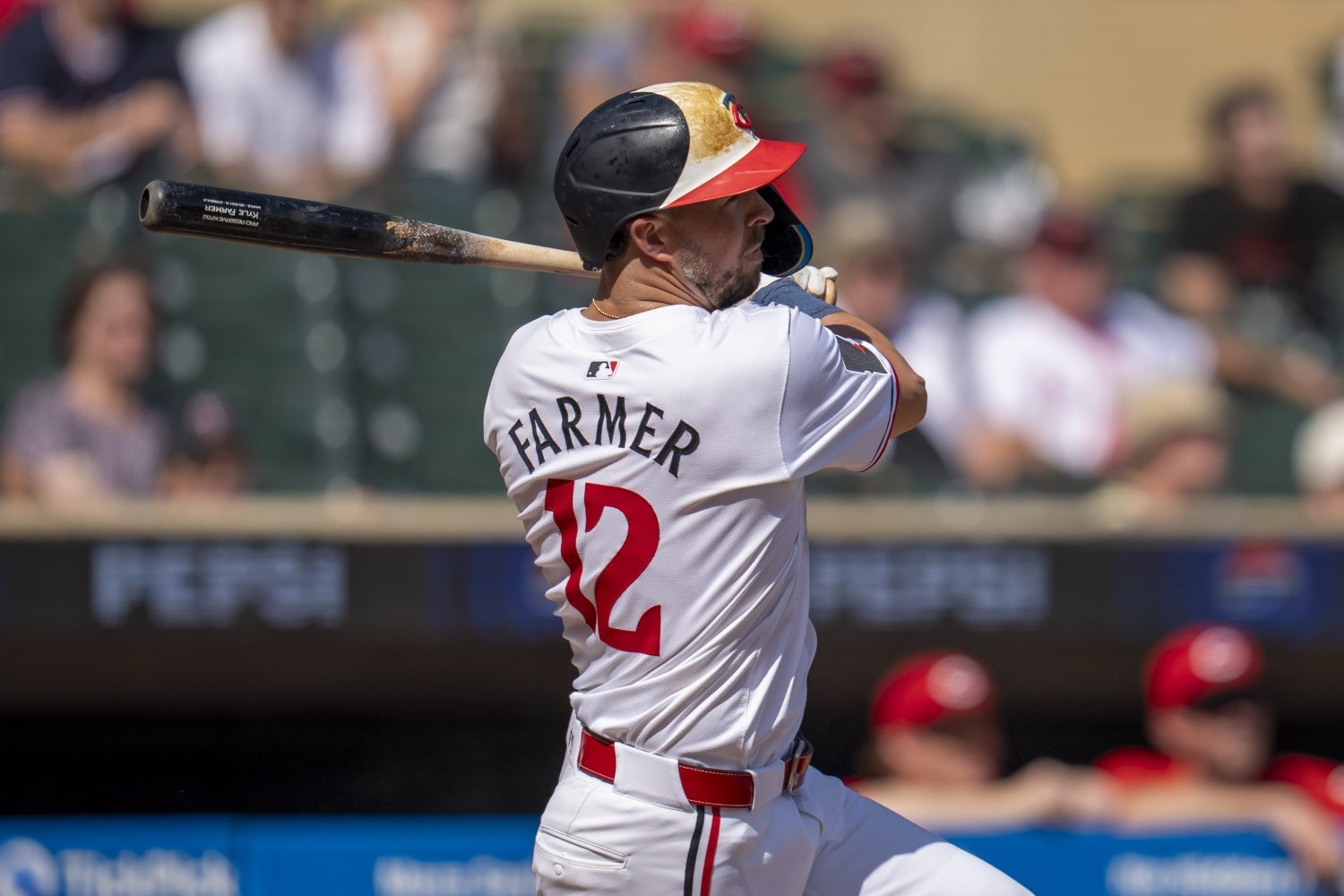
For most of this campaign, Farmer has been a slightly worse version of the 2023 iteration. He wasn’t hitting, putting up a .557 OPS as he slumped through the first half of the season. His sprint speed was a little worse. By midseason, fans were calling for the Twins to trade him or designate him for assignment, as he hit like a backup catcher for half a season. Then, the Twins announced that Farmer had been dealing with an injury for much of the year. He hit the IL, spent a month there, and upon his return, showed fans something unexpected.
Since Aug. 9, Farmer has 64 plate appearances. Over that span, he has hit .305, while slugging a ridiculous .627. He’s also cut down his strikeout rate to an impressive 17.2% over this stretch. In these 27 games, his .955 OPS is highest of anyone on the team not named Byron Buxton, and over a much larger sample than Buxton, who's just getting back from his own IL stint. Where did this offensive breakout come from, and is it sustainable?
To begin, let’s look at a direct side-by-side comparison, and see what we can glean.
|
|
Pre IL Stint |
Post Return |
|
OPS |
.557 |
.955 |
|
Slugging |
.265 |
.627 |
|
wOBA |
.256 |
.394 |
|
Barrel Rate |
3% |
14% |
|
Average Launch Angle |
16.1 |
22.3 |
|
Average EV |
85.6 |
91.4 |
|
Hard Hit |
22.8% |
44% |
|
K% |
20.5% |
17.9% |
|
BABIP |
.248 |
.289 |
So, a stark contrast, right? What’s been driving it? For starters, to state the obvious, he’s seeing the ball much better, and producing at a higher level across the board. What's behind this?
Pitch Mix
Farmer has done well against changeups all season. Post-return, he’s been crushing them, with a 5.2 run value on that pitch type. The scouting reports seem to have not caught up to that fact, though, as he’s seen proportionally more of them since his IL stint. Pitchers are also pumping more fastballs at him. Historically, that’s been a bit of a problem for him, as Farmer does not have elite bat speed. His swing averages around three miles per hour slower than league average. More telling, his fast swing rate (characterized as any swing faster than 75 miles per hour) sits at just 1.3% on the season, compared to the league average of 22.5%. While his results against four-seam fastballs are the worst of any pitch, since his return, he’s been better at catching up to them, just a bit worse than average.
Hitting for Average
So, he’s seeing the ball better and crushing changeups. Can he sustain it? BABIP is usually a good predictor for regression. In this case, Farmer’s BABIP since returning from the IL is actually aligned with his results, at .289. This is a sign that good times should continue.
Hitting for Power
In the first half, Farmer wasn’t squaring up, with just three barrels across 101 batted-ball events for a 3% barrel rate. Since his return, he’s had six barrels across roughly 40 batted balls. According to Baseball Savant, of the five home runs he’s hit since his return, two were no-doubters, and he’s also had four balls that would be out in most ballparks. He's also been pulling the ball 44% of the time, compared to 34% prior to his IL stint. Pulling the ball is generally the right approach to hit for power, and he has committed to this approach. It's how he found success last year.
All that said, this is the one piece that’s likely to be unsustainable for Farmer. He’s almost certainly not going to slug .600 long-term. But, can he do it for another month? Maybe. Based on these things, it’s fair to conclude that yes, Farmer’s improvements at the plate are for real. And, it’s about the best possible time for him to turn it on. With two weeks left in the regular season, and a fairly thin margin for error to reach the postseason, the Twins need all the hitting they can muster.
If Farmer does keep it up, he could also be setting himself up for a decent deal this offseason — it just probably won’t be with the Twins. Minnesota holds a $6.25-million mutual option, which will almost certainly be declined, and Farmer will test his fortunes as a 34-year-old utility infielder on the open market. But, his time with the Twins will forever be remembered for the Home Run Sausage. That memory will be a bit moldy if the team misses the playoffs, but if they make it and have another strong October, it'll be a piquant and poignant legacy.








Recommended Comments
Create an account or sign in to comment
You need to be a member in order to leave a comment
Create an account
Sign up for a new account in our community. It's easy!
Register a new accountSign in
Already have an account? Sign in here.
Sign In Now