


Twins Video
The Twins closed August with a win Sunday, beating the Padres 7-2. It was a bad month for the team, who went 11-17 as they tried (and failed) to patch the holes punched in the roster by the trade deadline fire sale the front office executed to close out July. For many fans, though, it was less frustrating to watch the team for stretches of this month, with the pressure off and some new faces in the mix. While the pitching staff was far too thin to hold most of the leads the team was able to generate, the offense began to show signs of new life.
Key to that revival (they scored a respectable 4.4 runs per game for the month) were the returns of two players who hadn't been part of the lineup in May, June or July: Luke Keaschall (injured since April) and Austin Martin (stashed in Triple A all year, until the deadline). Keaschall batted .303/.380/.506 after returning from the injured list in the first week of the month, while Martin managed a .271/.363/.371 line as a restored piece of the outfield mix. For a team that has had precious few reliable on-base guys over the last two seasons, Keaschall and Martin were a breath of fresh air.
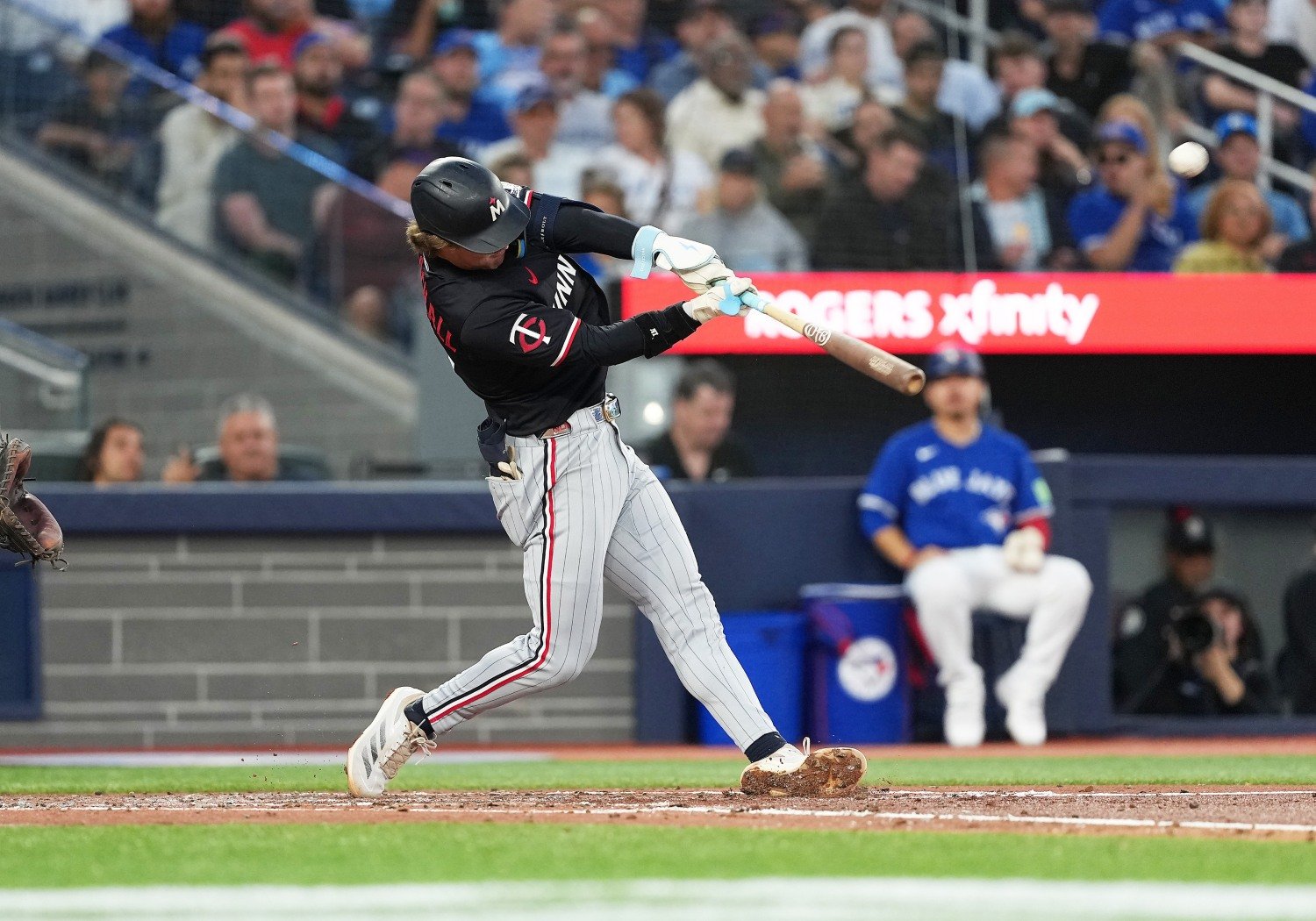
Both are right-handed batters with good athleticism, but both have shown limited defensive value in their young careers. Both are potential long-term pieces, but Keaschall is viewed as a part of the core, whereas Martin is more of a complementary option—and is unlikely to enter 2026 as a regular for the team. When you watch them play, you're left with an impression of two very different players. They have contrasting approaches, and they use their bodies differently. In terms of swings, though, they're a bit like—well, twins.
Cody Schoenmann wrote about the unique combination of shortness and steepness in Keaschall's swing two weeks ago. Along the way, though, he also touched on the fact that Martin shares some key swing attributes with Keaschall. Here are their average swing speed, contact point (relative to their body), swing tilt and attack angle and direction, for comparison.
- Keaschall: 67.1 mph, 32.0 in., 35° tilt, 8° attack angle, 0° attack direction
- Martin: 67.1 mph, 29.5 in., 40° tilt, 10° attack angle, 3° Pull attack direction
They have, in short, identical bat speed (although it doesn't quite play that way; more on that shortly), and each is steep to the baseball. Dipping one's barrel steeply, relative to one's hands, is a consistent and noteworthy characteristic. It's usually a good way to generate loft on batted balls, and it can be great for increasing one's margin for error to find the grass with a hit even when not perfectly on time. However, as you might imagine, swinging steeply tends to make it hard to hit high pitches. It's usually a characteristic of players who want to "drop the bat head" on the ball, like this.
That creates a particular challenge for each of them, in a league full of pitchers who can pound the top of the zone with fastballs: how do you get to those high offerings with a swing that seems geared to attack the ball down? This is where things get interesting, because the two of them could not be more different in the ways they answer that question.
For Martin, it's mostly a matter of laying off.
"That’s not my approach," Martin said of handling the high heater. "I don’t look to do damage on fastballs up in the zone. So I think that also helps me in terms of not chasing up, because that’s not where I’m looking—but yes, with the steep swing, that makes it a little more difficult, because I’m not as flat to the ball."
The key, the second-year big-leaguer said, is to recognize that pitch but not offer at it early in counts. Once he gets to two strikes, he has to protect the whole zone, but he's learned to simply flick the ball foul and fight to get a more hittable offering. If he can avoid whiffing and keep making good swing decisions, eventually, pitchers will either give in and throw him a breaking ball down—or miss with a heater that's not as elevated as they intended.
"Obviously, there’s a skill gap between a major-league pitcher and a Triple-A pitcher," Martin said. But I haven’t felt at this moment that it’s an issue. I haven’t been attacked too much that way. Even though they’re capable of locating it more [consistently], doesn’t mean that they locate it that often, so it’s not anything that I’m concerned about."
Indeed, you can easily see what Martin is looking for when he steps into the box: a pitch down and out over the plate, where he can feast.

That approach makes Martin a bit more prone to chasing low and away than one might expect such a patient batter to be, but he's not getting himself out by expanding at the top of the zone. At least, when he does swing at a pitch down and away, he's taking a pass at a pitch he can theoretically handle. Again, with that extreme tilt on his swing, he's much better on the ball inside—but it has to be below the belly button, or it ties him up. Here's a heat map like the one above, but instead of showing his swing rate by location, it shows his run value above average per 100 pitches, by location.

The ball away is hard on him, but because he's disciplined both low and high and dangerous on the inner third, we still see a lot of red here. What Martin's doing is working, even if his swing is unthreatening by the standards of most big-league batters.
Keaschall's process is very different—not just because he's much less cerebral than Martin in his approach, but because he actually goes after the high pitch. He hits it, too.
"It depends on your approach, depends on what you’re trying to do," Keaschall said, by way of explaining why a guy with a steep swing seems to like the ball up. "But there’s a lot more to hitting than what angle your swing is."
He's right, of course. His swing is a symphony of unusual things, and watching him prepare for games gives a glimpse into how carefully it's been engineered. His pre-batting practice routine involves several reps in which he holds the bat in one hand (each, in turn) and practices a short, shadow version of his stroke, with the lower half and the explosive rotation of it all quieted down and everything slightly slowed. He's locking in the exceptionally short hand path that seems to deliver barrel to ball consistently—and his imaginary target always seems to be chest-high. His swing gets its steepness not from an attempt to whip the bat head down through the ball, but from an assiduous effort to maximize efficiency of movement.
"I’ve worked really hard on my swing since high school, so it changes a lot," Keaschall said. "But at the end of the day, you’re built the way you’re built, and you’re gonna swing the way you swing. I’ve always had a pretty short swing, pretty quick to the ball, putting an emphasis on making contact, just being a consistent hitter in the box. I’d say it’s something you’re taught, but I mean, God gave you the tools that you have and God gave you a certain type of body. I’m a very tight individual, and that helps me stay short to the ball, as opposed to a big, loose person with a longer swing."
That's the crucial insight, for him, and the distinguishing feature between him and Martin. Whereas Martin is a fluid athlete whose limbs always seem to be in motion, Keaschall gives the impression of being one big muscle, moving all at once. That can be a liability in the field (he's not very adaptable or smooth when the ball gets near him at second base), but at the plate, it lets him come so cleanly to the ball that he can handle pitches other hitters otherwise like him would have no chance to attack. He takes a much more expansive approach than does Martin, for that very reason. His compact movements make everything seem hittable.

It's actually the high pitch on which Keaschall does most of his damage. He's that slight bit flatter than Martin, anyway, but he also has that hardwired handpath—with the violence and the extra space creation of his hard stride and explosive rotation built back in, come game time—on his side. Pitchers have to be good enough at commanding their stuff to consistently pound him away, or to hit a target above the letters with that fastball. Otherwise, they're in big trouble.

That shortness and tightness in his frame makes it hard to get the good part of the wood on the ball low and away, and you can start to see how the league might eventually figure out Keaschall and force him through a tough set of adjustments. For now, though, he's covering everything nicely. He's just not doing it anything like the way Martin does.
Let's circle back to the question of their bat speed. They each swing at 67.1 mph, well below the MLB average. Neither is a budding slugger, for that reason. However, each has ways to make up for that lack of sheer swing speed, and the different ways they do so help elucidate their differences in approach.
Here's how each sets up in the box and strides into the baseball.
(10).png.a2198ced99d820d526338d53e0f62afa.png)
As we've talked about before, Keaschall has a high-energy stride that carries him right into the baseball. He also doesn't stand especially deep in the batter's box. He's not trying to buy himself time in there, because even though he lacks elite swing speed, he gets started early and still makes good swing decisions. He's firing early and committing himself early, which lets him catch the ball out front even with a slow swing. That directness in the path of his hands helps in that regard, too.
Martin, by contrast, stands very deep in the box and takes a small stride. He's close to the plate, to maximize the extent to which he can cover the outer edge despite a swing that doesn't use the full length of his lumber, horizontally. He's a later decider than Keaschall, so he necessarily catches the ball deeper. His best swings will be the ones where he's slightly early, but he provides himself a margin for error by being willing to get there a hair later.
Keaschall has shown much more power so far, but Martin is drawing walks and getting on base at a stellar rate. Each has passed the first test the league poses to a steep-swing righty batter without elite bat speed, in their own way. Each has been fun to watch and helped make the team's offense more so in their first full month with the team. While they're destined to be defined by their differences, their shared swing quirks make them an interesting shared case study and provide a good window into the problem-solving ahead as the Twins try to build a more successful lineup in 2025.









Recommended Comments
Create an account or sign in to comment
You need to be a member in order to leave a comment
Create an account
Sign up for a new account in our community. It's easy!
Register a new accountSign in
Already have an account? Sign in here.
Sign In Now