


Twins Video
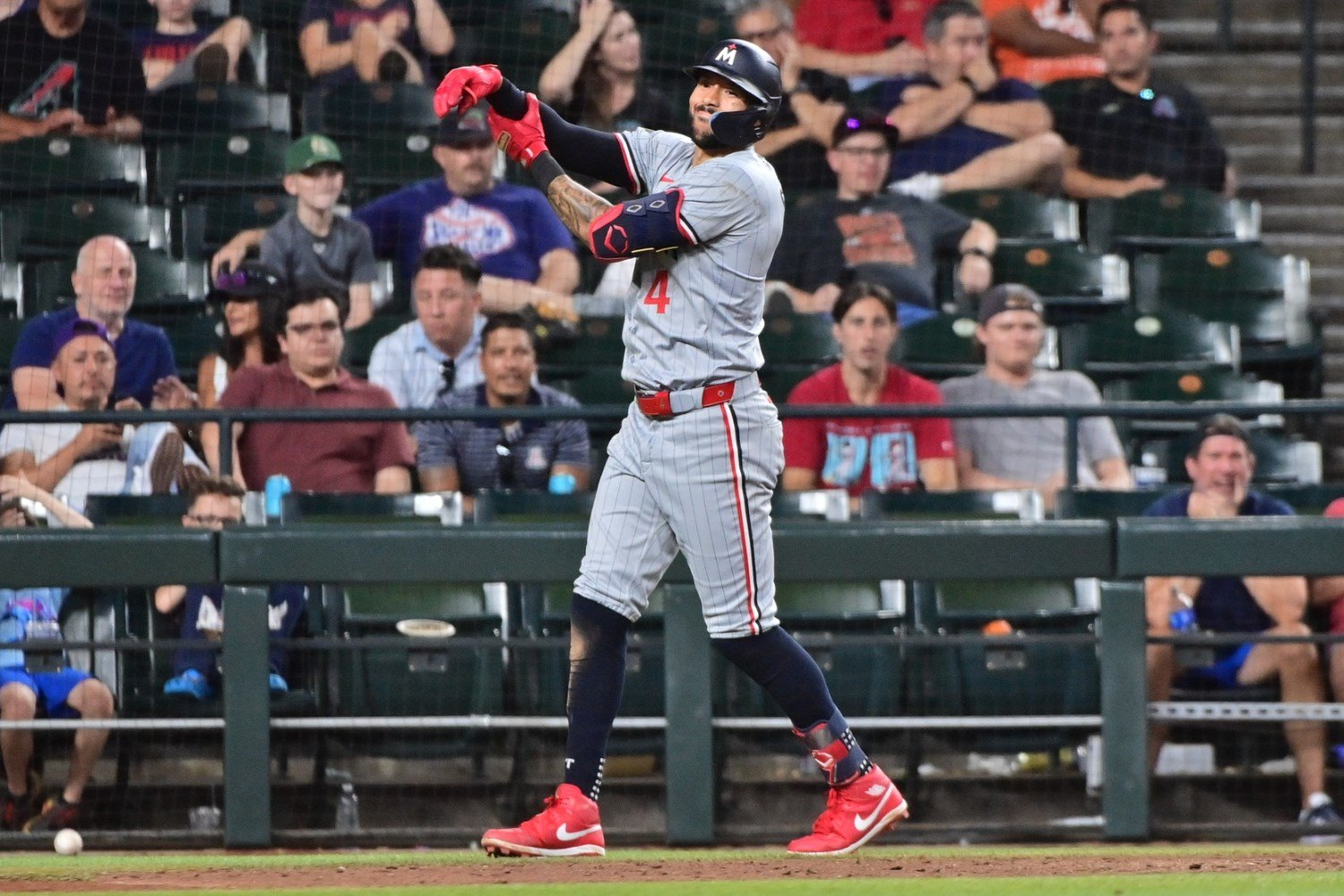
Willi Castro had a chance to break the game open against the Pittsburgh Pirates. It was the top of the 10th inning. Although the Twins had brought a run across the plate, the automatic runner in extra innings meant no guarantee of a win. Castro fell behind early with two strikes, but then got a lucky break.
Except in his mind, it wasn’t so lucky:
The Twins have been the recipients of 57 plunkings over the first half of the season—one ahead of their rivals, the Cleveland Guardians. That’s on pace for over 114 hit by pitches (HBPs), eight more than the record set by Buck Showalter’s Mets in 2022. And if Matt Wallner rejoins the squad, given his penchant for hit by pitches, they will almost certainly set an unexpected record.
Plunk me once, shame on you. Plunk me twice, shame on me? It certainly seems like more than dumb luck that the Twins have become targets for those on the mound (and on top of that, very good luck that Carlos Correa narrowly missed a few broken bones in the rubber game against the Diamondbacks). But there are some surprising decisions by the batters that have resulted in the not-so-lucky chase for bruised glory.
Hit by pitches have generally increased in recent years. What was once limited to a revenge decision (and as we saw Kody Funderburk plunk Blaze Alexander, occasionally still is) has become quite common in recent years. While I cannot say for certain, I do not believe any of the HBPs this season have been thrown with malice. Instead, it's just the new norm. With pitchers throwing more gas on off speed pitches and three true outcomes pushing for more pitches in general, teams seemed to have accepted there is little difference between a walk and an HBP. And in the same way that “he gets on base” might have become the first turn toward baseball analytics, teams are willing to let players take the base.
Teams have certainly begun strategizing for “plate crowding.” During the 2021 Astros-Braves World Series, the not-so-great catcher Martín Maldonado came up to bat with the bases loaded in Game 5. Maldonado specifically chose to crowd the plate and took a plunk from A.J. Minter’s wild cutter. “Did you guys notice how close he was to the plate on the at-bat against Minter?” A future Twins shortstop told The Athletic at the time. “That was sick.” Perhaps Correa brought that energy to the Twins, though in the words of Jean Renoir, everyone has their reasons.
There is one curious stat that helps us understand exactly why these HBPs might be landing on Twins’ arms more than others. Baseball Savant provides a stat called Plate X, an advanced metric that measures the horizontal distance of the ball when crossing the plate from its direct center. Obviously, the Plate X for all HBPs is going to be further out than 0. But when you break out each player, most of them are below the MLB average. These are not balls traveling that far outside the zone.
| # of Ht By Pitches | Plate X (Closer to 0, Closer to Plate) | |
| MLB Average - Righties | -1.94 | |
| Margot | 3 | -1.66 |
| Correa | 2 | -1.68 |
| Jeffers | 11 | -1.77 |
| Castro (RHB) | 1 | -1.81 |
| Farmer | 6 | -1.83 |
| Buxton | 7 | -2.21 |
| Miranda | 3 | -2.18 |
| MLB Average - Lefties | 1.99 | |
| Castro (LHB) | 10 | 1.76 |
| Wallner | 4 | 1.52 |
| Kepler | 3 | 1.76 |
| Santana (LHB) | 3 | 2.01 |
Two hitters in particular are leading the way: Ryan Jeffers and Willi Castro. Both have been hit 11 times. There are obvious reasons why pitchers pound them low and inside. They swing and miss most often when locating there, and when they do it, it’s most likely to be a ground ball:

Jeffers is a curious case. When asked about the bruises, Jeffers simply described himself as turning into an armadillo, unable to really move out of the way.
But looking at his actual plate appearances, there is a curious problem he faces: Jeffers is a toe tapper when he swings:
Many players throughout baseball end up tapping their foot before grounding, but what makes Jeffers a curious case is he does it so late in his swing. Here are three images from games where Jeffers is right about to be hit—the ball is halfway to the plate and Jeffers has not yet begun to move. He’s too busy setting his timing with the darn toe:

No wonder why he has little time to get out of the way.
Castro is a different case. At 6’1” and just a bit over 200 lbs, he is a rather slight player. He has also admitted he likes to crowd the plate.
But more than anything, he really, really loves to swing across the whole plate. This would not be a problem if Castro was Aaron Judge. But because he is a little guy with a below-average swing length, he often throws his whole body into it.
If you look at his home runs, he will often end up with a foot right in the middle of the zone because of the amount of spin on his body. Here are three home run machines and Castro at the end of their home runs, and you can see where the body lands:

Castro uses his body so much that, well, he can end up on his ass, which we saw against the Diamondbacks:
So what does that have to do with HBPs? Castro loves hunting for that nicely placed ball on the outside of the zone, so he is certainly standing closer to the plate. This is not someone thinking about getting hit. Instead, he is simply fishing to ensure those meatballs end up as dingers.
The common thread here is balance, and the ability it provides to get out of the way when the ball comes at you. Jeffers gets his front foot down very late, which leaves him almost no time in which to make a move, because you can't bail out effectively with that foot in the air. Castro has the foot down sooner, but is transferring his weight and a whole lot of kinetic energy down through that leg just as the ball is reaching him. He's even more locked into his spot in the box than Jeffers, just with the other leg. You'll often see some hitters raise their hands, go casually up on tip-toes, and let a ball sail by, within a few inches of their pants or shirtfront. Neither Jeffers nor Castro really has that move in their bag of tricks.
Other Twins are creeping up in HBPs: Byron Buxton has now reached seven, a curious case given how much he deliberately chooses to not crowd the plate, while Kyle Farmer has six (notably in low playing time) and Santana sits at four. (Wallner, in his brief time at the beginning of the season, also amassed four.) But no one is doing it like Jeffers and Castro.
After becoming the Bomba Squad in 2019, I doubt the Twins hoped to become the Bruise Squad. But, recent offensive production suggests whatever the team is doing at the plate is working. So, let us salute the beans! Let those smacks lead to runs scored. Just watch out for those dear little bones.
Do you approve of the job the Twins front office is doing?

Follow Twins Daily For Minnesota Twins News & Analysis



- BH67, Dman and nclahammer
-
 3
3


Recommended Comments
Create an account or sign in to comment
You need to be a member in order to leave a comment
Create an account
Sign up for a new account in our community. It's easy!
Register a new accountSign in
Already have an account? Sign in here.
Sign In Now