



Matthew Trueblood
-
Posts
1,033 -
Joined
-
Last visited
Content Type
Profiles
News
Minnesota Twins Videos
2026 Minnesota Twins Top Prospects Ranking
2022 Minnesota Twins Draft Picks
Minnesota Twins Free Agent & Trade Rumors, Notes, & Tidbits
Guides & Resources
2023 Minnesota Twins Draft Picks
The Minnesota Twins Players Project
2024 Minnesota Twins Draft Picks
2025 Minnesota Twins Draft Pick Tracker
2026 Minnesota Twins Draft Tracker: Picks & Bonuses
Forums
Blogs
Events
Store
Downloads
Gallery
Everything posted by Matthew Trueblood
-
The Twins play an afternoon rubber match Wednesday against the Rockies, and there will be a returning option in the bullpen for Rocco Baldelli. Also, is it time we stopped acting like the Twins' problems with the Yankees are mysterious? Image courtesy of © Matt Krohn-USA TODAY Sports In a move that will surprise some, the Twins are recalling Jay Jackson to join their bullpen Wednesday. They had to designate Diego Castillo for assignment to do it, which the team is always loath to do, but those who read Theo Tollefson's piece here at Twins Daily earlier this week know why they made this call. Jackson has rediscovered the slider that is, more or less, his whole career. He couldn't consistently execute that offering during his first stint with the big-league team, and when that's the case, he's not an MLB-caliber pitcher. While he was in St. Paul, though, he maintained a good attitude and found the shape on that pitch that makes him not only MLB-caliber, but a valuable middle reliever. Theo gave you all you needed to realize Jackson was primed for a return, and it's no surprise that Varland is headed back to the minors after his spot start. All that remains to explain is the choice to let Castillo go in the process, but that's not a galloping shock, either. Castillo filled in adequately as the last arm on the staff for a short time, but he's past his best utility in the big leagues. Jackson is a better fit for the roster, now that he has his best weapon back. Why the Twins Can't Beat the Yankees Tuesday night, while the Twins struggled against the Rockies, the Yankees were busy thoroughly bashing the Royals. They've made a habit of that, over a not-insignificant stretch. In fact, while the Twins get the headlines, the Yankees' 116-49 record against Kansas City since the year 2000 is even better than their 114-51 against the Twins. That doesn't count their dominance over the Twins in the playoffs, of course, but not coincidentally, the Royals' two playoff appearances during that span (2014 and 2015) each came in seasons when the Yankees just didn't make it. It feels less notable that the Yankees lay such a whupping on the Royals than that they consistently drub the Twins, because the Twins have been much better than the Royals over those 25 seasons. Because the Twins are a winning team when not playing New York, their inability to beat the Bombers has become a popular enigma on which to muse. Here's the thing: it's not really a mystery at all. Ask yourself two important questions, any time one team seems to have special mastery over another: What does the team with the upper hand do especially well? What does the team getting beaten do poorly? If the answer to those two questions is the same, it makes plenty of sense for one team to dominate the other. In this case, the overlap couldn't be more perfect. The 2024 Twins are the perfect illustration of this point. Their pitching staff strikes out batters as well as almost any in baseball, and issues very, very few walks. That's what they do well. What do they do poorly? It's the same thing they've done poorly for the last 30 years, in otherwise good times and in bad ones. The Twins give up home runs. They give up lots and lots of home runs. An assemblage of fly-ball pitchers, they're vulnerable to power, even in seasons in which they do everything else well. What do the Yankees do well? They hit home runs. Much about that team has changed over the last quarter-century, just as much has changed about the Twins, but the Yankees still (always, forever) hit home runs. When one team has one of the league's greatest vulnerabilities to a particular outcome, and the other team has one of its greatest proclivities to produce that outcome, and when that outcome is the most extremely valuable (or damaging) one in baseball, it's a recipe for trouble. The Yankees' .466 SLG against the Twins since 2000 is the sixth-highest for any team against an opponent they've played at least 100 times. Three of the top five involve the Rockies. The other two are the Yankees against the Royals, and the Red Sox against the Royals. When you're just plain bad, you're going to give up power to great power-hitting teams. When you're otherwise above-average, it feels like that should be avoidable, but because the Twins remain a team that gives up power in exchange for more whiffs and fewer walks, they run into the same trouble as worse pitching staffs. No team in baseball throws fewer sinkers than the Twins. They work vertically within the zone, rather than horizontally. They do a lot of things well, but when they face the team who most consistently does well what they do a poor job of preventing, they lose. That's not a mystery, and the Yankees don't have a special hold on the team. The Twins can get the upper hand, or at least stop losing five or six games a year to the Bombers. They just have to make some adjustments that will frustrate the Yankee offense more effectively. View full article
- 12 replies
-
- 1
-

-
- jay jackson
- diego castillo
- (and 1 more)
-
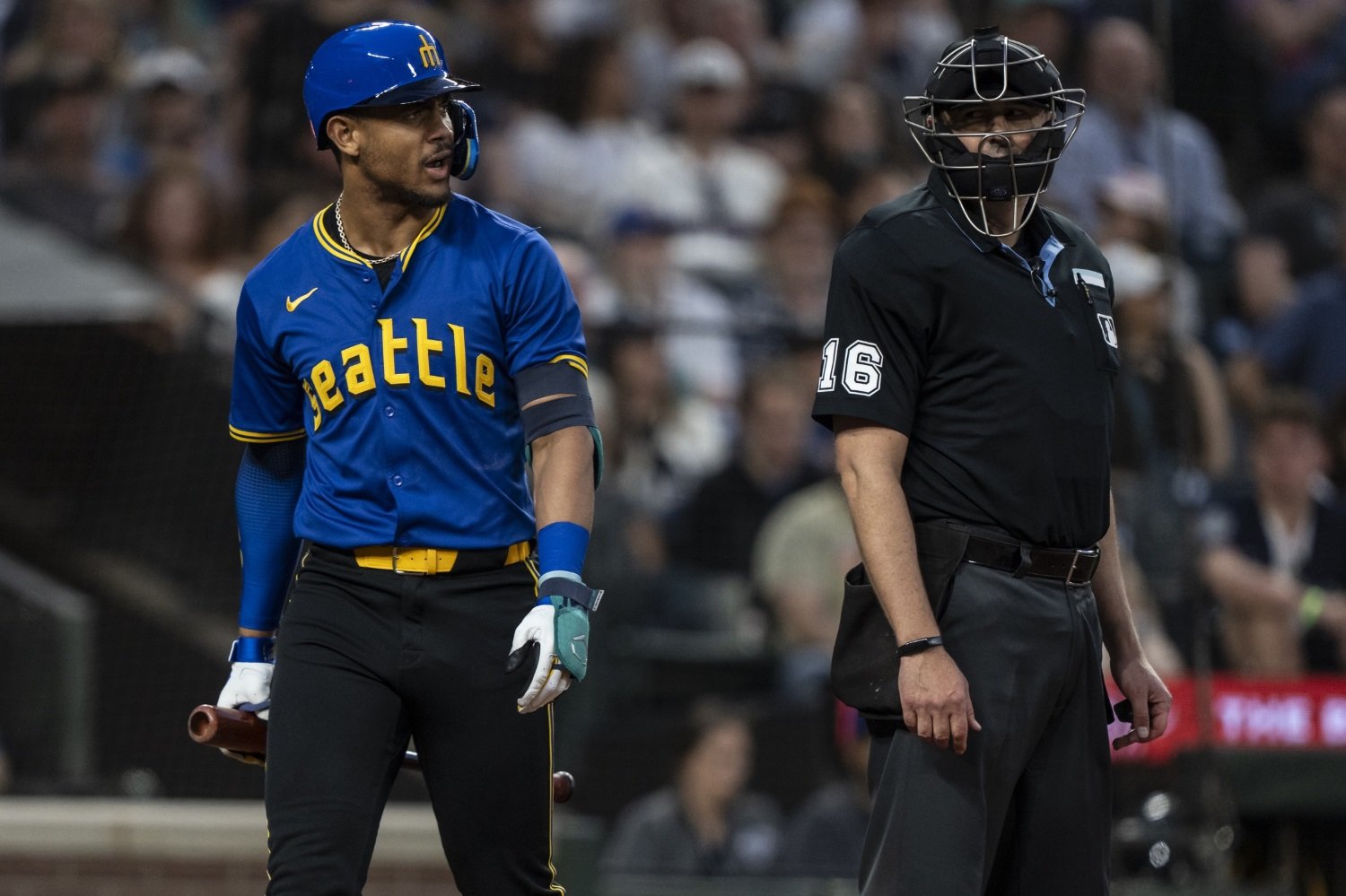 Monday night's Twins-Rockies tilt was a crisp affair, played in 2 hours, 9 minutes and with a bevy of balls in play. Twins pitchers struck out 10 Colorado batters, but only issued one walk, and on the flip side, they only struck out and walked twice each on offense. That wasn't surprising, because Monday's home-plate umpire, Alfonso Márquez, is one of the game's more hitter-friendly (and balls in play-friendly) arbiters. Of 77 qualifying umps since the start of 2023, Márquez is 67th in Adjusted Strikes Looking (SL+), at 96.6. For that stat, 100 is average, and higher means more called strikes than expected, based on the location of pitches not swung at while they're behind the plate. He's also 19th in In Play% among those 77, meaning that when Márquez is back there, the ball tends to keep moving. It's hard to come by a much larger change than the two teams will see tonight, as Lance Barrett dons the mask and chest protector instead of Márquez. Barrett is third in SL+, at 106.3. Whereas Márquez's calls have added 9.8 runs to scoreboards since the beginning of last season, Barrett's have prevented 17.7. Barrett's games also tend to involve more of the two least interesting true outcomes. Since the best umpires have the least impact on the runs in either direction, it probably won't shock you to learn that Márquez ranks 55th in Adjusted Correct Call % over this sample, and that Barrett is even worse, at 72nd. For the very patient Twins offense, there's either a quick adjustment or an evening of frustration ahead. In four games with Barrett behind the dish over the last two seasons, they're 2-2, but have batted just .211/.264/.398, striking out 25.5 percent of the time and walking just 5.5 percent of the time. Life With Louie It's just a spot start for Louie Varland Tuesday night; he's not guaranteed anything beyond this chance to help the team stretch its starting rotation and get key pitchers some rest. However, this feels like a golden opportunity for the young righthander to have some success and reestablish his confidence at the MLB level. After the exceptionally tight zone that governs Triple-A baseball, Barrett's will feel positively oceanic. It's up to Varland, who has admirably lowered his walk rate during a St. Paul sojourn, to show he can make use of that space. As you've heard by now, Varland has tweaked his pitch mix to optimize his development while pitching for the Saints, with more sinkers and changeups. The idea is to finally get him comfortable attacking the arm side of the plate, inside on righty batters and away from lefties. The focus has also been on reshaping the changeup. Varland has seen a drop in the velocity difference between that pitch and his fastball while with St. Paul, but it's also moving more, both vertically and horizontally. That's a good trade for Varland. Tuesday will give him a chance to test some of his changes, and then he figures to get another chance to hone things in the minors. It's Not Your Day, Kid No less a luminary than Bill James once suggested that, for player safety and conflict management reasons, a pitcher be ejected automatically if they hit a second batter in any game. His theory was, if you plunk two guys in one game, you don't have adequate control that day--or there's something nefarious afoot. That's too extreme, but as I watched the frustration (and injury risk) mount and tensions wind unnecessarily high Sunday afternoon, I couldn't help thinking that James was on the right track. Ben Heller of the Pirates didn't have any semblance of command that day, and it put the Twins in danger. It also invited anger that could have boiled over into a brawl. Heller had already done some damage and angered some people in the Minnesota dugout by the time he hit Kyle Farmer, the third HBP of his day, and the game was over. The Pirates left him in, though, to continue absorbing a beating and spare their bullpen. It's not really fair to Heller that he was forced to do that, and it's even more unfair to the Twins that they were subjected to that risk longer than anyone would have called acceptable, except that the Pirates didn't want to use any more arms in a lost cause. I wanted to see what it would look like to draw a line, somewhere, and automatically eject pitchers who plunk three batters in a game. For my money, it's viable. There have been 46 outings since the start of 2021 in which a pitcher did hit at least three batters, and in 18 of those, the hurler in question worked at least into the sixth inning. That's where we need to check on this, because if the rule were going to push a bunch of pitchers out of starts unnecessarily, it would be a no-go. Instead, of those 18 appearances, only four would have been curtailed sharply by this rule. An automatic ejection after a third HBP would have knocked Yu Darvish out of a 2022 start in the first inning, and Zac Gallen out of one in the second. Both Chris Bassitt and Alex Wood would have been thrown out of starts in the third in 2021, even though they went on to at least see the sixth. Much more often, though, third plunkings act as a sign to a skipper that his guy has lost it, anyway. While with the Marlins in 2022, Pablo López was voluntarily removed after hitting his third batter of the game, in the seventh inning. Tanner Houck has twice been lifted immediately after hitting his third batter of the game in the sixth inning, and Carlos Carrasco got the same treatment in one game last season. Another handful of times, pitchers got between one and three more batters after their third HBP. Were this rule instituted, umpires would have to be slightly more strict in their enforcement of the rule against batters leaning into pitches. You don't want hitters forcing pitchers out of the game by trying desperately to get hit. At the same time, it would make each hit-by-pitch more interesting, and hitters could still find ways to draw an extra plunking here and there, to apply pressure to the pitcher and their manager. Games like the one Heller had are inevitable. Their potential negative impact on the game and its players can be blunted, though, and I think we should seriously consider doing it.
- 12 comments
-
- 15
-
-

-

-
- louis varland
- ben heller
- (and 3 more)
-
In honor of the Twins' lake-centric theme for their City Connect uniforms, we're going to offer up some notes on occasion for the balance of this summer, under the unifying headline "Ripples". Today, we have three quick but interesting topics to tackle. Image courtesy of © Stephen Brashear-USA TODAY Sports Monday night's Twins-Rockies tilt was a crisp affair, played in 2 hours, 9 minutes and with a bevy of balls in play. Twins pitchers struck out 10 Colorado batters, but only issued one walk, and on the flip side, they only struck out and walked twice each on offense. That wasn't surprising, because Monday's home-plate umpire, Alfonso Márquez, is one of the game's more hitter-friendly (and balls in play-friendly) arbiters. Of 77 qualifying umps since the start of 2023, Márquez is 67th in Adjusted Strikes Looking (SL+), at 96.6. For that stat, 100 is average, and higher means more called strikes than expected, based on the location of pitches not swung at while they're behind the plate. He's also 19th in In Play% among those 77, meaning that when Márquez is back there, the ball tends to keep moving. It's hard to come by a much larger change than the two teams will see tonight, as Lance Barrett dons the mask and chest protector instead of Márquez. Barrett is third in SL+, at 106.3. Whereas Márquez's calls have added 9.8 runs to scoreboards since the beginning of last season, Barrett's have prevented 17.7. Barrett's games also tend to involve more of the two least interesting true outcomes. Since the best umpires have the least impact on the runs in either direction, it probably won't shock you to learn that Márquez ranks 55th in Adjusted Correct Call % over this sample, and that Barrett is even worse, at 72nd. For the very patient Twins offense, there's either a quick adjustment or an evening of frustration ahead. In four games with Barrett behind the dish over the last two seasons, they're 2-2, but have batted just .211/.264/.398, striking out 25.5 percent of the time and walking just 5.5 percent of the time. Life With Louie It's just a spot start for Louie Varland Tuesday night; he's not guaranteed anything beyond this chance to help the team stretch its starting rotation and get key pitchers some rest. However, this feels like a golden opportunity for the young righthander to have some success and reestablish his confidence at the MLB level. After the exceptionally tight zone that governs Triple-A baseball, Barrett's will feel positively oceanic. It's up to Varland, who has admirably lowered his walk rate during a St. Paul sojourn, to show he can make use of that space. As you've heard by now, Varland has tweaked his pitch mix to optimize his development while pitching for the Saints, with more sinkers and changeups. The idea is to finally get him comfortable attacking the arm side of the plate, inside on righty batters and away from lefties. The focus has also been on reshaping the changeup. Varland has seen a drop in the velocity difference between that pitch and his fastball while with St. Paul, but it's also moving more, both vertically and horizontally. That's a good trade for Varland. Tuesday will give him a chance to test some of his changes, and then he figures to get another chance to hone things in the minors. It's Not Your Day, Kid No less a luminary than Bill James once suggested that, for player safety and conflict management reasons, a pitcher be ejected automatically if they hit a second batter in any game. His theory was, if you plunk two guys in one game, you don't have adequate control that day--or there's something nefarious afoot. That's too extreme, but as I watched the frustration (and injury risk) mount and tensions wind unnecessarily high Sunday afternoon, I couldn't help thinking that James was on the right track. Ben Heller of the Pirates didn't have any semblance of command that day, and it put the Twins in danger. It also invited anger that could have boiled over into a brawl. Heller had already done some damage and angered some people in the Minnesota dugout by the time he hit Kyle Farmer, the third HBP of his day, and the game was over. The Pirates left him in, though, to continue absorbing a beating and spare their bullpen. It's not really fair to Heller that he was forced to do that, and it's even more unfair to the Twins that they were subjected to that risk longer than anyone would have called acceptable, except that the Pirates didn't want to use any more arms in a lost cause. I wanted to see what it would look like to draw a line, somewhere, and automatically eject pitchers who plunk three batters in a game. For my money, it's viable. There have been 46 outings since the start of 2021 in which a pitcher did hit at least three batters, and in 18 of those, the hurler in question worked at least into the sixth inning. That's where we need to check on this, because if the rule were going to push a bunch of pitchers out of starts unnecessarily, it would be a no-go. Instead, of those 18 appearances, only four would have been curtailed sharply by this rule. An automatic ejection after a third HBP would have knocked Yu Darvish out of a 2022 start in the first inning, and Zac Gallen out of one in the second. Both Chris Bassitt and Alex Wood would have been thrown out of starts in the third in 2021, even though they went on to at least see the sixth. Much more often, though, third plunkings act as a sign to a skipper that his guy has lost it, anyway. While with the Marlins in 2022, Pablo López was voluntarily removed after hitting his third batter of the game, in the seventh inning. Tanner Houck has twice been lifted immediately after hitting his third batter of the game in the sixth inning, and Carlos Carrasco got the same treatment in one game last season. Another handful of times, pitchers got between one and three more batters after their third HBP. Were this rule instituted, umpires would have to be slightly more strict in their enforcement of the rule against batters leaning into pitches. You don't want hitters forcing pitchers out of the game by trying desperately to get hit. At the same time, it would make each hit-by-pitch more interesting, and hitters could still find ways to draw an extra plunking here and there, to apply pressure to the pitcher and their manager. Games like the one Heller had are inevitable. Their potential negative impact on the game and its players can be blunted, though, and I think we should seriously consider doing it. View full article
-
Try though he might, the young hurler who began the season as the fifth member of the Minnesota Twins' starting rotation couldn't develop the pitchability to get the most out of his stuff. The righty who's replaced him has no such problem. Image courtesy of © Geoff Burke-USA TODAY Sports It won't be like this all year. Simeon Woods Richardson is not a true-talent 2.57 ERA pitcher in MLB, and his strong showing since joining the Twins rotation is due for some measure of regression. However, the success he's had isn't unearned. He's made material changes since last season, and he's crafted a versatile arsenal--partially by making two of the pitches within that mix versatile in and of themselves. After tweaking his mechanics this winter to unlock his former velocity and be more athletic throughout his delivery, Woods Richardson has established a four-pitch repertoire this spring: four-seam fastball, slider, changeup, and curveball. Neither the changeup nor the curve is especially effective, though, so his fastball and slider need to do a lot of different things. It's hard to have lasting success as a starter with two pitches driving the bus; you need the ability to manipulate those offerings. Thankfully, then, Woods Richardson has fostered just that kind of flexibility this year. Here's the movement chart for all of his offerings for the season to date: It's hard, at a glance, to see what makes this unique, so firstly, let's compare Woods Richardson to one of his teammates. Here's the same chart for Twins starter Bailey Ober. In analyzing pitch movement, the default tends to be to study the average of all pitches of a given type. How much does that offering typically move, and in which direction(s)? Our brains aren't supercomputers, so to break these things down, we try to take a single number. The average is the intuitive one to use. When you look at the charts above, though, something should jump out right away: the shape of the distribution of movement is different, and the size of the spread for each is different. Ober has a tight cluster of fastballs; his heaters all move relatively similarly. Woods Richardson, by contrast, has a big spread--but only in one direction. The band of vertical movement he gets on his heaters is pretty small, but the band of horizontal movement is quite wide. This actually is something we can measure, and relatively easily; it's just not often taken into account. Here are all the pitchers who have thrown at least 200 four-seam fastballs so far in 2024, plotted based on the range of movement they show on those pitches, both horizontally and vertically. (The range, here, is defined as the difference between their 90th-percentile movement in that dimension and their 10th-percentile movement in it.) This isn't a set of data in which you necessarily want to have as small or as big a number as possible. Were we examining the standard deviation of movement, we'd probably view smaller values as better ones, because that might stand in for command, but that's not what we're doing here, exactly. Rather, we're seeing how far a pitcher can stretch and move their movement in each dimension. As you can see, Woods Richardson has one of the largest horizontal movement ranges in the sport, but a below-average vertical range. While it's not clear in all cases how these numbers reflect value, for Woods Richardson, that's a clearly positive thing. Why? Because he pitches like this: cThMN2xfWGw0TUFRPT1fVndjQVVWTU5YbFFBRGdFQlhnQUFWUVpTQUZrRlUxUUFCVklDVmdZR1VBTUdCQUJR.mp4 That's not as dramatic an overhand delivery as Woods Richardson used last year, when he was interfering with his own arm strength and cutting the ball at under 90 miles per hour, but it's still a high arm slot. Based on throwing that way, we would normally expect his errors--the balls that don't move the way he wants them to--to be in the vertical dimension. In other words, when he gives the pitch more lateral movement from one offering to the next, he's not just missing. He's manipulating the pitch, to attack different parts of the zone and/or give hitters different looks. Here's Woods Richardson's movement chart for last season's stint with the Twins. Again, you can see that dramatically different average movement profile, but you can also see less of a scatter--less maneuverability with the fastball. Now, let's talk about the slider. That pitch has significant two-plane separation from the fastball, but it also has a different orientation in terms of the spray of its movements. This time, compares to the average hurler, he has a greater vertical movement range, but a smaller horizontal one. Obviously, in keeping with the above, this indicates more difficulty with command, and the risk is that it means leaving too many sliders up; those might get crushed. However, a pitcher who needs to attack hitters two or three times within a game needs the ability to do more than one thing with their breaking ball. Woods Richardson has to be able to throw the slider for a strike (strike to strike, starting out looking like a high fastball and ending up low in the zone), for chases (strike to ball, diving below the zone), and to steal called strikes (ball to strike, dropping into the zone unexpectedly). Thus, the ability to change how much vertical movement a pitch gets from one to the next is important to Woods Richardson, and he's demonstrating that valuable skill. Again, he's going to give up more runs at some point. He's going to hang a slider or two, and he's going to miss out over the plate with a fastball meant for a corner. His ERA is more likely to start with a 4, the rest of the way, than to start with a 2. Still, this is pitchability in a nutshell. Woods Richardson is young, but he's also mature, thoughtful, and talented. This year, he's getting a chance to show it, and he's seized that opportunity so far. View full article
-
Visualizing and Quantifying Pitchability, with Simeon Woods Richardson
Matthew Trueblood posted an article in Twins
 It won't be like this all year. Simeon Woods Richardson is not a true-talent 2.57 ERA pitcher in MLB, and his strong showing since joining the Twins rotation is due for some measure of regression. However, the success he's had isn't unearned. He's made material changes since last season, and he's crafted a versatile arsenal--partially by making two of the pitches within that mix versatile in and of themselves. After tweaking his mechanics this winter to unlock his former velocity and be more athletic throughout his delivery, Woods Richardson has established a four-pitch repertoire this spring: four-seam fastball, slider, changeup, and curveball. Neither the changeup nor the curve is especially effective, though, so his fastball and slider need to do a lot of different things. It's hard to have lasting success as a starter with two pitches driving the bus; you need the ability to manipulate those offerings. Thankfully, then, Woods Richardson has fostered just that kind of flexibility this year. Here's the movement chart for all of his offerings for the season to date: It's hard, at a glance, to see what makes this unique, so firstly, let's compare Woods Richardson to one of his teammates. Here's the same chart for Twins starter Bailey Ober. In analyzing pitch movement, the default tends to be to study the average of all pitches of a given type. How much does that offering typically move, and in which direction(s)? Our brains aren't supercomputers, so to break these things down, we try to take a single number. The average is the intuitive one to use. When you look at the charts above, though, something should jump out right away: the shape of the distribution of movement is different, and the size of the spread for each is different. Ober has a tight cluster of fastballs; his heaters all move relatively similarly. Woods Richardson, by contrast, has a big spread--but only in one direction. The band of vertical movement he gets on his heaters is pretty small, but the band of horizontal movement is quite wide. This actually is something we can measure, and relatively easily; it's just not often taken into account. Here are all the pitchers who have thrown at least 200 four-seam fastballs so far in 2024, plotted based on the range of movement they show on those pitches, both horizontally and vertically. (The range, here, is defined as the difference between their 90th-percentile movement in that dimension and their 10th-percentile movement in it.) This isn't a set of data in which you necessarily want to have as small or as big a number as possible. Were we examining the standard deviation of movement, we'd probably view smaller values as better ones, because that might stand in for command, but that's not what we're doing here, exactly. Rather, we're seeing how far a pitcher can stretch and move their movement in each dimension. As you can see, Woods Richardson has one of the largest horizontal movement ranges in the sport, but a below-average vertical range. While it's not clear in all cases how these numbers reflect value, for Woods Richardson, that's a clearly positive thing. Why? Because he pitches like this: cThMN2xfWGw0TUFRPT1fVndjQVVWTU5YbFFBRGdFQlhnQUFWUVpTQUZrRlUxUUFCVklDVmdZR1VBTUdCQUJR.mp4 That's not as dramatic an overhand delivery as Woods Richardson used last year, when he was interfering with his own arm strength and cutting the ball at under 90 miles per hour, but it's still a high arm slot. Based on throwing that way, we would normally expect his errors--the balls that don't move the way he wants them to--to be in the vertical dimension. In other words, when he gives the pitch more lateral movement from one offering to the next, he's not just missing. He's manipulating the pitch, to attack different parts of the zone and/or give hitters different looks. Here's Woods Richardson's movement chart for last season's stint with the Twins. Again, you can see that dramatically different average movement profile, but you can also see less of a scatter--less maneuverability with the fastball. Now, let's talk about the slider. That pitch has significant two-plane separation from the fastball, but it also has a different orientation in terms of the spray of its movements. This time, compares to the average hurler, he has a greater vertical movement range, but a smaller horizontal one. Obviously, in keeping with the above, this indicates more difficulty with command, and the risk is that it means leaving too many sliders up; those might get crushed. However, a pitcher who needs to attack hitters two or three times within a game needs the ability to do more than one thing with their breaking ball. Woods Richardson has to be able to throw the slider for a strike (strike to strike, starting out looking like a high fastball and ending up low in the zone), for chases (strike to ball, diving below the zone), and to steal called strikes (ball to strike, dropping into the zone unexpectedly). Thus, the ability to change how much vertical movement a pitch gets from one to the next is important to Woods Richardson, and he's demonstrating that valuable skill. Again, he's going to give up more runs at some point. He's going to hang a slider or two, and he's going to miss out over the plate with a fastball meant for a corner. His ERA is more likely to start with a 4, the rest of the way, than to start with a 2. Still, this is pitchability in a nutshell. Woods Richardson is young, but he's also mature, thoughtful, and talented. This year, he's getting a chance to show it, and he's seized that opportunity so far.
 -
There's a lot of extra detail in the Caretakers-exclusive part of the piece, I can promise you that. Not much on the velocity; it's more about location and command. But that's as much as I can tell you! We always welcome window-shoppers into the store, but we can't give away all the merchandise. 😆
- 15 replies
-
- 3
-
-

-
- pablo lopez
- ryan jeffers
- (and 1 more)
-
The Minnesota Twins' ace hasn't quite been ace-like this season. He's shown flashes of being his dominant self, but there have been too many tough innings, leading to some uneven outings. What's wrong? Image courtesy of © Rafael Suanes-USA TODAY Sports On one level, this is all pretty simple. Has Pablo López been good enough this season? There's a nuanced, layered, difficult, even self-contradictory answer, but there's also a pretty simple one: his ERA is 4.72. That's not good enough--not for a hurler the Twins needed to pitch like the ace he was down the stretch last season, and not as a highly-paid veteran on a team that cut back its payroll for 2024 and doesn't seem eager to raise it again for 2025 and beyond. That doesn't mean López isn't a good pitcher. By no means does he seem to have totally lost his good stuff, and despite a couple of starts in which his fastball has been noticeably diminished, both he and manager Rocco Baldelli insist that he's healthy. He's struck out 27.9% of opposing batters, and walked just 4.0% of them. That's ace-caliber work, and his stuff remains ace-caliber, when he's commanding it. We can sum up the "yeah, but" pretty succinctly: he's giving up home runs at exactly the same rate at which he's issuing walks, and as a result, opponents are slugging .437 against him. Preventing home runs is the least stable of the three bedrock skills a pitcher can demonstrate, but when you struggle to do it, the other skills don't matter as much as one might like. López is giving up harder contact and getting fewer ground balls this year, and when hitters hit him hard, they're getting a lot of juice out of the squeeze. Evaluating López is difficult, then, because he's winning as many at-bats as ever--as many pitches as ever. Sometimes, baseball is a game defined by probabilities. Win more matchups than the average pitcher (or batter, if that's your role), and you help the team win. This is why batting average was the first metric by which fans measured players for the first 70 or 80 years of professional baseball, and why on-base percentage is now recognized as the best individual indicator of a hitter's performance. Now, however, we live in a somewhat different era. On-base percentage still matters a lot, and (flipping the image to read it from the pitcher's side) strikeout-to-walk ratio is still an excellent barometer of pitching ability. More than in the past, though, danger lurks throughout a big-league lineup, and runs are scored in sudden thunderclaps, rather than insistent showers of singles and runner advancements. The game is less about probabilities and more about payoffs than it used to be, which means that a vulnerability to the home run on the mound is more damaging and limiting than it used to be. López and the Twins are feeling that in a big way right now. The gopheritis afflicting López lately is not a merely abstract concept, though, and we don't have to treat it as an inscrutable mystery. There are a couple of material problems at play. Let's identify them, so we can watch for signs of López fixing them in future starts. View full article
-
.png.cd292b5573b9767d9e9a0792e5a88bc4.png) On one level, this is all pretty simple. Has Pablo López been good enough this season? There's a nuanced, layered, difficult, even self-contradictory answer, but there's also a pretty simple one: his ERA is 4.72. That's not good enough--not for a hurler the Twins needed to pitch like the ace he was down the stretch last season, and not as a highly-paid veteran on a team that cut back its payroll for 2024 and doesn't seem eager to raise it again for 2025 and beyond. That doesn't mean López isn't a good pitcher. By no means does he seem to have totally lost his good stuff, and despite a couple of starts in which his fastball has been noticeably diminished, both he and manager Rocco Baldelli insist that he's healthy. He's struck out 27.9% of opposing batters, and walked just 4.0% of them. That's ace-caliber work, and his stuff remains ace-caliber, when he's commanding it. We can sum up the "yeah, but" pretty succinctly: he's giving up home runs at exactly the same rate at which he's issuing walks, and as a result, opponents are slugging .437 against him. Preventing home runs is the least stable of the three bedrock skills a pitcher can demonstrate, but when you struggle to do it, the other skills don't matter as much as one might like. López is giving up harder contact and getting fewer ground balls this year, and when hitters hit him hard, they're getting a lot of juice out of the squeeze. Evaluating López is difficult, then, because he's winning as many at-bats as ever--as many pitches as ever. Sometimes, baseball is a game defined by probabilities. Win more matchups than the average pitcher (or batter, if that's your role), and you help the team win. This is why batting average was the first metric by which fans measured players for the first 70 or 80 years of professional baseball, and why on-base percentage is now recognized as the best individual indicator of a hitter's performance. Now, however, we live in a somewhat different era. On-base percentage still matters a lot, and (flipping the image to read it from the pitcher's side) strikeout-to-walk ratio is still an excellent barometer of pitching ability. More than in the past, though, danger lurks throughout a big-league lineup, and runs are scored in sudden thunderclaps, rather than insistent showers of singles and runner advancements. The game is less about probabilities and more about payoffs than it used to be, which means that a vulnerability to the home run on the mound is more damaging and limiting than it used to be. López and the Twins are feeling that in a big way right now. The gopheritis afflicting López lately is not a merely abstract concept, though, and we don't have to treat it as an inscrutable mystery. There are a couple of material problems at play. Let's identify them, so we can watch for signs of López fixing them in future starts.
On one level, this is all pretty simple. Has Pablo López been good enough this season? There's a nuanced, layered, difficult, even self-contradictory answer, but there's also a pretty simple one: his ERA is 4.72. That's not good enough--not for a hurler the Twins needed to pitch like the ace he was down the stretch last season, and not as a highly-paid veteran on a team that cut back its payroll for 2024 and doesn't seem eager to raise it again for 2025 and beyond. That doesn't mean López isn't a good pitcher. By no means does he seem to have totally lost his good stuff, and despite a couple of starts in which his fastball has been noticeably diminished, both he and manager Rocco Baldelli insist that he's healthy. He's struck out 27.9% of opposing batters, and walked just 4.0% of them. That's ace-caliber work, and his stuff remains ace-caliber, when he's commanding it. We can sum up the "yeah, but" pretty succinctly: he's giving up home runs at exactly the same rate at which he's issuing walks, and as a result, opponents are slugging .437 against him. Preventing home runs is the least stable of the three bedrock skills a pitcher can demonstrate, but when you struggle to do it, the other skills don't matter as much as one might like. López is giving up harder contact and getting fewer ground balls this year, and when hitters hit him hard, they're getting a lot of juice out of the squeeze. Evaluating López is difficult, then, because he's winning as many at-bats as ever--as many pitches as ever. Sometimes, baseball is a game defined by probabilities. Win more matchups than the average pitcher (or batter, if that's your role), and you help the team win. This is why batting average was the first metric by which fans measured players for the first 70 or 80 years of professional baseball, and why on-base percentage is now recognized as the best individual indicator of a hitter's performance. Now, however, we live in a somewhat different era. On-base percentage still matters a lot, and (flipping the image to read it from the pitcher's side) strikeout-to-walk ratio is still an excellent barometer of pitching ability. More than in the past, though, danger lurks throughout a big-league lineup, and runs are scored in sudden thunderclaps, rather than insistent showers of singles and runner advancements. The game is less about probabilities and more about payoffs than it used to be, which means that a vulnerability to the home run on the mound is more damaging and limiting than it used to be. López and the Twins are feeling that in a big way right now. The gopheritis afflicting López lately is not a merely abstract concept, though, and we don't have to treat it as an inscrutable mystery. There are a couple of material problems at play. Let's identify them, so we can watch for signs of López fixing them in future starts.- 15 comments
-
- 1
-
-
- pablo lopez
- ryan jeffers
- (and 1 more)
-
There are brand-new ways to (publicly) quantify and evaluate hitting skills. Let's take a quick look at three insights they yield for the Minnesota Twins. Image courtesy of © Dan Hamilton-USA TODAY Sports Bat-tracking data has been the next big thing for which lovers of baseball data hungered for over a year, and on Sunday, Baseball Savant went live with new numbers that let us measure and compare players' bat speed, the solidity of their contact, and their directness to the ball. There's still nore coming, but let's take a look at three things we can learn by glancing at the new data through Twins-colored glasses. Alex Kirilloff's Early-Season Surge, and Subsequent Struggles Increasingly, the Twins' former top prospect's offensive performance is a topic of concern and conversation. Last week, Cody Pirkl broke down the way Kirilloff has fallen off after a very exciting hot start, and now, we can take a closer look at how that has happened. Through April 15, Kirilloff's average swing speed was 72.9 miles per hour, and his average swing length (the distance traveled in three-dimensional space by the tip of the bat from the start of the swing to the contact point, whether contact is actually made or not) was 7.7 feet. In the second half of April, the latter number held steady, but the former one fell to 72.1 MPH. Since May 1, Kirilloff is down to 71.9 MPH in average swing speed, and his swing length has crept up to 7.8 feet. In a vacuum, a shorter swing is better, but because shorter swings tend to be slower ones, we have to balance swing speed and swing length in evaluating a hitter's choices at the plate. Here, though, Kirilloff is losing swing speed without shortening up at all. If anything, the swing is getting a hair loopier, as well as slower. That's bad news, though it's too early in both the season and the public lifespan of this data to know how unusual it is or to assess whether it means Kirilloff is hurt again. View full article
-
.png.28714689cae22f6f38efa0807bf22711.png) Bat-tracking data has been the next big thing for which lovers of baseball data hungered for over a year, and on Sunday, Baseball Savant went live with new numbers that let us measure and compare players' bat speed, the solidity of their contact, and their directness to the ball. There's still nore coming, but let's take a look at three things we can learn by glancing at the new data through Twins-colored glasses. Alex Kirilloff's Early-Season Surge, and Subsequent Struggles Increasingly, the Twins' former top prospect's offensive performance is a topic of concern and conversation. Last week, Cody Pirkl broke down the way Kirilloff has fallen off after a very exciting hot start, and now, we can take a closer look at how that has happened. Through April 15, Kirilloff's average swing speed was 72.9 miles per hour, and his average swing length (the distance traveled in three-dimensional space by the tip of the bat from the start of the swing to the contact point, whether contact is actually made or not) was 7.7 feet. In the second half of April, the latter number held steady, but the former one fell to 72.1 MPH. Since May 1, Kirilloff is down to 71.9 MPH in average swing speed, and his swing length has crept up to 7.8 feet. In a vacuum, a shorter swing is better, but because shorter swings tend to be slower ones, we have to balance swing speed and swing length in evaluating a hitter's choices at the plate. Here, though, Kirilloff is losing swing speed without shortening up at all. If anything, the swing is getting a hair loopier, as well as slower. That's bad news, though it's too early in both the season and the public lifespan of this data to know how unusual it is or to assess whether it means Kirilloff is hurt again.
Bat-tracking data has been the next big thing for which lovers of baseball data hungered for over a year, and on Sunday, Baseball Savant went live with new numbers that let us measure and compare players' bat speed, the solidity of their contact, and their directness to the ball. There's still nore coming, but let's take a look at three things we can learn by glancing at the new data through Twins-colored glasses. Alex Kirilloff's Early-Season Surge, and Subsequent Struggles Increasingly, the Twins' former top prospect's offensive performance is a topic of concern and conversation. Last week, Cody Pirkl broke down the way Kirilloff has fallen off after a very exciting hot start, and now, we can take a closer look at how that has happened. Through April 15, Kirilloff's average swing speed was 72.9 miles per hour, and his average swing length (the distance traveled in three-dimensional space by the tip of the bat from the start of the swing to the contact point, whether contact is actually made or not) was 7.7 feet. In the second half of April, the latter number held steady, but the former one fell to 72.1 MPH. Since May 1, Kirilloff is down to 71.9 MPH in average swing speed, and his swing length has crept up to 7.8 feet. In a vacuum, a shorter swing is better, but because shorter swings tend to be slower ones, we have to balance swing speed and swing length in evaluating a hitter's choices at the plate. Here, though, Kirilloff is losing swing speed without shortening up at all. If anything, the swing is getting a hair loopier, as well as slower. That's bad news, though it's too early in both the season and the public lifespan of this data to know how unusual it is or to assess whether it means Kirilloff is hurt again.- 11 comments
-
- 8
-
-
- byron buxton
- willi castro
- (and 1 more)
-
Should Max Kepler Have Stayed at Third?
Matthew Trueblood replied to Matthew Trueblood's topic in Twins Daily Front Page News
If he doesn't eventually score, yes. I regard that as a bad thing, though, and our problem, not (the hypothetical) Kepler's. -
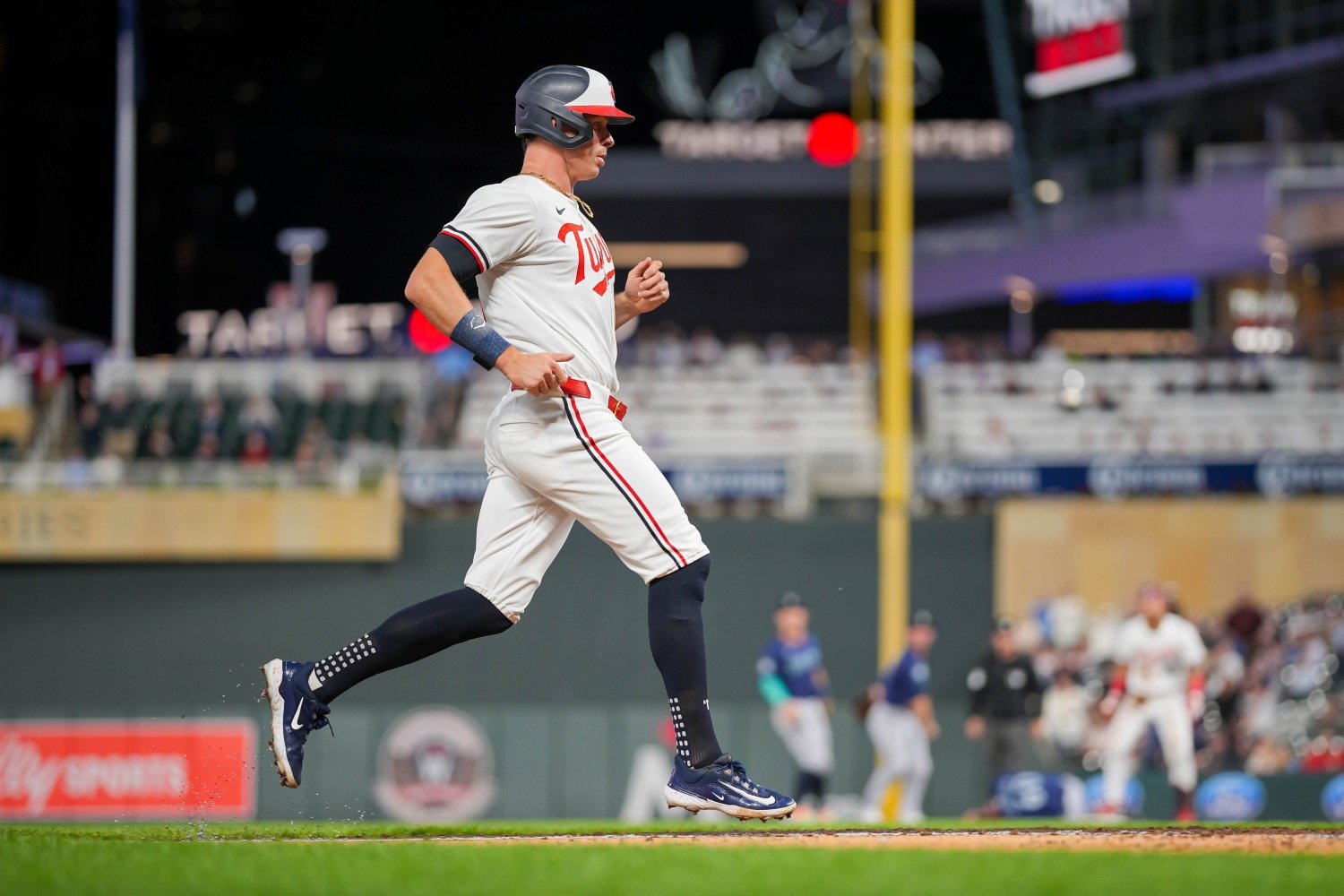 For those who didn't see the Twins' 10-6 loss to the Mariners Tuesday night, here's all you need to know to catch up for this particular piece: In the bottom of the eighth inning, on a dribbler to the right side of the diamond, Austin Martin legged out an infield single. In the process, he slid headfirst, trying to avoid both a potential tag and a potential collision with Mariners pitcher Taylor Saucedo, but (in one of those cruel twists that fate sometimes dispenses, on diamonds and elsewhere) he ended up causing an injury, instead. Martin slid into Saucedo, who badly injured his knee and crumpled to the ground. Max Kepler was at third base, having scampered there from his starting station at second when the ball went to the right side. The score was 6-5 Mariners, at the time, and as Saucedo fell and the ball rolled away, Kepler briefly hesitated, then took off for home plate. He scored the tying run, uncontested. As far as it goes, that's a reasonable stance. It's an especially tough call late in a close game. Kepler's run was important, and in this day and age, we (regrettably) have to consider the implications for the perceived integrity of the contest if a player doesn't seize every opportunity to score, given the way the league facilitates and even invites gambling on its product. Kepler's wiring, and that of Tommy Watkins, told him scoring there was non-optional. I want to make something clear, though: he did have a choice. In that moment, even though it was impossible to know whether Saucedo's injury will be career-altering and no reason to think it will be life-altering, he could have stopped and let Saucedo be more important than the tying run. We can, and I think we should, make other people more important than the vehicles through which we interact with them, like sports or business transactions or parties or city buses. It's not Martin's fault that Saucedo got hurt, and Kepler is more right than he is wrong about what the majority of people inside Target Field Tuesday night expected of him once Saucedo went down. I just think we should change that. In our society, the broad assumption is that other people's misfortune is (if not their own fault) their own problem. In many, many instances throughout our daily lives, we instinctively reject the notion that those misfortunes should be allowed to inconvenience us--partially because we fear (with some sound basis) that no one would allow our misfortune to inconvenience them, were the roles reversed. Sports are an especially (even unavoidably) dog-eat-dog world. They're partially about finding out who wants it more, and that makes it especially hard to prioritize people over runs and points and wins in moments like that one. Sports aren't as valuable or engaging if we permit the possibility that anything else matters more than winning. It does, though. In that moment, Kepler could have stayed at third. He didn't do anything wrong, by our current norms and expectations. Nonetheless, I think he missed an opportunity to do something truly right--or, maybe, righteous. He'd have been at third with one out, anyway. He might well have still come around to score, although we can't come anywhere near assuming he would have. It doesn't matter. I want to call this out now, so that next time a similar situation arises, we can come a little bit closer to expecting better of people. Eventually, we can play a version of sports in which everyone wants to win, and everyone knows it, but everyone also understands when someone's pain (or triumph) transcends the outcome of a given game or inning. I don't think we're all that close to that, yet, but we should try to get there.
 -
Sport is never more important than when it demands our full humanity, but even in those moments, it also applies pressure to that humanity. It's a game. Someone has to win. How badly can you want it, before you want it too much? As far as it goes, that's a reasonable stance. It's an especially tough call late in a close game. Kepler's run was important, and in this day and age, we (regrettably) have to consider the implications for the perceived integrity of the contest if a player doesn't seize every opportunity to score, given the way the league facilitates and even invites gambling on its product. Kepler's wiring, and that of Tommy Watkins, told him scoring there was non-optional. I want to make something clear, though: he did have a choice. In that moment, even though it was impossible to know whether Saucedo's injury will be career-altering and no reason to think it will be life-altering, he could have stopped and let Saucedo be more important than the tying run. We can, and I think we should, make other people more important than the vehicles through which we interact with them, like sports or business transactions or parties or city buses. It's not Martin's fault that Saucedo got hurt, and Kepler is more right than he is wrong about what the majority of people inside Target Field Tuesday night expected of him once Saucedo went down. I just think we should change that. In our society, the broad assumption is that other people's misfortune is (if not their own fault) their own problem. In many, many instances throughout our daily lives, we instinctively reject the notion that those misfortunes should be allowed to inconvenience us--partially because we fear (with some sound basis) that no one would allow our misfortune to inconvenience them, were the roles reversed. Sports are an especially (even unavoidably) dog-eat-dog world. They're partially about finding out who wants it more, and that makes it especially hard to prioritize people over runs and points and wins in moments like that one. Sports aren't as valuable or engaging if we permit the possibility that anything else matters more than winning. It does, though. In that moment, Kepler could have stayed at third. He didn't do anything wrong, by our current norms and expectations. Nonetheless, I think he missed an opportunity to do something truly right--or, maybe, righteous. He'd have been at third with one out, anyway. He might well have still come around to score, although we can't come anywhere near assuming he would have. It doesn't matter. I want to call this out now, so that next time a similar situation arises, we can come a little bit closer to expecting better of people. Eventually, we can play a version of sports in which everyone wants to win, and everyone knows it, but everyone also understands when someone's pain (or triumph) transcends the outcome of a given game or inning. I don't think we're all that close to that, yet, but we should try to get there. View full article
-
I think the key thing is, they clearly don't have a good alternative to Margot in house at the moment. (Keirsey truthers, I see you. I just think you're wrong.) So the question is, do they have sufficient surplus somewhere to make a need-for-need trade with someone who might have a surplus of righty outfield bats? Where would they trade from to upgrade that role on the roster? Maybe they could get someone interested in a particular high-minors arm?
-
Could you make that argument? I guess so. Would it be a good-faith argument, and is it in any serious way the same as the argument I made? Well. I'll let you answer that one. C'mon man.
-
You know, I almost mentioned this in the piece, but now I'm glad I didn't. I like that we have a chance to kick it around here. Here's my take on that: You don't actually want to call your best reliever in just to target a team's best hitters, and their best hitters only. It can be a waste of them, and it can also take an undue toll on them. I think if you task Duran with always facing the other team's best, you'll see him wear down more, and he might feel (justifiably!) frustrated by the dent it could put in his numbers, even if it didn't dent the value he actually provides for the team. As I *did* say in the article, I see some unique characteristics of that game and that lineup that are unlikely to repeat often, but I sort of love the creativity and balance in the approach Baldelli took. You do get him against their toughest hitter, in Rodríguez, but you also don't maximize the stress of the outing for him, and you have a pretty darn good chance of getting through the inning in three batters, as we saw happen. Had he not gotten them 1-2-3, of course, he *would* have stayed in to face the next two or three hitters, so in any scenario wherein the Mariners mounted a major comeback, it would be Duran on the mound to deal with it, right? I get what you're saying. But I dug this move and I'm interested to see what variants on it Baldelli tries in the future.
-
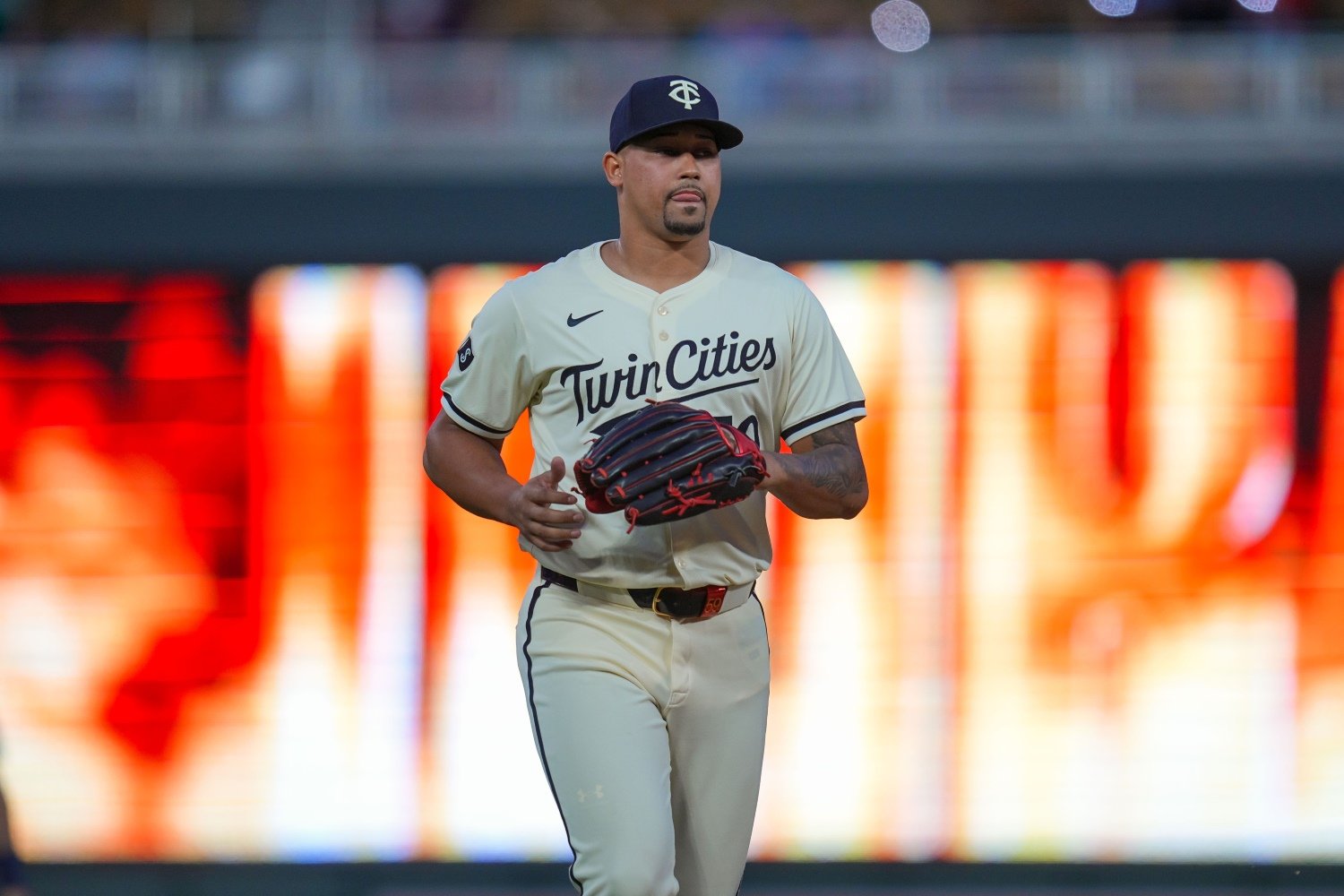 It was a bit strange to see Baldelli turn to Jhoan Duran for the eighth inning Monday night against the Seattle Mariners. The Twins did have a narrow lead, and he'd already used Griffin Jax for the seventh, as the Mariners had sent up the heart of their lineup. Because Jax had an uneven game and had to face six batters to escape that frame, the eighth and ninth hitters were due up for Seattle. Normally, if the Twins are going to turn to Duran before the ninth inning, you'd expect it to be because the meat of the opposing lineup is coming up. Dylan Moore and Josh Rojas don't exactly constitute a threat, and on one level, bringing in a pitcher as good as Duran just to get out Julio Rodríguez at the end of that sequence seems like overkill. Again, though, Jax had already been used, and bringing him back for a second inning of work didn't seem like a viable option--particularly given how his one inning of work had gone. With Brock Stewart on the injured list, the relief pitcher Baldelli trusts most (beyond Jax and Duran) is Caleb Thielbar. Rojas is a left-handed batter, but Moore and Rodríguez are both righties. It's easy to understand why Baldelli didn't want to have Thielbar face that particular set of hitters, at a point when any run allowed would make the ninth inning harder for whichever pitcher came in thereafter. It feels as though this move was primarily determined by the three-batter minimum rule. Baldelli knew that if he brought in Thielbar, he would not be able to remove him until after Rodríguez's plate appearance. Rodríguez might be off to a tough start, but on talent, he's a one-man heart of the lineup. In a tight game, the margin for error was too small to be locked into a bad matchup with him. In effect, Baldelli was trying to put out a fire before it could start, and the best way to do so was to turn to his flamethrowing relief ace. The situations in which the three-batter minimum alters the order in which a skipper calls upon their high-leverage relievers figure to be few, but when they come up, they're interesting. It's also fun to think along with Baldelli in this way. He wasn't waiting for trouble to start, but nor was he managing unduly nervously. Given that Jax wasn't going to come back for the eighth, Baldelli only had that one moment, going into the inning, to select the right matchup for Rodríguez. That meant using his closer an inning early, but so be it. My guess is that, if the Twins bullpen is ever at full strength (that is to say, if they have Stewart back; Jax and Duran intact; and Thielbar, Justin Topa, and the rest of their best available), this kind of decision would look different. To preserve and protect Duran, it makes sense to keep using him as a closer in many situations. Given Stewart's health history, Thielbar's age, and more, though, it's not all that likely that the pen will be so robust at any time this year. This situation, with its combination of constraints and opportunity, might not come up again, but we might keep seeing scenarios in which using Duran earlier in games is either necessary or expedient. It was good enough for a clean and relatively easy win Monday night, at least.
 -
Rocco Baldelli has used Jhoan Duran in some interesting ways since the fireballer returned to the Twins bullpen last week. Briefly a traditional closer with non-traditional stuff, Duran is now getting looks in a former role--or perhaps a whole new version of it. Image courtesy of © Brad Rempel-USA TODAY Sports It was a bit strange to see Baldelli turn to Jhoan Duran for the eighth inning Monday night against the Seattle Mariners. The Twins did have a narrow lead, and he'd already used Griffin Jax for the seventh, as the Mariners had sent up the heart of their lineup. Because Jax had an uneven game and had to face six batters to escape that frame, the eighth and ninth hitters were due up for Seattle. Normally, if the Twins are going to turn to Duran before the ninth inning, you'd expect it to be because the meat of the opposing lineup is coming up. Dylan Moore and Josh Rojas don't exactly constitute a threat, and on one level, bringing in a pitcher as good as Duran just to get out Julio Rodríguez at the end of that sequence seems like overkill. Again, though, Jax had already been used, and bringing him back for a second inning of work didn't seem like a viable option--particularly given how his one inning of work had gone. With Brock Stewart on the injured list, the relief pitcher Baldelli trusts most (beyond Jax and Duran) is Caleb Thielbar. Rojas is a left-handed batter, but Moore and Rodríguez are both righties. It's easy to understand why Baldelli didn't want to have Thielbar face that particular set of hitters, at a point when any run allowed would make the ninth inning harder for whichever pitcher came in thereafter. It feels as though this move was primarily determined by the three-batter minimum rule. Baldelli knew that if he brought in Thielbar, he would not be able to remove him until after Rodríguez's plate appearance. Rodríguez might be off to a tough start, but on talent, he's a one-man heart of the lineup. In a tight game, the margin for error was too small to be locked into a bad matchup with him. In effect, Baldelli was trying to put out a fire before it could start, and the best way to do so was to turn to his flamethrowing relief ace. The situations in which the three-batter minimum alters the order in which a skipper calls upon their high-leverage relievers figure to be few, but when they come up, they're interesting. It's also fun to think along with Baldelli in this way. He wasn't waiting for trouble to start, but nor was he managing unduly nervously. Given that Jax wasn't going to come back for the eighth, Baldelli only had that one moment, going into the inning, to select the right matchup for Rodríguez. That meant using his closer an inning early, but so be it. My guess is that, if the Twins bullpen is ever at full strength (that is to say, if they have Stewart back; Jax and Duran intact; and Thielbar, Justin Topa, and the rest of their best available), this kind of decision would look different. To preserve and protect Duran, it makes sense to keep using him as a closer in many situations. Given Stewart's health history, Thielbar's age, and more, though, it's not all that likely that the pen will be so robust at any time this year. This situation, with its combination of constraints and opportunity, might not come up again, but we might keep seeing scenarios in which using Duran earlier in games is either necessary or expedient. It was good enough for a clean and relatively easy win Monday night, at least. View full article
-
For the entire duration of Rocco Baldelli's tenure, the Minnesota Twins have focused on elevating the ball. Traditionally, the most available way to measure that emphasis is to break batted balls up into ground balls, line drives, and fly balls. Let's break with tradition. Image courtesy of © Jordan Johnson-USA TODAY Sports Ask anyone who has worked at length with batted-ball data, detailed versions of which go back more than 20 years, and they'll roll their eyes and inveigh against the bane of every such analyst's existence: line-drive rates. What counts as a line drive? How far from home plate must it get before bouncing, in order to avoid being tabulated as a ground ball? How high can it get before it's functionally a fly ball? For a long, long time, baseball people who wanted to get their arms around the value of various batted-ball profiles had to accept a deeply imperfect data set, stained not only with subjectivity, but with outright (and essentially unavoidable) bias. The stringers and video scouts tasked with classifying batted balls were not only forced to make a lot of tough calls (imagine if there were a half-dozen plays a game on which the official scorer could credibly call either a hit or an error), but also very likely to be swayed by the outcomes. If a ball dropped in front of an outfielder, it was always more likely to be counted as a liner than as a fly ball. If a ball that first bounced near the edge of the infield apron went through, it was frequently labeled a liner. If it was picked and the batter was retired, it was usually a ground ball. Then, too, there was the simple problem that line drives are less frequent than either grounders or flies. The league's average breakdown fluctuates and evolves, of course, but it has tended to break down along the lines of 40-20-40. Everyone knows line drives are the best type of batted ball, but is it worth chasing them if they're only half as likely as either of the other types? The advent of Statcast brought in the option to work around this, and both the league and the community of analysts have done that, to some extent. We now have the launch angle of every batted ball, throughout the league. By and large, though, that 40-20-40 distribution has remained. What if we did away with it? View full article
-
The Minnesota Twins and a New Way to Break Down Batted-Ball Data
Matthew Trueblood posted an article in Caretakers
.png.31e8486dc0379e2740fa1abd1ea1b934.png) Ask anyone who has worked at length with batted-ball data, detailed versions of which go back more than 20 years, and they'll roll their eyes and inveigh against the bane of every such analyst's existence: line-drive rates. What counts as a line drive? How far from home plate must it get before bouncing, in order to avoid being tabulated as a ground ball? How high can it get before it's functionally a fly ball? For a long, long time, baseball people who wanted to get their arms around the value of various batted-ball profiles had to accept a deeply imperfect data set, stained not only with subjectivity, but with outright (and essentially unavoidable) bias. The stringers and video scouts tasked with classifying batted balls were not only forced to make a lot of tough calls (imagine if there were a half-dozen plays a game on which the official scorer could credibly call either a hit or an error), but also very likely to be swayed by the outcomes. If a ball dropped in front of an outfielder, it was always more likely to be counted as a liner than as a fly ball. If a ball that first bounced near the edge of the infield apron went through, it was frequently labeled a liner. If it was picked and the batter was retired, it was usually a ground ball. Then, too, there was the simple problem that line drives are less frequent than either grounders or flies. The league's average breakdown fluctuates and evolves, of course, but it has tended to break down along the lines of 40-20-40. Everyone knows line drives are the best type of batted ball, but is it worth chasing them if they're only half as likely as either of the other types? The advent of Statcast brought in the option to work around this, and both the league and the community of analysts have done that, to some extent. We now have the launch angle of every batted ball, throughout the league. By and large, though, that 40-20-40 distribution has remained. What if we did away with it?
Ask anyone who has worked at length with batted-ball data, detailed versions of which go back more than 20 years, and they'll roll their eyes and inveigh against the bane of every such analyst's existence: line-drive rates. What counts as a line drive? How far from home plate must it get before bouncing, in order to avoid being tabulated as a ground ball? How high can it get before it's functionally a fly ball? For a long, long time, baseball people who wanted to get their arms around the value of various batted-ball profiles had to accept a deeply imperfect data set, stained not only with subjectivity, but with outright (and essentially unavoidable) bias. The stringers and video scouts tasked with classifying batted balls were not only forced to make a lot of tough calls (imagine if there were a half-dozen plays a game on which the official scorer could credibly call either a hit or an error), but also very likely to be swayed by the outcomes. If a ball dropped in front of an outfielder, it was always more likely to be counted as a liner than as a fly ball. If a ball that first bounced near the edge of the infield apron went through, it was frequently labeled a liner. If it was picked and the batter was retired, it was usually a ground ball. Then, too, there was the simple problem that line drives are less frequent than either grounders or flies. The league's average breakdown fluctuates and evolves, of course, but it has tended to break down along the lines of 40-20-40. Everyone knows line drives are the best type of batted ball, but is it worth chasing them if they're only half as likely as either of the other types? The advent of Statcast brought in the option to work around this, and both the league and the community of analysts have done that, to some extent. We now have the launch angle of every batted ball, throughout the league. By and large, though, that 40-20-40 distribution has remained. What if we did away with it? -
The Minnesota Twins announced Wednesday night that their Thursday afternoon starter would be rookie Simeon Woods Richardson. Is this finally the time that the up-and-down prospect gets a chance to stick around a while? Image courtesy of © Jesse Johnson-USA TODAY Sports When Simeon Woods Richardson started half of a rain-necessitated doubleheader for the Twins earlier this month, it marked the third season in which he's made an appearance for the team. When they sent him back down to Triple-A St. Paul immediately afterward, it marked the third time that the visit to the big leagues had lasted exactly one outing. Woods Richardson's career has seen a lot of change and a lot of peaks and valleys already, but this time, he might stick on the MLB roster for a little while. Earlier this week, the Twins demoted Louie Varland to St. Paul, ending a failed experiment to make him one of their back-end starters this season. Woods Richardson is taking the first start in the rotation vacancy created by that change, and he's positioned himself to be taken seriously as a candidate to keep this job for a while. Our John Bonnes wrote about the boost in Woods Richardson's velocity this year back in spring training. After a disappointing 2023 in which he and the Twins tried to reinvent him by giving him a very cutterish fastball and saw his velocity slip south of 90 miles per hour, he came to Fort Myers throwing freer and more naturally, and the ball started exploding out of his hand. Woods Richardson's average fastball velocity this year is 93 miles per hour, and he's touched 95 more than once. He doesn't have a radical shape on the pitch anymore, but it's still shown good cut-ride action. This is how Woods Richardson had success against the Tigers in Detroit two weeks ago; that newfound velocity is the foundation for everything. The rest of his arsenal is also interesting, though, and could be good enough to keep him ahead of the adjustment curve for a bit as he matriculates to the majors in a more complete way. He doesn't have an elite collection of secondary pitches. Woods Richardson's slider is a bit like a cutter, really. It's thrown 85-88 miles per hour, with some unusual lift for a slider but plenty of movement separation from the fastball. One way to see why it's unusual is to study the direction of the spin he imparts out of the hand, on all his pitches. The idea with charts like this is to communicate the direction of spin around a clock, akin to going around a baseball. Vertical breaking balls (like Woods Richardson's curveball, hanging off the bottom of the clock) have topspin, and thus tend to have a lot of downward movement. Some sliders are basically hard curves, with spin direction almost that low. More often, they're on the side of the clock (it'd be on the left side, between 8 and 10 o'clock, for a righty like Woods Richardson), showing the sidespin that creates horizontal sweep on the pitch. Not so for Woods Richardson. His slider has something close to true backspin, like a four-seam fastball--or, more saliently, like many pitchers' cutters. It looks more like a fastball out of the hand this way, but the movement separation between the two offerings should tend to be smaller than for a slider with notably disparate spin direction from a guy's fastball. As we've seen, though, there's a fair amount of that separation for Woods Richardson. Let's put that separation onto the same clock-style diagram, to visualize it better. (These charts are based solely on spin and/or movement direction and the frequency of pitches that move that way; don't confuse the size of a bar with the magnitude of movement.) Because of Woods Richardson's arm slot, and thanks to the way he positions the seams as he grips his slider, the ball swerves more than the spin tells the hitter it will. That's a good thing. There's still a lack of vertical differential between the two offerings and a smallish velocity gap to consider, and those things will cap the swing-and-miss potential of the pitch, but Woods Richardson should be able to be effective with this fastball-slider tandem. There's a bit more in the way of bad news about his curveball and changeup. The curve has a lovely, aesthetically pleasing shape, but because it sits in the mid-70s, the hitter has a lot of time to recognize it and hold back, or adjust their swing. When he deploys it well in sequence, he can and does steal called strikes with the curve, but he hasn't gotten a whiff on that pitch all year, in MLB or Triple-A. The changeup, meanwhile, does give an opposite-handed hitter a cue right out of Woods Richardson's hand; his spin direction on the change is noticeably different than on the fastball. The best changeups either create a huge amount of movement separation or disguise themselves well by having a similar spin axis out of the hand, then tailing off the fastball's line because of seam orientation and the way the seams interact with the air. Woods Richardson doesn't have either thing going for him, so he has to sell the change with his arm action and command it finely. I would expect the tall righty to have a hard time against left-handed batters for a while in MLB. So far, taking both levels of competition together, lefties have posted a .353 wOBA against Woods Richardson, while he's held righties to an anemic .227. He's made enough changes to give himself a legitimate chance to survive as a starter, though, and given the level of the Twins' current need, that might be enough to earn Woods Richardson a window within which to make further adjustments. View full article
-
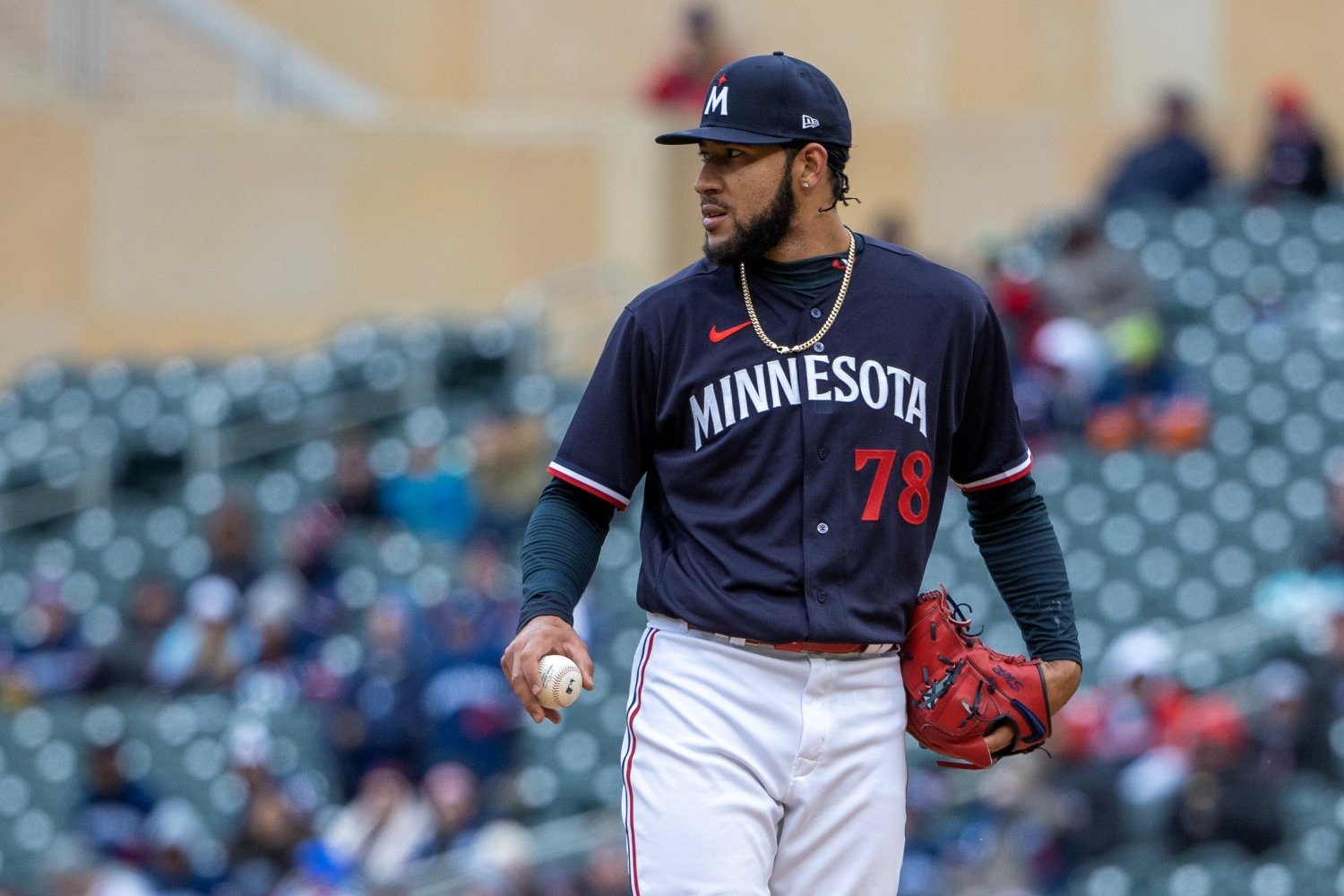 When Simeon Woods Richardson started half of a rain-necessitated doubleheader for the Twins earlier this month, it marked the third season in which he's made an appearance for the team. When they sent him back down to Triple-A St. Paul immediately afterward, it marked the third time that the visit to the big leagues had lasted exactly one outing. Woods Richardson's career has seen a lot of change and a lot of peaks and valleys already, but this time, he might stick on the MLB roster for a little while. Earlier this week, the Twins demoted Louie Varland to St. Paul, ending a failed experiment to make him one of their back-end starters this season. Woods Richardson is taking the first start in the rotation vacancy created by that change, and he's positioned himself to be taken seriously as a candidate to keep this job for a while. Our John Bonnes wrote about the boost in Woods Richardson's velocity this year back in spring training. After a disappointing 2023 in which he and the Twins tried to reinvent him by giving him a very cutterish fastball and saw his velocity slip south of 90 miles per hour, he came to Fort Myers throwing freer and more naturally, and the ball started exploding out of his hand. Woods Richardson's average fastball velocity this year is 93 miles per hour, and he's touched 95 more than once. He doesn't have a radical shape on the pitch anymore, but it's still shown good cut-ride action. This is how Woods Richardson had success against the Tigers in Detroit two weeks ago; that newfound velocity is the foundation for everything. The rest of his arsenal is also interesting, though, and could be good enough to keep him ahead of the adjustment curve for a bit as he matriculates to the majors in a more complete way. He doesn't have an elite collection of secondary pitches. Woods Richardson's slider is a bit like a cutter, really. It's thrown 85-88 miles per hour, with some unusual lift for a slider but plenty of movement separation from the fastball. One way to see why it's unusual is to study the direction of the spin he imparts out of the hand, on all his pitches. The idea with charts like this is to communicate the direction of spin around a clock, akin to going around a baseball. Vertical breaking balls (like Woods Richardson's curveball, hanging off the bottom of the clock) have topspin, and thus tend to have a lot of downward movement. Some sliders are basically hard curves, with spin direction almost that low. More often, they're on the side of the clock (it'd be on the left side, between 8 and 10 o'clock, for a righty like Woods Richardson), showing the sidespin that creates horizontal sweep on the pitch. Not so for Woods Richardson. His slider has something close to true backspin, like a four-seam fastball--or, more saliently, like many pitchers' cutters. It looks more like a fastball out of the hand this way, but the movement separation between the two offerings should tend to be smaller than for a slider with notably disparate spin direction from a guy's fastball. As we've seen, though, there's a fair amount of that separation for Woods Richardson. Let's put that separation onto the same clock-style diagram, to visualize it better. (These charts are based solely on spin and/or movement direction and the frequency of pitches that move that way; don't confuse the size of a bar with the magnitude of movement.) Because of Woods Richardson's arm slot, and thanks to the way he positions the seams as he grips his slider, the ball swerves more than the spin tells the hitter it will. That's a good thing. There's still a lack of vertical differential between the two offerings and a smallish velocity gap to consider, and those things will cap the swing-and-miss potential of the pitch, but Woods Richardson should be able to be effective with this fastball-slider tandem. There's a bit more in the way of bad news about his curveball and changeup. The curve has a lovely, aesthetically pleasing shape, but because it sits in the mid-70s, the hitter has a lot of time to recognize it and hold back, or adjust their swing. When he deploys it well in sequence, he can and does steal called strikes with the curve, but he hasn't gotten a whiff on that pitch all year, in MLB or Triple-A. The changeup, meanwhile, does give an opposite-handed hitter a cue right out of Woods Richardson's hand; his spin direction on the change is noticeably different than on the fastball. The best changeups either create a huge amount of movement separation or disguise themselves well by having a similar spin axis out of the hand, then tailing off the fastball's line because of seam orientation and the way the seams interact with the air. Woods Richardson doesn't have either thing going for him, so he has to sell the change with his arm action and command it finely. I would expect the tall righty to have a hard time against left-handed batters for a while in MLB. So far, taking both levels of competition together, lefties have posted a .353 wOBA against Woods Richardson, while he's held righties to an anemic .227. He's made enough changes to give himself a legitimate chance to survive as a starter, though, and given the level of the Twins' current need, that might be enough to earn Woods Richardson a window within which to make further adjustments.
 -
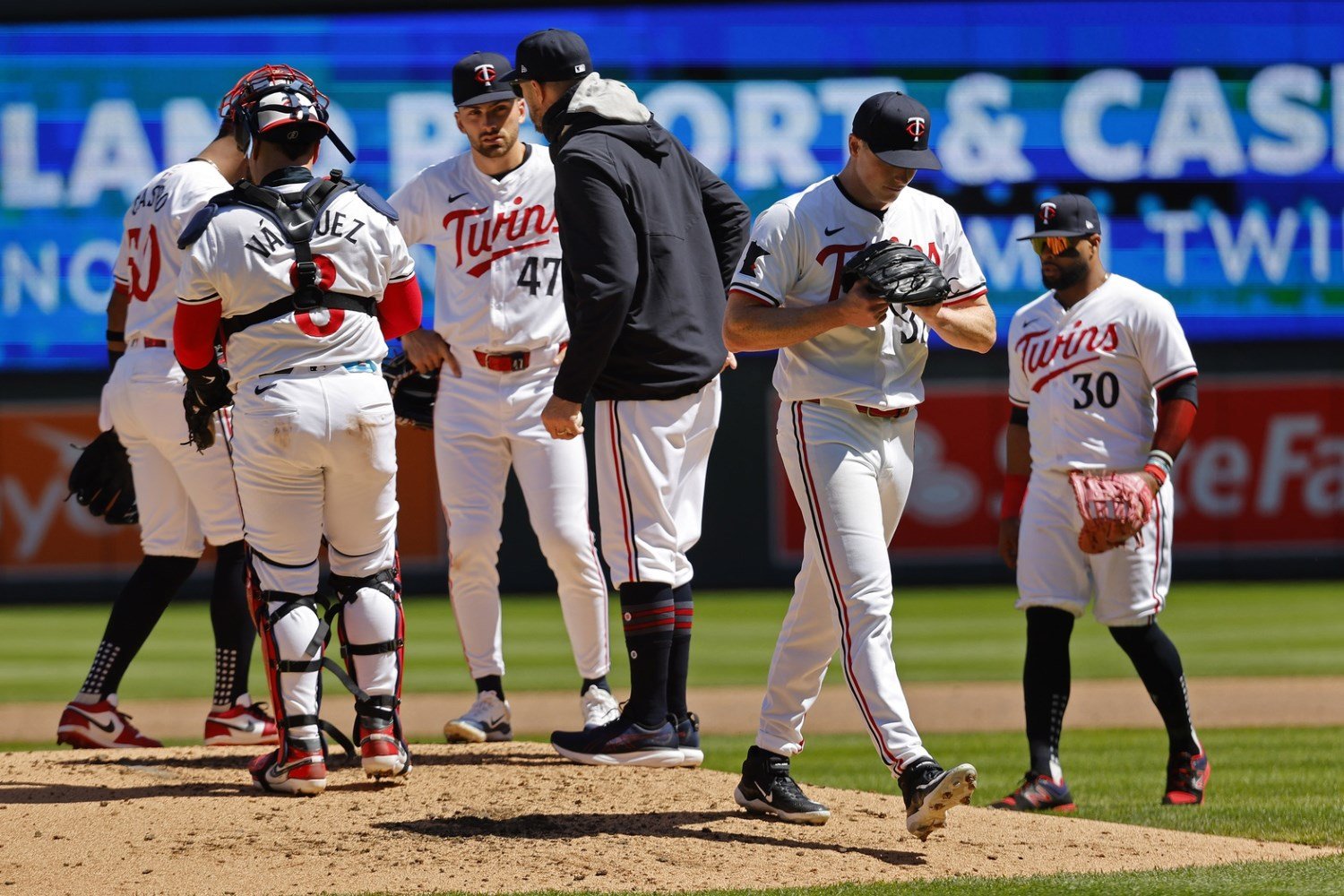 Don't take Louie Varland's intensity, his work ethic, or his open-minded efforts to fix what went wrong for him last year for granted. The Twins have had multiple pitching prospects fall by the wayside over the past half-decade because they lacked those very qualities, and the fact that Varland is (by all accounts) desperate to be great will serve him well in the difficult weeks ahead. Those trials are no longer avoidable, though. Manager Rocco Baldelli demurred on Varland's status as a member of the team's starting rotation after the latest in a string of brutal outings to begin what has been a brutal season in Twins Territory Sunday. It was a message sent as much in the reticence as in the recitation, because Baldelli's default posture is to back up and build up a struggling player. He knows his team can't continue to scramble for coverage early in what become blowout losses twice each time through the rotation, though, and for multiple reasons, demoting Varland (probably to Triple-A St. Paul, where he can remain stretched out and try to answer the troubling questions raised by this early turbulence) is much easier and more likely than doing the same with the unimpressive Chris Paddack. Varland has a 9.18 ERA, and the Twins have lost all four of his starts. His velocity is actually up about one mile per hour, relative to his time as a starter last season, but it's done no good whatsoever. Other than that theoretical bit of good news, there is no good news at all. Of the 175 pitchers who have faced at least 50 batters this year, only 17 have a lower whiff rate on opponents' swings than Varland has. Only two hurlers have a lower chase rate on pitches outside the strike zone. As we well documented this spring, Varland worked hard at some changes to his arsenal this winter that were designed to make him a more viable starter. He added a sinker, and he swapped out the sweeper he used in 2023 for a curveball, with a much more vertical movement profile. The sinkers were supposed to keep right-handed hitters honest, and looking inside more often. The curves were supposed to help him achieve greater split neutrality. He's hardly thrown the sinker, which is a problem, but we'll come back to it shortly. The change of breaking ball profiles has worked out nicely, in a vacuum: the curve is outperforming last year's sweeper. His changeup, too, is getting fine results. It's just that everyone--lefties, righties, everyone--is obliterating Varland's four-seam fastball and cutter. It's clear that Varland never got comfortable with the sinker, and while the Twins are trying not to be as mono-fastball as they've been for the last handful of years, they're still not going to be the team forcing a pitcher to go that direction. They like fastballs, especially ones with average ride from a low release point and with great extension, like Varland's. His four-seamer is, in some ways, what the Twins want all of their hurlers' fastballs to look like. That's what makes this so scary. The heater itself hasn't changed shape this year, and as we said before, it's coming in harder. Hitters are hammering it, though, because Varland lacks command of the pitch. It wanders over the heart of the plate sometimes, and it misses the zone altogether sometimes. It rarely finds the nice, pitcher-friendly edges of the zone, this year. His cutter has a bit more of a concrete issue with which to deal. That pitch has taken on a bit more velocity and a bit more horizontal movement. He's been trying to use it in the place of the sweeper from last year, against righties. He keeps missing with it to his arm side, which means right over the middle of the plate. Ditto for lefties, because he's trying to jam them with the pitch inside. The results, all the way around, are a devastating failure. A sinker might, at least, engender a bit lower-quality contact. I spun up a statistic to measure the inverse of the sweet spot rate you sometimes see cited for hitters. It's the percentage of a pitcher's opponents' batted balls that leave the bat at an angle either below -10 degrees or above 45. Anything hit that way tends to turn into an easy grounder or a can of corn, so I named this metric Harmless %. Of the 175 pitchers mentioned above, Varland's Harmless % for 2024 ranks dead last. Hitters are generating power against him, and when they hit him hard, they're doing it right in the band of launch angles within which the damage is greatest. This might yet be fixable, but there's a long road ahead for Varland. He's unlikely to find the same success as a starter that he had as a reliever, without changing his mix to reflect the different realities of those jobs. As enticing as the cutter seemed last year, it's not working in longer outings, without a triple-digit fastball to set it up. It'll be interesting to see whether the Twins elect to test their charge's feel a bit, by having him bring back the sweeper but keep the curve. A four-seamer like Varland's could set up the sweeper to righties and the curve to lefties, without much need for the cutter. The changeup is just enough of a wrench in the works against lefties, and the sweeper and curve can work to righties in tandem, with the right pitch-calling. None of this will matter if he can't find a way to get outs with his fastball, but there's still plenty here. The Twins need to ask Varland to put the pieces of the puzzle back together elsewhere, but he's unlikely to fall out of their plans for the rest of the season. He just needs a chance to reset and evaluate the mistakes mixed into his latest round of adjustments.
 -
As badly as everyone wanted it to work for the Minnesota Twins' homegrown, home-state righthander in the starting rotation for 2024, he seems destined for a tune-up at the other end of the Green Line. What does he need to fix to find success again in MLB? Image courtesy of © Bruce Kluckhohn-USA TODAY Sports Don't take Louie Varland's intensity, his work ethic, or his open-minded efforts to fix what went wrong for him last year for granted. The Twins have had multiple pitching prospects fall by the wayside over the past half-decade because they lacked those very qualities, and the fact that Varland is (by all accounts) desperate to be great will serve him well in the difficult weeks ahead. Those trials are no longer avoidable, though. Manager Rocco Baldelli demurred on Varland's status as a member of the team's starting rotation after the latest in a string of brutal outings to begin what has been a brutal season in Twins Territory Sunday. It was a message sent as much in the reticence as in the recitation, because Baldelli's default posture is to back up and build up a struggling player. He knows his team can't continue to scramble for coverage early in what become blowout losses twice each time through the rotation, though, and for multiple reasons, demoting Varland (probably to Triple-A St. Paul, where he can remain stretched out and try to answer the troubling questions raised by this early turbulence) is much easier and more likely than doing the same with the unimpressive Chris Paddack. Varland has a 9.18 ERA, and the Twins have lost all four of his starts. His velocity is actually up about one mile per hour, relative to his time as a starter last season, but it's done no good whatsoever. Other than that theoretical bit of good news, there is no good news at all. Of the 175 pitchers who have faced at least 50 batters this year, only 17 have a lower whiff rate on opponents' swings than Varland has. Only two hurlers have a lower chase rate on pitches outside the strike zone. As we well documented this spring, Varland worked hard at some changes to his arsenal this winter that were designed to make him a more viable starter. He added a sinker, and he swapped out the sweeper he used in 2023 for a curveball, with a much more vertical movement profile. The sinkers were supposed to keep right-handed hitters honest, and looking inside more often. The curves were supposed to help him achieve greater split neutrality. He's hardly thrown the sinker, which is a problem, but we'll come back to it shortly. The change of breaking ball profiles has worked out nicely, in a vacuum: the curve is outperforming last year's sweeper. His changeup, too, is getting fine results. It's just that everyone--lefties, righties, everyone--is obliterating Varland's four-seam fastball and cutter. It's clear that Varland never got comfortable with the sinker, and while the Twins are trying not to be as mono-fastball as they've been for the last handful of years, they're still not going to be the team forcing a pitcher to go that direction. They like fastballs, especially ones with average ride from a low release point and with great extension, like Varland's. His four-seamer is, in some ways, what the Twins want all of their hurlers' fastballs to look like. That's what makes this so scary. The heater itself hasn't changed shape this year, and as we said before, it's coming in harder. Hitters are hammering it, though, because Varland lacks command of the pitch. It wanders over the heart of the plate sometimes, and it misses the zone altogether sometimes. It rarely finds the nice, pitcher-friendly edges of the zone, this year. His cutter has a bit more of a concrete issue with which to deal. That pitch has taken on a bit more velocity and a bit more horizontal movement. He's been trying to use it in the place of the sweeper from last year, against righties. He keeps missing with it to his arm side, which means right over the middle of the plate. Ditto for lefties, because he's trying to jam them with the pitch inside. The results, all the way around, are a devastating failure. A sinker might, at least, engender a bit lower-quality contact. I spun up a statistic to measure the inverse of the sweet spot rate you sometimes see cited for hitters. It's the percentage of a pitcher's opponents' batted balls that leave the bat at an angle either below -10 degrees or above 45. Anything hit that way tends to turn into an easy grounder or a can of corn, so I named this metric Harmless %. Of the 175 pitchers mentioned above, Varland's Harmless % for 2024 ranks dead last. Hitters are generating power against him, and when they hit him hard, they're doing it right in the band of launch angles within which the damage is greatest. This might yet be fixable, but there's a long road ahead for Varland. He's unlikely to find the same success as a starter that he had as a reliever, without changing his mix to reflect the different realities of those jobs. As enticing as the cutter seemed last year, it's not working in longer outings, without a triple-digit fastball to set it up. It'll be interesting to see whether the Twins elect to test their charge's feel a bit, by having him bring back the sweeper but keep the curve. A four-seamer like Varland's could set up the sweeper to righties and the curve to lefties, without much need for the cutter. The changeup is just enough of a wrench in the works against lefties, and the sweeper and curve can work to righties in tandem, with the right pitch-calling. None of this will matter if he can't find a way to get outs with his fastball, but there's still plenty here. The Twins need to ask Varland to put the pieces of the puzzle back together elsewhere, but he's unlikely to fall out of their plans for the rest of the season. He just needs a chance to reset and evaluate the mistakes mixed into his latest round of adjustments. View full article
-
Didn't expect to read that headline before we even reached May Day, did you? But hey, maybe May Day is here, even while it's April on the calendar. Image courtesy of © David Reginek-USA TODAY Sports The 2024 season is off to a nightmarish start for the Minnesota Twins. They've lost their two best position players to injuries and the two guys they hoped would be upside plays at the back end of the starting rotation are showing off their downsides, instead, but worst of all, the team's offensive approach looks broken again. The Twins are 27th in MLB in wOBA and have the third-highest strikeout rate in the league. Coming into the season, we knew this team would strike out a lot. It's wired into their approach at the plate, and by consciously refusing to make major changes to that approach when the count reaches two strikes, they're leaning into the risk of strikeouts. When they're going right, though, they make up for that with the walks and power that are part of that same approach. They lay off pitches on the edges of the zone as a matter of policy, and if that means taking a lot of called third strikes, so be it. Philosophically, they want to wait for a pitch they can crush and then crush it. The good news, if you're feeling generous, is that that is working, as far as it goes. On four-seam fastballs, the Twins have the seventh-highest wOBA in MLB. They're second-best against curveballs, too. What are they looking for? Stuff without a lot of wiggle, that both starts and ends over the white of the plate. What happens when they get it? They hit it hard. The bad news, as you've already guessed, is everything else. The Twins are 29th in wOBA against sinkers, 27th against sliders and sweepers, and dead last against splitters and changeups. In Harmon Killebrew's time, executing this strategy this well would have led to one of the best offenses in baseball, because most pitchers threw fastballs that we'd now consider pretty straight, and paired it with curveballs. As any calendar and at least one grave marker will tell you, though, this is not Harmon Killebrew's time. How do you fix this problem? How do you take a studied and carefully crafted but insufficiently nuanced team approach and make it more flexible, more dynamic, and more effective? And how on Earth is the answer to that question a guy whom no one wanted to see be a lineup fixture until a handful of days ago? View full article


.png.cd292b5573b9767d9e9a0792e5a88bc4.png)
.png.28714689cae22f6f38efa0807bf22711.png)
.png.31e8486dc0379e2740fa1abd1ea1b934.png)
