



IndianaTwin
-
Posts
6,561 -
Joined
-
Last visited
-
Days Won
27
Content Type
Profiles
News
Minnesota Twins Videos
2026 Minnesota Twins Top Prospects Ranking
2022 Minnesota Twins Draft Picks
Minnesota Twins Free Agent & Trade Rumors, Notes, & Tidbits
Guides & Resources
2023 Minnesota Twins Draft Picks
The Minnesota Twins Players Project
2024 Minnesota Twins Draft Picks
2025 Minnesota Twins Draft Pick Tracker
2026 Minnesota Twins Draft Tracker: Picks & Bonuses
Forums
Blogs
Events
Store
Downloads
Gallery
Everything posted by IndianaTwin
-
Or to say it this way, the Twins ARE Lopez’s rough patch.
- 36 replies
-
- 2
-

-
- jose miranda
- sonny gray
- (and 3 more)
-
And that Brandon Hyde mismanaged the bullpen.
-
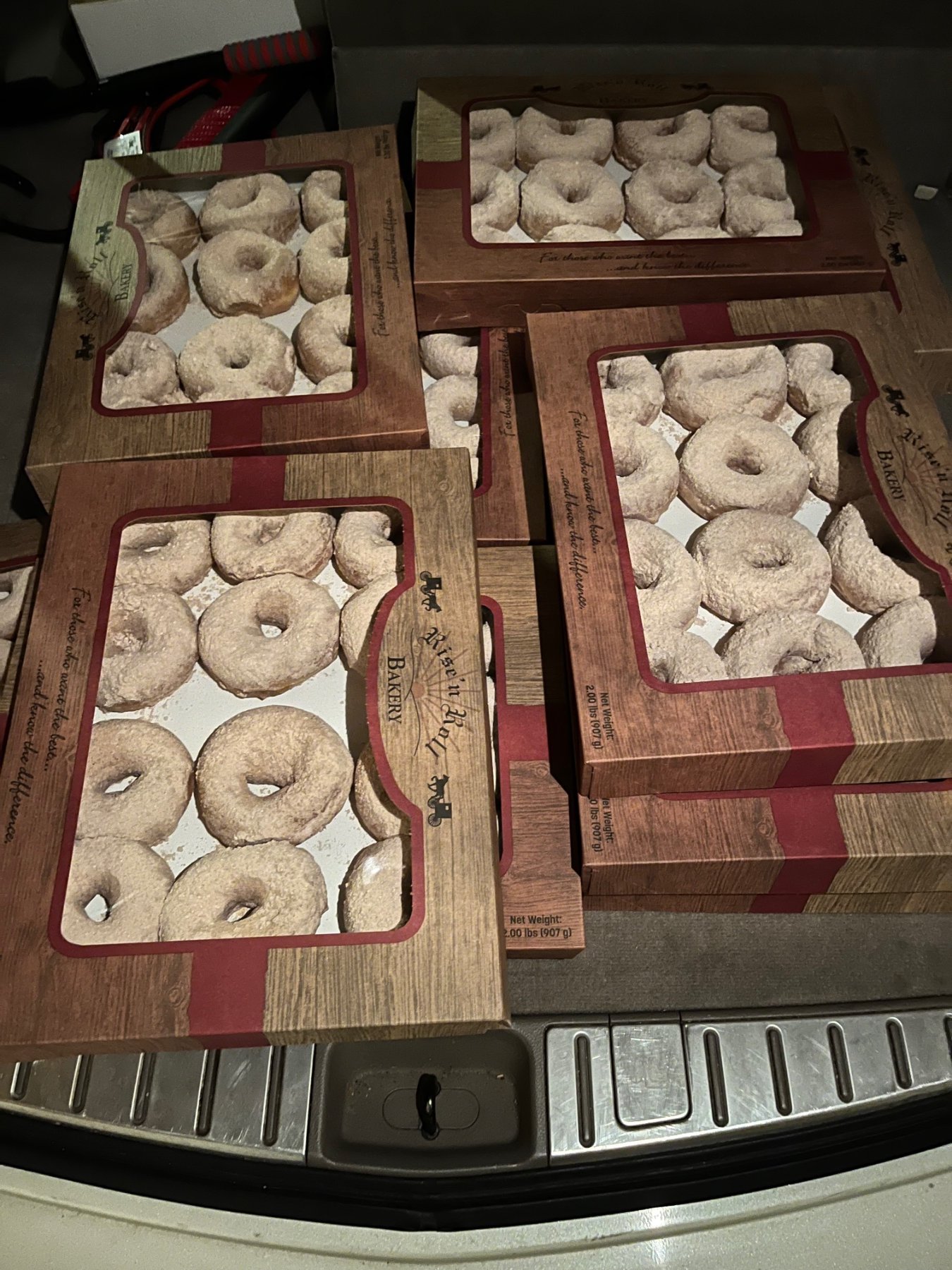
If you’re looking for some donuts, stop by my church this morning. Mrs IT is on the nominating committee, and this week they are providing donuts from the local Amish bakery as a thanks for all the folks who volunteer over the course of the year. (There may or may not be one missing from the 12 dozen that were in the car when I got up this morning.)
- 36 replies
-
- 2
-
-
- jose miranda
- sonny gray
- (and 3 more)
-
Miguel Sanó’s Looming Return
IndianaTwin replied to Cody Christie's topic in Twins Daily Front Page News
Yeah, what he said, much more succinctly than I did. Particular agreement with the part I bolded. -
Miguel Sanó’s Looming Return
IndianaTwin replied to Cody Christie's topic in Twins Daily Front Page News
I think it will mostly come down to health -- not so much his, but other people's. For Sano, when he does come back, it will be with a rehab assignment. With several days off along the way. A minor league rehab assignment can be as long as 20 days. With the amount of time he's had off, it's hard to imagine something less than seven days, even if he crushes the ball. Much more likely is that it will take most or all of the 20 days. And unless he's crushing the ball in the minors, it's hard to imagine them clearing a 26-man spot for him on the shorter end of the 7-20 day range. Unless someone gets hurt, which is where the first part of the health comes in. If someone does get hurt, then you can clear a spot for him. If not, I think he stays in St. Paul for the full 20 days. More on that later. Unless someone gets hurt on another team. If that happens, and if he's crushing it in St. Paul, then maybe there's a smidgen of trade interest on him, IF the other team doesn't have a minor leaguer of their own. But it's hard to imagine receiving much of anything for him in a trade. Teams won't view it as 1.3-1.4 seasons of control, because there's virtually no team that is going to pick up the option at that cost. And someone's going to have to pay the buyout. If the Twins make the other team do that, the prospect return is even smaller. It seems more likely that the Twins would have to send cash to cover the buyout, if not also part of this year's salary. That's a lot of "if" and "unless," making me think it's very unlikely that a trade happens. Which brings us back to the rehab scenario. There's no point, and no savings, in a DFA, other than being able to keeping someone else in his stead when he's required to come off the rehab assignment. So it's back to a Twins player's health, and I'm guessing they wait as long as they can to make a decision. That means doing as much rehab as you can before you start the 20-day clock, UNLESS someone gets hurt or starts to slump. Then, they can use the whole 20 days if they need to, making the decision on how he's performing vs. however someone with options is performing, calling him up when there's a sense that he can improve the team. By then, yeah, if nothing has opened up and he continues to struggle, you can go ahead and consider a DFA, but realistically, that's not going to happen before the trade deadline when you consider that the rehab hasn't started and can last 20 days. And related -- given how Kirilloff, Arraez and even Miranda have played, given how poorly Sano plays first, and given that they will want to Sano from a re-injury, it seems very unlikely that he will get even an inning of 1B, either in rehab or when/if he comes up. -
Two questions: 1. What have been the relative stats of the Twins bullpen in the first half vs the second half over the past several seasons? (My sense is that they have consistently been better in the second half.) 2. How does that improvement (if I remembered correctly) compare with the league average? I would suspect that the league average in the second half is typically better than in the first half, since other teams are also jettisoning flotsam in the second half.
-
Twins have a DH on Tuesday. That’ s a logical time to bring Winder back.
-
Ranking the Twins' Top-5 All-Star Candidates
IndianaTwin replied to Cody Christie's topic in Twins Daily Front Page News
Buxton could get chosen, but it’s really hard for me to see him actually go, when there’s a golden opportunity for extended rest. -
One Guy's Review of Globe Life Field
IndianaTwin commented on IndianaTwin's blog entry in Un/Necessary Sports Drivel
Check back in, and let us know where you agree/disagree. -
One Guy's Review of Globe Life Field
IndianaTwin commented on IndianaTwin's blog entry in Un/Necessary Sports Drivel
Definitely agree on the heat. We spent several days in Texas and were exhausted after moderate activity, but were pretty relaxed after the game. It definitely takes a toll, and I'm guessing the regularly going elsewhere and returning makes it difficult to acclimate. -
Another way to consider it is to look at WAR before they hit free agency, since that’s how long a drafting team can control a player. Seager and Gausman have reached free agency. Buxton is still playing his last controllable season, so he could easily pass the pre-FA total for those two. (By contrast, Olson still has more years before he would have reached FA.) Different question — are Buxton/Berrios the best combo, other than Correa and whoever the Astros picked next? If so, that’s noteworthy as well.
-
I wasn’t watching, but on the question of Smeltzer pitching the fifth, I would guess it was affected pretty dramatically by him having thrown 101 pitches the last time out.
-
One Guy's Review of Globe Life Field
IndianaTwin commented on IndianaTwin's blog entry in Un/Necessary Sports Drivel
The Amazing Mrs. IT, who has accompanied me to 23 of the current 30 parks. -
One Guy's Review of Globe Life Field
IndianaTwin commented on IndianaTwin's blog entry in Un/Necessary Sports Drivel
More of this, please. -
One Guy's Review of Globe Life Field
IndianaTwin commented on IndianaTwin's blog entry in Un/Necessary Sports Drivel
The dominant interior design motif. -
One Guy's Review of Globe Life Field
IndianaTwin commented on IndianaTwin's blog entry in Un/Necessary Sports Drivel
Available in the Team Store -
One Guy's Review of Globe Life Field
IndianaTwin commented on IndianaTwin's blog entry in Un/Necessary Sports Drivel
Chuck Morgan's PA booth. -
One Guy's Review of Globe Life Field
IndianaTwin commented on IndianaTwin's blog entry in Un/Necessary Sports Drivel
Pre-game view. -
One Guy's Review of Globe Life Field
IndianaTwin commented on IndianaTwin's blog entry in Un/Necessary Sports Drivel
A main entrance. -
One Guy's Review of Globe Life Field
IndianaTwin commented on IndianaTwin's blog entry in Un/Necessary Sports Drivel
Ryan statue outside stadium. -
Having completed my trek to visit all 30 current major league stadiums a few years ago, the Rangers threw me a curve by opening a new park, even though the old one wasn’t that old. My hope had been to visit the new Globe Life Field when it opened in 2020, but then this thing called COVID happened. Next up was to catch the Twins in Texas last year, but they had the nerve to schedule their series the weekend of my son’s wedding. I love baseball, but they ain’t topping my son. And I would have liked to catch the Twins this year, but it’s the weekend of my mom’s 90th birthday. I like baseball, but they ain’t topping Mama either. So instead, it was off to Texas on the Take a Tums Tour, where I managed eight straight days of barbecue or chili, topped off with a visit to Arlington today. Here’s one person’s report. In a word, I’d call Globe Life Field “underwhelming.” But I don’t do just one word, so here’s more. (Also, I’m a technological nincompoop, sitting in an airport, so I’ll put pictures in the comments rather than trying to embed them in the blog.) GLF does bring a number of positives. It’s located next to Jerry World, so perhaps it’s taking advantage of Cowboy Fever to have a good amount of parking nearby. The biggest plus inside is the seating. Like most of the recent stadium builds, it’s not massive in size, seating just 40,300. My sense is that there are likely few bad seats in the mix. Seats circle the entire field, and most of the way from pole to pole, there are five levels or sublevels. It’s also built more “up” than “out,” so it seems that there are few places where there are more than perhaps 20 rows in a section. The biggest exception was the right field upper deck, which had quite a few rows. We were in the front row in the outfield, above the left field fence, so we would had to stand and lean over the rail to see a ball on the warning track. I’m guessing that those behind us probably missed some of deep left field. It's Texas and it was 92 degrees outside, so it was a welcome break to have the dome covering the field for the entire game. It’s covered whenever the temp gets to 85. Most of the game was pretty Three True Outcomes, so for non-fan Mrs. IT, the roof definitely made things bearable on what could have been a fairly unpleasant afternoon. When considering the difference between cold and hot, I think my preference is for a dome in hot weather. One can always add a layer of clothing, but when it’s hot at a game, it can be just plain miserable. Not so at GLF. My son has a physical limitation, so accessibility issues are important to me. He wasn’t with us on this trip, so I wasn’t looking for handicap parking, but I didn’t see handicap parking on the side we entered. There was more space on the other side, however, so perhaps it’s there, but that would have meant more walking once we got inside the park. As for accessibility inside, the concourses were wide, perhaps as wide as I've experienced anywhere, and a good number of the sections had wheelchair seating at the back. That is another bonus to the “up” rather than “out” format – at many stadiums, lower-bowl wheelchair seating is at the back of sections, which puts them very distant from the field. In eyeballing, I’m guessing that a wheelchair user would be closer to the field at GLF than at most other parks. But as for ambience, not so much. Remember the classic stadium look when Jim Morris joins the Rays in “The Rookie”? Not here. That was across the street at The Ballpark in Arlington. Whereas Target Field has the Kasota Gold limestone, the design motif at GLF could best be described as “Early 21st Century Garage Floor Epoxy.” No stately looking beams that remind a person of the grand old sites. In a walk around the concourse, the most unique characteristic is being able to look directly into the back of the booth for Ranger PA legend Chuck Morgan, now in his 44th year at the mic. I assume one can watch him at work during the game. Though Morgan is a legend, the sound system didn’t do him justice. Likely it was because of the airplane-hangar effect one often gets with a dome, but the acoustics were lousy. With such bad sound, maybe it didn’t matter much that there wasn’t much between-inning entertainment. There was the Dot Race (won by Red). A girl raced in to steal third base in less than 30 seconds, winning Chick-Fil-A for her row. And there was…, well, not much else. Plenty of crowd shots on the Jumbotron, but no Kiss Cam, no Flex Off, no dance contests, no trivia, no nothing. I guess the plus was also that there was no “Everybody Clap Your Hands.” Clap-clap-clap-clap, ad nauseum. Oh, another win was that there were two Jumbotron screens, so everyone can see one. Their content was pretty routine and didn’t evolve much during the game. Also over the p.a., it was Sunday, so they sang the extra song during the Seventh-Inning Stretch. Folks generally stood attentively. Then most of them sat down for “Take Me Out to the Ballgame.” A little energy returned when the country instrumental started after that. I guess, if you’re going to play (canned music) in Texas, you gotta have a fiddle in the can. The team store had the basic stuff. Perhaps the highlight was knowing that for $400, I could have bought a framed, autographed picture of Nolan Ryan beating the snot out of Robin Ventura. Speaking of Ryan, though the Rangers don’t come to mind as the most tradition-rich team, there wasn’t much to celebrate their history, particularly noteworthy in that they are celebrating the 50th anniversary of the move from Washington to Texas in 1972. On the side we entered, there was a Nolan Ryan statue. Inside there were a few other things noting him, though not much of it in the big scheme of things. At a display behind Morgan's booth, there was some Pudge, Beltre and Palmeiro memoribilia, but I didn’t see much of anything else. The retired numbers weren’t particularly noticeable -- certainly not as prominent as at Target Field. As mentioned above, this was the end of a week of barbecue (including brisket and turkey for lunch), so food wasn’t high on the priority list for me today. From what I saw, that’s probably a good thing. I saw very little food being eaten in our section. When we got to our seats, the folks next to us finishing off a small helping of what looked like some sorry pulled pork nachos. Later in the game, they returned with mini-helmets of ice cream, where “mini” also described the serving size. There wasn’t a single food vendor that came to our section – in fact, I don’t remember seeing any food vendors walking through the stands. In walking around, I don't remember many booths with unusual or local food. I don’t drink, but for those who do, it’s hard to imagine there being much in the craft beer world, given the lack of food options. So, as I said, largely underwhelming. Go, if you want to check Globe Life Field off your list, but I’m not seeing GLF being held in high esteem among the best stadiums to visit. Frankly, I felt like it was a step down from The Ballpark in Arlington/Ameriquest Field/Rangers Ballpark in Arlington/Globe Life Park in Arlington/Choctaw Field. Oakland and Tampa Bay, how soon can you get me a new destination?
-
I get that the point is to say that they are missing a lot of firepower, but it’s not really accurate to say “18 of their 40-man roster are unavailable.” Sano and five of the pitchers are not actually on the 40-man roster because they are on the 60-day IL. Guys like Coulombe and Megill are only on the 40-man roster because Maeda, Dobnak, et. al, are not. Saying that 18 of their 40-man roster are unavailable implies they are playing with a 22-man roster, which isn’t the case.
- 29 replies
-
- 1
-
-
- kyle garlick
- jose miranda
- (and 3 more)
-
Can Buxton be Worth $100M Playing 100 Games?
IndianaTwin replied to John Bonnes's topic in Twins Daily Front Page News
Well, he’s leading a first-place team in bWAR. -
But let's definitely not try him at catcher. ? (And I know that's not what you're suggesting.)
-
After writing the previous, I'll add that I concur. I'd keep it simpler and have him only play 3B and CF in the minors, unless they put him at SS from time to time to stay sharp.

