


Twins Video
It’s common baseball knowledge that balls hit hard in the air to the pull side generate the best outcomes. Recently, Baseball Savant introduced a new metric to the public—a stat called AIR%—that quantifies how often players and teams make that kind of contact. From their Batted-Ball Profile leaderboard page: “From 2022-24, while only 17.5% of batted balls were “pulled airballs,” that subset was responsible for 66% of all home runs. Pulled airballs in that time produced a .547 average, 1.227 slugging percentage and .733 wOBA, making them an extremely valuable outcome.”
Ok. Makes sense, right?
A new stat is really only useful when you start to dig under the hood a bit. Let’s start by looking at what the AIR% actually measures. Basically, this looks at batted-ball data by direction and trajectory, and groups batted balls by whether they were pulled, hit straight, or hit oppo, and whether they were on the ground or in the air. This leads to six different categories of batted-ball events. AIR% combines line drives, fly balls, and popups, without measuring which direction a ball was hit. The true utility comes when breaking this down a bit further, and looking at the aforementioned six classifications of contact.
- Pull AIR% measures the the rate at which balls are hit in the air to the pull side, which delivers the best outcomes (home runs, doubles off the wall, etc).
- Straight AIR% is, as it sounds, the rate at which balls are hit in the air up the middle. This can lead to bloop singles, which are fine, but typically, a guy has to really get ahold of one to hit it out to straightaway center.
- Oppo AIR% is the rate at which a player hits the ball the other way. Again, this can lead to some bloop singles, but unless a guy is in the Miguel Sanó-Joey Gallo-Matt Wallner power club, the ball isn’t going out much at all.
- Pull GB% measures the worst category of contact, which typically leads to easy groundouts to second base for left-handed hitters. Right-handed hitters fare slightly better on pulled grounders, but it’s still not a great outcome. Across baseball in 2024, hitters put up a .208 batting average when pulling grounders.
- Straight GB% is better than a pulled grounder, by a wide margin. Grounding up the middle will lead to some hits, but depending on the defensive alignment, this will still lead to a lot of outs.
- In fact, the only grounders that get consistently good results are those that go the other way, which Baseball Savant classifies as Oppo GB%. These are often the “excuse-me” swings where a hitter’s timing is off, or the ball connects with the end of the bat. These go for hits pretty frequently, but are hard to hit on purpose.
So, who are the standouts (and laggards) in some of these categories?
Pull AIR% Leaderboard
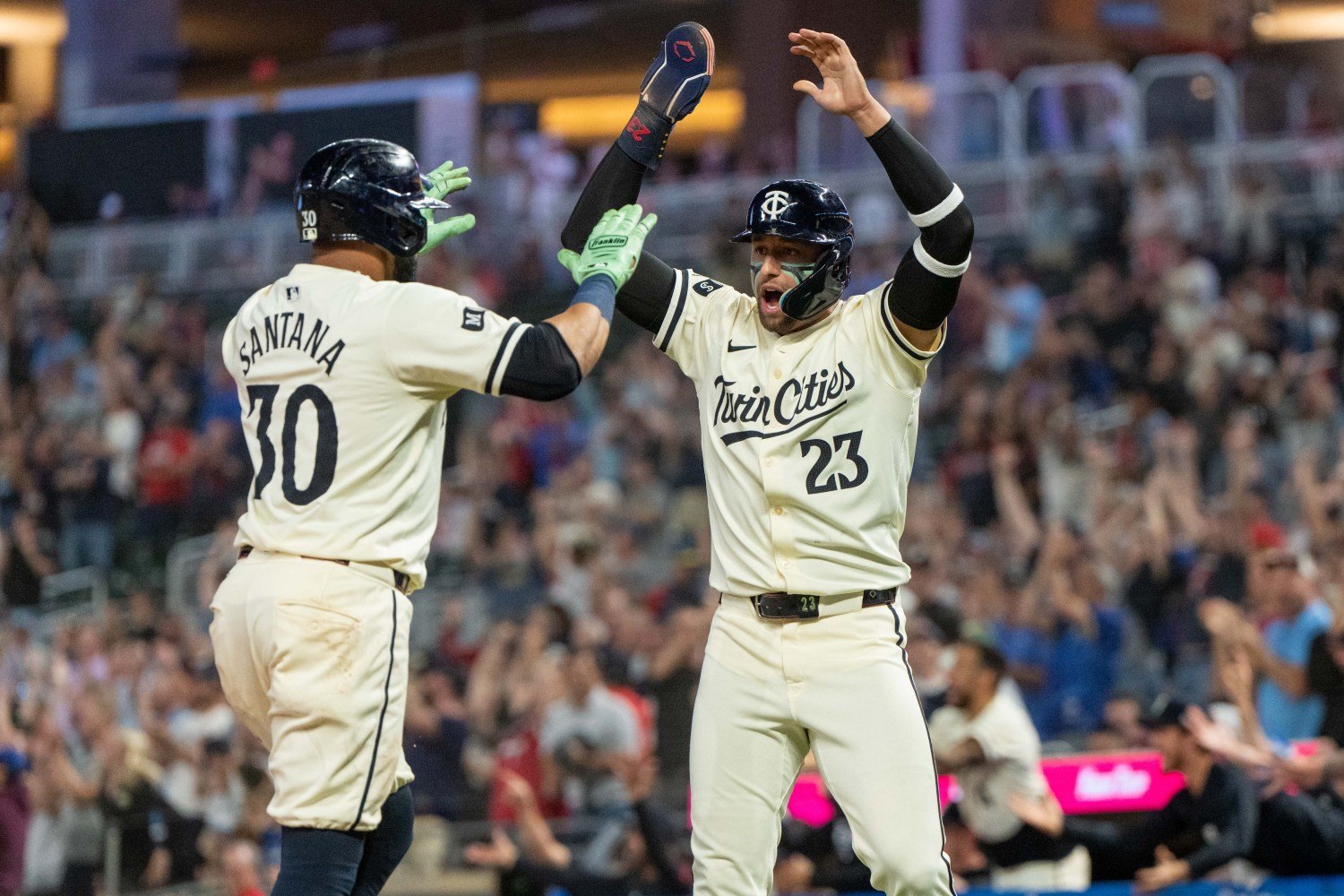
The Twins have two hitters who were top-10 in baseball in Pull Air% last season: Byron Buxton (30.2%) and Royce Lewis (29.1%). This makes sense, as both have 40-homer power in a 162-game season. Wallner, had he qualified for the leaderboard based on plate appearances, would have been top-10 as well, at 29.4%. Carlos Santana was 17th, at 27.4%. Having four guys in the top 20 is a little wild, but it portends good things that three of them are a part of the team again in 2025. In full, the Twins had eight hitters who were above-average in pulling the ball while hitting it in the air.

Manuel Margot
On the other side of the spectrum, you had Manuel Margot, at 258th overall, with a paltry 11.7 Pull AIR%. Does that surprise you? It shouldn’t. In 2024, Margot was almost completely devoid of pop and looked cooked. When he did pull the ball while elevating it, it rarely left the park.
Edouard Julien
It’s well-documented that Julien’s 2024 season was a mess, and this new data paints quite the picture. With an 11.6% Pull AIR%, he was 260th of 288 qualified hitters. Unfortunately, looking at the Pull GB% leaderboard, among left-handed hitters, he had the 14th-highest rate, at 24.4%. Finally, his Oppo AIR% was 7th-highest in baseball, at 26.8%. Combining these three data points, one can begin to see part of the problem he faced with his swing in 2024. The quality of his contact was generally not conducive to favorable outcomes, and led to a lot of weak flyouts the opposite way and infield choppers, not to mention all those strikeouts.
Trevor Larnach
Larnach had the 19th-highest Pull GB% amongst lefties, but he balanced this by having a better-than-average 18.7% Pull AIR rate, and a solid Oppo GB%. Because he hits the ball hard (average exit velocity in the 90th percentile) and squares it up frequently, he was still able to maximize the quality of his Pull AIR% to hit some bombs, and got a decent number of grounder singles the other way. Looking at his spray chart, we can see this in action. Knowing that he was making adjustments to his approach to breaking balls in real time, and that he saw a lower fastball percentage than most, he’s a hitter who could take another step forward in 2025.

How do the new Twins hitters profile here, and what might it mean for them this season?

His Pull AIR% is a very healthy 23.6%, and his Oppo GB% is also better than average at 7.0%. You might be getting excited about this. Don’t, as there is another factor at play here, and that’s Bader’s power numbers. Remember what I said about pulling the ball hard in the air? Unfortunately, his swing would lead to good things if his batting profile didn’t look like this.

You probably already knew Bader won’t be an offensive force for the Twins. How about the other newcomer?
Ty France
France is a little tough to pinpoint, coming off two down years. Last season can largely be attributed to a heel injury that lingered, impacting him at the plate. If we look at 2023, we might get a hint of his true current talent level, and it shows him with a solidly above-average 20.6 Pull AIR%, and a slightly above-average Oppo GB%, at 5.7%. His launch angle sweet spot was in the 76th percentile across baseball, so it’s likely safe to count on 15 homers. If the coaching staff can work on his approach even slightly, he could return to form as an above-average bat that can do damage at the plate.

They say that what can be measured can be improved. This new data, while likely not new to teams themselves, helps teams, players, writers, and fans better understand the tweaks necessary to optimize the damage hitters can do at the plate. While data can be tortured to tell some interesting stories, this data (combined with hard hit-rates and launch angle statistics) can help explain all the factors at play every time a hitter steps to the plate. As fans, let’s hope that a couple more Twins hitters can find the sweet spot of Pull AIR%, launch angle, and hard-hit rates. If so, the offense could be better than people expect.
Do you approve of Twins ownership?

Follow Twins Daily For Minnesota Twins News & Analysis



- ToddlerHarmon, glunn, Karbo and 2 others
-
 5
5


Recommended Comments
Create an account or sign in to comment
You need to be a member in order to leave a comment
Create an account
Sign up for a new account in our community. It's easy!
Register a new accountSign in
Already have an account? Sign in here.
Sign In Now