


Twins Video
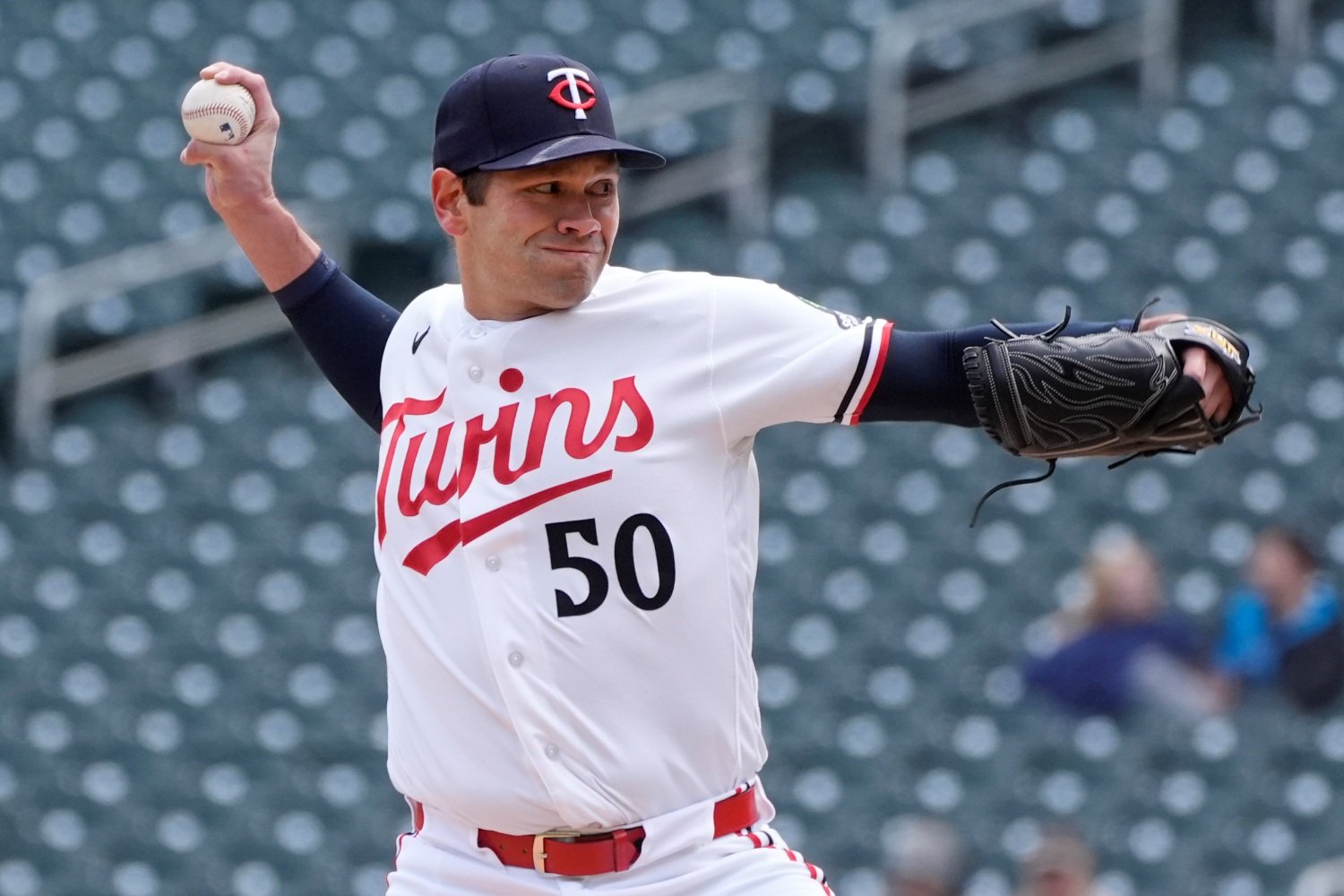
It looks pretty innocuous. Garrett Acton isn't notably big or small. He doesn't have a funky arm angle or a complicated delivery. He just kicks and delivers, and it's not like his fastball hums in at 100 miles per hour. On the contrary, in his two appearances with the Twins so far this season, he's averaging just 94 MPH with the fastball. He's only thrown fastballs and sliders, so far. It's not an elaborate or an overwhelming operation.
That's probably why Acton has always been below the prospect radar. He was a 35th-round pick by the White Sox in 2016, coming out of a high school in Chicago's southwest suburbs. Instead of signing, though, he went to junior college at Parkland College in Champaign, Ill. From there, he moved on to Saint Louis University and the University of Illinois-Champaign, but he went undrafted in 2019, and again in the COVID-shortened 2020 event. He signed as an amateur free agent, with the Athletics.
He stuck with the Oakland organization for almost three years, even making a brief debut in 2023, but he then became a 40-man roster casualty. He wasn't claimed on waivers at the time, and didn't find a new home until signing with the Rays that December. He underwent Tommy John surgery and missed all of 2024. Last year, he pitched just well enough at Triple-A Durham to earn one appearance with a forgettable Rays team. He didn't morph into a relief ace, or anything.
Somewhere in there, though, he became an in-demand asset. The Rockies claimed him on waivers in November, and the Marlins plucked him from Colorado the same way in early February. If you're hearing the words 'Rockies', 'Marlins' and 'waivers' and thinking this guy doesn't sound all that in-demand, you're not entirely wrong, but remember: waiver priority is determined by team quality. He did end up on the waiver wire repeatedly, even though he was passing through the hands of some bad teams, but then again, he got claimed by bad teams who had good spots in the line for such players.
The Twins became the third team to scoop him up, this time via a trade, at the beginning of this month. It was a minor move, for a minor arm, but it could end up making a more significant impact than you'd guess. There's a reason why Acton has become a buzzier name lately: his stuff is sneakily good.

In the image above, the distributions on the left show that all four pitches Acton throws (though he hasn't yet shown his splitter or curveball in the bigs) are above-average. His fastball-slider combination, in particular, rates well on Baseball Prospectus's StuffPro model. Why? Look at how high that heater rides, on the right. It sets up the tight slider gorgeously, and vice-versa.
Again, Acton's delivery is unremarkable—but that's to his advantage. The way the ball spins and carries out of his hand is unexpected, to the batter. Taj Bradley (to choose a familiar name, especially at the moment) gets lots of carry on his heater, but he does it with a very high arm slot, so hitters expect a bit more of that movement. When a pitcher's vertical movement doesn't quite match their slot, though, it creates more deception.
Stereotypically, fastballs with that extra vertical hop achieve swings and misses at the top of the zone, as in the pitch above. It's less obvious, but this extra carry also helps at the bottom of the zone, when a pitcher locates and sequences well. It can earn you called strikes, because a hitter expects the pitch to dip low, only to see it hold on for a strike on what should have been a hittable pitch.
For those reasons, this is a trait the Twins hunt. Bradley's rising heater appealed to them, but so do pitches with much less raw movement, like the heaters of Mick Abel, Bailey Ober and Eric Orze. Plot pitchers by arm angle and vertical movement, and you can see how unusual the movement some of those hurlers achieve really is, based on how they throw.

Unlike Ober, Orze or Abel, though, Acton's fastball does something else: cut more than expected based on the arm angle, too. That cut-ride action is a shape the Twins like, and a very rare one. Most pitchers whose arm slots are low enough to allow for unexpected vertical ride have a hard time achieving that while still getting around or behind the ball enough to give it relative cut. Not Acton. In this chart, the lower a pitcher's point appears, the less arm-side movement their heater has.

That characteristic is especially valuable for setting up the slider. Because the batter will struggle to distinguish the two pitches from one another out of the hand, he can miss bats with the slider even when he misses his spot with it—but it's especially devastating when well-located, moving out of the same tunnel as the fastball.
This is plus stuff. Acton didn't suddenly show up with it this spring, either. In his longish career in Triple-A, he struck out over 28% of opposing batters. The reason it's taken him until age 27 to find any lasting foothold in the big leagues is exactly the one you'd guess, given everything we've discussed so far: he struggles to throw strikes. Acton has walked roughly 10% of the batters he's seen in Triple-A. That humming fastball often rises above the zone, and his command of the slider isn't great. To be a useful big-league reliever, he has to find the zone more consistently.
He might be en route to making that crucial adjustment, though. Last year, he had a bit more of a high front side, slightly increasing deception but taking some stability out of his delivery.
This season, he's quieted that down. A simpler delivery might beget just enough more control to allow Acton to turn the corner and establish himself as a good reliever—and if he does, for this Twins team, he'll simultaneously establish himself as a solid setup man, or more. He's one of the highest-upside arms in a bullpen with a lot of journeymen but few who still have his ability to generate whiffs.
Acton has minor-league options remaining, so he doesn't have to depart the organization if the team needs his roster spot. He might have to ride the Green Line a time or two this year, but he's showing enough to make it relatively likely that he sticks with the Twins organization for a while. He might even emerge as an important cog in a pen the team will count on to keep them from collapsing into non-competitiveness as the season wears on.
Do you approve of the job the Twins front office is doing?

Follow Twins Daily For Minnesota Twins News & Analysis



- 4twinsJA, Mia Bednar, tarheeltwinsfan and 6 others
-
 8
8
-
 1
1


Recommended Comments
Create an account or sign in to comment
You need to be a member in order to leave a comment
Create an account
Sign up for a new account in our community. It's easy!
Register a new accountSign in
Already have an account? Sign in here.
Sign In Now