



Twins Video
Thanks to MLB's Statcast, statistics like launch angle and exit velocity are starting to become part of the baseball lexicon. How do the Twins stack up in this new statistical era?
Launch Angle
The Washington Post took a deep look into the launch angle revolution happening across baseball. As part of the story, they say that MLB players have reached "the conclusion that not only are flyballs, on average, better than grounders but the latter are to be avoided at all costs." With teams utilizing more defensive shifts, there are fewer holes in the infield so it makes sense to try to put the ball in the air.
Minnesota hitters seem to have bought in to the launch angle revolution. The Twins currently have MLB's fourth lowest GB/FB rate because they have the third highest FB%. From a hitter's vantage point, a launch angle between 25-35 degrees is optimal. To put that in perspective, Miguel Sano has averaged a 28.2 degree launch angle on his team-leading 14 home runs.
While hitting the ball in the air might be good for some players, it can also mess with the swings of others. FiveThirtyEight did a study on launch angles and concluded "the correlation between a batter's changing flyball rate and his subsequent change in production is nonexistent."
Exit Velocity
Launch angle is only part of the equation. If a player hits it at the right angle, there still needs to be enough force behind the ball and this is where exit velocity comes into play. The Twins are not only putting the ball in the air, they are also in the top-10 when it comes to hard-hit percentage. In fact, multiple Twins hitters rank very well when it comes to average exit velocity.
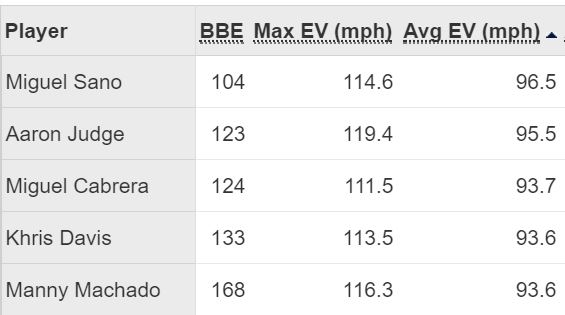
Miguel Sano leads all of baseball in average exit velocity (see rankings above) while Max Kepler is just inside the top-20 with Joe Mauer and Brian Dozier ranking near the top-40. ESPN updates the hard hit leader-board on an almost weekly basis. In this week's update, Kepler ranks in the top-10 (seventh) with Mauer (14th) and Sano (26th) both in the top-30.
Questions still remain about the validity of some of these new statistical areas. Statcast is only three years old and some might call it a work-in-progress. The information being provided by this new technology is untested. Statcast continues to add an extra dimension to the baseball world. However, there is much still to be discovered when it comes to this new statistical era.
What has Statcast added to your baseball-viewing experience? Did any of the Twins rankings surprise you? Leave a COMMENT and start the discussion.






Recommended Comments
Create an account or sign in to comment
You need to be a member in order to leave a comment
Create an account
Sign up for a new account in our community. It's easy!
Register a new accountSign in
Already have an account? Sign in here.
Sign In Now