


Twins Video
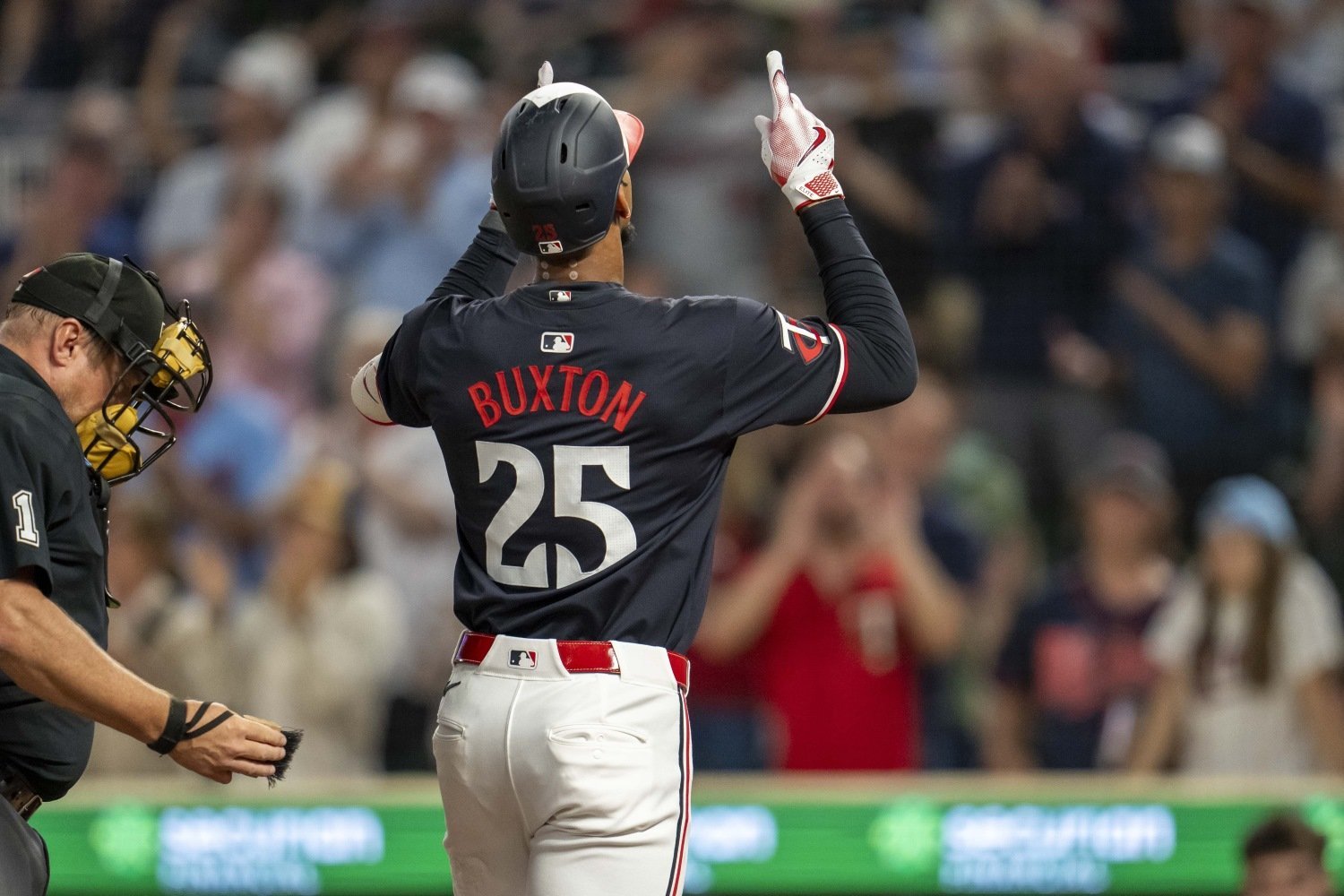
Byron Buxton has become one of the most electrifying players in recent Twins memory, captivating fans with his speed, power, and defensive prowess. But as he ages, Buxton will need to modify his game to stay effective, and he wouldn’t be the first Twins center fielder to make these adjustments. Torii Hunter, one of Minnesota’s iconic players, redefined his own game over time, shifting his role to keep contributing well into his 30s. If Buxton follows a similar path, it could extend his career and secure his place as a cornerstone in the lineup. Maybe it would even lend him a newfound ability to stay in the lineup on more than a semi-regular basis.
Moving from Center Field to the Corners
Hunter, like Buxton, was known for his acrobatic catches and range in center field. But by his early 30s, Hunter saw his defensive capabilities deteriorate, and he eventually moved to right field to preserve his legs and better serve his team. Buxton’s elite defense in center field has been one of his most significant contributions. Still, injuries have impacted his ability to stay on the field, prompting the team to use him exclusively as a designated hitter during the 2023 season. In 2024, he primarily played in center again, but his defense was noticeably worse than in the past.
If Buxton can transition to a corner outfield spot, could he reduce the risk of injury while still providing defensive value? Like Hunter, Buxton has the arm strength to handle either right or left field. A corner spot could allow him to play more regularly, while offering the Twins an experienced glove and a potent bat in that position. With younger prospects like Walker Jenkins and Emmanuel Rodriguez potentially ready to contribute in center, Buxton’s transition to a corner role could come sooner rather than later, especially if it means he can continue to impact the lineup over a full season.
Evolving as a Hitter
Hunter entered the big leagues as a free swinger, known for his pop and aggressiveness at the plate. However, as his career progressed, he learned to adjust, improve his plate discipline, and focus more on being selective. The result was a hitter who could still deliver power, but with improved on-base skills. As Hunter entered his 30s, he put up some of his best offensive seasons by prioritizing quality at-bats over sheer slugging. After walking in 6.4% of his plate appearances in his 20s, that number surged to 8.3% from ages 30-35. From his age 33-37 seasons, he hit .291/.350/.462, a 123 OPS+. In that five-year span, he posted three seasons with a .299 or higher batting average.
For Buxton, a similar approach could be transformative. He’s evolved into more of a power hitter, but that approach has downsides, particularly regarding contact rate and chasing pitches. Buxton’s swing has become more pull-oriented, and while he can still turn on inside pitches with authority, pitchers have exploited his willingness to chase outside of the zone. He’s had a career 28.9 K%, but he posted a career-best 10.1 BB% last season. He could add another dimension to his game by focusing on discipline and working counts, as Hunter did at the same age.
The Twins’ coaching staff could be instrumental here, with Matt Borgschulte at the helm as the hitting coach. Buxton has the tools to be a patient power hitter, and a shift in approach could keep him productive even as his speed (and bat speed) naturally decline. Following Hunter’s example in this area would help Buxton remain a middle-of-the-order threat, regardless of how his power numbers fluctuate.
Managing Loss of Speed
Hunter, known for his stolen bases and agility in his early years, eventually slowed down. Rather than letting that diminish his value, he refined his baserunning instincts, picking his spots and utilizing his experience. From 2010-11, Hunter combined for over -11 BsR, but he improved in the next two seasons to a 5.8 BsR in his late 30s. Buxton’s speed on the basepaths has always been a weapon, whether he’s stealing bases or stretching singles into doubles. But age and injuries have gradually slowed him down, making it harder for him to rely solely on speed as he has in the past.
Instead, Buxton could adjust by focusing on high-probability stolen base opportunities and using his baserunning intelligence to stay valuable on the bases. Speed will likely remain an asset for Buxton for several more seasons. Still, as Hunter eventually modified his game to be more efficient rather than explosive, Buxton may benefit from preserving his legs by being selective with his opportunities.
A Prolonged Career in Minnesota
Hunter extended his career by adapting his game, which helped him play through his late 30s as a productive outfielder. Buxton has shown glimpses of being a franchise-defining player, and with his recent contract extension, Minnesota is committed to him for the long haul. For Buxton, the move from center to a corner spot, an increased focus on plate discipline, and refining his baserunning are all avenues that could help him carve out a path to longevity.
Fans have come to expect highlight-reel catches and electrifying plays from Buxton, but as Hunter showed, there are other ways to make an impact. If Buxton can adjust, he could blaze a new trail for the next generation of Twins outfielders looking to define themselves as complete, well-rounded players.
In what ways should Buxton modify his game to match Hunter? Leave a comment and start the discussion.
Do you approve of the job Derek Shelton is doing as Twins manager?

Follow Twins Daily For Minnesota Twins News & Analysis



- Fatbat, nclahammer and mrcharlie
-
 3
3


Recommended Comments
Create an account or sign in to comment
You need to be a member in order to leave a comment
Create an account
Sign up for a new account in our community. It's easy!
Register a new accountSign in
Already have an account? Sign in here.
Sign In Now