


Twins Video
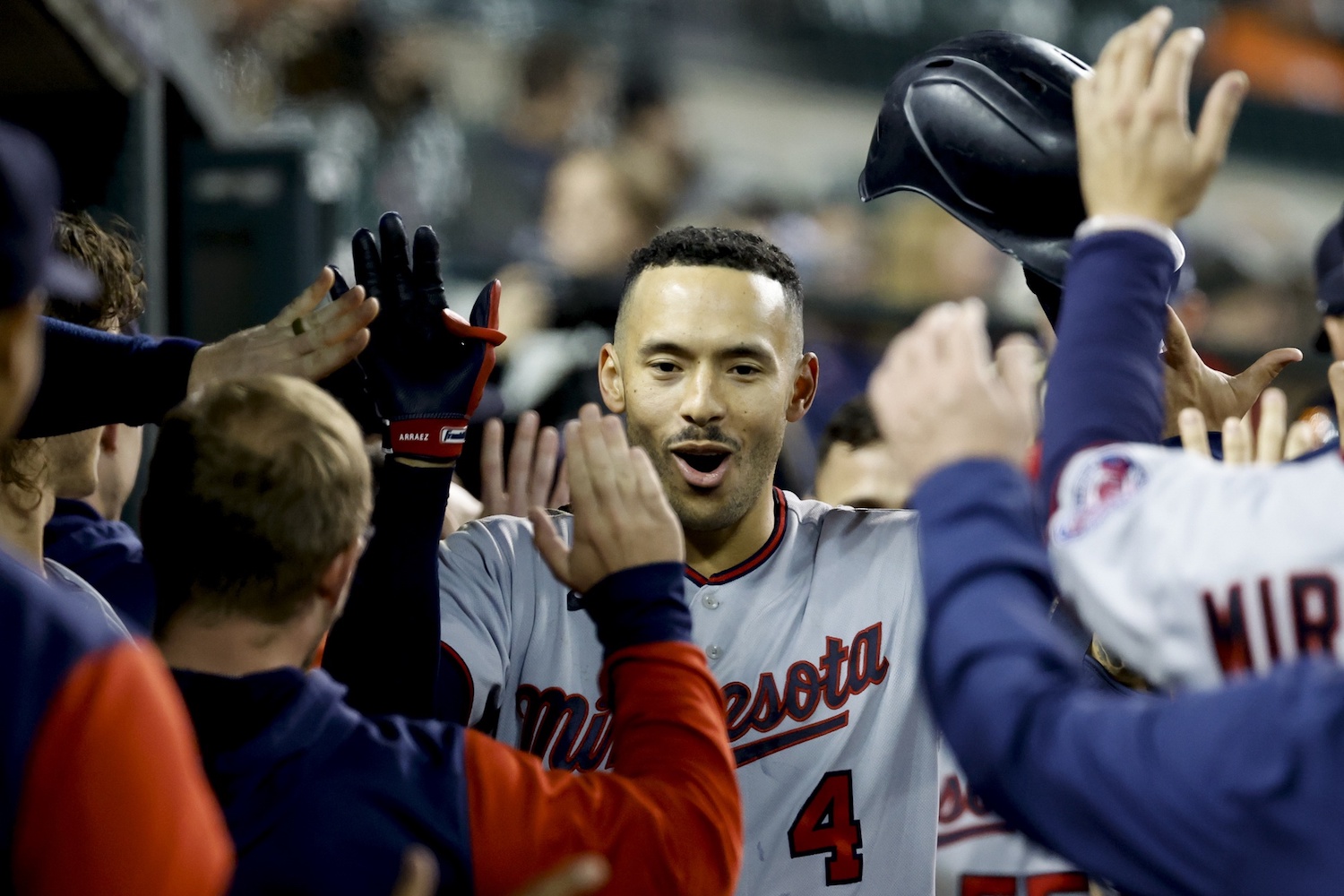
Teammates, media, and fans laud Carlos Correa for his leadership ability. Shoot, players on other teams compliment Correa for being a leader: On Tuesday, Correa was caught putting his arm around Carson Williams, a 19-year old Rays prospect, after the youngster committed an error in a spring training game.
When it comes to identifying what exactly he does as a leader, though, we can struggle to quantify it. Today, we’re starting an ol’ Gregg deep dive into leadership, its observable outcomes or benefits, and why Correa gets explicitly highlighted as a leader.
You can take this series as a continuation of this blog post looking at what “clubhouse presence” might generally mean for a player like Correa. I’ll reference papers discussed there, so if you’re interested, check out that blog.
Leadership Defined
Let’s start at the top with a definition of leadership. Many will cite traits or behaviors like empowering others, providing support, giving guidance, or something like that. However, at its most basic level, leadership is influence. Leaders influence those who follow them into certain behaviors.
Leaders can come in all forms. One easy way to think about them is informal or formal leaders who can be from inside or outside of a team. A player like Correa would be an informal leader inside the team.
Under our definition of leadership, an excellent informal leader can change others’ behavior. Now, it’s possible to influence behavior positively or negatively, so it’s crucial to have the right type of leader. A bloviating blowhard can walk into a clubhouse and certainly influence their teammates, but if that influence isn’t beneficial for the team, then what’s the point?
Even worse, a front office could bring a leader into the clubhouse, but the team could still reject that person as a leader. Clearly, this was not the case in Minnesota last year, at least from outsiders’ perspectives. So let’s move on to how players become leaders.
Leader Emergence
As mentioned in my previous blog post, players can have informal roles like leader that are not officially bestowed on them by the powers that be (as opposed to first baseman or leadoff hitter). Instead, their teammates agree that that person fills the role.
In a study led by Jeemin Kim of Wilfred Laurier University, teams tended to be most satisfied with their play when verbal leaders made up 10-15% of the team. On a baseball team, that would be between two and four players, and Correa certainly fits that bill on this Twins team.
Long ago, a psychologist named Robert F. Bales put forward a theory suggesting that three things mattered for a person to fill an informal role: being noticed, skills, and likeability. These three factors matter for all roles—not just leadership. For example, the role of clubhouse cancer would require a person to be very good at disrupting the clubhouse.
Let’s stick, though, to the role of informal leader. That player needs to have influence, be likable (to some extent), and be noticed for his traits. Correa has the on-field ability of one of the top players in the sport. That helps, but plenty of talented players aren’t seen as leaders.
Instead, he must also help guide teammates, provide an example for them, and be there for them—all of the things people think about when they think of a leader. He doesn’t need to be all of them, just enough of them to be noticed by his teammates.
From a social scientist’s perspective, he has an increased potential to be noticed simply by his position in the field. Teams have what are called social networks—complex relationships between players. These networks can be mapped out and measured. Networks can come in all types, such as friendship or time spent playing together. Players with more friends on the team can have a wider friendship network, and teammates who have played longer can have stronger familiarity bonds with each other.
A team is a series of different types of networks that can become somewhat confusing. For the visual of you out there, see the network I approximated based on coordination. Thicker lines indicate more substantial levels of coordination needed for the players at each position on the field. They’re also color-coded, with purple being the strongest, yellow being medium, and red being the weakest.

This map isn’t exact, but it gets the point across. If you look closely, shortstops and catchers appear to require the most coordination with their teammates. Catchers specifically work incredibly closely with their pitchers and then everyone else to some extent. Shortstops have, at minimum, a moderate level of coordination with everyone else on the team, save the pitcher (though even that could be higher if you consider the amount of coordination necessary for shifting and pitch selection).
This diagram isn’t just me making things up to support my thoughts. As far back as the 1960s, social scientists observed this very thing. Having more ties and stronger ties makes a player more centralized in their network, and Oscar Grusky of UCLA discovered that the more central a player’s position was, the more likely they were to become a manager.
This finding isn’t a new discovery in the baseball world, either. Many reading this already know that catchers and middle infielders are more likely to become managers than pitchers or outfielders. However, it’s worth noting that psychology has been on the same wavelength as conventional wisdom in this regard.
All this is to say that a player like Carlos Correa is in a prime position to be identified as a leader by his teammates. In the next installment, I will look at what sort of leadership Correa exhibits that solidifies him as a leader.
Bales, R. F. 1966. “Task roles and social roles in problem solving groups”. In Role theory: Concepts and research, Edited by: Biddle, B. J. and Thomas, E. J. 254–262. New York: John Wiley.
Grusky, O. (1963). The effects of formal structure on managerial recruitment: A study of baseball organization. Sociometry, 26, 345–353. doi:10.2307/2786074
https://www.jstor.org/stable/2786074
Kim, J., Godfrey, M., & Eys, M. (2020). The antecedents and outcomes of informal roles in interdependent sport teams. Sport, Exercise, and Performance Psychology, 9(3), 277–291. https://doi.org/10.1037/spy0000179







Recommended Comments
Create an account or sign in to comment
You need to be a member in order to leave a comment
Create an account
Sign up for a new account in our community. It's easy!
Register a new accountSign in
Already have an account? Sign in here.
Sign In Now