Lucas Seehafer PT
-
Posts
525 -
Joined
-
Last visited
-
Days Won
2
Content Type
Profiles
News
Minnesota Twins Videos
2026 Minnesota Twins Top Prospects Ranking
2022 Minnesota Twins Draft Picks
Minnesota Twins Free Agent & Trade Rumors, Notes, & Tidbits
Guides & Resources
2023 Minnesota Twins Draft Picks
The Minnesota Twins Players Project
2024 Minnesota Twins Draft Picks
2025 Minnesota Twins Draft Pick Tracker
2026 Minnesota Twins Draft Tracker: Picks & Bonuses
Forums
Blogs
Events
Store
Downloads
Gallery
Everything posted by Lucas Seehafer PT
-
 The Minnesota Twins lost Royce Lewis to yet another muscle injury on Wednesday afternoon, this time a Grade 2 right adductor strain. It is the fourth significant injury to his right leg in the last three seasons. Image courtesy of © Matt Blewett-USA TODAY Sports The Minnesota Twins lost Royce Lewis to yet another muscle injury on Wednesday afternoon, this time a Grade 2 right adductor strain. It is the fourth significant injury to his right leg in the last three seasons. Luckily, the Twins are hopeful that it isn’t as severe as the right quadriceps injury which caused Royce Lewis to miss the first two months of the season. The adductor muscles provide breaking forces through eccentric muscle contractions (i.e. the muscle is contracting while lengthening) to help control athletic movements. So, it should come as no surprise that groin and adductor strains are among the most common muscular injuries in elite athletes. The Grade 2 categorization essentially indicates that it is a moderate injury. From an advanced imaging standpoint, this means at least 10% but no more than 50% of Lewis’s muscle fibers were damaged. Because of the wide range of damage, outcomes for Grade 2 strains vary considerably, though most generally heal within six to eight weeks. That would be a rough estimate for Lewis’s return sometime between Aug. 14 and the end of that month. Now, the question facing Lewis and the Twins, one that is undoubtedly on everybody’s mind: What can be done to prevent this from occurring again? As I mentioned previously, this is the fourth significant injury Lewis has suffered to his right leg—ACL twice, quadriceps, adductor—since reaching MLB, and the sixth issue (those four, plus strains of his left oblique and left hamstring) that has landed him on the IL. Unfortunately, there aren’t any easy, straightforward answers here. It’s often said that the best predictor of future injury is past injury, though that saying is only true as it pertains to the same muscle or location. For example, the best predictor of suffering a right ankle sprain is if you previously sprained that right ankle. All of Lewis’s injuries thus far—save for the ACL—are to unique muscles. Muscle weakness is a common characteristic following ACL reconstruction, yet there is a surprising lack of research looking into the presence and persistence of weakness in muscle groups other than the quadriceps. However, there is evidence that muscle activation patterns (specifically the co-activation of the gluteal and adductor muscles) are impaired for up to two years following surgery. Unfortunately, research going the next step—determining if these impaired activation patterns are associated with greater injury risk—is largely absent. It’s also important to consider that, as a professional athlete, Lewis has access to elite rehabilitation and strength and conditioning programs. The Twins have been cautious with his rehab and training, and assess his force production (strength, power, etc.) via scientific means such as force plates and dynamometry regularly. Athletes aren’t cleared to return to play following a major injury until all of their measures have reached or exceeded their pre-injury values. (As far as imbalances go (i.e. one side is stronger than the other), there isn’t much strong evidence to suggest it is an important factor in injury risk mitigation or performance.) Finally, the most powerful but least satisfying factor needs to be considered: Dumb luck. We don’t like to think that nothing could have been done; that Lewis’s injury was an accident, the simple flap of the butterfly’s wing throwing into motion a chain of events that were unpredictable and uncontrollable. Suggesting so nullifies the ability to ascribe blame, leaving our frustrations and sympathies simply afloat in the ether. We can’t blame Lewis’s legs or work ethic, nor can we question Nick Paparesta’s treatment philosophy and practices. But often that is done anyway, by the talking heads and individuals with no avenue for venting their frustrations. They label the athlete as “injury-prone”—despite not fully appreciating the complexities of the human neuromusculoskeletal system and injury risk mitigation—and place blame via jumps in logic and correlation-equals-causation thinking. Losing Royce Lewis sucks--for him, for the team, and for us. We all want to see Lewis batting in the middle of the order and playing a stout third base. But right now, he’s headed for another IL stint. It’s not his fault. It may not even be his body’s fault. It may just be Lady Luck striking yet again. View full article
 -
 Luckily, the Twins are hopeful that it isn’t as severe as the right quadriceps injury which caused Royce Lewis to miss the first two months of the season. The adductor muscles provide breaking forces through eccentric muscle contractions (i.e. the muscle is contracting while lengthening) to help control athletic movements. So, it should come as no surprise that groin and adductor strains are among the most common muscular injuries in elite athletes. The Grade 2 categorization essentially indicates that it is a moderate injury. From an advanced imaging standpoint, this means at least 10% but no more than 50% of Lewis’s muscle fibers were damaged. Because of the wide range of damage, outcomes for Grade 2 strains vary considerably, though most generally heal within six to eight weeks. That would be a rough estimate for Lewis’s return sometime between Aug. 14 and the end of that month. Now, the question facing Lewis and the Twins, one that is undoubtedly on everybody’s mind: What can be done to prevent this from occurring again? As I mentioned previously, this is the fourth significant injury Lewis has suffered to his right leg—ACL twice, quadriceps, adductor—since reaching MLB, and the sixth issue (those four, plus strains of his left oblique and left hamstring) that has landed him on the IL. Unfortunately, there aren’t any easy, straightforward answers here. It’s often said that the best predictor of future injury is past injury, though that saying is only true as it pertains to the same muscle or location. For example, the best predictor of suffering a right ankle sprain is if you previously sprained that right ankle. All of Lewis’s injuries thus far—save for the ACL—are to unique muscles. Muscle weakness is a common characteristic following ACL reconstruction, yet there is a surprising lack of research looking into the presence and persistence of weakness in muscle groups other than the quadriceps. However, there is evidence that muscle activation patterns (specifically the co-activation of the gluteal and adductor muscles) are impaired for up to two years following surgery. Unfortunately, research going the next step—determining if these impaired activation patterns are associated with greater injury risk—is largely absent. It’s also important to consider that, as a professional athlete, Lewis has access to elite rehabilitation and strength and conditioning programs. The Twins have been cautious with his rehab and training, and assess his force production (strength, power, etc.) via scientific means such as force plates and dynamometry regularly. Athletes aren’t cleared to return to play following a major injury until all of their measures have reached or exceeded their pre-injury values. (As far as imbalances go (i.e. one side is stronger than the other), there isn’t much strong evidence to suggest it is an important factor in injury risk mitigation or performance.) Finally, the most powerful but least satisfying factor needs to be considered: Dumb luck. We don’t like to think that nothing could have been done; that Lewis’s injury was an accident, the simple flap of the butterfly’s wing throwing into motion a chain of events that were unpredictable and uncontrollable. Suggesting so nullifies the ability to ascribe blame, leaving our frustrations and sympathies simply afloat in the ether. We can’t blame Lewis’s legs or work ethic, nor can we question Nick Paparesta’s treatment philosophy and practices. But often that is done anyway, by the talking heads and individuals with no avenue for venting their frustrations. They label the athlete as “injury-prone”—despite not fully appreciating the complexities of the human neuromusculoskeletal system and injury risk mitigation—and place blame via jumps in logic and correlation-equals-causation thinking. Losing Royce Lewis sucks--for him, for the team, and for us. We all want to see Lewis batting in the middle of the order and playing a stout third base. But right now, he’s headed for another IL stint. It’s not his fault. It may not even be his body’s fault. It may just be Lady Luck striking yet again.
 -
Manual manipulation of the spine (aka back cracking) is probably one of the hands-on treatments they're doing as well as soft tissue massage. The back cracking causes nitrogen bubbles with the joints to break up, which reduces pressure in the joints that can be aggravating for the nerves and surrounding tissue. That's why cracking joints feels so good and improves mobility.
-
This is a tough question to answer. The short answer is yes, sports medicine is better than it was in the past. The more detailed answer is that injuries are complex. Athletes have never been stronger or faster. They also are specializing in their sport at a much earlier age and are playing year round. In the 50s, athletes played during their season, maybe did some offseason training, and possibly worked a second job. Athletes are exposing their bodies to such dramatic forces so frequently these days that they breakdown and do so at earlier ages. However, the treatments for these injuries have never been more scientifically based and effective. We know way more now than we did even a decade ago. It's just all the miles the athletes put on their bodies starting as low as age 10 is just too much to compensate for new training and treatment techniques. At least that's my educated guess in a nutshell.
-
 A herniation, which often first presents as back spasms as the lumbar musculature contracts to "protect" the injured tissue, occurs when the inner, more fluid portion of the intervertebral disc protrudes outward either against or through the outer, more dense rings of cartilage. Brooks Lee, of course, was first diagnosed as suffering back spasms when he was held back to begin the minor-league season. The most common mechanism for acute (i.e. "instantaneous") herniation is the forceful rotation of the spine in combination with an axial load. It is no coincidence that the textbook definition of "the forceful rotation of the spine in combination with an axial load" is a baseball swing. If the herniation is large enough, it can compress nearby nerves, or even the spinal cord itself, which can cause numbness, tingling, and weakness in the legs. However, as concerning as that sounds, disc herniations are exceedingly common--and they typically resolve without surgical intervention. According to previous research, it is estimated that up to 30-40% of elite athletes (depending on their sport) have disc herniations in their lower back, but do not have any symptoms. Among professional baseball players who do have symptoms (i.e. pain, numbness, tingling, etc.), the return-to-play rate is nearly 100%, with athletes who ultimately underwent surgery returning in an average of eight months and those who did not returning in six. According to Gleeman, Lee is approximately halfway through an eight-week rehabilitation process overseen by Dr. Robert Watkins, one of the foremost back specialists in the United States. Current best practices indicate that athletes should undergo roughly eight weeks of rehab, focusing on improving core and lower back strength while reducing nerve irritation, before even contemplating going under the knife. (It is common for athletes to also receive a cortisone injection, which reduces inflammation of the nerve and surrounding tissue.) Most symptoms of disc herniation resolve within the above timeframe. Contrary to popular belief, disc herniations (especially those that are relatively small) can be reabsorbed by the body and spontaneously heal on their own. Surgery to remove the disc, known as a microdiscectomy, is viewed as a last resort, as its rate of success is commensurate with conservative treatments and may increase the odds of re-herniation. Disc herniations have been reputed to be a significant, career-altering, potentially career-threatening injury, but the research suggests that it isn't that cut-and-dried. The academic studies that have indicated that the condition can seriously impact an athlete's career contain a significant risk for inaccuracy, due to the difficult nature of adequately establishing control groups in professional sports. (They also tend to use statistics such as batting average and runs batted in to measure the impact of the injury. We know better now.) It is by no means good news that Lee has been diagnosed with a disc herniation but, as the research shows, it also shouldn't be a cause for panic.
 -
According to Aaron Gleeman, the Minnesota Twins' top prospect is expected to miss at least another month after recently being diagnosed with a disc herniation in his balky back. Image courtesy of © Sam Navarro-USA TODAY Sports According to Aaron Gleeman, the Minnesota Twins' top prospect is expected to miss at least another month after recently being diagnosed with a disc herniation in his balky back. A herniation, which often first presents as back spasms as the lumbar musculature contracts to "protect" the injured tissue, occurs when the inner, more fluid portion of the intervertebral disc protrudes outward either against or through the outer, more dense rings of cartilage. Brooks Lee, of course, was first diagnosed as suffering back spasms when he was held back to begin the minor-league season. The most common mechanism for acute (i.e. "instantaneous") herniation is the forceful rotation of the spine in combination with an axial load. It is no coincidence that the textbook definition of "the forceful rotation of the spine in combination with an axial load" is a baseball swing. If the herniation is large enough, it can compress nearby nerves, or even the spinal cord itself, which can cause numbness, tingling, and weakness in the legs. However, as concerning as that sounds, disc herniations are exceedingly common--and they typically resolve without surgical intervention. According to previous research, it is estimated that up to 30-40% of elite athletes (depending on their sport) have disc herniations in their lower back, but do not have any symptoms. Among professional baseball players who do have symptoms (i.e. pain, numbness, tingling, etc.), the return-to-play rate is nearly 100%, with athletes who ultimately underwent surgery returning in an average of eight months and those who did not returning in six. According to Gleeman, Lee is approximately halfway through an eight-week rehabilitation process overseen by Dr. Robert Watkins, one of the foremost back specialists in the United States. Current best practices indicate that athletes should undergo roughly eight weeks of rehab, focusing on improving core and lower back strength while reducing nerve irritation, before even contemplating going under the knife. (It is common for athletes to also receive a cortisone injection, which reduces inflammation of the nerve and surrounding tissue.) Most symptoms of disc herniation resolve within the above timeframe. Contrary to popular belief, disc herniations (especially those that are relatively small) can be reabsorbed by the body and spontaneously heal on their own. Surgery to remove the disc, known as a microdiscectomy, is viewed as a last resort, as its rate of success is commensurate with conservative treatments and may increase the odds of re-herniation. Disc herniations have been reputed to be a significant, career-altering, potentially career-threatening injury, but the research suggests that it isn't that cut-and-dried. The academic studies that have indicated that the condition can seriously impact an athlete's career contain a significant risk for inaccuracy, due to the difficult nature of adequately establishing control groups in professional sports. (They also tend to use statistics such as batting average and runs batted in to measure the impact of the injury. We know better now.) It is by no means good news that Lee has been diagnosed with a disc herniation but, as the research shows, it also shouldn't be a cause for panic. View full article
-
 Carlos Correa left Friday night's loss to the Tigers after experiencing tightness in his right side. He was placed on the injured list on Saturday with what was originally stated to be a right oblique strain. However, an MRI conducted after Correa left the game Friday instead revealed the injury to be a minor right intercostal strain. The obliques are a group of large, powerful muscles located on each side of the trunk that, along with the rectus abdominis (i.e. the abs), the transverse abdominis (i.e. the body's internal corset), and a slew of back muscles, comprise the core. In fact, there are two types of oblique muscles, the external and the internal. The external oblique is the primary driver for "cross-body" rotation of the trunk, whereas the internal oblique is the primary driver for "open-body" rotation; for example, when a right-handed batter swings, their right external oblique and left internal oblique contract powerfully to twist the core. Oblique injuries are notorious for lingering and recurring, because of how frequently those muscles are utilized during baseball activities: any swing of the bat or throw of the ball recruits the muscles. Additionally, muscle injuries most frequently occur when the muscle quickly and forcefully transitions between a concentric and eccentric contraction. During a concentric contraction, the individual muscle fibers pull each other closer, causing the muscle to shorten; during an eccentric contraction, the muscle fibers grip onto each other like a hug while the muscle lengthens. This transition between muscle contraction types exerts significant force through the musculature, and if the force is too great, the muscle fibers tear (i.e. a muscle strain). Correa's injury occurred during a check swing, which definitionally occurs when a batter begins their swing but abruptly stops. This is an example of a concentric-to-eccentric muscle contraction transition and is a common way in which the oblique muscles get injured among batters. Add in that he immediately grabbed at his right side and an initial diagnosis of an oblique strain makes sense. Luckily, further testing revealed that the intercostal muscles were actually the culprit of Correa's discomfort. The intercostal muscles are located between each rib and, like the obliques, consist of an external and internal variant. Whereas the obliques function to rotate the trunk, the intercostals are primarily involved with forceful inhalation and exhalation. The internal intercostals forcefully contract during actions such as coughing and holding one's breath (like when swinging at a 95-mph heater). Correa revealed Saturday morning that he had been dealing with an illness recently, which may have caused his side to ache. It isn't uncommon for repetitive, forceful coughing to strain the intercostal muscles; in rare instances, it can even fracture ribs. Intercostal muscle strains are generally relatively minor and don't impact long-term performance. They typically heal within a couple of weeks. Correa is guaranteed to miss 10 games due to being placed on the IL, but, likely, he won't miss much more time than the minimum. Over the past three seasons, oblique injuries have resulted in injured-list stays averaging roughly five weeks in length. Intercostal injuries are not only much, much less common, but have resulted in injured list stays averaging roughly 20 days. The Twins caught a major break here, and just have to hope Correa stays healthy on the other side of this brief absence. The Four-Year Injury Map graphics in this piece are drawn from Baseball Prospectus. View and explore the tool here.
 -
The Minnesota Twins had a rough weekend in Detroit, splitting the series and losing shortstop Carlos Correa to the injured list. However, in better news, the star's prognosis turns out to be better than first thought. Image courtesy of © Matt Krohn-USA TODAY Sports The Minnesota Twins had a rough weekend in Detroit, splitting the series and losing shortstop Carlos Correa to the injured list. However, in better news, the star's prognosis turns out to be better than first thought. Carlos Correa left Friday night's loss to the Tigers after experiencing tightness in his right side. He was placed on the injured list on Saturday with what was originally stated to be a right oblique strain. However, an MRI conducted after Correa left the game Friday instead revealed the injury to be a minor right intercostal strain. The obliques are a group of large, powerful muscles located on each side of the trunk that, along with the rectus abdominis (i.e. the abs), the transverse abdominis (i.e. the body's internal corset), and a slew of back muscles, comprise the core. In fact, there are two types of oblique muscles, the external and the internal. The external oblique is the primary driver for "cross-body" rotation of the trunk, whereas the internal oblique is the primary driver for "open-body" rotation; for example, when a right-handed batter swings, their right external oblique and left internal oblique contract powerfully to twist the core. Oblique injuries are notorious for lingering and recurring, because of how frequently those muscles are utilized during baseball activities: any swing of the bat or throw of the ball recruits the muscles. Additionally, muscle injuries most frequently occur when the muscle quickly and forcefully transitions between a concentric and eccentric contraction. During a concentric contraction, the individual muscle fibers pull each other closer, causing the muscle to shorten; during an eccentric contraction, the muscle fibers grip onto each other like a hug while the muscle lengthens. This transition between muscle contraction types exerts significant force through the musculature, and if the force is too great, the muscle fibers tear (i.e. a muscle strain). Correa's injury occurred during a check swing, which definitionally occurs when a batter begins their swing but abruptly stops. This is an example of a concentric-to-eccentric muscle contraction transition and is a common way in which the oblique muscles get injured among batters. Add in that he immediately grabbed at his right side and an initial diagnosis of an oblique strain makes sense. Luckily, further testing revealed that the intercostal muscles were actually the culprit of Correa's discomfort. The intercostal muscles are located between each rib and, like the obliques, consist of an external and internal variant. Whereas the obliques function to rotate the trunk, the intercostals are primarily involved with forceful inhalation and exhalation. The internal intercostals forcefully contract during actions such as coughing and holding one's breath (like when swinging at a 95-mph heater). Correa revealed Saturday morning that he had been dealing with an illness recently, which may have caused his side to ache. It isn't uncommon for repetitive, forceful coughing to strain the intercostal muscles; in rare instances, it can even fracture ribs. Intercostal muscle strains are generally relatively minor and don't impact long-term performance. They typically heal within a couple of weeks. Correa is guaranteed to miss 10 games due to being placed on the IL, but, likely, he won't miss much more time than the minimum. Over the past three seasons, oblique injuries have resulted in injured-list stays averaging roughly five weeks in length. Intercostal injuries are not only much, much less common, but have resulted in injured list stays averaging roughly 20 days. The Twins caught a major break here, and just have to hope Correa stays healthy on the other side of this brief absence. The Four-Year Injury Map graphics in this piece are drawn from Baseball Prospectus. View and explore the tool here. View full article
-
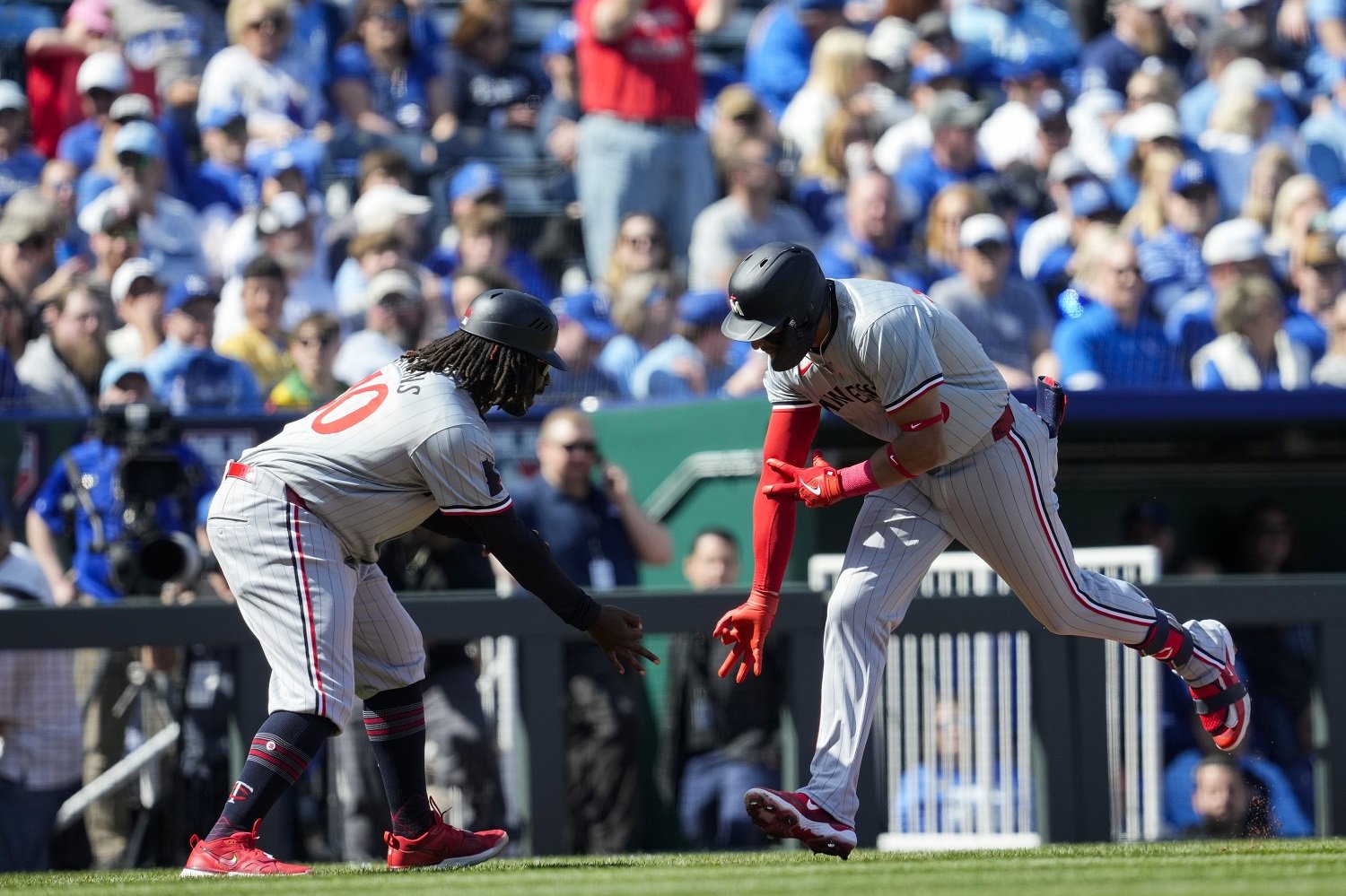 President of Baseball Operations Derek Falvey labeled Lewis's injury as "severe" and "serious" but did not provide a grade for the strain, the traditional way for communicating the extent of a soft tissue injury. According to The Athletic's Dan Hayes, surgery was never considered. Soft tissue injuries, such as quadriceps strains, exist on a spectrum with grade 1 injuries considered mild and grade 3s the most severe. But even within the traditional 1-3 grading system, vagueries exist concerning the extent of damage. MRIs determine the degree of the muscle strain, or torn muscle tissue. If less than 10% of the muscle fibers are damaged, the injury is classified as grade 1 and usually heals within a week or two. If more than 50% of the fibers are torn and/or the integrity of the connecting tendon is compromised, it's classified as a grade 3, and recovery is generally on the order of 4-6 months, especially if surgery is required. Grade 2 strains comprise a bulk of the classification system with 10-50% of muscle fibers needing to be damaged to meet the criteria. Unlike grade 3 injuries which are all debilitating regardless if 50% or 100% of the fibers are damaged, the amount of function lost and the time needed to heal varies widely based on how many muscle fibers are compromised in grade 2 strains. If the number is closer to 10%, the injury heals similar to a grade 1; if it's closer to 50%, well, you get the idea. Based on Falvey's description, Lewis's injury likely lands on the more significant end of the grade 2 spectrum. As I reported in our initial story following Lewis's injury, Baseball Prospectus's injury database has the average days missed following a quadriceps strain at 30. According to the Twins, Lewis will spend at least the next 30 rehabilitating before being re-evaluated to determine if it is appropriate to begin ramping back up to game speed. MLB athletes get 20 days once designated for a rehab assignment, so the most optimistic return for Lewis would be in 50 days, or May 19. A more realistic return date may be June 1, which is 63 days from the time of writing, though a later return date can't be ruled out. While disappointing, the Twins would still have 104 games remaining on their schedule if Lewis returns on June 1, leaving him plenty of time to make an impact on the team's playoff hopes. In the meantime, Austin Martin and Brooks Lee, once he himself returns from injury, will get plenty of run in the big leagues. Injuries are an unfortunate aspect of sport and no one, other than perhaps Byron Buxton, knows this more than Royce Lewis. Yet, after every roadblock, he returns to post high levels of productivity. Despite the severity of his current malady, we shouldn't expect anything less from the former first overall pick this time around either.
 -
The Minnesota Twins announced on Saturday morning that star third baseman Royce Lewis is headed to the 10-day injured list after straining his right quadriceps during Thursday's season-opening win over Kansas City. Image courtesy of Jay Biggerstaff-USA TODAY Sports The Minnesota Twins announced on Saturday morning that star third baseman Royce Lewis is headed to the 10-day injured list after straining his right quadriceps during Thursday's season-opening win over Kansas City. President of Baseball Operations Derek Falvey labeled Lewis's injury as "severe" and "serious" but did not provide a grade for the strain, the traditional way for communicating the extent of a soft tissue injury. According to The Athletic's Dan Hayes, surgery was never considered. Soft tissue injuries, such as quadriceps strains, exist on a spectrum with grade 1 injuries considered mild and grade 3s the most severe. But even within the traditional 1-3 grading system, vagueries exist concerning the extent of damage. MRIs determine the degree of the muscle strain, or torn muscle tissue. If less than 10% of the muscle fibers are damaged, the injury is classified as grade 1 and usually heals within a week or two. If more than 50% of the fibers are torn and/or the integrity of the connecting tendon is compromised, it's classified as a grade 3, and recovery is generally on the order of 4-6 months, especially if surgery is required. Grade 2 strains comprise a bulk of the classification system with 10-50% of muscle fibers needing to be damaged to meet the criteria. Unlike grade 3 injuries which are all debilitating regardless if 50% or 100% of the fibers are damaged, the amount of function lost and the time needed to heal varies widely based on how many muscle fibers are compromised in grade 2 strains. If the number is closer to 10%, the injury heals similar to a grade 1; if it's closer to 50%, well, you get the idea. Based on Falvey's description, Lewis's injury likely lands on the more significant end of the grade 2 spectrum. As I reported in our initial story following Lewis's injury, Baseball Prospectus's injury database has the average days missed following a quadriceps strain at 30. According to the Twins, Lewis will spend at least the next 30 rehabilitating before being re-evaluated to determine if it is appropriate to begin ramping back up to game speed. MLB athletes get 20 days once designated for a rehab assignment, so the most optimistic return for Lewis would be in 50 days, or May 19. A more realistic return date may be June 1, which is 63 days from the time of writing, though a later return date can't be ruled out. While disappointing, the Twins would still have 104 games remaining on their schedule if Lewis returns on June 1, leaving him plenty of time to make an impact on the team's playoff hopes. In the meantime, Austin Martin and Brooks Lee, once he himself returns from injury, will get plenty of run in the big leagues. Injuries are an unfortunate aspect of sport and no one, other than perhaps Byron Buxton, knows this more than Royce Lewis. Yet, after every roadblock, he returns to post high levels of productivity. Despite the severity of his current malady, we shouldn't expect anything less from the former first overall pick this time around either. View full article
-
Unintuitively, flexibility has almost no impact on injury prevention. This has been shown in the research many times. Simultaneously, having more muscle bulk and strength has been shown to be protective against injury in the grand scheme. This is partially why strength training has become so prevalent while traditional stretching programs have declined in favor of what's called "dynamic" stretching. Dynamic stretching focuses less on holding static positions and more on working through a full range of motion while moving. This increases blood flow to the muscle tissue and, because of friction between the different muscle fibers, literally warms up the muscles. That's why you see athletes doing band work, jogging, carioca, etc. prior to games. That's not to say there isn't a place for flexibility work, but I don't think it's the issue here.
-
The glossy patina covering the Minnesota Twins' 4-1 season-opening win over the Kansas City Royals was dulled a bit due to an unfortunate scene that has been all too common in recent years: a franchise cornerstone exiting the game due to injury. Image courtesy of © Ken Blaze-USA TODAY Sports The glossy patina covering the Minnesota Twins' 4-1 season-opening win over the Kansas City Royals was dulled a bit due to an unfortunate scene that has been all too common in recent years: a franchise cornerstone exiting the game due to injury. The injury bug once again burrowed its displeasing proboscis into star third baseman Royce Lewis, sucking up some of the vigor fueling the Twins' otherwise promising start to the season. Lewis came up lame rounding second base on a double by Carlos Correa and quickly exited the game following a consultation with athletic trainer Nick Paparesta. The team later relayed that Lewis had suffered a quadriceps injury and underwent an MRI as the contest progressed. (As of this writing, the results of the MRI have not been revealed.) The quadriceps is the primary muscle group of the thigh, and is comprised of four different muscles (hence the name). Their purpose is to forcefully extend (i.e., straighten) the knee, particularly during powerful movements such as sprinting and swinging. Without a fully functional quadriceps, completing athletic movements becomes difficult, if not impossible, especially at the level needed to play major-league baseball. Quadriceps strains are fairly common in baseball, with 68 having occurred between 2016 and 2023, according to Baseball Prospectus’s Recovery Dashboard. The average number of days missed following a quadriceps strain falls between 21 and 30 days, or approximately four weeks. However, the severity of the strain (as well as how Lewis responds to rehabilitation and ramping back to full baseball activity) will determine how much time he misses. Grade 1 strains—the least severe—tend to sideline athletes for a couple of weeks; Grade 2 strains may linger for a couple of months. Regardless, it seems as though a trip to the injured list is in the cards for Lewis. As a result, expect the Twins to call up either Austin Martin or Jose Miranda should Lewis land on the IL. Brooks Lee would likely have been first in line for a promotion following a solid spring, but the former first-round pick is expected to miss the first month of the season as he recovers from back spasms, according to St. Paul Saints manager Toby Gardenhire. Martin played third base extensively during his college days at Vanderbilt but has not appeared at the hot corner during his minor league career; should he get the call, he will likely primarily appear at second base with Kyle Farmer shifting to third. Miranda rose up the minor league ranks and made his MLB debut as a third baseman, however, he has been transitioned to first base following a shoulder injury and corresponding surgery. Unsurprisingly, Lewis—who is known for his glass-half-full disposition—was his typical positive self after the win, reflecting on how cool it was to be in the big leagues on Opening Day for the first time in his career. He also mentioned that he was relieved that his latest injury did not directly impact his twice-surgically-repaired right knee. Speculation will run rampant about whether Lewis’s two ACL ruptures caused, or at least contributed to, his quadriceps strain. The true answer is that it’s almost impossible to know, despite the seemingly clear correlation. Athletic injuries are complex and multifactorial. As such, there is never a clean explanation for why they occur, or if they were even preventable. Correlation does not equal causation, despite how logical the correlation may look on paper. Regardless of how much time Lewis misses, this is not an injury that should hamper his future outlook, either this season or moving forward. As he has shown all too often, Lewis is perhaps the most resilient player in MLB. The big questions are whether and how much the Twins prove to be resilient after losing him, for some period of time. View full article
-
On Royce Lewis, Quadriceps Strains, and the Twins' Options
Lucas Seehafer PT posted an article in Twins
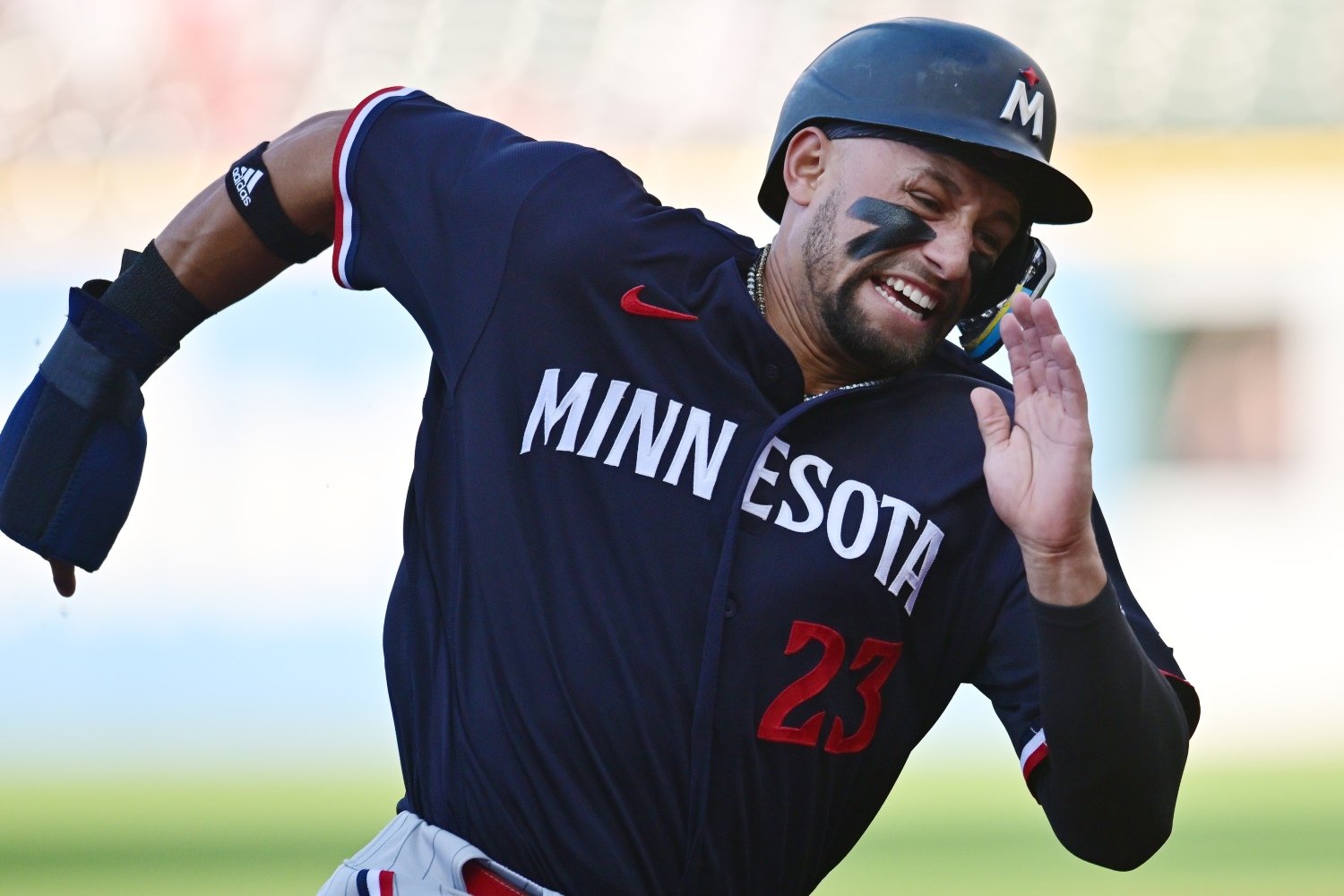 The injury bug once again burrowed its displeasing proboscis into star third baseman Royce Lewis, sucking up some of the vigor fueling the Twins' otherwise promising start to the season. Lewis came up lame rounding second base on a double by Carlos Correa and quickly exited the game following a consultation with athletic trainer Nick Paparesta. The team later relayed that Lewis had suffered a quadriceps injury and underwent an MRI as the contest progressed. (As of this writing, the results of the MRI have not been revealed.) The quadriceps is the primary muscle group of the thigh, and is comprised of four different muscles (hence the name). Their purpose is to forcefully extend (i.e., straighten) the knee, particularly during powerful movements such as sprinting and swinging. Without a fully functional quadriceps, completing athletic movements becomes difficult, if not impossible, especially at the level needed to play major-league baseball. Quadriceps strains are fairly common in baseball, with 68 having occurred between 2016 and 2023, according to Baseball Prospectus’s Recovery Dashboard. The average number of days missed following a quadriceps strain falls between 21 and 30 days, or approximately four weeks. However, the severity of the strain (as well as how Lewis responds to rehabilitation and ramping back to full baseball activity) will determine how much time he misses. Grade 1 strains—the least severe—tend to sideline athletes for a couple of weeks; Grade 2 strains may linger for a couple of months. Regardless, it seems as though a trip to the injured list is in the cards for Lewis. As a result, expect the Twins to call up either Austin Martin or Jose Miranda should Lewis land on the IL. Brooks Lee would likely have been first in line for a promotion following a solid spring, but the former first-round pick is expected to miss the first month of the season as he recovers from back spasms, according to St. Paul Saints manager Toby Gardenhire. Martin played third base extensively during his college days at Vanderbilt but has not appeared at the hot corner during his minor league career; should he get the call, he will likely primarily appear at second base with Kyle Farmer shifting to third. Miranda rose up the minor league ranks and made his MLB debut as a third baseman, however, he has been transitioned to first base following a shoulder injury and corresponding surgery. Unsurprisingly, Lewis—who is known for his glass-half-full disposition—was his typical positive self after the win, reflecting on how cool it was to be in the big leagues on Opening Day for the first time in his career. He also mentioned that he was relieved that his latest injury did not directly impact his twice-surgically-repaired right knee. Speculation will run rampant about whether Lewis’s two ACL ruptures caused, or at least contributed to, his quadriceps strain. The true answer is that it’s almost impossible to know, despite the seemingly clear correlation. Athletic injuries are complex and multifactorial. As such, there is never a clean explanation for why they occur, or if they were even preventable. Correlation does not equal causation, despite how logical the correlation may look on paper. Regardless of how much time Lewis misses, this is not an injury that should hamper his future outlook, either this season or moving forward. As he has shown all too often, Lewis is perhaps the most resilient player in MLB. The big questions are whether and how much the Twins prove to be resilient after losing him, for some period of time.
 -
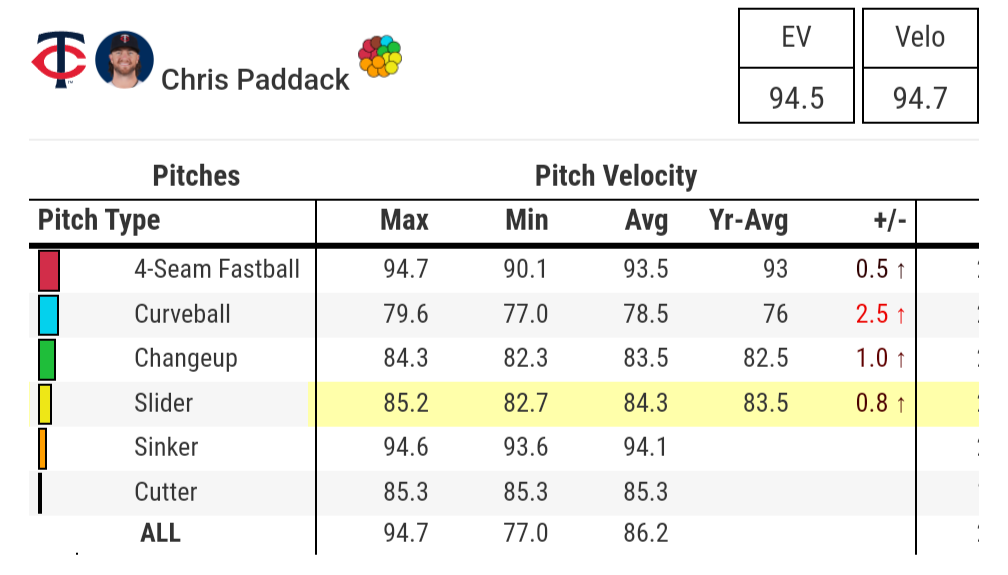
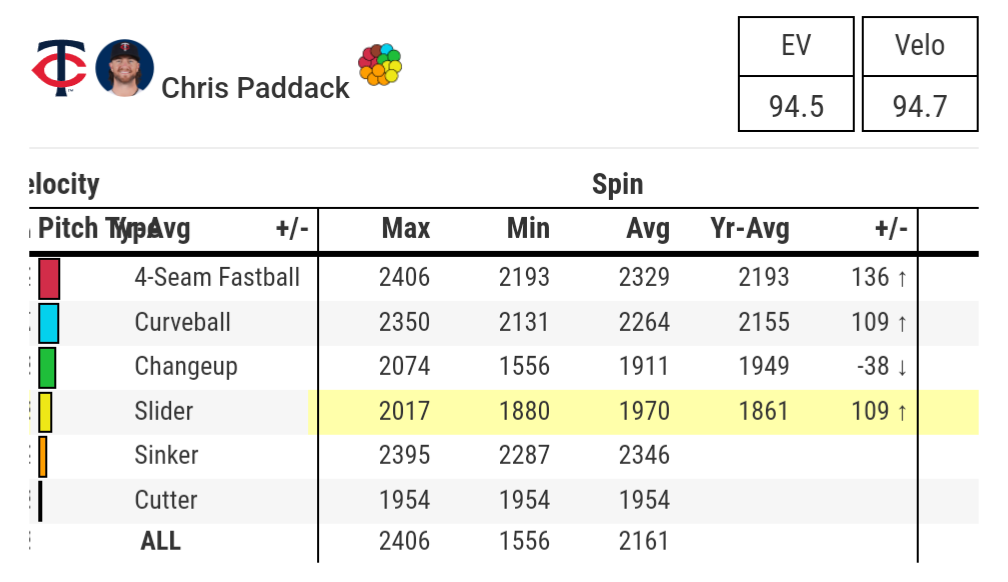
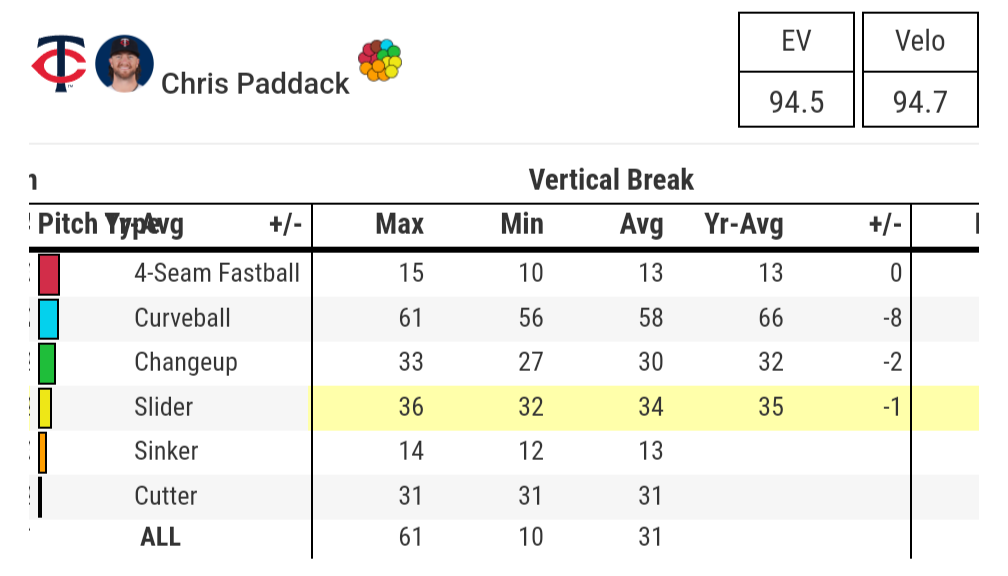
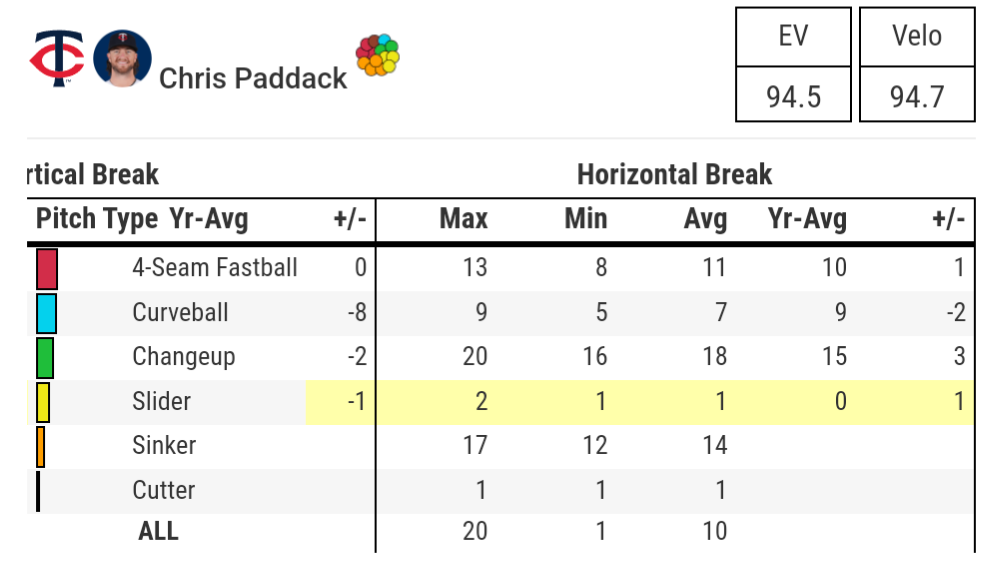
Results are in from Paddack's first appearance. Very low spin rate, more vertical than horizontal break, moderate velo. Seems like Paddack's new pitch is a gyro slider.
-
League average last year was 4.33. If offense, continues to rise, as is likely, 4.50 may very well be average this summer. I'd take a 4.28 with high K rate from Paddack every day.
- 32 replies
-
- 4
-

-

-
- chris paddack
- starting rotation
- (and 2 more)
-
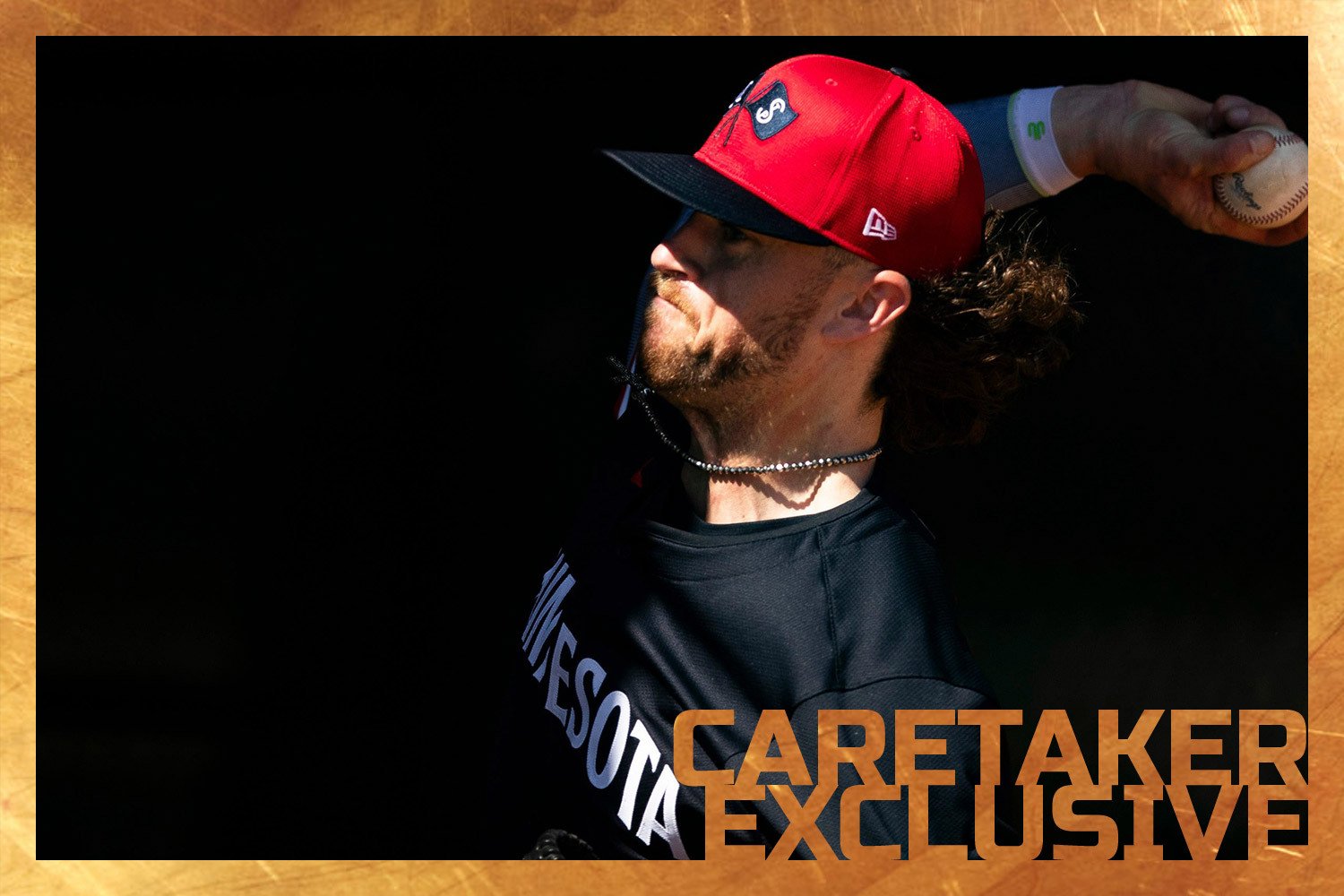
According to reporters on the scene in Fort Myers, Minnesota Twins starting pitcher Chris Paddack is working on a new pitch. What should Twins fans think of this development? Image courtesy of © Jonah Hinebaugh/Naples Daily News/USA Today Network-Florida / USA TODAY NETWORK According to reporters on the scene in Fort Myers, Minnesota Twins starting pitcher Chris Paddack is working on a new pitch. What should Twins fans think of this development? Chris Paddack raised many an eyebrow in late September, when he returned from his second Tommy John surgery pumping 97-mph gas out of the bullpen. His four-seamer averaged 95.5 mph across 35 regular-season offerings, which was nearly 0.7 mph faster than his previous career high, set in 2021. However, with the dawn of the 2024 season on the horizon and Paddack firmly in position to be in the Opening Day starting rotation, the Twins determined that the best course of action was for him to add another pitch. As Matthew Trueblood wrote recently, Paddack’s most frequently used pitch throughout his career has been his four-seamer. However, despite its newfound velocity (if that even has staying power as he moves back to starting), the heater has poor “shape”, meaning it doesn’t have the typical traits you’d expect highly successful fastballs to possess. For example, although its spin efficiency is elite (approximately 100%, or pure backspin), its 2,254 RPM spin rate is below-average, especially given the velocity. Additionally, its 15-inch induced vertical break (IVB)—or the amount the ball doesn’t drop during flight, giving the pitch the appearance of rising action—is just ok. (For reference, an IVB of 20 inches or so is elite.) Because he stands 6-foot-5 and uses a high three-quarters arm slot, his adjusted vertical approach angle—or the angle at which the ball approaches the plate, adjusted for its vertical location when it reaches the plate—is quite poor. Paddack!.mp4 Luckily, Paddack possesses a strong changeup that plays well off his mediocre fastball. Again, it has a poor vertical approach angle due to his arm slot but it owns seven inches of drop, nearly 16 inches of arm-side run, and is thrown between 10-13 mph slower. For all intents and purposes, Paddack’s changeup looks like his fastball out of the hand…but it just keeps running. Paddack!!.mp4 This brings us, finally, to why Paddack is working on a “slider/cutter”. Briefly: He needs a reliable third pitch, a second good pitch, and ideally one that plays well off his fastball. View full article
-
 Chris Paddack raised many an eyebrow in late September, when he returned from his second Tommy John surgery pumping 97-mph gas out of the bullpen. His four-seamer averaged 95.5 mph across 35 regular-season offerings, which was nearly 0.7 mph faster than his previous career high, set in 2021. However, with the dawn of the 2024 season on the horizon and Paddack firmly in position to be in the Opening Day starting rotation, the Twins determined that the best course of action was for him to add another pitch. As Matthew Trueblood wrote recently, Paddack’s most frequently used pitch throughout his career has been his four-seamer. However, despite its newfound velocity (if that even has staying power as he moves back to starting), the heater has poor “shape”, meaning it doesn’t have the typical traits you’d expect highly successful fastballs to possess. For example, although its spin efficiency is elite (approximately 100%, or pure backspin), its 2,254 RPM spin rate is below-average, especially given the velocity. Additionally, its 15-inch induced vertical break (IVB)—or the amount the ball doesn’t drop during flight, giving the pitch the appearance of rising action—is just ok. (For reference, an IVB of 20 inches or so is elite.) Because he stands 6-foot-5 and uses a high three-quarters arm slot, his adjusted vertical approach angle—or the angle at which the ball approaches the plate, adjusted for its vertical location when it reaches the plate—is quite poor. Paddack!.mp4 Luckily, Paddack possesses a strong changeup that plays well off his mediocre fastball. Again, it has a poor vertical approach angle due to his arm slot but it owns seven inches of drop, nearly 16 inches of arm-side run, and is thrown between 10-13 mph slower. For all intents and purposes, Paddack’s changeup looks like his fastball out of the hand…but it just keeps running. Paddack!!.mp4 This brings us, finally, to why Paddack is working on a “slider/cutter”. Briefly: He needs a reliable third pitch, a second good pitch, and ideally one that plays well off his fastball.
 -
Very much disagree here. Front offices hire biomechanists, sports scienticists, analytic quants exactly because there are a ton of secrets waiting to be discovered. Baseball is not as figured out as people think.
-
 Anthony DeSclafani was once considered among MLB’s up-and-coming starting pitchers before injuries began to hamper his career. He has spent significant time on the injured list, due to a right UCL sprain (all of 2017), right flexor-pronator strain (2023), right ankle inflammation (2021) and surgery (2022; peroneal tendon repair), right shoulder fatigue (2021), right teres major strain (2020), and two left oblique strains (2016 and 2018). However, when healthy, DeSclafani has proved he’s a viable MLB starter. He has posted ERAs of 3.17, 3.89, and 4.05 in the three seasons in which he’s made at least 30 starts, and 3.28 and 4.93 in the two seasons in which he started between 20 and 30. He's a traditional five-pitch mix, but has largely relied on his sinker and slider over his past two seasons with the San Francisco Giants. (The Mariners traded for DeSclafani earlier this offseason, before flipping him to the Twins.) DeSclafani’s best and most-thrown—44.8% usage rate last summer—pitch is that slider. It sits at 87-89 mph, with poor spin efficiency (43% active) and a 60-minute deviation in observed versus spin-based movement. In English: DeSclafani’s slider features more gyroscopic spin than active (i.e. movement-causing) spin. Thus, it relies more on gravity and seam-shifted wake to create drop, rather than on the Magnus effect to create run. slider.mp4 As a result, his bullet slider is a ground-ball machine, with the average launch angle against it in 2023 registering at 10 degrees; he’s only surrendered 34 home runs across 4,578 career offerings. It’s a legit weapon, though it works in defiance of the Twins’ sweeper-crazed ethos last year. DeSclafani’s second most-utilized pitch is a sinker. (Notice I said second-most utilized, not second-best. More on that in a second.) To be blunt: It’s nothing special. It does exactly what you’d expect of a sinker. It has decent arm-side run (16 inches; basically league average) and a modest 2,128 RPM spin rate (same). It’s used for inducing ground balls, and that’s about it. sinker.mp4 Those two pitches became his bread-and-butter during his tenure by the Bay, but there might be much more to him than what the Giants have tapped into recently.
 -
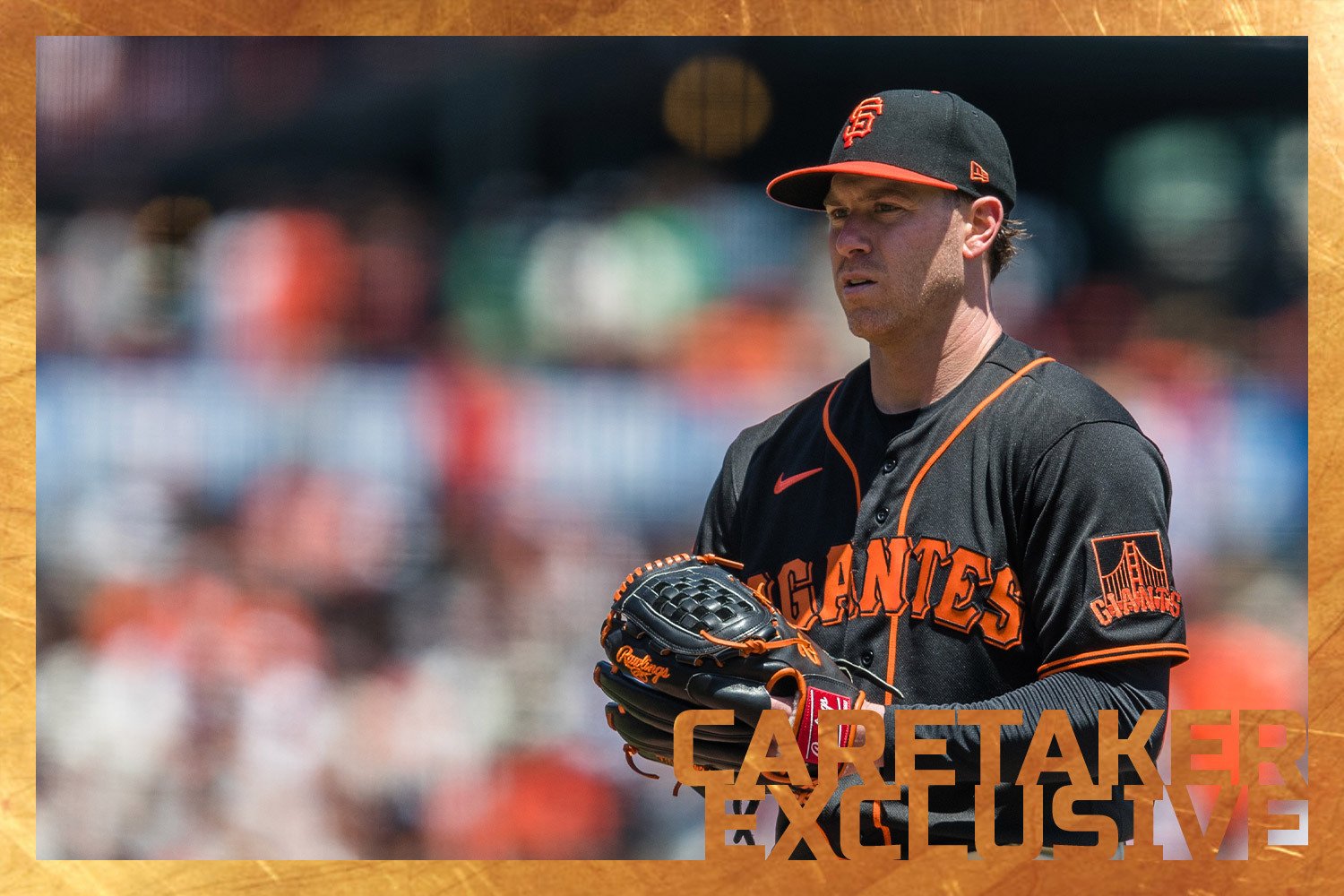
The Minnesota Twins acquired starting pitcher Anthony DeSclafani from the Seattle Mariners on Monday evening. While his superficial numbers aren’t particularly eye-popping, DeSclafani provides solid rotation depth. He may also have some potential waiting to be unlocked. Image courtesy of © D. Ross Cameron - USA Today Sports The Minnesota Twins acquired starting pitcher Anthony DeSclafani from the Seattle Mariners on Monday evening. While his superficial numbers aren’t particularly eye-popping, DeSclafani provides solid rotation depth. He may also have some potential waiting to be unlocked. Anthony DeSclafani was once considered among MLB’s up-and-coming starting pitchers before injuries began to hamper his career. He has spent significant time on the injured list, due to a right UCL sprain (all of 2017), right flexor-pronator strain (2023), right ankle inflammation (2021) and surgery (2022; peroneal tendon repair), right shoulder fatigue (2021), right teres major strain (2020), and two left oblique strains (2016 and 2018). However, when healthy, DeSclafani has proved he’s a viable MLB starter. He has posted ERAs of 3.17, 3.89, and 4.05 in the three seasons in which he’s made at least 30 starts, and 3.28 and 4.93 in the two seasons in which he started between 20 and 30. He's a traditional five-pitch mix, but has largely relied on his sinker and slider over his past two seasons with the San Francisco Giants. (The Mariners traded for DeSclafani earlier this offseason, before flipping him to the Twins.) DeSclafani’s best and most-thrown—44.8% usage rate last summer—pitch is that slider. It sits at 87-89 mph, with poor spin efficiency (43% active) and a 60-minute deviation in observed versus spin-based movement. In English: DeSclafani’s slider features more gyroscopic spin than active (i.e. movement-causing) spin. Thus, it relies more on gravity and seam-shifted wake to create drop, rather than on the Magnus effect to create run. slider.mp4 As a result, his bullet slider is a ground-ball machine, with the average launch angle against it in 2023 registering at 10 degrees; he’s only surrendered 34 home runs across 4,578 career offerings. It’s a legit weapon, though it works in defiance of the Twins’ sweeper-crazed ethos last year. DeSclafani’s second most-utilized pitch is a sinker. (Notice I said second-most utilized, not second-best. More on that in a second.) To be blunt: It’s nothing special. It does exactly what you’d expect of a sinker. It has decent arm-side run (16 inches; basically league average) and a modest 2,128 RPM spin rate (same). It’s used for inducing ground balls, and that’s about it. sinker.mp4 Those two pitches became his bread-and-butter during his tenure by the Bay, but there might be much more to him than what the Giants have tapped into recently. View full article
-
Thanks! I know he was back at Driveline a month or so ago. I imagine we'll hear/see what he was tinkering on come Spring Training. I'd imagine altering his grip a bit on the sweeper and splitter to induce more movement would be the main focus.
-
It’s often said that baseball is a game of inches. Perhaps no pitcher better illustrates that than Joe Ryan. Image courtesy of © Matt Blewett-USA TODAY Sports It’s often said that baseball is a game of inches. Perhaps no pitcher better illustrates that than Joe Ryan. Joe Ryan—acquired the summer before in exchange for fan favorite Nelson Cruz—burst onto the scene in 2022, thanks largely to his unique arm slot and heavy four-seam fastball usage. A hair over 60% of his offerings in 2022 were heaters, a number generally reserved for fireballing relievers; that number dropped only incrementally (to 56.9%) in 2023, thanks to increased reliance on a new splitter (27.2%) and sweeper 11.3%). Despite possessing a relatively poor spin rate (2216 RPM in 2023, 415th of the 648 pitchers with at least 10 plate appearances ending with the pitch) and movement profile (10.3-inch horizontal break, 17.6-inch vertical; each below 50th percentile league-wide), Ryan generates whiffs by attacking the top of the zone with his heat, leveraging his high spin efficiency (96%) in combination with a 5-foot vertical release point and trebuchet-like arm action to hide the ball until release. The result is one of MLB’s most valuable and underrated fastballs, worth 33 runs over his 335 career innings. JR.mp4 However, something changed in 2023. See if you can spot the result in the chart below. YEAR xBA xWOBA xSLG xERA ERA MPH SPIN 2B/3B HR 2022 .200 .300 .377 3.57 3.55 92.0 2194 11 9 2023 .208 .274 .381 3.53 4.51 92.3 2216 15 19 Ryan’s home run per fly ball rate on fastballs ballooned from 9.5% in 2022 to 14.9% in 2023. The good news is that his expected stats stayed steady, which is suggestive that plain ol’ bad luck played a major role in Ryan’s metamorphosis from arguable All-Star snub to untrusted in the playoffs. That's why Cody Pirkl wrote, this weekend, that there's hope for a bounceback from Ryan in 2024. (His home run problems were particularly punishing after the All-Star Game, as he surrendered 16 in a mere 54 ⅔ innings to go along with a not-nice 6.09 ERA.) But waving away Ryan’s misfortunes solely to luck lacks rigor, nuance...and truth. View full article
-
Joe Ryan and the Difference Between Accuracy and Precision
Lucas Seehafer PT posted an article in Caretakers
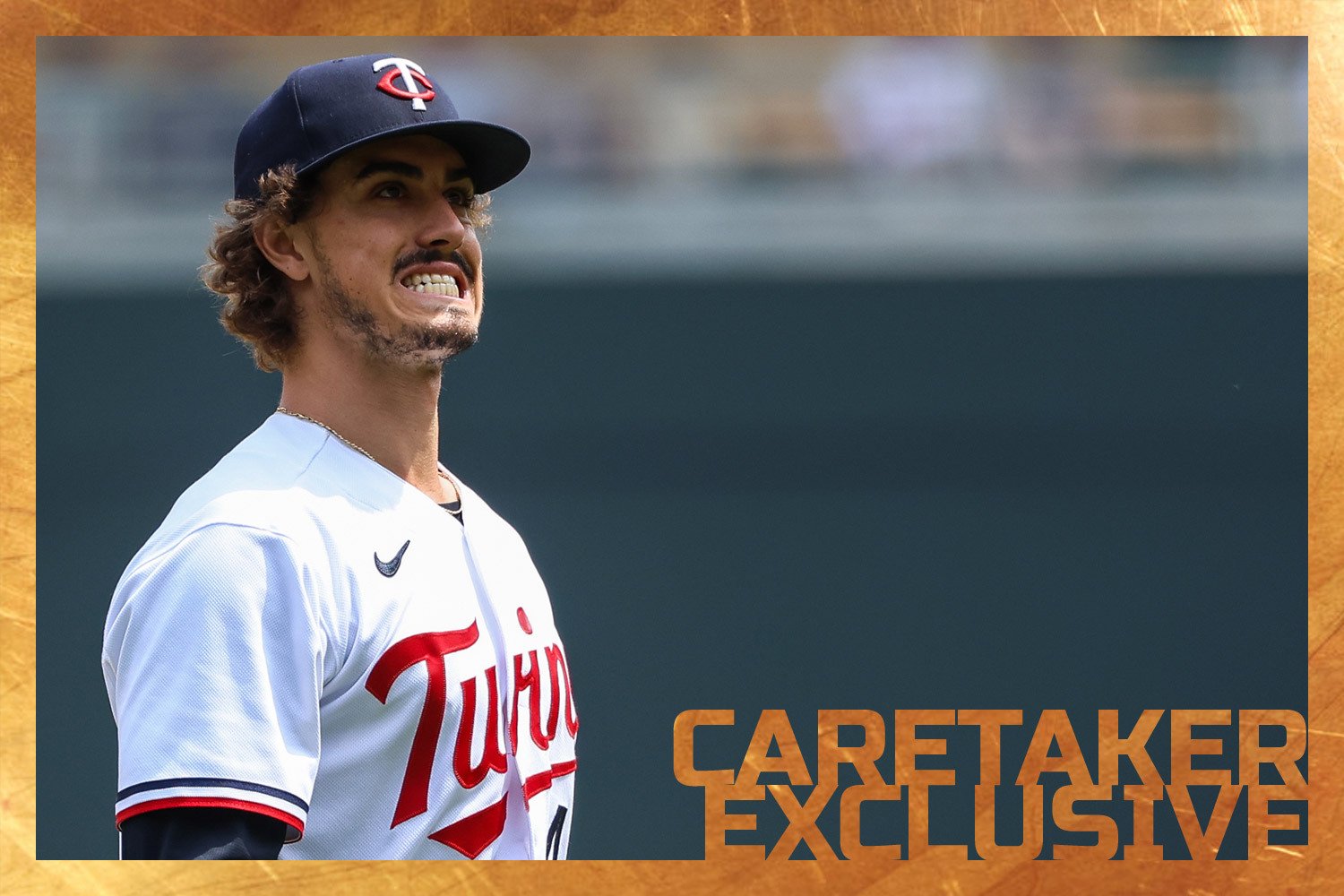 Joe Ryan—acquired the summer before in exchange for fan favorite Nelson Cruz—burst onto the scene in 2022, thanks largely to his unique arm slot and heavy four-seam fastball usage. A hair over 60% of his offerings in 2022 were heaters, a number generally reserved for fireballing relievers; that number dropped only incrementally (to 56.9%) in 2023, thanks to increased reliance on a new splitter (27.2%) and sweeper 11.3%). Despite possessing a relatively poor spin rate (2216 RPM in 2023, 415th of the 648 pitchers with at least 10 plate appearances ending with the pitch) and movement profile (10.3-inch horizontal break, 17.6-inch vertical; each below 50th percentile league-wide), Ryan generates whiffs by attacking the top of the zone with his heat, leveraging his high spin efficiency (96%) in combination with a 5-foot vertical release point and trebuchet-like arm action to hide the ball until release. The result is one of MLB’s most valuable and underrated fastballs, worth 33 runs over his 335 career innings. JR.mp4 However, something changed in 2023. See if you can spot the result in the chart below. YEAR xBA xWOBA xSLG xERA ERA MPH SPIN 2B/3B HR 2022 .200 .300 .377 3.57 3.55 92.0 2194 11 9 2023 .208 .274 .381 3.53 4.51 92.3 2216 15 19 Ryan’s home run per fly ball rate on fastballs ballooned from 9.5% in 2022 to 14.9% in 2023. The good news is that his expected stats stayed steady, which is suggestive that plain ol’ bad luck played a major role in Ryan’s metamorphosis from arguable All-Star snub to untrusted in the playoffs. That's why Cody Pirkl wrote, this weekend, that there's hope for a bounceback from Ryan in 2024. (His home run problems were particularly punishing after the All-Star Game, as he surrendered 16 in a mere 54 ⅔ innings to go along with a not-nice 6.09 ERA.) But waving away Ryan’s misfortunes solely to luck lacks rigor, nuance...and truth.