Greglw3
-
Posts
1,124 -
Joined
-
Last visited
Content Type
Profiles
News
Minnesota Twins Videos
2026 Minnesota Twins Top Prospects Ranking
2022 Minnesota Twins Draft Picks
Minnesota Twins Free Agent & Trade Rumors, Notes, & Tidbits
Guides & Resources
2023 Minnesota Twins Draft Picks
The Minnesota Twins Players Project
2024 Minnesota Twins Draft Picks
2025 Minnesota Twins Draft Pick Tracker
2026 Minnesota Twins Draft Tracker: Picks & Bonuses
Forums
Blogs
Events
Store
Downloads
Gallery
Everything posted by Greglw3
-
Wallner's a good fielder. Do you not watch the games and consider the opinions of long time, quality baseball men that affirm Wallner’s defense and arm? Kepler was a below average major league hitter, especially 2020-2024. Lifetime ~ .236 hitter.
- 67 replies
-
- 2
-

-

-
- max kepler
- brent rooker
- (and 3 more)
-
Is Harrison Bader This Year’s Byron Buxton Insurance?
Greglw3 replied to Cody Christie's topic in Twins Daily Front Page News
Worst. Signing. Ever.- 57 replies
-
- 2
-
-
- harrison bader
- byron buxton
- (and 2 more)
-
Is Harrison Bader This Year’s Byron Buxton Insurance?
Greglw3 replied to Cody Christie's topic in Twins Daily Front Page News
Agree with that strongly re musical chairs. Agree to disagree on Keirsey Jr. We will probably find out soon enough. -
What's Left at First Base in Free Agency?
Greglw3 replied to Nick Nelson's topic in Twins Daily Front Page News
I’d inclined to take a chance on Andrew Binentendi who has a nice offensive track record and dealt with an achilles muscle problem last year while nosediving to a very atypical .229 average. He’s only 29 and has been quite hitterish along the way.- 81 replies
-
- 2
-
-
-
- carlos santana
- pete alonso
- (and 1 more)
-
Is Harrison Bader This Year’s Byron Buxton Insurance?
Greglw3 replied to Cody Christie's topic in Twins Daily Front Page News
It is! Derek Falvey engages in it every year. For the life of me, I can’t figure out how he went out and got about 90 HR in Cron, Schoop and Cruz, won 101 games, and then turned into one of the quintessential below average and passive gm/POBO’s I’ve ever seen. My preference would be sign Profar for LF, Keirsey/Buxton for CF and Keirsey Wallner (Keirsey hits lefties) for RF. I’d sign .360 OBP Jesse Winker to DH and Larnach as depth or a trade. Sign .333 hitting Iglesias as Correa’s backup. Hurry along J Ishbia!!!! We should be going aggressively after Sasaki and I would move Jax to the rotation, 7 innings a start or more and he’d be #2 behind Sasaki (who may want to play for a small to mid-market team due to difficulties he had in Japan). -
Is Harrison Bader This Year’s Byron Buxton Insurance?
Greglw3 replied to Cody Christie's topic in Twins Daily Front Page News
I agree with your whole premise and feel that it’s time to hand that job over to Keirsey when Buxton doesn’t play CF and have DKJ play some left and right also. He’s absolutely mastered the AAA level and a stunning sliding catch and a HR in very limited playing time shows he can do it in MLB too. Give Keirsey, Jr. 500 AB!!! He hits lefties also!- 57 replies
-
- 1
-
-
- harrison bader
- byron buxton
- (and 2 more)
-
Is Harrison Bader This Year’s Byron Buxton Insurance?
Greglw3 replied to Cody Christie's topic in Twins Daily Front Page News
Counter that, I believe Keirsey, Jr. can do it as well or better and hit and steal better too.- 57 replies
-
- 1
-
-
- harrison bader
- byron buxton
- (and 2 more)
-
Thank you, I’ve long felt this. WAR completely disproportionately punished Eddie compared to the reality of baseball. Eddie was no Delmon Young. My examination of the situation in 2019 concluded that Eddie lost 75 percent of his 3.x WAR derived from offense to his defense and ended up 0.9. That’s the kind of thing that makes this analytics/statistics/predictive analytics major on the graduate level at Northwestern who got an A in every statistics course he ever took, conclude that the people running the tool (analytics) have no feel for the real game of baseball. Just because you have a BMW doesn’t mean you are a good driver. Take a bad driver and give them a tool like the BMW and they will still be a bad driver. This speaks to the Rocco Baldelli approach. To the extent that he can free himself of blind adherence to misguided analytics, he can become a good manager and I’ve seen him struggle with it. He just can’t break free. Molitor has a much better feel for the game. I think the defective range related defensive metrics which are new, untested and unproven are responsible for insane conclusions about the defensive abilities of many players, including Carlos Correa. The worst thing is the insistence of some teams to allow analytics majors who know 1/1000 about the diversity of tools needed to win baseball games to actually dictate to the manager what he is to do against his feel for the game. Joe Maddon stands out, a brilliant baseball mind run out of baseball by the reckless and downright stupid approach they took with him managing his team. The last thing is that all this reliance on poorly thought out analytics, especially on the defensive side but also the offensive analytics like exit velocity that have lead to the home run approach and screw bunting, stealing, etc have really hurt the game. I’ll note that the Twins have had a black hole in LF ever since Eddie and his 30+ HR and 109 RBI were run out of town. And you’re right, Eddie single handedly carried the Braves to a World Championship after he left the Twins. The Twins organization is never going to do well on a grand scale until they let go of this beast. I think if the Phoenix ownership group takes over, they’ll fix it in a hurry. I still think the Twins real true mission could be carried out with new owners and sans Falvey and Baldelli.
-
AGe 24, 25, 26, 27 seasons Winker had well over .900 OPS twice and close to a cumulative .900 OPS for the 4 seasons, including .939 and .949. Winker had .360 OBP in 2024 (.374 with Nationals) Larnach .338. Billy Beane either had it right or wrong. Best season for Winker, he was vastly better than Larnach has ever been at age 27 with .305/.394/.556 = .949 OPS and 143 OPS+. Winker has had 143 OPS+, 139, 132, 126, 125, 118, 103. The .199 average was less than 200 AB so out of context with his career. Winker lifetime: .262/.367/.437 .804 OPS 118 OPS+ Only 30 y.o. Larnach lifetime: .236/.323/.403 .726 OPS 102 OPS+ You still think Larnach is the better over all player? Oh, and Jurickson Profar 2024: OPS+ = 134
-
My plan speaks for itself, all names and salaries listed at 129.xx million. Vazquez = 5 MM, Paddack = 7.5 MM Castro = 6.7MM, Larnach = 2.x = 21.x MM. I used the full 36 for C4 and 21 for Pablo. They could easily go out and sign Profar and Winker if they wanted to and I used 45MM for Profar. And I also got .333 hitting SS Iglesias to back up C4. Plus I added Danny Coulombe for 3 MM to shore up the LHR problem. Jeffers and Camargo will be fine with the addition of Profar, Winker, Iglesias and Jax as a front of rotation starter. I read that Sasaki wants to play for a smaller market team with a good farm system and Twins have top money at 7.555 to offer him. But that would just be the icing on the cake. I’m not saying this is what they will do but I’m trying to show what they CAN do if they’re aggressive like the Royals or Padres GM. My approach would be a hard working, aggressive, can--do approach and that’s what my plan does in considerably improving the offense. With Jax in the rotation and an aggressive run for Sasaki, the Twins Rotation could be WS capable. Advantage to smaller market (per little birdie) and MAX that any team can offer. Under team control for 6 years. C: Ryan Jeffers ($4.70M) 1B: Jose Miranda ($0.80M) 2B: Royce Lewis ($2.3M) 3B: Brooks Robinson Lee ($0.8M) SS: Carlos Correa ($36.00M) LF: Jurickson Profar ($15.00M) CF: Byron Buxton ($15.00M) RF: Matt Wallner ($0.80M) DH: Jesse Winker ($3.5M) 4th OF: Austin Martin ($0.80M) Utility: Jose Iglesias ($2.25M) Utility: DaShawn Keirsey ($0.80M) Backup C: Jair Camargo ($.8M) NA: Dead Money Here ($0.00M) SP1: Roki Sasaki ($0.8M) SP2: Griffin Jax ($2.60M) SP3: Pablo Lopez ($21.75M) SP4: Joe Ryan ($3.80M) SP5: Bailey Ober ($4.30M) RP: Jhoan Duran ($3.70M) RP: Funderburk ($0.8M) RP: Simeon Woods Richardson ($0.8M) RP: Jorge Alcala ($1.50M) RP: Cole Sands ($0.80M) RP: David Festa ($0.8M) RP: Louie Varland ($0.80M) RP: Danny Coulombe ($3.0M) Payroll is 0.77% under budget
-
Profar estimated by Jim Bowden at 3/39MM = 13MM = less than Vazquez and Paddock’s contracts. I had Profar as my LF long before I filled out the Twins blueprint tool and included him there and came in below 130MM even w offering Profar 3/45MM. And I added Jesse Winker too.
-
I'm with you, money shedding trades and prospects for young controllable talents. Almost no offensive player should be untouchable because so many are Injury or inexperience risks. I''d try to get Profar, Jesse Winker, Hays, Laureano and more hitters via trade. The offense is the worst problem with the Twins now.
-
Sasaki has supposedly said he wants to play in a smaller market and Twins have most Intl pool money. w a few other teams. Laureano signed a $740,000 contract with Atlanta and a fair salary for Hays would be 5MM for 1 yr. Notice I overpaid for Profar at 15 MM but saw 3/39MM projected last couple days so let’s say my ~129 MM + $740,000 +5 MM for Hays = ~ 136 MM if Profar accepts 3/39, then ~134 MM. There’s no way Polahd’s will squash a 134-136 MM payroll Ya gotta admit, my roster is much stronger than last years :-)
-
Look at my plan! it’s all there. Profar is projected for 3/39 MM, so 13, Winker can’t be more than 5 = 18 MM, which is Vazquez and Paddack’s salary and Laureano would be inexpensive as would Hays.
-
They need money to work with. Vazquez+Paddack+Castro+Larnach could free up 5+7.5+6.75+2= 21.25 million. First addition would be Profar, then Hays, Laureano and Jesse Winker for probably less than the 21.25 million.
- 62 replies
-
- 1
-
-
- chris paddack
- christian vazquez
- (and 1 more)
-
I believe trading Vazquez and paying 50% and using Camargo would be OK but I would try to use a 15-20 prospect instead of the $5 MM. I heard someone in the know mention that Camargo puts on amazing long ball shows in B which doesn’t make him a hitter but maybe shows some HR potential ??? My plan for the team that I filled out using the template is sweeping and brings in Profar for LF, Jesse Winker to DH, Jose Iglesias as backup for Correa. Jax and Sasaki for the rotation, Chafin for the pen and now I would also sign Hays and Laureano. Trading Vazquez, Paddack, Castro, Larnach and I’m just about persuaded by the first commenter on trading Correa. This team needs a big time shakeup. Across the outfield and across the infield, we don’t have a single non injury-prone (Correa, Buxton, Lewis, Lee?) or questionable due to lack of experience (Wallner, Lewis, Larnach, Lee) or questionable due to lack of offense that kills the team’s lineup (Jeffers, Vazquez) player in sight. Question marks everywhere and we’ve been playing that game for a few years, longer with Buxton. I have the most optimism about Miranda, Martin and Keirsey Jr. to stay healthy and carry their weight. I thought Matthew Trueblood wrote an excellent article about how to acquire 1 or 2 young stars by trading prospects.
-
Falvey surely learned his lesson on Gallo and Margot, right? A 7 year old GM could do better than that!
-
I agree with that and I liked the article a lot and the Twins should make 1 or 2 of those moves. The article shows a can-do approach that the Twins FO, Falvey seems to lack. DO at least one of those moves, bring in Hays and/or Laureano and sign Jurickson Profar and Jesse Winker. The offense is in dire need of depth and higher quality. My Twins planner brought in both Winker and Profar for under $130 MM but shed Vasquez and Paddack’s salaries. Almost everybody is an injury or slump risk across the OF and IF. Count me, also as one who believes DaShawn Keirsey, Jr. can be the first adequate Byron Buxton insurance the Twins have had in years, if ever.
- 53 replies
-
- 1
-
-
- lawrence butler
- mason miller
- (and 3 more)
-
We agree to disagree! From an article by Seth Stohs [ https://twinsdaily.com/profile/19-seth-stohs/ ] on Keirsey Jr. during 2023 season "Through 63 games this season, he is hitting .312/.367/.494 (.861) with 12 doubles, three triples, and he’s already got nine home runs. He has been successful in 24 of 28 stolen base attempts. All the while, he has played great centerfield defense. He has made some spectacular diving plays but often catching balls that others might have to dive for look easy." Next shot, sourced to MLB.com, quoting none other than Baseball America
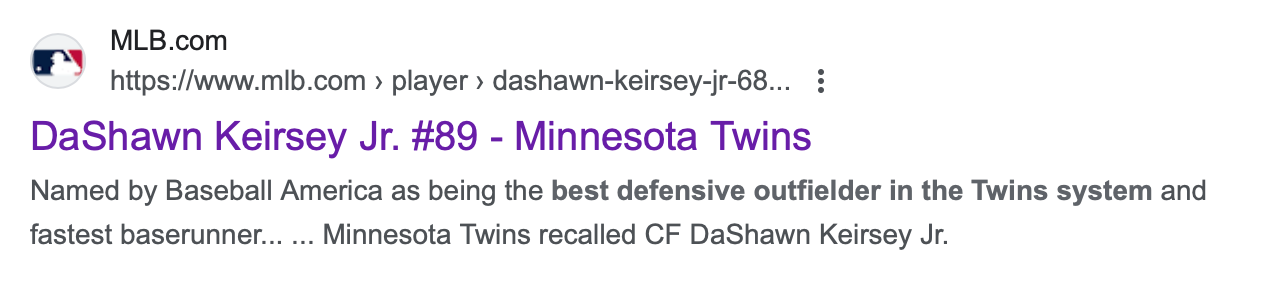
-
I'll take your word for it and watch the clips again. I have to admit, I’m old school and don’t trust any of the new SABR inspired defensive metrics. I’d much prefer to see write-ups or interviews with a few MLB scouts, using the 20-80 scale for range, arm, errors, etc. One thing we agree on is he has a boatload of athletic ability. I also like that he makes a lot of contact, which will get runners in from 3rd on an out sometimes vs. K and spraying singles around can create a lot of 1st and 3rds. I’m still very hopeful on him but would still get Hays, Laureano, Profar and Winker. The offense needs a big infusion and much more depth.
-
As I wrote to another poster, to say Keirsey hasn’t produced in AAA like he belongs in MLB, he did everything a leadoff hitter should do and then some, this is an absolutely splendid season! Keirsey had a .300 batting average, .368 OBP, .476 SLG Pct and not an .800 OPS but an .845 OPS. Plus he had 14 HRs and 81 RBIs batting mostly leadoff. That’s unheard of. And he’s an ace defensive center fielder. He also stole 36 bases in 43 attempts. Nothing about this premium season in 2024 suggests that he should be pigeonholed into any generalizations like, subtract 150 or 200 on base points for MLB.
-
Keirsey had a .300 batting average, .368 OBP, .476 SLG Pct and not an .800 OPS but an .845 OPS. Plus he had 14 HRs and 81 RBIs batting mostly leadoff. That’s unheard of. And he’s an ace defensive center fielder. He also stole 36 bases in 43 attempts. Nothing about this premium season in 2024 suggests that he should be pigeonholed into any generalizations like, subtract 150 or 200 on base points for MLB. Some players are better in the majors than they were in the minors. I lived in Toledo when Kirby Puckett played for the Mud Hens and he was struggling along in the upper .230s to lower .240s, got called up, went off and the rest is history.
- 65 replies
-
- 1
-
-
- austin hays
- byron buxton
- (and 2 more)
-
You said the HR robbing clip shows his slow reaction time, destroying his range and he made one of the best over the fence HR robbing plays I’ve seen? And how does a player with destroyed range make the second spread out diving catch? You’re asking a rookie to step in and not have slumps in the field, where you wouldn’t ask Matt Wallner, Trevor Larnach, Edouard Julien, Royce Lewis to go slump free at the plate in their first year.
- 65 replies
-
- 1
-
-
- austin hays
- byron buxton
- (and 2 more)
-
The only one I’d consider is Austin Hays. It’s a myth to say that all the Twins need in the outfield in a RHH batter. The whole outfield is question marks. Larnach still hasn’’t cracked .250, Buxton is injury prone and very hot cold when playing as in chasing bad pitches and going on HR and Double binges. Hopefully Wallner is the Wallner of 2nd half 2024 but you never know. The player you left out is Ramon Laureano who hit .296 for the Braves with an over .500 slugging percentage. I think you missed the mark on Austin Martin by calling him an underpowered hitter and lousy defender. I have two clips of Martin catches. It’s my contention that a lousy defender could never have made either of these plays in a million years. Did Martin make some mistakes? Yes, but he’s young and these two clips show his potential. https://www.youtube.com/watch?v=bEVVcsXyfpU https://www.mlb.com/video/nolan-arenado-lines-out-to-center-fielder-austin-martin As for the underpowered hitter, Martin hit .253, and the American League average in 2024 was .243. As far as power, he doesn’t need to be a power hitter. Further, he absolutely should not be a power hitter. Twins fans have witnessed enough strikeouts in the last few years and the results are apparent. Very inconsistent offense. The Twins almost ruined Martin by trying to turn him into a power hitter and it went poorly. When he went back to his old approach, he started hitting again. My contention is to measure success of a player, you have to look at the role they play on a team. One can’t legitimately say, Wallner had a higher OPS than Luis Arraez, 3 consecutive batting titles, and high on base for the leadoff slot, so therefore Wallner’s the better hitter. I would sign Hays and Laureano. Then, I’d go out and sign Jurickson Profar to play LF and Jesse Winker to DH. I did that in my roster building plan and came in under $130 MM. We’ve seen what lack of quality OF depth can do from the day we first said hello to Jake Cave and a long list of Buxton backups. I do think DaShawn Keirsey Jr. can fill in in CF. I’m one of his biggest fans after watching lots of his offense and defense on Tom Froemming’s podcasts.
- 65 replies
-
- 1
-
-
- austin hays
- byron buxton
- (and 2 more)
-
Here are some newly available players who would be low cost and could help the Twins. Recently non-tendered or released players I’d be interested in for the Twins: Austin Hays (previous 22 HR season), Ramon Laureano (hit .296 w > .500 SLG for Braves), Cal Quantrill and Cody Morris, who I saw pitch a dominant gem at Cleveland in person against the Twins and have never forgotten it! That being said, my nice tidy 129.xx million dollar blueprint for the Twins brings in Jurickson Profar at 3/45MM and Jesse Winker. I still think Laureano would be a cheap and good signing and Hays too. Twins have learned you can never have too much depth and the OF still has a lot of ???. Of course if Falvey wants to sign Teoscar Hernandez to a 3/71 contract as a Fangraphs writer floated and multiple articles were written about, I won’t complain! Credit for Feature photo: Baseball Reference