bean5302
-
Posts
7,571 -
Joined
-
Last visited
-
Days Won
36
Content Type
Profiles
News
Minnesota Twins Videos
2026 Minnesota Twins Top Prospects Ranking
2022 Minnesota Twins Draft Picks
Minnesota Twins Free Agent & Trade Rumors, Notes, & Tidbits
Guides & Resources
2023 Minnesota Twins Draft Picks
The Minnesota Twins Players Project
2024 Minnesota Twins Draft Picks
2025 Minnesota Twins Draft Pick Tracker
2026 Minnesota Twins Draft Tracker: Picks & Bonuses
Forums
Blogs
Events
Store
Downloads
Gallery
Everything posted by bean5302
-
Time to Make a Trade: Swap CJ Abrams for Royce Lewis
bean5302 replied to Nate Palmer's topic in Twins Daily Front Page News
.748 vs .687 OPS is not remotely close. It's the slugging percentage that blows things out of the water. That's 2 WAR right there. -
What Should the Twins Do About the Middle Infield?
bean5302 replied to Alex Boxwell's topic in Twins Daily Front Page News
I'd hire a coach who understands how to coach defense... but that's just me.- 84 replies
-
- 3
-

-
- brooks lee
- ha seong kim
- (and 2 more)
-
Time to Make a Trade: Swap CJ Abrams for Royce Lewis
bean5302 replied to Nate Palmer's topic in Twins Daily Front Page News
If the Nationals trade CJ Adams, they'll be looking for prospects. Not arbitration eligble MLB players. Royce Lewis isn't going to be an interest for Washington if the team is rebuilding. If you want CJ Adams, it's Walker Jenkins you have to give up. Maybe a combo of Connor Prielipp, Luke Keaschall, and David Festa if you were trying to avoid parting with Jenkins. -
Time to Make a Trade: Swap CJ Abrams for Royce Lewis
bean5302 replied to Nate Palmer's topic in Twins Daily Front Page News
CJ Abrams trade value +54 Royce Lewis trade value +20 This trade proposal is nonsense. -
I'm glad Correa isn't on the roster. The fact it cost $10MM a year to get him off the roster isn't a great look, but we're saving $21.5MM, that's what this article should be about. The fact we don't have a guy stirring things up in the clubhouse by demanding effort from the rest of the players that he isn't putting in while simultaneously not playing well and being paid more than 20 guys on the roster combined wasn't helping the team.
-
The Twins are All-In on Royce Lewis (Again)
bean5302 replied to Cody Christie's topic in Twins Daily Front Page News
Did Falvey also express disappointment Lewis wasn't asked to play at least 4 positions per game last year? Where's that coveted versatility? I honestly don't want to hear another word out of that talking head (Falvey).- 36 replies
-
- 5
-
-
- royce lewis
- derek shelton
- (and 1 more)
-
McCusker didn't exactly tear up AAA towards the end of the year, and he was clearly outmatched against MLB pitching in his brief stint in the big show. I expect he'll clear waivers. I could see the Twins bringing him back on a MiLB contract.
-
I guess having 5 relievers with more than 20 IP each all with an ERA at 2.45 or better doesn't move your needle for "stacked"
-
Outman doesn't play for the Twins at AAA at all because he has no options. So the Twins can DFA and watch him walk now or they can keep him on the 40 man, watch his performance in Spring Training and either watch him walk or give him some leash. AAA depth charts aren't relevant to that discussion.
-
Yeah, it's a bummer not every single prospect who rakes in AAA turns out to be a good hitter at the MLB level. Outman seems like he's probably AAAA, and yet, there was another hitter not too long ago this team wrote off before he became a multi-year All Star with Oakland. Outman is worth getting a look in Spring Training and a little leash since the Twins don't have anything of likely higher value for LF.
-
Triston Casas He's not a starting caliber 1B.

-
Need 8 guys who can be starters. 6-7 guys who can start 20+ games. (Ryan, Ober, Lopez, SWR, Bradley, Matthews) 1 guy who can cover 5-10 games in a pinch (Morris, MacLeod, Festa, Abel, Rojas, Prielipp) Spring Training will probably tell us a lot. The Twins have just enough guys you'd feel okay about counting on for a starter's workload, but not much more than that.
- 23 replies
-
- 2
-
-
- zebby matthews
- david festa
- (and 6 more)
-
It's not my rating. BTV had Stewart as a +6 trade value. That's right in line with what I quoted. Back end top 10 org prospect land.
-
Brock Stewart was worth a good org's top 10 prospect last year. Twins equivalent like Gabriel Gonzalez or Andrew Morris type.
-
Trade our unproven guys for stuff because we're "deep" on starting pitching? We've got 2 bonefide playoff team caliber starting pitchers on the roster. Lopez and Ryan. Ober +20 trade value SWR +16 trade value, very low ceiling. maybe an adequate #5 Matthews +18 trade value, should be better, but hasn't been Festa +12 not worth much due to health concerns Bradley +26 all projection Abel +10, about to wash out as a projectable starter Prielipp +15 lots of questions here, upside, by a very low floor. Morris +4 won't make it as an MLB starter I'm not sure these pitchers move the needle on a legitimate upgrade, it's just swapping guys who aren't likely big contributors for guys who aren't likely big contributors. Rearranging the deck chairs so to speak. Not sure why there's such an obsession with Casas around here. I see his name popping up frequently for years. If another team is trying to cast him off, why do we want him so desperately?
- 50 replies
-
- 6
-
-

-
- pablo lopez
- joe ryan
- (and 6 more)
-
Kody Clemens: A Good Player in the Wrong Role?
bean5302 replied to Adam Friedman's topic in Twins Daily Front Page News
Kody Clemens owned a xwOBA of .330 last year, which corresponds with a wRC+ in that 110-115 range, mostly. 1B = 1.5-2.0 WAR LF = 2.0-2.5 WAR 2B = 2.5-3.0 WAR I think that's probably his ceiling. Adequate at 1B, solid at LF, plus 2B if his defense is solid at any of those positions. I think the Twins are going to be giving the keys to 2B to Keaschall and the logjam at LF probably means Clemens is a bigger lock for 1B and the dearth of guys we have there. His floor is obviously much lower, depending on how pitchers adjust to his successes, and how Clemens plays defensively. There really isn't enough history on him, and his age makes him harder to project and rely upon. -
I'm not as bearish on Outman as others it seems. I don't have high hopes for him or anything, but he did go .289/.378/.592 OPS .970 11.7% BB, 30.3% K last year with the Dodgers AAA club in 333 PA. His sprint speed was 28.5 last year and he's got a cannon arm. In addition, it seems like there was some improvement in expected results (still bad). In any case, hopefully, he'll get a good look in Spring Training and turn things back around. I see his 2024 as more of a rookie Danny Santana kind of campaign where it was all smoke and mirrors, but I don't think Outman is a guaranteed negative WAR guy, either.
-
Jeffers is probably worth $30MM on a 3yr deal which would replace this season. Pretty similar to Vazquez when the Twins signed him, a little more due to Jeffers being a tick younger and a tick better, but with more risk. I'd imagine Jeffers would jump at that. I wouldn't want to go more than 2 extension years on Jeffers given how close he is to a single step back wiping his value out, and how limited his ceiling is.
-
Trying to get as close to 30 catchers as I could each season. The number of qualified catchers at that PA varies a bit. 350 could return 28 catchers or 15 in any season. btw, Median is also average, just not as highly used as Mean :p
-
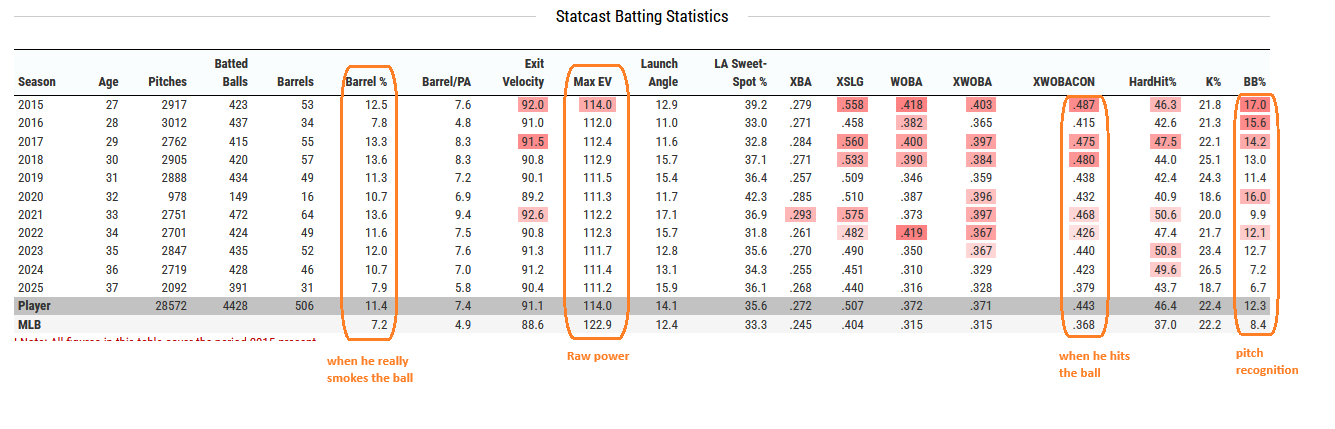
Goldschmidt probably has another year of solid league average bat in him. Maybe a brief rebound, but he doesn't project like a Nelson Cruz.
-
Okay, let's look at this from a homer perspective, just because the negativity around here is a bit much even for me hahah. C - Ryan Jeffers 2.5 WAR (free agent year performance) 1B - Trevor Larnach 2.0 WAR 2B - Luke Keaschall 3.0 WAR SS - Kaelyn Culpepper 4.0 WAR 3B - Royce Lewis 5.0 WAR LF - Austin Martin 2.5 WAR CF - Byron Buxton 5.0 WAR RF - Walker Jenkins 4.0 WAR BC - Jackson 1.0 WAR UO - Roden 1.0 WAR UI - Lee 1.0 WAR Util - Clemens 0.5 WAR SP1 - Lopez 3.5 WAR SP2 - Ryan 3.5 WAR SP3 - Ober 2.5 WAR SP4 - Matthews 2.5 WAR SP5 - Bradley 2.5 WAR Spot - Abel 1.0 WAR Cl - Festa 2.0 WAR 8th - Prielipp 1.5 WAR BP3 - SWR 1.0 WAR BP4 - Topa 0.5 WAR BP5 - Sands 0.5 WAR BP6 - Funderburk 0.5 WAR BP7 - Rojas 0.5 WAR BP8 - Morris 0.5 WAR That's 54 WAR = 99 Wins!!!
- 139 replies
-
- 2
-

-
- joe ryan
- pablo lopez
- (and 4 more)
-
Ryan Jeffers is not above average. He's below average, technically. fWAR 2025 = Rank of 26 catchers with 350+ PA (15 of 26) 42% 2024 = Rank of 32 catchers with 300+ PA (22 of 32) 31% 2023 = Rank of 31 catchers with 300+ PA (14 of 31) 55% He's been a pretty durable, below average defensive catcher with a league average-ish bat in potential decline. That's a solid profile for a reliable starting catcher, but it's not great or above average. I've always been annoyed by these "the Twins owe mediocre player <x> something." Jeffers doesn't even have a ton of trade value. +12 on BaseballTradeValues.com. It's fine. He'd be expected to bring back something of value or he could potentially be packaged to get a little more from somebody, but he's not going to change the Twins' farm system or something. Appreciate him for what he is, but as is history with Twins fans, any player who is with the team for more than 2-3 years becomes "special" just based on the older history of this team being nothing more than a farm system for competitive clubs.
-
For the comments about not rebuilding, what is the ceiling of the current roster without the rebuild? vs. what is the ceiling of the players we have coming up now or could acquire? This team lost 92 games last year with Pablo Lopez, Joe Ryan, Byron Buxton and a lot of talent which was cast off at the deadline. What does the 2025 team look like as-is? The players the Twins traded were worth 10 WAR for Minnesota last year. This team with Lopez, Ryan and Buxton is potentially a 100 loss team as-is. Established veterans worthy of starting positions for a playoff caliber team. C - Jeffers 1B - Nothing 2B - Nothing SS - Nothing 3B - Nothing LF - Nothing CF - Buxton RF - Wallner DH - Nothing BC - Nothing UO - Nothing UI - Nothing Util - Martin? Almost every single position is a question mark with a floor well below starter caliber (2+ WAR). I'd argue 1B, 2B, SS and LF all have below replacement level potential floors. SP1 - Lopez SP2 - Ryan SP3 - Nothing SP4 - Nothing SP5 - Nothing Regardless of how fans feel about Bailey Ober, he's 30 and couldn't crack 1.5 fWAR last year with declining velo. SWR can't seem to handle a real starter's workload, and he has FIPs only a #5 workhorse could get away with. The rest of the options are just as sus in a realistic view. Closer - Nothing Setup- Nothing RP3 - Sands RP4 - Topa RP5 - Nothing RP6 - Nothing RP7 - Nothing RP8 - Nothing With the complete bullpen completely ravaged by Falvey's deadline moves, there's virtually nothing left a playoff caliber team reasonably could count on. There's nothing to "blow up" on this roster. Only potential and some aging short term assets. If the Twins are going to go all-in, sure, there's reason to keep Buxton and Lopez, maybe even Ryan. But standing pat means missing the playoffs already. This isn't likely a good team. I mean, there's certainly potential to be great, but it's just not likely they'll be good.
- 139 replies
-
- 1
-
-
- joe ryan
- pablo lopez
- (and 4 more)
-
Almost every team to make it to the World Series has undergone a significant rebuild/reconstruction in the past decade. You either do that or you have an exceptionally high budget or both. The problem is I don't really think "Falvey" burning it down helps. The Twins have deserved only 1 playoff appearance in Falvey's entire tenure, and that's 2019. Otherwise, the team has been gifted playoff spots in what was the worst division in baseball. Since 2017 (changing now with the expanded playoffs) an 87 win team has less than a 10% shot at the playoffs. The Twins have only 1 season under Falvey with more than 87 wins. The teams he's built just aren't very good. They're "competitive" but not strong. He and his front office have not good enough to recognize and develop talent. Topping it off, Falvey's fresh out of Bill Smith and Terry Ryan drafted talent to trade away or prop up his poorly built rosters so there might not be a lot of rebuild quality on the horizon. I expect a Falvey rebuild looks an awful lot like a White Sox rebuild. We're hosed so long as Falvey remains in his position.
- 139 replies
-
- 6
-
-

-
- joe ryan
- pablo lopez
- (and 4 more)
-
Plus the potential to be first in line to purchase the team or a path to increasing their stake or controlling interests etc. All kinds of potential perks. Could be anything. The ability to never allow Deshawn Keirsey to play a regular season game again might be at the top of my list of asks.