


Twins Video
Let’s set the scene. It was 2003. The unexpected Anaheim Angels were coming off the first World Series championship in franchise history. Kids who are adults now were glued to their TVs, growing up with shows such as SpongeBob Squarepants and quoting it non-stop. The Minnesota Twins were staying home after a hard-fought 2002 division title and an equally hard-won court ruling prevented their move out of town.
In the mix of all that, an up-and-coming website going all-in on covering baseball from the majors to the minor leagues was entering its seventh season on the scene: Baseball Prospectus. Now, it is one of the leading sites in covering the sport online and has produced or been home to some of today's beat writers (Aaron Gleeman) and even front office executives (ex-GMs Chaim Bloom and James Click, longtime Cleveland guru Keith Woolner, and Twins staffer Kevin Goldstein, among many others).
That year, Prospectus released its first comprehensive, online top 40 prospect rankings. This list included three players in the Twins system at the time, one future Twins player, and one manager.
The three Twins ranked on the list at the time were Joe Mauer, Michael Cuddyer, and Justin Morneau. Mauer was the only one of the three ranked within the top 10, coming in ninth overall according to the writers who made up the panel at the time.
There were some names ranked higher than Mauer that certainly were understandable at that time, notably the top three on this list. At number one, Mark Teixeira; at number two, the Japanese superstar who earned the nickname Godzilla, Hideki Matsui; and at number three, José Reyes.
However, with 20/20 hindsight (and perhaps just with the new knowledge about the game we have gained in the last two decades), there were a few names ahead of Mauer on this list that were a bit baffling. Full disclosure: This author has his biases on the rankings. I was only four years old in 2003 and it wouldn’t be another two years until I really cultivated a basic understanding of the game I love most, but Mauer was my childhood hero in this game.
Yet, even with those biases and hindsight taken into account, it’s still odd to see a prospect list where Victor Martinez, Hee-Seop Choi, and Jerome Williams were all ranked higher than Mauer. Martinez proved to be a worthy adversary to Mauer on rival teams dating back to his early years with the former Cleveland Guardians. By the time both were in the majors full-time in 2006, Mauer and Martinez would often be found on top-10 catcher lists by writers and fantasy experts league-wide until 2012. Martinez, like Mauer, had his time spent behind the plate cut short (although more by his defensive limitations than by injury issues), and caught only five games in his final six seasons.
Mauer came out the better catcher during their peak seasons behind the plate. Mauer’s 2006-2013 seasons, compared to Martinez’s peak seasons (2004-2010) behind the plate, eclipse him in all but a few facets. Mauer had a .327/.410/.473 slash line, with an OPS+ of 139. Martinez had a .304/.372/.475 line, good for an OPS+ of 124.
Despite the differences in peaks and rankings in 2003, Martinez and Mauer both turned out to be among the fantastic catchers of their eras, proving their rankings by Baseball Prospectus 20 years ago to be sound.
Williams and Choi, on the other hand, didn’t have their careers pan out as prospect gurus were predicting at the time. Williams had a strong rookie campaign with the Giants in 2003 at the age of 21, posting a 3.30 ERA in 131 innings of work across 21 starts, along with an ERA+ of 128. But his strikeout-to-walk ratio of 1.8 wasn’t glamorous.
Williams would never reach the heights of his rookie campaign again, and by the end of a dismal 2007 season making six starts with the Washington Nationals, it looked as though his career was over. He would make a comeback in 2011 and stayed in the Majors as a journeyman, back-end starter for six seasons, but stardom eluded him entirely.
Choi, who was signed out of South Korea by the Chicago Cubs in 1999, was expected to be Shin-Soo Choo (whom, fun fact, Baseball Prospectus ranked 16th on this list) before Choo broke into the majors. But Choi only played 80 games with the Cubs in 2003, hitting .218/.350/.421 in 245 plate appearances. A nasty collision with pitcher Kerry Wood on a pop-up that summer concussed him and changed the trajectory of his career.
Choi would split time between the Marlins and Dodgers in 2004 and played a full season with LA in 2005, but beyond appearing in the 2005 MLB Home Run Derby, representing his home country, Choi’s career wouldn’t see much more excitement.
In hindsight, Mauer may be the only one of Baseball Prospectus's Top 10 prospects in 2003 to make the Baseball Hall of Fame. While Reyes is on the ballot alongside Mauer this year, he has garnered zero votes amongst public ballots so far released. The only other player some writers (and, someday, an Eras Committee) may take into consideration is Teixeira, with his 400-home run club membership being the greatest point in his favor. Others who had substantial careers, like José Contreras and Brandon Phillips, will never get the Hall of Fame accolades.
Returning to the other former Twins mentioned back then, sitting at their No. 15 spot was outfielder Michael Cuddyer. Cuddyer’s career earned him a batting title with the Rockies in 2012, after a Minnesota tenure that garnered membership in the Twins Hall of Fame. He became a fan favorite, and hit home runs to get out of slumps when Twins fans sitting behind the first base dugout yelled “You suck Cuddyer!” (True story.)
The famous baseball player-cum-amateur magician didn’t have much ground separating him and his longtime teammate in these rankings. Like those ranked ahead of Mauer, many can argue Cuddyer had a better career than all those ranked between him and Joe.
Ranked 10 through 14 at the time were Chris Snelling (Mariners), Jason Stokes (Marlins), Rich Harden (Athletics), Jesse Foppert (Giants), and Marlon Byrd (Phillies). Byrd would be the only player to end up with more plate appearances (6,123) than Cuddyer (6,102), but Byrd was dinged with steroid suspensions in his career and retired after the second suspension in 2016 that landed him 162 games out.
Despite a higher career bWAR than Cuddyer’s (17.6), Byrd’s 25.8 career bWAR might be the only accolade in his career to make an argument of a better outcome based on ranking. Snelling only accumulated 273 plate appearances across five seasons. Stokes never made the majors. Harden enjoyed a few frustrating but strong seasons in his mid-20s, then became one of baseball’s biggest ‘what if he stayed healthy’ cases in the 2000s, behind Mark Prior, and Foppert would only pitch in 27 total games for the Giants between 2003 and 2005 before retiring.
Cuddyer’s WAR certainly doesn’t seem to reflect the good feelings Twins, Rockies, and even Mets fans got from him throughout his career. With hindsight, it’s safe to say this is one BP writers at the time got right.
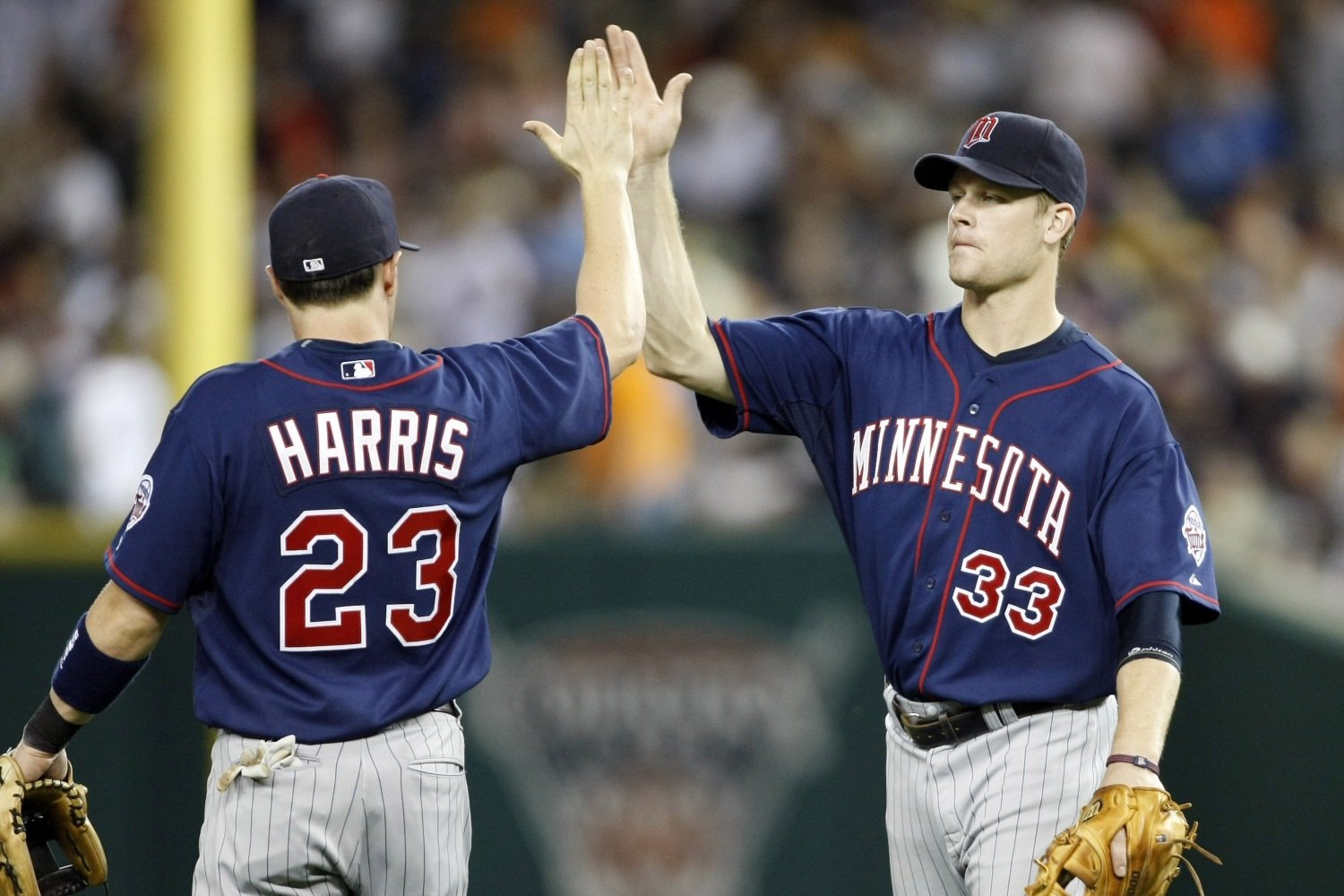
Next on the list among the Twins alumni was a guy not even in the Twins system at the time. Ranked 18th overall was infielder Brendan Harris, who was with the Cubs and had a strong 2002 campaign between High-A and Double-A. That season, Harris posted a .329/.389/.534 slash, with 15 home runs and 65 RBI in 530 plate appearances.
These numbers certainly gave Harris recognition as one of the Cubs' best prospects at the time, but it also gave him one of the most bizarre player comps by a baseball writer ever documented on the internet. Prospectus co-founder Rany Jazayerli was so high on the potential Harris showed as a prospect in 2002, that he compared the production to that of a breakout prospect in the Cardinals system two years earlier; Albert Pujols.
For context, Pujols had only 14 more plate appearances as a prospect in 2000 going to the plate 544 times between High A, Double A, and Triple A. In his first professional season, the 20-year-old Pujols had a .314/.378/.543 triple slash, 19 home runs and 96 RBI.
The similarities in statistical production were so enticing to Jazayerli at the time, that he was confident in making the comparison. Jazayerli wrote about Harris, “There are some differences–notably that Harris was a classification higher than Pujols–but the raw numbers are eerily similar. Harris is the biggest sleeper prospect in the game, and I was compelled to move him into our Top 20.”
Boy, would he get that one wrong. That's not to say that Harris didn’t have a decent career, but he was never going to be Albert Pujols. By mid-2004, he was a small piece of a huge trade, conveyed from the Cubs to the Twins in the four-team deal that brought Nomar Garciaparra to Chicago and sent Doug Mientkiewicz to Boston. His first two seasons with the Twins were solid, but in 2010, he fell to the bottom of the pecking order on the Twins bench, hitting only .157 in 120 plate appearances. Harris would be sent (alongside J.J. Hardy) to the Orioles in the subsequent offseason, but wouldn’t return to the majors until 2013 with the Angels.
Lastly, there’s Morneau and future Twins manager Rocco Baldelli. These two were ranked very close to each other, toward the bottom quartile of the top 40 list--Baldelli at 28, and Morneau at 30. The only player separating them (in the 29th overall spot) was Miguel Cabrera.
Baldelli’s story as a superstar prospect whose career became derailed by injuries has become all too familiar to Twins fans. Twins fans have experienced their version of Baldelli’s journey with Byron Buxton. Despite constant injuries in his career, his first two seasons with the Devil Rays were solid, as he had a .285/.326/.425 line in 1,249 plate appearances across 292 games. But after missing all of 2005, Baldelli would never play more than 100 games in a season again. His transition into coaching has made him one of the more respected managers in the league and a Manager of the Year Award winner in his rookie season in 2019.
For someone ranked as the 30th-best prospect in the league at the time, Morneau panned out well beyond expectations. He was the 2006 AL MVP, a four-time All-Star, the 2008 Home Run Derby champion, owner of two Silver Sluggers, and the winner of a batting title with the Colorado Rockies in 2014. Like so many others ranked on this list, Morneau’s career was altered by a head injury, which came on July 7, 2010. Morneau was sliding into second base when Blue Jays shortstop John McDonald accidentally drilled him in the head with his kneecap. What resulted was a concussion that stopped Morneau short of a second MVP campaign, and he was never the same again.
Despite that, Morneau’s career has landed him in the Twins Hall of Fame. He’s fourth on the Twins' all-time home run list with 221, only behind Bob Allison (256), Kent Hrbek (293) and Harmon Killebrew (559).
In retrospect, the Twins on Baseball Prospectus's Top 40 prospect list 20 years ago may have had the best collective outcome (for the team they were with at that time) out of any. Mauer, Cuddyer, and Morneau all gave the Twins at least six full seasons of production. The three combined for a bWAR of 90.9 in their Twins' tenures. The only other player on this list guaranteed to enter the Hall of Fame, Cabrera, had a career bWAR of 67.3.
The Twins had a good run of these five guys in the organization in the long run, and outside of Harris, all still contribute to the team’s front office in some capacity today. All and all, it’s safe to say the Baseball Prospectus writers of 2003 got it right with the Twins prospects of the time, but also that we evaluate prospects much differently (and much better) now than we did then.
Do you approve of Twins ownership?

Follow Twins Daily For Minnesota Twins News & Analysis



- mikelink45, JCinNWMN, PatPfund and 5 others
-
 8
8


Recommended Comments
Create an account or sign in to comment
You need to be a member in order to leave a comment
Create an account
Sign up for a new account in our community. It's easy!
Register a new accountSign in
Already have an account? Sign in here.
Sign In Now