Jump to content
Twins Daily
  • Create Account
  • Twins News & Analysis

    The Wallner-Gallo Problem: A Case Against the Lineup Value of Matt Wallner

    Matt Wallner's raw stat line is impressive. Yet, the team doesn't always treat him like a heart-of-the-order bat, and some advanced numbers suggest that there's a reason for that.

    Matthew Trueblood
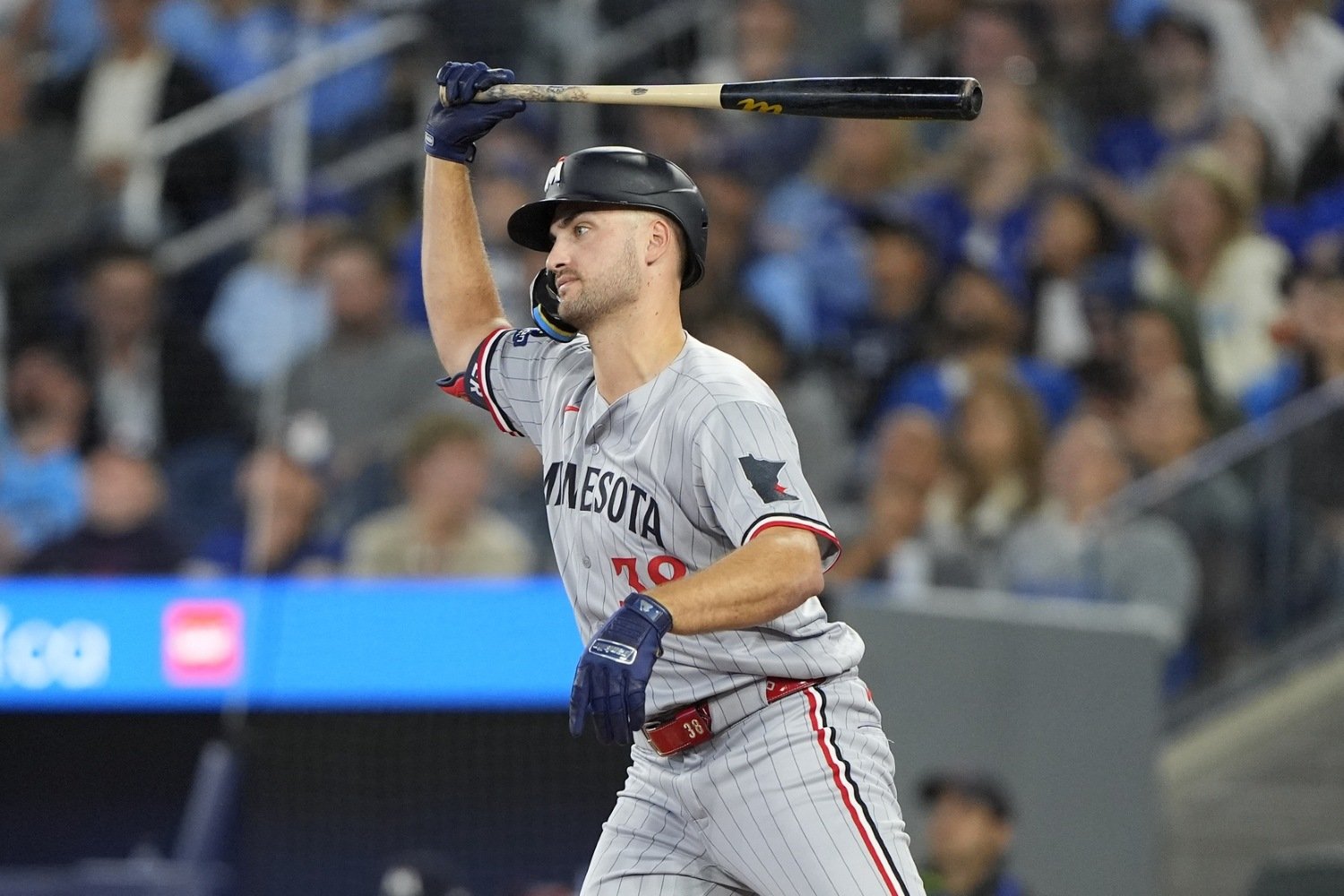
    Image courtesy of © John E. Sokolowski-Imagn Images

    Twins Video

    Editor's Note: Welcome to the final installment of a series meant to dig deeper into the most compelling enigma on the 2025 Twins: outfielder Matt Wallner. Check out Eric Blonigen's piece about Wallner and Trevor Larnach, and Cody Pirkl's on whether Wallner deserves more respect than he gets from either fans or his employers. Today, though, we'll take the conversation down a slightly different path.

    This article started with an email. Almost two weeks ago, I got a note from Twins Daily co-founder John Bonnes. It came in the wake of the Twins' win over the Tigers on August 17—a good game, but one in which Matt Wallner went 0-3, with nothing but a walk after the game had long been decided. Specifically, in the bottom of the third, Wallner had come up with runners on the corners and one out, and he'd struck out. It got John thinking.

    "I was reminded that his WPA this year is negative," John wrote. "And, in fact, he’s never had a positive WPA greater than 0.5. Which, I think is a big discrepancy from his WAR."

    He was alluding to win probability added, of course. That stat apportions credit and blame to hitters and pitchers for the outcomes of games, using the expected runs and wins implied by the situations in which each plate appearance takes place and the effect of the outcome of each such battle on those expectations. Different sites measure these things very slightly differently, and I'll use Baseball Reference's framework for this piece; they did credit Wallner with 0.6 WPA in 2024. John was right, though, to note that Wallner is at -0.6 this year. Despite an OPS+ of 122 that suggests stoutly above-average production, he hasn't pushed the Twins toward wins this year. On balance, he's pushed them away from them.

    Naturally, John was also right that that lack of value from a context-sensitive perspective stands in stark contrast with the inputs for his WAR value at Baseball Reference, and elsewhere. The best way to view this, perhaps, is to compare his batting runs (Rbat, the number of runs the site's model estimates he's been worth relative to a league-average batter) with his RE24 (the runs he's added based on the expected runs when he came up, after accounting for the 24 possible base-out states). This doesn't account for fluctuations in game leverage, but it adjusts from measuring raw outcomes to baking in the runners on base and the number of outs each time Wallner came to bat. His Rbat this year is 10. His RE24 is just 2.4.
     
    When you hear that, surely, you think the same thing everyone else does: well, sure. That extreme high-strikeout, power-over-hit profile leads to homers and walks and pretty individual numbers, but it can't win games.
     
    "So I just looked at Joey Gallo’s stats page and found something very similar," John continued. "Gallo had a few years where his WAR was four. Overall, for his career, his WPA was negative. Even in those years that he posted a high WAR, WPA was barely positive."
     
    It's true. Gallo had -4.2 WPA for his career, though he rated as an above-average hitter before adjusting for situations. Gallo, like Wallner, had a patient approach and light-tower power, but ran a strikeout rate near the upper limit of what the league will accept. Thus, John posed the question:
     
    "Is it possible this type of player Fs with the correlation that we have between WAR and winning games? Like, if you are a player whose OPS is heavily dependent on SLG, does WPA tend to have a negative discrepancy compared to WAR? In short, are the cranks on all-or-nothing hitters right?"
     
    It's a fair question. In fact, if we want to properly value one of the presumptive core pieces of the team's medium-term future, it's one we'd better find a good answer to. So I decided to try.
     
    Offense is made up, mostly, of four components: the ability to avoid strikeouts, the ability to draw walks, the ability to get hits on balls in play, and the ability to hit for power. Strikeout rate, walk rate, BABIP and isolated power (ISO, which is just slugging average minus batting average) are the big four for a first-level analysis of any player. Here's what I did:
     
    • Assembled a list of all players with at least 100 plate appearances this year (n=471)
    • Listed their rOBA, Baseball Reference's context-neutral rate stat for offensive output; strikeout and walk rates; BABIP and ISO; and WPA/PA, which is just their win probability added divided by their number of plate appearances, to make WPA a rate stat, too.
    • Found the correlations between (first) rOBA and (next) WPA/PA for BABIP, ISO, K% and BB%

    If we're onto something here—if how you generate value at the plate influences how much you contribute situationally—we should see a different relationship between those correlations for rOBA than for WPA/PA. Here's the data.

    Correlation to: BABIP ISO K% BB%
    rOBA 0.59 0.72 -0.18 0.38
    WPA/PA 0.42 0.58 -0.18 0.29
    Ratio 1.4 1.26 0.98 1.29

    The correlations are (almost) all considerably stronger for rOBA than for WPA/PA, which makes sense. Adding things beyond the control of the hitter (the situation in which he comes to bat) adds noise to the whole system. Still, as you can see, there's something to the idea that different shapes of production matter more (or less) when you add the game state to the equation. There's evidence, here, that striking out more makes you less helpful to winning games than your simple stat line implies. On the other hand, power still appears to be pretty important. It's the ability to find holes when putting the ball in play (a noisy skill to begin with, as we know) that loses the most potency when we switch from a context-neutral to a context-dependent way of measuring batting value.

    The "or-nothing" in all-or-nothing hitters seems to be the broad source of their problems producing as many wins as the runs they produce would be expected to create. But that's a bit of a problem for our narrative. Wallner is hitting for more power and walking just as much this year, but he's striking out markedly less than he did in 2024. It's still a lot, but he's less extreme than he used to be. The category in which he's suffered in 2025, as our previous examinations of him this week have already shown, is BABIP, which isn't supposed to be what makes or breaks a hitter's capacity to influence WPA as much as they increase raw scoring.

    In Wallner's case, at least, the answer's simpler and less structural than that. Guys who depend on slug don't broadly tend to have a worse WPA than you'd expect; that's only true of certain individuals. Once we acknowledge that, we can look a bit closer.

    Here are Wallner's 2025 (and career) numbers in low-leverage, medium-leverage, and high-leverage situations.

    • Low Leverage: .289/.359/.726 (.284/.380/.631)
    • Medium Leverage: .150/.267/.260 (.195/.315/.371)
    • High Leverage: .125/.327/.350 (.205/.339/.425)

    In the plate appearances that hardly matter at all, in terms of winning or losing, Wallner is a machine. When the stakes rise even modestly, though, he's pretty bad—and specifically, he becomes extremely dependent not on hitting for power, but on drawing walks to deliver any value. So, is Wallner simply un-clutch?

    That can, of course, be part of the answer. For that matter, that can be extrapolated a bit to other hitters, too. Even if leaning on power and striking out a lot don't fundamentally lead to less win production than run production on their own, do they make one less likely to be able to hit the better pitchers who tend to pitch more important innings?

    For that, perhaps, there's some evidence. If you've been trying to figure out why the Twins themselves also seem not to have much faith in Wallner, by the way, this is the time to start paying extra attention. What's one trait we can safely say most high-leverage pitchers have, to set them apart from those who work when the game is essentially decided? They throw harder. Here's the run value (per 100 pitches) for all Twins hitters on pitches at a velocity of at least 96 mph, among those who have seen at least 100 such pitches this year.

    • Willi Castro: 0.048
    • Brooks Lee: -0.497
    • Harrison Bader: -0.855
    • Byron Buxton: -0.934
    • Carlos Correa: -1.128
    • Kody Clemens: -1.680
    • Wallner: -1.682
    • Royce Lewis: -1.762
    • Ryan Jeffers: -1.826
    • Trevor Larnach: -1.900
    • Ty France: -1.909
    • Christian Vázquez: -2.472

    That might not look so bad—no one on the Twins has hit heaters that hot all that well this year, and Wallner falls in the middle of the pack. Maybe it's simply too hard to hit upper-90s fastballs to expect anyone to regularly hit them hard. Alas, all this really turns out to mean is that the Twins are uniquely bad at handling those fastballs. Among 138 players who have seen at least 200 such heaters this year, almost half (65) have positive run value against them, and Wallner's rate ranks 120th of the cohort.

    Why, though? The defining characteristic of Wallner at the plate is his elite bat speed. We could understand France or Larnach or even Jeffers getting overwhelmed a bit by pitches approaching triple digits on the radar gun, but why Wallner? That's the next question, and one we probably can't completely or perfectly answer here. This is a durable problem, though, and one tied to the nature of his swing. Over a decade ago, before Statcast gave us any insights like these, I began to suppose that what great bat speed really does for hitters is allow extra time for the swing decision—facilitating power by letting a hitter spot the spin on a breaking pitch or the telltale change in arm action on a changeup, and still (after starting late) get the barrel out in front of them and hammer the ball.

    Meanwhile, the hitters who handle velocity well might or might not have great bat speed, but what gets them to those high-octane heaters on time and on plane is the fact that they make early decisions. Wallner makes slightly late ones, and as good as bat speed is, the difference between someone who triggers their swing early and someone who can't is larger than that between someone with 76 mph bat speed and someone at 72. The problem with a very simple plan to start sooner, for someone with that 76-mph swing like Wallner (or Gallo), is that they might end up too early on breaking or offspeed stuff. 

    Wallner is limited by his inability to hit good fastballs. He can do plenty of other things, but not being able to do that puts a low ceiling on his real, situational utility. That's why he bats lower in batting orders than you might otherwise guess, and it's why his raw numbers don't match his win probability metrics. When the game is on the line, teams know how to create a bad matchup for him. If he can eventually fix this—if some approach adjustment allows him to get started earlier, without ending up ahead of everything but the game's best fastballs—Wallner might well blossom into a truly lethal slugger. For now, though, the curmudgeons are at least partially right about him—even if not for the exact reasons John and I might have initially imagined.
    Follow Twins Daily For Minnesota Twins News & Analysis

    Recent Twins Articles

    Recent Twins Videos

    Twins Top Prospects

    Marek Houston

    Cedar Rapids Kernels - A+, SS
    The 22-year-old went 2-for-5 on Friday night, his fourth straight multi-hit game. Heading into the week, he was hitting .246/.328/.404 (.732). Four games later, he is hitting .303/.361/.447 (.808).

    User Feedback

    Recommended Comments


    Featured Comments

    2 hours ago, cheeseheadgophfan said:

    Spread out over 550 AB's this year, he hits 40 HR's.   He is what he is and will presumably continue to improve.  I don't know how you measure defense but I don't think he is terrible.  And anyone who thinks his arm isn't borderline elite isn't watching the same guy.

    I do think one of he or Larnach should grab a 1B glove in the offseason and learn the position. The fact that we have no real first baseman is ridiculous.  Clemons isn't the long term answer. 

    Putting Wallner or Larnach at First would be asininely stupid.

    7 hours ago, LambchoP said:

    I think Wallner COULD be a viable middle of the order bat if he improves upon a few things. He needs to cut down on the K's and make more contact. Right now he is a true 3 outcome hitter. It's HR, walk, or nothing. I think we should see if he can play first base. DH would be best for him but it would hurt his value. Maybe it's best to DH him regularly and have him play RF only on a part time basis. Next year will be important for him to put a good season together because a lot of younger options are coming up soon. Guys like Fedko, Rodriguez, Gonzalez, Rosario, and eventually Jenkins. I think guys like Larnach, Outman and Roden should be long gone.

    I agree. The Twins have first base open and Wallner's slowness wouldn't hurt as much there, and his size and long reach could help. He probably has another year or so for the Twins to hope he improves at the plate but I doubt he gets much more time than that.

    10 hours ago, In My La Z boy said:

    Do you think our coaches know this? How are we not hitting fastballs? Nice to see Brooks Lee on top of the list. Fans have given him an undeserved beating lately. He's going to be a gamer 100%. On Wallner, we've missed our peak value window on him for making a trade, so we'll probably trade him this winter after picking up 2 more left-handed hitting corner OF'ers at the trade deadline. What is Falvey's obsession with left-handed hitting corner OF'ers??? How many does one team need???

    Actually we picked up 3 left handed corner outfielders. The third no seems to talk about.

    12 hours ago, Doug Y said:

    Maybe the subtitle of this article should be why OPS is not the new batting average. It’s a useful stat, but it favors high slugging over contact. We keep looking for the one perfect stat to define all hitters, but so far it doesn’t exist. 

    Exactly! Wallner's HRs are as empty as his hits too. 

    Wallner's approach at the plate even reminds me of Gallo. Like Gallo was his unofficial hitting coach in Wallner's formative years. Would love to see an analysis of this. Gallo had this distinctive dig in the left foot, swing in the right, couple of windmillish swings, bend backwards (Wallner always does this too) and then bat .168 with a.700 ops. Why would you repeat the same approach so faithfully for hundreds of at bats with such lousy results? 

    WPA shouldn't be compared directly to WAR.  WAR's baseline is a mythical AAAA player you can acquire for peanuts.  WPA's baseline is, more or less, a .500 winning percentage, and thus a mythical average major league player.  If you want to compare WPA, compare it to WAA, which is Wins Above Average and is derived from WAR.

    Of course most versions of WAA (and WAR) taken into account defensive stats while WPA is just situational batting, so a player whose WAR is significantly aided by his defense numbers will have a WPA that looks bad, on average.

    I don't even want to get into the discussion of whether any of these aggregate stats are good.  But let's not compare apples to oranges.


    A key negative for Wallner vs early Schwarber/Ortiz is K/BB - higher K rate and lower walk rate.  This is partly a trade-off for higher slugging.  The 2-year age difference is also important to note.

    I don't think Wallner will be Schwarber or Ortiz, but I believe it's still too early to know where his career lands.

      Kyle Matt David
      Schwarber Wallner Ortiz
           
    PAs 1274 901 1227
    K 369 294 252
    K% 29.0% 32.6% 20.5%
    BB 174 95 143
    BB% 13.7% 10.5% 11.7%
    2B 36 44 76
    HR 72 49 38
    AVG 0.228 0.238 0.263
    OBP 0.341 0.35 0.354
    SLG 0.472 0.501 0.457
    OPS 0.813 0.851 0.811
    OPS+ 108 133 105

    Im going to repeat a few things I stated in the previous thread with a few alterations.

    Removing his rather brief 2022 debut, Wallner's Quad Slash line for a healthy 2023 and 2024 are as follows:

    .254/ .371/ .515/ .885 with an OPS+ of 144. That means he was ABOVE AVERAGE in EVERY category, including BATTING AVERAGE, and was 44% BETTER as an all around batter than the rest of the league.

    44% better overall than the rest of the league.

    INCLUDING his brief 2022 debut and a rough 2025...with an OPS STILL ABOVE .800...possibly due to his injury, but who knows for certain, his CAREER Quad Slash line is:

    .238/ .350/ .501/ .850 with an OPS+ of 133. That means over 4yrs his BATTING AVERAGE has been slightly less than the rest of the league.  But it also means for his career he's been 33% better than average as a productive batter than the rest of the league.

    33% better overall than the rest of the league.

    Decades ago, hitters were judged on 3 things, AVG, HR, and RBI. Now, those aren't EMPTY stats. They still have relevance. BUT, teams got smarter over time and realized a batter with a high AVG, but didn't have power and didn't drive in runs, had less value than originally perceived.

    They also realized guys with big power who couldn't get OB, or drive in many runs, and sometimes had a poor AVERAGE, had less value than originally perceived.

    It's really not that hard if you drop old perceived values/walls and just understand the greater perspective that ALL TEAMS...not just the Twins...discovered over time with deeper research.

    Average, HR, and RBI by themselves DON'T paint an accurate picture!

    Remember, over the years, when you saw various hitters with 25 HR but only 60-ish RBI and you wondered how that could be? It's because nobody was OB for them to knock in! OR, they couldn't HIT for a damn, only had power, so that was the only time they knocked guys in!

    It's actually MATH over DECADES of research by ALL TEAMS. OB% was a measurement that simply went ignored for too long. And they finally figured out the best way to measure a batter wasn't to use any SINGLE statistic, but to combine them ALL to figure out who was ACTUALLY a good OVERALL hitter.

    That's why the Quad Slash line exists today. OPS + is a way to quantify how below or above a hitter is compared to the rest of the league, or by each position. 

    EXAMPLE: A catcher only bats .250, and gets OB about 32% of the time. He strokes enough Doubles and HR to have a SLG% of around .425. His OPS would then be around. His OPS would be around .740, which would make him ABOVE average considering the LEAGUE AVERAGE usually hovers around .700, give or take about 10-15 points. Right there you'd have a hell of an offensive catcher! 

    Again, it's not mysticism or magic. It's JUST MATH measuring a players overall offensive ability! NOBODY is trying hoodoo-voodo to convince you of some strange new world of baseball. It's simply a newer, more complete and accurate picture of hiw to measure the performance and potential a player/batter has.

    BACK to Wallner again:

    He's NOT slow. In regard to SPRINT SPEED, he's one of the faster Twin players. But he's also not QUICK. That means his READS have to be better in order to be a quality defensive OF.

    Some previously couldn't watch the Twins for a while. Some maybe have refused to. I'm not in a blackout area, and I've watched a TON of games over the past few years. And I can tell with honest heart that he really has improved his tracking skills over the past couple of seasons.

    I can also honestly tell you that his defense has slipped in 2025. And I don't know if that is physical, or him taking offensive frustrations out in to the field. He has a 95mph CANNON for an arm that is also accurate. So good is his arm that teams don't even try to run on him any longer. So I automatically dismiss any comment about his arm.

    Wallner will ALWAYS K more than a lot of people want to see, even he's lowered that number this year. But Wallner will also always have a solid OB% due to BB and some hit batsmen. (Witness a career .350 OB%). He's also never going to HIT to a .280-ish AVG. (.250 is about AVERAGE these days).

    IMO...other than some fan bizarre  perception he should HIT at a .270 AVG and have a K% of 20%..MY ISSUE is his usage and FO perception.

    Most sluggers will run hot and cold. But when he had a poor 2024 ST, and then a poor start to 2024, the FO sent him down to AAA. But they did so after about 26 AB. What does 26 AB tell you about anyone? Especially for a player coming off a previously good season before? But FINE, they wanted to give him a brief re-set. But then he RAKED. And they still kept him down? Why? Because they didn't KNOW who he was? And when they FINALLY called him back up, what did he do? He produced ANOTHER .800plus season.

    To begin 2025, Rocco decided they should put him at LEADOFF as he was one of the teams best hitters. There was SOME logic to that due to his power and OB ability and being one of the best batters on the team. But I never really liked that plan. He and Buxton and Lewis should have been a 3-4-5 option with Castro and Correa as a 1-2.

    But Wallner was pretty good there initially and then got hurt. And since he's been back, his defense has slumped somewhat, and he hasn't been the BATTER that he was in 2023-24. But how much of that is post injury "getting right", or coaching, or Wallner's own head? 

    Do anti-Wallner haters realize he's STILL got the highest OPS on the team behind Buxton? And sorry, I'm dismissing Keaschall in this point of the conversation for reasons that should be obvious. 

    You want to build back Wallner's confidence? Then stop throwing him down in the lower third of the lineup. 

    Should Wallner be a part of the immediate Twins future? ABSOLUTELY. He's almost as talented of a potential producer as Lewis.

    You can't ignore an injury season on a bad team team where he's still better than almost anyone else.

    Again, MATH, previous numbers, potential to repeat high numbers, nobody is going to take away your Fandom.

    Is the team better with Uber prospect Rodriguez getting healthy for once and grabbing a spot and fellow Uber prospect Jenkins joining him and making Wallner a mostly full time DH and part time OF? Absolutely!

    That would be OUTSTANDING and what most of us have been dreaming of. But there is no guarantee it WILL happen.

    **BTW, @LA VIkes Fanhas produced some interesting numbers lately showing Wallner is trending towards not being negative towards LHP. That's a really good thing!

    And I could ramble on forever and never get through the ingrained minds/opinions of some posters. And I'm dismissing the current coaching staff or the FO and ANY kind of direction they might have. 

    But Wallner is a potentially HUGE component of the lineup over the next few years. The really good numbers are there to look at.


    Doc Bauer makes a lot of good points.  I like Matt Wallner.  I think it's incredibly stupid, no matter what "analytics" tell you, to bat a player like Matt Wallner LEADOFF.  Wallner belongs in the #4-#6 spot in the order.  This is like hitting Harmon Killebrew leadoff.  Harmon had a lot of power and a high OBP & OPS.  Would you bat Killebrew leadoff because of that???

    Granted, Killebrew consistently hit for a higher average which allowed him to drive in runs much more consistently than Wallner ever has.  But something in the "analytics" encourages Rocco to hit guys like Jeffers, Larnach and Wallner at the top of the order.  And it hasn't worked.

    Maybe Wallner or Larnach could become at least league average fielders at 1B, maybe not.  But with all the OF coming up sooner, rather than later, a position switch wouldn't be a bad idea.  One thing is certain.  We can't play everyone in RF or LF.

    Someone suggested Wallner's trade value is only that of a middling prospect.  Wrong.  That guy is Larnach.  Wallner, in a straight up, one-for one trade would bring back our choice of Kyle Teel or Edgar Quero from the White Sox.  The White Sox can't play both Teel and Quero at Catcher at the same time either.

    Maybe the Twins should consider a Wallner for Teel trade?  It would give the White Sox a OF/DH power bat while the Twins get a Catcher to pair with Jeffers for a couple years until Tait is ready.   

    I'll comment here on the thread most critical of Wallner. OPS and OPS+ presents the most positive light on Wallner's offense (and value). WPA shows quite a different picture. I do think reality is better represented by WPA.

    Wallner isn't real slow and has actually swiped a couple bases in the last week, but he's been really uneven in his almost three years on the scene for the Twins. It's pretty hard to keep him in the middle of a lineup.

    To my eye, Wallner has looked rougher in the outfield this year than he did last year, but according to the two most quoted defensive metrics, he is not that bad on defense and it is undeniable that he has a strong arm. Also he isn't really slow. His sprint speed is in the 36th percentile.

    Carrying one guy like that is fine with a lineup of more balanced players, but carrying three or four guys who depend on slug for their value makes the offense very inconsistent. I keep seeing people suggest converting Wallner or Larnach to first basemen. I believe the die is cast and neither will be considered to change positions. 

    On 8/29/2025 at 4:27 PM, RpR said:

    Putting Wallner or Larnach at First would be asininely stupid.

    Wow......your analysis is not only thought provoking, but backed up with incredibly strong facts and research.  Well done.  


    Create an account or sign in to comment

    You need to be a member in order to leave a comment

    Create an account

    Sign up for a new account in our community. It's easy!

    Register a new account

    Sign in

    Already have an account? Sign in here.

    Sign In Now

×
×
  • Create New...