


Twins Video
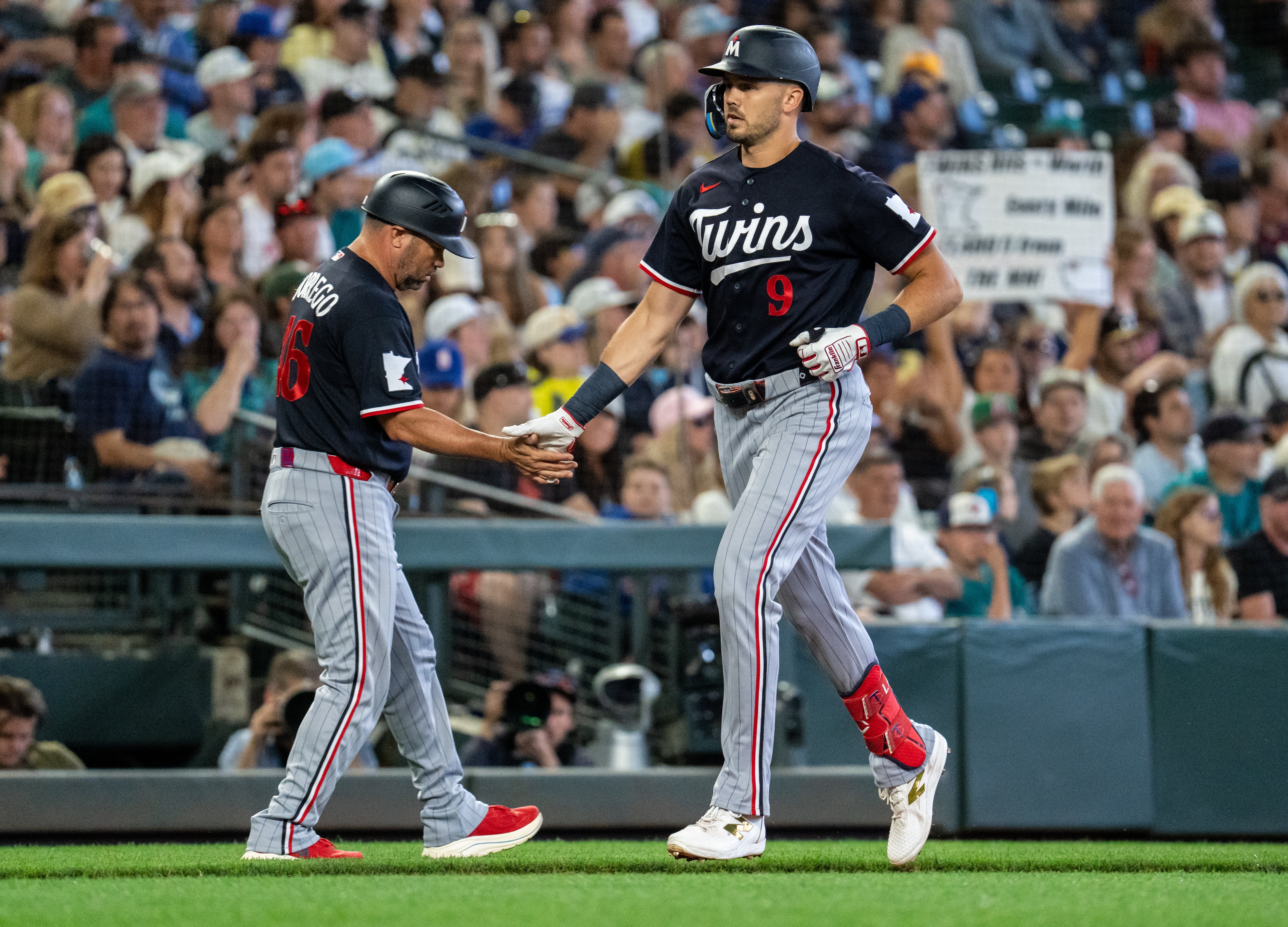
Trevor Larnach has been one of the most impactful bats in the Twins’ lineup this season.
Through 380 plate appearances, Larnach is currently sporting career-high marks in batting average (.266), on-base percentage (.351) and OPS (.769). And while he had largely been a glorified strong-sided platoon bat for much of his career, he has taken his performance to another level in 2026. Through the first half, Larnach looked like a legitimate middle-of-the-order contributor rather than simply a player who needed to be shielded from certain matchups.
Then came the trade deadline. A lot of people, myself included, believed Larnach would be traded to make room for the next wave of outfield talent within the Twins’ system. With players like Walker Jenkins, Emmanuel Rodriguez and Hendry Mendez looming, it made sense to wonder whether Larnach’s time in Minnesota was coming to an end. And for a minute, it looked like it was. The Twins and Astros reportedly had a deal lined up that would have sent Larnach to Houston in exchange for reliever Bryan Abreu. But Astros owner Jim Crane ultimately vetoed the trade because of his unwillingness to subtract talent from Houston’s major league roster during a playoff push.
Just like that, Larnach was staying in Minnesota. And from that moment on — whether it was because of almost being traded or simply a coincidence — he hasn’t been the same player. Across 53 plate appearances in August, Larnach is hitting just .163. He’s striking out at a higher frequency, getting on base less often and, after serving as the Twins’ leadoff hitter against right-handed pitching for most of the summer, he’s now hitting in the bottom half of the lineup.
On the surface, it looks like a player who has completely lost his way. But there’s a pretty important caveat to Larnach’s recent struggles: He might just be one of the unluckiest hitters in baseball right now.
Larnach’s quality of contact in August has actually been some of the best contact he’s made all season. His average exit velocity is 89.3 MPH, comfortably above his season-long mark of 87.7 MPH. His 51.4% hard-hit rate is exceptionally high, especially for a player who is hitting .163. His overall offensive approach hasn’t drastically changed. The same types of batted balls that have helped Larnach find success throughout the season simply haven’t been finding holes in August. His BABIP sits at just .171 during the month, an extremely low mark for someone making contact at the quality Larnach has been.
That doesn’t mean every part of his slump can be dismissed as bad luck. Strikeouts and an inability to get on base are still legitimate concerns, and eventually, poor results can point toward an underlying issue. But when a hitter is making harder contact than usual without seeing the results follow, it’s difficult to completely panic.
Still, there is one notable change with Larnach that goes beyond his batted-ball profile. The pitch he has struggled with the most this season is the split-finger. He has whiffed on half of the swings he’s taken against splitters, and offspeed pitches in general have given him trouble in 2026. But the splitter, in particular, has been a problem. It would seem as though opposing pitchers have caught onto that, too. In August, Larnach is seeing splitters at more than double the rate he saw them during the rest of the season. Splitters have accounted for 13.3% of the pitches he has seen this month. From May through July, when Larnach was arguably at his best, that number was right around 4.5%.
Even if Larnach’s contact quality remains strong, opposing pitchers have clearly identified a potential weakness in his profile. If a hitter has struggled to make contact against a particular pitch, there’s little reason for pitchers not to continue testing him with it. And that creates a different challenge for Larnach than simply waiting for his BABIP to normalize. If pitchers are going to throw him more splitters and offspeed pitches, Larnach has to prove he can adjust.
That could mean laying off pitches below the zone, doing a better job of recognizing the splitter out of the pitcher’s hand or simply finding a way to make more consistent contact against it. Whatever the adjustment looks like, it will be an important one for a hitter who had seemingly figured things out for most of the season. Because despite the last few weeks, the foundation that made Larnach so successful remains intact.
He’s still hitting the ball hard, his approach hasn’t fallen apart, and his season-long numbers remain far better than anything he has produced over a full season to this point in his career. That’s why it’s probably too early to look at his August numbers and assume Larnach has suddenly reverted to the player he was earlier in his career. There’s certainly some bad luck involved.
But opposing pitchers also introduce a new wrinkle, and Larnach will have to show he can counter it. For a Twins team fighting for a postseason spot, getting Larnach back to his normal self could be a major development. The player who emerged as one of Minnesota’s most reliable offensive pieces earlier this season is still in there. Now, he just needs to prove he can adjust.







Recommended Comments
Create an account or sign in to comment
You need to be a member in order to leave a comment
Create an account
Sign up for a new account in our community. It's easy!
Register a new accountSign in
Already have an account? Sign in here.
Sign In Now