


Twins Video
But the more striking narrative here pertains to the duo's good fortune, rather than their miraculous intervention.
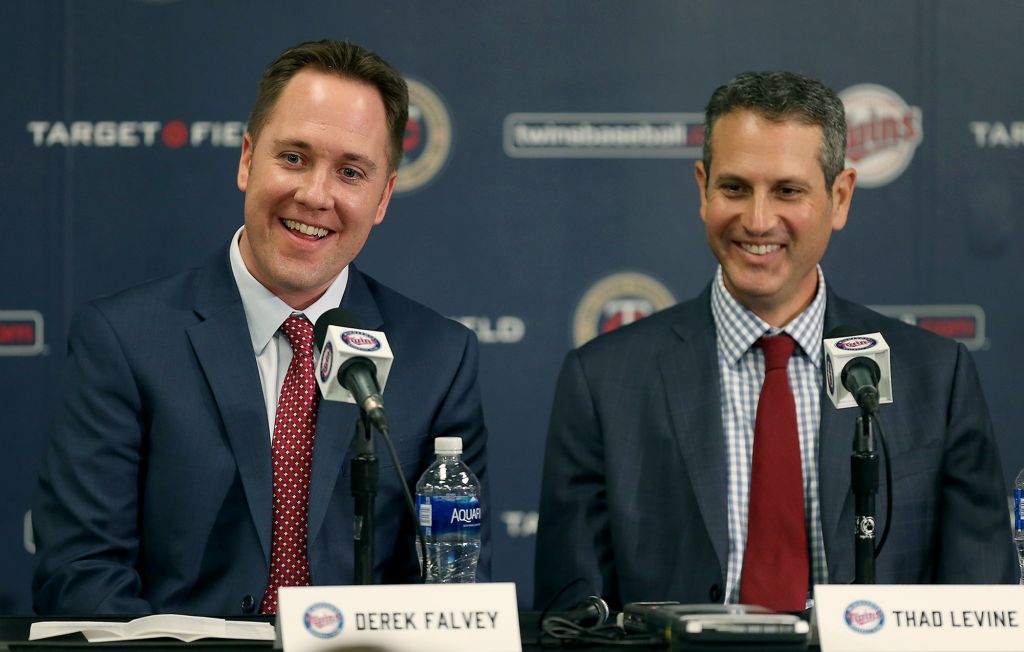
Most often, baseball executives getting their first chances to lead a major-league front office are tasked with overhauling a complete mess. From the outside, that's what this looked like: Falvey and Levine inherited the reigning worst team in baseball, one that had lost 90-plus games in five of the last six seasons.
They spoke frequently about their big-picture mindset, expressing an intent to eschew shortcuts and quick fixes.
But the staggering improvement we've seen this year owes to something we mostly already knew, despite the 2016 debacle: This rebuild was already well underway when the new Chief Baseball Officer and GM arrived. Most of the critical pieces had reached the big-league ranks and others were on the brink.
It's just about the most favorable situation one can imagine walking into. For much of that, Falvey and Levine can thank their predecessor Terry Ryan and his colleagues, who assembled a great deal of talent.
But while Ryan deserves credit for assembling much of this core, the "Boy Geniuses" (as my pal Clarence Swamptown blithely refers to them -- BeeGees for short) have given us plenty of indications that they're the right ones to bring it forward.
The Deadline Dance
Recently, I've seen some retrospective debate surrounding the front office's approach at the trade deadline. The critical argument goes like this: Falvey and Levine made a miscalculation by pivoting to seller mode and trading away assets, rather than adding, at the end of July. Regardless of the impact these moves had, the signal was one of resignation, and now it looks bad.
This line of thinking doesn't really work for me, for two reasons:
1) It wasn't really a "sell"
They didn't trade Brian Dozier, or Ervin Santana. They gave up a starter they'd acquired a week earlier, and a reliever who proved nonessential. Good front office execs are opportunistic, and that's exactly how to describe these moves; the market for Jaime Garcia heated up as the Yankees developed a need, and Brandon Kintzler's value was at its absolute peak. Both are heading for free agency.
And in fact, you can argue there's been significant overall benefit from removing them, as it opened the door for Kyle Gibson and Trevor Hildenberger – who will be around next year – to step into bigger roles and flourish.
2) It was a perfectly reasonable strategy even if you want to call it a sell
Look, we don't need to delve into playoff odds and percentages, which were dreadfully low as the Twins reached the end of July, trailing several teams in the race and playing uninspiring ball. An honest assessment showed at the time (and still shows) that this isn't a great team, not yet anyway.
It would've been impossible to predict that laggards like Gibson and Jorge Polanco would suddenly take off while the rest of the American League completely folded, but the FO didn't do anything to sabotage the Twins' chances in such an event – obviously.
In fact, I see Minnesota's deadline approach as a savvy one that avoided the pitfalls of this new postseason format. The addition of a second Wild Card slot means more teams are in the mix, and this compels clubs to make "Buy" moves when they're not necessarily warranted*. The Royals traded prospects to acquire Trevor Cahill and Melky Cabrera. The Angels made deals in August to acquire Justin Upton and Brandon Phillips. All of this got them nowhere. Meanwhile, the Twins – who are at the front end of their winning cycle – added future assets and will still get their shot. Falvey and Levine come away from this looking pretty good.
* As a middling club aiming for a WC berth, you're still facing serious uphill odds with a one-game play-in for the chance to face superior teams in the Division and League Championship Series. I like the system but it begs for a merely solid team to sacrifice long-term thinking in order to chase that tiny chance. Given their position, the Twins were wise to steer clear of this trap.
Putting Pieces in Place
How much did the execs influence the team's success this year? It's tough to measure, but I think we can safely say they had a positive impact.
As mentioned before, the Twins' turnaround was largely driven by players brought into the organization by Ryan and even Bill Smith. Meanwhile, the same manager is running the show. But the dramatic improvement in on-field results has likely been facilitated in some ways by the new regime.
For one thing, there were free agent signings like Jason Castro and Matt Belisle. Castro has proven a very solid addition, helping the pitching staff with his strong framing work, while Belisle has been brilliant in the ninth, negating the absence of Kintzler.
Perhaps more importantly, there were organizational changes and coaching staff additions like James Rowson and Jeff Pickler. I don't think it's coincidence that so many young hitters are suddenly turning corners, or that the Twins have suddenly catapulted to the top tier of MLB defenses, with these two handpicked coaches in the dugout.
Moreover, Levine has mostly pulled the right roster strings throughout the summer, showing a refreshing willingness to shuttle players in and out as needed, and to experiment with a multitude of arms to see what works.
Through it all, decisions have seemingly been guided by evidence, data, and good intelligence. I'm not confident these guys will always make the right calls – no one does. But I am feeling confident that those calls will be well-informed and guided by the three things mentioned above. My interactions with Falvey and Levine, and everything they've done and said, reinforces the team's decision and leads me to believe this beautiful gift is in very good hands.
And make no mistake: it is a beautiful gift. The Twins have one of the best and youngest offenses in the game, with every member of a top-tier lineup locked in for next year. They have a strong farm system, with a pipeline ready to deliver. And they also have significant spending freedom on the horizon, with Joe Mauer's $23 million coming off the books next year and minimal contractual commitments beyond that.
Lefty Gomez once said, "I'd rather be lucky than good."
Why not both?





Recommended Comments
Create an account or sign in to comment
You need to be a member in order to leave a comment
Create an account
Sign up for a new account in our community. It's easy!
Register a new accountSign in
Already have an account? Sign in here.
Sign In Now