
Jump to content
Twins Daily
  • Create Account
  • Twins News & Analysis

    Twins 2024 Position Analysis: Second Base


    Nick Nelson

    The Twins front office under Derek Falvey has gradually whittled away all of the quality talent they inherited in the middle infield, trading two All-Stars and a former top draft pick within the past year or so. 

    And yet, as the organization charts a new future at second base, its prospect-driven outlook is as bright as ever.

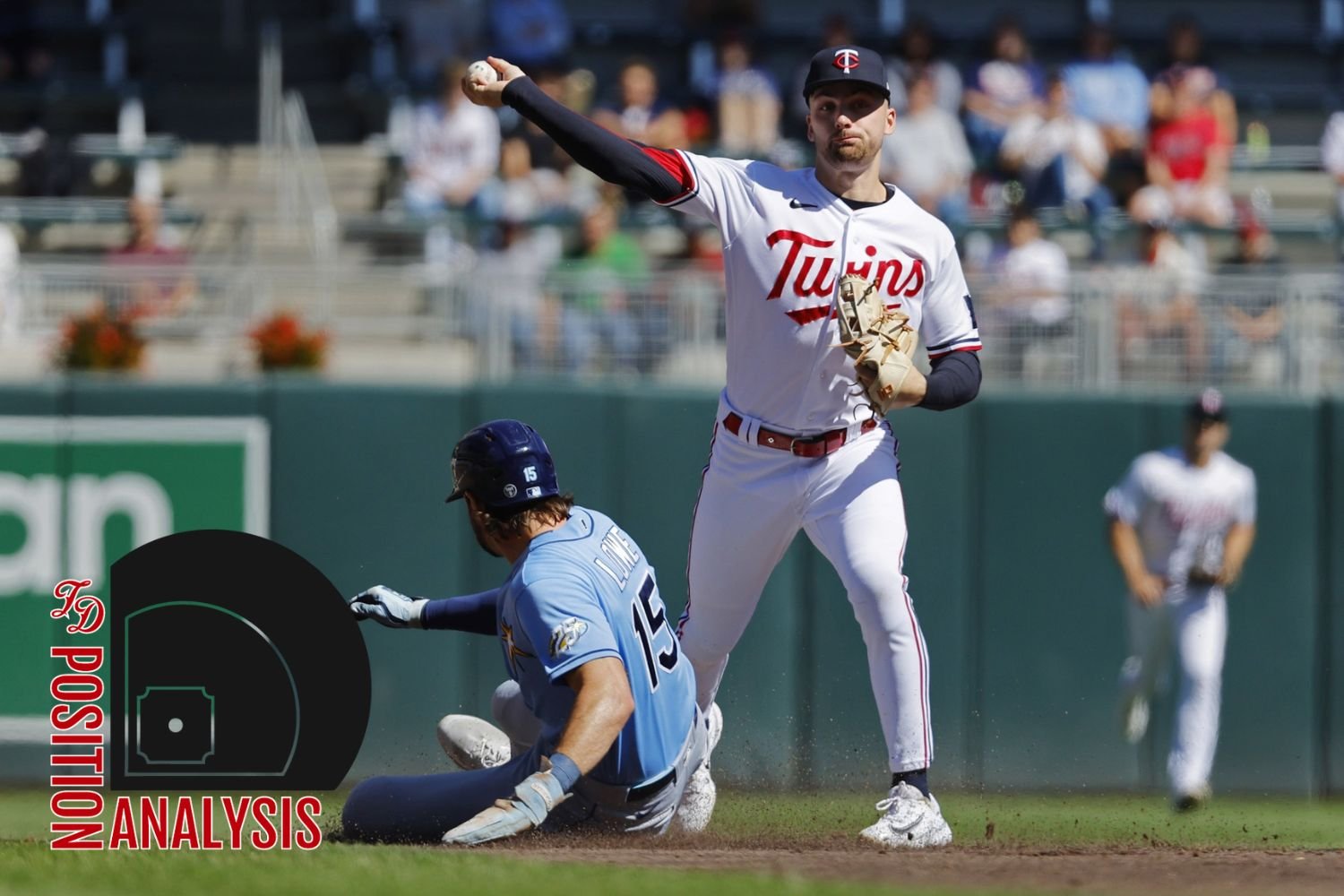
    Image courtesy of Bruce Kluckhohn-USA TODAY Sports

    Twins Video

    In 2022, the following three players combined to start 156 of 162 games for the Twins at second base: Jorge Polanco, Luis Arraez, Nick Gordon. One season later, all three holdovers from the previous regime are gone, as the front office embeds its own wave of talent in planning at second base. 

    This position was among the defining strengths for the Twins offense in 2023, ranking second among American League teams in wOBA and fWAR, behind only the world champion Texas Rangers. Can they maintain that advantage this year?

    TWINS SECOND BASEMEN AT A GLANCE

    Starter: Edouard Julien
    Backup: Kyle Farmer
    Depth: Willi Castro, Austin Martin, Michael Helman
    Prospects: Brooks Lee, Tanner Schobel, Luke Keaschall

    Twins fWAR Ranking Last Year: 3rd out of 30
    Twins fWAR Projection This Year: 14th out of 30

    THE GOOD
    Julien is legit. That much is impossible to deny after he carried over his impeccable offensive track record to the major leagues. He ranked seventh in the AL Rookie of the Year voting by slashing .263/.381/.459 in 109 games during his first go with the Twins. Unfazed by the big lights of October, the newcomer even posted a 1.043 OPS in the playoffs.

    Regression always has to be considered a factor for sophomore big-leaguers coming off monster partial rookie seasons – especially one who rose out of relative obscurity like Julien. But it's getting harder and harder to doubt the former 18th-round draft pick; he literally produces everywhere. Aside from an elbow injury that sidelined him for a year, there have been no real lapses since he joined the pro ranks. Julien's signature skill – unparalleled discipline at plate – has proven viable at every level, keeping pitchers on the defensive.


    This isn't to say Julien is a perfect offensive player. He does strike out a lot and benefitted from a .371 BABIP as a rookie. He needs to be executing on his plan to punish pitches in the zone in order for his approach to fully pay off. But he's already shown enough power put himself on another tier of upside compared to Arraez, and Julien should be viewed as a top-of-the-lineup cornerstone in the same way Arraez was. At least, against right-handed pitching.

    As good as he is against righties, Julien is pretty much unplayable against left-handers. He slashed .196/.229/.217 versus southpaws as a rookie after posting a .649 OPS against them in the minors the previous year. So it's very handy to have Farmer on hand as a platoon-mate with a reliable veteran glove and .825 career OPS vs. LHP.


    This is a strong setup out of the gates. How long it remains in place will be dictated by health, Julien's glove, and how hard the prospects are pushing from below. Specifically, Lee is trending toward an MLB debut by midseason after wrapping up 2023 in Triple-A. With third base and shortstop now occupied indefinitely, second base currently looks like the best path for the switch-hitting top prospect, whose glove would almost surely be superior to Julien's. At that point, first base or designated hitter become possible destinations for the latter.


    Down the line, the Twins have a pair of other promising talents rising through their system, with Schobel and Keaschall drafted out of college in the second rounds of successive drafts. The two sit at No. 10 and 11 in Twins Daily's preseason prospect rankings as they prepare to conquer the high minors. In short, the pipeline is loaded at this position.

    THE BAD
    Minnesota's front office traded away a great deal of established quality in their overhaul at second base. Arraez is a star and Polanco was an extremely consistent producer when on the field. Even Gordon had shown an ability to deliver value in the majors. The Twins have shipped these veteran players out while investing their future at second largely in the unknown.

    Farmer is the most proven commodity of the current crop but he's a backup-caliber player, turning 34 this season. The Twins are obviously hoping Julien will carry the torch, and as mentioned there's plenty of reason to believe, but he's not without drop-off risk. Also, it wouldn't be shocking to see his shaky defense deemed untenable with further exposure, forcing him off the position. 

    From there we are really putting a lot of faith in Lee. The Twins are propping up their No. 2 prospect as the heir apparent at second, with the left side of the infield now locked down by franchise players. It's important to remember, though, that even the most successful big-leaguers often experience a learning curve. Julien's immediate breakthrough last year was more the exception than the rule. FanGraphs projects a .245/.304/.379 slash line and .298 wOBA from Lee in the majors this season. It'd be an okay rookie year but underwhelming production from the primary starter at second, especially after Julien set the bar.

    I don't fault the Twins for trading players like Arraez, Polanco and Gordon proactively to get value for them while they can, but the downside of this plan is removing layers of depth and placing faith in inexperienced players, which has been a volatile proposition in the past. 

    THE BOTTOM LINE
    With one of their top prospects knocking on the door behind their reigning top rookie, the Twins feature premier young talent at second base. Polanco leaves big shoes to fill as a two-way player who powered the top of the lineup, but between Julien, Lee, Schobel and Keaschall, there's a bright future ahead, while Farmer, Castro, Martin and others provide quality short-term depth. I feel very optimistic about this unit compared to the middling projection from FanGraphs.

    Catch up on the rest of our position-by-position preview series:

    Follow Twins Daily For Minnesota Twins News & Analysis

    Recent Twins Articles

    Recent Twins Videos


    User Feedback

    Recommended Comments


    Featured Comments

    14 minutes ago, Riverbrian said:

    I'm a big Julien fan however... I'd really like to hear that it happened against a left hander. 

    I remember that game last September just before we clinched when Julien came up to bat in the 9th with RISP against a lefty. Oh wait, nope. Vasquez pinch hit for him. What a waste of an opportunity. 
    The game ended on that weak attempted AB by a catcher in a slump. 

    2 minutes ago, Fatbat said:

    @Riverbrian Julien is at it again in the 3rd inning. Leadoff hit, C4 & buck get BB, Lewis….. grand slam🤯

    I think Lewis is a superstar and I reserve superstar for maybe a handful of players in all of baseball. 

    I drink to his health. 

    16 hours ago, tony&rodney said:

    This is an interesting take. When a rundown of third base happens will you remove the home runs that Royce Lewis hit to arrive at a similar conclusion? Consistency is a thing, right.

    Don't know where you are going with this statement, but yes, Lewis was just 1-18 if you remove his HR's in the play-offs. Watching the games, I thought he was selling out trying to hit these HR's at the expense of just driving the ball and putting it in play. Not to use an injury as an excuse, but he was playing with a bad hamstring and maybe it affected his swing a little and he didn't want to make adjustments during a short series, I don't know. 

    Regular season splits;

    May 29 - Aug 22( 32 games):  .316/.355/.453 (.808 OPS) 4 HR, 17 RBI, 5/34 BB/K ratio

    Aug 23 - Sep 19 (26 games): .300/.391/.660 (1.051 OPS) 11 HR, 35 RBI, 15/21 BB/K ratio

    Playoffs (6 games): 5-22 4 HR, 5 RBI, 4/8 BB/K ratio .227/.346/.773 (1.119 OPS)

    Looking at the numbers, nothing suffered if he made a conscious effort to try to hit more HR's from Aug. 22 on. In fact, except for a slight dip in AVG, his regular season numbers actually improved across the board. By a lot.

    You can't remove his HR numbers, as a more accurate comparison to Julien trying to work the count deeper would be Lewis trying to hit more HR's, which he did. His AVG suffered in the playoffs and his K % regressed to be more in line with with his pre-Aug 23 numbers, but all other numbers remained in line with his later production. It is a SSS, but hopefully Lewis is skilled enough to make the necessary adjustments going forward so as to not fall into any prolonged slumps.

    Outs Above Average has a glaring issue. Positioning. A fielder who positions themselves well and thus doesn't have to make as many highlight reel plays doesn't get credited for it. OAA is more like a defensive ceiling, a way to rate a player's physical capabilities, especially when it comes to infielders. It's also the least stable of the metrics IMHO, often wildly swinging back and forth from year to year for the same player.

    Of course, the older metrics have their issues as well.

    Range Factor cares only how many plays were made by a fielder compared to other fielders in the league. For example, a team which deploys the shift a lot would likely see their shortstop making far more plays than they normally would. Thus, their RF/9 would potentially be inflated vs. the league average.

    Older Zone Ratings section up the field into tons of little zones and assign some "zones" for each position to cover. These methodologies don't account for shifts, holding defenders accountable to cover their sections of the field, regardless of whether or not the fielder is actually present to make the play, and the metric doesn't care about batted ball data, like how hard balls are hit or the kind of hit it is.

    Ultimate zone rating does use batted ball data. How hard the ball is hit. Where the ball is hit. The type of batted ball, and it  throws out the plays where there is a defensive shift on as those shifts change the zones a player is responsible for; however, UZR also makes assumptions on normal shifting based on base runners and situational data. In addition, UZR has park factors. Arm, double play rates, etc are also included. Players are bonused for making what should be a difficult play for the position they're playing and negative bonuses if they flub what should be an easy play for the position based on their peers' performances. The bonuses are somewhat limited, having an impact sort of like grading on a a curve. It then compares how many outs a player records vs. the league average players. UZR is an incredibly sophisticated metric, not some throwback to a bygone era. It is not your grandpa's old "Zone Rating"

    Defensive Runs Saved also uses the same BIS batted ball data like Ultimate Zone Rating, but it's passively active for shifts by recompiling shift data for the entire team. DRS is also less forgiving on plus/minus calculations penalizing more for not making what would be considered a routine play and bonusing more for making a play which would be considered difficult based on the position and the batted ball data. DRS also incorporates a ball timer, and has a subjective metric instead of plays being ruled errors or non-errors which are potential advantages over UZR. Like UZR, DRS is also highly sophisticated. 

    Since all the metrics have their flaws, relying on a single metric as gospel is sketchy, and when you have a single metric which stands out opposite of all the rest of the metrics, it seems pretty dubious to ignore the discrepancies. 


    Create an account or sign in to comment

    You need to be a member in order to leave a comment

    Create an account

    Sign up for a new account in our community. It's easy!

    Register a new account

    Sign in

    Already have an account? Sign in here.

    Sign In Now

×
×
  • Create New...